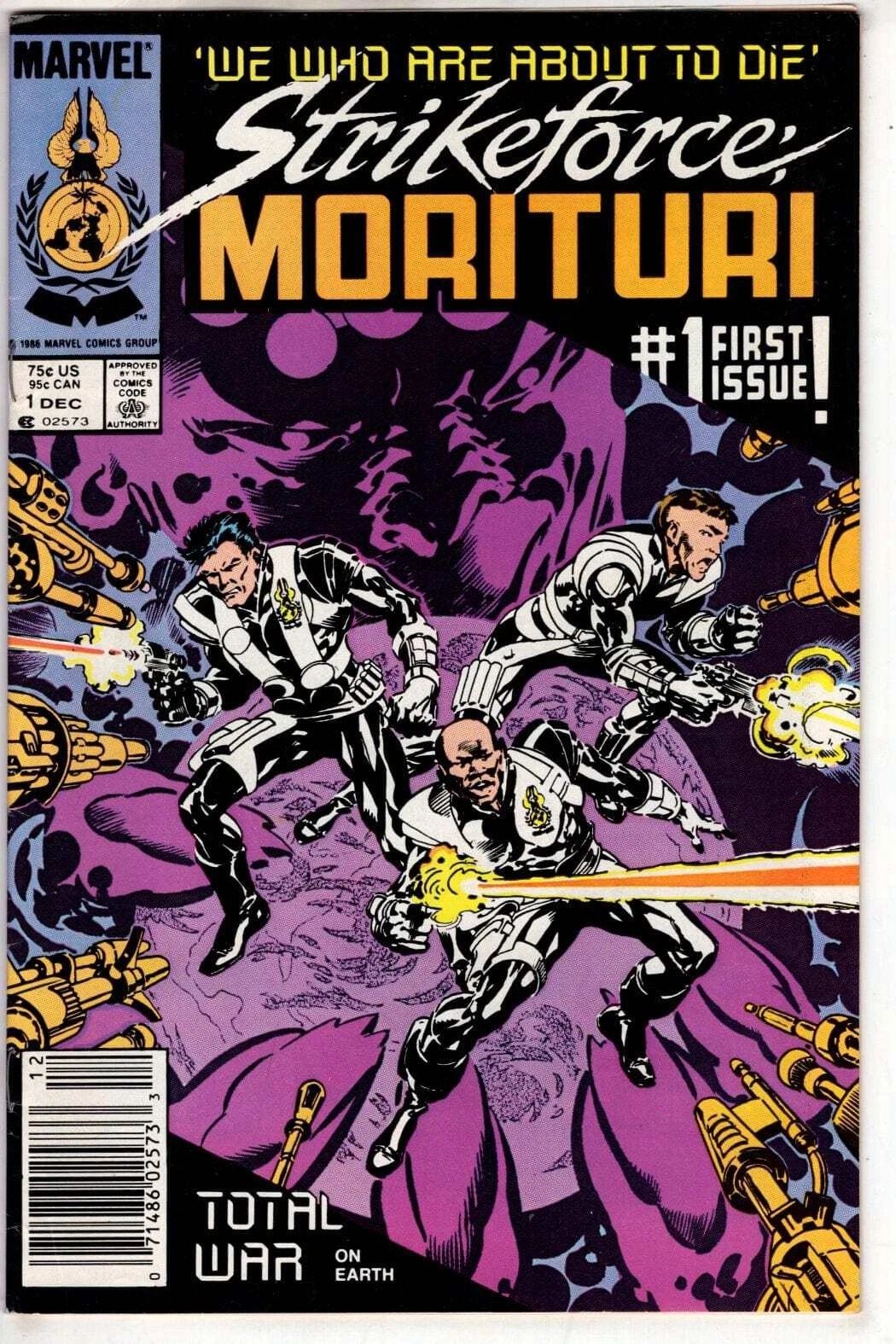


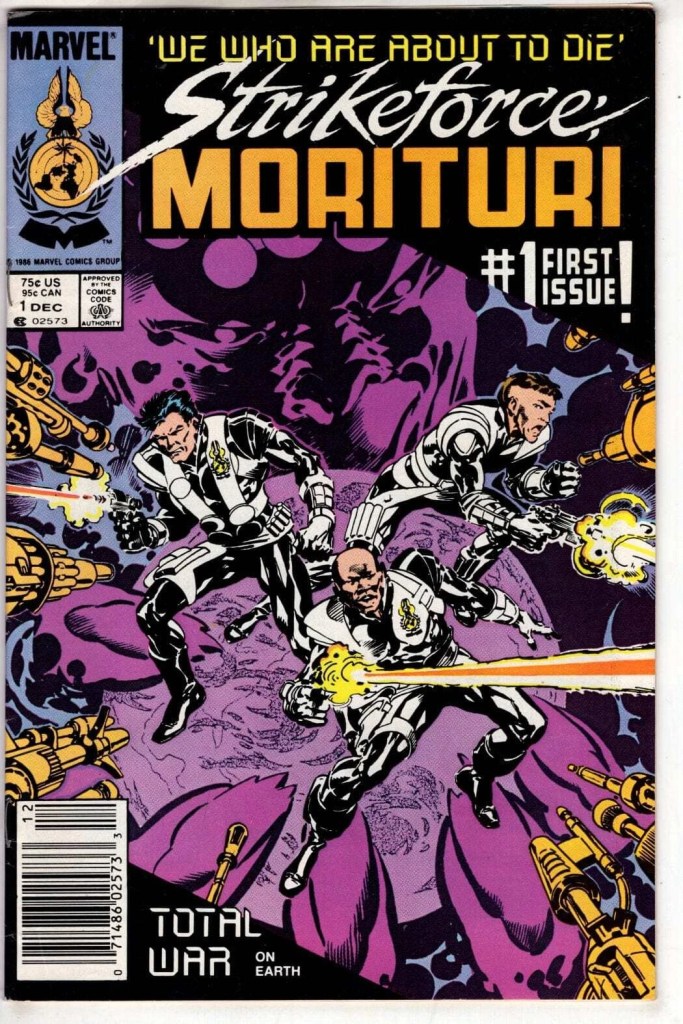
Not every title originally conceived for the New Universe initiative wound up being released under its auspices. Certain titles fell out as the parameters of the new line shifted during the development process. One such series was STRIKEFORCE: MORITURI, a super hero war series set in the future. As pitched by writer Peter B. Gillis to editor Carl Potts, STRIKEFORCE: MORITURI was greenlit as the first New Universe title. Potts speaks about this development, and the early days of the New Universe, at his blog here: https://generaleclectic123.blogspot.com/2008/09/marvelous-tales-secret-origin-of-new.html
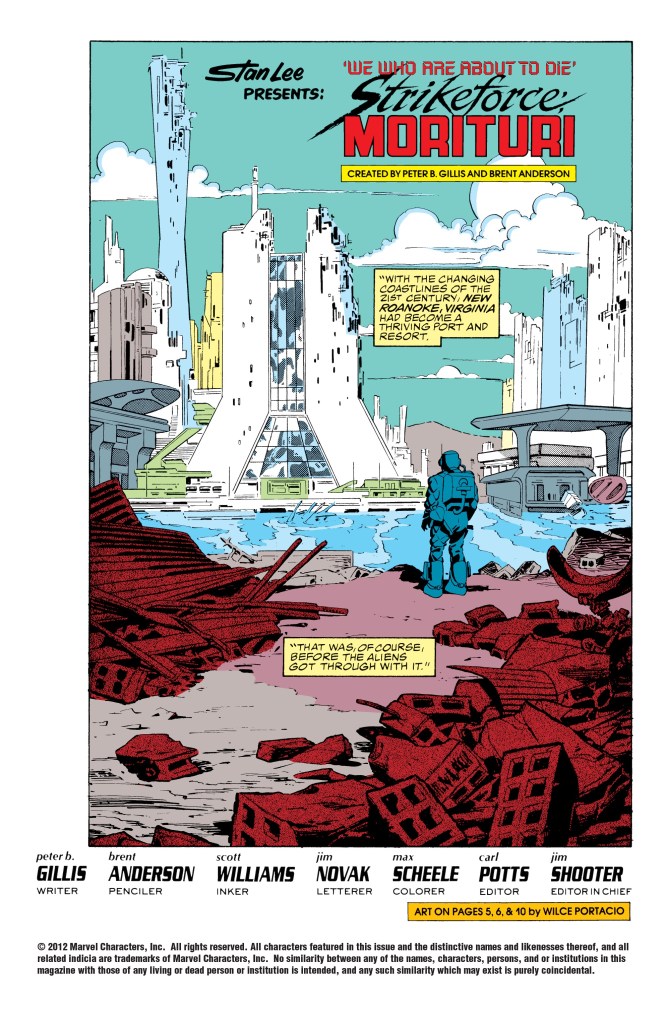
In the end, STRIKEFORCE: MORITURI was released as a stand-alone series by Marvel, set neither in the traditional Marvel Universe nor a part of the New Universe. As such, its prospective fortunes would have seemed to have been limited. But the series ran for 31 issues, a respectable run, with storylines completed thereafter in the five-issue squarebound series ELECTRIC UNDERTOW. All in all, the book lasted about as long as the New Universe titles, so even though it stands apart, it’s worth considering in the umbra of that launch.
And it has to be said, STRIKEFORCE: MORITURI has one of the best premises for an ongoing super hero series ever devised. In the world of the near future, Earth is attacked by aliens called the Horde. They’re space barbarians, disgusting creatures who prey on lesser species, stealing resources from them. But they possess technology beyond what mankind has, and so they’re able to roll over Earth’s defenses. The Horde isn’t interested in conquest, they’d rather slowly exploit and consume the resources of our world. It turns out later that the technology isn’t even really theirs, it belonged to another races of aliens who had come to help the Horde after they had poisoned their own planet. But the Horde jumped their benefactors, made off with their ships and weapons, and began to go from planet to planet, sucking each dry in turn. There doesn’t seem to be any way for humanity to hang on and triumph–until Dr. Tuolema devises what becomes known as the Morituri Process.
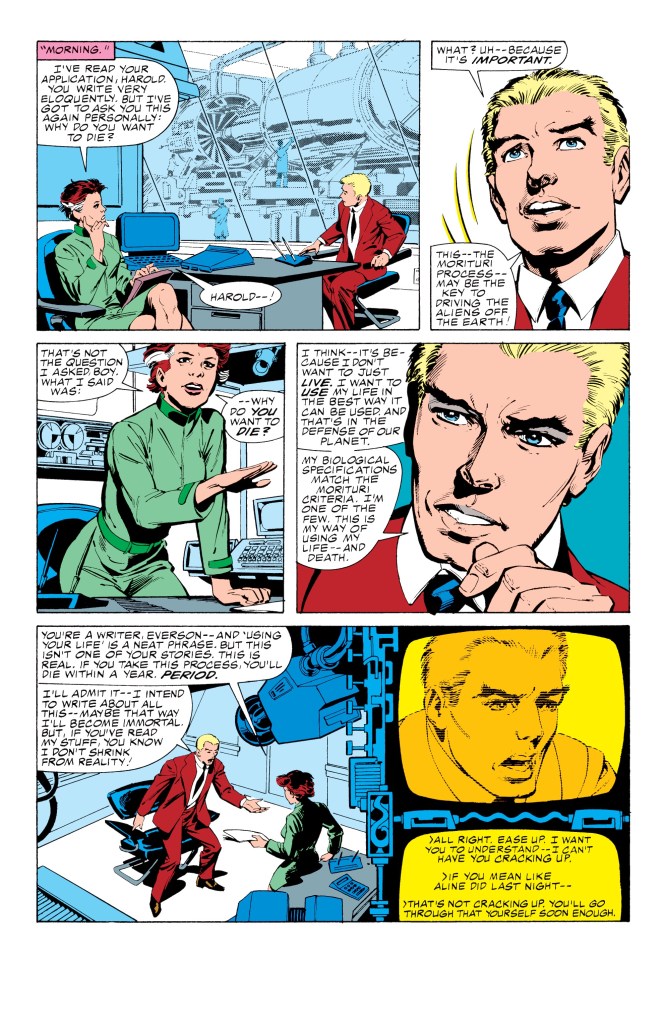
The Morituri Process, put simply, allows for certain compatible young people to be granted superhuman powers. The idea is for volunteers into the program to become super-soldiers fighting back against the oppressor Horde. The hitch, though, is that the Morituri Process is inherently unstable. Anyone subjecting themselves to the process is fated to die at some point within twelve months when their body inevitably rejects what it has been subjected to. So all of the Morituri candidates are sign a literal death warrant for themselves. They can become heroes, but only for a limited time, and then they’re going to die in agony, whether killed on the battlefield or destroyed by their own bodies. It’s a pretty dark premise, but inherently compelling. It’s a war comic dressed up in the trappings of a super hero comic, and that’s what makes it work.
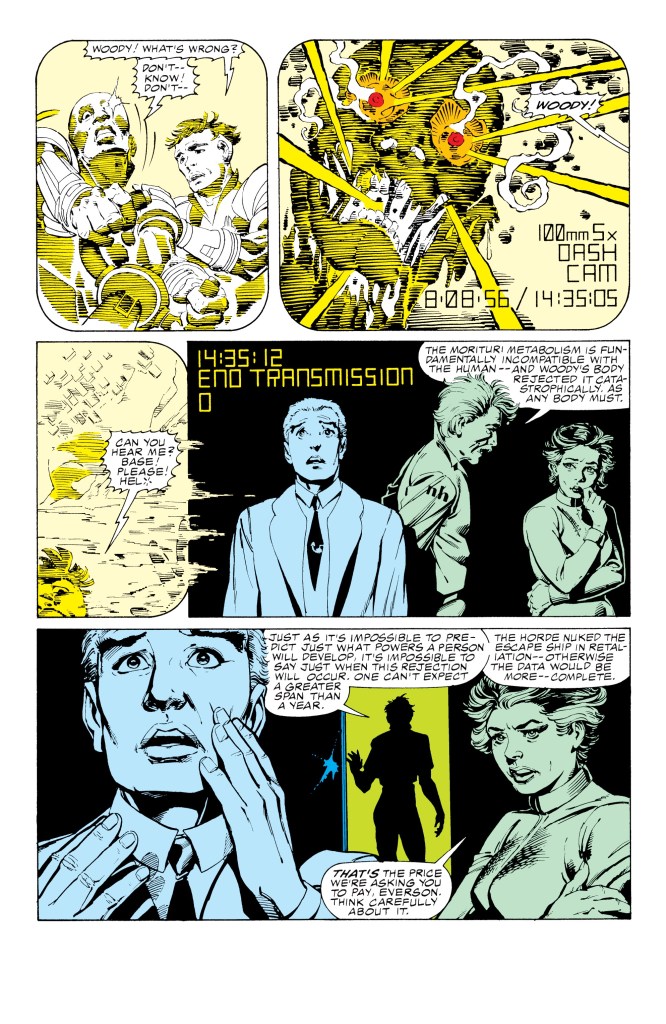
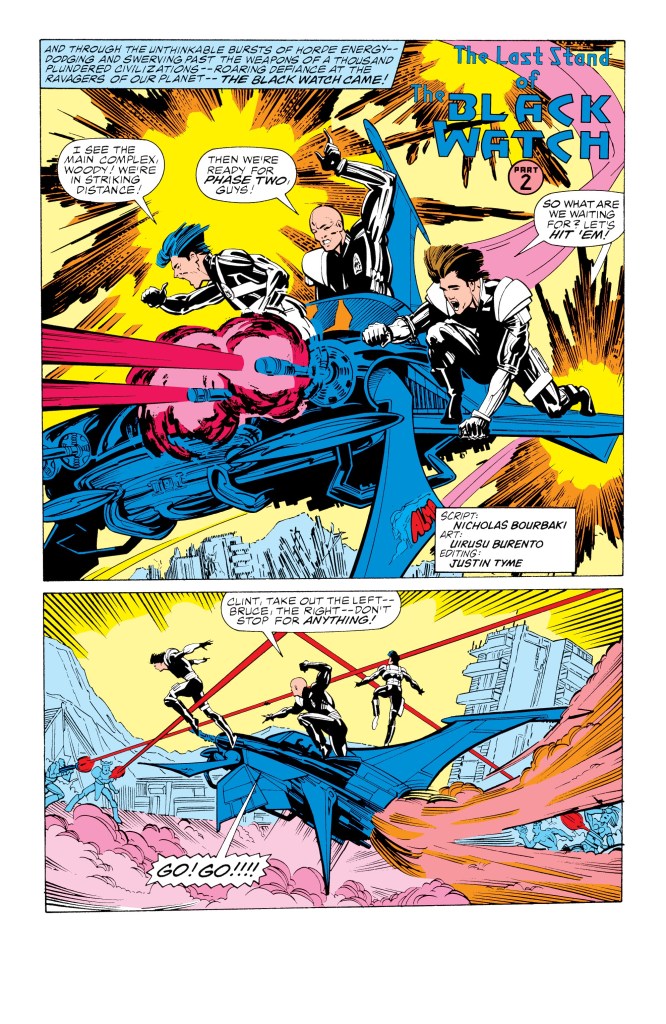
Editor Potts paired up writer Gillis with Brent Anderson, an artist who had come to some prominence through his work on KA-ZAR with Bruce Jones. Inker Scott Williams gave the series a nice, tight sheen while retaining much of Anderson’s Neal Adams-inspired realism. Additionally in this first issue, the comic-within-a-comic dedicated to the Black Watch, the first soldiers to volunteer for the Morituri Process, which has been circulated as propaganda about their exploits, is illustrated by Whilce Portacio. So it’s a good looking first issue all around.
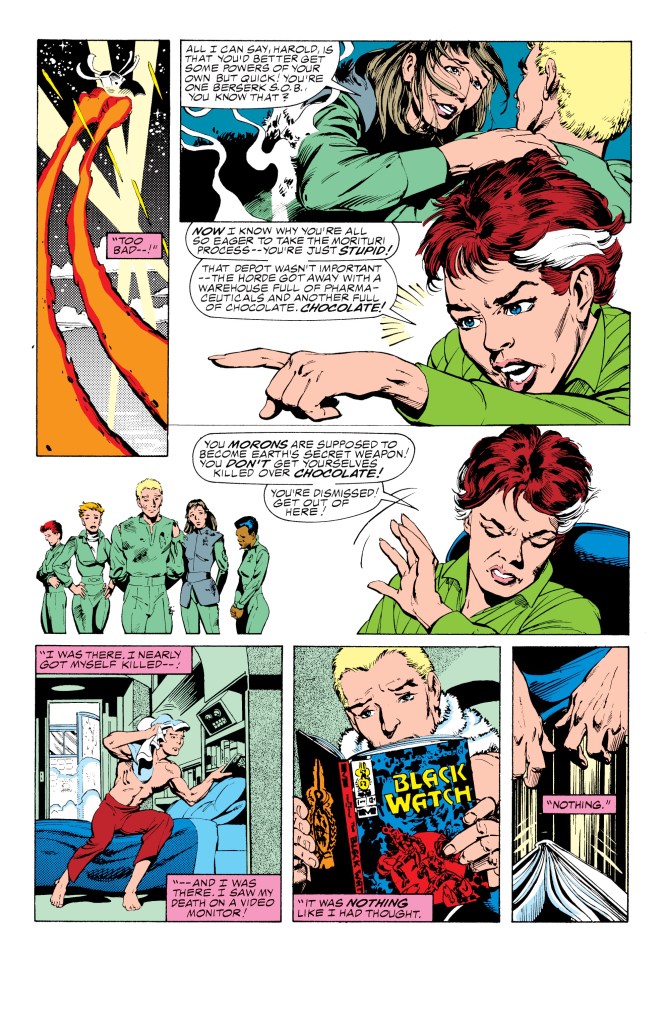
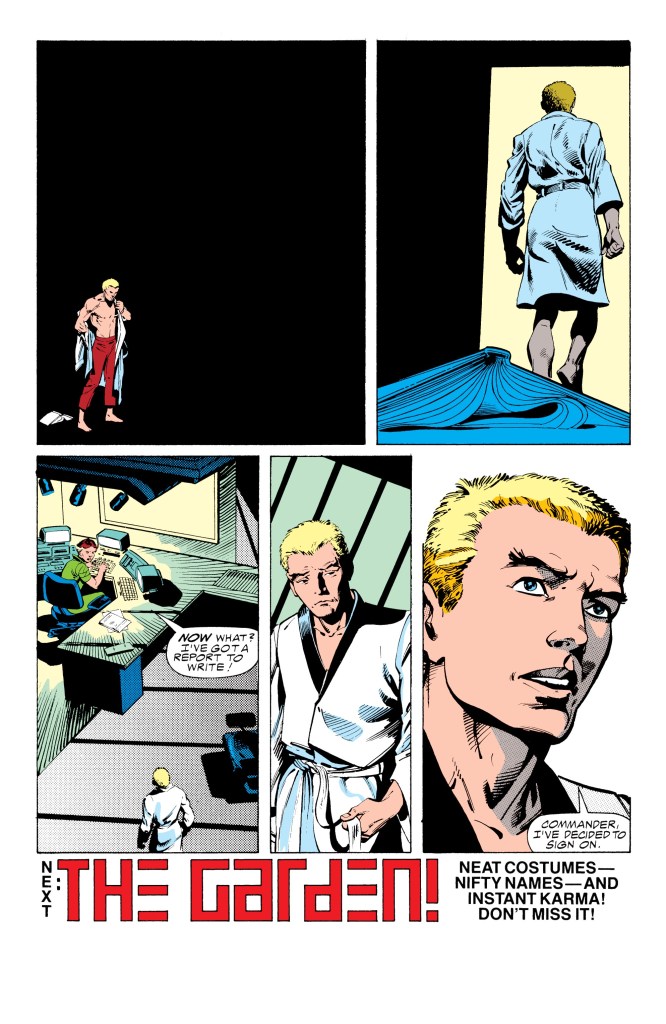
This first issue introduces us to the world and the situation through the eyes of Harold Everson, soon to be called Vyking but here nicknamed R.B., or “Rabid Beaver”, by his co-workers. A would-be writer, he’s volunteered to undergo the Morituri Process in part due to reading the comic book recounting of the Last Stand of the Black Watch, who were the first to undergo the process. But Everson doesn’t really fully comprehend what he’s signing up for, and we see his worldview start to change as he learns the truth about the Black Watch’s final, fatal mission (two of them died in the process of activating their powers, two were killed horribly in battle, and the last was doomed by the Morituri Process itself just prior to the end of the mission.) But all of this doesn’t shake Everson’s determination to do something worthwhile with his remaining time, and so he undergoes the process, becoming one of six characters whom we’ll follow throughout the series’ first year, all of whom are doomed to perish. Everson himself will be killed by Morituri Rejection in issue #6, in a move that was both shocking and yet also utterly necessary.
STRIKEFORCE: MORITURI is a real hidden gem of the era, at least for its first 20 issues, which were produced by Gillis and Anderson. Unfortunately, the creative team that followed them made two key changes to the premise that reduced the series to being just another regular super hero title: they brought the war with the Horde to a conclusion and they had a cure for the Morituri Process discovered. Without the hanging sword of impending demise and the wartime ethos of soldiers in a foxhole forming the bedrock of the premise, it became far less interesting, and ran its course in about a year.


Such a great series, but as you say, only under its original creators.
LikeLike
I really liked the art, but didn’t find the characters compelling. And, while that’s a great premise as a hook — I had limited interest in getting hooked by the characters, even if I was able to get into them, only to see them die.
I wasn’t opposed to the book or anything — it’s an interesting idea — I just wasn’t the audience for it.
I did, though, like that Brent Anderson art a lot. I wonder what ever happened to him…?
LikeLiked by 3 people
I remember reading this series when it came out. It was interesting and sad. If memory serves, the so-called “cure”, in these later issues, was revealed to always be there from the beginning. The governments just didn’t want to deal with 1000s of super-soldiers running around after the war. So they purposely made the process fatal, murdering their own people. When some of the last of the heroes discover this, they try to tell the world about it before their time was up.
If the story had been written 20 years later, the heroes would have been able to easily publish what they found on social media instead of the struggle they went through.
Reagan said “Trust but Verify”. This series, to me, was giving the message, “Never Trust and if you Verify it will be worse than you thought!”
LikeLiked by 1 person
Blame it on John Byrne for killing off Guardian! Or Conway and Romita for Gwen Stacy’s fate! But while I found the concept of “Strikeforce: Morituri” quite intriguing, I was afraid that I would actually like and care about these characters who weren’t going to stick around. As a result, I deliberately skipped this one.
One definite regret was missing Brent Anderson’s artwork. I’d liked his fill-in work on the X-Men but never picked up Kazar. I could tell that he was certainly an up-and-coming talent. But due to my missing out, I didn’t see his art again years later when I read some collections of Astro City. (Wish I could remember who wrote that series?)
LikeLiked by 1 person
This pretty much flew under my radar at the time. At a glance, it looked more like military / sci-fi than super-heroes, and thus outside my sphere of interest. I’ve certainly liked other things that Gillis and Anderson worked on, so I should probably track it down one of these days.
LikeLiked by 1 person
The only thing I remember about this book is liking it. Artist and writer both were favorites. I don’t eve recall the creative team change or the revelation about the process so I’ll have to assume I just went with it.
LikeLiked by 2 people
I don’t recall seeing this on the stands, but it is nice looking art. I liked Brent Anderson’s work wherever he would pop up. This title smacks me as something that wouldn’t have been out of place at Charlton…. super heroes but kind of not.
LikeLike
Tried this. Loved it. Then they switched the writing to James Hudnall who didn’t like alien invasion stories and hated the premise. Read one issue, stopped.
LikeLiked by 1 person
In retrospect, one of the only comics I ever decided not to buy based entirely on the logo design. Still hurts my eyes. A shame because it sounds like I probably would have liked it.
LikeLiked by 1 person
I’ve always wanted to read this. Has it ever been collected by Marvel?
LikeLike
Strikeforce: Morituri” was reprinted in the form of 3 TPBs back in 2012. No idea how easy they are to find these days…
LikeLike
I had a couple of issues of this. I was taken in by the art. I liked a few of the military styled uniforms worn by the characters. Also the flared sleeves of one who seemed to project some sort of light energy. And a really tall guy who wore a sort of “piscator” Roman gladiator helmet.
Brent Anderson’s appealing, dramatic naturalist art style was well served by Williams’s slick, well-lit inking. It created something unique, and totally “cutting edge”, compared to what else was being released then. Scott’s inks were different than most else out there. I’d notice him again over Whilce Portacio’s art on “The Punisher” initial ongoing monthly, after my main man Klaus Janson sadly (for me) left that series. I never made the connection between Whilce and this series before.
I was into a lot of what Carl Potts was doing then. I liked some of his own art, including a really striking “Daredevil” cover, with DD on a small wooden bridge, fighting multiple Samurai style Japanese warriors at night, in the snow. Also at least 2 Moon Knight covers, and an issue of MK interiors art, featuring a retooled Fly villain. I thought the books Carl’s edited were forward looking, and had better over-all design than others.
Never knew this was originally slated to be a “New Universe” book. But the opening credits’ letting font seems consistent with that line’s look.
LikeLiked by 1 person
No super-powers but earliest comic book team fighting a war whose members get killed off is Quality Comics’ Death Patrol [ Military Comics#1 ( August 1941 ) Del Van Dyne and reformed criminals Butch O’Keefe ( dies in #4,6 & returns in #12 comics.org ), Peewee, Hank ( #9 appears to die, but returns in #12 ), Slick Ward ( dies in #3 ) & Gramps ( returns from the “dead” in #12 ); new member Stoney Rock ( dies in the issue he first appears in #2 ), Zazzy ( intro in #3 & dies in #5 ), Chief Chuck-a-Lug ( intro #4 ), King Hotentot ( African, intro in #5. Appears to die in #10 but returns in #12 ), Boris ( intro #6 ), The Patchwork Kid ( Frere Jacques#9 – intro #7 ), Mademoiselle from Amentieres ( French female assassin – intro #8 ) Goucho ( intro #9 ), Prince Totintot ( intro #10, son of King Hotintot ), Henry ( intro #11 – a talking blimp ), Yogi ( telepath/telekinetic from India – intro #20 ) — lose their uniforms in issue 20 and no more members would die in action ]
LikeLiked by 1 person
Aliens invade and citizens volunteer to be turned into super-soldiers brings to mind Rom and the other Space Knight volunteers to counter the Dire Wraiths. Plus the Horde overpowering friendly aliens and stealing their technology reminds me a little of “In a Mirror, Darkly -part 1 ( Star Trek: Enterprise — season 4 episode 18 ( April 22, 2005 ) ) – In 2063, a Vulcan ship lands on Earth, making first contact with humans ( as seen in Star Trek: First Contact ). Instead of peacefully greeting them, Zefram Cochrane shoots the lead Vulcan and the humans storm and loot the ship.
LikeLiked by 1 person
Did anyone here read/have an opinion on ELECTRIC UNDERTOW?
LikeLike
“Ave Imperator; Morituri te salutamus” (Hail Emperor, We who are about to die, salute you.”)
Apparently, what Gladiators said before matches (although they only rarely were killed in actual practice.)
There was a famously troubled 1965 film with Yul Bryner; Malon Brando; Janet Margolin; and his boyhood friend Wally Cox called (variously, I told you it was troubled):
Saboteur: Code Name Morituri.
LikeLike