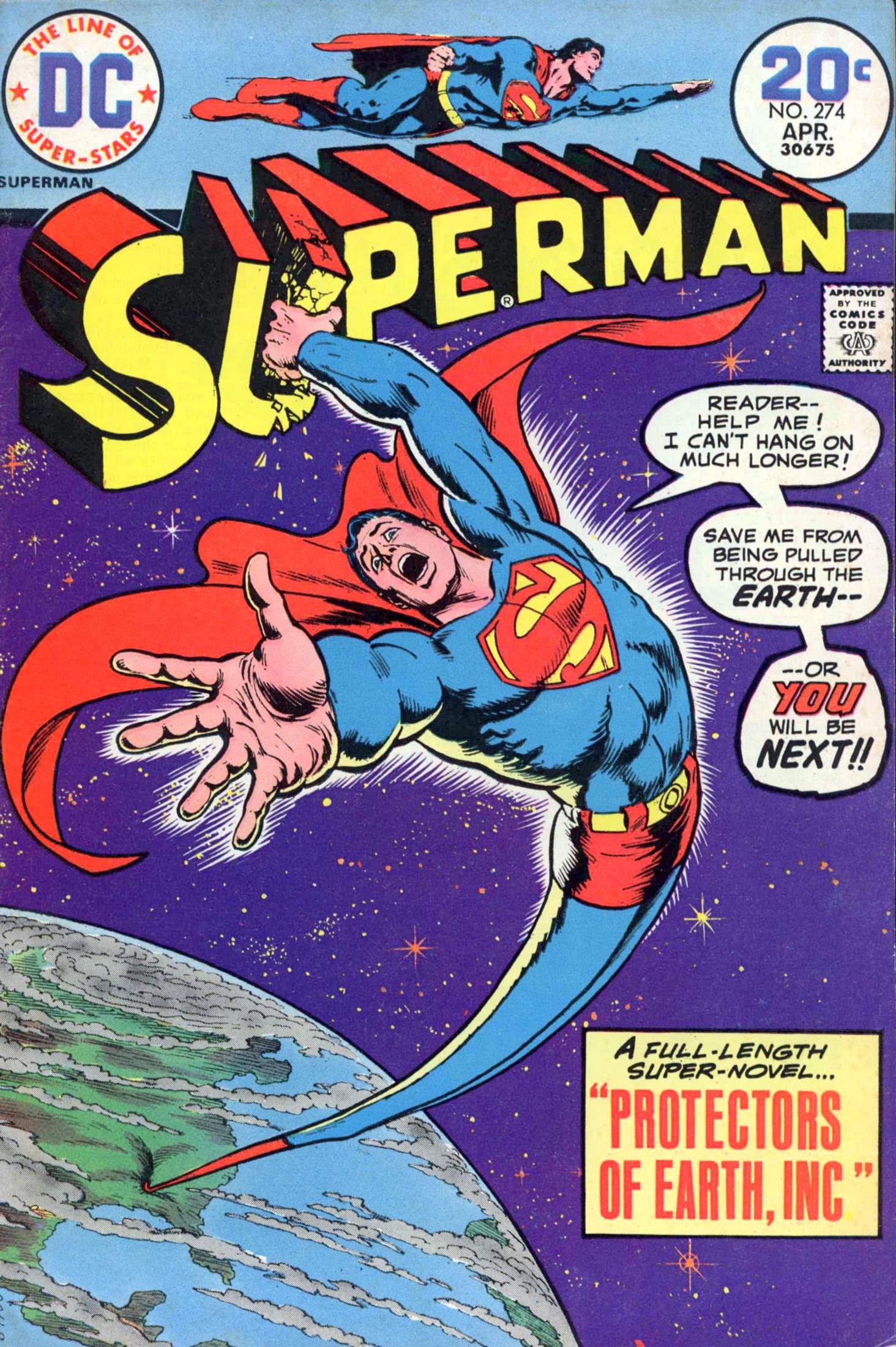


When I was growing up in the early 1970s, you didn’t have a whole lot of choice about who your friends were. You were pretty much limited to any other kids who happened to live on your street. In my case, that included a kid my age who lived down the block named Charles Grella. He was a more athletic kid than I was, and a bit of a troublemaker in the Eddie Haskell style, and as we got older, he became as much a foe as a friend, though we began to circulate in different crowds once we were able to. But when I was six or seven, he was among the cast of characters in my life. And like all kids in that era, he had a couple comic books. He was never really into comics, certainly not the way that I was, but it was inevitable that somebody would buy a kid a comic from time to time. This issue of SUPERMAN was one of the books that he had, and while I never outright borrowed it from him, I did manage to kind of speed-read it at some point when I was over at his place one afternoon.
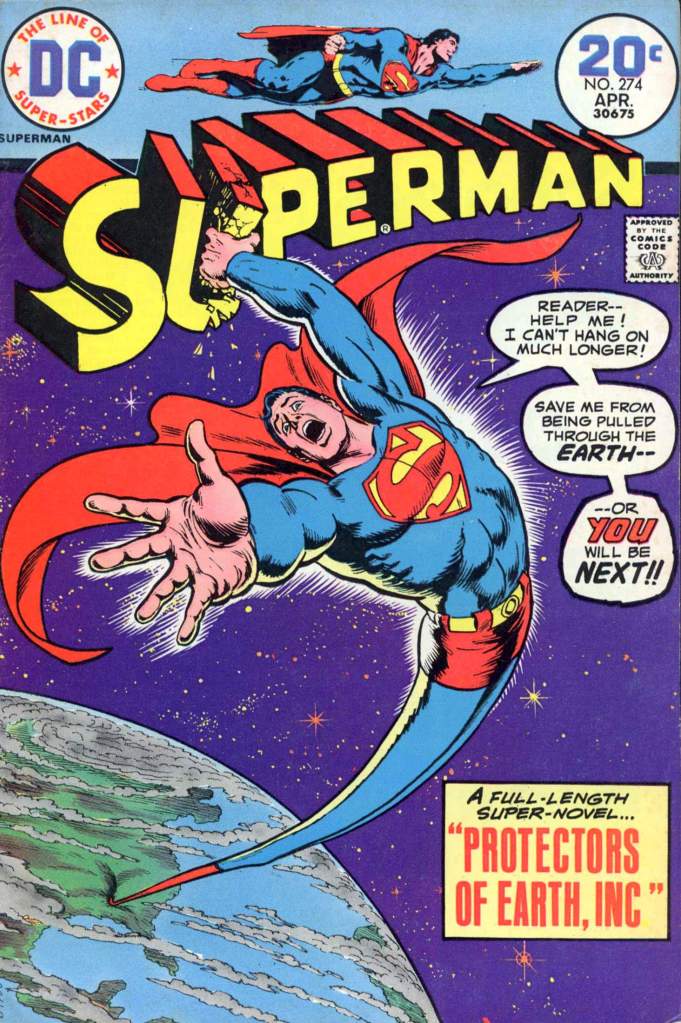
For one thing, I was mesmerized by this cover, the work of the great Nick Cardy working over a sketch by DC boss Carmine Infantino. I was fascinated by the way the Man of Steel was grabbing and crumbling his own logo on this image, and the manner in which he was talking directly to the viewer–i.e. me. This piece started showing up in house ads this month as well, but I’m pretty sure that I saw it on a copy of this issue first during a visit to the 7-11 at which I didn’t buy it. But now I had a chance to see what it was all about. I remember relatively little about the story, only that I felt as though the cover promised more than was delivered. But let’s see together.
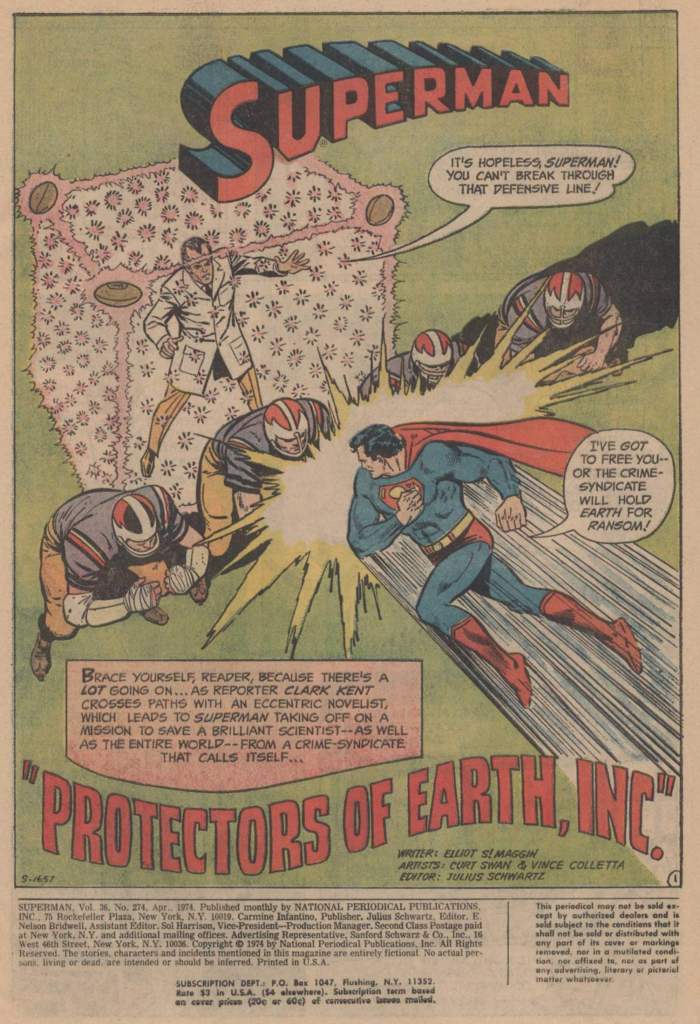
This story involves two characters of slightly greater note today. The first is author Wade Halibut Jr., who makes an appearance on the Johnny Nevada show and tells the interviewer that he’s stuck on the plot of his next novel, which is about a reporter stumbling upon a doomsday device. In order to work out an ending for his book, Halibut decides to use Clark Kent as a stand-in for his character, creating the same fictitious situation around Kent that his character experiences and seeing what he does. Halibut, of course, has no idea that Kent is secretly Superman. And Halibut is a thinly-disguised stand-in for renowned author Kurt Vonnegut, (just as Johnny Nevada was Metropolis’ version of Johnny Carson) not that I understood this at the time. But Curt Swan’s depiction of Halibut was so specific in its design and mannerisms that there was clearly something going on that I wasn’t following.
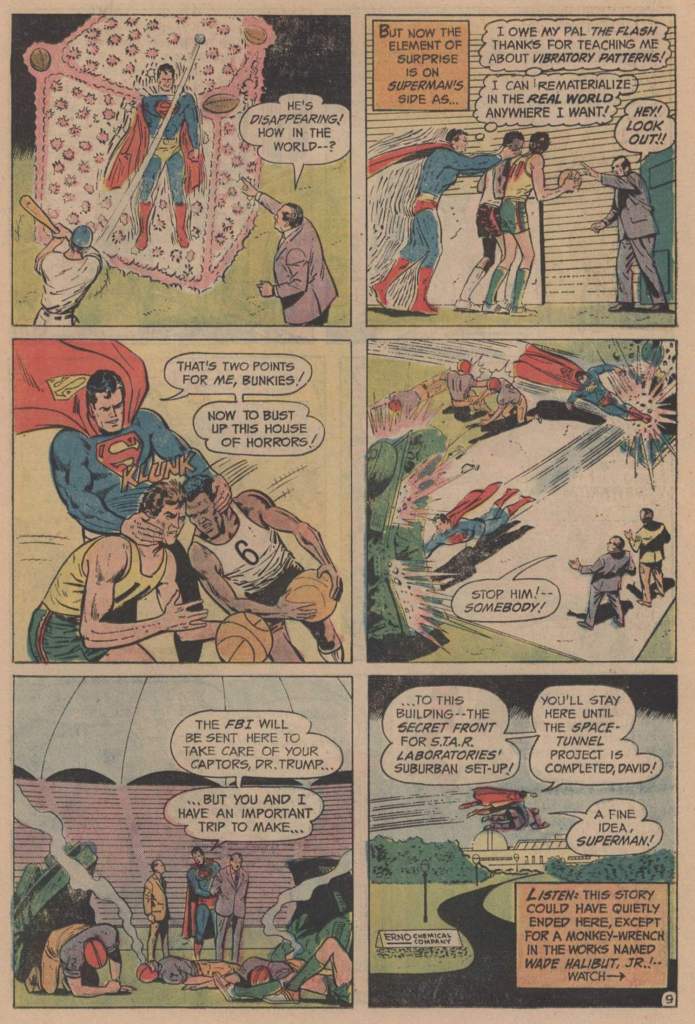
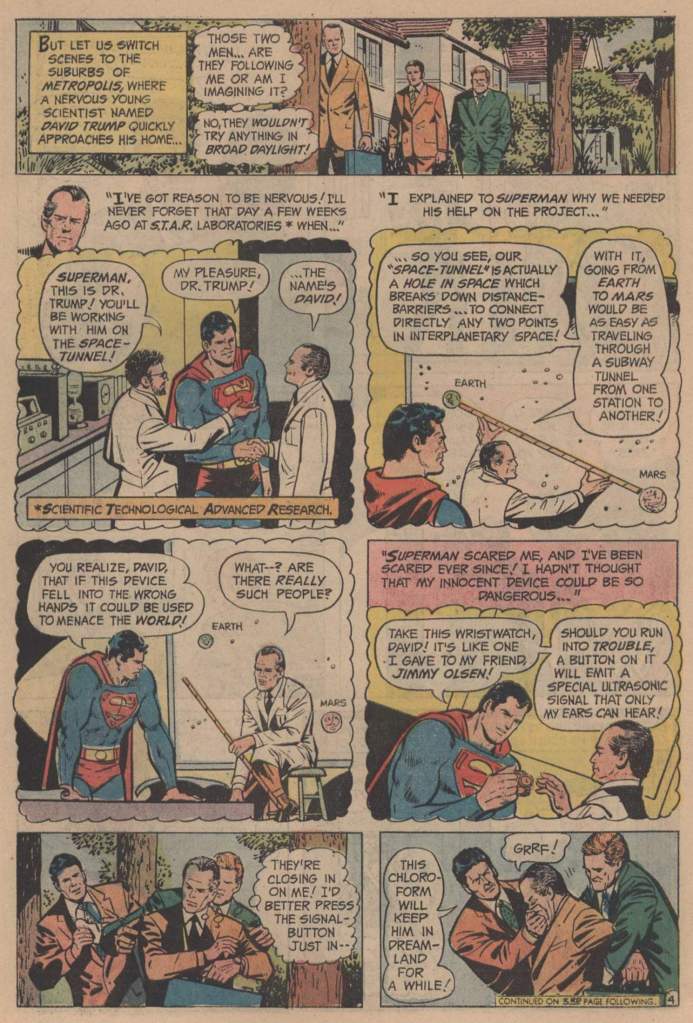
The second player of note today is a scientist named Dr. David Trump–a name that evokes unintended connections in 2026. Trump has been working on a method to create wormholes in space that will allow for instantaneous travel between the Earth and Mars. Because his research is of interest to enemy nations, Superman has given him a signal watch with which to summon the Man of Steel should the scientist be in danger. And that’s exactly what happens here, as Trump is abducted by enemy agents looking to steal his device. They say they work for a criminal conglomerate known as Protectors of Earth, Inc, which acquires powerful super-weapons and uses them to blackmail the nations of the world. One bit that I remember from reading this story initially is that, when Superman comes to the rescue and the bad guys trap him in an energy cage, he’s able to free himself by vibrating his molecules in the manner of his friend, the Flash. Of course I remembered that bit. In later years, however, it was decided that Superman’s molecular structure was too dense to permit him to vibrate through solid matter in the manner of the Flash, thus preventing him from being able to use that trick regularly.
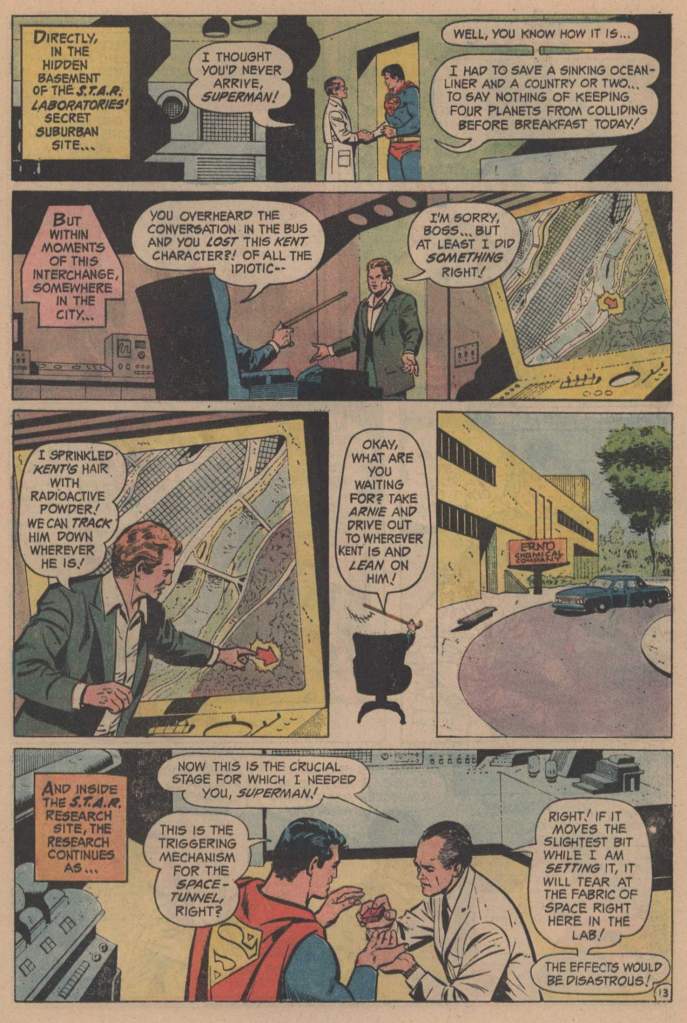
Anyway, the situation is complicated when Halibut approaches Clark Kent in disguise and passes him what he says are the microfilm plans for a doomsday weapon. This exchange is overheard by agents working for the Protectors of Earth, which makes both Halibut and Kent targets. Superman has to spend a bit of energy getting the author out of the jam he’s stumbled into as a result of his actions, while still keeping one ear out for danger to Trump. But in the scuffle with the Protectors’ agent, Kent’s hair was dusted with a radioactive compound, allowing the organization to track his whereabouts–or rather Superman’s. This brings them to Trump’s laboratory just when a critical part of his experiment is in the process of being completed. Superman must hold the triggering mechanism for the wormhole absolutely still while it’s being primed–which means that he can’t do a single thing when the Protectors’ agents invade the lab.
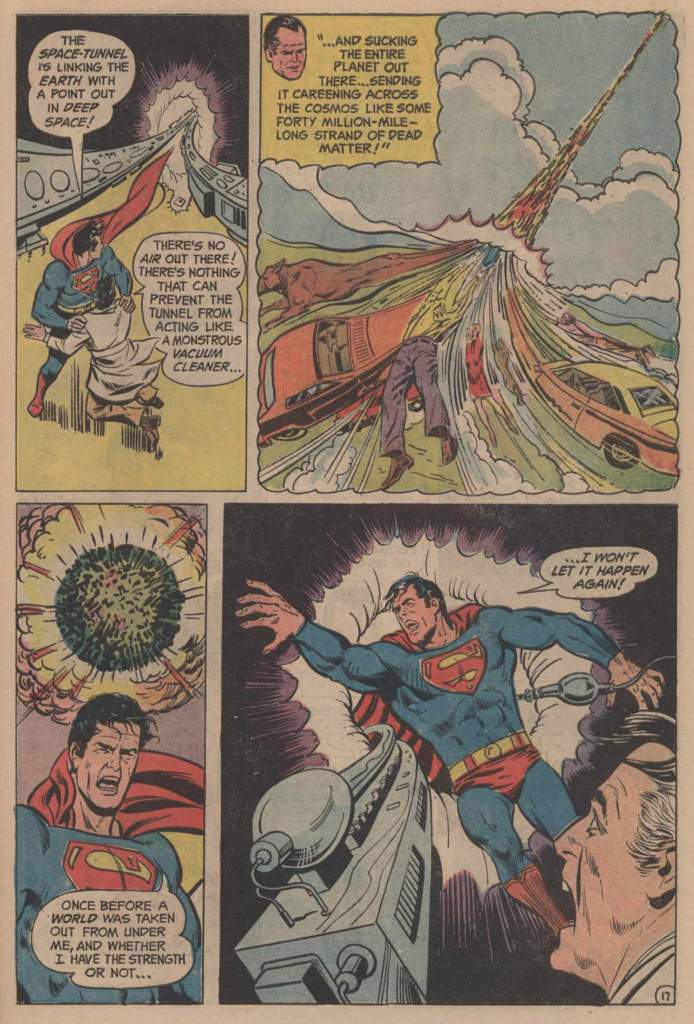
At first, the criminals think that Trump simply has a Superman statue he’s working with for some reason, and they delight in shooting at it–the bullets bounce off harmlessly, of course. But when one of them makes a move to shoot Trump, Superman has no choice but to step in, even though it means dropping the trigger mechanism. Trump is saved for the moment, but a wormhole is being formed right there in the lab, one that threatens to pull the entire Earth through it and deposit it at some far-off point in space like an extended strand of spaghetti. Determined not to let another world die like his homeland of Krypton, Superman steps into the breach and blocks the wormhole with his own body.
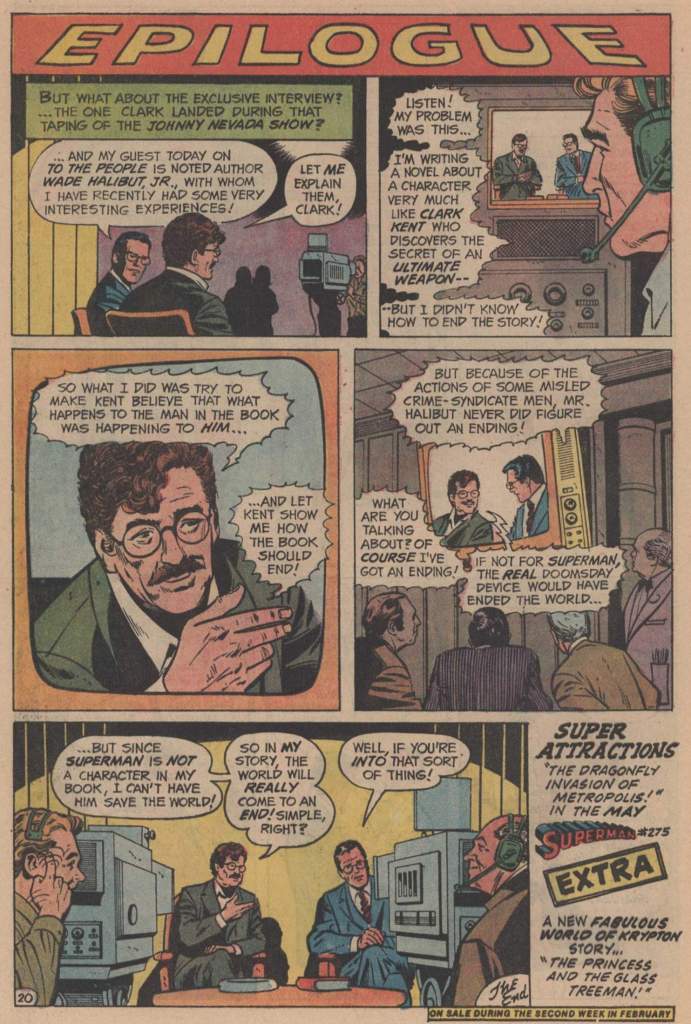
For a page, the Man of Steel struggles to keep the entryway closed, like a kid with his finger in a holed dike. His body is horribly distended in the process, but he triumphs through sheer force of will. Eventually, the device powers down and Superman limply slumps to the ground–but only momentarily. The Protectors guys don’t want to mess with him at all after witnessing what he just did, and so the story wraps up at this point. All except the epilogue, in which Kurt Halibut reveals in an on-air interview with Clark Kent (who doubled back to the lab to help keep his secret identity a secret) that because Superman isn’t a character in his novel, he can’t use what he learned from following the reporter. So he’s simply going to have the book end with the world being destroyed. Simple, huh?
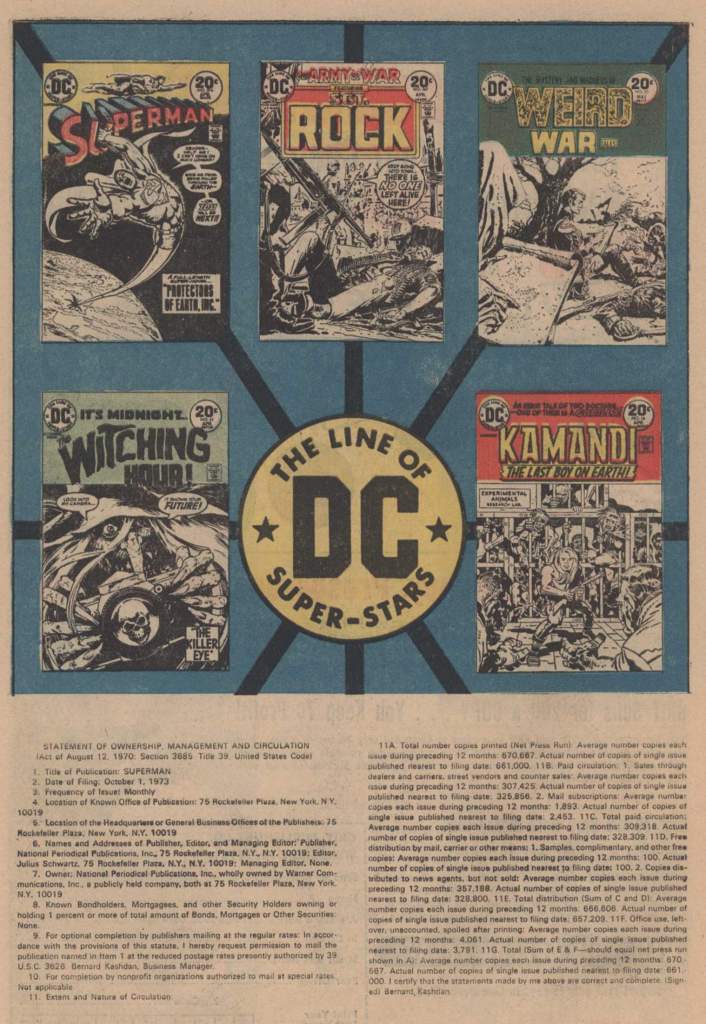
As it turns out, this issue also contained the yearly Statement of Ownership, which charted how well a title had been performing in the 12-18 months prior. The one for this issue wound up running as the bottom third of the house ad page that included the reproduction of this issue’s cover. In any event, it reveals that at this time, SUPERMAN was selling a not-inconsiderable 325,826 copies on a print run of 661,000, giving the series an efficiency rating of 49%. This was right around the time where Marvel’s sales overtook those of DC, but the Man of Steel continued to remain incredibly popular during this period.


One of the worst thing about growing up in the 70s was in school you were stuck with the same 30 kids all the way through till high school.
LikeLiked by 1 person
It makes you wonder how authors write their books in a world where Superman exists. If they want some kind of fictional disaster, do they explain why Superman doesn’t just fix it, or do they all postulate an alternate world without him?
LikeLike
Space-Tunnel, also known in science and science fiction as a Wormhole ( I guess the writer didn’t know this name ): Wormholes are theoretical “shortcuts” through spacetime, bridging vast cosmic distances to potentially allow rapid interstellar travel. Originating from Einstein’s general relativity. these Einstein-Rosen bridges are not yet proven to exist. They would likely require exotic matter to stay open and stable.
LikeLiked by 1 person
My thought on this issue is huge props to Elliot S! Maggin and Curt Swan for managing to even craft a story that comes close to that dazzling, eye-stealing cover! Thank heavens I never saw that cover on any comic book stands in my hometown. Given that it was published in the two dimes era, there’s an even chance I could have opted for it over an issue of Iron Man or some other Marvel I was beginning to collect. My life would have taken a completely different course.
In all seriousness, that amazing cover aside, the interior exemplifies to me the difference between DC and Marvel with the former following their tried-and-true formula while the latter sought to break new ground. Not that Marvel always exceeded, but there was a sense of adventure to those books – even ones struggling as badly as Iron Man at that time – that I just didn’t sense with the few DC books that I read.
As for growing up, once I caught the collector’s bug in 6th grade, I was the annoying kid trying to buy or borrow every old Marvel comic I came across.
LikeLike
I never had this one but I’m familiar with that excellent cover via the house ad. Those b+w thumbnails were pretty effective.
LikeLiked by 1 person
I remember really liking this story as a kid (and I still think it’s pretty great), just because there were so many interesting elements to it. The space-tunnel, the evil organization stockpiling weapons, and the eccentric author manipulating Clark Kent were all very clever ideas. Like Tom, I didn’t know anything about Kurt Vonnegut at the time, but once I started reading his works years later, it made this story even more entertaining. I don’t know if Maggin had this particular angle in mind, but from what I’ve read, writing was often a very difficult and arduous process for Vonnegut (see his not-quite-a-novel TIMEQUAKE), so the idea that he might resort to such a crazy stunt to expedite things almost seems plausible!
LikeLiked by 1 person
It’s just struck me that “Wade Halibut Jr.” is not just a play on Vonnegut, but also on his creation Kilgore Trout, as well. [And Trout was a play on Theodore Sturgeon, so why not?]
LikeLiked by 1 person
The thing I thought was neat as a kid reading this was that “Kilgore Trout” lived in Cohoes, NY in Vonnegut’s works (I later read that he had worked for GE in either Schenectady [Power Systems] or Waterford [Plastics] right after WWII, both around Cohoes, I forget which). I lived in Troy, nearby (Trout originally lived in Vonegut’s fictional version of Troy, Illium, also used in Player Piano).
A wormhole (Chrono-Synclastic Infundibulum ) figures in both Sirens of Titan and Slaughterhouse Five.
Maggin sometimes used fictional versions of famous people he admired in stories, like Danny Kaye.
LikeLike
This was maybe the 2nd comic I got as a kid – for the cover. I learned the word “epilogue” from this particular comic. I really like Superman’s “I lost one world and won’t lose another” speech – I think there’s another one of these in a World’s Finest (co-starring The Atom) from around the same time.
Not gonna talk about the inks here, but this is a long way from the Swan/Anderson combo of a few years back.
LikeLike
I think National Lampoon did this type of cover better.
Just can’t connect to these stories. Until the Marvel writers worked for DC, I think that there was a real difference between Marvel and DC.
LikeLike
Is it the writers or the demands of the editors? (Or, you know, both.)
LikeLike
I think the DC editorial fiefdoms hurt them at the end. They didn’t share characters, didn’t communicate, and didn’t cooperate. Even Batman and Superman very rarely interacted outside of JLAa and World’s Finest and in JLA they barely coexisted. Flash and Green Lantern were really the only cross pollination before the 80’s. I don’t count the 12 Labors of Wonder Woman.
LikeLike
The DC of the 1970s evolved out of two companies (DC and All American) that shared some ownership and Trade Dress but were technically sperate until the mid to late 1940s.
Editors like Weisinger; Schiff; Boltinoff and Kashdan came out of DC. Schwartz and Kanigher came out o All American.
Kanigher did a lot of cross overs in his war books. Schwartz periodically did Flash and GL cross overs and Atom and Hawkman crossovers and (in Detective Comics.) Batman and Elongated Man cross overs (Elongated Man had been introduced in The Flash).
Kashdan did a lot of odds and ends of cross overs in his Brave & The Bold book, some of which made great sense (Flash and Atom for example) but did not catch on with Schwartz. Others (like Flash and Martian Manhunter or Hawkman and Aquaman) were in different editorial fiefs.
LikeLike
The whole point in DC hiring former Marvel writers was to bring over the Marvel magic. There was a house style which was more than Superman heads. It gets internalized or if it doesn’t then that artist or writer doesn’t work out.
The thing that is amazing to me in a way is how writers especially were able to script hundreds of issues. I may not like reading them but it says something.
LikeLike