

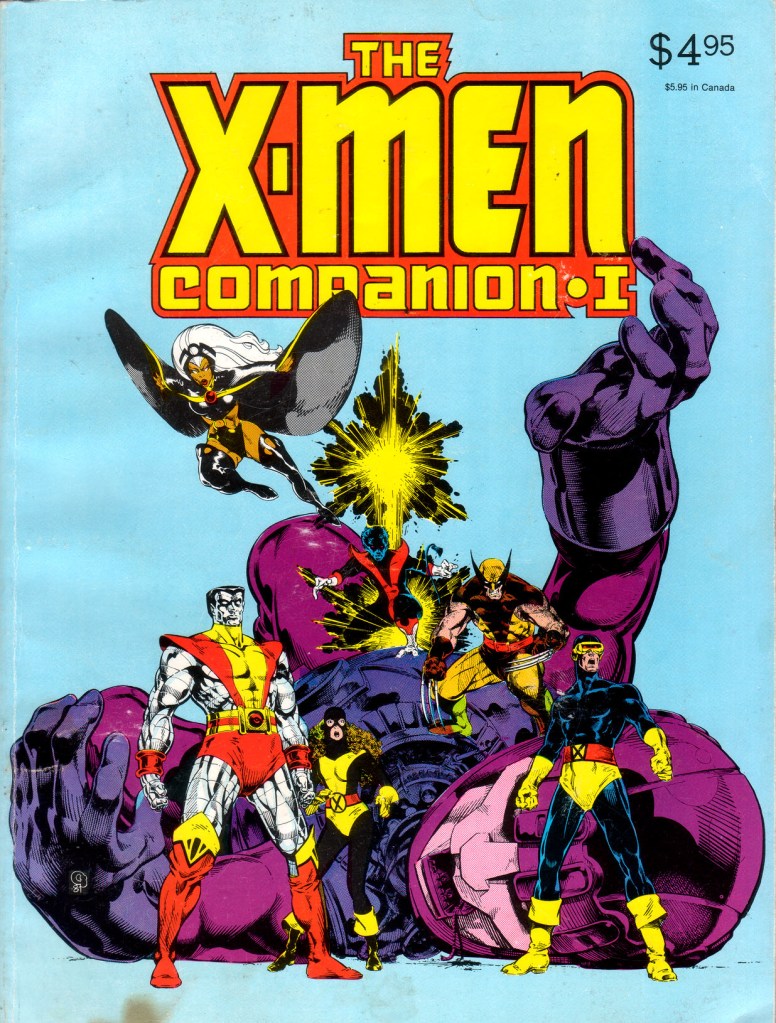
I owned at least two copies of this first volume of THE X-MEN COMPANION, possibly three. And I got them for the stupidest of reasons. At the time, having relocated to a new development in Delaware, I was forced to get my comic books monthly via mail order from Geppi’s Comic World. This meant filling out and submitting an order form each months and then being ready with the cash when the package arrived C.O.D. sometime later. And the reason that I wound up with multiple copies of this book was that it ran late. So when it didn’t turn up in the shipment it was meant to be in, I called the Geppi warehouse to complain, and then sent out a replacement copy once the books came in. So I had copies turn up on at least two occasions. This was one of the reasons that I stopped using the mail-order service, I didn’t have so much disposable income at that point where I could be dropping an additional $4.95 on books that I already had.
The two volumes of THE X-MEN COMPANION were among the stranger publications released by Fantagraphics in the 1980s. The firm was mostly know for publishing the Comics Journal, a monthly magazine devoted to comic book criticism. Over time, it skewed more and more away from the mainstream and towards works of greater artistic merit, but in 1982, they were still covering the comics scene of the moment. One of the mainstays of the Comics Journal was their long in-depth interviews with creators in the field; no matter how much I might have disliked or disagreed with the magazine’s editorial slant, those long interviews were always worth buying it for. Fantagraphics themselves had higher artistic aspirations. They had begun to publish LOVE AND ROCKETS by this time. But artistic efforts didn’t always pay the bill, and so the company was forced to also publish AMAZING HEROES as something of a cash cow to stay afloat. These two X-MEN COMPANION volumes were an extension of those efforts.
By 1982, there was no more popular comic book in the Direct Market of comic book specialty shops than X-MEN. In particular, the All-New, All-Different X-Men that had debuted in 1975 in the pages of GIANT-SIZE X-MEN #1. As X-MEN had been a reprint title for many years, those early issues featuring the new team were hard to find, which helped to drive up back issue prices exponentially as more and more readers fell under the spell of what the series’ creators were doing. This all reached a crescendo with UNCANNY X-MEN #137 and the unexpected and emotional Death of Phoenix storyline. Interest exploded, and it never really cooled down again for at least two decades.
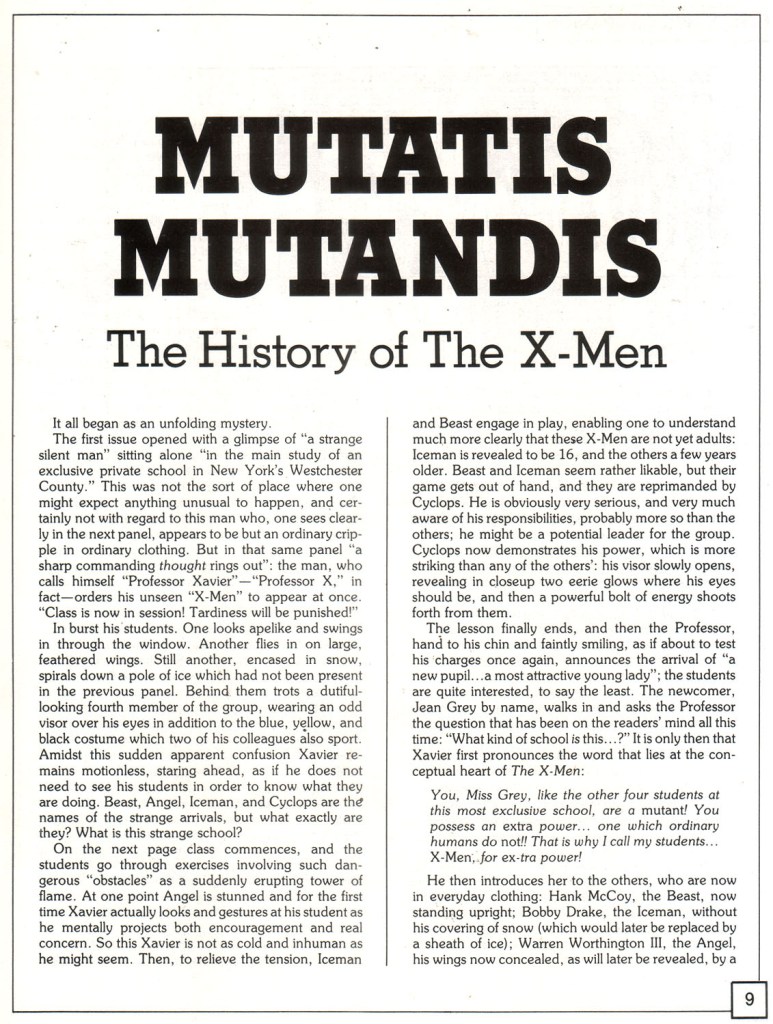
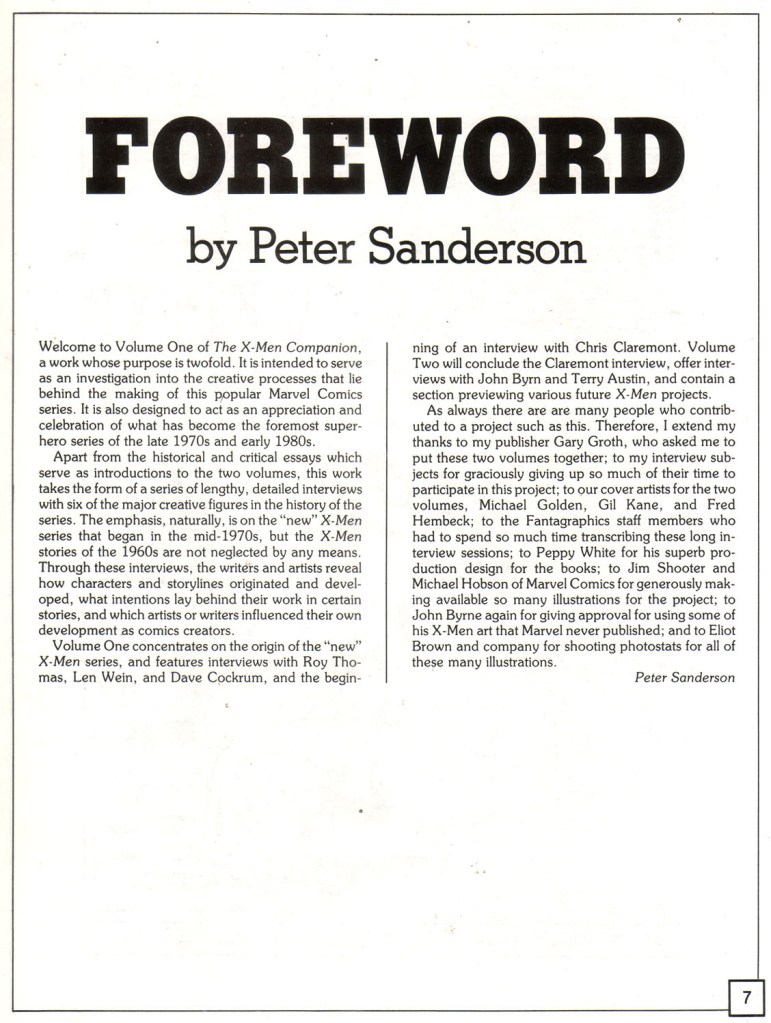
What’s more, the nascent fan community had learned that there’d been extensive changes made to that storyline in its final issue, changing its outcome completely. This galvanized conversation, and represented an opportunity for a savvy publisher. Somehow, Fantagraphics struck a deal with Marvel Comics to produce a two-volume retrospective on both the history and creation of the series and specifically the Death of Phoenix storyline and what was going to be coming thereafter. Interviews with all of the major creators as well as historical text was to be produced by Peter Sanderson, a comic book historian and letter-writer who was well known to most of the principles involved. In effect, the book was to be a deep dive look behind the curtain as to how this groundbreaking series came together. I can say for myself that I found it illuminating and inspiring as I pursued my interest in coming into the field.
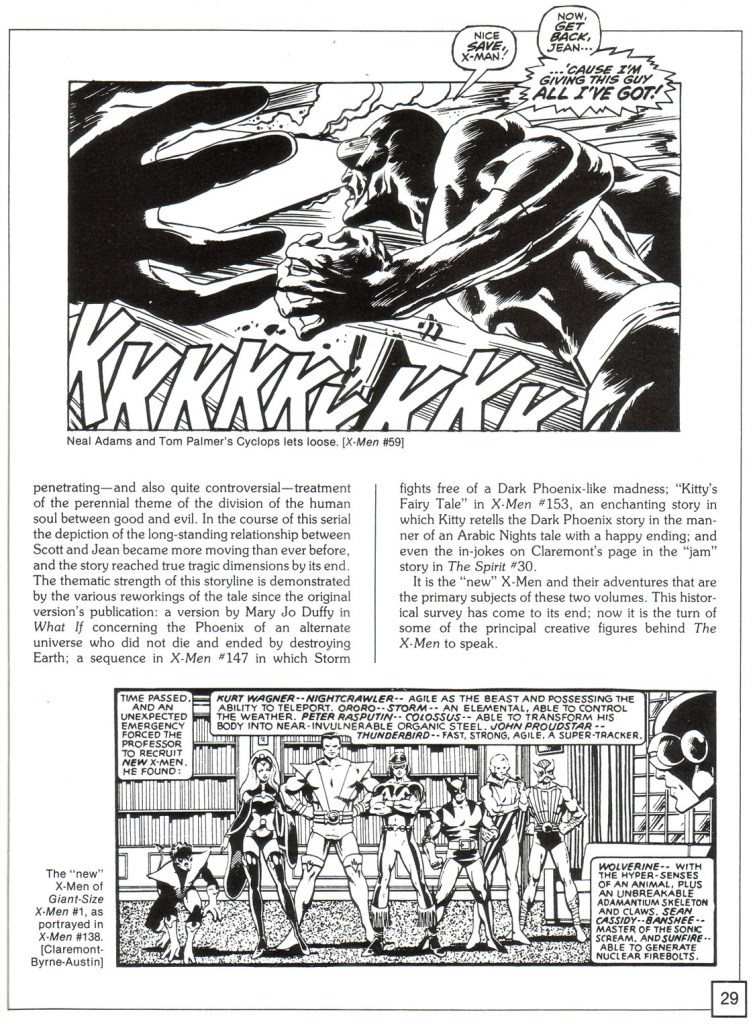
Not only was Sanderson permitted access to the assorted creators and editors, but Marvel also provided Fantagraphics with black and white proofs from its archive so that the volume could be illustrated with pages, panels and images drawn from throughout X-Men history. This was another part of the appeal for me, as it gave me a glimpse into a wide assortment of comic books that I had never read before. (The same was true, I expect, for a lot of other New X-Men fans who hadn’t been exposed to the original 1960s incarnation of the group.)
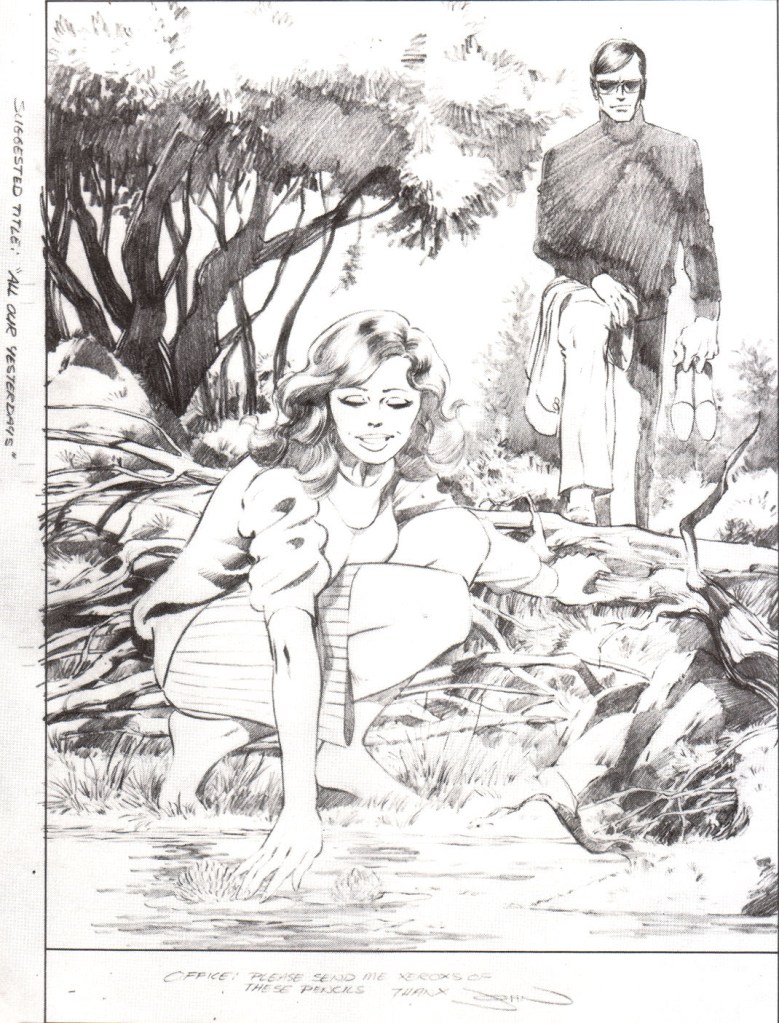
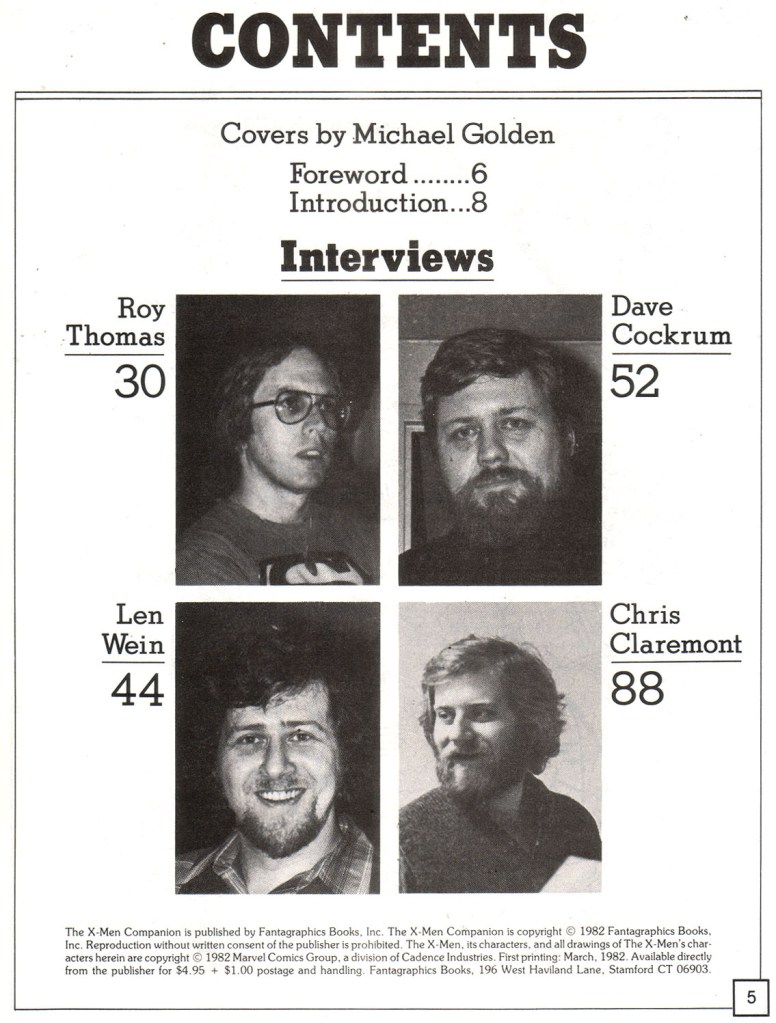
Behind a lovely and dramatic cover by Michael Golden, the book opened with a historical overview of the series written by Sanderson, then segued into interviews with four of the principle creators on the title: Roy Thomas, Len Wein, Dave Cockrum and Chris Claremont. The latter’s long interview was broken in two, with the second half slated to be published in the follow-up volume, along with an interview with artist John Byrne. Additionally, this volume reproduced a number of panels and pages from the unused and discarded ending to UNCANNY X-MEN #137, which were amazing to see. I can remember using these pages to try my hand at doing inking samples. Terry Austin didn’t have much of anything to worry about.
The whole publication was really a treasure trove of information about how a comic book series was conceived and executed and how the various writers, artists and editors thought about the job and the work they were producing. I read it cover to cover again and again, and looked forward to the second volume appearing. Which it eventually did, also late, far more so than the first. It sported a cover by Gil Kane rather than the Neal Adams image that had been promised–Kane was a good friend of Fantagraphics publisher Gary Groth, and so it’s likely he stepped in to help Groth out when Adams’ cover never materialized for whatever reason. But I didn’t care. Just like the first book, the second volume was also a treasure trove of insightful information. And especially so many decades later, these two volumes are invaluable as a testimony as to the origins of these characters and storylines, as al parties involved’s memories would have been years fresher in 1982 than in subsequent recountings of events.
 The Tom Brevoort Experience
One of the great things about online comics discussion is reminding me that other fans have completely different frames of reference as to what was new, what was current and what was before their time.
LikeLiked by 1 person
That is a fine cover by Michael Golden. I think I see his influence on Art Adams, that Adams has mentioned in interviews. Maybe Pat Broderick’s, too, though I’m unsure if Golden or Broderick was published first. And possibly on Bill Willingham, since I think Willingham’s style resembles Golden’s a bit.
The only other X-Man missing that I consider essential for my ideal roster is Rogue. This cover likely predates her joining the team. Golden drew her in that 1981 Avengers Annual.
Wolverine’s green boots can serve as tribute to Rogue’s usual green costume.
LikeLiked by 1 person
The X-Men Companion was the model I used to do my own Companion books, decades later. Read it over and over and over again. Didn’t even know there was a second one until many, many years later!
LikeLiked by 1 person
Yes, this book was a treasure trove of amazing information. But for me, reading as someone who lived life at that time vicariously through the X-Men, it was a lens providing me a true glimpse into the minds of those who had created those wondrous comics. Upon my first time reading through Volume 1, a few weeks before graduating from college in 1984, it almost seemed forbidden fruit to read the opinions of people who I had all but deified in my young mind. Of course, as I realized even months later, each individual was as human as I with a variety of opinions and egos as well. Ultimately, both this volume and the next brought these talented professionals to a level where I respected them no less but understood them even more.
And of course, I no longer have either volume, lost somewhere over the decades amid several moves.
LikeLike
I don’t think X-MEN was the most popular book in the DM at the time, not in terms of actual unit sales, but it was the hottest, the buzziest, and therefore the best choice for a book like this.
I had a copy of this, too, though I didn’t pay for it — this was shortly after I decided I was done with X-MEN forever (a decision that didn’t quite last), but I still wound up with the book, so maybe I was given one. Pretty sure I still have it.
Anyway, I read it with interest, because I was fascinated by the behind-the-scenes stuff (that was the year I broke in, and I had a lot to learn), and very interested in all the material about the X-Men before the point I’d soured on the book. Even the stuff about the material after that was interesting because of all the procedural stuff.
I remember hoping Fantagraphics would do other books, like, say, an AVENGERS COMPANION or a DAREDEVIL COMPANION. But I can understand why X-MEN was the top choice.
LikeLike
Pretty sure it was Chris Claremont (although it might have been Jim Shooter) who once said that when Paul Smith became the X-Men artist, that was when it became Marvel’s top book. That whenever the X-Men switched artists, the sales increased. So from Cockrum to Byrne, they went up, then up again when Dave came back, then up again when Paul Smith took over in very late ’82. Which means it was most likely ’83 when X-Men took the top spot, roughly a year after The X-Men Companion was published.
LikeLike
Glen Cadigan–
X-MEN became the top-selling color comic book in North America during the 1980-1981 sales year. That year covered about the last eight or nine issues of John Byrne’s run, with the balance right after it. Those Statements of Ownership don’t lie. Just remember they reflect sales information for issues published about 9-21 months prior.
I don’t know what Jim Shooter or Chris Claremont may have said. I do know John Byrne habitually claims the book became the top-seller during Paul Smith’s run. Assuming this is an honest mistake, it’s because he’s erroneously reading the Statements of Ownership as covering a later sales situation than they do. (Byrne left the title about a year before Marvel instituted back-end payments and began sending creators sales statements. He’s looking at the Statement of Ownership info.) However, I’m not sure of Byrne’s good faith here. He does not look back on his time on X-MEN fondly, and he clearly resents those comics defining his career to the degree they do. He has personal incentive to belittle their success.
I don’t think Kurt Busiek is wrong about the series not being the top-seller in the DM when the first X-MEN COMPANION was published. The top-selling comic in the comics stores at the time was probably DAREDEVIL, which was near the end of Frank Miller’s initial run. The early issues of NEW MUTANTS were around this time, too. The speculation boost may have had them outselling the contemporaneous X-MEN issues as well.
LikeLike
Back in 1990, in my waning days in the Direct Sales Department, Ralph Macchio was considering firing Ann Nocenti from DAREDEVIL, and asked me to do a sales report on DD during her time. I did, and for added context, went back all the way to somewhere in the early-mid-stages of Miller’s first run.
I was surprised to see the DD had only broken into the top ten books at Marvel once, and I can no longer remember whether it was very late in the first run or during the Born Again run. But it was a jolt; I’d have expected different.
I can’t remember at this point whether I was compiling direct-only numbers or total sales numbers; the DM was a fairly small percentage of sales during Miller’s first run, so if it was total sales, the DM numbers would have been, not a negligible part of it, but easily and substantially outweighed by the newsstand sales.
[The results of the sales chart on the Nocenti run were that the book was in decline for her entire run, despite the great reviews. There would be sudden upward spikes whenever a popular guest star or crossover event happened, and then the book would drop down to slightly lower than it had been before, and continue its march downward. By the time her run ended, I was gone from the sales department, so I don’t know whether it reversed its fortunes under Dan Chichester, but at a guess I don’t think it did.]
LikeLike
That’s curious.
My Statement of Ownership research shows Daredevil being a midlist Marvel title saleswise during the 1985-1986 sales year. The “Born Again” storyline didn’t appear to generate any big sales boost. As I recall, the “Born Again” back issues didn’t command unusually high prices back then, either.
But sales for Miller’s first run during its final year appear quite good. It was ninth among reported titles during the 1981-1982 sales year, and fourth by sales-year’s end. For the 1982-1983 sales year, the first half of which was Miller issues, it ranked only by X-MEN among reported titles.
LikeLike
I was looking at Marvel’s internal sales records.
What relationship they had to the Statement of Ownership numbers, I don’t know, and I don’t have the supporting data to say which is more accurate. I would tend to assume that internal numbers were truer, but…assumptions are assumptions, not proof. But for the whole run I compiled and put into a chart for Ralph, the book only cracked the top ten once.
Like I said, it wasn’t what I’d have expected, from the perspective of a reader looking at how the book were received, but it’s what that particular data said.
LikeLike
I’m all for debunking fan lore when it needs to be debunked.
And there’s fan lore with Miller’s DAREDEVIL that I can get behind debunking. The “Born Again” storyline didn’t significantly boost sales during its run, for example. Others would be that, shortly after Miller took over the writing during his first run, the decision to bump the book from bi-monthly to monthly does not appear due to increased sales. The book also does not appear to be a very good seller during Miller’s first run until the final year or so.
But I have to go with the data I have, and it says Miller’s initial run on DAREDEVIL was a top-selling title during its final year. I can show others that data, and I can explain my analysis of it, because those Statement of Ownership filings do need some exegesis.
I don’t doubt you’re reporting what you recall. But from a historian’s perspective, here are my problems with what you’re saying. You can’t show me that data so I can evaluate it. You’re also offering a 35-year-old recollection, and memories play tricks on all of us. And I have official contemporaneous company documentation that contradicts what you’re saying.
I don’t say this to be patronizing. I apologize if it comes off that way. I’m just following the rules of historical research I was taught in graduate school.
Let me close by acknowledging an error in an earlier comment. I remembered this X-MEN COMPANION book being published towards the end of 1982. It was actually published in March. As I said, memories play tricks. THE NEW MUTANTS series wouldn’t start publishing until over six months afterwards.
LikeLiked by 1 person
I’m not trying to debunk your comments, just offering a perspective. That’s why I pointed out that I can’t confirm which set of data is more accurate.
I’ll also note that not making it into the top ten of what Marvel was publishing isn’t the same as being a poor seller. Marvel was doing pretty well in the early 80s, and if DD was, say, the number-12 book in a particular month, it was doing well. Much better than before Frank got there.
My understanding was that Frank’s big win in his first run was that he transformed DAREDEVIL from a weak seller into a solid seller, but not all the way to being a top seller. An impressive performance, even if it didn’t beat out Spider-Man.
But again, this is an observation, not verifiable data.
LikeLike
“Those Statements of Ownership don’t lie.”
There’s a great quote from Dick Giordano in Comic Book Artist # 1 about sales figures. He’s talking about when he was an editor at DC in the sixties, but it’s worth keeping in mind:
“I wouldn’t take the Publisher’s Statement numbers to church. I’m not sure where they came from but I’ll tell you one thing I know for sure-because I can’t get in trouble. At Charlton, they just made them up.”
https://twomorrows.com/comicbookartist/articles/01giordano.html
I’m not sure how much more different Marvel was from its competitors, but I would look at Statements of Ownership like tax returns: maybe they’re accurate, maybe they’re not. I think a lot of estimating went on because it wasn’t worth the bother to do all the work. It’s not like the post office was going to audit them; they had comic books to put out and they wanted to get home in time for dinner. As long as it was close enough for government work, it was fine by them. A company’s internal sales data would be more reliable.
LikeLike
Dick’s not the only person to have said the Statements of Ownership were unreliable, but I think most of the people who said it were talking about the 1960s or early 1970s, and I don’t know if it was widespread, or if it was true by the 1980s.
Plus, while I’d agree that internal sales documents would be more dependable, I can’t offer any — any my memory of them can’t be substituted for the real thing. I’m very clear on what I saw — I can’t remember the numbers, but I remember being surprised by finding out what I did, so that’s the part that stuck — but by the time I say it now, it’s hearsay.
I’d make a rotten historian — I’m fascinated by the history and have been mentally gathering information for 50 years or so now, but I haven’t kept notes and I often couldn’t tell you where I learned something, whether it was in an interview or a conversation or gossip, and I don’t have organized archives to check. So I’m a source of anecdotes, for the most part, not hard data.
This anecdote, I’m very sure of what I said, but I’m also clear about the limits of what I said (and saw). So while I could swear to it in a court of law, no one else has to take my word for it.
If that memo to Ralph were to turn up somewhere, that’d be supporting data, but I doubt Ralph saved it, and I have no idea what the sales department would have saved, after all this time, but I bet it’s limited to things deemed crucial.
LikeLike
To paraphrase Dick Giordano:
“Back when I was working for a comic-book publisher that was a money-laundering front for organized crime, we used to falsify the books!”
Marvel was never like Charlton. It was never a mob front. In the 1980s, it was operating in the world of publicly traded parent companies, investment-bank loans, and so forth. They would not knowingly report inaccurate numbers to the government in sworn affidavits.
The Statement of Ownership numbers can be expected to match those on internal documents. That’s a major reason why I’m skeptical of Mr. Busiek’s recollections.
The Statement of Ownership numbers impeach Mr. Busiek’s recollections, not the other way around.
Documents are to be trusted over recollections, especially when both are decades old.
LikeLike
growing up, I was all for all the supplementary material I could get: the journal, amazing heroes, comics interview, comics scene, cbg and the rest.
LikeLike