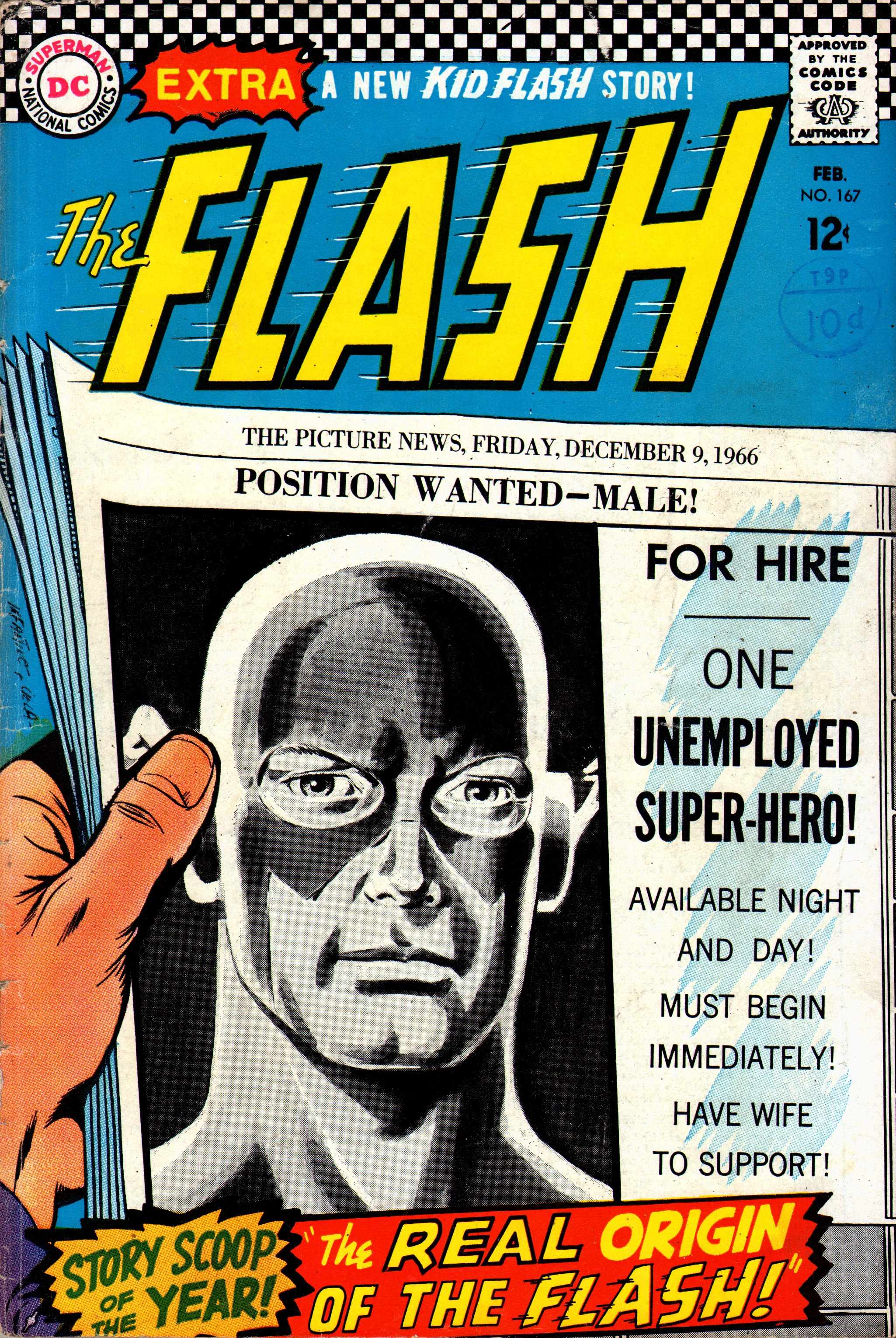


One of the more overused concepts in comic books in the 1980s and 1990s was that of “Everything You Know Is Wrong”; which is to say, some new revelation is about to change some or all of the fundamental beliefs about a particular character’s backstory or origin. This trope gained popularity after author Alan Moore completely overhauled Swamp Thing, revealing that the titular creature wasn’t actually a transformed Alec Holland at all, but rather a newly-born plant elemental with Holland’s memories. This change opened up all sorts of new avenues for the character, and Moore’s skilled, literate writing made the series wildly popular. And so, inspired, other creators began to attempt similar transformations on other characters, with mixed (and typically lackluster) results. But that wasn’t the first time that such an overhaul of a character’s formative history had been attempted. Not, the first such story appeared unheralded in THE FLASH #167 in 1967.
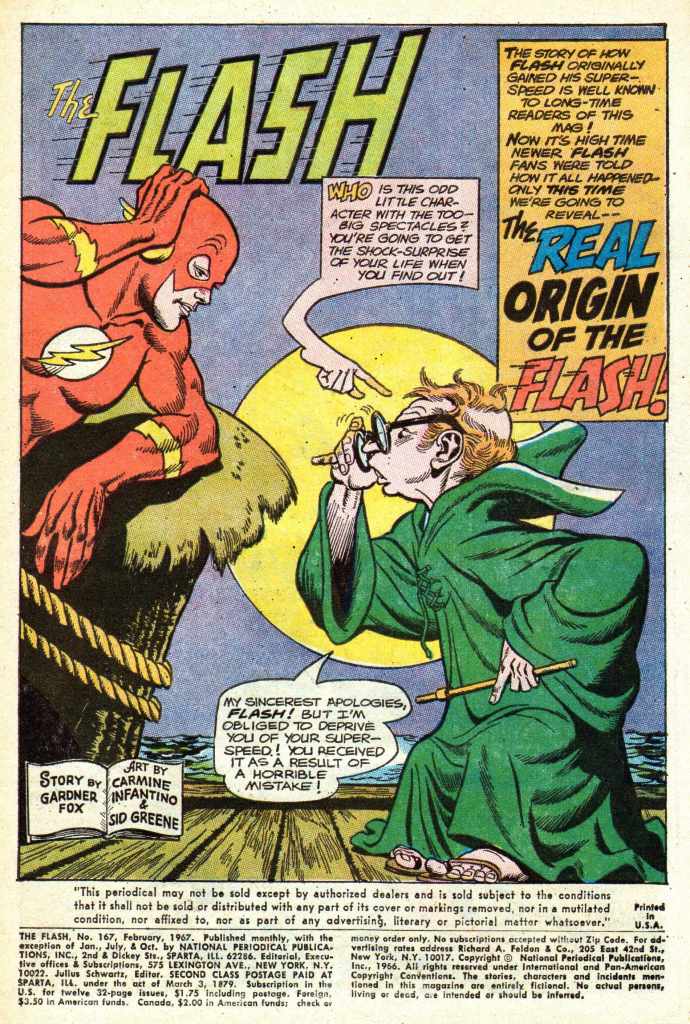
The story was written by Gardner Fox, who originated the first Golden Age incarnation of the character, working here under editor Julie Schwartz. The artwork was delivered by FLASH mainstay Carmine Infantino, here inked by Sid Greene. It’s anybody’s guess what motivated this story and what these creators were thinking. This being the Go-Go Checks era, I suspect that the “camp” influence of the 1966 BATMAN television series may have played a part in germinating this tale. But at around this time, possibly in response to the encroachment of Marvel on sales or a general downturn in the business, a number of strange and premise-shaking stories began to turn up in Julie’s titles. This is still well within the bounds of the Silver Age of Comics and wasn’t a latter day revision–this was very much the work of people who had been working on the character for a long period of time. And yet, it’s a staggeringly dumb story from end-to-end.
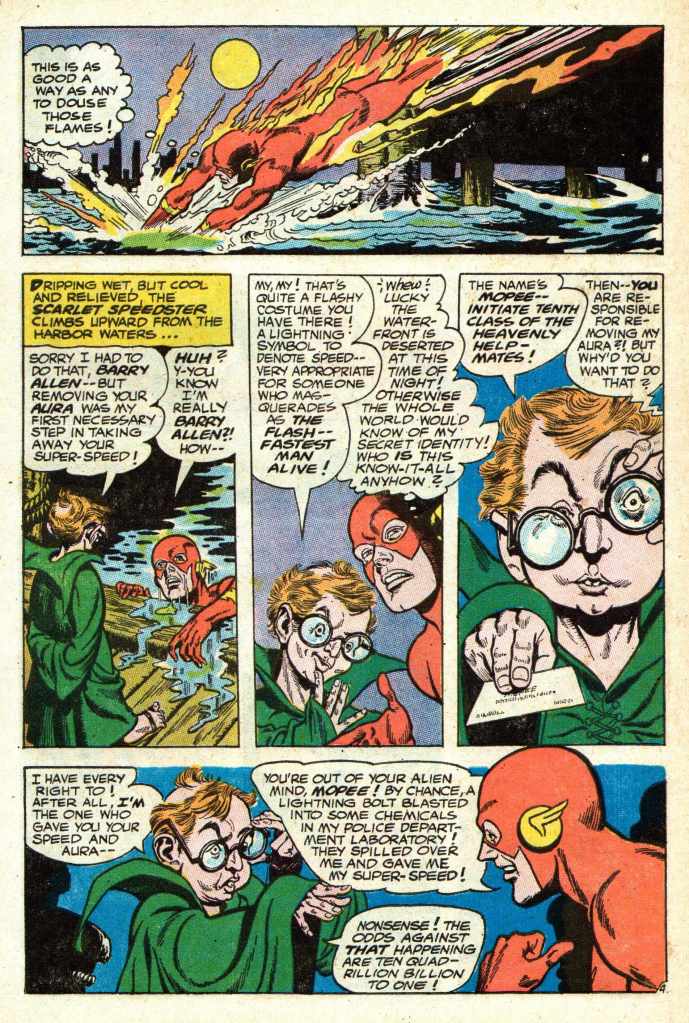
The story opens ordinarily enough, with the Flash getting the jump on a ring of jewel smugglers that he’s been after. Following a page or two of super-speed action, the Flash finds that he’s beginning to overheat. The protective aura that absorbs the friction of the use of his super-speed has stopped functioning. After taking a quick dip in the water to cool himself off, Flash finds himself confronted by a strange little man as he emerges from the waves. This purportedly comical figure with too-large glasses and a balding hairline introduces himself as Mopee of the Heavenly Helpmates, Initiate Tenth Class. And he tells the Flash that he’s come to eliminate the Flash’s super-speed because a mistake had been made when Mopee caused the accident that gave the Flash his powers in the first place. Mopee is clearly meant to be a bit funny, but he comes across instead as just being dumb.
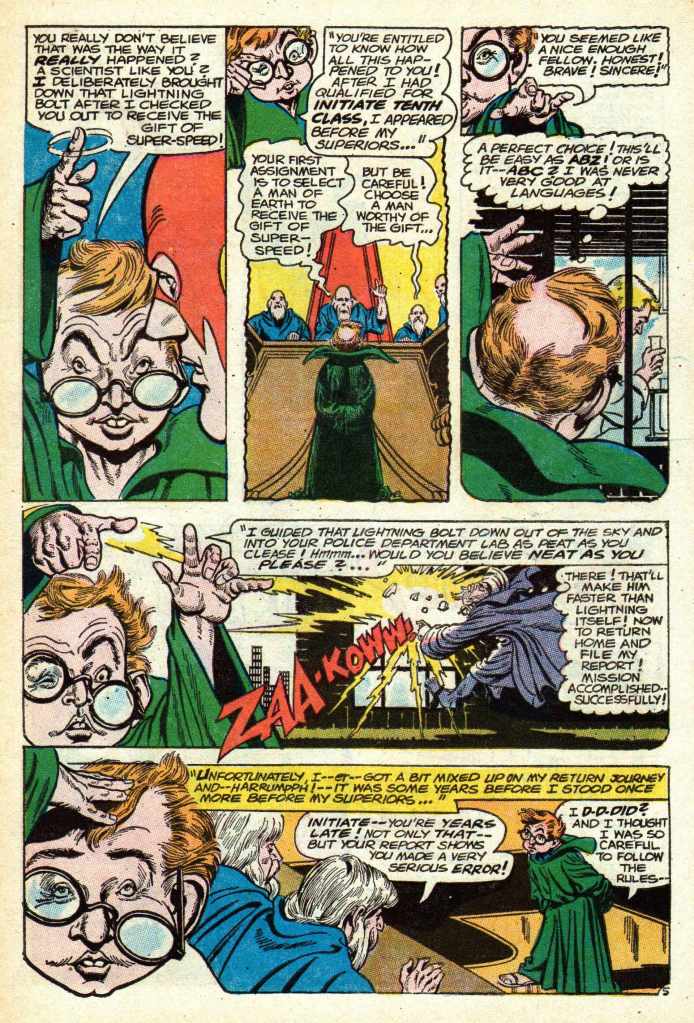
Mopee explains that as a Heavenly Helpmate–kind of a guardian angel–he had been ordered to descend to Earth and grant some lucky individual super-speed abilities. He chose Barry Allen, seemingly at random, and generated the lightning bolt that struck Allen and the chemicals he was standing in front of, the resulting discharge giving him his vibrational powers. But upon returning to his own dimension, Mopee was told by his superiors that everything used in the granting of such powers must belong to the giftee–and so, since Barry was working at the crime lab, he didn’t really own those chemicals he was doused with, and so his super-speed must now be taken away again. Flash actually considers this for a moment. He’s only just married Iris West, so the prospect of living a regular life is appealing to him. But in the end, he decides that he needs to keep his speed in order to help others, and asks Mopee if there’s some way that can be arranged.
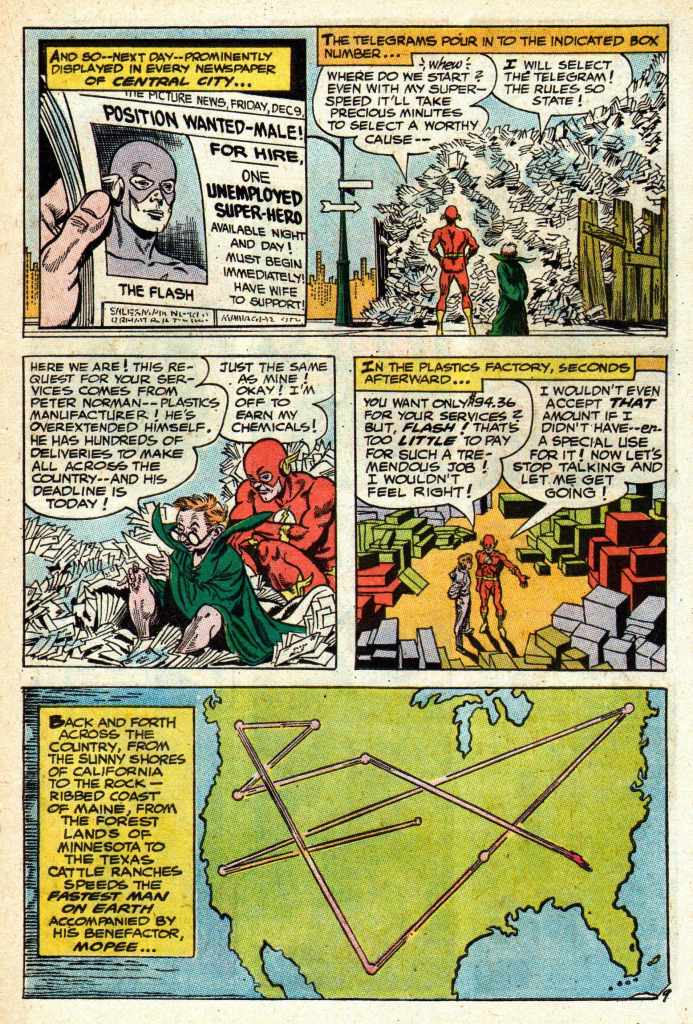
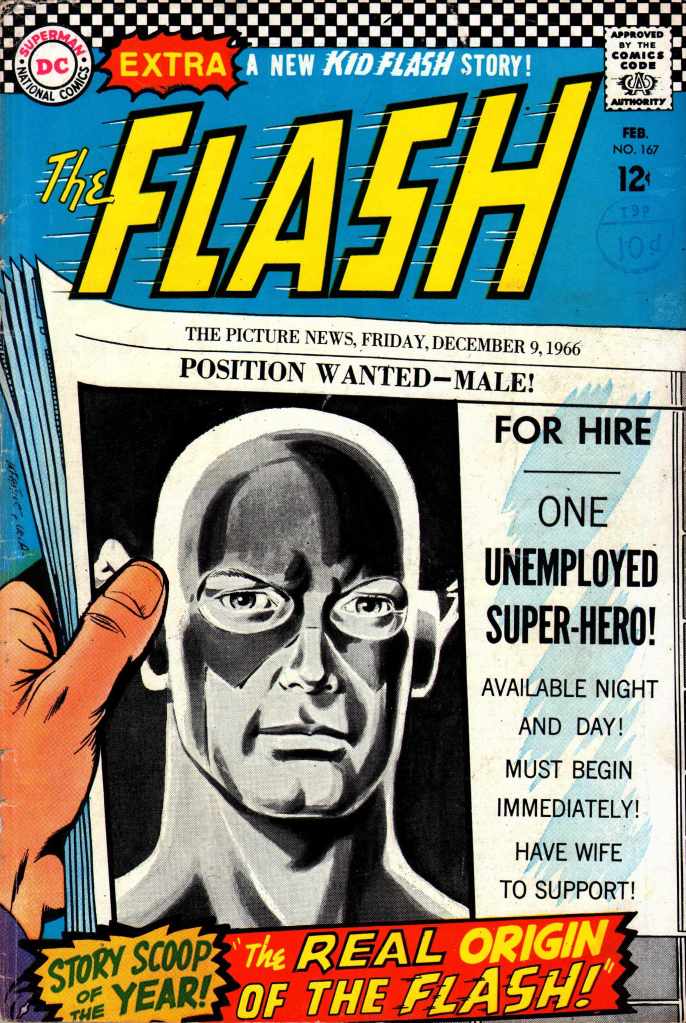
After looking it up in the Heavenly Helpmate charter, Mopee tells the Flash that if he can earn enough money to buy a replacement set of chemicals within 24 hours, Mopee can repeat the original process and renew Flash’s powers. He also restores Flash’s missing speed-aura for the duration. In order to justify the cover (which was undoubtedly created before the story, as was the manner in which Schwartz often worked), Flash and Mopee place a situations wanted ad in the local paper so that he can earn the needed cash as the Flash to fulfill the bargain. The specific situation that Mopee chooses from the responses–helping a manufacturer deliver a number of parcels all across the country–winds up by unlikely coincidence being a front for the jewel smugglers from the opening to disperse their ill-gotten gains, so Flash takes a page or two out to clobber and curtail them before making his fateful purchase.
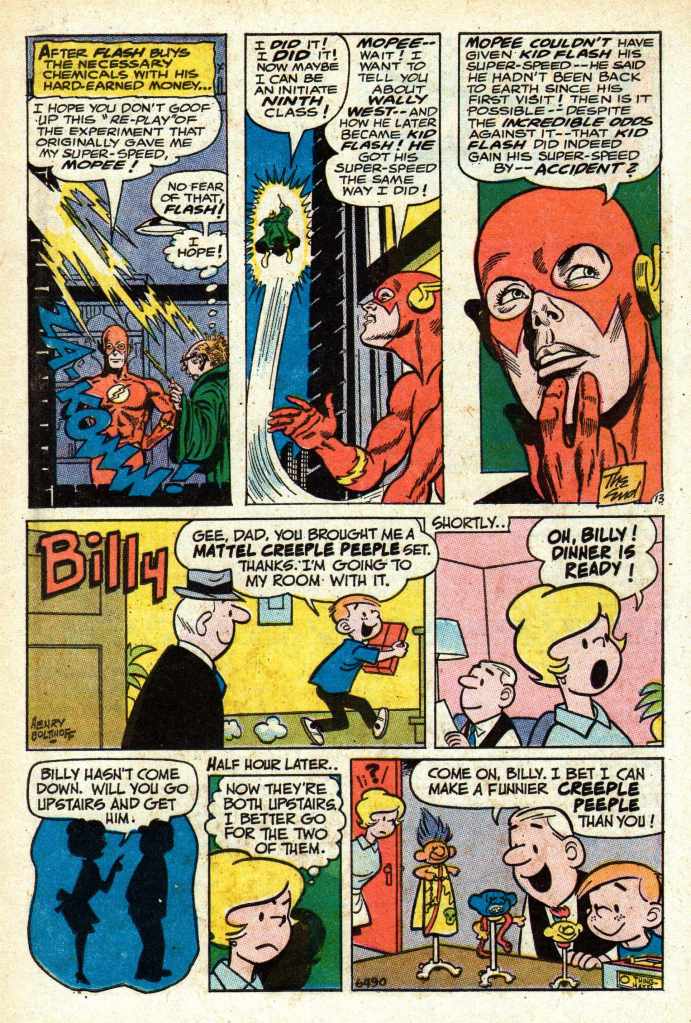
And that’s pretty much it. Flash and Mopee re-stage the original accident that empowered the Flash, and then the Heavenly Helpmate goes on his way, now hoping to be promoted to Initiate Ninth Level. And Flash realizes that as unlikely as his origin was, it actually happened to somebody else–Wally West, Kid Flash. But as startling as this story was, it was immediately ignored by everybody involved, audience and creators alike. It would be decades before it would ever even be referenced again, and there it was done to make a joke out of it. Collectively, everybody who experienced this issue unanimously decided to ignore its events completely–which was certainly for the best, as absurd as the Flash’s origin might be, getting his super-powers from an awkward angel was even more ridiculous. It turned out that Everything We Knew Was Wrong was, in this instance, Wrong.
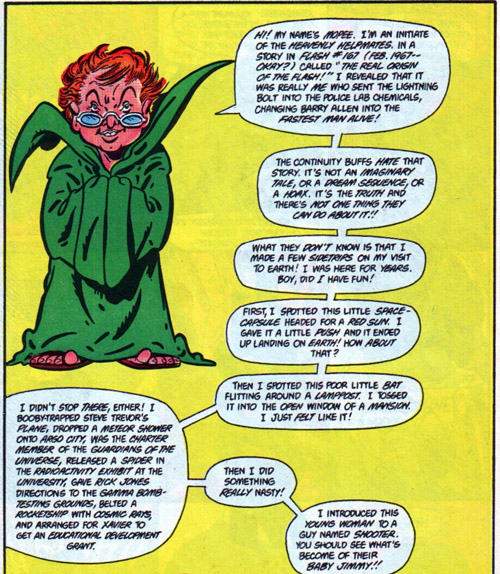
Mopee would turn up for a one-page cameo in AMBUSH BUG #3 in the mid-1980s courtesy of Robert Loren Fleming, Keith Giffen and editor Julie Schwartz. At the time, some twenty years later, most readers were entirely unfamiliar with the story in THE LFASH #167. But that didn’t prevent Given and Fleming from making a mockery of it. Just desserts.


I thought that Frank Miller might have made changes to Daredevil’s origins ( That his powers weren’t mutation but mystical ), but Google AI Overview says: While Miller left the original radioactive truck accident intact, he altered how Matt Murdock came to master his condition -(1) THE INTRODUCTION OF STICK: Miller introduced Stick, a blind martial arts master who took a young, overwhelmed Matt Murdock under his wing. (2) LEARNED DISCIPLINE –Through Stick, Miller suggested that while the radiation heightened Matt’s raw biology, his actual “radar sense” and ability to function without sight were LEARNED SKILLS developed through rigorous ninja mental training. (3) THE PROXIMITY SENSE –Miller wanted to ground Daredevil’s abilities, reframing the radar sense less like an abstract superpower and more like the realistic “proximity sense” that real-world master martial artists claim to possess.
LikeLike
Claim is right on the so-called Proximity Sense, more like they pulled a Buffy the Vampire Slayer when she fought that Invisible Girl ( Out of Mind, Out of Sight –season 1 episode 11 ) or a snowblind Iron Fist vs. Sabretooth [ Iron Fist#14 ( August 1977 ) ] and just listened.
LikeLiked by 1 person
Stan Lee and Jack Kirby beat this New Flash Origin by 2 years with their Marvel Age retelling of Captain America’s Origin [ Tales of Suspense#63 ( March 1965 ) The Origin of Captain America! Professor Reinstein renamed Dr. Erskine here ] making him more a U.S. government prototype to a Universal Soldier ( 1992 film ) and not a prototype to Project Olympus ( government created superheroes answerable to the President ) [ The Defenders#126 ( December 1983 ) –failed attempt at one was Leviathan renamed Gargantua ( Dr. Edward Cobert ) ] like his Timely Comics Origin said he was suppose to be ( The First of a Corps of Super-Agents. We shall call you Captain America, son! ) [ Captain America Comics#1 ( March 1941 ) Captain America 1st story –Case No. 1. Meet Captain America ].
LikeLike
I think a proper “Everything You Know Is Wrong” story isn’t just a revision to an origin, but a story where the earlier version is acknowledged as it’s overturned. The Swamp Thing was devastated to learn he wasn’t Alec Holland, Barry Allen in this story is surprised to learn that his origin isn’t what he thought it was, etc.
If you just retell a story and change the details, that’s a retcon, but an EYKIW story needs to say, “You may have thought X was true, but it’s not!” And the characters probably need to have thought X was true as well.
LikeLiked by 3 people
Add Namorita following in Swamp Thing’s footsteps, when Namor finds out that Namorita is a clone( If I remember right, she was altered to not look identical ) of Namora [ Namor the Sub-Mariner#19 ( October 1991 ) & 20 ( November 1991 ) when Namor told her ] when he and Namorita thought she was Namora’s daughter. This part isn’t about the character finding out a truth, but both John Byrne and Roy Thomas ignoring Namora’s comic history was undone: The Order#6 (18) ( September 2002 ) — Namora as a young teen with Ankle Wings and Caucasian Skin ( Both historically accurate with Timely and Atlas Comics and contradicting John Byrne and Roy Thomas ) — I hated Namorita being turned into a clone ( I’m pro-clone if it is done like DC Comics Guardian or the Post-Crisis Superboy ). I can’t remember if the first Agents of Atlas series showed Namora with Caucasian skin when she was younger.
LikeLiked by 2 people
I’d forgotten about that rather dreadful storyline. While overall, I enjoyed much of John Byrne’s run on Namor, I did not enjoy this version of EYKIW. Namorita was a character you liked or you didn’t. Still, she was a distinct character who was absolutely deminished as a result of this poorly considered plot. Good thing that’s the only time Marvel ever misused clones in any other comics! (Kidding!)
LikeLiked by 1 person
Last night I remembered that there was a Captain America story that fits this– BHOC: Captain America#222 ( June 1978 ) Steve Rogers “older brother” Mike Rogers ( son of Walter Rogers ) killed during the Pearl Harbor attack( I assume that was suppose to be Steve’s motive for wanting to enlist in the army — which ignores that Cap was active for most of 1941 before the Pearl Harbor attack ) which was undone in Captain America#247 ( July 1980 ) which revealed the U.S. military used a False Memory Chamber to implant those memories ( Which makes no sense since both of Steve Rogers parents were dead, so why endanger Walter and Elizabeth Rogers after they lost their sons Mike and Grant at Pearl Harbor ) –profile at marvunapp.com .
LikeLike
THE COVER-FIRST METHOD: in 2004, DC Comics published an 8-issue tribute mini-series called DC Comics Presents to Honor legendary editor Julius “Julie” Schwartz after his passing. The project honored Schwartz’s famous editorial habit of commissioning a striking, high-concept cover image FIRST, and then asking writers and artists to build a brand-new story around it. The method of Cover-First was used in Star Trek: Deep Space Nine season 6 episode 13 “Far Beyond the Stars”, Captain Benjamin Sisko experiences a vivid, multi-sensory vision sent by the Bajoran Prophets. As 1950s African-American science-fiction writer Benny Russell during the 1950s the publisher uses the Cover-First Method and he conceives a groundbreaking story about a futuristic space station called Deep Space Nine, led by an African-American captain named Benjamin Sisko — Google AI Overview for both ( There was an EC story the Comics Code tried to stop being reprinted because it had an envoy/ambassador from Earth that on the last page revealed to be “Black” ).
LikeLiked by 1 person
I’ve never heard of that tribute mini. It sounds interesting enough of a concept to hunt it down.
LikeLike
It’s got some fun stuff in it. I got to do a Hawkman story with Walter Simonson!
LikeLiked by 2 people
Oddly, only four of the eight issues are available on DCUI. Luckily, DC Comics Presents: Hawkman (2004-) #1 is one of the four. Beside the Busiek and Simonson story there’s one by Cary Bates and John Byrne. Know I have to read all four.
LikeLike
Kurt, I just finished DC Comics Presents: Hawkman #1 and I really enjoyed “Love in the Air,” your retcon of Hawkman #6’s “The World Where Evolution Ran Wild.” And I got to enjoy yet another Walt Simonson penciled story I wasn’t aware of.
LikeLike
Very glad you liked it. I’ve only gotten to work with Walter a couple of times, but I’ve loved the results every time.
In this one, the story was so tightly-plotted that I wrote it full-script, and it was the first time Walter had worked that way for years, but he said that felt somehow appropriate for a Julie Schwartz tribute. In SUPERMAN 666, we worked plot-style, and I think the difference is pretty obvious…
LikeLike
Kurt, it’s understandable the story was tightly-plotted and written full-script, since you only had 11 pages to work with. The story in Hawkman #6 was 24 pages (actually 23 after discounting the ads).
I like that you used the issue number of the Superman comic to come up with the story idea (or at least I think you did). I really enjoyed the writing and Walter’s artwork on the story. Based on some comics I found in my comic boxes I was buying comics in 2007, so I’m not sure how I missed this issue when it was published. I also see what you mean about the difference in writing style between the two stories.
LikeLike
It’s a fun mini. I particularly liked Grant Morrison’s Adam Strange story.
LikeLike
I guess Kurt Busiek means a story more like the one in Superma#307 ( January 1977 –dc.fandom.com ): Supergirl angrily destroys the bottle ( Bottle City of Kandor ) and declares Clark created the whole Krypton fantasy because he couldn’t face the reality of their true origin: They didn’t come from Krypton. Her father Fred Danvers and his father Jonathan Kent were human scientists that received huge does of radiation as working in an atomic lab. Linda plays a video showing their fathers working in a lab and Clark’s birth as stating Clark and herself are Earthborn human mutants. Superman#309 ( March 1977 ) Supergirl explains it was the Kandorians who cooked up such a scheme. All of them=including her-were growing concerned over his mental health due to his growing obsession with Krypton’s loss.
LikeLike
Well, no, because that turns out to be a hoax.
If what Supergirl told him in that issue turned out to be true, then yes, it’d qualify. But since Supergirl’s lying to him, and by the end of the story two issues later, Everything You Knew Is Right After All, it doesn’t really work.
And Everything You Know Is Wrong story needs to be an upheaval that’s recognizably an upheaval — it needs to acknowledge the earlier status quo as something we and the characters thought was true — but then it tells you the new truth, and it’s meant to be the actual truth.
“The Anatomy Lesson” sets up a new status quo for the Swamp Thing. A story like that Superman story, or like FLASH 300, was never intended to be true; it gets exposed as a fake by the end of the issue or story arc.
LikeLiked by 1 person
I guess that would be the ever changing parents of Quicksilver and the Scarlet Witch; plus their current non-mutant status ( AXIS and Uncanny Avengers storylines in 2014-2015 –Google AI Overview ).
LikeLike
Certainly, the Avengers story that told us that the Whizzer and Miss America weren’t the parents of Wanda & Pietro, and Magda and (Magneto) were would qualify, at least to my mind.
The many revisions to that story, and the de-mutanting of them, I haven’t seen, but I’m guessing they probably fit.
LikeLiked by 1 person
Your comments on Superman #307-309 made want to read the story. I was able to read issues #307-308 on DCUI, but they don’t have issue #309 online, so I’m currently unable to read the conclusion to the story.
At this time I was looking at new issues as they came out at my local pharmacy and I made sure to buy Superman #300. However, I wasn’t a fan of the paper or print quality of DC comics at that time, so I passed on these issues back then.
LikeLike
Thank you for introducing me to this story. I always thought the first The First Time Everything You Knew Was Wrong story was Superman’s new origin in Action Comics #370 (December 1968) 100 Years…Lost,Strayed or Stolen! Similarly ignored and forgotten, but a bit more extreme in the changes; it has stuck with me all these decades.
LikeLiked by 1 person
Just read Action #370 based on your post. That story is some kind of crazy. So they just added an extra 100 years to Kal-El’s life – he lives a full life into senior adulthood and then devolves back to being an infant – and it’s never mentioned again. I’m amazed that DC gave the writers that much leeway to create such a story that is (I assume) considered canon up until Crisis on Infinite Earths.
LikeLiked by 1 person
That was during the Weisinger tenure, so it wasn’t about DC giving the writers “leeway” — Mort ruled with an iron hand.
So it’s quite possible that Mort came up with the story premise, and E. Nelson Bridwell made sure nothing in it would affect anything we knew about Superman prior to the story. I mean, it’s possibly it was Cary Bates’s idea, but it’s equally possible that it wasn’t.
LikeLiked by 2 people
It’s never mentioned again, according to a later letter column, because after publishing it they decided it changed Superman’s origin too much so best to let it die unwept, unhonored and unsung. I blogged about it here.
LikeLiked by 1 person
I also just read Action Comics #370. That story is bad in so many ways. The Supergirl story was likewise pretty bad, but for the cringeworthy dialogue (OK, it was on the cusp of the Seventies and DC was trying to be hip, but still…). On the plus side, I think the artwork on both stories is good. And it appears that DC cleaned up the artwork for this issue before it was put on DCUI.
LikeLike
It bugs me that when Kal’s planet is invaded by aliens, he does nothing but hide. Even given he’s basically an alt.version of the real Superman (and has no powers), it still feels Not My Superman.
LikeLike
such a story is probably easy to forget while youre reading it, yowza. the everything you know is wrong trope only rivaled in its over (and often poorly) used manner by the secret origin of… when youre breaking into the secret history of the curl in superman’s hair or the leather strap handle of mjolnir, you may want to reconsider your approach
LikeLike
It would have been funny if they had treated this as the new truth. A scene of Barry getting Wally to buy the chemicals necessary and then using the treadmill to put those in place of the ones that empowered Wally would have been a hoot!
LikeLike
I’m trying to picture the discussions at DC about this story. “Best way to beat Marvel is to make our stories downright silly. That’ll show ’em!” “Hey, Batman’s eating up the ratings and that has to be due to the camp stories and not at all because of the actors involved!” “That cover could be a story with Mirror Master or Gorilla Grodd. But I know our audiences are clamoring for completely nonsensical retelling of the Flash’s origin.”
Then there’s what more likely happened. “Gardner, there’s only one way you can pay off your debt from our monthly Poker game.”
LikeLiked by 1 person
I doubt that anyone involved considered this a serious change to the status quo, or worried about the implications going forward. I suppose if this issue had sold surprisingly well, they might’ve revisited Mopee and tried to make him make more sense. But as it is, I’m sure Gardner Fox completely forgot about him the moment the script left his typewriter. The Kid Flash loophole mentioned at the end gives them an “out”: Why should we believe anything Mopee says? He might be delusional, or just pulling a prank, ala Mr. Myxyzptlk.
LikeLike
I bought this issue when it came out, & while it was obviously bafflingly stupid, that last line about Kid Flash was a bit of a standout. For some reason, Schwarz tried stuff like this in The Flash now & then, like early on in the series when they tried to modernize Golden Age Flash comedy sidekicks/Three Stooges knockoffs Winky, Blinky & Noddy, or a later backup “Doorway To The Unknown,” a ghost story that, while interesting, was way out of step with the “religiously” science-based Flash stories. Mopee was obviously supposed to be whimsical, but why anyone might think him an “antidote” to the onslaught of Marvel Comics I couldn’t begin to guess. He was like a billboard declaring The Flash comic was intended only for very young children – who likely wouldn’t’ve begun to understand anything about the issue anyway. You’re almost certainly correct about the cover having been created first. I’ll give them the benefit of the doubt & assume everything else was the result of deadline crunch, (If John Broome had written it, I’d’ve chalked up to pot.)
But you have to admit: Barry Allen getting his Flash powers from being struck by a random array of lightning-doused chemicals (& I’d’ve much rather they stuck with that than gone with the later invocation of “the Speed Force,” which I always considered Mopee in new clothes) is no sillier than Golden Age Flash Jay Garrick gaining his Flash powers from inhaling fumes from “heavy water”…
LikeLiked by 1 person
Or Don Blake finding a random stick in a cave that turns him into Thor. Or Matt Murdock getting powers from radioactive ooze when everyone knows it turns you into a ninja turtle. Origin stories are like that.
I love the Speed Force as an origin expansion.
LikeLike
It’s the venerable Lab Accident origin, of which the most famous is “bitten by a radioactive spider”. Sadly, writers seem to be moving more and more to just Born That Way (mutant/metagene), which loses something in my view. Though a problem is that as the audience became older, there’s more of a world-building issue as to why in-universe there’s not e.g. more people irradiating spiders and subjecting themselves to bites to see if they could get superpowers too. Even with a very high chance of death, a lot of people would still risk it – or could be made to risk it.
LikeLike
I remember Sparx’ family in DC all knew they had a high-functioning metagene so young family members were prone to jumping into toxic waste or similar stunts to see if it would kick in.
LikeLike
I bought this issue when it came out, & while it was obviously bafflingly stupid, that last line about Kid Flash was a bit of a standout. For some reason, Schwarz tried stuff like this in The Flash now & then, like early on in the series when they tried to modernize Golden Age Flash comedy sidekicks/Three Stooges knockoffs Winky, Blinky & Noddy, or a later backup “Doorway To The Unknown,” a ghost story that, while interesting, was way out of step with the “religiously” science-based Flash stories. Mopee was obviously supposed to be whimsical, but why anyone might think him an “antidote” to the onslaught of Marvel Comics I couldn’t begin to guess. He was like a billboard declaring The Flash comic was intended only for very young children – who likely wouldn’t’ve begun to understand anything about the issue anyway. You’re almost certainly correct about the cover having been created first. I’ll give them the benefit of the doubt & assume everything else was the result of deadline crunch, (If John Broome had written it, I’d’ve chalked up to pot.)
But you have to admit: Barry Allen getting his Flash powers from being struck by a random array of lightning-doused chemicals (& I’d’ve much rather they stuck with that than gone with the later invocation of “the Speed Force,” which I always considered Mopee in new clothes) is no sillier than Golden Age Flash Jay Garrick gaining his Flash powers from inhaling fumes from “heavy water”…
LikeLike
I have to figure that Mopee was inspired by Clarence Odbody, AS2 (Angel Second Class), the bumbling angel from IT’S A WONDERFUL LIFE.
It’s not an awful idea for a throwaway story, had it been produced by creators who were better at being funny. But not a good addition to FLASH canon either way. Oddly, if you mentally assign it to Earth-B, like Bob Haney’s BRAVE & BOLD stories, it fits in just fine.
LikeLiked by 2 people
Oh, and I wouldn’t be surprised if the story had initially been sparked by fan mail pointing out how staggeringly unlikely the Flash’s origin was, and Julie (or Fox) decided to plug that plot hole.
LikeLiked by 1 person
I had not thought of the beloved Clarence from that wondrous holiday classic. Each year after we have had dinner and everyone has left, my wife and I still fix a nice Christmas drink and watch “It’s a Wonderful Life.”
LikeLike
I immediately thought that Mopees was inspired by Angel Second Class Clarence Odbody from It’s A Wonderful Life. But Mopee has a long way to go before he gets his wings.
LikeLiked by 1 person
As a kid (and adult) I loved the version of the Flash with his time-travelling treadmill and the ring with the expanding costume. Very much enjoy Carmine’s work on The Flash , Black Canary and Spiderwoman.
LikeLike
DC’s 80s Secret Origins revival really took that concept and made some great stories with it. It’s been ages since I last read it, so I don’t know how well it holds up, but Secret Origins Annual #2 (1988) was an absolutely brilliant reimagining of the Barry Allen Flash’s origin, with a great Wally West story as well.
Pretty viciously funny punchline with that Ambush Bug Mopee panel. I remember his character specifically from that appearance – it was nice seeing a bit of his original appearance here – but wow that was harsh.
LikeLiked by 1 person
The evolution of Thor might be a borderline case big enough for “Everything You Knew Was Wrong”. Initially, Doctor Donald Blake finds a magic artifact, which when invoked, grants him what I call magic skin armor. But he’s still the same person with the “power of Shazam, err, Thor”. However, this is then changed, that Donald Blake was never a real person, just a fake identity that Odin created in order to teach a life lesson to his son, Thor, a god.
The shift from Donald Blake’s a real person wearing armor, to a god is being turned into a human – and that’s status quo for a long time – seems to me to pretty big if you think about it. It means all of “Donald Blake” pre-creation life was either something Odin fabricated in terms of records, or enchanted so nobody cared about.
LikeLiked by 1 person
I always figured this was a practical joke by Green Lantern.
LikeLike
Oh man, Don Blake…! What a can of worms (or should I say “serpents”) the revelations about his actual existence opened up! What do you all think? Retcon or “EYKIW”?
LikeLiked by 1 person
I think Don Blake was less “Everything you know is wrong” and more “We don’t know what’s going on; explain it already.”
By the time they explained that Don Blake was a construct of Odin’s, they had so thoroughly contradicted the idea that Blake was just some guy being granted the power of Thor(r) that I don’t think it really counted as “everything you know” anymore. What we knew was that Thor was the real deal, so what the heck was Blake? And Lee and Kirby explained away the plot hole, but it didn’t overturn our understanding of the character, since we’d known he was the real Thor for years by then.
I say “we,” but I didn’t start reading THOR until late in the Conway run, so perhaps “they” is more appropriate.
LikeLiked by 1 person
Rereading that era, the weird thing is that Don Blake never contemplates being an illusory person—Stan and subsequent writers treat him as if he were Billy Batson to Thor’s Big Red Cheese.
LikeLike
I started reading Thor around #150, and I thought that Blake was just Thor’s secret identity, not really giving much thought as to how or why he became a doctor. When #158 came out explaining that is was Odin’s doing, it made sense.
LikeLike
I suspect Gardner Fox was shown the cover design to write a story around and had absolutely no idea what to do.
LikeLiked by 1 person
Another issue I never came across at Dunham’s Used Books, and I’m glad I never did. I just read it on DCUI and it’s not very good. Even if you enjoy the less serious DC stories of the time, which I do, this one is on the not good side.
I also read the Kid Flash backup story, which was also humorous in nature, but a fun read. I also learned that Blue Valley, which was the setting for the TVs series Stargirl was the hometown of Wally West.
I also want to say I’m pleased DCUI had the issue online. Unlike most older issues I’ve read there it hasn’t been restored.
LikeLike
It was nice to find out Fox’s powers were not absolute and he was merely mortal like the rest of us. I get the feeling this was one of those Cover First stories Julie was so famous for.
LikeLiked by 1 person
I seem to recall that Barry‘s 1985 Who’s Who entry felt the need to disclaim this story.
LikeLike
Would “The First Batman,” revealing Joe Chill was a hitman targeting the Waynes rather than a random shooter, qualify as Everything You Know? It doesn’t change events but it does change the context (and while rarely mentioned, it did stay canon).
So many Everything You Know stories are dreadful. Captain America was hidden in a government facility, not frozen in ice by accident. Spider-Man was enchanted by a spider-spirit. The Chief secretly engineering the origins of the Doom Patrol (even though that does seem to have become canon). Alan Moore making it work is an achievement.
LikeLike
Did “Evil Chief” ever appear again after Morrison finished his DP run? I had the impression that in Byrne’s “soft reboot” of DP, he just ignored “everything you know is wrong.”
LikeLike
I skipped some Doom Patrols but I get the feeling Chief just drifted back to being a good guy but he stayed an asshole.
LikeLiked by 1 person
In Geoff Johns’ Titans run, we see the DP back together and yes, the Chief is still canonically responsible for what happened but they’ve decided to get past that. A hand-wave to keep him usable. Not sure about more recent incarnations.
Never liked that twist myself, much as I enjoyed Morrison’s run.
LikeLiked by 1 person
Was he the one that killed off Tempest? That was a total waste.
LikeLike
DP Tempest or Garth Tempest? Either way, I don’t know — I never did more than glance at Johns’ Titans.
LikeLike
I only learned Byrne’s take existed when they were wiped out of continuity.
LikeLike
I looked at Byrne’s take. I looked away.
LikeLiked by 1 person
The “unemployed superhero” cover here reminded me of a JLA cover where we see the superheroes walking around with protest signs. What the two comics most have in common is that the cover idea is only justified for a page or so in the story proper, suggesting that Fox didn’t care about the cover schtick and just sought to get it out of the way so he could tell the story he wanted to tell. This pattern is also seen in a couple of Batman covers that come to mind: Batman getting turned into a scarecrow and Robin getting turned halfway into a coffin.
If I’m right that Schwartz just gave Fox the base cover idea, then Fox may bear total responsibility for Mopee. Of course in the forties he did things like Johnny Thunder as well as the Three Idiots. So Fox may have always had a liking for wacky notions, but usually kept that inclination under weaps for the majority of his DC work.
LikeLike
“If I’m right that Schwartz just gave Fox the base cover idea, then Fox may bear total responsibility for Mopee.”
Julie pretty steadily co-plotted the stories he edited — the writers would come in and they’d bat ideas back and forth until they had a story, and then the writer would go off and write the script (or scripts). John Broome used to come in and work up months worth of work and then go off to Paris or somewhere and write them.
So it’s very unlikely that Julie wasn’t involved in Mopee’s story, whoever’s idea it was.
LikeLike
To me the main responsibility for a bad idea is the person who conceives it, even if someone else abets the execution. My recollection of the lettercol for this issue was that two or three letter-writers condemned Mopee roundly: ergo, that suggests that a majority of fans of the period thought he was a pretty bad idea. (I think Schwartz often sought a mix of positive and negative letters to keep fans involved, and thus buying more issues.) Fox and Schwartz were probably just fooling around as they sought to make their deadline for that issue, and I doubt they ever meant for Mopee to return. I just wanted to point out that in the past Fox occasionally showed a little wackier approach to superheroes than did some of his contemporaries.
The situation with cover-ideas parallels at least one anecdote I heard from a Bob Rozakis piece somewhere: that Schwartz told Rozakis to use the pun “Yellow Peri” in a SUPERBOY story, and then let the writer spin off whatever he wanted. Schwartz probably co-plotted that story too, but probably after the writer conceived the base idea.
LikeLike
In a couple of letter columns, Julie (or whoever answered them for him) said they preferred to print letters where the writer made it clear what they thought of the issue in question, good or bad. That fits with what I remember reading.
LikeLike