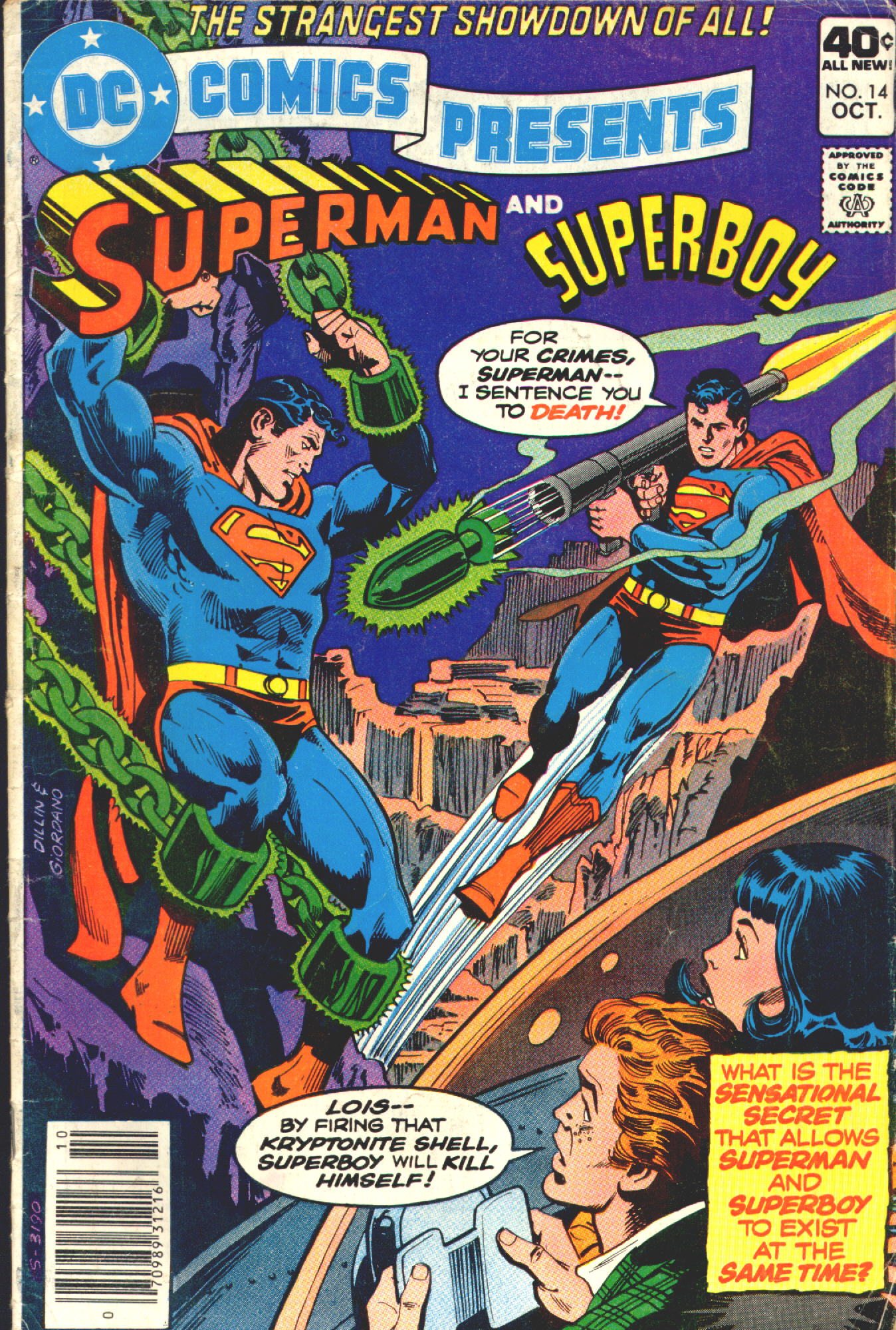


Another new series that I was given access to for the first time was DC COMICS PRESENTS, the Superman-led team-up title that had been launched during the hoopla of the SUPERMAN THE MOVIE film. I was aware of the book, having seen the many ads for its launch issue, which co-stared my favorite hero, the Flash. But no issues ever made their way to my local 7-11. As I’ve mentioned before, that location had stopped getting in any newly-launched series as well as any oversized issues such as Annuals, so that meant that I missed quite a few things if I didn’t inadvertently run into them at some other outlet. But my new Stationery Store location made that a thing of the past. And so I was only too happy to pick up this issue, #14, when it turned up there during one of my weekly trips.
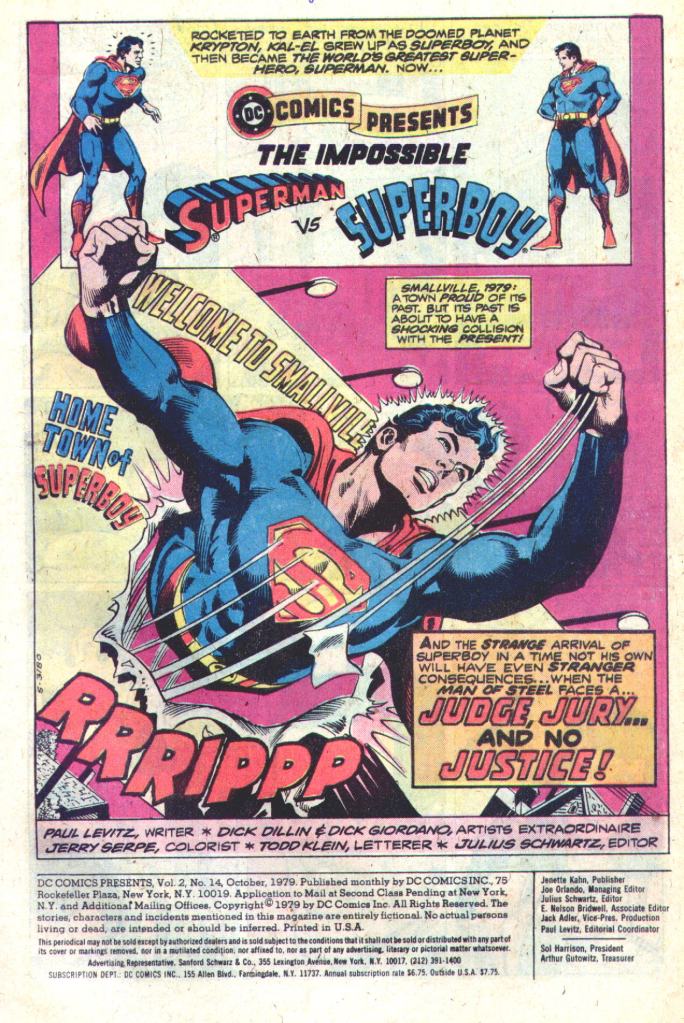
I could tell right away that this was the second part of a continuing story, though it would be literally decades before I’d finally get to experience the issue before this one and find out just how matters had gotten to this point. That said, I had no difficulty picking up the threads of the plot jumping in at this point. And no wonder–this was more of a sequel to last month’s issue than a direct continuation. The work was put together by a reliable creative team: writer Paul Levitz and artist Dick Dillin (whom I knew and loved from JUSTICE LEAGUE OF AMERICA) ably inked by Dick Giordano, all under the watchful eye of my editor of preference, Julie Schwartz. This was the epitome of a DC title of the period, of a sort that was beginning to vanish: consistent, reliable, steady.
After a quasi-symbolic splash page that features Superboy smashing his way through the Welcome to Smallville sign, the action gets under way in Metropolis, where Clark Kent and Lois Lane are attending the trial of the Sidecar Bandits, a bit of minor continuity as the Bandits had shown up in a recent issue of SUPERMAN.
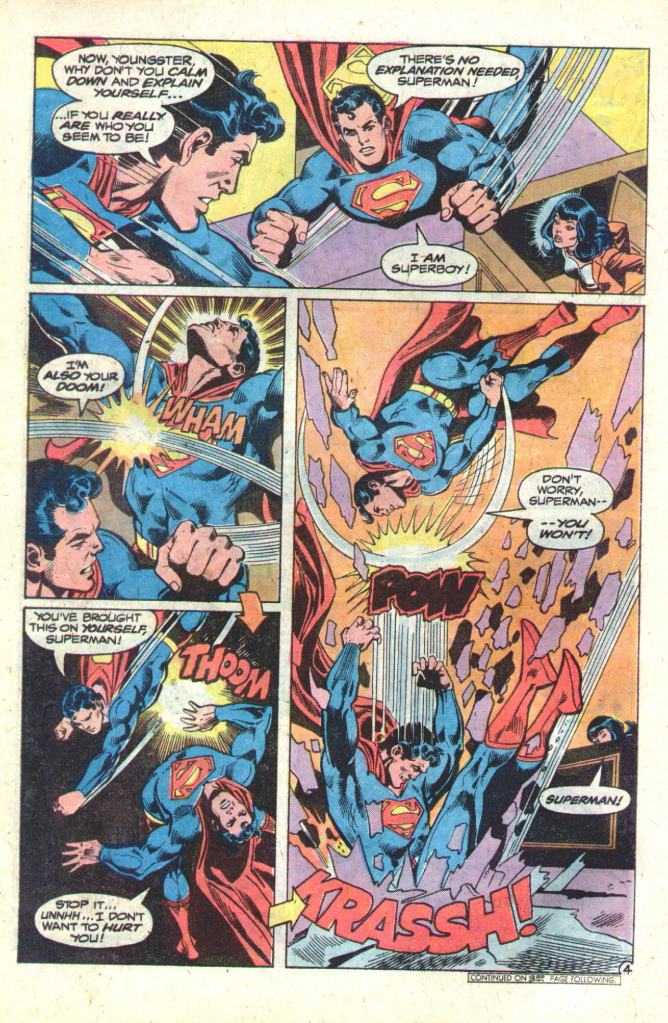
Lois is bored by the slow proceedings and walks out–just seconds before Superboy comes barreling in through the roof and clobbers Clark Kent. Kent is confused both by how Superboy can be here simultaneous with his present time self and why the Boy of Steel has such a mad-on for him, but he swiftly changes into his Superman togs and fights back. But the Man of Steel is surprised by the intensity of his younger self’s attack, and is unable to prevent Superboy from taking off, though promising to return and finish what he’d started here. Both Superman and Lois are confused by all of this.
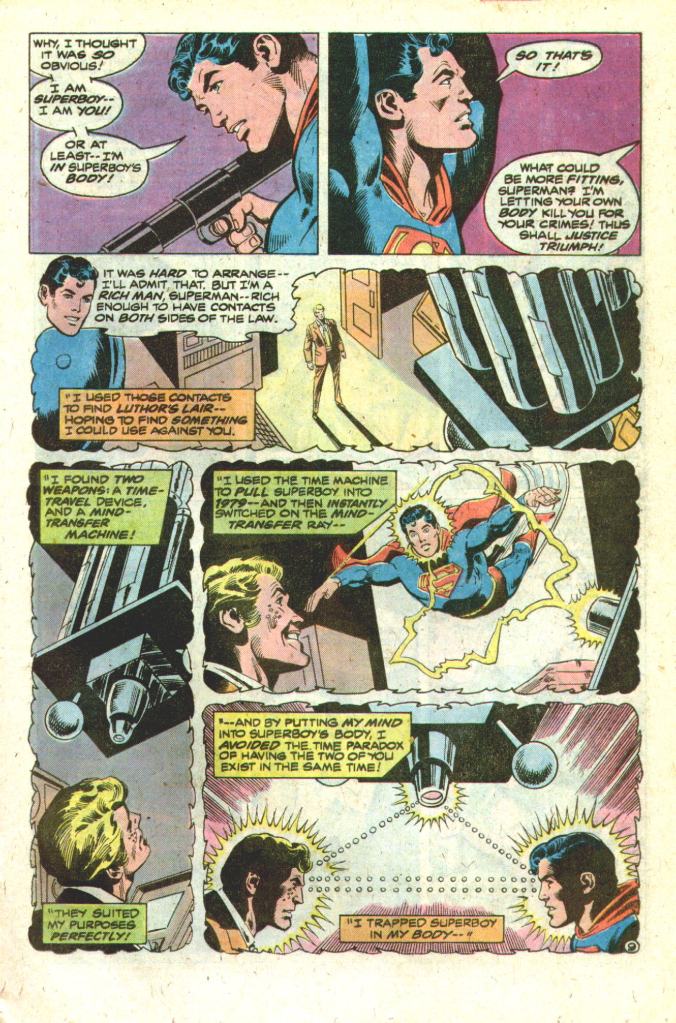
After establishing that Clark Kent is all right, Superman heads out after his young doppelganger, but is unable to find any trace of him. Some time later, though, he picks up the ultrasonic sound of Jimmy Olsen’s signal watch, sending a danger alert. Following the signal back to its source, Superman is ambushed by Superboy, who is able to stun him with a Kryptonite-firing bazooka. When the Man of Steel comes to, he’s chained up in the Grand Canyon in kryptonite chains, and a group of his closest friends has been gathered to serve as his jury, as Superboy intends to put his older self on trial. (I have no idea how Superboy managed to chain Superman up with kryptonite chains without being stricken himself–the story seems to imply that this mind-swapped version of Superboy isn’t vulnerable to kryptonite, which seems a stretch.)
To begin with, Superboy reveals himself to all assembled. He’s not really Superboy at all, but rather the Boy of Steel’s old friend Pete Ross who had used a time-ray of Luthor’s to pull Superboy’s body to the present and swap minds with it. This apparently was enough to short-circuit the guiding temporal principle that Superman couldn’t exist in two places at the same time. Pete did this because last issue, Superman was forced by fate and circumstances to let Pete’s son Jon go off into space with some aliens on a journey of vital importance to the history of the 30th Century according to the Legion of Super Heroes. But Pete isn’t having it, and so he’d dedicated his fortune to seeing that Superman pay for his crimes. However, when all of this is laid out for the jury of Superman’s friends, they all to a man stand behind the Man of Steel’s decision, trusting that he did the right thing as he always has. This pisses Pete off, and he decides to kill Superman anyway–but the Man of Tomorrow is able to find enough strength in him to rip his chains out and avoid Pete’s kryptonite shell.
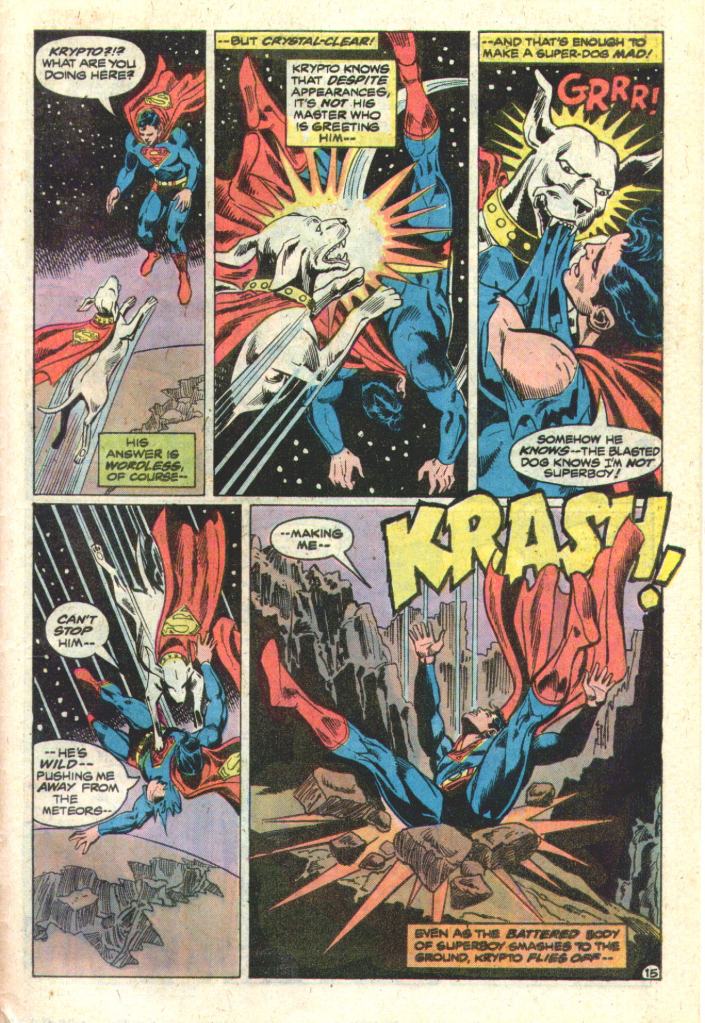
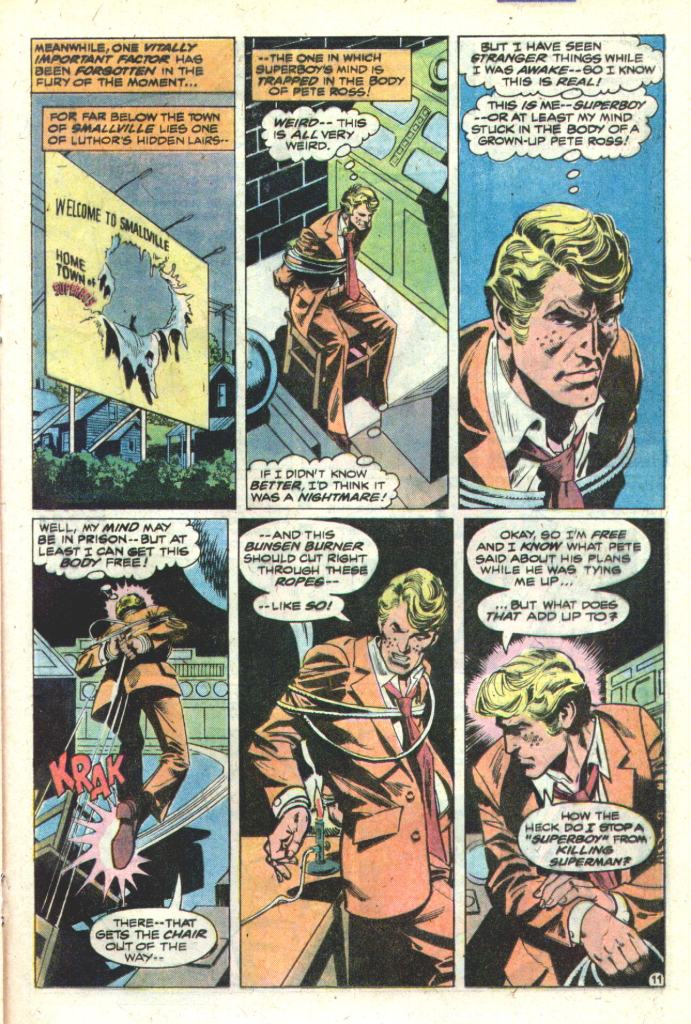
Elsewhere, in Smallville, we find Pete Ross with the mind of Superboy tied up in Luthor’s lab. Pete/Superboy is able to free himself, but without his super-powers, he’s not sure what he can do to stop Pete in his body. Making his way to Ma and Pa Kent’s boarded up old house, he find little left to work with apart from an old whistle. But that’s all he needs. Back at the Grand Canyon, Superboy has soared up into space, intending to rain down kryptonite meteorites atop Superman and friends to finish them off–when suddenly he’s attacked by Krypto the Superdog. Pete’s unprepared for the savage attack, and Krypto is able to knock him back into the atmosphere and back down to Earth where Superman has liberated himself from the kryptonite chains. Now that he’s ready for Superboy, Pete Ross doesn’t stand a chance against him.
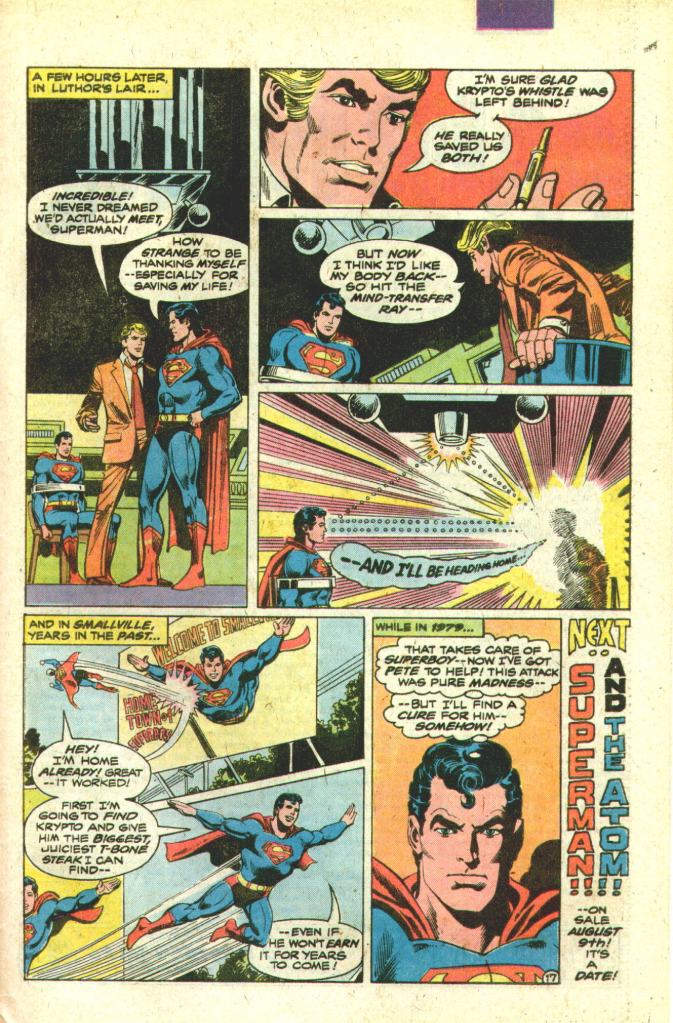
And in a final page epilogue, we learn that Superboy/Pete was the one that summoned Krypto with the whistle that he’d recovered. Superman is able to use Luthor’s tech to restore Superboy and Pete’s minds to their proper bodies and to send his younger self back to the past. But the question of what to do about Pete Ross’s homicidal tendencies remains (especially since he knows that Superman is also Clark Kent. That’s the note that the story goes out on–and it does feel like a bit of an ignominious end to Pete Ross’s career as a supporting character, not that it bothered me at the time. To the contrary, it felt meaningful and impactful, a genuine change to a long-established status quo. And a later issue of DC COMICS PRESENTS would resolve Pete and Jon’s story, so there was still that to come.


Pete Ross has been handed the crap end of the stick as an adult character no matter what the current continuity. Maybe he needs the Waid treatment to gain back the stature he should have even if he doesn’t gain any more prominence than he has now.
LikeLiked by 3 people
That is one hell of a coincidence cause earlier this week I was looking for any pre-1940s body swap stories in literature that used technology, but only found one in film: The Man Who Changed His Mind ( 1936 British science fiction horror film starring Boris Karloff and Anna Lee ) also known as The Brainsnatcher or The Man Who Lived Again.
LikeLiked by 1 person
Action Comics#584 ( January 1987 — team-up with the New Teen Titans ) scientist David Gundersen uses a mind-transfer device on the Post-Crisis Superman . Plus the Pre-Crisis Superboy would fight the Post-Crisis Superman in Superman Vol.2#8 ( August 1987 ) and Action Comics#591 ( August 1987 ) — Legion of Super-Heroes team-up. ( Silver Age crossover, 2000 ) – The space conqueror Agamemno forces a massive swap between the Justice League and their arch-enemies, trading Superman’s body with Lex Luthor’s ( alongside other hero/villain swaps ). Gorilla Grodd and Superman trade bodies, forcing Batman and the team to figure out how to stop Grodd while he wields Kryptonian powers ( We Are Yesterday event ).
LikeLike
A tasty piece of “Bronze Age” candy – once you look past a few story gaps. Last week, the comment I shared that “we like Batman because we can never be Superman” generated some fascinating discussion. DC Comics Presents #14 flips that comment onto it’s backside. Given Pete’s actions, it’s probably a good thing we can’t ever be Superman because it would seem that those powers simply prove too much a temptation to avoid breaking bad. Am I correct? Is there a time that someone – other than an arch villain – who has had the Man of Steel’s powers ever used them for benevolent purposes?
LikeLiked by 1 person
JLA: Foreign Bodies: the villain Kobra orchestrates a mass body and mind swap across the Justice League, putting Batman into Superman’s body ans Superman into Kobra’s. DC Comics Presents#81: Ambush Bug visits the Fortress of Solitude with red Kryptonite, causing him and Superman to switch bodies for a comedic issue. Superman/Batman#77: The Earth-2 Superman and Batman swap bodies with Powergirl and Huntress through the machinations of the Ultra-Humanite —-safe to say they never did anything sinister with Superman’s body.
LikeLiked by 2 people
Thanks, John. I’m pretty much convinced that if you don’t know a story, it simply didn’t happen. 😊
LikeLike
I enjoyed this series especially the Garcia-Lopez issues.
LikeLiked by 1 person
DC COMICS PRESENTS was a series I generally read only when I liked the creative team. There wasn’t any sub-plot flow through the series, so there wasn’t much reason to want to catch every issue, and it often felt like the artists were chosen based on who was available at the moment rather than who was a good creative choice.
Here, for instance, I read this story because it was Paul Levitz (and started out as a Legion crossover, and I’m a big Levitz Legion guy). But I have very little interest in seeing Dick Dillin draw the Legion (which I’d seen in JLA and didn’t like it there, either) or seeing him draw Superboy. Nice to have Dick Giordano inking him, but even so, young people are not his forte.
So it was a story that felt much more like a Schwartz story than a Levitz story, and the art didn’t have what I liked about the Legion. I was much happier when the artists suited the material (Garcia-Lopez on Deadman, Starlin on cosmic stuff, Pérez on OMAC, etc.) but that didn’t seem to happen all that often.
LikeLiked by 1 person
Having briefly worked for IND distributors in the 1970s, bundling books, magazines & comics for distribution to retail outlets – & IND to all intents & purposes controlled magazine & comics distribution throughout the country at the time – I can tell you exactly why your local 7-11 almost never received #1 issues. At the time the distributor received a rebate on unsold copies, that in much earlier times needed to be returned to the publisher intact, but by then only the top third of the cover – featuring the logo – needed to be returned to gain the credit. AKA “stripping” the cover. I was specifically ordered, with #1 issues of comics, to automatically strip 3/4s of the supply of any of those to return for credit, the thinking being that there would be no audience for new, unfamiliar titles, & they’d all be returned by retailers anyway. (The parts of the comics that weren’t the returned “strips” were allegedly destroyed, but there was quite an underground trade in bundling those & peddling them under the table to dime stores, dentist offices, & other places that might find them of some value, & those under the table profits were quietly pocketed at comics publishers’ expense. This made the subsequent direct market, which forewent returns, an almost irresistible option for publishers.)
Bulk stripping was hardly reserved solely for #1 issues, by the way, but it was way less random with #1s…
LikeLiked by 1 person
I wonder if that might have been a problem I encountered here in the deep south back in that era.
For example, Silver Surfer #1 simply never appeared anywhere in Columbus Georgia or La Grange Georgia. I saw the advertisements but looking in at least a dozen drug stores in two cities fifty miles away from each other (my grandparents lived in La Grange and we’d visit every week) it seems SS #1 simply never appeared in this area. I suppose it could have been a super successful debut but almost no other kids I knew cared at all about comic books in 1968, at least in my neighborhood. The same thing happened to Sub Mariner #1 and Avengers (I think) #67, the first appearance of The Vision.
Actually, in 1968 I was kind of new to actively seeking out comics and even regular comic reading in general, the first episode of the 1966 Batman being the spark that had turned me into a real “fan addict” by 1968. Distribution of Marvel didn’t seem as complete as DC back in 1966-67 either for some reason.
LikeLike
I really didn’t care for this two-parter. I always loved the character of Pete Ross and the fact that he was always helping out Superboy/Clark without glory or even the hero’s knowledge. In my mind, Lois and Lana were never worthy “friends” to Superman, let alone love interests because they wanted to expose his secret identity for whatever selfish, venal reason they might have had, but here was a guy who proved someone could learn it and use the knowledge for good. To me, he represented every kid’s best buddy, and the overall charm of Smallville in general as a Mayberry-like idealization of small town values. I was as offended by this plotline as Spider-Man readers would later be to see Gwen Stacy retroactively revealed as Norman Osborn’s mistress.
I hadn’t realized until now that Giordano inked this story. IMO he and Dillin don’t pair nearly as well here as they did years earlier on JLA.
Glad you seem to have enjoyed this issue, but I feel bad you didn’t get a better introduction to an often better-than-this series.
LikeLiked by 3 people
Rereading his early appearances, I notice that even when the cool kids tell Pete to dump Clark (before Pete knew his identity), he doesn’t. That’s a mark of character. As someone said in an earlier comment, he’s gotten the short end of the stick since.
IIRC, despite Pete’s son being absolutely indispensable to history turning out right, the resolution of this set up simply handwaves that.
LikeLike
This issue was published before I started buying new comics around 1983, but I never bought DC Presents regularly. I just read these two issues (#13 as well as this one). I love the Legion and have always enjoyed Superboy stories, Krypto and Pete Ross. But I didn’t care for the stories in either of these issues.
Regarding this issue in particular, Pete Ross going homicidal made no sense to me. It was also convenient that Lex Luthor’s lair Pete came across just happened to have both a time machine and brain transfer machine. At least Clark cleaned out the basement in his childhood home (and I hope he also filled in the secret tunnel).
LikeLiked by 1 person
Prior to COIE, did anyone take a shot at telling the story of how Pete Ross was able to save Superboy’s life because of his knowledge of the Clark Kent ID? The last time I remember a reference to it took place in the first two-part Mordru story. After Mordru is vanquished, Superboy learns that Pete knows his ID and plans to use a hypnosis machine to wipe out Pete’s memory of that info. Instead Mon-El turns the tables, using the same device to wipe Superboy’s memory of Pete’s knowledge, because in the future they know what Pete’s fated to do. But I think it fell between the cracks.
There was some sixties imaginary tale in which an adult Pete Ross becomes a villain because he marries Lana Lang but is acutely aware that she still loves Superman, despite the fact that the MOS publicly marries Lois Lane (I think). It was better than this story, which I remember only for the cover.
LikeLike
DC Comics Presents started off strong with art by J.L. Garcia Lopez–I loved those first few issues, but then it bogged down, and I didn’t really keep up with it. I might have seen this issue, but I didn’t buy it. Eventually I realized the series wasn’t going to have the same writer and artist every issue like Brave and the Bold did, and I started looking for individual issues that would be interesting. The Jim Starlin run later in the series really caught my eye.
LikeLike
LOVED this story at the time, as a big fan of Superboy (always more interesting to me than Superman), Pete and, especially, Krypto.
I do remember wincing a bit at the time at a few things:
As Kurt notes, Dillin just couldn’t draw younger bodies well–this Superboy looks nearly the same as his adult self.
And, yeah, the convenience of Pete discovering not only an abandoned Luthor Lair, but one with both a working mind swap device AND a working time was an eye-roller even for me as a young Bronze Age reader–more of a Silver Age plot contrivance. (Raises way more questions than it serves the plot.)
Also hard to swallow that both Luthor and Superman would have been quite so careless with locations and equipment that, obviously, were both pretty significant in their pasts. I think Clark, in particular, would long since have more fully secured the Kent home, the secret basement, the tunnel, etc.
I was surprised that Pete didn’t spill the beans about Clark/Superman to Lois and the others–seems to me that would have been a pretty obvious path to revenge, even if he didn’t decide to kill him.
I remember some months later reading a number of LOCs to this title decrying both this issue and the precursor story for giving young readers (or any readers) the idea that Superman would allow a young boy to be kidnapped and abandoned on an alien planet just because the Legion invoked a vague destiny. I think those critiques were spot on because: Superman, if he is to mean anything, almost always finds a way. This prompted the great Phantom Stranger team-up about 10 issues or so later, in which Superman finally decides to let fate take care of itself, rescues Jon, returns him to Pete, saves Pete’s sanity and, its implied, his own soul in the process.
LikeLike
No idea where this profile name came from, LOL. I’m George G.
LikeLike