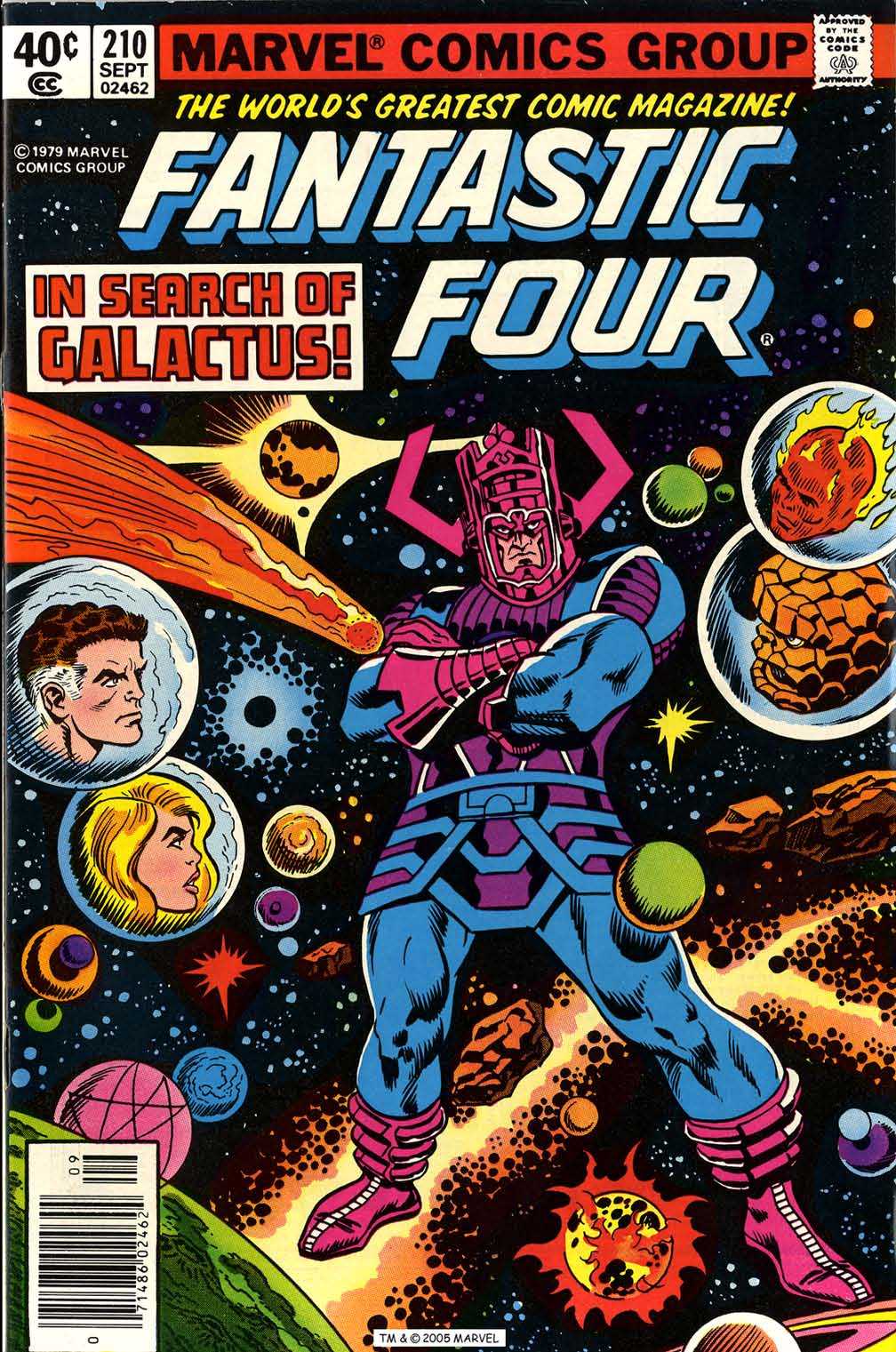


It was at some point around this time that my local postal carrier delivered my subscription copy of the latest issue of FANTASTIC FOUR–though not before it had already gone on sale and was available at my local outlet. Not buying the book and waiting for my copy proved to be difficult, especially after other comic-book buying friends got their copies and wanted to talk about it. At least the subscription copies were by this time being mailed flat rather than folded in half, but they were still at the mercy of the mails and would occasionally turn up a bit dinged. I had swiftly worked out that even this free subscription might have been more trouble than it was worth, though I was never so flush for funds that I took the plunge and bought an early copy prior to mine being delivered, as I would certainly do today.
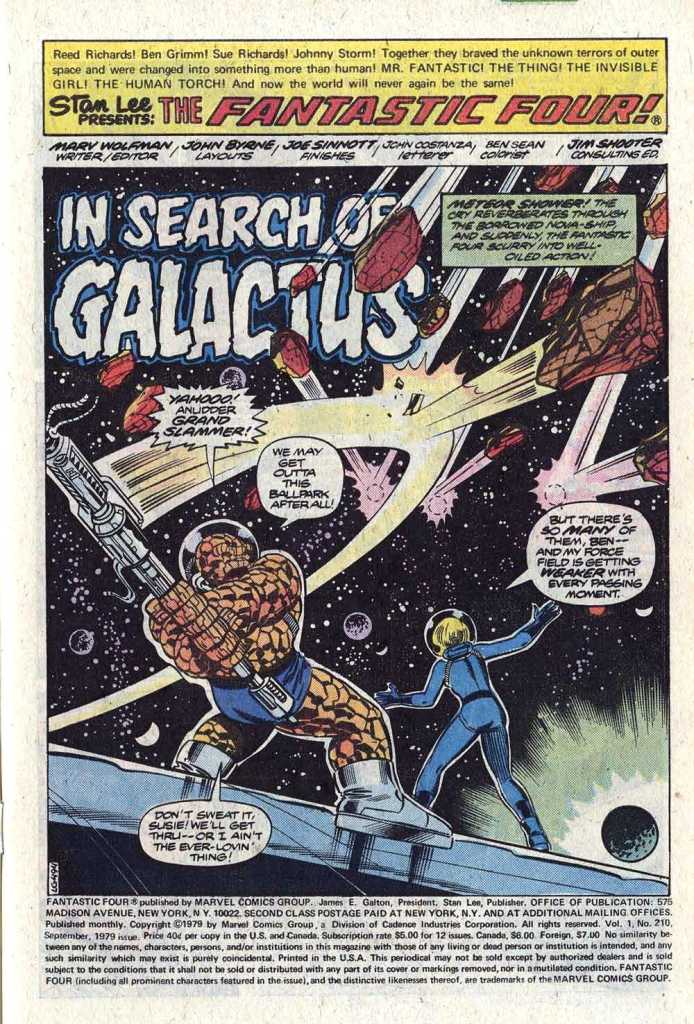
I was still enjoying FANTASTIC FOUR and it remained my favorite series. But there was a subtle sense of something being just a hair off and not quite as good as it ought to be. The book was being written by Marv Wolfman, a writer whose work I really liked during this period, and illustrated by artist favorite John Byrne under the steady embellishment of Joe Sinnott. So everything should have been firing on all cylinders. But somehow, the sum wasn’t as good as the individual parts. In particular, the combination of Byrne and Sinnott was somehow lightweight, rubbery, lacking in solidity and punch. In years to come, Byrne has said that he swiftly grew disenchanted with the stories he was illustrating during this run, so that may have been part of it. Another was that Sinnott’s strengths as an inker clashed a bit with Byrne’s. John had an expressive, cartoonish line that was still developing, and Sinnott brought that all back to FF standard but without adjusting any of the composition underneath it. The result was fine, but somehow lacking.
Plot-wise, the series had a lot going on. In deep space, the FF had witnessed the Sphinx gain cosmic-level powers and swear to use them to obliterate the world of his birth, Earth. Looking for a way to stop him, Reed hits on the idea of seeking out Galactus and enlisting his aid against the immortal villain. This despite the fact that Galactus has no motivation to help them. But Reed figures he’s got that covered as well–in exchange for the World-Devourer’s help, Reed will free him from his earlier vow never to consume the Earth. So it’s trading one menace for another, but the devil you know, right? Also, Reed, Ben and Sue are all still suffering the effects of a Skrull aging ray, which is making them grow progressively older at an advanced rate of speed. So on top of everything else, they need to save the Earth before they all collapse and perish.
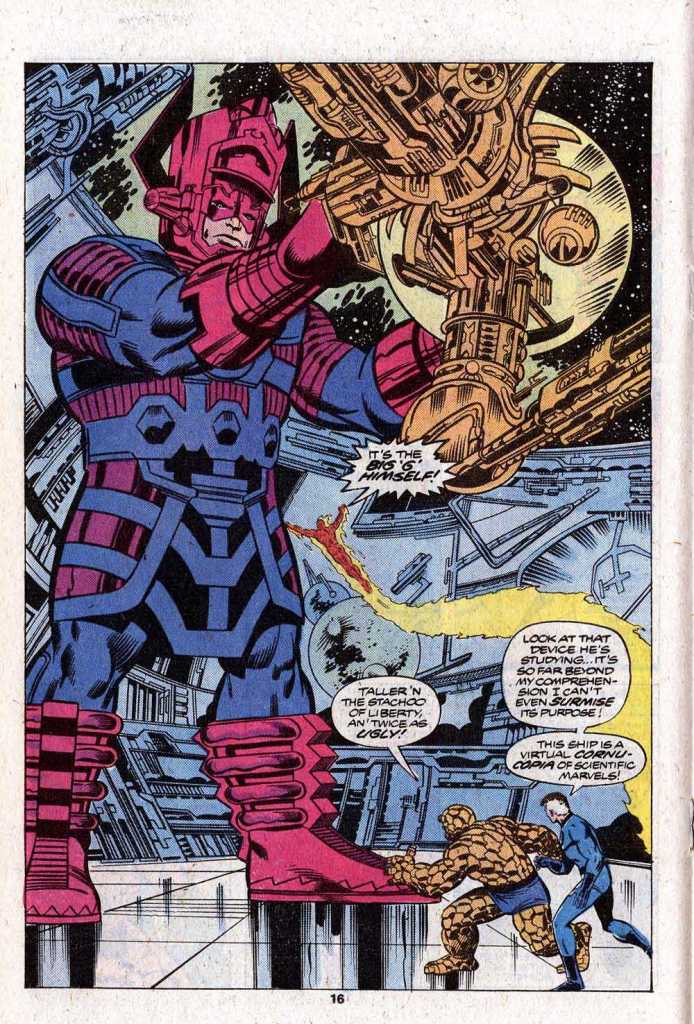
This story opens with the Thing and the Invisible Girl protecting their spacecraft from a meteor shower while Reed and HERBIE the Robot compute a course through hyperspace. Ben figures that the ship won’t survive long enough to make the jump if he isn’t there knocking down stray meteors, so he tosses Sue back through the airlock and seals it shut. In order to rescue Ben and defeat his sacrifice, the Torch melts his way through the outer wall of the ship, which explodes outward, sending him shooting into space. The Thing is able to catch him, though, and get him back inside a pressurized atmospheric environment inside the ship before he can perish. The science here is a little dodgy, but the scene is really about character and the strong bonds between the protagonists. Anyway, with that drama played out, the FF’s craft makes the hyperspace journey to Galactus’ World-Ship.
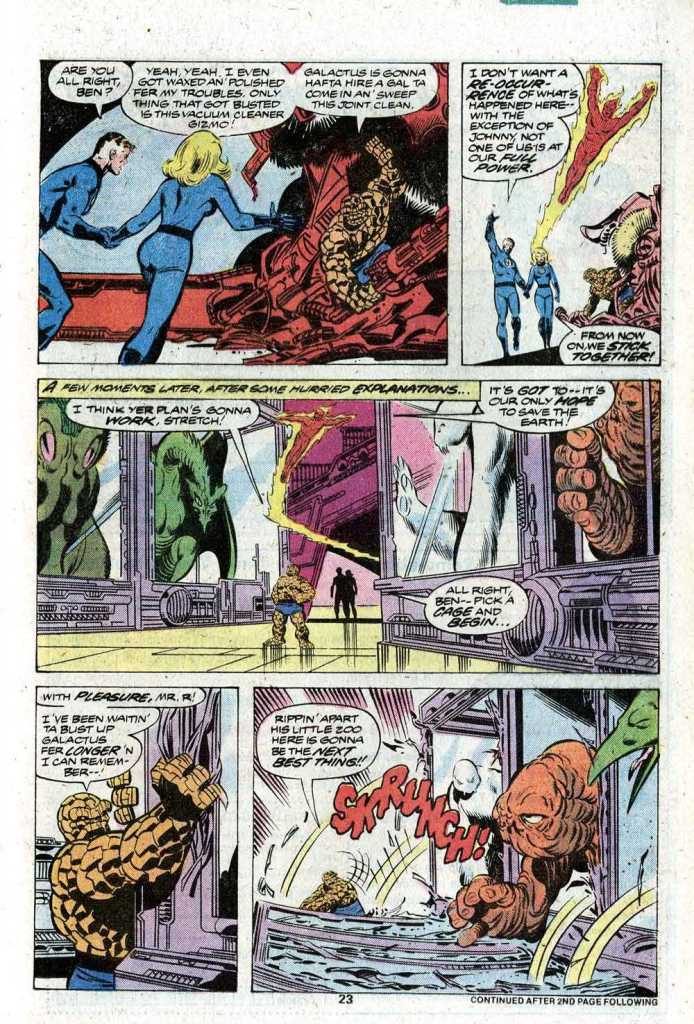
Along the way, Wolfman does a little bit of continuity clean-up, as the last time the FF encountered Galactus, he was seemingly destroyed. Which would seem to put a crimp in Reed’s whole plan. Reed therefore recounts how he was monitoring Galactus’ resurrection months before. In any event, the team enters the World-Ship and tracks Galactus down. But no matter what they do–including throwing things at him and zapping him in the face with fireballs, Galactus does not deign to notice them. His built-in security devices do almost murder Sue and Ben along the way, though, providing some incidental action. But the problem now is to get Galactus to parlay with the FF.
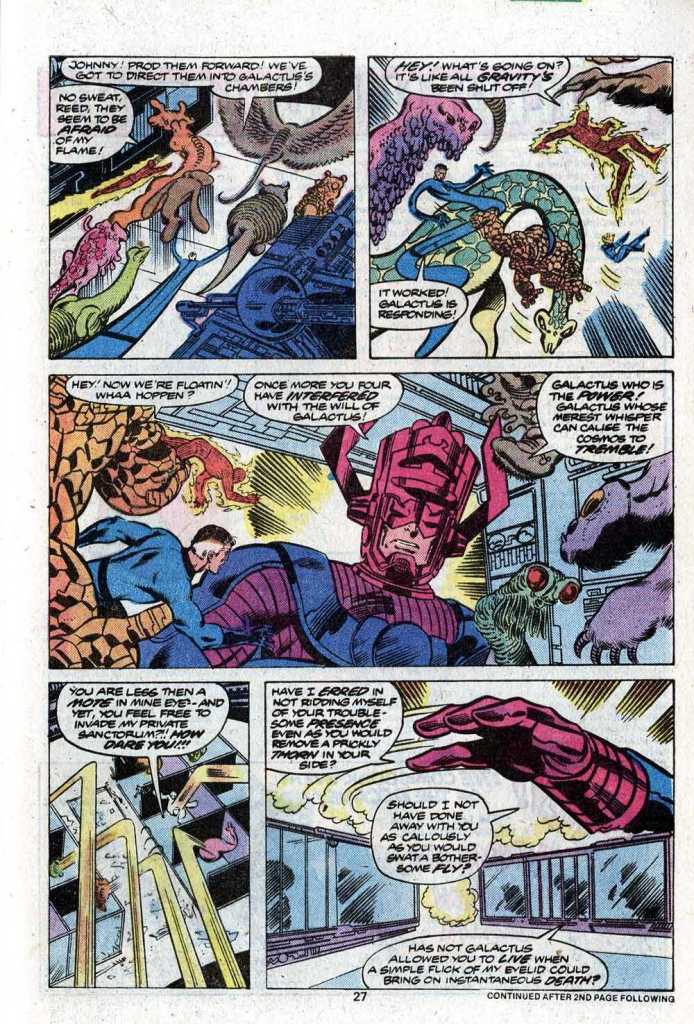
But Reed’s got a plan to get Galactus’ attention. Earlier on, the group passed a menagerie of specimens of assorted space animals, and so Reed proposes that they break them all out and herd them towards Galactus’ chamber. This they do, and as expected, Galactus isn’t pleased by this sudden outbreak of chaos. He’s able to restore his bestiary with scant effort, but the disruption is enough to get him to start conversing with the Fantastic Four–which is what Reed wanted in the first place. Of course, as Reed lays out his initial proposition, Galactus is uninterested–he doesn’t care whether the Sphinx destroys the Earth one way or the other. Reed’s proposition that he’ll rescind Galactus’ earlier oath about not consuming the Earth does intrigue the cosmic giant–but he wants something else as well before he’ll render assistance.
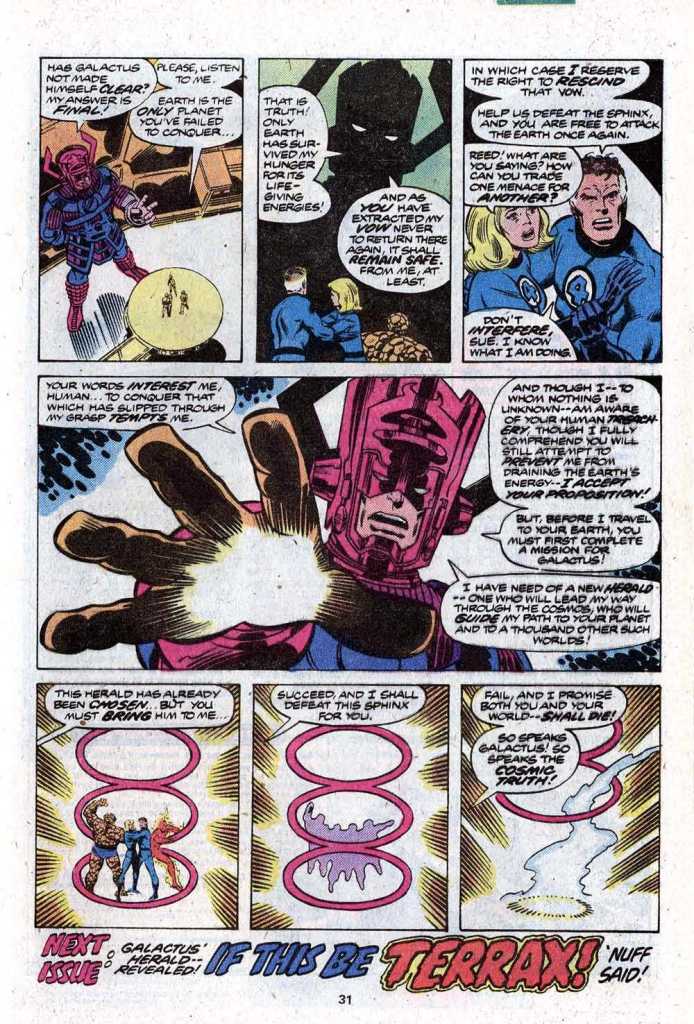
And that something else is a new Herald, to replace the silver Surfer, Gabriel the Air-Walker and Firelord, all of whom turned against Galactus at some point. Galactus already has the proper candidate in mind, but he wants the FF to go forth and bring him back. The close here, with the team being teleported away to the herald’s location, feels abrupt to me, as though the story simply ran out of pages–this final page crams a lot of back-and-forth into it in a somewhat surface manner. But that’s where the story was To Be Continued at this juncture. The story wasn’t bad, but it was certainly missing something, and there is the sense that Wolfman and Byrne aren’t entirely pulling in exactly the same direction. It’s possible and even probably that having been co-plotting X-MEN with Chris Claremont and having strong feelings about the Fantastic Four himself, John expected to have more leeway in the storytelling here.
 The Tom Brevoort Experience
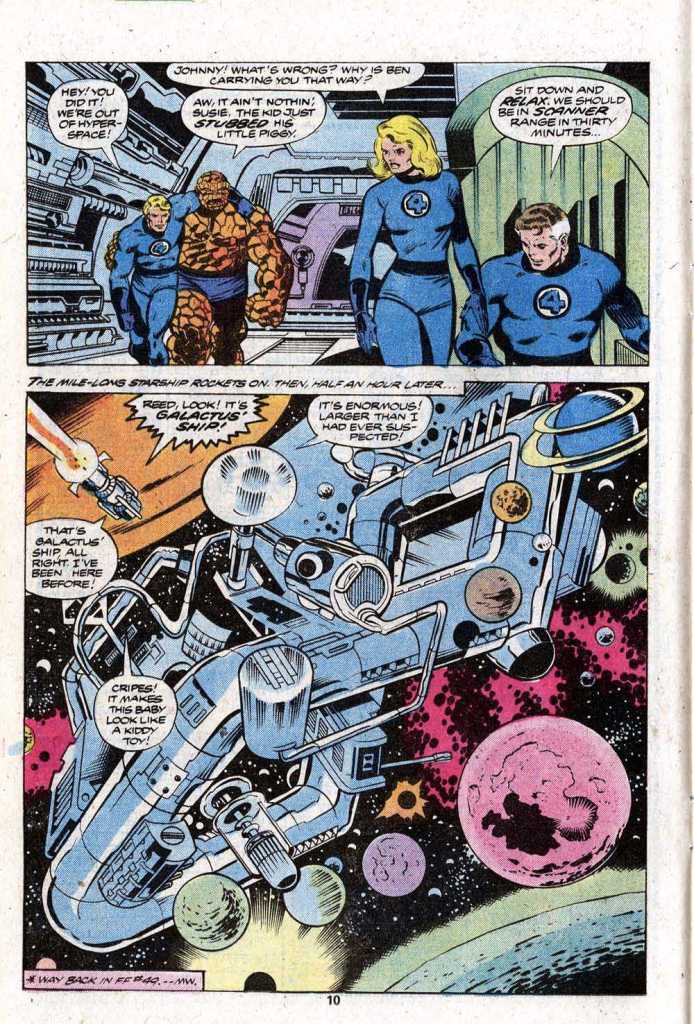
For the mismatch of Byrne and Sinnott, look at that p. 10 you have for us here, top panel. The bodies of Sue and Reed are not Byrne bodies — they’re more Sinnott bodies. Heavy, bulky, not curvy and energetic.
LikeLike
I have to say I really disagree with your general dismissal of this issue and the storyline as a whole. I also was a subscriber to Marvel at the time (Mailed Flat!) and FF was one of the subscriptions I looked forward to most. While I am not privy to the relationship involving the creators here, I think its a good example of Marvel at its best at that time with comics jam packed with propulsive stories and dynamic artwork. While Byrne was probably better on X-Men, Avengers and Marvel Team-Up, I think his visual story telling really shines throughout the Galactus/Sphinx run.
LikeLike
Galactus kept alien animals on Taa II, I wonder if he pulled a Brainiac and kept survivors of the planets he ate that had life on it ( even primitive life and not just civilizations )? To make it different than Brainiac they could be on Jack Kirby like artificial worlds like Transilvane [ Superman’s Pal, Jimmy Olsen#142 ( October 1971 ) ] but smaller ( Baseball or Golf Ball or Marbles size ).
LikeLiked by 1 person
AS I remember it the Silver Surfer was the only on of the 3 heralds that turned against Galactus, the Air-Walker was killed by the Ovoids trying to do his herald job ( Galactus to far away to rekindle the spark of life in him like the Surfer can do to someone about to die. Apparently Galactus doesn’t have the Grandmaster’s ability to resurrect dead beings no matter how badly damaged or dispersed they might be –marvel.fandom.com ) and Firelord asked for his freedom and Thor traded the Asgardian Destroyer for that freedom ( Funny considering the Destroyer was revealed important to Odin’s plan that he never punished Thor over it, but that plan wasn’t conceived of by a writer until years later ). I think this issue was the first time I saw Taa II ( Worldship ) — I didn’t have any reprints with it yet.
LikeLiked by 2 people
Once again, I’m thoroughly amazed at your recollection of all of that. I barely recall what I had for dinner two days ago.
LikeLike
On paper, this should have been a good issue of the Fantastic Four. The mix of Galactus, the Skrull aging ray and the Sphinx would seem the right ingredients for an engaging epic. But as Tom points out, it all falls flat. While I’m in complete agreement that Byrne and Sinnott are not the most compatible art team, it would seem that the lion’s share of any blame falls to a writer trying too hard. What I mean by that is Marv Wolfman’s not only dealing with the FF, but also wrapping up his Nova series that I believe had been initially intended to cross over with this title. He also adds too much to story that already had enough spinning plates. We eat up an issue in the “Space Sargasso” and another “recruiting” Terrax to say nothing of adding the most unpopular robot in this corner of the multiverse, HERBIE.
Oddly enough, a few months later, seeing the FF issue with the Big G squaring off against the Big S intrigued me enough to buy a comic for the first time in over two years. Since I was taking the plunge, I also grabbed X-Men #129. The FF issue was only okay, while my second choice grabbed me by my shirt collar, slapped me several times and convinced me that my life would never be right until I resumed collecting the X-Men right then and there.
LikeLiked by 2 people
IIRC, this seemed dramatic (and fun) at the time. Now that I’ve read more of Galactus’ earlier appearance, whoop-ti-do. It only took two years after Galactus made his sacred Never Breaks His Word vows before he attacked Earth again. His vow is basically “I will never attack Earth again … unless I think I need to.”
Wolfman’s dialog for Galactus also feels way off — he doesn’t usually have Odin’s pomposity.
LikeLiked by 1 person
P.S. The whole idea of Reed saving Galactus’ life was idiotic.
LikeLiked by 2 people
Byrne provided pencils for Marvel-two-in-One, Avengers, FF, and X-men all cover dated Sept 1979.
I recall liking this one well enough in terms of story and art.
LikeLiked by 1 person
I got this and the other parts of the story off the racks at the Navy Exchange when they were new and I liked them well enough at the time, but have no memory at all of how the whole thing played out, what the final resolution was. But re-reading the basic premise of this issue — obtaining the assistance of Galactus to beat the Sphinx with the bait of releasing Galactus from his oath to not gobble up Earth’s energies to feed himself now strikes me as completely bonkers. Richards already knows that the FF can’t defeat Galactus on their own and Galactus, having already been taken in by a couple of shady deals should be extremely wary of trusting anyone trying to strike some sort of bargain with him again. And the whole herald of Galactus bit has become a joke by this point. I really didn’t like Byrne’s later storylines in which Frankie Raye volunteers to become the new herald and then Richards goes to bat on behalf of Galactus when he’s put on intergalactic trial. “Oh, sure, he’s eaten quite a few planets, but, hey, with a little help we beat him off ours and we should just bygones be bygones, and let him loose to eat other planets. It’s the natural course of nature, after all, as long as he doesn’t try to have my planet for dinner!”
LikeLiked by 2 people
I’d never have guessed this had been drawn by John Byrne. Reed on Page 10, top right corner, the outline contour of Reed’s body is Byrne-ish, but not the interior detail. The head and face is slightly like Byrne. But if another artist’s name had been in the credits, I wouldn’t have questioned it.
I wasn’t ever a huge FF fan. I’ve probably bought less than twenty issues. Three or four from Byrne’s writer/artist years. At least three from Walt Simonson’s brief stint. One or two pre-Byrne issues. And some ‘Ringo issues. The three Alan Davis issues he drew with Claremont writing. I want to say some Carlos Pacheco drawn issues but maybe he never even drew FF. Oh, and the Grant Morrisson/Jae Lee mini, “1-2-3-4”, because I’m a Grant Morrisson fan.
LikeLike