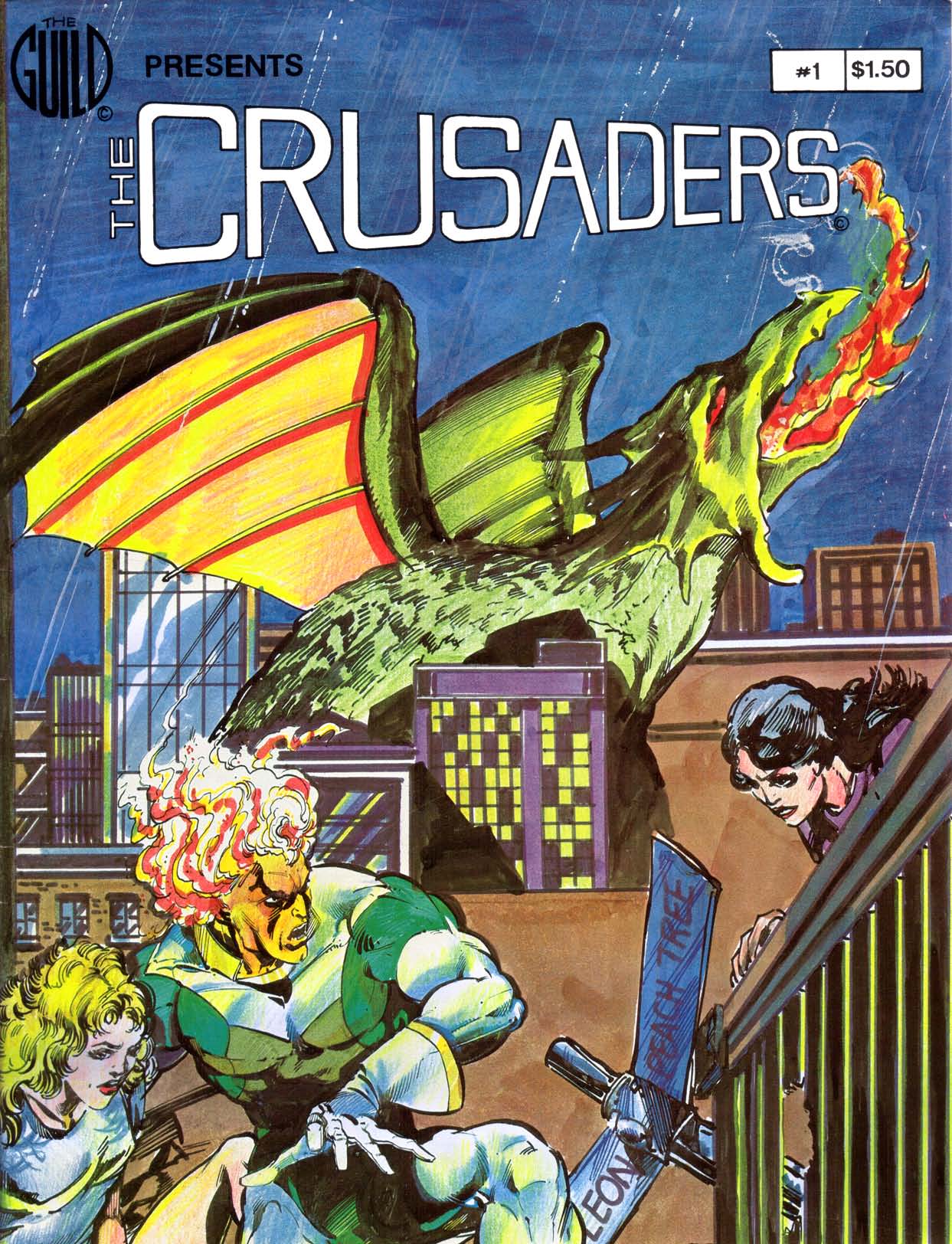


As the Direct Sales marketplace of comic book specialty shops became a larger and larger part of the marketplace in the 1980s, any number of new young publishers threw their hats into the ring. This led to a bevy of new companies putting forward their own efforts in an attempt to find fame and fortune. Some of these comics were quite good, original and innovative. Others were not so good, derivative and not terribly well produced. But it was all exciting for a comic book reader like myself. I had been growing a bit bored with the typical Marvel and DC releases, and so the arrival of all sorts of new books meant that I was entirely willing in most cases to drop a dollar or two and take a gamble on some new series. And that’s how I wound up purchasing THE CRUSADERS #1 from newcomers The Guild.
I wrote about THE CRUSADERS #1 a bit a couple of years ago; that write-up can be found here:
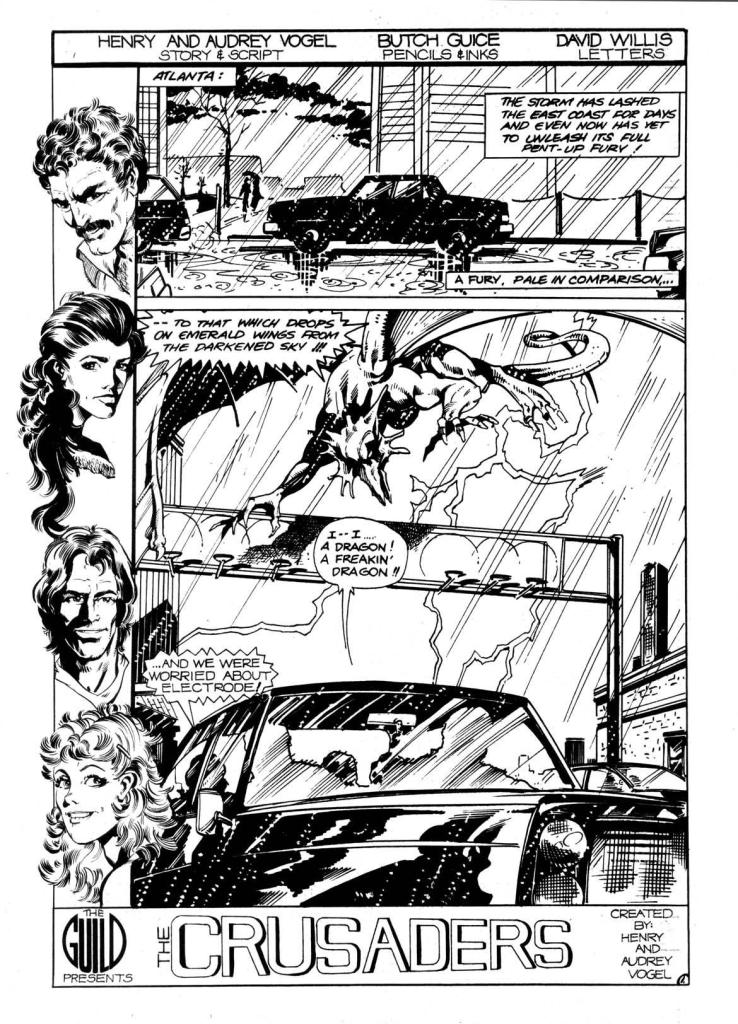
But to sum up the particulars once again: the book was a super hero title set in Atlanta, with certain attributes that presaged reader tastes to come. Specifically, most of the characters didn’t wear costumes, apart from the one who was a huge comic book fan. That character, Electrode, functioned in a kind of meta fourth wall-breaking format, as he was aware of the tropes of super hero comics and would point them out whenever a situation either conformed to those expectations or veered wildly from them.
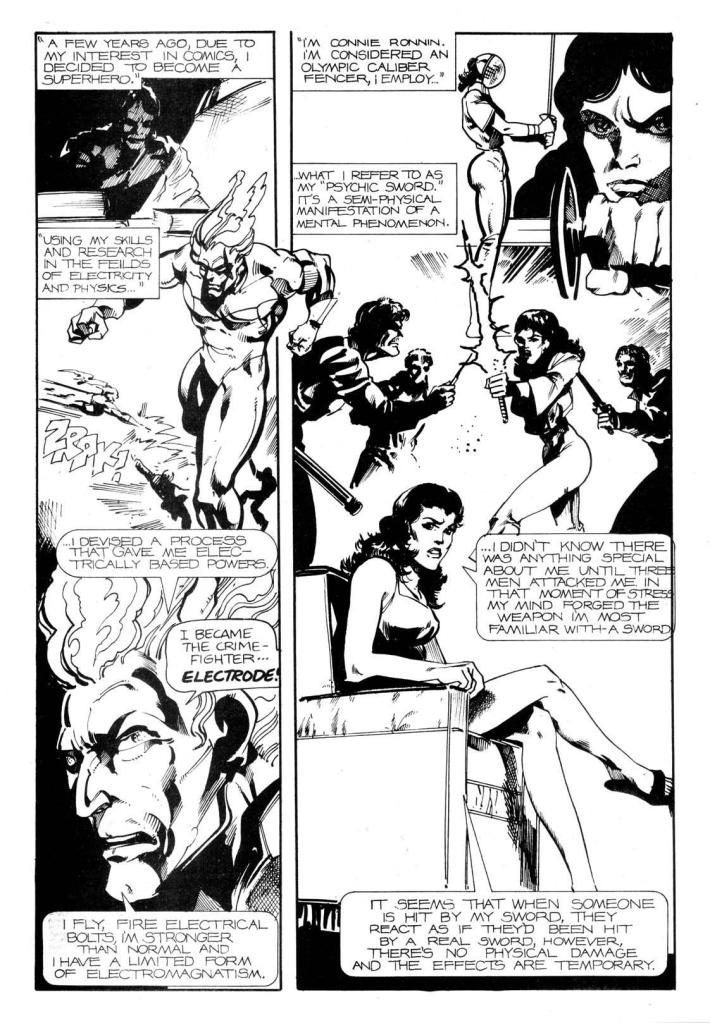
But the big draw in this first issue was the debut of artist Butch Guice. Guice’s work here is fannish and a bit unpolished, but here and there you can see flashes of brilliance. Indeed, by the time this first issue saw print, Guice had been recruited by Marvel to take over the MICRONAUTS series, leaving THE CRUSADERS without an artist. Writers and series creators Henry and Audrey Vogel would have to recruit a replacement artist for subsequent issues.
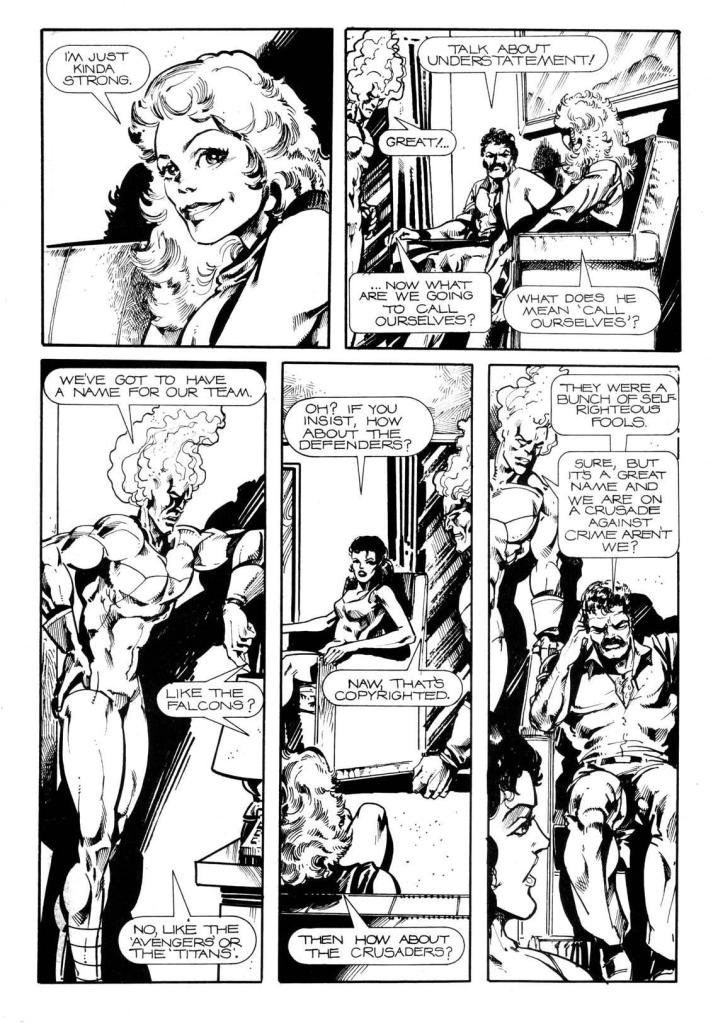
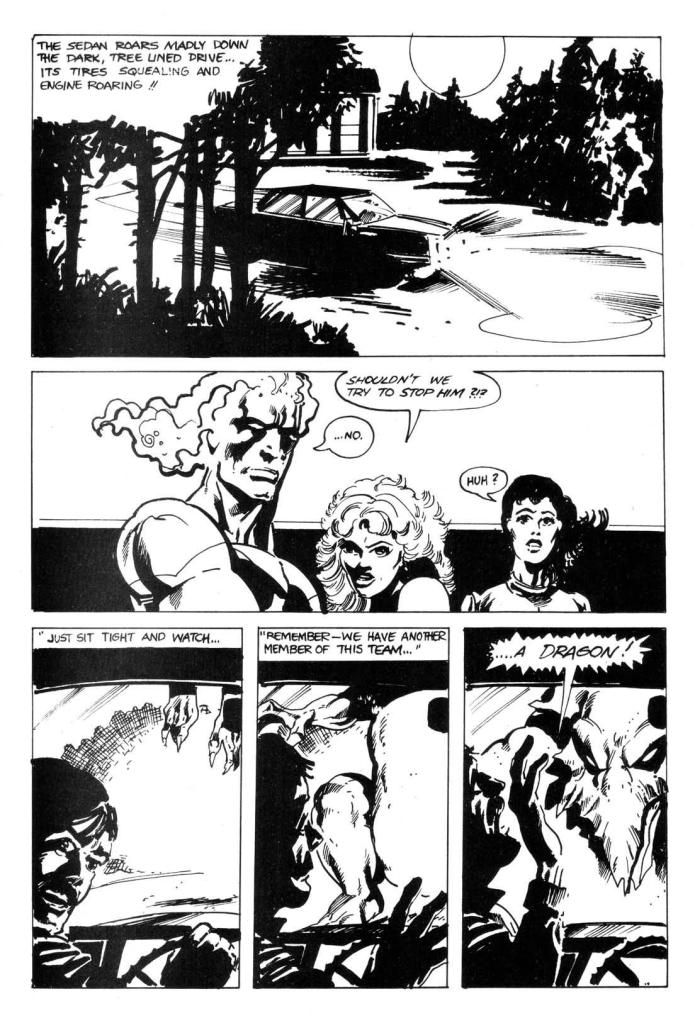
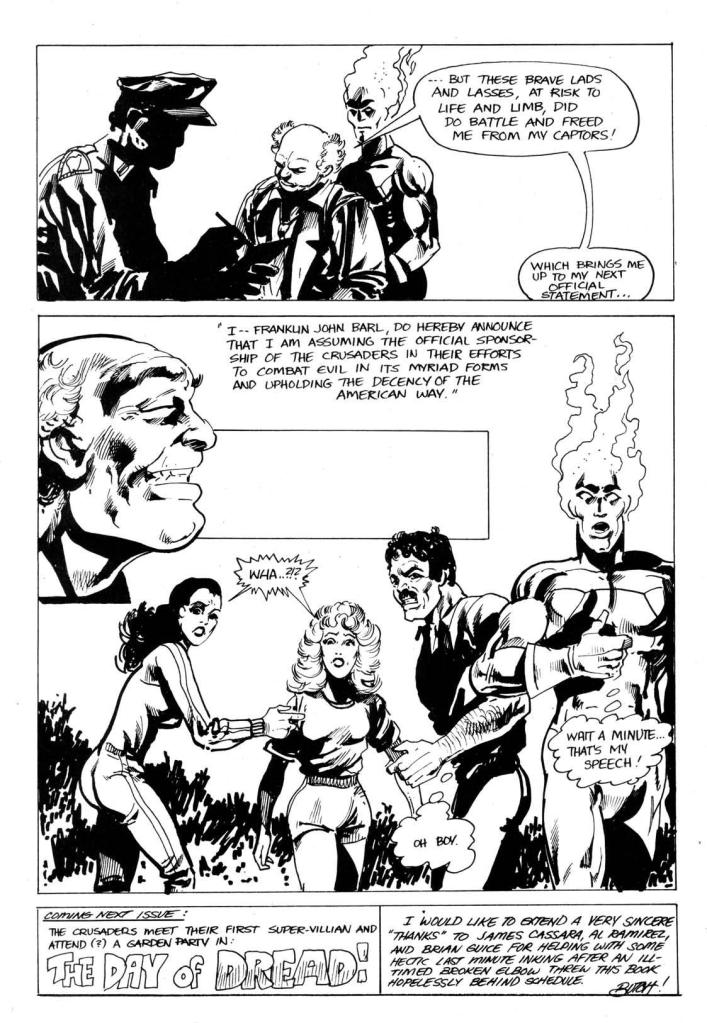
The Crusaders were David Shenk, A.K.A. Electrode, a comic book fan who used his scientific skills to give him electricity-based powers so that he could become a super hero; Connie Ronin, a fencer who could manifest a psychic rapier that predated Psylocke’s similar weapon; Mark Dagon, who is a literal dragon from antiquity who has just lived long enough to exist in the modern world and who maintains a human identity as well; and Kristen Austin, who is just kinda strong. The four all encounter one another when they see Dragon chasing after a fleeing car, mistaking him for a threat. In reality, the car contained kidnappers who have made off with Franklin John Barl, a wealthy socialite. Discovering their error, the four heroes team up to locate Barl and rescue him from captivity.
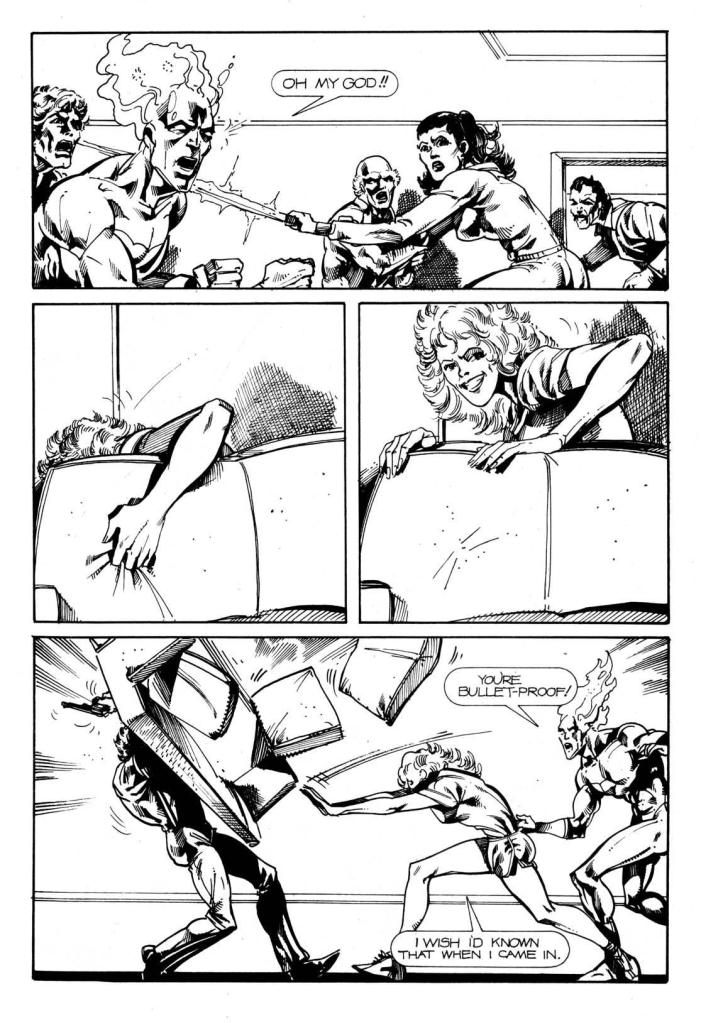
For all that it contained some wildly fantastic elements (such as an actual dragon), the story in this first issue is a relatively grounded affair, which made it a bit novel. The characters are broadly drawn and not terribly deep yet, but there is a genuine effort being made by the Vogels to make the adventure seem plausible and a bit more real world than the typical super hero outing. The Atlanta setting was a plus, as the creators use a decent working knowledge of the terrain.
Unfortunately, the Guild’s timing wasn’t the greatest, as around this same moment, Archie Comics decided to test the Direct Sales waters for super hero content as well, and they resurrected their old characters, the Mighty crusaders. This led to the Guild getting a Cease and Desist letter from Archie–which they folded into the storyline of their second issue. With #2, the book was retitled SOUTHERN KNIGHTS. It was also formatted at the standard comic book size–like so many of these early publishers, the Guild chose to release this first issue in the magazine format, which wasn’t as beloved by retailers.
As SOUTHERN KNIGHTS, the series ran for 33 issues and was a reliable low-key alternative super hero title, though it never really achieved enough popularity to rise above the rest of the pack. But it was pleasant and it has its fans to this day. Myself, I only read it intermittently after the first couple of issues; it was somehow a bit too low-key for my tastes.
 The Tom Brevoort Experience
I like some of the inking. Butch went on to a pretty successful career, drawing and/or inking that lasted a long time. A later highlight I think was on “Secret Avengers”. His “mood lighting” was very effective for espionage stories. Didn’t he work on some of Ed Brubaker’s Cap stories?
You can call a comic book team the Crusaders. Just not on the cover. 😉
I remember “Southern Knights”. Never followed it much. May have only bought 1 issue or 2. I remember a gold skinned guy. Like Adam Warlock sans a cape, in a white & green costume, I think.
LikeLiked by 1 person
I wonder if Southern Knights ever tried a crossover with Captain Confederacy (an ill-fated and I think ill-advised moniker).
LikeLiked by 1 person
Thinking more about it, too bad Chuck Dixon & Tom Lyle’s legacy Strike hero from the later 1980’s, who was Black, never got a crossover chance of embarrassing Captain Confederacy. I’d have bought that. In the vein of Steve Rogers’ Cap punching out the Red Skull. (Sorry, not sorry, “good ol’ boys”.)
LikeLiked by 1 person
He’s the Captain America of an alt.history Confederate States of America so it’s appropriate. And the initial 12 issues was all about walking about from being the symbol of that regime. I liked it a lot.
LikeLiked by 1 person
Part of the appeal is that it’s the first fiction I’d encountered to look at what North America would be like now if the South had won (as I discuss here: https://frasersherman.com/2017/09/27/what-if-the-south-had-won-captain-confederacy-sfwapro/)
LikeLiked by 1 person
Even if they could, I’m not sure the marketing is great going against a bigger company. Despite following Southern Knights back in the day, my first thought on seeing this post was “Funny, I thought I knew all the Mighty Crusader revivals, why don’t I recognize this one?”
LikeLiked by 1 person
My 1st thought was of the Archie/Red Circle team, too. 😉
These days I’d only use that name for a government sanctioned covert villain team. Poser heroes.
LikeLike
I like Butch Guice, his Micronauts, Deathlok & Doctor Strange: Sorcerer Supreme work ( Not the thing he was doing with photos that John Byrne mocked him for in the Sensational She-Hulk ), but not his angular Superman work ( Don’t know if that was the inker or him, but I like his characters more organic if that is the correct word for what I’m thinking ).
LikeLiked by 1 person
My fave work by Butch was late 90’s and through the 2000’s. When he got work that let him run with the darkly lit pulp style espionage stories, with superheroes or not.
LikeLike
Can you elaborate on what Guice did that drew Byrne’s attention? I know there was controversy when he used a picture of Amy Grant for the background of Dr. Strange cover. What was Byrne’s reaction? I read his She Hulk’s but can’t recall anything.
LikeLiked by 1 person
I think it might be magazine photos that he must have traced and then use them in some panels instead of drawing it from scratch. You don’t remember an issue of the Sensational She-Hulk where John Byrne was using magazine photos of women that the colourist made She-Hulk green for a number of pages?
LikeLiked by 2 people
I enjoyed the Southern Knights. To some extent because of the low-key quality that turned you off (each to their own and all that). Found the author’s inside-the-cover columns on the merits of anarchism unconvincing, as he ducks around some of the problems of having no government (I’ve seen worse, though). And I liked Connie’s psi-sword allowing her to slice and dice people without actually dismembering or killing them (Mr. Vogel saw that as an alternative to sword-wielding superheroes having to use the flat of the blade so much).
When I had a superhero RPG game going, I was going to pitch Southern Knights to my players as the name of the team but we didn’t last long enough.
LikeLike