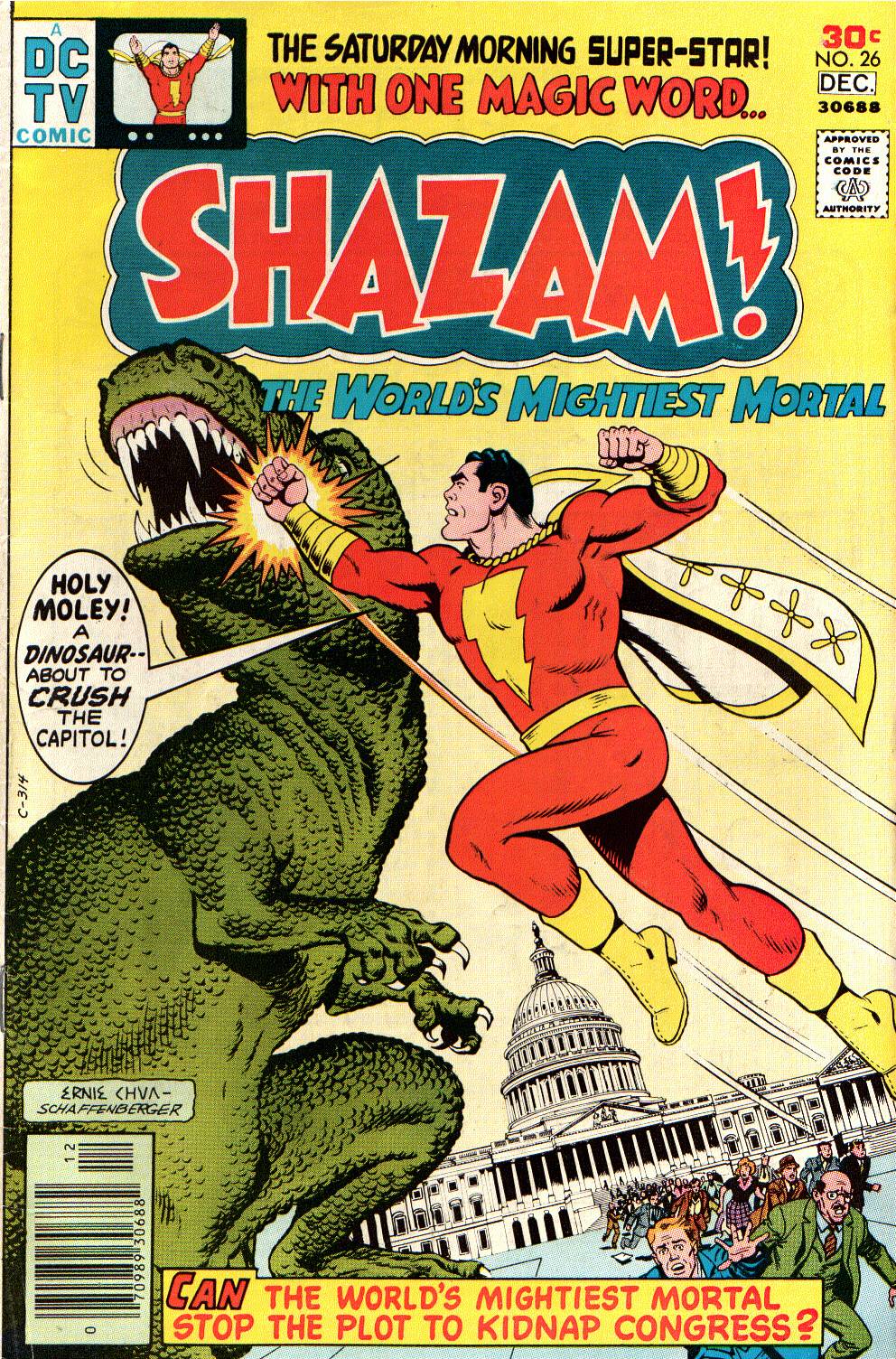


I was still making my way through the complete run of SHAZAM that my grade school friend Donald Sims had loaned to me. I had purchased and read issue #25 when it had first come out, and I’d read the story from this issue when it had been reprinted a short time after publication in the hardcover SHAZAM FROM THE ’40s TO THE ’70s volume. But this version was in full color, so I gave it another read. This was at the point where new editor Joe Orlando had taken over the title completely from Julie Schwartz. Orlando was given a new mandate from new publisher Jenette Kahn: have the series more closely reflect the events in the ongoing live action Saturday morning TV series. This was the first time in a couple of years that any body was putting a bunch of effort into SHAZAM.
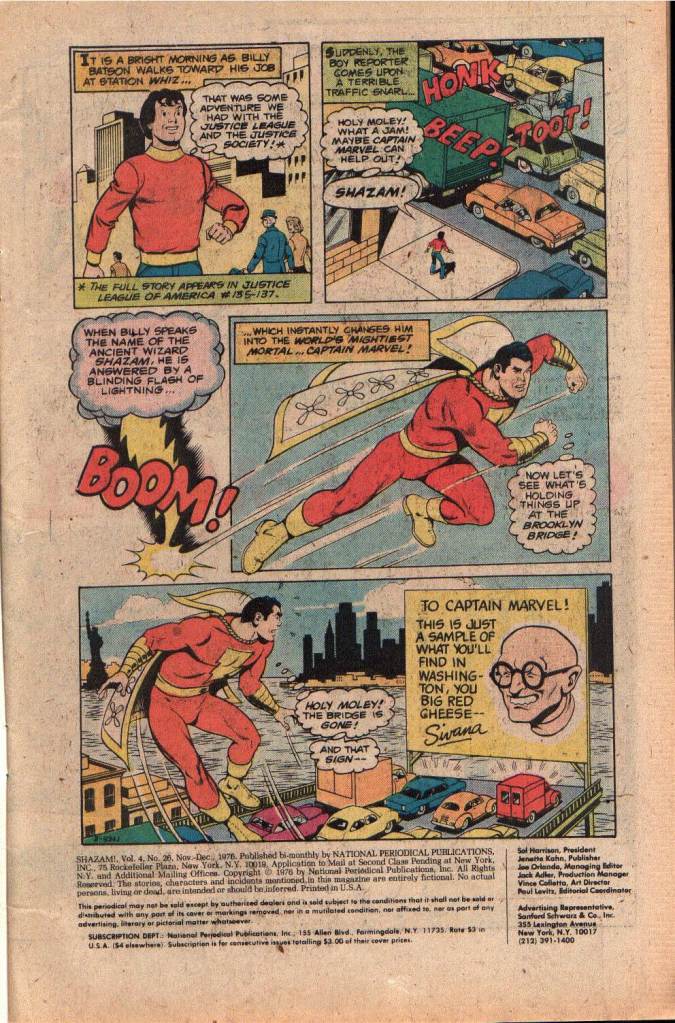
To make this transition, Orlando handed over the writing of the series to one of the character’s biggest fans, staffer E. Nelson Bridwell. Bridwell had proven adept in the past at squaring the circle of some of the complicated continuity of the Man of Steel, so he perhaps seemed like an obvious choice to do something similar with the Big Red Cheese. As the TV series involved Billy Batson traveling across the country in an RV with an older fellow named Mentor, finding youths in trouble and helping them out with their problems, it was a relatively big lift. But Bridwell managed it, in a manner that was still respectful to the source material.
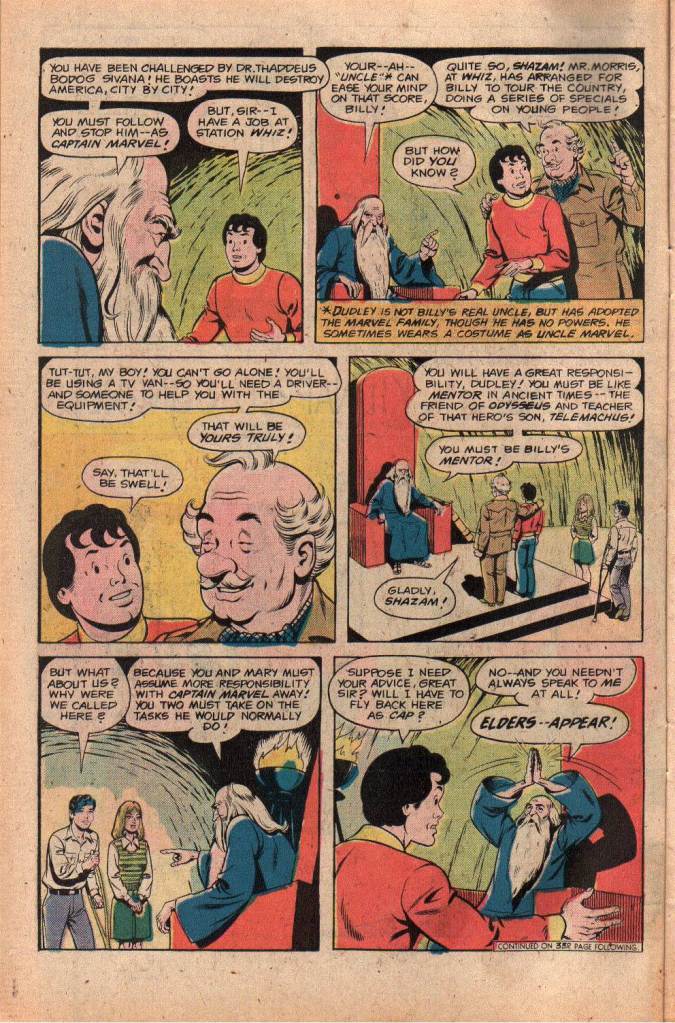
The story opens with the Marvel Family having been summoned by the Wizard Shazam. Among them is Uncle Dudley, who has grown a mustache in order to get with the times (and more closely resemble the Mentor character on the TV show.) Captain Marvel’s old foe Sivana has pledged to destroy all of the great cities of the United States in this bicentennial year, and so Billy will need to travel from city to city, state to state, in order to stop him (though simply capturing Sivana would seem to be enough to put an end to his plans.) Shazam and Dudley have arranged for Billy’s boss Mr. Morris at TV Station WHIZ to send Billy on a tour of the country to interview young people all across the nation. Mary and Junior will be staying behind to take care of matters while Captain Marvel is otherwise occupied.
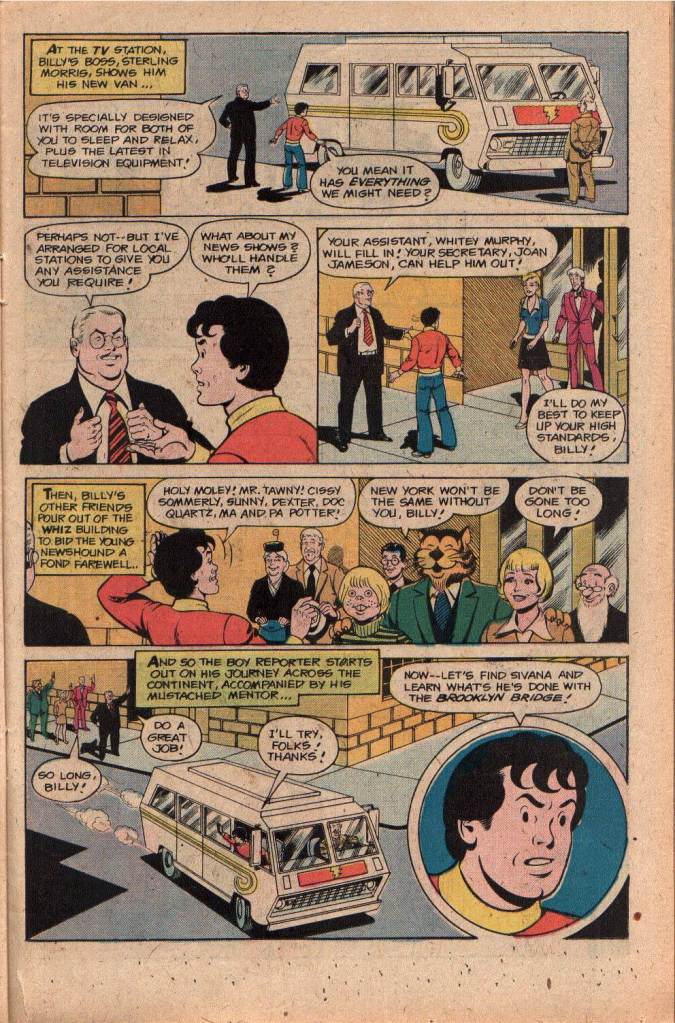
At Station WHIZ, Mr Morris outfits Billy with a broadcast van in emulation of the RV used on TV, from which he’ll be able to make remote broadcasts anywhere in the land. What’s more, Shazam has gifted Billy with the Eterni-Phone, which will allow him to make contact with any of the six enders whose power Captain Marvel channels whenever he might need their wisdom and guidance. He also appoints Uncle Dudley to be Billy’s mentor while they are on the road. Established Fawcett-era characters Whitey Murphy and Joan Jameson will keep Billy’s desk at WHIZ warm while he’s away. And with that, the television set-up is complete and Bridwell can get into the actual plot for this story.
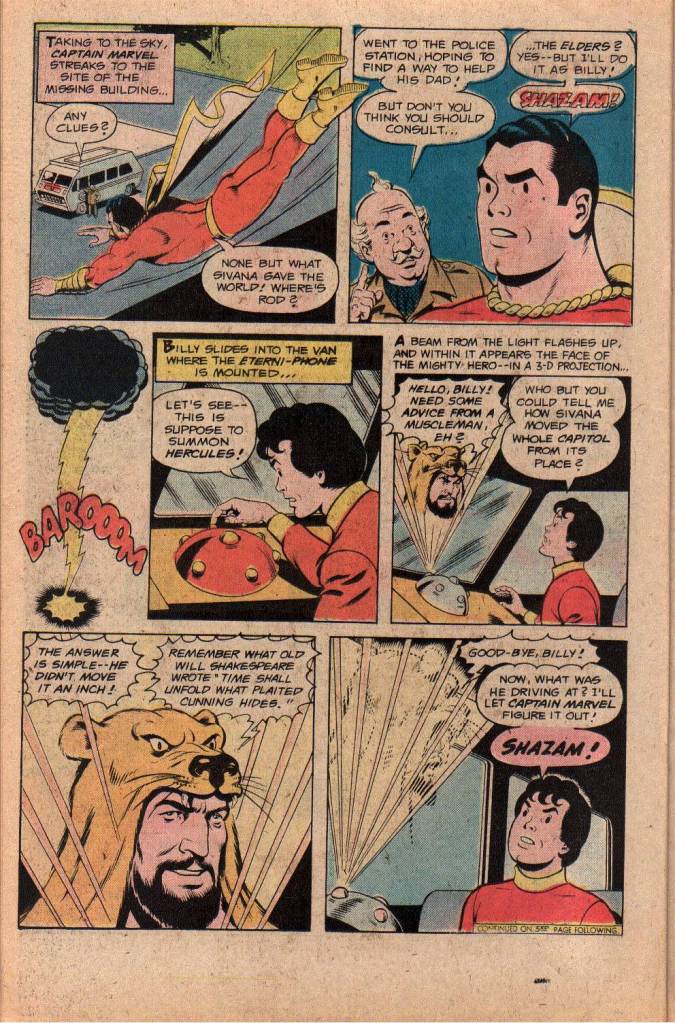
Billy and Dudley head first to Washington D.C., where they link up with local reporter Chet Porter, whose sone Rod is a Senate Page (and who functions as the kid whose problems Billy and Cap are able to address). When Chet heads back into the Capitol to report on an impending Congressional vote, suddenly the entire structure totally vanishes–Sivana’s doing no doubt. Captain Marvel tries to ascertain what’s happened to the building, but he’s baffled (and a bit dismayed at how casual teh citizenry is over the loss of Congress, whom they hold to be grifters and layabouts. Without any other clue, Billy decides to ring in a consultation from Hercules, who tells him that the building hasn’t moved an inch. Captain Marvel works out that this means that Sivana didn’t steal the building, but rather sent it back in time. He races to the Rock of Eternity and propels himself into the past to search it out.
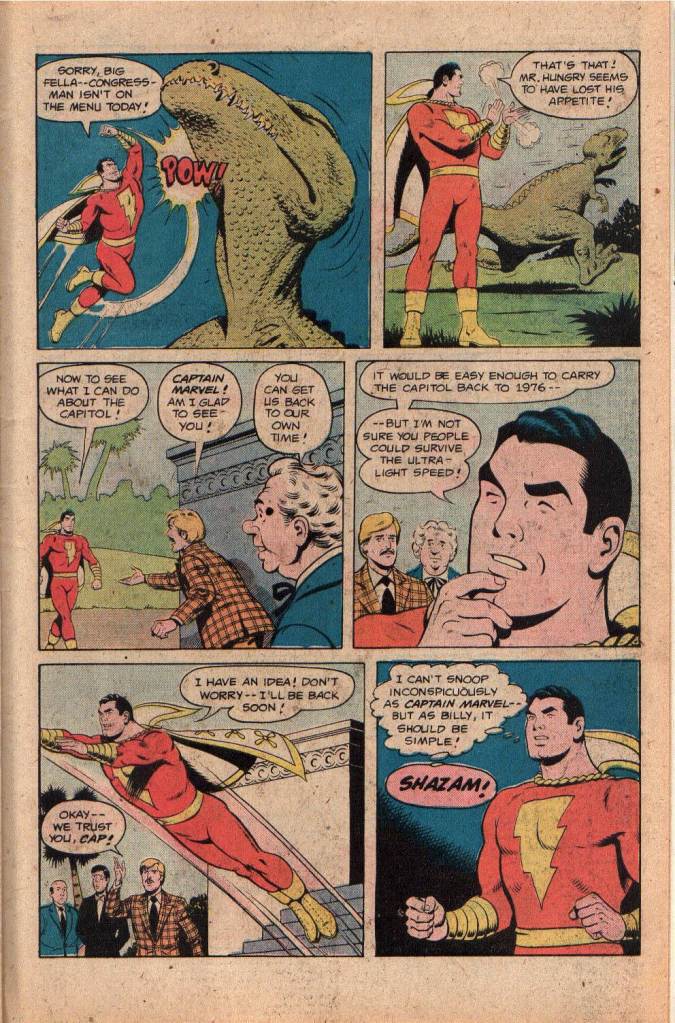
He eventually locates the Capitol, as well as the Brooklyn Bridge which was swiped by Sivana earlier. Cap can transport the Bridge back to its correct place and time physically, be he can’t do teh same for the building and all of its inhabitants. So after fighting off a dinosaur (so as to justify this issue’s cover scene) he instead heads back to the present intent on seeking out Sivana and getting him to reverse the process that sent it into teh past in the first place. In order to snoop around more effectively, Captain Marvel yields to Billy again–who promptly gets himself captured by Sivana’s caveman henchman Yorgull.
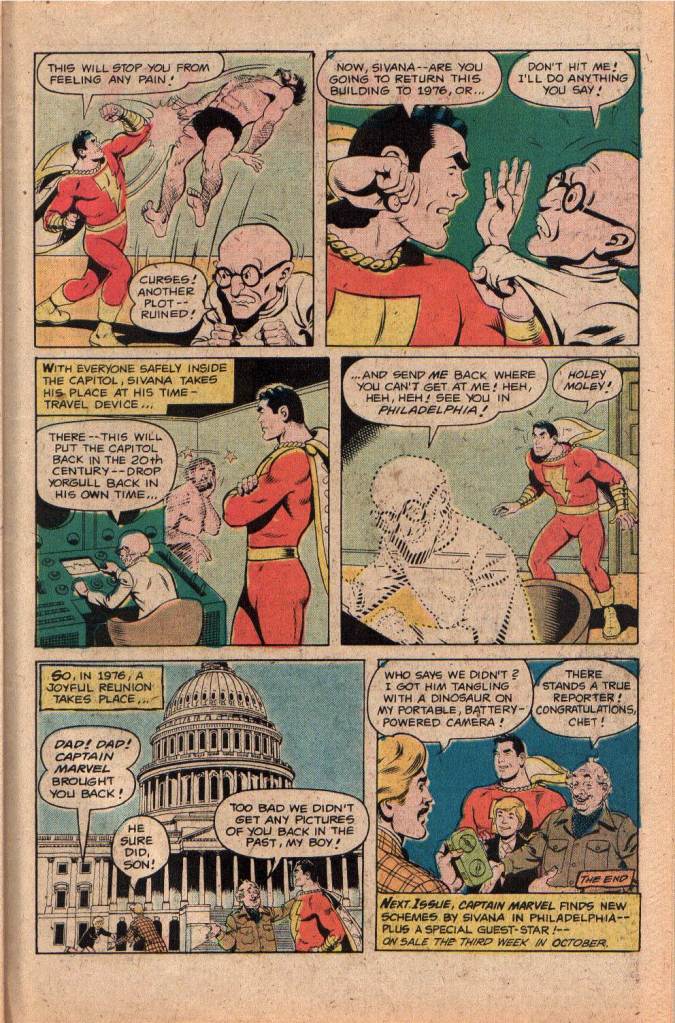
But this is old territory for Billy, and he’s able to escape Yorgull’s grip long enough to utter his magic word, leaving it to Captain Marvel to take care of the caveman. Cap forces Sivana to restore everything to its proper time and place, but the elusive scientist teleports himself to safety at the same time, promising to meet Marvel again in Philadelphia in their next encounter. And that’s a wrap. Kurt Schaffenberger, who had drawn teh character going back to the 1950s, handled the artwork in attractive fashion and with a slight bit less of teh stylization of creator C.C. Beck, which helped it to jell with the live action flavor a bit more smoothly. Bridwell had also adapted the idea of Billy going from city to city from a series of stories that had been published in the 1940s, so it was a throwback approach as well as being broadly reflective of the TV show. As these things go, it was about as painless a conversion as it was possible to have, and one of the better, more solid Captain Marvel stories produced since DC brought back the character.
 The Tom Brevoort Experience
A little funny to see Billy adopt the longer hair style from the 1970’s live action TV show, but still drawn in that 1940’s style.
The idea of getting closer to the TV show’s premise makes sense. But the 2 visual styles are so far apart. It’s jarring to compare them, despite the similarities of the premise; Billy in an RV with an older guy, travelling the country.
It might’ve worked better for me it the art had been more naturalistic. Years later, Don Newton’s “Shazam” feature in “World’s Finest” (and maybe “Adventure Comics”?) was more appealing to me. The CC Beck “Shazam” style wasn’t that visually far from the “Annie” comic strip to my untrained eyes.
LikeLiked by 2 people
Beautiful Natural Looking Scanned pages for this issue. I simply cannot stand when scans are artificially whitened.
LikeLiked by 1 person
I
LikeLike
Sorry, I have the hardest time getting this to work.
I got on board with Shazam! early on and, like Tom, I enjoyed the reprints more than the new stories, and drifted away during the TV years. I was buying comics infrequently by then because the lone place that carried them stopped doing so. I was only able to buy them when we went to a nearby city and rediscovered the Marvels via the Bridwell/Newton stories in World’s Finest and later the Adventure Comics digest, which I loved. This was the main reason I bought both comics. It took DC a bit of time, but I felt like this team really got it as far as how to present the Marvel Family.
LikeLiked by 1 person
Don Newton’s Captain Marvel looked great.
LikeLiked by 1 person
I’d been enjoying the reprints well enough, but I remember being very excited to see new stories again — especially with one of my favorite writers, E. Nelson Bridwell on board. I think this next run of stories is very strong, but in the end, it wasn’t enough to save the series.
LikeLiked by 2 people
I suspect a lot of people had given up on it by then. And not enough came from the TV show.
Still it was fun. Bridwell was an ace at carefully updating the original series’ whimsy. And who knows, without him bringing back Black Adam, Teth-Adam might never have been anything but a bar-trivia question (though Evil Captain Marvel is such an obvious hook, I wouldn’t bet on that).
LikeLike
Slightly OT, I recently reread the Hulk issue where Samantha Parrington becomes Valkyrie and noticed what a strong Shazam vibe she has: https://atomicjunkshop.com/if-marvel-comics-can-have-captain-marvel-why-not-mary-marvel-incredible-hulk-142/
LikeLike