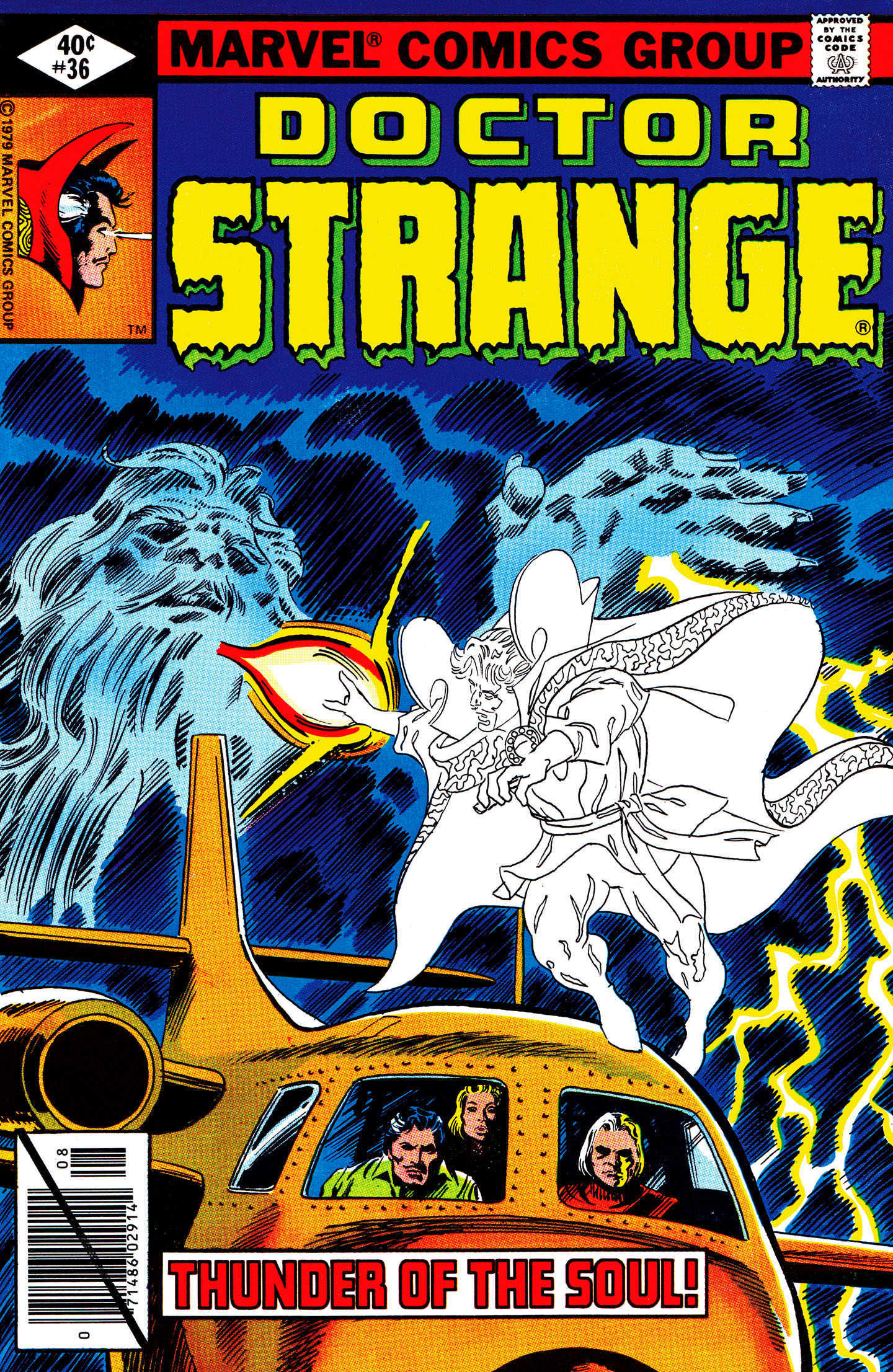


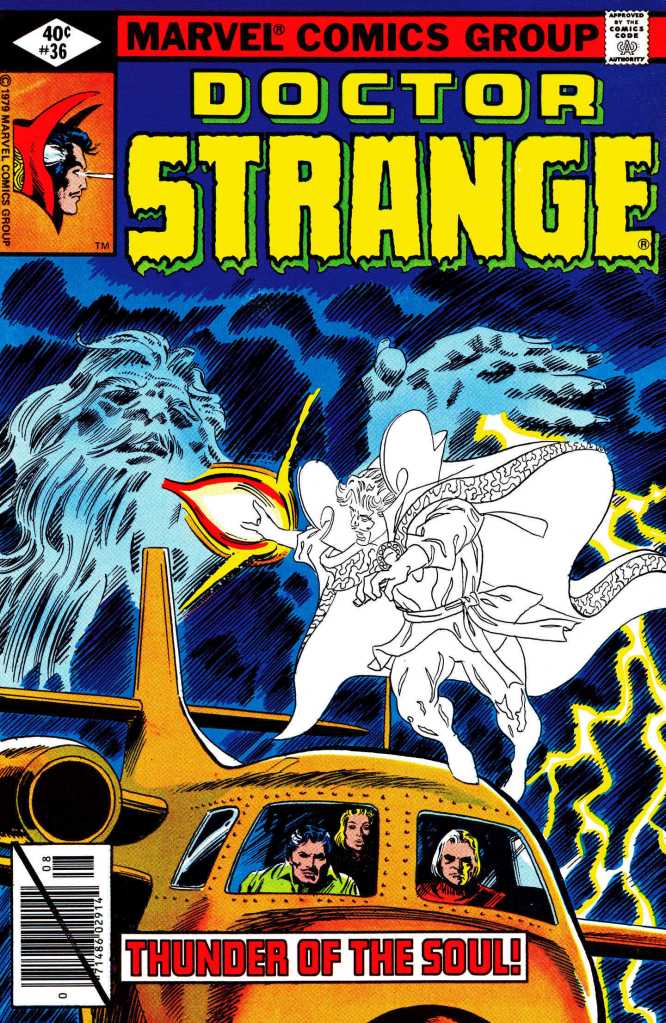
I was never really much of a DOCTOR STRANGE fan, and so outside of a few key runs, it wasn’t a title that I read avidly. Especially in the 1970s, when the tone and tenor of the series was being influenced by the wave of interest in the supernatural and metaphysical that was going on in the larger popular culture, I found the series to often be difficult to connect with. I was twelve, I didn’t really have broad philosophical concerns that I was grappling with, nor was I especially interested in spirituality. So DOCTOR STRANGE wasn’t really my jam. And yet, I bought this issue, largely, I expect, because I’d purchased the preceding two. it made so little impact on me that once again it’s a comic that I know I read but that I have scant memory of.
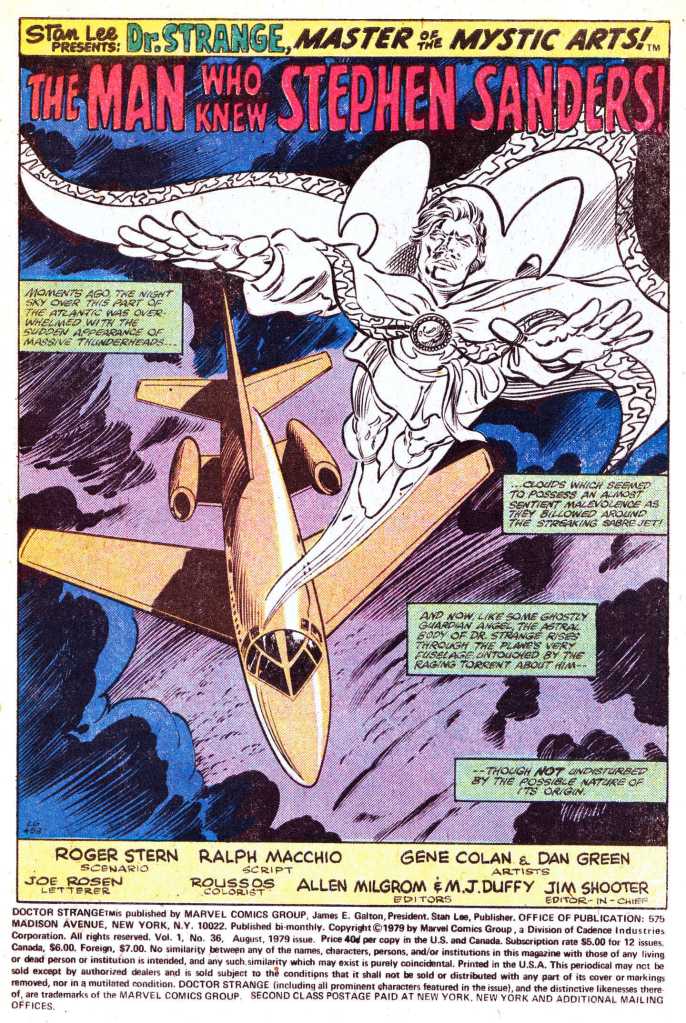
DOCTOR STRANGE had been in an almost constant state of turmoil since the sudden departure of writer Steve Englehart a few years earlier. No truly consistent creative team had stepped in to take over the series. Rather, there was a revolving door of writers who would produce an issue or three and then cede the assignment to somebody else. One gets the sense that, apart from Englehart, nobody up at Marvel really wanted to write DOCTOR STRANGE, at least not on a regular basis. This particular issue was plotted by the always-solid Roger Stern and scripted by Ralph Macchio, who had been called in to pinch hit on the book a couple times already. It was a yeoman effort, but as I said at the start, so unmemorable that it’s slipped from my mind almost entirely.

The artwork for this issue was produced by Gene Colan, an artist who was somewhat hit-or-miss for me. In part, this was due to the fact that Colan was notoriously difficult to ink well. He incorporated a lot of greytone work into his pencils, which made it an exercise in interpretation to translate his images into straight-up black and white. Colan also had a sort of personal relationship with anatomy, so his figures could sometimes feel a bit bloated or oddly-constructed. And his page layouts often tended towards the chaotic. Here, though, Colan largely makes good use of defining gutters, possibly urged to be more straightforward by editor in chief Jim Shooter, who felt strongly about clarity. Also, a bunch of the credit has to go to inker Dan Green. I don’t associate Green as an inker over Colan, but here he does a nice job of tightening up Colan’s looseness while maintaining the essence of his cartooning.
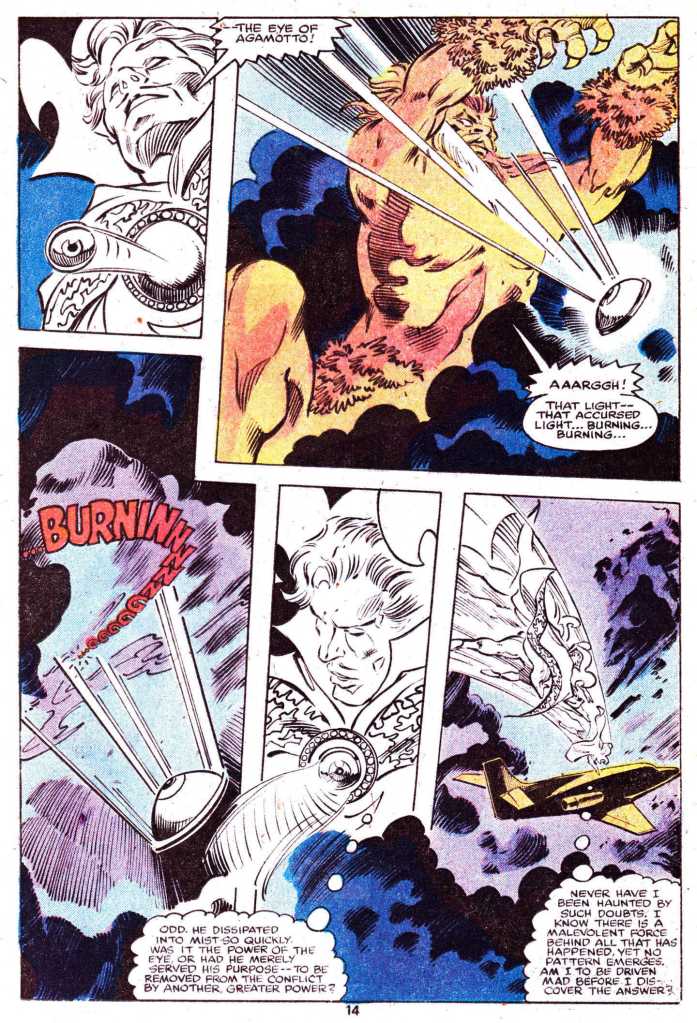
The story in this issue can only be described as a cornucopia of continuity clean-up. The issue opens with Doctor Strange, Clea and Murdoch Adams on their way to England to investigate the demon cult of Ningal. Adams, you see, had previously encountered this cult and this demon in a one-off story in an issue of CHAMBER OF CHILLS some years previously. He sought out Doctor Strange, but under the name Stephen Sanders, which was a short-lived alternate identity that Eternity had once created for Strange to operate under but which had been undone. The very fact that Adams remembers Stephen Sanders is what made him noteworthy enough for strange to meet with him in the first place. And all of this is recounted in a series of extended, foot-note-laden flashbacks that attempted to present all of this backstory in a digestible manner. I was usually a fiend for stuff like this, but in this instance, it was all so head-spinning that I didn’t connect with any of it.
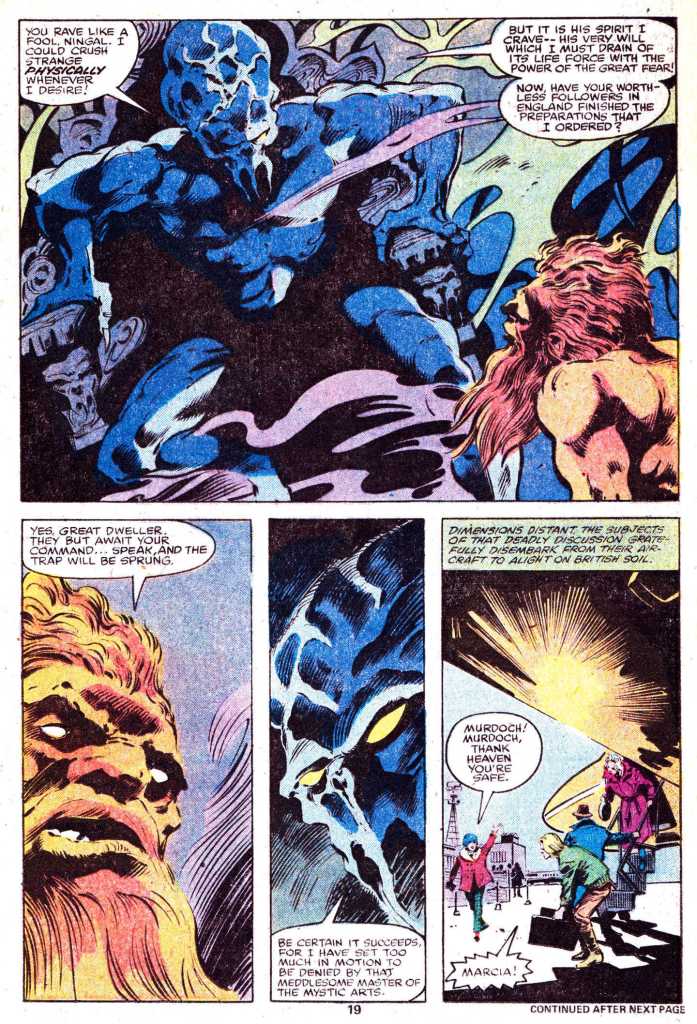
The group has also brought with them the petrified body of the Black Knight, who had been turned to stone several years earlier. They hope to be able to at last reunite Dane Whitman’s spirit with his body and restore it to normalcy. This too requires some extensive flashbacks to explain. To keep matters from getting entirely too encyclopedic, at the outset, Strange is forced to release his astral form to do battle with Ningal, who wants revenge on the trio for having killed his brother-in-arms Ludi last issue. Ningal, in turn, has been set upon them by the Dweller In Darkness, a malevolent entity who had been causing problems for Strange for some time, but who still remained largely undefined except as a string-puller of several lesser mystic threats. Anyway, after a bit of dancing around, strange is able to repel Ningal with the Eye of Agamotto, sending him back to the Dweller in momentary defeat.

Eventually, Strange’s plane touches down in England and the trio head out to Garrett Castle, the Black Knight’s homestead. There, they run into Victoria Bentley, another character from the past. Victoria had been saved from Baron Mordo by Doctor Strange in one of his first adventures, and they’d crossed paths a few times since. Here, she immediately makes Clea feel jealous. Strange and Clea begin to make preparations as they await the delivery of the crate containing the Black Knight’s body to be delivered from the airfield. it arrives in short order, but nosy old Victoria can’t help herself but to pry the lid off the thing and taking a look at it herself.
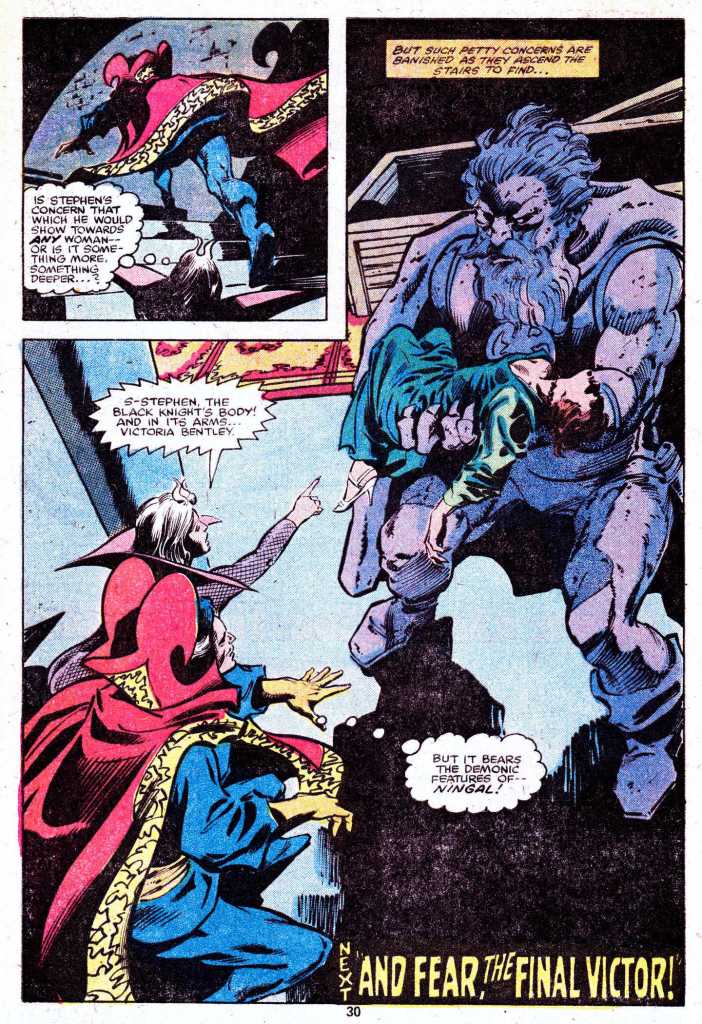
From there, we cut back to Strange and Clea as Victoria’s scream pierces the night. The two sorcerers come running in response, only to find themselves confronted by the statue of the Black Knight, reanimated and standing upright. What’s more, its features are now those of Ningal, and it holds the limp form of Victoria Bentley in its massive arms. Clearly Doc is going to have to do some crafty spellcasting to combat this renewed menace. And that’s where this issue s To Be Continued. I can see now why I don’t really recall this issue, as it’s relatively light on story events that aren’t recaps of older, earlier comic books.


I was always a huge fan of Dr. Strange. But that came with conditions. I wanted what I considered to be accessible, engaging stories that were unique to his particular wheelhouse of talents along with art that captured the incredible visuals associated with his mystical world. All of which is a long way of saying that like many others, I stopped collecting his series after the disastrous #19 where Steve Englehart’s final story is deconstructed for what appeared a far more mundane, duller future.
It wasn’t until the good Doc decided to rid the world of vampires that I returned. As much as I enjoyed Roger Stern’s work on the book at that time and going forward, this issue doesn’t appear quite as inspired. I also consider myself a fan of Gene Colan. But I also agree that he comes across far better with the right inker and when he’s on a series that best supports his unique style. As much as I typically like Dan Green’s inks, the overall art seems a few notches below the Gene Colan I so liked when paired with Tom Palmer some years earlier on this series.
This review also reminds me that at some point, I really need to use that Marvel.com site I pay for and read through the Dr. Strange issues prior to #60 when I returned. Any suggestions for a good starting point?
LikeLiked by 1 person
I would say #48, when Marshall Rogers began his six-issue run with Roger Stern. Issue #55, drawn by Michael Golden, is the high point between #48 and #60.
LikeLiked by 2 people
I’m always game to any issue with art from either Rogers or Golden. Thanks!
LikeLiked by 2 people
If you like Claremont comics, there’s an 8-issue Claremont/Colan run, in issues 38-45, that precedes the Roger Stern run you came back in the middle of. It’s not an epic for the ages, but it’s pleasant reading, and introduces one of the characters Roger makes very good use of later.
If you don’t like Claremont comics, then I’d start with issue 46, which has a lovely Stern/Golden/Craig Russell backup story that serves as something of an overture for Roger’s run. The rest of that issue is a David Michelinie/Kerry Gammill story that doesn’t do much — but again, it’s good-looking.
LikeLiked by 2 people
Given Claremont’s writing of Dr. Strange in that 1980 X-Men annual, I knew he had some familiarity with the character. Sounds like an excellent starting point.
And being from Oregon, how can I not enjoy anything from P. Craig Russell? Thanks!
LikeLiked by 1 person
You should probably be aware that the story crosses over into MAN-THING between issues 40 and 41. But it’s a Claremont-written MAN-THING, so it all fits together well enough.
LikeLiked by 2 people
Thanks, Kurt. I was glad to see Gene & Dan continued on the art all through that Claremont run on Dr. Strange. Then # 77 lists Roger Stern as writer. Gene & Dan are back, but it might have been their last issue together on the book before Roger & Austin joined Stern w/ #48. I really like the Colan/Green combination..
LikeLike
Ah, yes, a staple of Bronze Age Marvel: The story that exists mainly to tie up loose ends. Like Tom, I was very enamored of this kind of connect-the-dots world-building in my younger days, but less so as I got older. Speaking of Steve Englehart, he probably would have had a field day with this premise, since he was better than most at finding (or creating) connections between random back issues (The Celestial Madonna, the ’50s Captain America, etc.).
Dan Green was a great inker, as well as an excellent artist in his own right. I really enjoyed his brief stint pencilling Dr. Strange in the ’80s, as well as the painted graphic novel “Into Shamballa”
LikeLiked by 2 people
Have you read what he did with Carol Ferris’ past in Green Lantern? He took scenes from all the star Sapphire stories, redrawn faithfully by Joe staton, and made it seem there had been a years long plan for the character. The only downside was this story eventually led to Geoff Johns’ most tone deaf decision, making the Predator the avatar of the Star Sapphire Corps, the corps representing love.
LikeLiked by 2 people
That sounds pretty bad, but I’m not sure anything could top Johns turning Wonder Dog from the Super Friends cartoon into a hellhound who killed Marvin and crippled Wendy.
LikeLiked by 2 people
I forgot about that but I’m still gonna go with the embodiment of the force of love being the Predator as worse. Wendy and Marvin were just more of the unnecessary gore Johns can’t resist. Remember how the Shark was a super evolved shark with vast intelligence and mental powers before Johns had him turned into a man eating dullard?
LikeLiked by 1 person
There are chefs and there are line cooks. Alan Moore is a chef. So’s Grant Morrisson. “Chef Johns”? Maybe not. But he can serve up a bloody chunk of meat.
LikeLiked by 1 person
I tried to get into Doctor Strange a few times, but it only really clicked for me when Roger Stern, Marshall Rogers, and Terry Austin were at the helm. The earlier stuff was before my time and above my head at that point, and I was just never a big fan of Gene Colan’s art. I do remember an ad in various Marvel comics that set the stage for Frank Miller, but I never saw anything further……I stopped reading comics in mid 1983 when I went off to college.
LikeLiked by 1 person
Frank Miller on Doctor Strange never happened. Marshall Rogers began working on the feature instead.
LikeLike
There was a nice looking house ad though, wasn’t there? I’m glad looking back he didn’t do the book. His loose layouts looking as if inked with Sharpies by Janson turned me off of Miller long before those godawful Dark Knight sequels.
LikeLike
The Amazing Spider-Man Annual#14 ( 1980 – Spider-Man, Doctor Strange vs. Doctor Doom, Dormammu and Lucius Dilby. Plus their enchanted robot ) was the closest Frank Miller got to doing a Doctor Strange story ( script by Denny O’Neil ).
LikeLiked by 2 people
Miller did a very nice job with that annual. I wonder if it was an audition for the Dr. Strange assignment to some extent.
LikeLiked by 1 person
Dan Green’s a very underrated inker; he does a solid job on almost any penciler he’s handed. Over Colan, he does a straightforward job that doesn’t have the flash of Palmer, but it has a similar solidity to it.
Palmer, Janson and Leialoha are all standout Colan inkers of this era, but Green does well, preserving Colan’s strengths and not getting lost in his hard-to-interpret tonal work.
I think Roger has said that he wasn’t really able to focus on the book in his first run on STRANGE — he didn’t really have a vision for the book, and had too many other demands on his time, so he was just kind of marking time (and addressing plot danglers in Marvel’s mystic sphere). But with his second run, he really got a handle on the book, and it was a treat to read.
LikeLiked by 3 people
I enjoy the Ditko Doc Strange all the way around… because the stakes and the grudges seemed way more grounded in the early days. Ditko pretty much nailed it all down in pulpy fashion making it a hard act to follow.
I think Doc adds gravitas as a member of the Defenders… but absent Ditko or the Defenders I’m generally lukewarm on solo Doc regardless of the creative team…. and he’s had a number of folks who handle his solo adventures that I very much enjoy… Everett, Englehart, Colan, Brunner, Stern, etc.
He has a great looking costume, a cool hangout, and good looking girlfriend… I think I just don’t cotton to the undefined 70’s swirly magic angle and that he’s the all around best at it. He’s obviously somewhat of a hard sell for a lot of readers. I’ve tried… but I only have enough space for one egocentric guy with a pencil mustache who can pull off miracles and that’s Tony Stark.
The interior art here looks pretty good… but that cover is very awkward and undramatic compared to the first page splash imo.
LikeLike
I think the Ditko STRANGE is terrific, and I’m not sure Strange stories get any better than that huge long epic at the end of his run.
But I like Dr. Strage when there’s a good voice behind him — the murky powers are such that he depends on style more strongly than the more conventional superheroes, and a vague portrayal plus indistinct powers leads to mush. But when a writer can make you believe that the spells Strange is uttering mean something to him, at least, even if we don’t understand them, and that his world has coherence to the characters in it, I love it.
Ditko/Lee, Englehart/Brunner/Colan, the second Stern run…they’re all very different, but they all feel solid to me, because the writer’s vision (and the artists’ visuals) carry the stories. I also like a couple of Thomas runs, but he had a habit of getting nonsensical as he got to story climaxes — or later on, getting way too interested in the kind of continuity-spackling Stern and Macchio are doing here. But when it cooked, it cooked, with a strong voice and an artist who could handle both the mystic and the mundane well.
I see what you mean about the cover — the plane is so flatly aligned it could be parked on a runway, so while the figure of Strange is good, the rest seems static, not caught up in a dramatic storm, the way it seems intended to. It looks to me like a Cockrum rough, and maybe he expected Colan to vary it more. At least tilt the plane some, make the passengers seem alarmed and reactive. I can’t tell whether the inks are by Green or Milgrom.
LikeLiked by 3 people
All good points.
I’ve tried with Doc off and on since 1974 and Ditko is the only guy that sticks the landing for me… but I have missed some of those runs.
The cover inks look more like Milgrom to me. Yeah.. the static plane could be parked on a runway and the background menace isn’t that threatening. I think that on a cover…Strange leaving his corporal form behind on a plane is a critical dramatic point… and you’d have to be an avid reader to understand that his body is on that plane. I think the narrative on the splash is better all around because it’s clear that he’s ghost flying from a plane….better dramatics all around with fewer elements that don’t add up to anything.
LikeLike
Kurt, you wrote (or “co-wrote” w/ the wonderful Mary Jo Duffy) Dr. Strange in a Defenders miniseries. Have you written him elsewhere? Seems well within your wide scope of characters. The gravitas, his expertise, his intelligence. And your obvious love and respect for the character. I’d think it’d be a good fit for you and for Doc. Same for Marv Wolfman; I’d imagine he wrote Doc at some point, even if it was a guest role in his “Dracula” series.
LikeLiked by 1 person
Marv Wolfman wrote the infamous – at least to me – Dr. Strange #19 where he dismantled every plank of Steve Englehart’s previous story. (I still think Clea and Ben Franklin made a cute couple!). I’m not sure how much longer he was on Dr. Strange since that was my last issue until #60. I also acknowledge that with Englehart’s having left Marvel, someone had to write the book and do so in manner more suited to their style.
LikeLiked by 1 person
“Marv Wolfman wrote the infamous – at least to me – Dr. Strange #19 where he dismantled every plank of Steve Englehart’s previous story. Marv Wolfman wrote the infamous – at least to me – Dr. Strange #19 where he dismantled every plank of Steve Englehart’s previous story. (I still think Clea and Ben Franklin made a cute couple!). I’m not sure how much longer he was on Dr. Strange since that was my last issue until #60.”
He wrote another three issues and an annual. And a few other appearances.
It’s hard to blame him for the end of “The Occult History of the United States,” since when Steve abruptly quit, someone had to write the next issue, it was probably already late, and no one had any idea where the story was intended to go. Even Steve couldn’t have provided a map, since he was a seat-of-his-pants plotter, but in this case he wouldn’t have shared his plans even if he had them all worked out.
So turning it into a big hoax was probably the best solution anyone could come up with under the time pressure they were under. It wasn’t a good solution. But I don’t think anyone at Marvel at the time had the knowledge of the material Steve was using, about Franklin and the occult texts and all that came from history, to be able to plot out a satisfactory conclusion, even if they’d had more time.
But I’ve always wished we could get a real ending. DOCTOR STRANGE: ELSEWHEN, anyone?
LikeLiked by 3 people
This would’ve been the perfect year to do it, too, with the USA turning 250. Ah, well.
LikeLike
Sure, I co-wrote the 12 issues of DEFENDERS that preceded that mini, as well. And I wrote him in the STRANGE TALES one-shot I did with Ricardo Villagran. And in UNTOLD TALES OF SPIDER-MAN: STRANGE ENCOUNTER and a few other places.
I’d like to have written an ongoing stretch of DOCTOR STRANGE, but things never came together that way. I’d also really like to have done it with Gene, and that ain’t gonna happen, so even if I did a run today I don’t know who’d draw it…
LikeLiked by 2 people
Thanks, Rick! Agreed that other writers will write in their style or to their strengths. But I’d hope if it’s a strong character, well established, that the writer’s style is compatible, and can use their writing strengths to be true to the existing character. It’s been a bummer for me when a new writer comes onto a book, and the character loses some of what made them so good. I mean in how they’re written. The dialog. The stories. The personality traits.
Even great characters suffer from weak or bad writing. Batman’s my fave, and widely regarded by most as a great character, but certain writing and art has kept me away from his books off and on for years. Really good or great art might keep me on a stint of bad writing. And there are a very few writers that can keep me reading a book that has bad art. Finding a series that satisfies with both is rare and a real pleasure.
LikeLiked by 1 person
I actually talked briefly with Steve Englehart in 1988 about his “Occult History of the United States.” He said something to the effect that the sorcerer he was crossing swords with was essentially consuming mystical energy through history. Or something along those lines. He also said that a lot of people ask him about that particular storyline.
No fault assigned to Marv Wolfman or Alfredo Alcala for his art on #19. It’s more that both were quite jarring compared to the previous issue.
Although I haven’t read new comics in several years, I had again dropped Dr. Strange with Mark Waid’s run. Not that the writing was bad – it wasn’t! – but his take on the character didn’t work for me. But that goes to Kurt’s comment about finding the right angle or “voice” for Stephen Strange to truly work as a comic. It seemed that part of him changed with every new writer with some better than others, but none of it approaching Ditko, Englehart or Stern.
All of which is to say I’d return to collecting if Kurt gave the good Doc a go. 😊
LikeLiked by 1 person
“All of which is to say I’d return to collecting if Kurt gave the good Doc a go.”
I appreciate that, but I wouldn’t hold my breath.
Still, you never know. Or at least, I never do.
LikeLiked by 2 people
@ Kurt, “even if I did a run today I don’t know who’d draw it…” 2nd name that came to mind was Pat Oliffe. I don’t know if James Fry III is still working, his was the 3rd name I thought of. If I had the authority, I’d want a lead 16 pager by you and whichever artist. And then a quick 4 pages a month (for a 4-6 issue miniseries) of a side feature also written by you drawn by Neil Vokes.
If those artists couldn’t do it, and if I had unlimited Marvel resources, I’d ask Pepe Larraz (why not swing for the fences, even if chances are I’d strike out), or 1 of the Silvas (R.A,? R.B.?).
LikeLike
The Dweller-in-Darkness ( marvel.fandom.com ) now: The Dweller-in-Darkness, who described himself as an elder god, originated from the dimension Everinnye, and survived from a previous universe, where he fractured the M’kraan Crystal in an effort to destroy reality as a whole, creating fear throughout the universe that would feed his appetites. Instead the Phoenix Force united the minds of the dying universe, preventing them from being afraid, and foiling his plans.
LikeLiked by 1 person
I wonder if the Dweller-in-Darkness and Ulluxy’l Kwan Tae Syn [ Marvel Presents#1 ( July 1975 — Ulysses Bloodstone’s first appearance ] heads were influenced by H.P. Lovecraft’s Cthulhu?
LikeLiked by 1 person
Oh god, the Dweller in Darkness. A string of issues where, as here, he sits ominously — in darkness — sends out minions and ominously pontificates on his big and evil plans. And then the big finish was declaring “I have scared Dr. Strange! I win bigly!” and going to sleep. It was underwhelming.
LikeLiked by 1 person
Sounds like some of the senior managers at most big companies. 😉
LikeLiked by 2 people
And I mean of every business/industry. Just goofing on my own experiences. Wasn’t targeting comics companies.
LikeLike
I love a lot of Gene Colan’s work. And it really clicks more with/on some characters more than others. Dr. Strange is one of the “more” characters. The surreal, ethereal nature of his powers are well served by Gene’s wispy, moody art that communicates the surreal and ethereal. I agree with Kurt and some of you that part of that depends on the inker.
I wouldn’t have Steve Mitchell ink Gene on Dr. Strange (maybe on Iron-Man, but not the Spectre, which he did ink over Gene’s drawings for many issues). Tom Palmer, yes (as seems to be the majority view, for obvious reasons). Klaus Janson? Oh yeah (my fave inker for him on Batman).
There was a Marvel Fanfare story for which the great Al Williamsin inked Gene’s Dr. Strange. I’d say it was exquisite. I wonder how many times they collaborated? What a treat.
Dan Green inking Gene Colan’s art seems rare to me. I can’t remember when else it happened, but as two longtime professionals who worked for multiple publishers, it’d seem there would be many opportunities for them to’ve been matched up together. And I see how Dan’s think use of black ink would be complimentary to Gene’s atmospheric style.
I really like the art in this issue. The lighting and shadows. The textures of zip-dots and slick brush strokes. Dan Green was one of the very best. Yeah, Gene had his own expressive, interpretive “Col-anatomy”. 😉 But he still told a story very well, and his art was emotionally evocative. I wouldn’t have assigned him to extensive runs on every character. But I’d be interested in seeing his interpretations of almost every Marvel & DC character at least once.
LikeLiked by 1 person
Wanted to mention perennial great George Roussos. His hues of blues and purple shades add a lot to the visual mood. Reminds me of another great, Jerry Serpe, who’s colors really caught my eyes. Pretty sure on some Aquaman stories.
LikeLiked by 1 person
*Al WilliamSON. (Tim’s Typos Dept.)
LikeLike
I also really liked Bob Smith’s inks over Gene Colan’s work. Especially on “Night Force”. Bob also inked many of Gene’s Batman stories in “Detective Comics”. And I liked those, but they suffered a bit by comparison to Gene’s Batman inked by Klaus Janson. There was just a great synergy or chemistry when Gene’s and Klaus’s styles joined forces. And it fit Batman, for me, perfectly.
Similarly, I think the handful of issues Klaus inked Graham Nolan’s drawing of Batman stories in the 1990’s were my favorite stuff from Graham. Klaus is one of “my” definitive inkers for Batman. The 1 issue of “Detective” he inked over Pat Broderick’s drawings of Batman feels “more Batman” to me than any other time I’ve seen Pat’s Batman.
Bob Smith was exclusive to DC for much of the 1980’s, maybe longer. But I’d’ve liked to have seen Bob ink Gene on some Marvel stuff. Though Gene was gone from Marvel for most of the 1980’s because of his and Jim Shooter’s strained working relationship. Bob did some beautiful collaborations with Don Newton. “DC Comics Presents” # 54 (Superman, Green Arrow, & Black Canary). “The Brave & the Bold” # 156 (Batman & Dr. Fate).
LikeLiked by 1 person
I thought Bob Smith was an excellent inker — especially over Ramona Fradon and Joe Staton — but I wasn’t as fond of his inks over Colan. Still, DC didn’t have many ideal Colan inkers, and of the talent pool they had, Smith was one of the better choices.
Much better, to my mind, than when they gave up and buried him under Alcala and DeZuniga.
LikeLiked by 1 person
Maybe because it’s because I had less pre-conceived expectations for “Night Force” and what the characters should look like, but there are many panels and pages by Gene & Bob that really pull me in. The dramatic lighting, the textures. The linework is very rich and expressive.
On Batman it wasn’t quite as exciting, because I had Gene & Klaus’s work which set the bar almost as high for me as it could go. So Bob inking Gene’s Batman didn’t give me the same buzz. But better than many other of Gene’s inkers. And Bob’s inks worked very well on Gene’s stuff for characters other than Batman. I’d’ve had Bob ink Gene’s Spectre. Of course, Dan Green’s inks would look great over Gene’s Spectre, too. 😉
I wonder what Gene’s work looked like under the inks of another very good inking Bob, Bob Wiacek…
Bob Smith’s inks, as much as I did really like them, seemed very, maybe even unusually faithful to the original pencil drawings. His inks seemed softer, elegant. So, an artist who drawings were looser, less complete, that maybe needed more of a finisher/embellisher (open to interpretation, I know), might have some loose ends or flaws get inked as they were.
Bob’s inks looked best to me over artists who were drew really well.
LikeLike
Bob Wiacek inked Gene on WHAT IF 21, a short HULK magazine story and this and that else, including the covers to AVENGERS 208 and DOCTOR STRANGE 35.
It looks fine; very good on the tight stuff, but rather than go with the flow on the more gestural stuff, Bob tries to tighten it up, with mixed results. But certainly, Gene’s had much, much less skilled inking.
LikeLiked by 1 person
Thank you, sir. Much appreciated. I’ll try to look up those Colan/Wiacek collabs.
LikeLike
That “What if…” # 21 had come up last week, when Tom posted about “What If…” #1. Spidey joining the Fantastic 5. Issue #21 was then the follow up to the timeline in #1. Strange that the same story came up so soon after, because of the art team. I didn’t realize it until I saw the cover to #21 again. 😉
LikeLike
Kurt writing and Alan Davis drawing would be my choice. When we’ve seen it Alan’s Dr Strange has most obviously been influenced by Ditko while at the same time looking modern.
LikeLike
If I recall correctly, this Doc Strange story finally got rid of one of Englehart’s worst plot-devices: turning Black Knight’s body into stone while his spirit went back in time, found or made a body and decided to fight in the Crusades. Steve E also introduced, for the space of one panel, the idea that Valkyrie had fallen in love with Whitman, with whom she’d barely interacted before Enchantress stone-zoned him. I guess maybe Englehart had some rough notion for a future plot there, but it was never even close to being realized, maybe because such a realization might have messed up the status quo of Valkyrie having co-opted Whitman’s flying steed.
Oh, well, it’s been truly said, possibly by the Vishanti, that you must take the good and take the bad, for such are the facts of life.
LikeLike