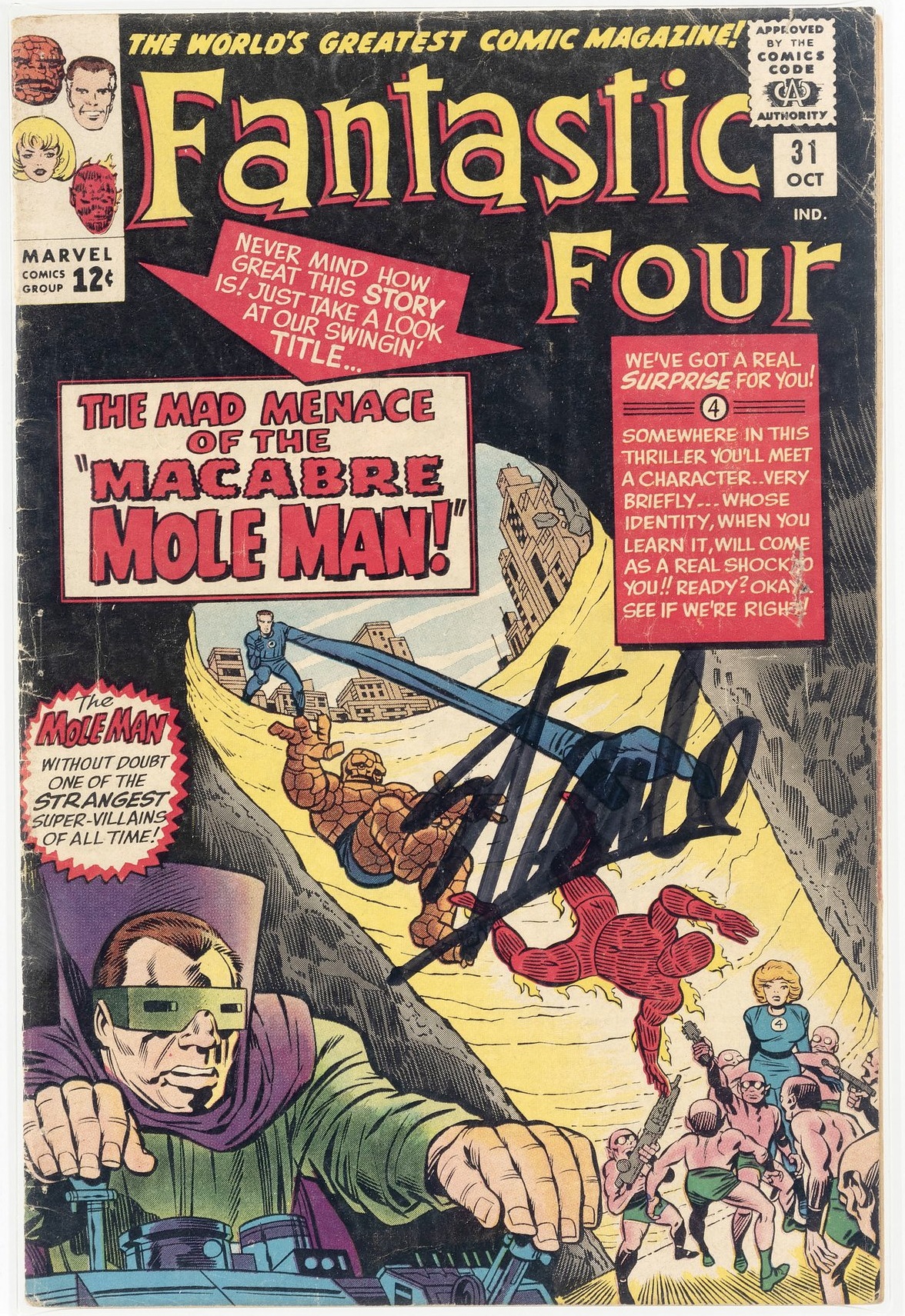


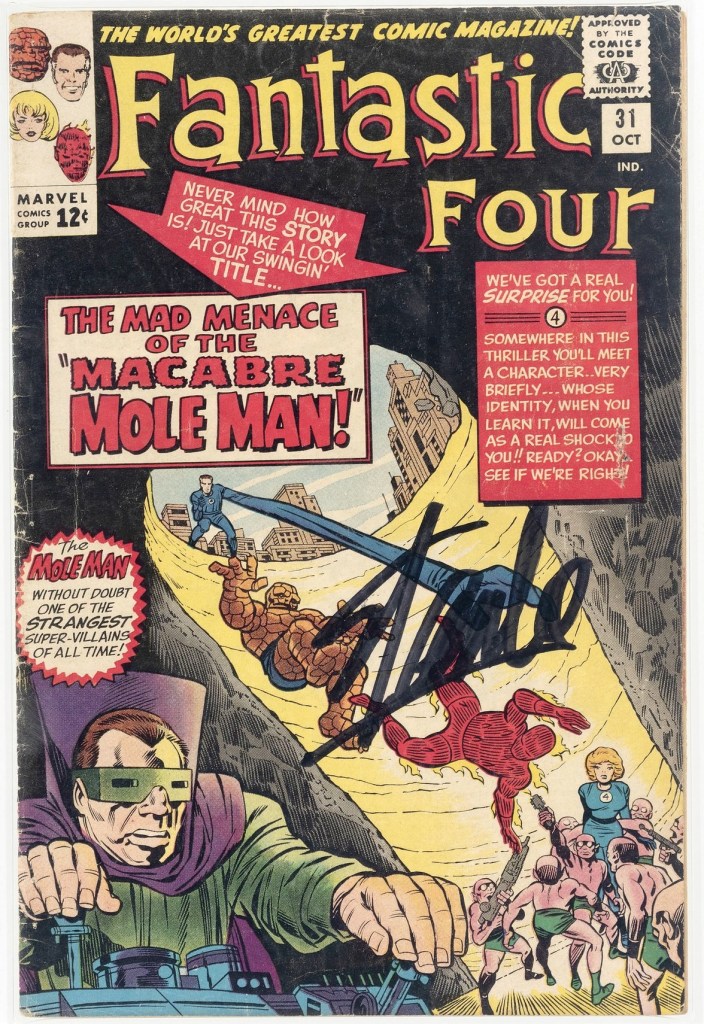
I had written about this a little bit before, in the context of a broader review of this early issue of FANTASTIC FOUR:
But creator Larry Lieber had held onto a discarded page from this story for all these years. I’d seen a bad photocopy of the page at the time I wrote that original piece–it had turned up among transcripts from one of the Marvel trials of that time–but the copy that I had was poor, with the artwork breaking up and Jack Kirby’s original border notes indecipherable. Just from context, i conjectured that the page may have indicated that the character being introduced here was not Sue and Johnny’s father Franklin Storm, as the finished story indicated, but rather instead some old beau of Sue’s As it happens, Larry is in the process of having portions of his collection auctioned off, and wouldn’t you know it, this discarded page was one of the listings. What’s more, there are far better scans of it that can enable us to make out some more information about it. So let’s take a closer look at it and see what we can see.

Above is the raw scan of the pages that appears at the Heritage Auction site. It’s already a much better copy than what I had to work with initially, but it’s still a bit difficult to completely decipher. Fortunately, rather than having to do the conversion work myself, Arlen Schumer took on the task of darkening up the piece for his own post on the subject, so it’s his version that you see below.

With this much better image of the page at hand, I’m willing to draw a couple of conclusions. The first of which is that this character is clearly intended to be the same Franklin Storm who appears in the rest of FANTASTIC FOUR #31. From Kirby’s border notes, it is clear that he intends for this to be Sue’s father (though at this point in the story, the reader isn’t meant to know that yet.) And in fact, this page, labeled as Page 6 here, slots smoothly into the issue as it was published. What’s more, FANTASTIC FOUR #31 was the first issue in which the printed length of the main story was reduced to 21 pages from 22, as had been the case on prior issues. So it seems clear that the need arose to cut one page from this story that Kirby had completed, and this was the one that Lee selected to be excised, reckoning that the story would still work without it. It does seem to slot in perfectly between Pages 5 and 6 of the published version.
As was becoming a regular part of their working relationship at this point, Kirby not only plotted and drew this page, but he also provided Lee with border notes to guide Stan in crafting the final dialogue for the page. The border notes give a clear insight as to his intent for this sequence. I’ve taken the liberty of deciphering as much of them as was possible below:
PANEL 1
YOU LOOK 20 YEARS YOUNGER ALREADY
YOU’RE SO CHARMING, DOCTOR
PANEL 2
SUE ENTERS. SEE DAD WORRYING OVER LARGE CHECK
PANEL 3
GIMME THAT!
WHO TOOK IT?
PANEL 4
ME–YOUR CONSCIENCE
PANEL 5
SUE–IT’S YOU–WHERE DID (something)
PANEL 6
GLADDASEEYA! I’VE BEEN IN JAIL
CAN’T SPOOF ME! YOU’RE UP TO YOUR OLD TRICKS! A STEP AHEAD OF THE COPS!
PANEL 7
FIRST SHOCKS BEGIN TO TREMBLE IN BUILDING
And there’s also a handwritten note from Stan Lee of the sort he’d sometimes write to himself after going over pages with Kirby as a reminder to himself as to what was going on in a certain sequence:
SHE DOESN’T REVEAL WHO HE IS–


That’s a lovely page, and a fascinating insight into the Lee/Kirby creative process.
Also, comparing this page to the finished pages reproduced in your earlier blog covering the whole issue reveals how faithful Chic Stone’s inks were to Kirby’s pencils.
LikeLiked by 1 person
This page is going to haunt me. Imagine if Lieber was right, and Sue had an older boyfriend before she connected with Reed (and we’ll neglect the fact that at the time of publication, it wasn’t really clear how old Sue was when she started dating Reed). I mean, how much does the character of Sue change in the reader’s mind if Sue’s type was much older men? I mean, between Reed, Namor (older than Reed!), and this guy…
LikeLike
Very nice! A cool find.
And Kirby’s character acting — both physical postures and facial expressions — is great here. Sue’s emotional attitudes are vivid throughout, and even little moments like in panel 2, where the rich lady is waving goodbye, besotted, and Dr. Storm is already ignoring her (and Sue is tiptoeing in carefully) are just great.
LikeLiked by 1 person
A sleazy dad is great for story but an older ex-boyfriend would have been a great way to negate Byrne’s thing with females being inappropriately younger than their beaus.
LikeLike
I agree that Byrne having Sue flirting with Reed as a very young girl is way off putting, but we could still presume that Sue could have also had a relationship with another suitor at some point while Reed was out of the picture…while at war on in college. This guy might not be much older than Reed as depicted in the pencils… but the lady leaving sure is. I presume they are a set.
I gotta say…until this thread I never considered that Sue’s attraction to Namor and Reed was a big clue she was just into older guys. Classic Reed definitely presents as a father figure to the team, but Namor is a bad boy, forever young rebel from the deep even to this day despite being born in the 20’s. He has more in common with an immortal god than he does with Dr. Reed PHD I think.
LikeLike
I think the Sue/Reed/Namor triangle was meant to be the standard soap-opera situation of a woman (Sue) torn between the stable, solid “family man” who is also somewhat distant and unemotional (Reed), versus the spontaneous, impulsive, “wild and crazy guy” who is demonstrative and passionate (Namor). Being a wild guy skews younger, and family man skews older, but I don’t see those as absolutes.
The key character point of a pre-Reed boyfriend might not be age so much, but rather emotionally manipulative.
LikeLike
So many balls to juggle at this stage of the game! Every panel complete but hey… I gotta leave also space for the still non-existent word balloons and captions. Incredible!
LikeLike
The idea that Sue’s much younger than Reed was due to the fact that if Sue was Reed’s age, she’d be older enough to be her brother’s mother. But the way John handled it was the misfire — they probably shouldn’t have met (or at least not more than glancingly) until Sue was older.
There was also a clash between the fact that Sue was described as a “socialite” early on, and was later shown to have been growing up in a home where they had to take in boarders to get by. But that had already been messed up a bit by establishing that Sue and Johnny were living in a modest house in suburban Long Island; not exactly socialite living…
LikeLiked by 1 person
Though it’s not implausible for Sue to be much older than Johnny. If Mother Storm had Sue when she was young at around 20, and Johnny was a “late life”/”surprise” baby when she was around 40, that’s completely biologically reasonable and not at all shameful. It could even be pushed further via making Sue a result of teen pregnancy, and Johnny a result of Mother Storm wanting another kid once Sue is an adult, due to “empty nest” feelings (and that taking a while).
At the start of FF#1, Johnny could be 15, Sue 36, Reed 39. Of course later time-scale starts having problems. But maybe the best solution is just not trying to resolve that point, if it means going into murky character waters.
LikeLike
It not unworkable to give them that kind of age gap, but it’s a little awkward. Splitting the difference — making her more like 25-26 at the start of the series — means there’s still an age gap, but not such a bizarre one.
Just don’t have Reed meet Sue while he’s a college freshman. If you want to have them meet in a university setting, wait until Sue’s in college and Reed’s been working on six doctoral dissertations at once.
Better yet, have Ben meet her first, since it feeds the short-lived romantic triangle among them well, and stitches Ben more firmly into the “family.”
LikeLiked by 1 person
I also recall a 70’s reprint of an early FF story with both Reed and Ben fighting in the “Big One” with Roy adding that Reed had to have signed up for the Korean War as well since Sue wasn’t that old. Marvel was clearly trying thread the age needle then almost on a year by year basis.
LikeLike
That wasn’t a reprint, I think, but a retelling, from when Roy took over as regular writer, and as he often did, gave the artist a framing sequence and a retold story Roy didn’t have to plot, so the artist had something to draw while Roy figured out what to do with the book.
And yeah, that may have been the beginning of the “age gap” thread — but it was pretty clearly done because Roy didn’t want to imply that Sue was old enough to have been someone’s girlfriend thirty years earlier.
And then, even when they dropped the idea that Reed and Ben had WWII histories, they kept the part about their being an age gap. Which at least works with Johnny’s youth.
Mostly, though, I bet Jack and Stan didn’t stop to figure out the characters’ ages, and what it meant for how they met and or grew up, back when they were creating the book. They just wanted a grey-templed scientist, his hot girlfriend and her little brother, plus — well, they hadn’t figured out that Ben was a longtime friend yet, either. He was just a pilot Reed knew somehow, and they’d figure it all out later, if this crazy book took off.
LikeLiked by 1 person
It might’ve been referenced in a retelling too, but Rick’s referring to Marvel Treasury Edition #2, which featured a reprint of FF #11. There’s a flashback panel of Reed working with the OSS during WWII, he makes a reference to “the girl I left behind”, and Roy adds the footnote as described.
LikeLiked by 1 person
Ahh, okay.
Either he did it twice, or I’m just misremembering. Or both.
LikeLiked by 1 person
J. Kevin’s right. I was referencing that Treasury Edition. But you picked up on my point that somehow these characters that they’d created over a decade earlier now faced the unexpected challenge of aging as they’d tied them into specific events like WW2. Overall, if you’re a comic book company, it’s a nice problem to have.
LikeLike
Apologies in advance because my issue numbers here will be approximate.
My working theory, based on others, is that Kirby was the dominant creative on the book for a few years.
I tend to peg it with the return of the Frightful Four circa issue 37. It becomes obvious toe me with the betrayal of Ben Grimm a couple of issues later. That period ends circa the “Beehive” issues. If my estimates are correct, besides having a plot Lee strongly disliked enough to rewrite while scripting, its creation is around the same time as the Herald Tribune debacle of crap reporting and its dissing of Kirby.
After that, Lee was back in on actual plotting, becoming ever more the dominant plotter til the end of Lee/Kirby run.
Now, where I get confused sort of is that I’ve seen Kirby’s dominance starting as noted above — but that Hulk/Thing story in issues 25 and 26 can only be Kirby to me.
Tom’s post here somewhat clarifies that that domination (if of course that’s accurate) started earlier than my estimate, although I’m not so sure it started with issue 25. Maybe Kirby just presented a really strong plot at a conference with Lee re #25, maybe, again, Lee had a lot of input but the plot resonated with Kirby and we got, what was at the time, a real banger of a story.
LikeLike
I think Kirby was probably doing the lion’s share of the plotting from very early on — I think it’s the first or Puppet Master story where the end of it is lifted from a story he’d edited and drawn (and maybe co-written) years before? — and I’d bet that by the end, Kirby was virtually the sole plotter. What you see as Stan returning as main plotter is just Jack choosing to be less inventive, to give Marvel fewer new characters, less ambitious plots, saving his new ideas for later. The Beehive story wraps up around issue 67, but the story where they’re trapped in Latveria in 84-87 is built around Kirby’s enjoying the PRISONER on TV, and the story where Ben Grimm is taken to be a gladiator in the Skrull Empire (90-93 or so) is Kirby being inspired by a STAR TREK episode he liked.
I think Stan did a lot less of the plotting that people tend to assume, which was why he wrote the credits the way he did — to create that inaccurate assumption.
LikeLike