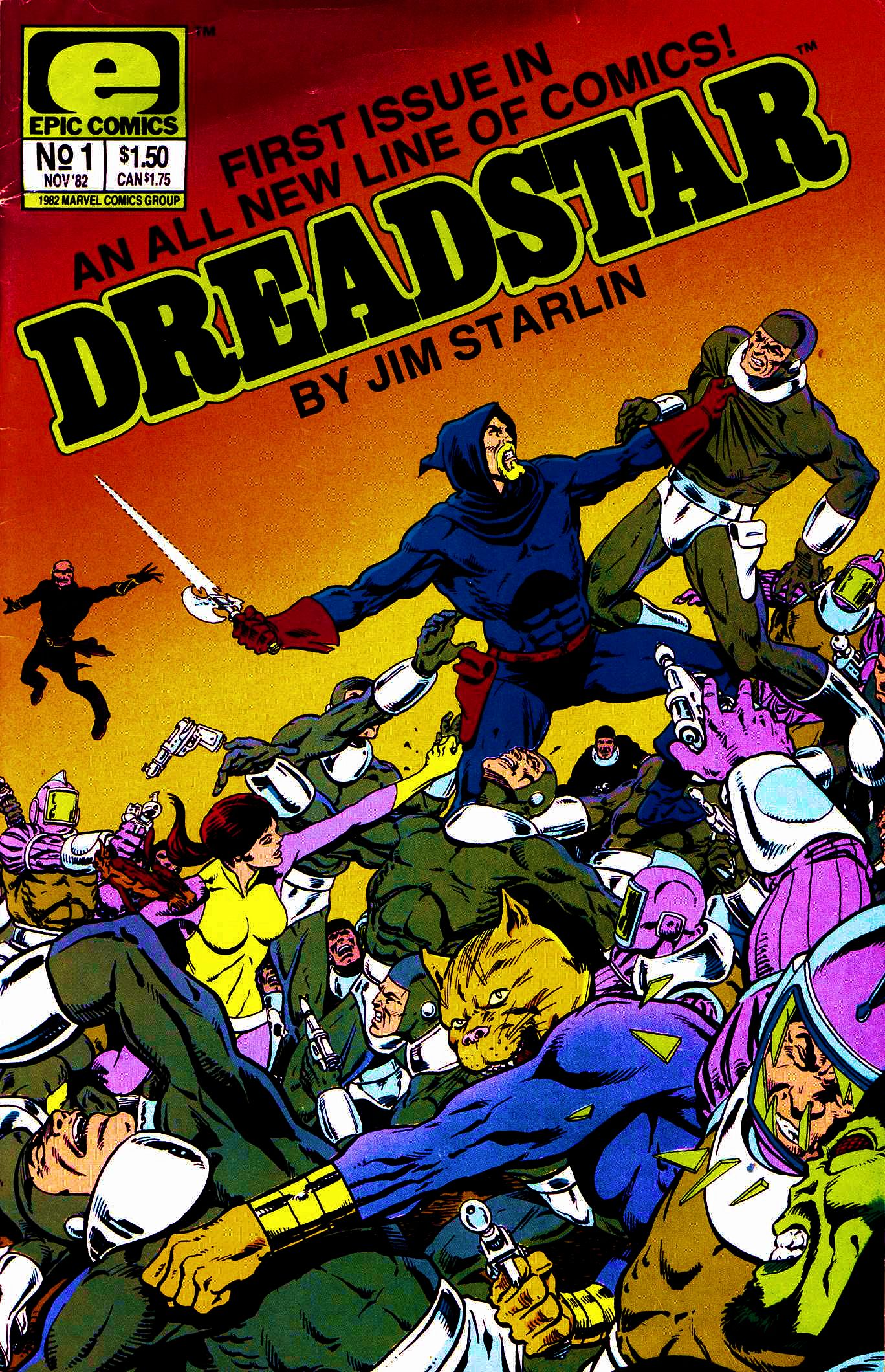


In 1982, the comic book marketplace was expanding. The Direct Sales network of comic book specialty shops had proven itself as a viable alternative to mainstream newsstand distribution, and so suddenly all sort of publishers were jumping into this new market with a variety of releases, some more polished than others. It was an exciting time to be a reader. One of those who were most aggressive about the new marketplace was Marvel, and it’s no wonder. At this point, Marvel’s sales made up close to 70% of this market, so it’s no surprise that the organization would tailor new initiatives to take advantage of that success. One of those initiatives was the creation of Epic Comics, an imprint spun off from the regular EPIC ILLUSTRATED magazine in which creators could retain the rights to their own work. It was seen as a way of winning back key creators who had left the fold in part due to changes in copyright law, giving them a place where they could bring their ideas to market backed by Marvel’s bankroll and clout in the industry. The first Epic Comics release was DREADSTAR #1, the continuation of a storyline that creator Jim Starlin had initially spooled out in the pages of EPIC ILLUSTRATED.

I had been a regular reader of EPIC ILLUSTRATED and Starlin’s METAMORPHOSIS ODYSSEY had in particular grabbed my attention. It seemed more sophisticated and adult than most of the rest of what I was reading–and that wasn’t just down to the bare breasts that appearing in EPIC ILLUSTRATED permitted. The strip was presented primarily in black and white, with certain chapters painted in full color, and I found it to be a gripping cosmic saga. So when Starlin decided to continue to produce material with the surviving characters, first in the one-off graphic novel THE PRICE for Eclipse and later in a MARVEL GRAPHIC NOVEL dedicated to Vanth Dreadstar, I was there for both of them. There was an additional DREADSTAR story that saw print in a later issue of EPIC ILLUSTRATED but which had been created to run as the lead feature in BIZARRE ADVENTURES, Marvel’s black and white magazine. But BIZARRE ADVENTURES changed format, and the decision was made to run that one story in EPIC ILLUSTRATED and instead launch DREADSTAR as the first of the new line of creator-owned Epic Comics.

And it has to be said, DREADSTAR #1 was an attractive package. It cost more than a typical comic book of the era, priced at $1.50, but it was on much better paper with much brighter coloring. And the story took up the entire issue, a whopping 32 pages. However, not everything was a plus-up, not in my opinion. As i said earlier, I liked the fact that METAMORPHOSIS OSYSSEY and its offspring felt more sophisticated than a typical Marvel comic. That all went away with this issue. Rather than being painted, the artwork was delivered in the typical pen and ink style. What’s more, there was a subtle shift in the manner in which the characters were depicted. To be blunt, they started looking and feeling more like typical super heroes, like figures that wouldn’t have seemed out of place in DC’s OMEGA MEN or the like. This shouldn’t have been a big problem for me as I liked super heroes, but it really was. It felt like the specific flavor that I came to DREADSTAR for had evaporated overnight. And so this first issue was the only one that I bought, at least as it was coming out.
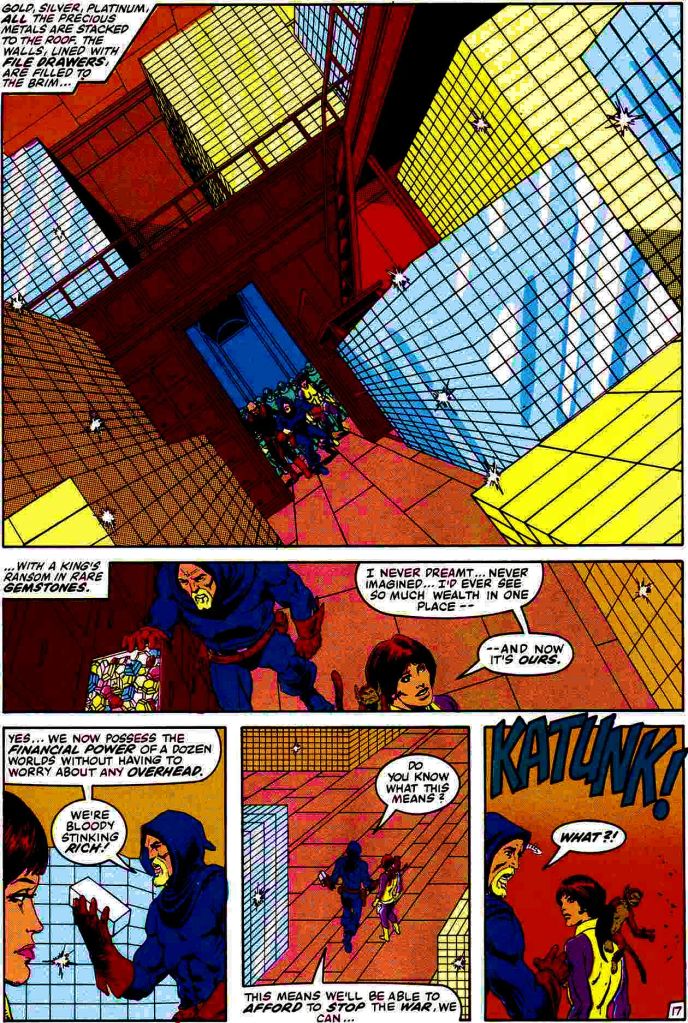
The truth is that METAMORPHOSIS ODYSSEY and its offspring weren’t really as worldly and adult as my younger self had thought them. Looking back, they really do feel like a hybrid, a cross between Jim Starlin’s typical cosmic sagas and the prevailing influence of STAR WARS upon popular culture. The main thrust of the ongoing comic book, at least at the outset, was a return to one of Starlin’s favorite themes: overthrowing an oppressive religious regime, in this case the Instrumentality, a political/mystical/religious order that owes a little bit to the Jedi/Sith. Dreadstar and his gang were cast as an opposition to this power, as a rebel alliance one might say. This was all delivered with Starlin’s typical storytelling aplomb, but to me, when place din contrast to his WARLOCK series of some years earlier, it paled in comparison. It felt more populous, more dumbed down, more action-forward. I knew a few of my fellow fans who absolutely adored it, but the dividing line seemed to be whether or not they’d previously read WARLOCK. I had, so I remained underwhelmed. In many ways, DREADSTAR felt like the dividing line between the loosie-goosey mind-expanding Marvel of the early 1970s and the more rigidly quality-controlled Marvel of Jim Shooter’s era. DREADSTAR was a competent product, but it lacked the anarchic spirit and the philosophy of Starlin’s earlier series.
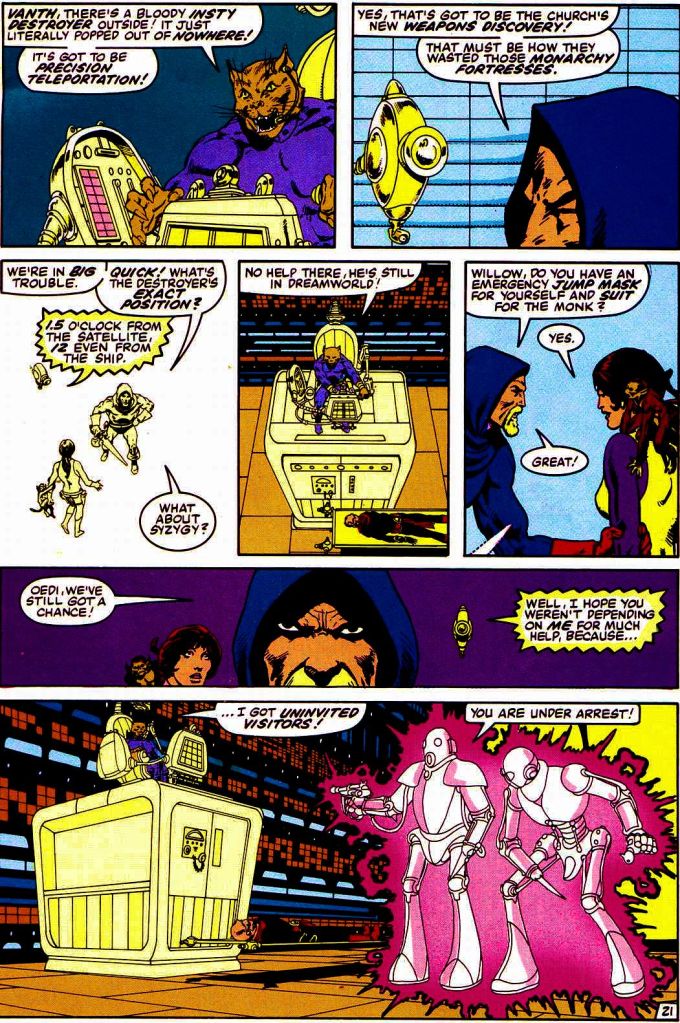
So what did DREADSTAR #1 have to offer? Well it began with an extensive recounting of the story so far, a recap which took up a full ten pages, even if it was all told entertainingly. In it, we learn of the decades-long war between the Instrumentality and the Monarchy that has plagued the galaxy, and how an ill-considered decision to attack the planet that he’d settled on resulted in Dreadstar’s wife being killed and Dreadstar himself once again taking up his sword to sort out the mess. Prior to this, Dreadstar had been the only survivor of the Milky Way Galaxy, which he’d helped to destroy in order to eliminate a prodigious evil, so he was used to committing genocide on a massive scale. And now, alongside the sorcerer Syzygy Darklock, the cat-hybrid Odie and the telepathic Willow, Dreadstar has already lopped off the head of the Monarchy, putting the remains of it under his control, and turns his attention to the Instrumentality.

In this issue, that takes the form of Dreadstar and company striking against one of the Instrumentality’s Treasury Stations, where the stolen wealth of the galaxy is kept. The place houses a tenth of the Church’s wealth, and Dreadstar intends to use that money to finance the Instrumentality’s overthrow. But first he’s got to get it. Which he does by fighting his way through waves of enemy combatants, with Willow guarding his back and Odie playing “man in the chair” back on their ship. So this is primarily an action comic, and when the Instrumentality sends in a Destroyer to eliminate the threat to the Church’s bankroll, it’s simply one more obstacle that Dreadstar needs to overcome through guts and moxie and strategy and superior firepower. There isn’t a whole lot of philosophy or introspection on display here–this is Starlin hitting hard and striking fast, which is probably why I didn’t care for it. The action is expertly delivered, but I was seeking something with a bit more meat on its bones.

As the issue wraps up and Dreadstar’s group reconvenes on their ship, Vanth opines that with as much money as they now possess, they’ll be able to begin work on “Plan M”, their master strategy for taking out the opposition. What Plan M was all about would comprise the first major storyline of the series. Elsewhere, the big villain of the series, the Lord High Papal, having learned of Dreadstar making off with the Treasury earnings petitions his dark gods to grant him the power to obliterate this threat to their church. He’s rewarded for his pleas with cosmic power, and it’s clear that Dreadstar and company will be the target of his wrath. To Be Continued. But not for me. As I’ve indicated earlier, this wasn’t what I wanted from the series, and between the high cover price and the bevy of alternatives as well as the fact that any appeal this sort of story had for me was already being scratched by other series, I left DREADSTAR by the wayside.


To each their own about how much they liked this series. I preferred the tone to the more ponderous one of the earlier Metamorphosis Odyssey episodes. It was a fun read until about midway through the Epic Comics run, when Starlin had to find a new story direction after the triumph of the Instrumentality Church over the Monarchy. Things got bogged down with an interminable “traitor” storyline. Dreadstar’s new superhero costume and the destruction of the Star Sword didn’t help things.
There were a lot of simultaneous Starlin publications with the release of this comic. The Epic Illustrated episode that bridged the Dreadstar GN with this first issue was published a week earlier. A month before, Marvel launched a six-issue Special Edition Baxter-paper reprinting of the Starlin Warlock run.
LikeLike
Thanks, Tom. The next mocha is on me!
Reason being that back in my early comic collecting days, I was all in on all things “Starlin.” But this and his other work came out when I was in college. With a tight budget and the Talking Heads, Go-Go’s and Elvis Costello making great music, sacrifices had to be made. When Jim Starlin took over the Silver Surfer in 1990, I was once again all in on his work – although that passion dimmed with each subsequent Infinity crossover. As a result, I’d wondered just what I’d missed with Dreadstar. Now, thanks to this review and the accompanying pages, I believe that question has been answered.
LikeLiked by 1 person
I think you hit the nail on the end — after you’ve read WARLOCK, Starlin’s DREADSTAR is really just a pale shadow. The layouts and character designs on these pages are really great, but the dialogue is stiff and the story is not that exciting.
LikeLiked by 1 person
I bought this series for a while — I think up to around the point where Dreadstar got the superhero unitard — but I couldn’t tell you anything about the story at this point. I think I was mostly buying it because I liked the idea of Epic Comics and I wanted to support it. Plus, I liked Jim Starlin’s work.
But for whatever reason, it just didn’t spark my interest, so I wasn’t paying much attention and was forgetting what happened issue to issue. Eventually that, and lack of funds, caught up to me.
I keep thinking someday I’ll get an omnibus or something and catch up on the series — at least the Starlin part of the series — but that someday has yet to come.
Not gonna rule it out, though. I do like Starlin comics.
LikeLiked by 1 person
If your library subscribes to Hoopla, the digital service has Dreadstar Omnibus 1 available. I plan to check it out soon.
LikeLike
That’s a good thought. Thanks.
LikeLiked by 1 person
I am still a fan of Dreadstar and I think I know why I liked him better than Starlin’s Captain Marvel and warlock. Both were great works but as much as he adjusted it, Starlin was stuck with a loser set up with having to drag Rick Jones along. With Warlock, he was just too damn whiney for me to like the character as much as the art and plot. Dreadstar was a much stronger lead and especially the original three if the supporting cast were all fully rounded and interesting. I especially loved WilloW!
LikeLiked by 1 person
My reaction to the series was similar to Tom’s. If this had been a completely new character, I might’ve appreciated it more, but the cognitive dissonance between the earlier installments and this series was too much. I guess Starlin felt (or was told) that he had to downplay the pessimism and make it more conventional in order to appeal to the Marvel audience? Or maybe he just wanted a change of pace, who knows? But after the powerhouse trilogy of Metamorphosis Odyssey / Dreadstar / The Price, this was a real let-down.
LikeLike
I didn’t have access to this series. But I saw the ads for it in many Marvel comics. It wouldn’t be until Jim took it to First Comics that I’d see issues on the shelves in comic book stores. And by then his art wasn’t something I was into. Papal reminded me of Thanos, Mongul, etc. I actually started buying it after Jim hired Peter David to write it, first with Luke McDonnell drawing it, and then Angel Medina (I think).
I didn’t follow Jim’s cosmic Marvel work, with few exceptions. Having George Perez drawing the “Infinity”-something stories (with inks by Joe Rubinstein?) was a better incentive for me. Patrick Oliffe on some of the ongoing Warlock issues was also irresistible to me. Otherwise, I wasn’t interested enough. On the other end of the spectrum was Jim’s highly successful run on “Batman”. But Jim Aparo’s art was too far from its highest points 10 years earlier for me to stay with it.
His Adam Strange stuff also failed to grab me. I much preferred Ivan Reis’s (the artist, but I forget who wrote it) take on Adam Strange. And then writer Andy Diggle and artists Pascal Ferry’s sleeker, more futuristic take. But I’ve long wondered what Jim would’ve done with the Omega Men.
LikeLiked by 1 person
Dreadstar #3 was the first comic book I read by Jim Starlin after the Death of Captain Marvel graphic novel. Simply put, that issue of Dreadstar absolutely blew my mind. The ending was so shockingly dark & downbeat, and my young self had previously never seen anything like it before. I really didn’t have much of a chance to get any other issues of Dreadstar as they came out, but I bought a whole bunch of them, including this one, as back issues in the 1990s. I later got my copy of the first issue autographed by Starlin.
LikeLiked by 4 people
I liked the 6 issues published in Brazil in the late eightioes, and in the nineties I was able to get most of the First Comics issues in a Chicago comic shop (only the Nexus corossover was missing). I like the series, but I did prefer Starlin art inked by the likes of Al Milgrom, Steve Leialoha & Joe Rubinstein
LikeLike
With my love of science fiction I bought the Dreadstar Graphic Novel when it was published. But since I’m really not a fan of the painted art style used in the Metamorphosis Odyssey, I didn’t like or appreciate it. However, when Dreadstar #1 came out with regular comic art I bought it and enjoyed. I don’t recall if I stopped buying it before I left comics behind in the nineties or not, but I do recall the series with fondness. Enough so that I bought the Ominous Press complete boxed set last year after learning that it existed.
As I wasn’t a big Marve fan I had never read any of Stalin’s work on Warlock and Captain Marvel. Therefore, I had nothing else by Starlin to compare Dreadstar to. Later I read The Infinity Gauntlet when it was published, but I never really thought about which story I like better.
LikeLike
Dreadster was great, had never seen anything like it. The art was fantastic, it was so dark and grown up to me. I couldn’t believe some of the stuff they were doing in that book.
On top of everything else they would throw in these odd little side bits like the stalker guy getting crushed by Teuton in the last panel of an issue.
And then they made him into a tights wearing superhero and I stopped reading comics because of it…
LikeLike
‘Dreadstar’, like the contemporaneous ‘American Flagg!’ and ‘Elementals’, hit the ground running and then some. Ultimately — inevitably — neither Starlin nor Chaykin nor Willingham could keep up the pace, but what we got for a while was very good indeed.
LikeLike
Chaykin’s fetish artwork and the fact Willingham was nowhere near as skilled an artist as he was a writer had me sticking with Starlin the longest. I’d have to check but I think I’ve only skipped more recent Dreadstar.
LikeLike
I was blown away by American Flagg when I was buying it off the stands. Rereading a few years ago, the stories weren’t as interesting and yeah, the heavy sexualization of all the women didn’t help.
LikeLike
When I asked a Certain Comics Pro his opinion of Chaykin’s art, he said, “all his men look like Flagg and all his women look like hookers.”
LikeLiked by 1 person
Read the first omnibus. I agree with Tom’s point that Team Dreadstar starts feeling more and more interchangeable with the Omega Men or the Starjammers as it progresses. Which would be fine if I liked the story more, but I don’t.
Very goodlooking though.
LikeLike