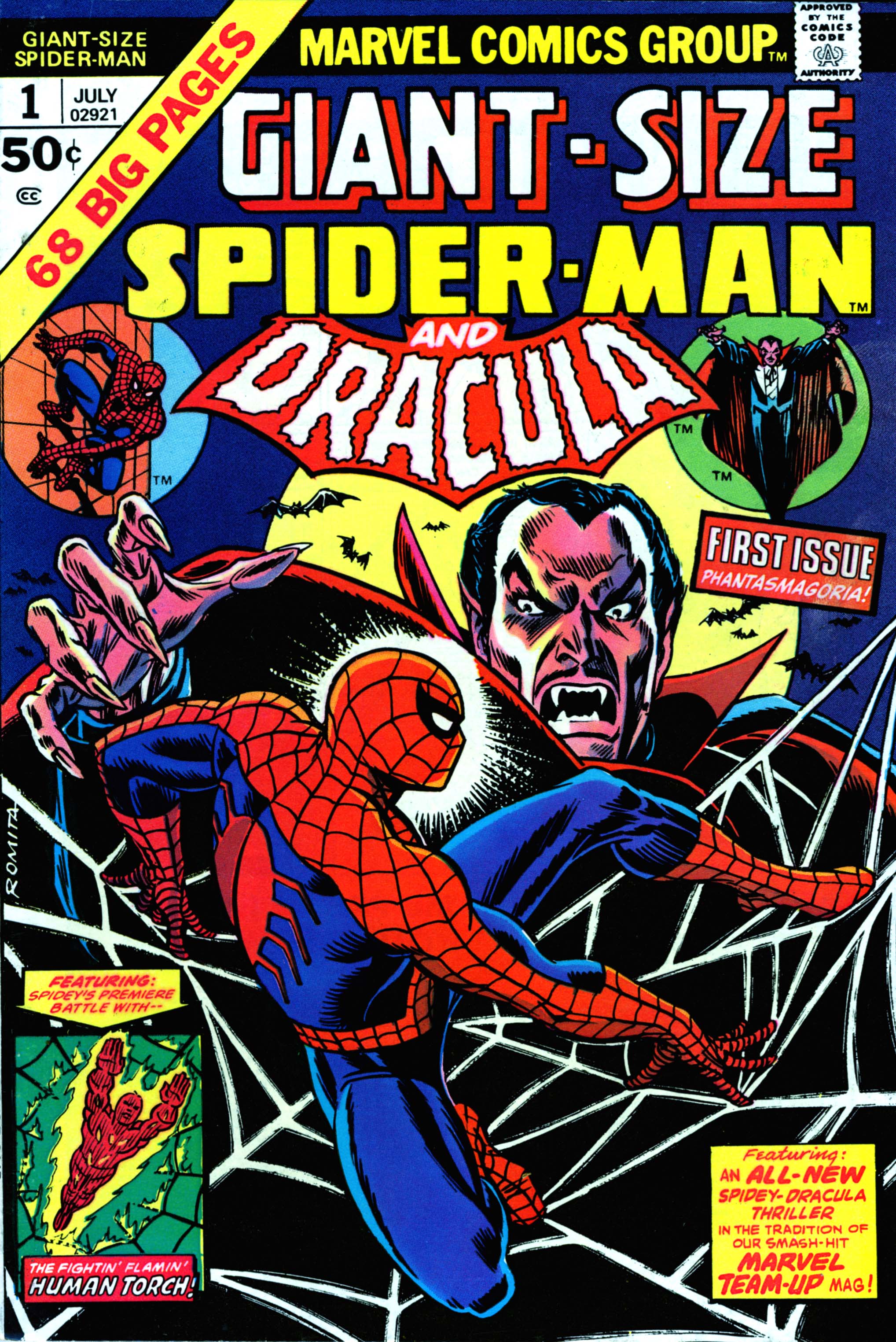


As I’ve spoken about numerous times on this page, I was relatively limited in what I was looking for in my comic books. I was a super hero guy, and so none of the other genres which were then still readily available when I started reading the books in the 1970s were of any real interest to me. In a certain way, they felt like a squandering of resources–you could have made another super hero story with those creators and that press time. So I was a little bit put off when I found this issue of GIANT-SIZE SPIDER-MAN among the books owned by my friend David Steckel. But I still borrowed it from him–undoubtedly due to the promise of the Human Torch in the issue. I was enough of a fanatical Fantastic Four fan at this point that I’d even put up with monster crap like Dracula in order to get my hit.
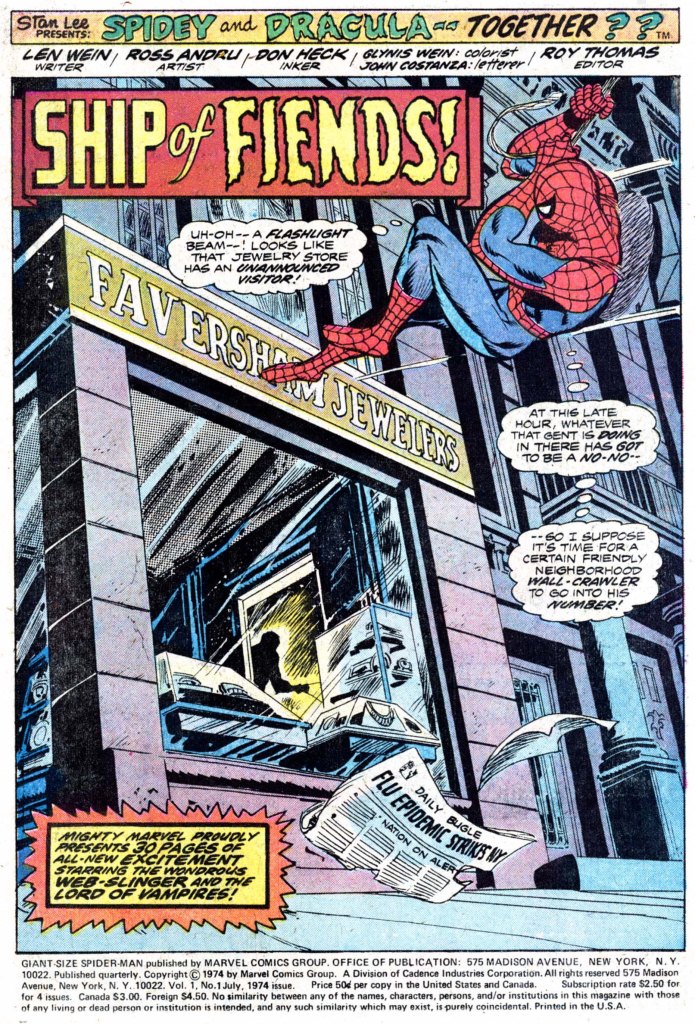
GIANT-SIZE SPIDER-MAN was a bit of a misnomer, as what this series actually was was GIANT-SIZE MARVEL TEAM-UP. By design, each extra-length story co-starred Spidey with another stalwart from the Marvel line–often unlikely choices such as Shang-Chi or Doc Savage or the Man-Thing. This first one featured Dracula, and represented something of a challenge for creators Len Wein and Ross Andru. Because on the surface of things, a historic monster such as Dracula felt like a weird thing to exist in Spider-Man’s contemporary New York setting, whereas the wall-crawler was a cartoonish fit for the more grounded realism of the Lord of Vampire’s TOMB OF DRACULA. Len squared this circle by only having the two main characters meet in passing (and even then, Spidey was in his civilian guise as Peter Parker.) And I have to say, it worked.
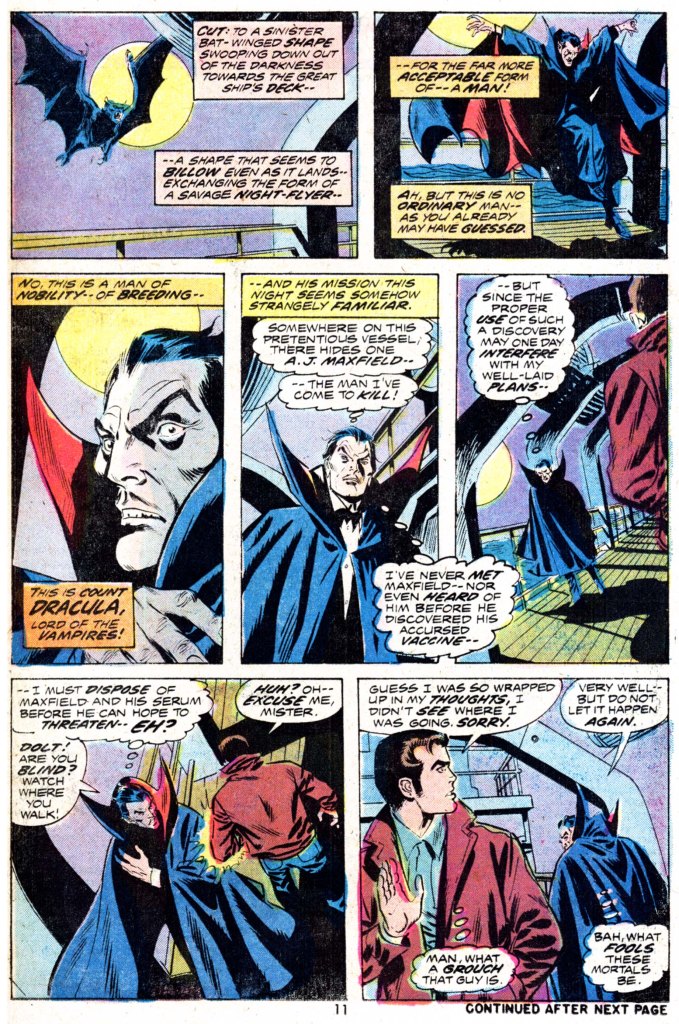
The story opens with a brief skirmish between Spidey and a shadowy villain–this bit isn’t really germane to this tale, rather it’s a set-up for that month’s issue of MARVEL TEAM-UP, in which the Human Torch will follow up on this encounter. But after that little bit of action, the tale really begins with Peter visiting his ailing Aunt May, who has contracted an especially virulent new variation of the Flu. It’s resistant to regular forms of treatment, but Peter is told that reclusive Doctor A. J. Maxfield is sailing towards Manhatan with a new vaccine that he’s created that should prove effective. Impatiently, Spidey hits up the Fantastic Four for a plane (tipping the Torch off to his earlier encounter to set him up for MARVEL TEAM-UP) and flies out to the ship in the midst of the ocean, intent on securing the vaccine and saving Aunt May’s life. But Dracula has also made his way to the ship with the intent of killing A.J. Maxfield. This page above is the only point in the story where the two characters will cross paths.
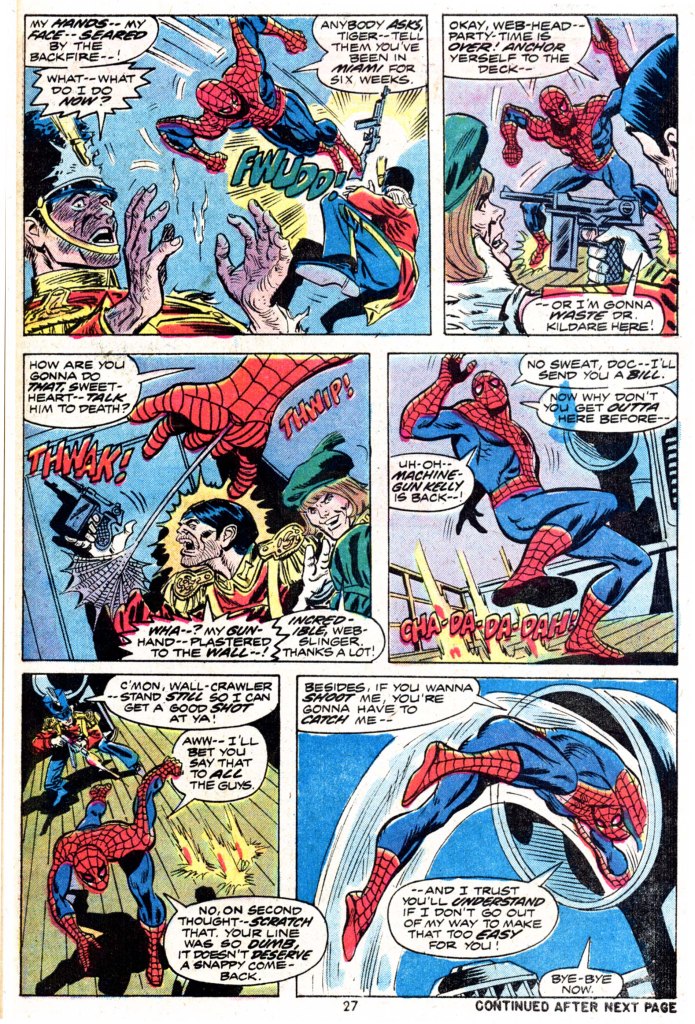
It turns out, though , that Maggia crime boss Anthony “The Whisperer” Cavelli, is also after Maxfield’s vaccine, intending to use it as a bargaining chip to gain entrance back into America, from which he was deported. His gunmen scour the ship for the scientist, and make the unfortunate error of taking a shot at Dracula while he’s in the process of stalking a comely lass for the day’s meal. The Lord of Vampires makes short and gruesome work of a bunch of Maggia gunsels, then chows down on another passenger, bringing Peter Parker racing to the scene. But Peter can’t believe that an actual vampire is stalking the ship. Fortunately, Doctor Maxfield and his aide are summoned to try to save the stricken passenger, so Peter gets to find them–though only seconds before more goons break in and take the Doctor away at gunpoint. Pete goes out a porthole and switches to his Spidey togs, intent on making a fight of matters.
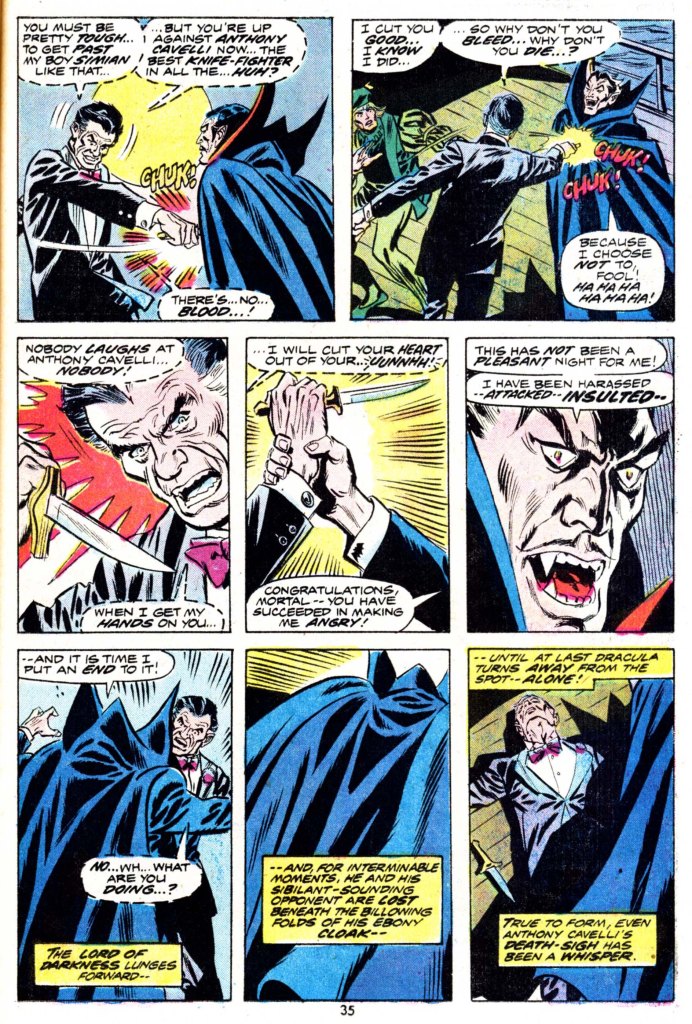
Spidey mops up on more Maggia goons, but he’s lost track of Maxfield and there’s an entire ship to search. The Doctor, meanwhile, has made his way down to the central ballroom, where Dracula is haunting the shadows. Cavelli makes a show of sickness, prompting the Doctor to attempt to assist him. But when the two men head for the sick bay, they’re stopped by Dracula, who finally has his prey in sight. Cavelli, a trained knife fighter, slashes away at Dracula, but that’s just not going to get the job done, and so Dracula drains him dry, discarding his lifeless corpse, then proceeds to throw Maxfield overboard. His task completed, Dracula transforms himself into his bat-form and leaves the ship–never noticing that Spider-Man had been clinging to the side of the ship coincidentally and that the web-slinger was able to prevent Maxfield’s plunge into the icy waters.
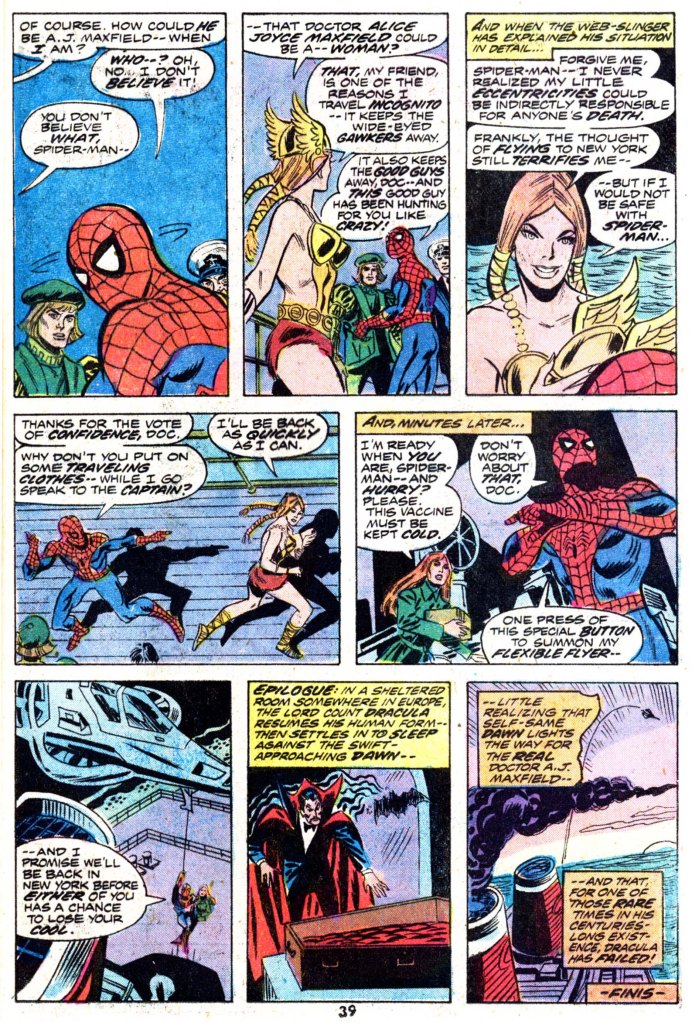
From here, we get a quick wrap-up, as Spidey clobbers the remaining Maggia guys and learns that the person everybody had been thinking was A. J. Maxfield all story long was in actuality Maxfield’s aide–the real Maxfield was the comely woman Dracula almost chowed down on at the start of the story. She agrees to accompany Spidey back to New York on his borrowed FF flying craft despite her fear of flying, and the presumption is that Aunt May gets the needed vaccine and is all right. Dracula, for his part, retires to his coffin for the evening. I wonder if he ever realized that A. J. Maxfield and her vaccine were still around? If so, it never came up again, so getting rid of it, and her, seems to have simply been a bit of busy work for the Count.
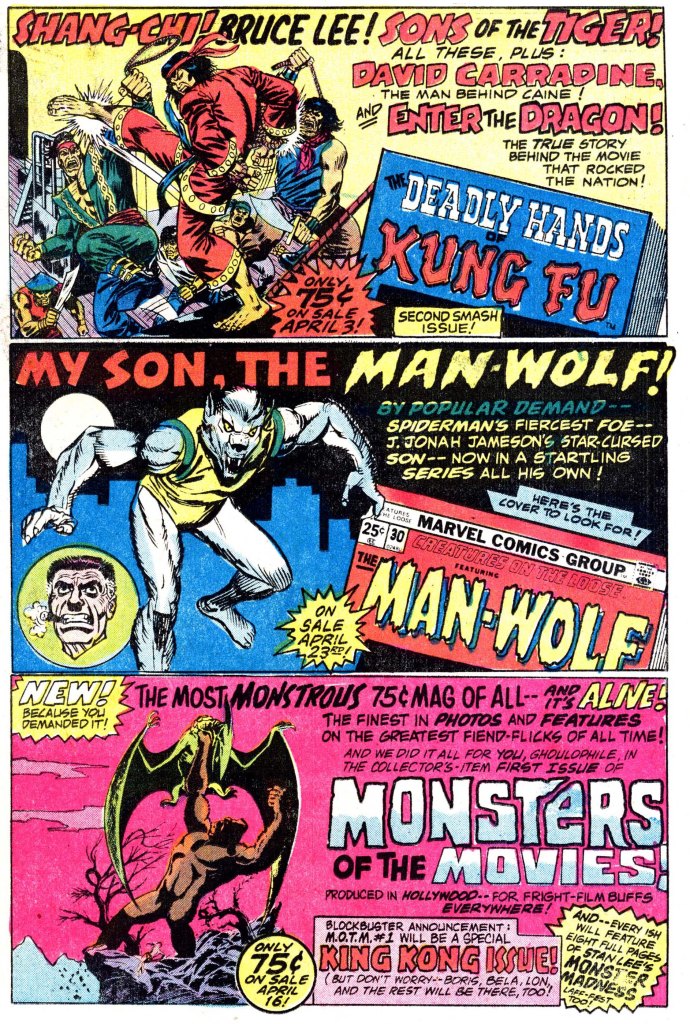
Perhaps seeing this book as an opportunity for some cross-promotion, right after the story wraps up this three-tier House Ad runs, spotlighting not any of Marvel’s assorted super hero titles but rather some of its monster and kung fu releases. In particular, Man-Wolf is called out as being the son of J. Jonah Jameson, and thus of potential interest to Spidey readers. So it was a smart play.
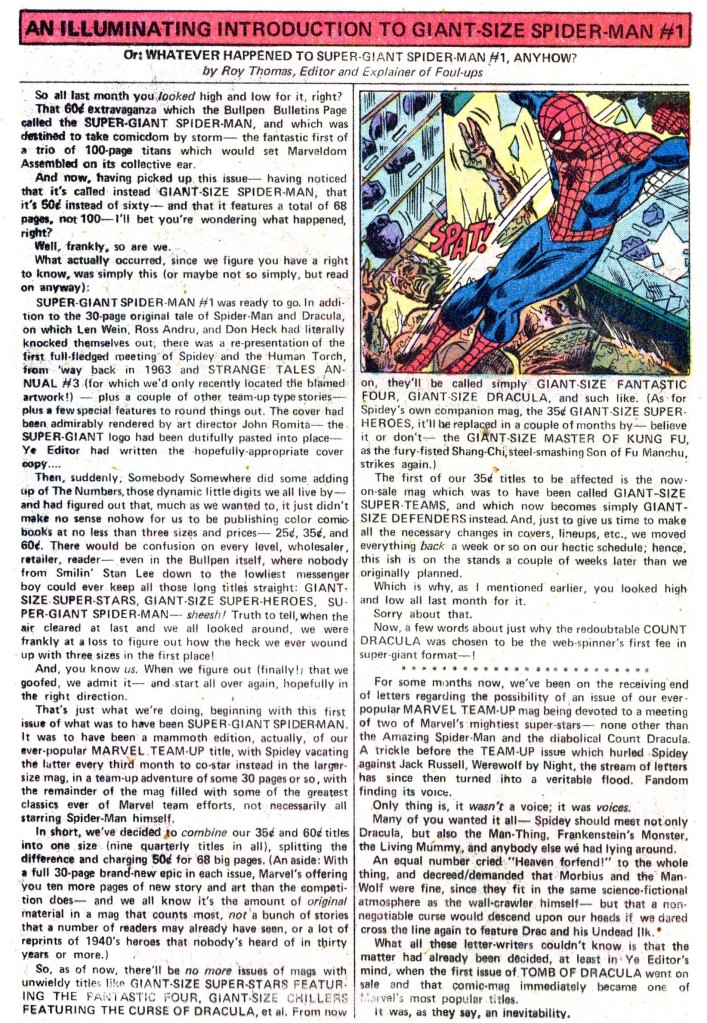
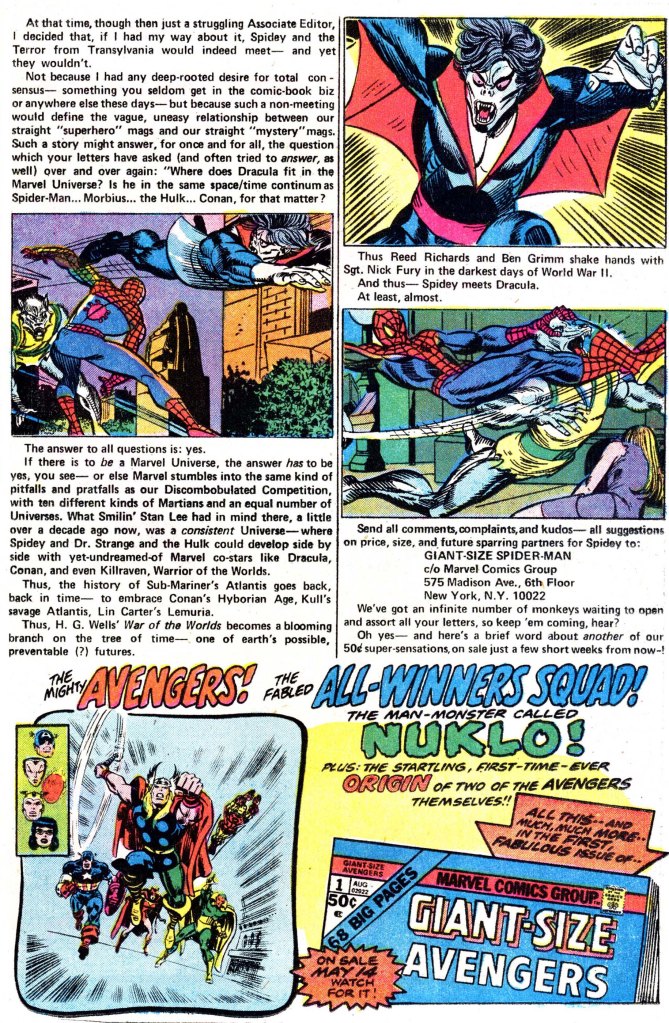
Thereafter follows and chatty and frank two-page text feature written by editor Roy Thomas explaining in depth both why the announced SUPER-GIANT-SPIDER-MAN, which was to have been a 100-Page 60 cent release (in the format of DC’s 100-Page Super-Spectaculars) had instead made it to press as the 64-page 35 cent GIANT-SIZE SPIDER-MAN, as well as why Dracula was the first guest-star. Roy ducks around the issue, but the plain truth is that DC’s 100-Page books had been posting smaller and smaller returns, to the point where following up in that format was seen as a mistake. As for Dracula, Roy makes the argument that the Marvel Universe ought to include everything that the company publishes, wither Dracula or Killraven or Conan. This approach would eventually come back to bite Marvel on the rear in later years when the rights to certain properties were no longer with them, which made it impossible to reprint certain stories. But in 1975 when this piece was written, nobody was thinking about even the possibility of Trade Paperbacks and hardcovers and Omnibuses.
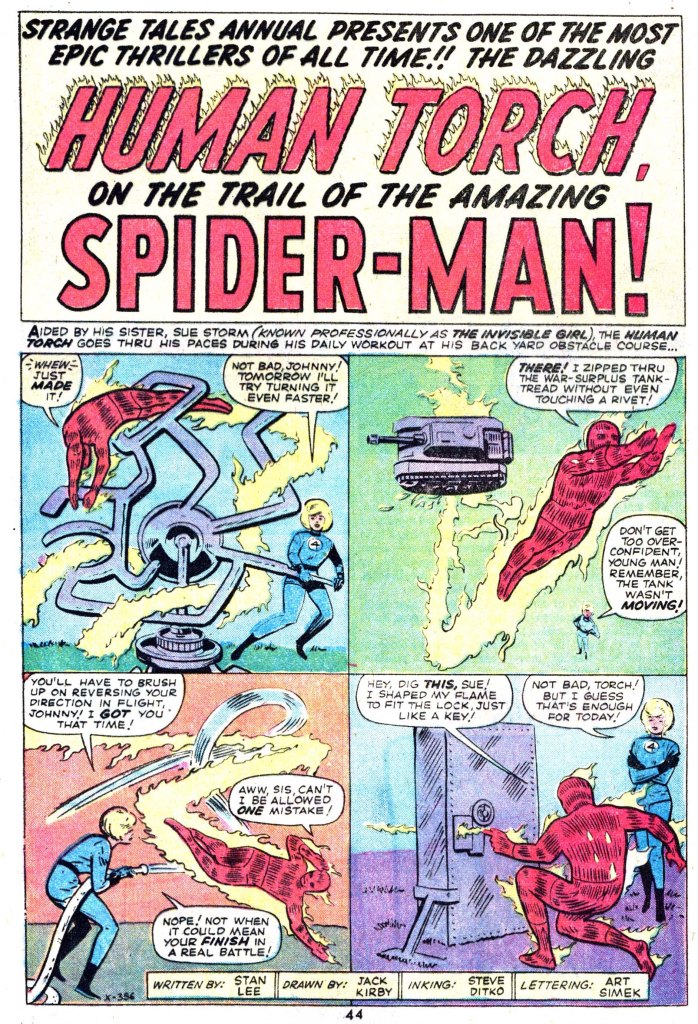
The back-up story in this GIANT-SIZE was really the reason why I had borrowed it, and it did not disappoint. It’s a story I’ve been meaning to take a much closer look at, as it was produced very early in the history of Spider-Man (it was published contemporary with AMAZING SPIDER-MAN #4) and it represents the only time early on that Jack Kirby drew (and presumably plotted) a full-length Spider-Man adventure. As such, it gives a bit of an idea as to how he might have handled the feature had it gone ahead with his original conception (which Lee and Martin Goodman felt was too close to that of Archie’s THE FLY once Steve Ditko pointed out the similarity.) Ditko inked this story, and presumably worked to bring Spider-Man a bit more on-model, as Jack always seemed to have difficulties wrapping his head around the character and how his costume worked.
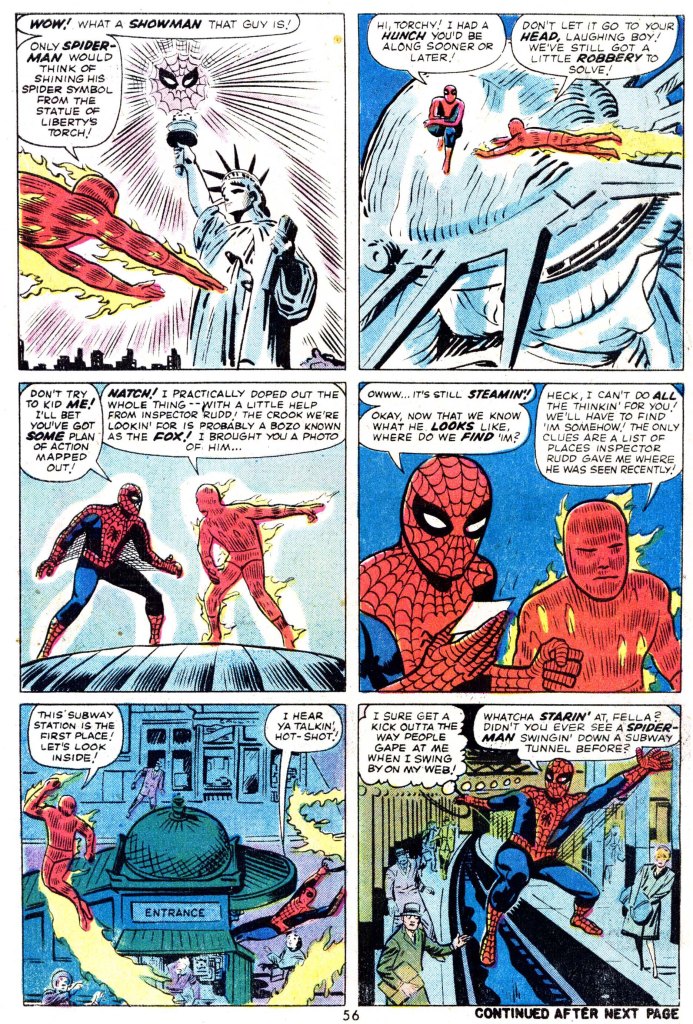
This story was the origin point of the long-running rivalry between the wall-crawler and the Human Torch, and it sets up a couple of recurring points, such as the two teens’ regular meeting place atop the Statue of Liberty. The villain here is a master of disguise called the Fox, a thief who manages to frame Spidey for his crimes, putting the Torch onto his tail. Even after the two heroes work out their differences and join forces, the crafty crook is able to stay one step ahead of them both for an almost unbelievable number of pages. You can kind of see all three creators working out stuff about the character on the fly as they work on this yarn. With Ditko’s inking, Kirby’s Spider-Man feels more like his typical self, though he doesn’t quite move in the spidery fashion that Ditko originated. But it’s a nice showcase of both artists’ talents.
 The Tom Brevoort Experience
A shared universe can be great but sometimes the parts don’t always fit together and Thomas was big on jamming discordant things together. On the flip side, I am reminded of a JSA Classified arc I read recently with the modern Dr. Mid-Nite & Mr. Terrific chasing down a vampire but acting as if they were just a myth and not actually real in the DCU.
LikeLike
Well Peter had more interaction with Dracula than the original Ms. Marvel ( Carol Danvers ) did in Ms. Marvel#14 ( February 1978 — like Dr. A.J. Maxfield, Dracula saw Carol as a potential meal ). Spider-Man never got to be face to face with Doc Savage in Giant-Size Spider-Man#3 ( January 1975 ) like the Thing and the Human Torch did [ Marvel Two-in-One#21 ( November 1976 ) — to bad Reed Richards missed out on that ]. Spider-Man has teamed up with Doctor Strange so how is Dracula appearing in the same book as him a problem? Encountering a supernatural vampire isn’t that much different than a science spawned one like Morbius the Living Vampire. Plus Marvel had him encounter a supernatural werewolf in Marvel Team-Up#12 ( August 1973 — Werewolf by Night ) almost a year before this story.
LikeLike
I’d disagree that “Encountering a supernatural vampire isn’t that much different than a science spawned one like Morbius the Living Vampire.”. Morbius keeps getting grouped with supernatural characters like vampires, Ghost Rider, or Son of Satan. But he’s a completely different type. He’s like The Lizard, except instead of lizard powers, he has vampire bat powers, derived from biological experimentation on himself (gone wrong). However, the vampire bat is not supernatural. The “vampire” is just descriptive in its name. You can’t scare it away by wearing a cross, and it’ll be fine roosting in a church, or drinking holy water. Being called “The Living Vampire” is like “The Red Ghost”, who is not a literal ghost but has intangibility powers.
Thus encountering him is like: Yesterday, The Lizard, today The Vampire Bat. But Dracula is an entirely different type of entity.
Good point about Dr. Strange though. Still, it’s not completely obvious how much someone like Peter Parker knows or thinks about the magic world. From his perspective, Dr. Strange does stuff like levitate, teleport, open portals, mind manipulation, bolts from his fingers, etc. All of these are physical feats that his scientific team-up superheroes do too. It’s still something of leap from that, to believing in supernatural vampires.
LikeLiked by 1 person
Well, IMO there’s a tonal difference between the Lizard (birthed by science) and Morbius (birthed by WEIRD science). WEIRD SCIENCE also gave rise to a host of horror-themed characters ranging from prose creations like the Frankenstein Monster, the Invisible Man, and Mister Hyde or comics spawn like The Man-Wolf and Deprayve. (Don’t be embarrassed if you don’t remember the latter, a crappy Mister Hyde knockoff I’d forgot until I reread WEREWOLF BY NIGHT.)
Sure, it’s arbitrary to focus on whether characters are horror-themed or not, but my point is that it’s also arbitrary to do “science vs magic.” That’s not a slam; all categories are arbitrary. So that’s my arbitrary take on the subject.
LikeLike
Seth I did point out that Spider-Man met a supernatural werewolf ( Werewolf by Night ) almost a year before Peter Parker bumped into Dracula is this issue, but left out he encountered Man-Wolf before that ( what classification does the Moon-Gem put Man-Wolf under? Magical or Science? ). So it shouldn’t be that much of a leap for him to wrap his head around Dracula being a supernatural vampire and not a science spawned one like Morbius. Plus I meant why the powers at be at Marvel conflicted about having Spider-Man and Dracula in the same story.
LikeLike
Don’t bother answering the Man-Wolf’s Moon-Gem question, I was distracted by Man-Wolf as the Star-God and forgot that you don’t have to be a mythological god to have the word or title god attached to you: see Eternals, immortal mutants ( Externals ), aliens and fakes.
LikeLike
d9dunn: I’m not clear how a guy who is transformed into a giant lizard due to bology experiments gone wrong is less “WEIRD SCIENCE” than the others. Is it because he’s wearing a lab coat? The distinction I’m making here is less “horror” and more at “supernatural”. While there can be fuzzy boundaries between science and magic, I’d say there’s also many cases which are firmly in one category or the others. Morbius is “science”, Dracula is “magic”. There’s been many writers who science-ify traditional vampires somehow, but that’s not Morbius. He’s not any variation on vampires, he’s an animal-powers character where the animal was named after the vampire legend.
John Holstein: Werewolves in general are a strange case, come to think of it. Traditionally, shapeshifting was solidly “magic” (e.g. turn someone into a frog). But Jekyll/Hyde popularized “science” shapeshifting, and that’s now become the far more common version. The whole idea of the Hulk was a man involuntarily shapeshifting into a monster, originally at night (very horror-inspired). And that’s firmly a “science” case. Thus if Spider-Man meets Werewolf By Night, how is he to know this is any different from e.g. the Beast, or Hulk, or The Thing, or any of all the other characters he knows who have “science” based transformation? In-universe, I can imagine someone saying “Maybe you just think you’re a supernatural werewolf, but in fact what has happened is your mutant power has manifested itself, and you’re having trouble coping with that”. I mean, that’d be wrong in this specific case – but based on the hero/villain population, doesn’t it actually sound like it’s much more likely? I suspect that with all the things he has on his mind, Peter Parker just doesn’t spend much time pondering this stuff.
LikeLike
Seth my original point has never been about the character ( Peter Parker/Spider-Man ) but the powers that be a Marvel questioning if Dracula should be in a book with Spider-Man ( though much later they would put the Silver Surfer in Tomb of Dracula — have marvel.fandom.com to see what that was about ). Sure there is no way for Peter/Spider-Man to know had he really faced Dracula ( instead of bumping into a guy in a cape ) if he was a supernatural vampire or science vampire or alien vampire. Decades from this issue he would run into 2 mutants that transform into werewolves( Eduardo and Carlos Lobo ). I’m not debating if a character can tell a supernatural vampire/werewolf from mutant/mutate or alien ones but why the powers that Marvel even gave a first thought to questioning Spider-Man and Dracula in the same book, especially for a character ( Dracula ) that is public domain.
LikeLike
John Holstein: Are you talking about this part of the post? “This first one featured Dracula, and represented something of a challenge for creators Len Wein and Ross Andru. Because on the surface of things, a historic monster such as Dracula felt like a weird thing to exist in Spider-Man’s contemporary New York setting, whereas the wall-crawler was a cartoonish fit for the more grounded realism of the Lord of Vampire’s TOMB OF DRACULA.”. I found that clear. Note, I think Morbius was specifically designed to “fit” into Spider-Man’s world, as a “scientific” pseudo-vampire. And what might be risked for one typical story in a regular series like Marvel Team-Up, isn’t the same as the launch of a more expensive special. I can see that there might be a concern to make sure the lead story here was at least somewhat “on-model” for both characters’ adventures, or at least, didn’t leave readers feeling they’d paid more and gotten less. Basically, it sounds like they were worried about disappointing readers of either character, which probably wouldn’t be good for sales.
LikeLike
Amazing Fantasy Annual 2 was a HUGE improvement from its previous issue, and I attributed it to this new character Spider-Man. So I picked up a copy of Spider-Man 4 on my next bike trip to Osborn’s Drug Store. Spider-Man was a LOT more interesting in his own title.
There was a VERY interesting story in AF Annual that I wish had a sequel; “I was the Invisible Man.” It’s premise that this guy ran so fast, no one could see him and, like Barry Allen, nobody noticed any air displacement from such a speedster. We got a lot for a nickel in those days!
LikeLike
Funny to see Roy Thomas speaking disdainfully of “1940s heroes that nobody’s heard of in thirty years or more.”
LikeLiked by 2 people
As I have mentioned to you, I would give a day of my life to know what would have been in SUPER-GIANT SPIDER-MAN #1.
You nodded to it, but maybe worth explicitly mentioning for newcomers to Marvel history who aren’t aware, further codifying this book, really, as GIANT-SIZE MARVEL TEAM-UP: during this time, Human Torch took Spidey’s place in MTU every month GSSM was published.
LikeLiked by 1 person
As a 14-year old just falling completely under the spell of Marvel Comics, I was one of those hugely disappointed fans who’d impatiently awaited SGSM #1. My buddies and I had devoured our share of DC’s 100-page comics, but this was Marvel we were talking about. Dracula was only part of the fun. We were thrilled to experience whatever Silver Age gems Marvel opted to reprint.
That meant some pouting over this issue – although I understand the approach with their flagship hero and the Lord of Fangs. While I liked Andru’s work in Amazing at that time, I also didn’t care as much for Heck’s inks over his pencils.
But hey, the cute doctor switch was fun. Nor did I mind the Human Torch sharing a comic with the Iceman that same month.
LikeLike
I mostly bought these as back issues, in random order, so I never made that connection. It’s funny to think back to a time when Marvel actually seemed to worry about a character becoming over-exposed. But it was a very different marketplace back then.
Having Spidey and Drac involved in the same situation, but on completely separate tracks, is pretty clever, and probably the best way to handle a “team-up”. Dracula has crossed over with superheroes a number of times since this (Silver Surfer, Thor, X-Men, etc.) and it usually ends up being a little dodgy, with a lot of hand-waving required to keep the average super-guy from easily pulverizing the Count. (I tried to do a vampire story in my “Lady Spectra & Sparky” webcomic, and even with the freedom to “set the rules” for the characters on both sides, I’m still not sure it entirely worked…).
LikeLike
Unlike Rick Moore, I thought Don Heck did a terrific job over Andru’s pencils — maybe not the right look for ongoing Spider adventures, but the roughness and textures of it worked well for a story with Dracula in it.
And hey — since A.J. Maxfield never appeared again, maybe Dracula did catch up to her. Or maybe her vaccine turned out to be less relevant to his “plans” (whatever they were) than he’d thought.
LikeLike
Wow another great post from Tom. This annual is a great read. Great script from Len and Ross Andru does an exemplary job. A brilliant Spidey artist. The cover by John Romita is a masterpiece. I enjoy the horror element to the annual. Spidey has had his share of horror foes such as Man-wolf and Morbius, Stegron, and more recently Hallows Eve and so forth. Enjoyable books. These Annuals can produce very entertaining stories with the extra pages. I very much enjoyed this 70s encounter between Spidey and Drac. Maybe it wouldn’t have worked as well in Spidey’s regular book. Come closer I vant to suck your blood!
LikeLike
Not an “Annual,” but rather a quarterly.
LikeLike
Yeah, your absolutely right. Still it’s a marvelous slice of 70’s Marvel. A lot of those books have a Halloween feel to them. Great stuff. Spidey is a bit of a horror character when you think about It.
LikeLike
I find it funny that in his text page, Roy Thomas takes a swipe at DC’s 100 page giants, slamming them for “reprints of 1940s heroes that no one’s heard of in 30 years,” when he, Roy Thomas, LOVES 1940s characters!!
LikeLike