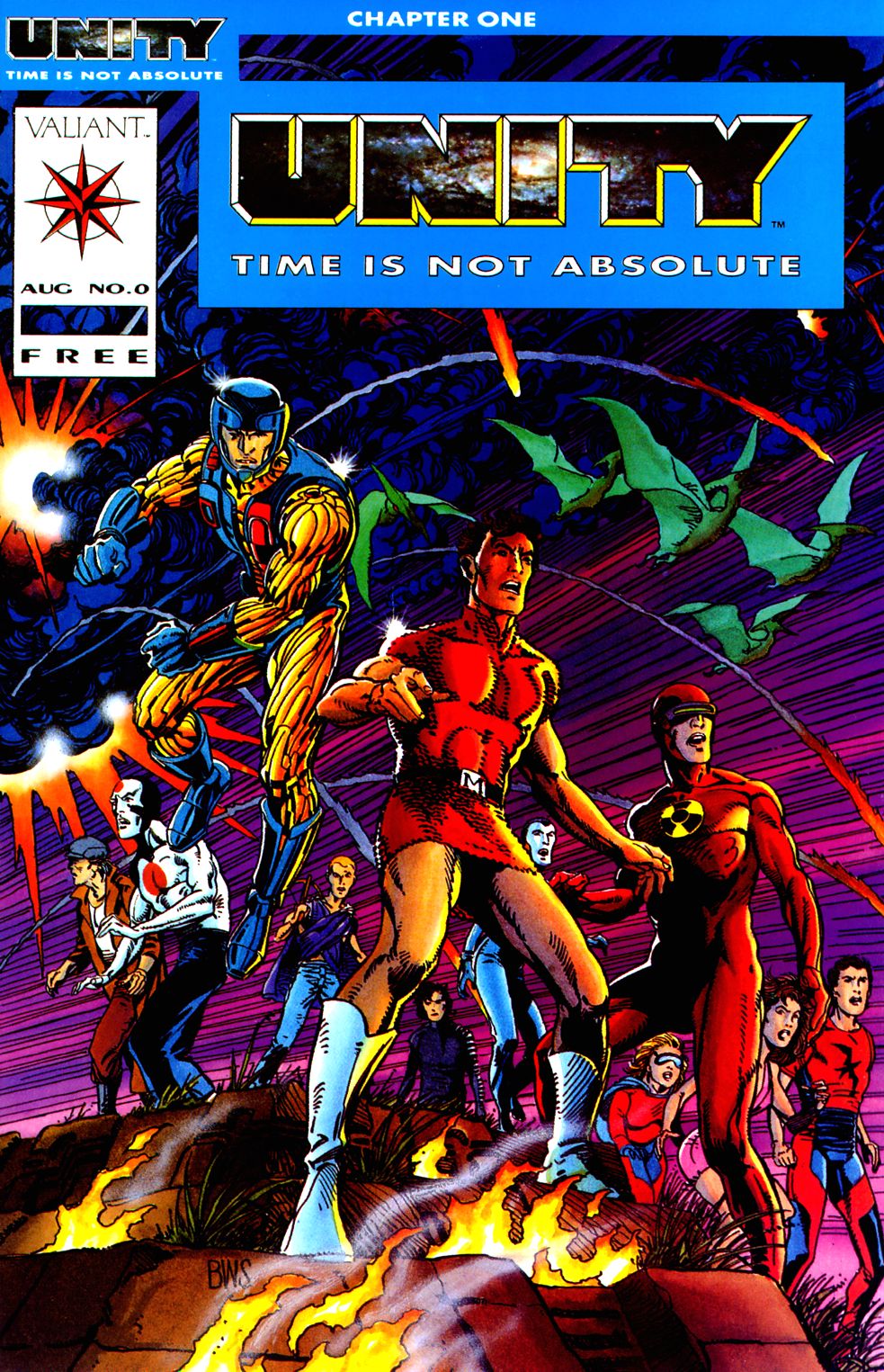


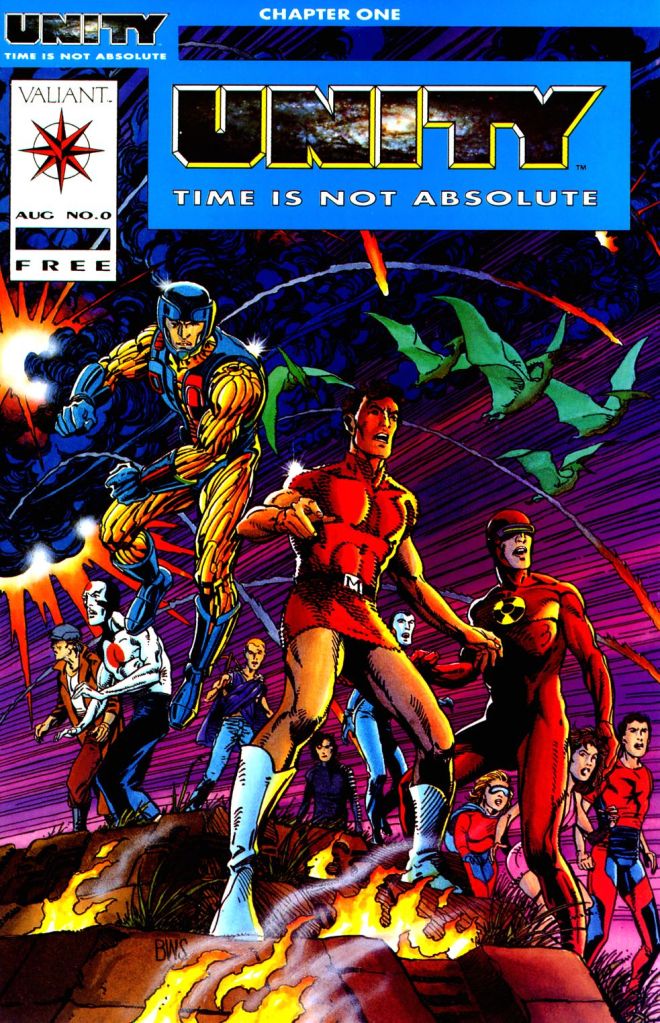
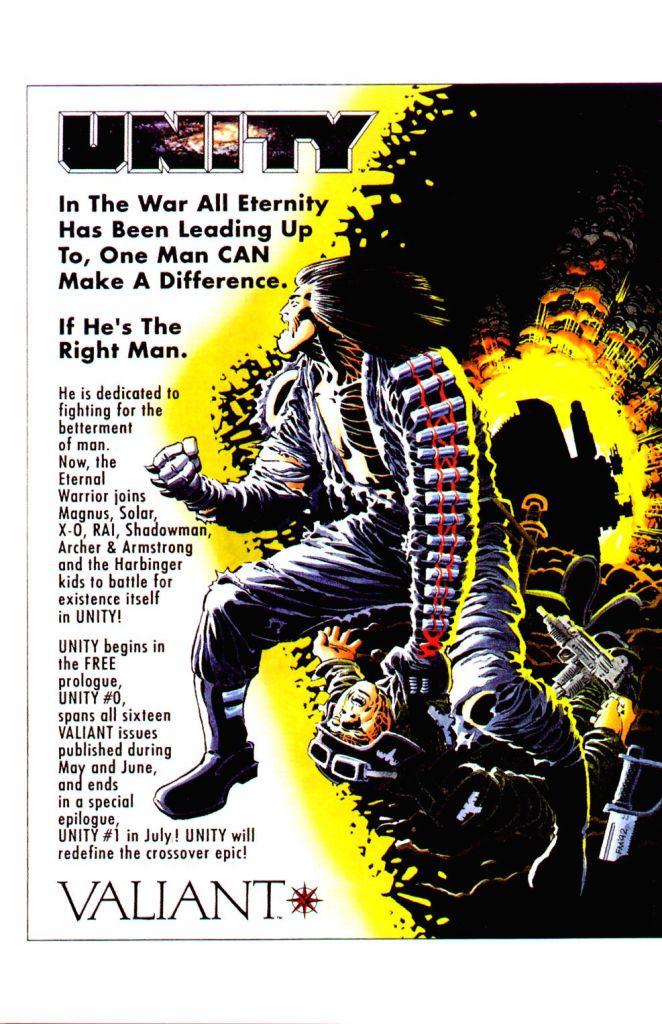
Having been publishing super hero comic books for about a year, Valiant editor in chief Jim Shooter was about to unveil his master stroke. Jim had scored massive numbers writing MARVEL SUPER HEROES SECRET WARS years before, the very first company-wide crossover series, and its success must have been top of mind as he and his team laid down the foundation for their Valiant Universe. For the next two months, every super hero title Valiant put out would represent a chapter in UNITY, a line-wide crossover series that would bring all of the company’s main characters together and quantify the relationships between them all. As a way of luring in prospective readers who may not yet have sampled his books, Shooter decided to release the first chapter as a stand-alone #0 issue provided free to retailers and fans. This strategy seemed to pay dividends as this was the point where interest in Valiant truly exploded, and the prices of key back issues skyrocketed as newcomers tried to get caught up on what they had missed.
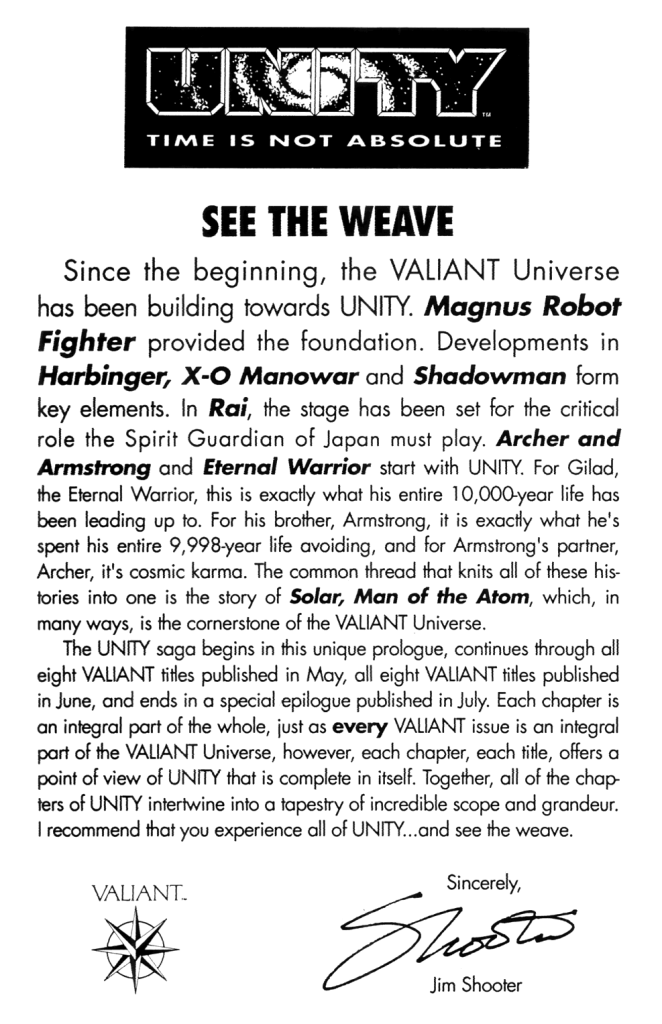
Valiant distributed 250,000 copies of UNITY #0, a huge number (though not quite as huge for the era). They also did their usual trick of creating rarer variant editions of the book with different logo colorations and much smaller print runs–5000 copies for the red log variant and an unknown amount of a gold logo variant. As I say, this was money well spent as the company saw an immediate return on the sales of their entire line as readers became interested in what was going on. In his inside front cover editorial, Shooter promised that each tie-in issue would contain an integral part of the story, the lack of which had become a common complaint about many crossover tie-ins of this time. As Shooter wrote pretty much all of them, and mapped out his story timeline in granular detail, this turned out to be largely true.
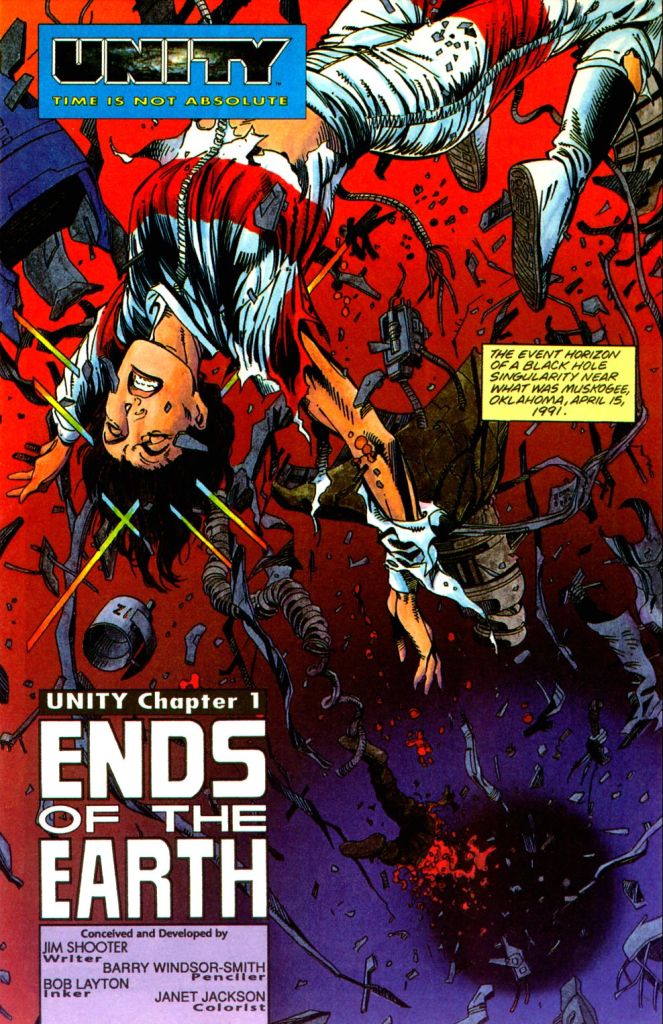
The UNITY #0 issue was penciled by Barry Windsor-Smith and inked by Bob Layton, who were probably Valiant’s two most popular and well-known artists at the time. It’s consequently a good-looking story. Janet Jackson provided the full process coloring that at points was a little bit overdone, but which was a lot more sophisticated in terms of the number of possible colors than most of what Marvel and DC were releasing at the time. This kickoff story was only 16 pages long, but it was dense enough that it felt like a substantial read, even with the shorter run time.
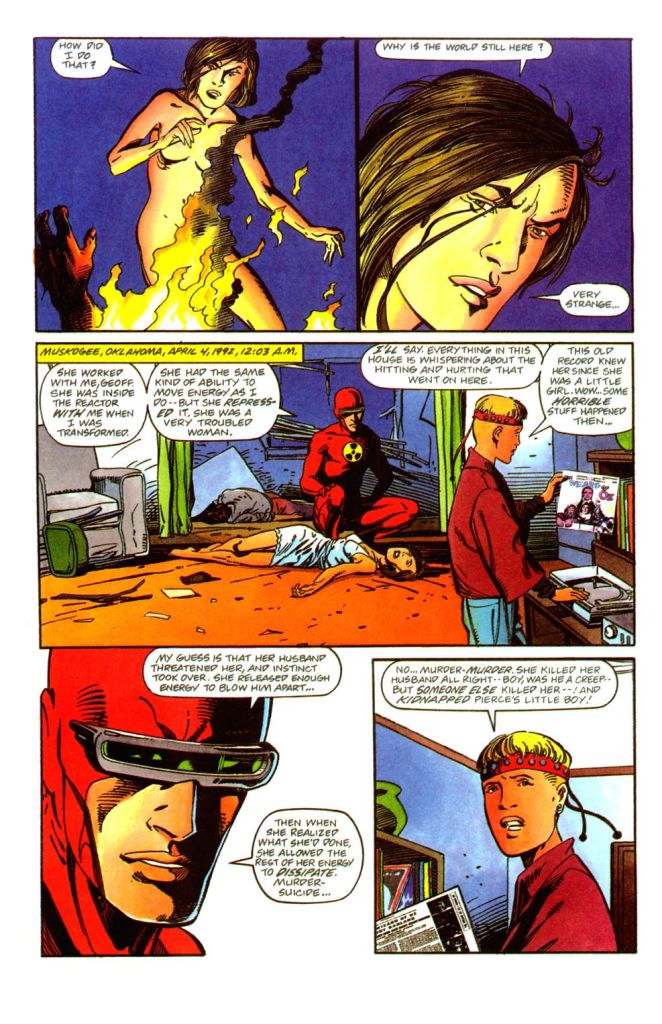
The story of UNITY #0 grows directly out of recent events in SOLAR, MAN OF THE ATOM. The main villain of the piece is Mothergod, who is actually Erica Pierce, a co-worker of Phil Seleski’s who went through the same transformation that he did, emerging on the other side with the ability to manipulate energy in a godlike fashion. Pierce was thought destroyed in the accidentally-generated black hole that had looped Solar back to the moment of his own creation, but a new character, Geoff McHenry, the Geomancer who can speak to the spirit of the Earth, warns Solar that Erica is still out there and still a threat. The pair work together to try to locate the troubled woman before she can become the world-ending threat that past geomancers have prophesied.
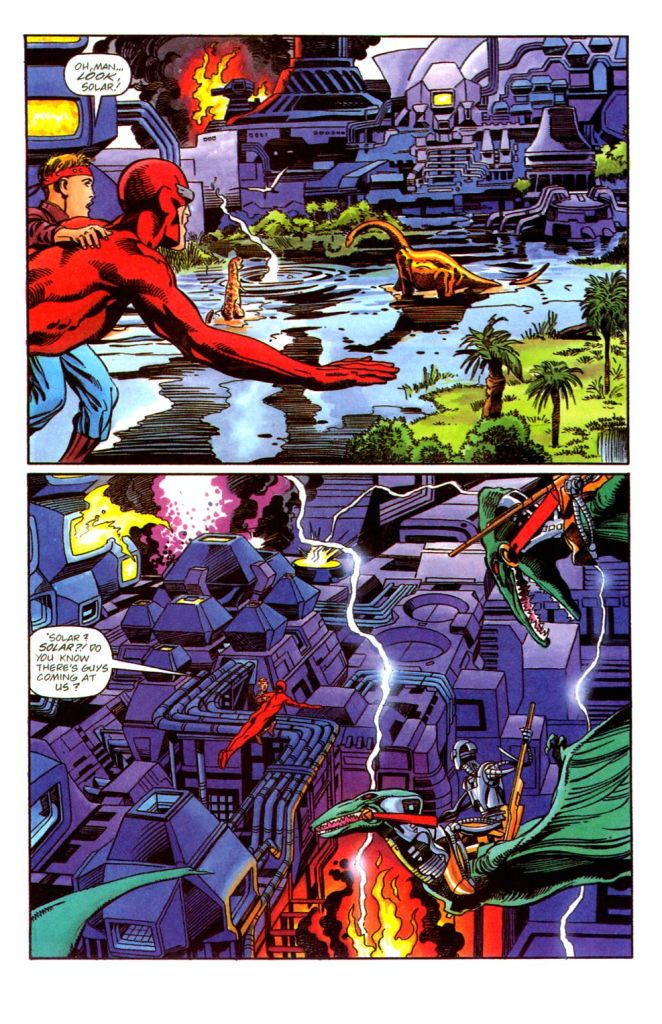
Solar and Geoff follow Erica’s trail into the timestream, to an area that Solar refers to as being “backstage of the universe”. There, they discover a pocket continuum that Erica has made her own, grafting together pieces from throughout time in a manner reminiscent of SECRET WARS’ Battleworld. In this Lost Land, dinosaurs cohabitate with futuristic cityscapes and robotic sentries–it’s a fabulous mishmash of elements. Also, because it exists outside of the normal flow of time, this realm can be accessed from any point in the timestream–whether the present as Solar and Geoff recognize it or from the 4001 AD time period of Magnus and Rai and company. This allows for different Valiant characters who are set in different time periods to all participate in this story together. (one fun element of the story is that we wind up with two iterations of Gilead, the Eternal Warrior, in it, one from the present and a later one from Magnus’ future.)
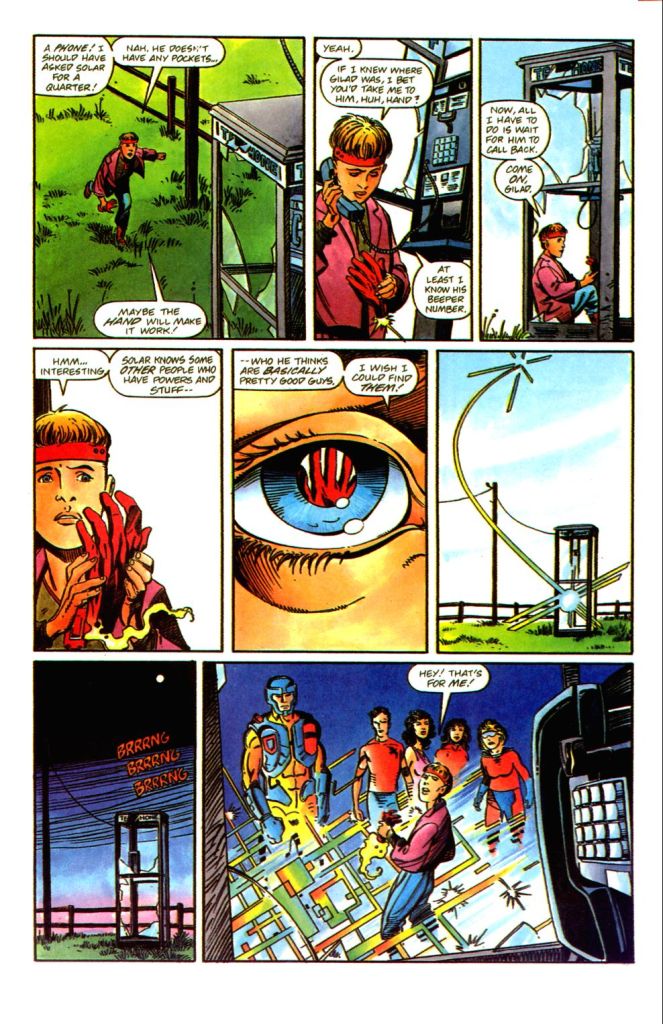
As Solar and Geoff begin to be pursued by Erica’s forces, Solar sends Geoff back to Earth with a piece of himself, his hand, to summon help–primarily Gilead, the Eternal Warrior, who battles on behalf of the Earth. Geoff is additionally conveyed by Solar’s energy to the location of the Harbinger kids and X-O Manowar, who had just concluded a team-up story of their own, and are willing to come along and help for really no good reason beyond the fact that this is a big crossover story and everybody is going to get involved, like it or not. Wanting allies he can trust at his back, Gilead takes a moment to pull in his brother Armstrong, getting Armstrong’s new friend Archer in the process. So all of the present day players are now assembled–with the exception of Shadowman, who will enter the storyline on his own later.
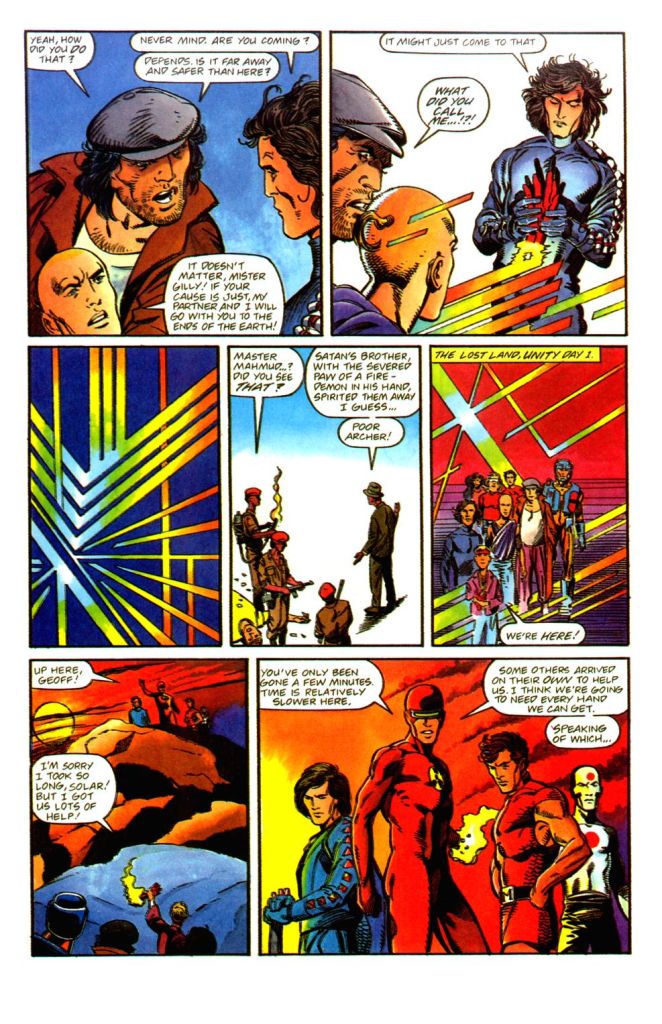
Returning to the Lost Land, Geoff and his group are surprised to discover that only a few minutes have passed since he’d left–time moves at a different rate here that in the outer world. But in those couple of minutes, a trio of other heroes have also arrived to lend a hand, this group from 4001 AD: Magnus, Rai and that second Gilead I mentioned earlier. From there, the focus shifts over to Erica herself, as she lays out some of the basics of this world and her plan to Albert, who was the son of the parallel Erica Pierce whom Mothergod killed and replaced. She tells Albert that her ultimate goal is to fix the damage that Solar caused to the timestream by essentially wiping creation clean and then beginning again, with a universe crafted to her own specifications. Thematically, this makes Mothergod of a piece with some of Shooter’s other past villains, including Korvac/Michael and even the Beyonder. You can tell that Shooter had an ongoing fascination with characters with ultimate power who tried to right the wrongs of the universe but whose humanity made them too fallible to truly succeed.
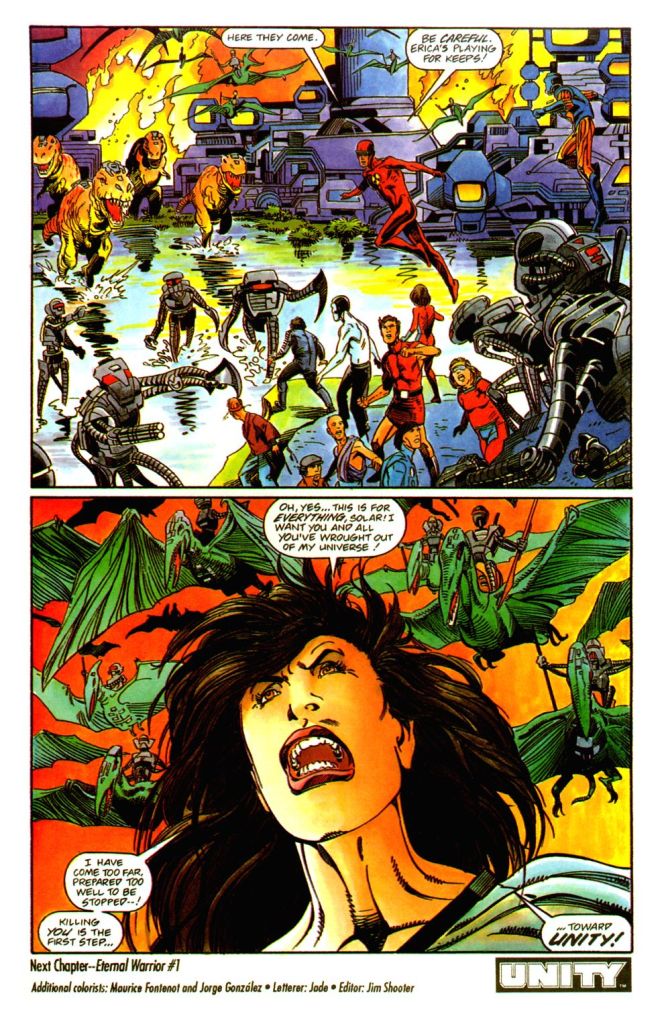
And so the issue closes with the forces of Pierce and the assembled Valiant heroes about to throw down in what promises to be a spectacular conflict. That conflict would play out across all eight Valiant releases over the next two months, eventually concluding in UNITY #1 two months later. As a way of visually uniting each months’ releases, as well as bringing some additional excitement to the event, Shooter and company recruited Frank Miller to produce all of the Valiant covers for May and then Walt Simonson to do all of the covers for June.
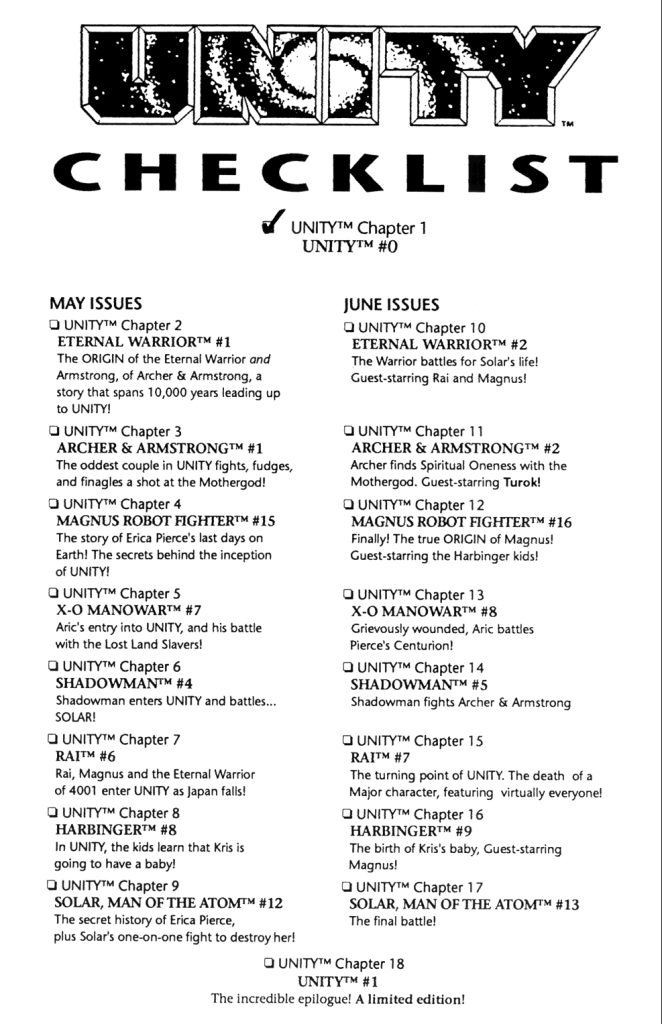
UNITY fit together pretty well, and it contained some big touchpoints for the nascent Valiant Universe. Magnus, it turned out, was the child of Harbingers Flamingo and Torque (who had died prior to this story) carried to the future and raised there Cable-style. And Rai was killed off, but not before setting up that his powers and mantle would be passed on to a successor in his future and that his line stemmed back to the present day, presaging the introduction of another key Valiant hero. Everything had come together perfectly and valiant was now poised to capitalize on the success of what it had been building. But one person who wouldn’t get to enjoy the fruits of that labor was Jim Shooter, who was ousted from the company at around this time. Accounts differ on all of the circumstances–Shooter told his version on multiple occasions and in multiple places. But regardless of how everything went down, after UNITY, Shooter’s name disappeared from Valiant for the most part. (A couple of stories and concepts that he had helped to come up with prior to his departure continued to carry his byline.) In his place, Bob Layton stepped up to become the new EIC of Valiant, bringing a slightly more commercial sensibility to what the company produced, but losing some of the tight line integration that had made the early Valiant titles so fascinating.
Valiant continued to be a market force for the next couple of years, but UNITY was really the company’s biggest moment. Thereafter, as the marketplace shuddered after the speculator bubble of the early 1990s burst, the group began to struggle more and more as sales decreased throughout the industry. The Valiant line was relaunched at a certain point in the event known as BIRTHQUAKE, then relaunched again by Acclaim, who wound up buying the company just before the bottom dropped out. What had seemed for a hot second like it would become a viable long-term third publisher in the field didn’t much make it out of the 1990s. But the characters are still well-remembered by fans of this era and a couple of attempts have been made to bring them back to prominence, some of them very well done. But alas, it seems as though Valiant’s time has largely passed, apart from a loyal niche audience.


I did enjoy some of the story beats of Unity, like Aric getting horribly injured and essentially stuck inside the Manowar armor for a time, and Rai’s sacrifice and subsequent powers being passed on. They did get a lot of mileage out of Bloodshot’s blood.
LikeLiked by 2 people
I’ve never had the opportunity to read Unity in its entirety, but the chapters that I have read are all really good. It’s a shame that from such lofty heights, Valiant would crash & burn within just a few years, and the various attempts to restart the company and reboot the Valiant universe have all ended up being short-lived.
I think there’s a certain validity to what Tim Pendergast commented on Tom’s post about Magnus #1, namely “Any reboot of Valiant will fail without the Western/Gold key characters.” The Valiant universe, for me at least, is just not the same without Magnus and Solar and, to a lesser degree, Turok.
Also, I really do not think it helps at all that the company keeps getting sold and re-sold. And the recent teaser images posted on social media by the current iteration of Valiant have, from all accounts, failed to generate any sort of buzz, and in fact are prompting a backlash due to them apparently having been created with AI. So, yeah, a sad state of affairs for what was, once upon a time, a great company.
LikeLiked by 1 person
It’s kind of wild that the letterer credit is left to the bottom of the last page. I mean, the lettering here is not fantastic, but still, why not put all the credits in one place?
LikeLiked by 1 person
I’m with you on both fronts — I don’t like the lettering much at all, and it’s weird to leave the credit out of the splash page when you credit everyone else.
LikeLiked by 1 person
Mothergod’s plan of wiping creation clean and then beginning again, with a universe crafted to her own specifications: Years later in the MCU Thanos would tell Captain America, Iron Man and Thor a similar thing in Avengers: Endgame ( 2019 ) — which I just finished watching on TV ( Avengers marathon was on ).
LikeLike
The Valiant Universe’s UNITY event/crisis that its characters from different time periods to all participate in the story together is what I wished Marvel’s 70th Anniversary books had done: Timely Comics & Marvel Comics characters interacting with each other because of some temporal event/crisis. But if it had to be Timely Comics heroes or WW2 heroes only, then the stories should have been linked. Spawn of the Witch-Queen [ Captain America Comics#20( November 1942 ) Captain America 1st story — The Spawn of the Witch Queen — Book of Thoth is used. Witch-Queen mentioned here but seem in Amazing Mysteries#33 ( July 1949 ) 2nd story — see marvunapp.com profile for both ] — possible other Timely Comics objects of Egyptian power: Ruby of the Nile ( taken from a statue of Ra — so maybe its other name is the Ruby of Ra )[ Captain America Comics#8( November 1941 ) CA 1st story — The Strange Mystery of the Ruby of the Nile and Its Heritage of Horror — Ra the Avenger ( Henry Sanders ) ], Cleopatra’s Diamond [ Captain America Comics#3 ( May 1941 ) CA 3rd story — The Queer Case of the Murdering Butterfly and the Ancient Mummies ] —more that appear after WW2 – Nile Sapphire [ MMC#65 ( July 1945 ) Human Torch story — Worthless Beads ] and a Ruby Scarab [ MMC#78 ( November 1946 ) Human Torch story — 3000 Years Dead! — a living mummy ]. I believe I said before that when I read about the Spawn of the Witch-Queen and his mother the Witch-Queen on marvunapp’s Masterlist they reminded me of Morgan le Fey and Mordred. As for a temporal event ( which was inspired by scenes in the Crisis on Infinite Earths ) someone could have done their version of the aborted Avengers/JLA story with Kang and the Lord of Time with Kang and Future Man with the Marvel-Timely characters ( Heroes-Villains ) instead.
LikeLike
Woke up this morning and remembered 2 other Egyptian Timely Comics artifacts: The Idol of Death ( grant the power to rule men )[ Marvel Mystery Comics#21 ( July 1941 ) Human Torch story ( The Idol of Death ) — Prince Itor mutated by the Idol of Death and granted mind-control powers ] and the Pharaoh’s Eye ( a ruby ) [ Marvel Mystery Comics#30 ( April 1942 ) Terry Vance story ( The Mystery of the Pharaoh’s Eye ) — Finog ]. Also remembered that on a smaller scale( turns Manhattan into a medieval nightmare — comics.org’s words ) that Conan/Red Sonja sorcerous foe Kulan-Gath did what Mothergod was planning to do in Uncanny X-Men#190-191 ( February-March 1985 ) and Morgan le Fay did it on a planetary scale in Avengers#1-3 ( February-April 1998 ).
LikeLike
Just remembered the second Sphinx ( Meryet Karim ) remade the Earth too in New Warriors#11-13 ( May-July 1991 — Forever Yesterday Part 1-3 ).
LikeLike
Over at Pre-Crisis DC Comics the Earth-1 Johnny Thunder erased the Justice League members from history using the Earth-2 Johnny Thunder’s Thunderbolt and replaced them with his criminal henchmen as the new Atom, Batman, Flash, Green Lantern, Martian Manhunter and Superman who are members of the Lawless League [ Justice League of America#37-38 ( August-September 1965 ) ]
LikeLike
I guess Phil Coulson using a demonic cube was the only Marvel character to remake the universe to his liking since Hyperion was a member of the Imperial Guard [ Heroes Reborn: Hyperion & the Imperial Guard#1 ( July 2021 ). Heroes Reborn#1-7 ( July-August 2021 ) ].
LikeLike
Even before the MCU (but after Unity), Parallax was planning something similar in Zero Hour.
LikeLike
I don’t think I read any of this, despite this chapter being free and drawn by Windsor-Smith, which would ordinarily be a big draw for me. Either my local comics shop had given all the issues away by the time I got there, or I’d decided I just wasn’t interested in another line-wide crossover, especially one where I was regularly following maybe one of the books at best. So UNITY may have been a jumping-off point for me.
It could be fun to read if it were easy to put together a set — or if it’s been collected (or will be, someday) in a single volume. I think I’ve seen Kickstarters for it that I think didn’t make it (or was that some other crossover project, involving Shooter and Jim Starlin?) — but these days, the whole thing would fit into a Marvel Epic Collection-sized TPB.
LikeLiked by 2 people
My intro to Barry Windsor Smith was Iron Man 232. I had missed all but one issue of Armor Wars, so I really wasn’t sure what was going on… but it sure looked great.
LikeLike
Money permitting, I’d buy something like that, and I have no experience with Valiant.
LikeLike
UNITY was definitely my jumping on point for Valiant comics. As a kid with a limited budget, $free was exactly the price I could afford to try something new. The beautiful BWS cover didn’t hurt either. John, at River City Comics in Clinton, IA, seemed to commend Valiant’s efforts, and I had always viewed him as some sort of enlightened comics guru, sitting behind his high glass counter, watching taped episodes of MYSTERY SCIENCE THEATER 3000 while he oversaw his comics kingdom. I stuck with X-O MANOWAR for a while, but left shortly after Bart Sears stopped drawing the book.
LikeLiked by 1 person