

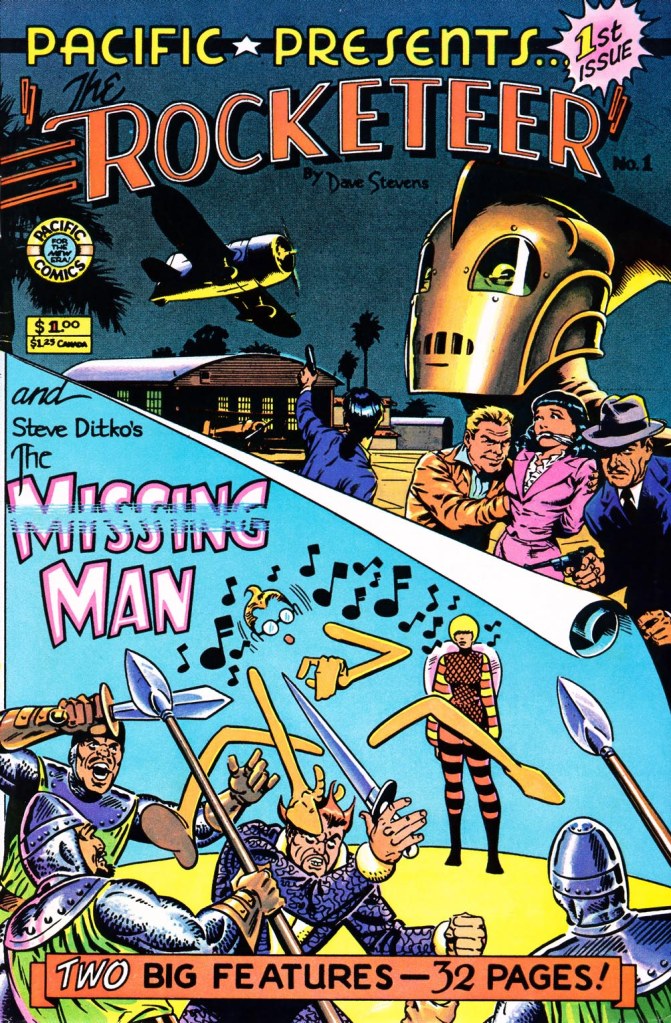
Now this was a book that we fans had been waiting for ever since the Rocketeer had first debuted in the back pages of STARSLAYER #2 and #3 a short while previously.
The strip had caused a huge stir in fandom, largely because it came seemingly out of nowhere and was so accomplished. Rocketeer creator Dave Stevens was an absolute unknown quality, but his artwork was so delightful that it captured the attention of the fan audience. As Pacific Comics was attempting to establish itself as a viable alternative to the mainstream, this was something they were all in favor of, and they quickly prevailed upon Stevens to continue his story as a headline feature. Stevens was a perfectionist, though, as well as not being incredibly fast, so this resulted in the Rocketeer sharing a split book, PACIFIC PRESENTS, with another feature, so the demands upon Stevens wouldn’t be insurmountable.
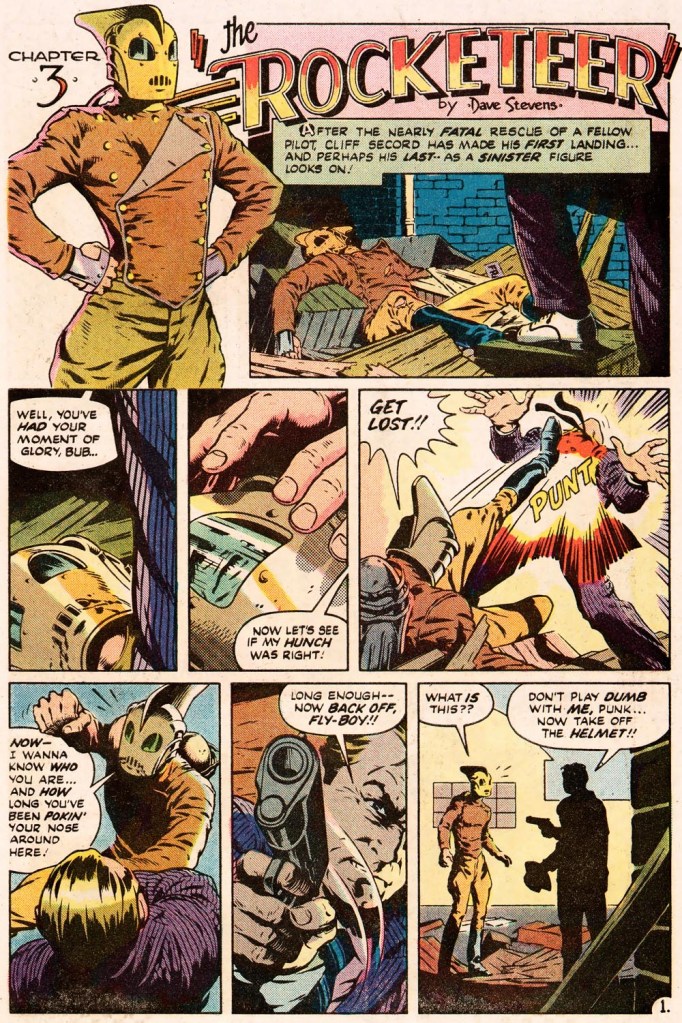
They wound up still being pretty insurmountable, though, and so the Rocketeer was only featured in the first two issues of PACIFIC PRESENTS. An eventual conclusion to the story was released as a one-shot thereafter, but by that point Pacific’s plans of being a publisher had gone belly-up, and so the ROCKETEER SPECIAL wound up being released by Eclipse instead, even though it had been commissioned and underwritten by Pacific. Even here, in an inside front cover editorial, publisher Bill D. Schanes reveals that Stevens has another commitment that will keep him from focusing on the Rocketeer, and so issue #2 will be released months after #1.
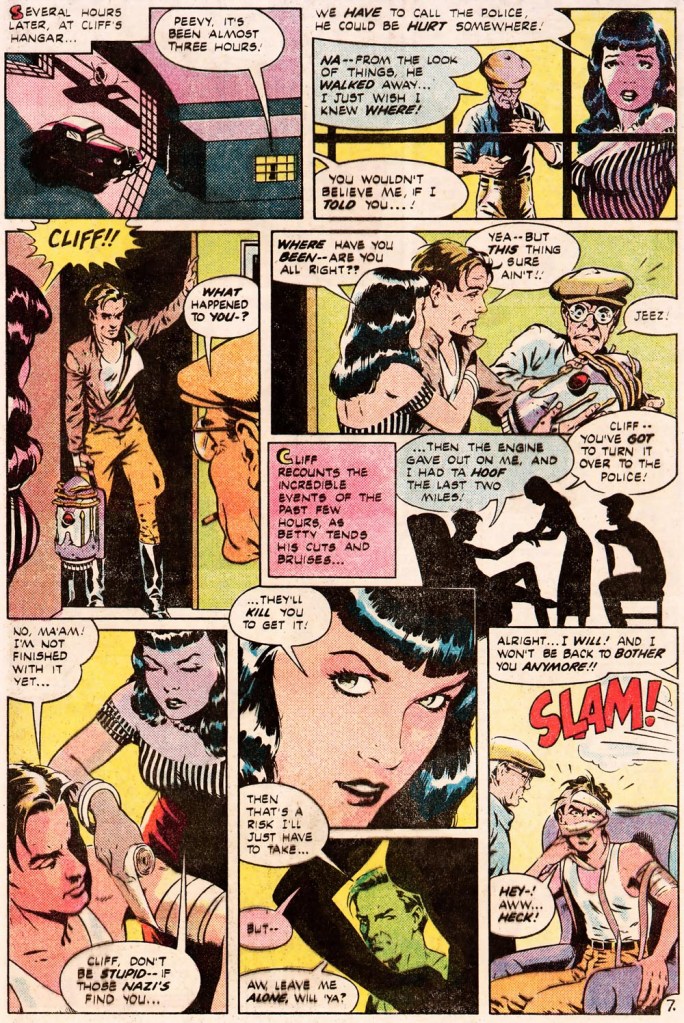
The Rocketeer was a pulpy adventure series set in the late 1930s about a down-on-his-luck aviator, Cliff Secord, accidentally falling into possession of a rocket pack that enabled him to be able to fly without a plane. Secord uses the rocket pack to make a name for himself, attracting the attention of assorted parties who have an interest in the stolen device. Secord’s girlfriend Betty was based directly on vintage pin-up model Betty Page, someone that most readers of the time weren’t initially aware of. Stevens visually based Cliff Secord on himself, and Cliff’s friend and mentor Peevy on fellow artist Doug Wildey. None of the three leads is especially altruistic, they’re all motivated by self-interest, which is one of the factors that gave the strip its appeal. The whole thing was also a broad homage to the Rocket Man/Commando Cody serials of the 1940s.
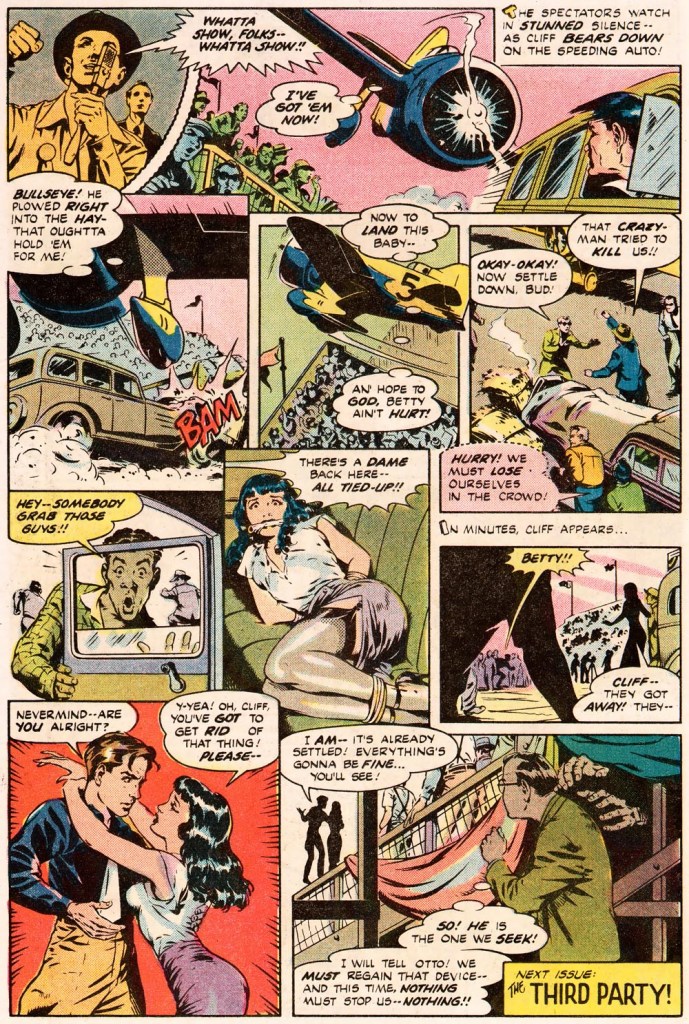
In this 12-page adventure, Secord is caught after a crash-landing and herded into a car which is promptly run off the road by another vehicle. He survives the crash, but the driver doesn’t–and Secord is astonished to learn that the man had been an FBI agent, and the guys who sent them plummeting to oblivion were Nazi fifth columnists. Secord uses the rocket pack to escape, but the device is banged up along the way. Eventually, the Nazis show up at the airfield and, unable to locate Secord or the rocket pack make off with Betty as a bargaining chip. Secord gives chase in his “Blind Bulldog” racing plane and forces the fleeing Nazis to crash. So Betty is saved, but the bad guys get away, and they still have designs on Cliff’s rocket. To Be Continued. It was a fun, fast-paced outing with some wonderfully rendered artwork, even if the pages sometimes felt a bit cramped and claustrophobic with dozens of panels. Stevens worked to get a lot of story into a relatively short amount of space. Later on, when the material was collected in a single edition, Stevens went back and expanded on a few of these sequences, with help from Jaime Hernandez.
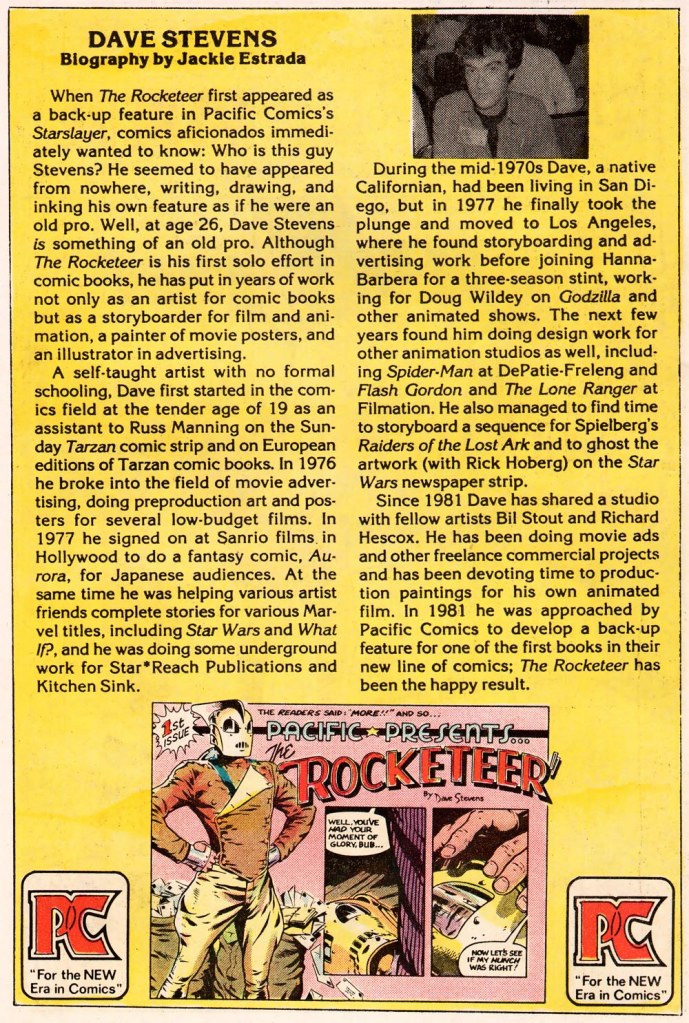
The issue also included a biographical feature on Dave Stevens written by future San Diego Comic Con officer Jackie Estrada. This was the first inking that most fans of the time had as to Steven’s bona-fides.
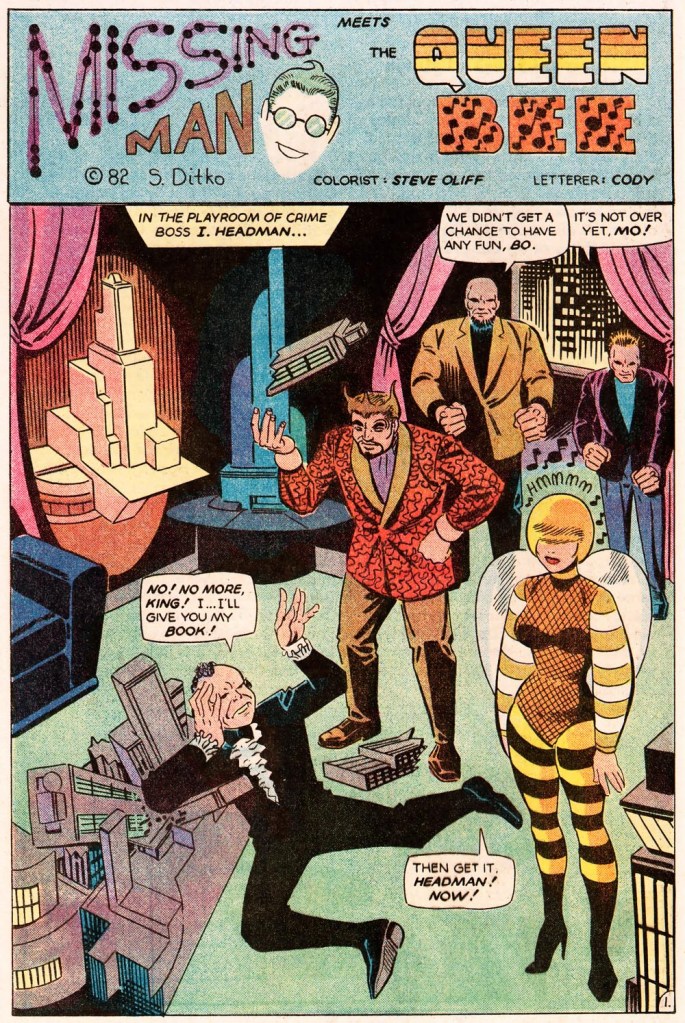
The back-up feature–which was longer than the lead, as things turned out, was Steve Ditko’s Missing Man. It was another one of his “odd hero” features, this one concerning ace troubleshooter Syd Mane who could transform himself into a weird torsoless crime-fighter by donning a pair of special glasses. Apart from the weird visual, it was difficult to say whether Mane gained any other abilities from this transformation, as he leapt around and fought like a typical Ditko hero. None of this was the stuff that Dirko was most interested in anyway. While the series wasn’t steeped in Ditko’s Objectivist belief system as some of his other self-helmed projects became, it also wasn’t especially deep. Pretty much what you saw was what you got, as the plot was thin and the characters simple types rather than fleshed-out individuals. The Ditko artwork, though, was pretty strong.
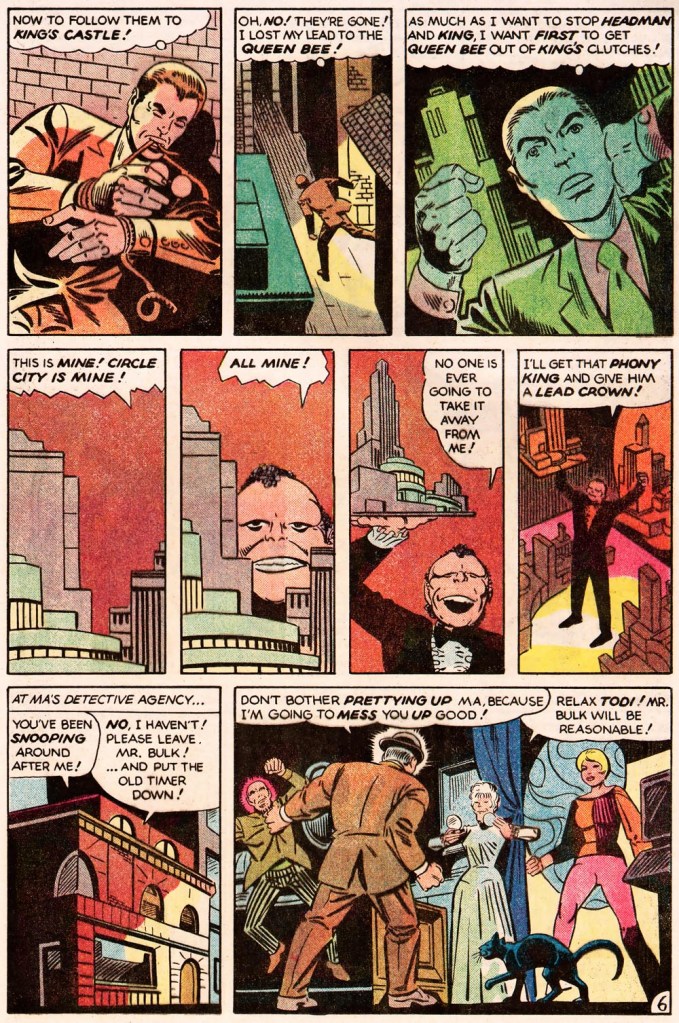
Perhaps the most noteworthy thing about the story is how perfunctory all of the dialogue and copy is. Calling it functional would almost be an exaggeration. It’s pretty leaden–you can see why the publishers had asked mark Evanier to come in and redialogue the character’s initial outing in the back pages of CAPTAIN VICTORY prior to this (and without Ditko’s consent, a fact Evanier was unaware of.) The strip is also full of weird names of the sort that became something of a hallmark of Ditko’s self-published efforts. There’s crime boss I. Headman, mob goons Bo and Mo, would be underworld ruler King, a thug named Mr. Bulk and a detective agency run by an older woman known only as Ma. The whole thing in aggregate gives the strip a strange air to it, as though it’s meant to be a larger allegory of some sort.
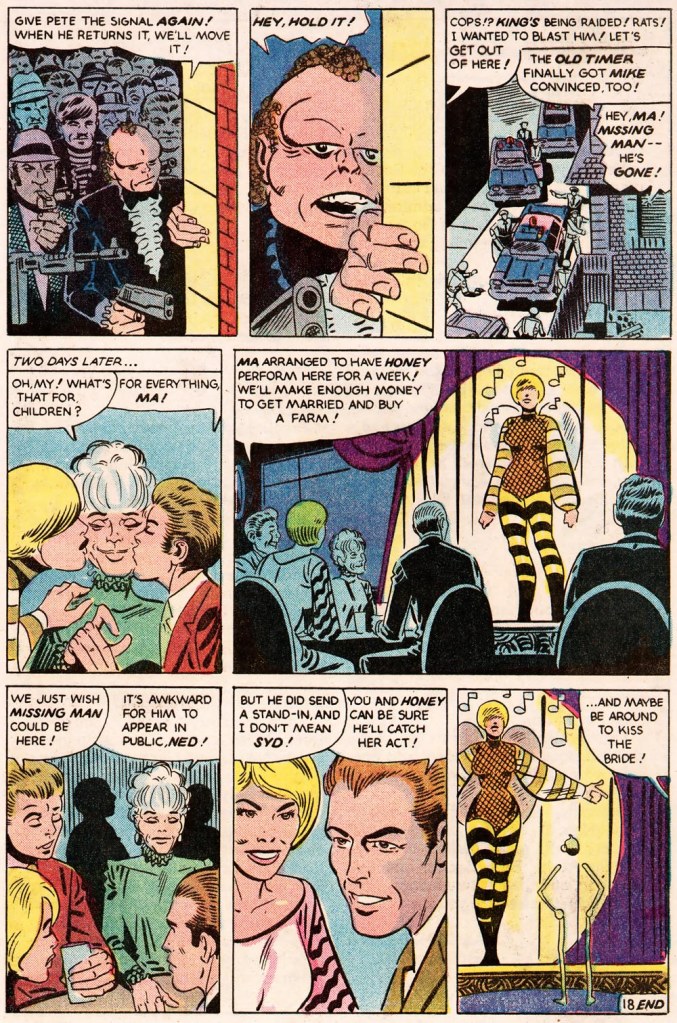
The story proper is about King trying to take over I. Headman’s rackets though the use of Queen Bee, a singer with a sonic voice whom King has tricked into thinking that Headman was responsible for the demise of her lover, Ned, who was actually ambushed by King and who has been comatose in a hospital eve since. Syd as the Missing Man battles both King and Headman’s mobs–though he’s relatively unnecessary to the story’s resolution as Ned gets his memory back and Queen Bee learns that she’s been tricked. She turns on King’s mob, neutralizing them with her voice, but it’s Missing man who gets to punch out King right at the end. It wasn’t a great strip, and the clunkiness of the dialogue definitely detracted from the overall effect. But it wasn’t bad.
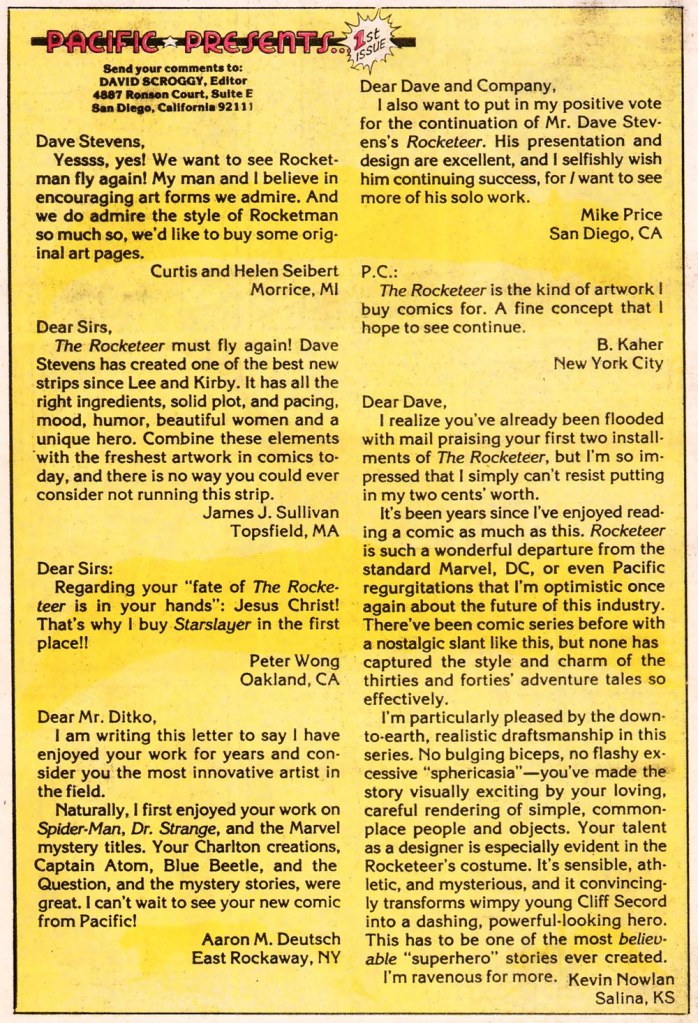
The letters page in this issue included a missive from artist Kevin Nowlan, who was just on the cusp of breaking into the industry himself. Nowlan was impressed by Stevens’ artwork, as you might expect.
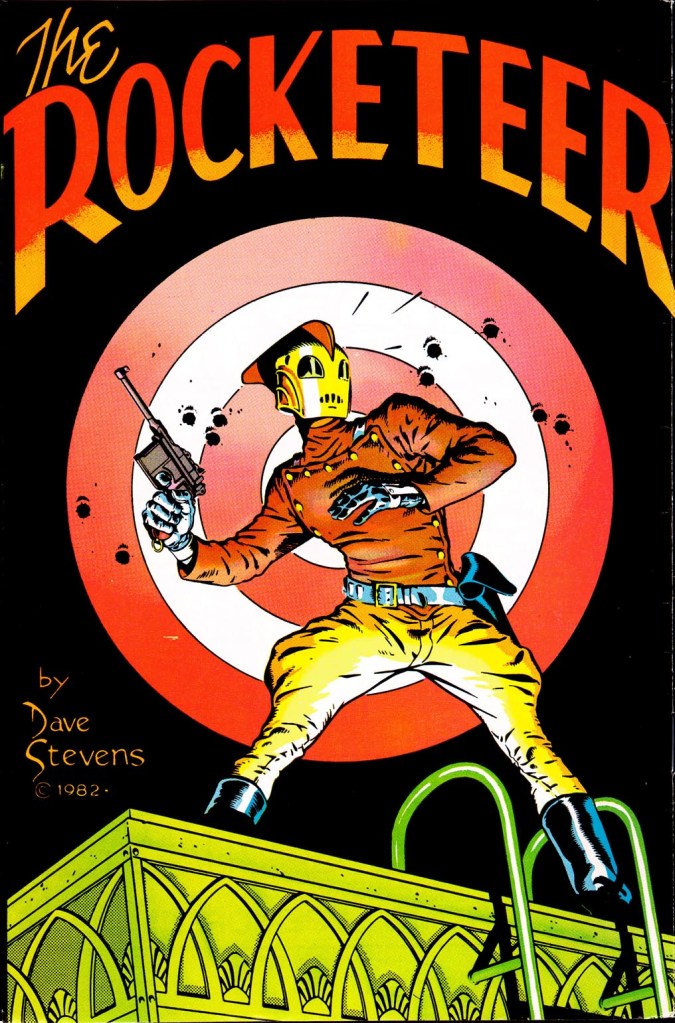
The back cover featured this much-repurposed Rocketeer full page pin-up image.
 The Tom Brevoort Experience
I always thought that Dave Stevens’ artwork looked a lot like Sandy Plunkett’s fine line artwork… or vise versa. At least that’s what it looks like to me. Do you agree?
LikeLiked by 1 person
THE ROCKETEER was very Quality Comics redux. Eisner, Crandall, Cole–one can check off their influences on Stevens and the strip.
LikeLike
It’s cool to see Stevens paired with the idiosyncratic Ditko… I doubt they could have put two artists to fill out a book who were more different in approach if they tried.
Stevens would have been at home at EC with their best artists in the 50’s, and Ditko… love him or leave him….I think his work is so distinctively and stubbornly individual that it’s compelling as an artistic statement even if it doesn’t entertain. The rigidness, strange names, awkward phrasing, and the anachronistic pov moves it into the realm of something akin to outsider art. There’s also absolutely a cautionary tale to being “the one guy who does it all” because I think Ditko was excellent at a number of storytelling devices and arguably substandard at others…. and it greatly impacted his career in the negative. Regardless, he was consistent in his approach for decades. It’s still tough to square this work with the 38 issues of Spider-man… that are so seminal to super-hero comics for the next 60 years. What a long shadow and a long sunset.
LikeLike
Rocket Man ( 1949 )/Commando Cody ( 1953 ): Rocketman [ Scoop Comics#1 ( November 1941 ) Chesler Dynamic ] Cal Martin and his fiancee, Doris Dalton, two young scientists whose inventions have been used to combat crime and help better society. When he invents a “three-cartridge rocket pack” that allows him to fly through the air, he makes one for Dalton, and together they fight crime and the Germans as Rocketman and Rocketgirl. They are partnered with Billy Wood, a young boy who they gave a jet-pack to and who helps them as Rocket Boy.
LikeLike
I bought this on my very first trip to Fantastic Worlds, which was Bob Wayne’s tiny shop on Camp Bowie Blvd in Fort Worth, not far from where I lived. The staff there – it was probably Bob himself – pointed this 12-year-old towards something brand new in the market. Totally blew my mind.
LikeLiked by 1 person
Rocketeer’s appeal has always been lost on me. The pin up girl connection is a turn off to my taste and the era, especially the setting, never interested me. I can see it as quality art but not in any story I’d be interested in reading.
LikeLike
It’s never clicked with me either even though a 1930s pulp-style adventure should have been catnip for me.
LikeLike
Hi Jon – glad we helped you find Rocketeer.
best, Bob Wayne
LikeLike
Hi Bob – Thanks! It wasn’t just Pacific Presents – more broadly, y’all steered me towards at least considering comics beyond just the DC and Marvel stuff, which was all I had exposure to at the 7-11.
I was at a good age to want to see more, comics were at a moment of expanding what was possible, and whether you realized it or not, your retail shop took the care to help create a lifelong fan of all types of comics. I still support my local shops in Austin as a result.
Jon
LikeLiked by 2 people
The Twomorrows book on the history of Pacific mentioned how this title was originally conceived to be a showcase for a veteran creator + emerging new talent. This issue definitely embodies that, but what a contrast of styles.
LikeLike
There’s a movement in fundamentalist fan circles calling for all comics, when they’re collected in paperback or hardcover, to be reprinted with their original colors. I think the above is an example of why this is often such a terrible, misguided idea. The original colors on The Rocketeer were awful, and the colors on the collected editions (both the original Eclipse graphic novel, and the second recoloring on the IDW hardcover) were sooooo much better.
LikeLike
One thing I’m kind of puzzled by in Ditko’s self-written work, post-Silver Age Marvel, is how static the characterizations are (no pun intended). It’s not just the dialogue, it’s the character plotting. Where Ditko kept Peter Parker’s life hopping, even when he and Stan weren’t speaking to one another and he was solely in charge of the plotting. In Dr. Strange, he didn’t have much room, but the romantic/adventure plotting with Clea showed a clear indication that he wanted to keep the hero’s personal life a priority.
But in later works, the supporting cast seems to come on stage, behave in a formulaic way, with the same arguments or goals being expressed over and over, with no movement, no development. The flat, declamatory dialogue didn’t help, but it strikes me as odd that the character plotting all but vanished.
The Rocketeer, of course, was a delight. Stevens was crowding the pages as he figured out how much plot he could get into each installment, but the drawing was gorgeous, the story was exciting and the characters were lively. And his love for the era and the setting came through strongly. It was just compelling, instantly-engaging stuff, and it’s easy to see why it became a sensation.
If only it could have been a more regular sensation. But, well, if he couldn’t produce at that level without taking that much time, so be it.
LikeLiked by 1 person
That’s a really interesting observation about Ditko. I wonder if it had anything to do with him getting more deeply entrenched in Randian Objectivism? I’m reminded of how CEREBUS changed as Dave Sim got more and more interested in the Bible (and his idiosyncratic interpretation thereof). Sometimes becoming a True Believer doesn’t leave much room for nuance.
Or who knows, maybe Ditko was doing the character stuff through gritted teeth all along, thinking it was expected of him at Marvel, and he was happy to ditch it once he was out of there.
LikeLike
Kurt another unfinished comic by Dave Stevens he created was called Aurora which I think predates The Rocketeer. I think it was published in a book called Alien Worlds but only one episode and then abandoned leaving the story unfinished. Beautiful stuff. I loved Aurora’s alien friend Unk! Delightful.
LikeLike
I think Ditko mostly rejected the idea of soap-opera plotting after he quit Marvel because he didn’t want his subsequent work to resemble his collaborations with Lee. He occasionally moved back into the mode of serial melodrama, as he did with SHADE. But on ideas he originated, he tended not to develop the soap opera potential very much.
LikeLike
The Rocketeer by Dave Stevens was great. A character that endures even today. Stevens was a talent in the same league as Frazetta or Williamson. His Rocketeer had a lovely 30’s atmosphere and authentic dialogue. Very enjoyable. Likewise Ditko’s The Missing Man. Theres never been a weirder or more original character than this. An underrated strip from Ditko. Love It! A nice addition to his ouevre.
LikeLike
I. Headman is at the level of the 1940s Bat-books with disguises like I. Namtab and Mr. Rekoj.
Todi = Toady, I guess.
LikeLike
I bought Pacific Presents #2 as a back issue in the early 1990s. I never had an opportunity to track down any of the other chapters of The Rocketeer, which was too bad, because I really enjoyed the movie that came out in 1991. IDW finally published a collection of the complete series by Dave Stevens, but again I never had a chance to get it. I finally found a copy of the trade paperback for $20 at a small comic con in Brooklyn this past Saturday. I’m reading it now. The story is fun but a bit meandering, but the artwork by Stevens is definitely the major attraction. It’s absolutely gorgeous. Great recoloring job by Laura Martin.
Whatever the case, Stevens was an incredible artist, and it’s a tragedy that he died so young.
LikeLike
Frankly, neither story excited me that much, but I loved the artwork on both stories! Even with his great art, The Rocketeer story was full of pulpy stereotypes done straight. Which is okay if you like that kind of thing. As for The Missing Man, I don’t know if it was just a matter of Ditko not caring, or perhaps caring too much and realizing he didn’t know how long the series would be published. Why do subplots if you don’t know if you can continue them?
LikeLike