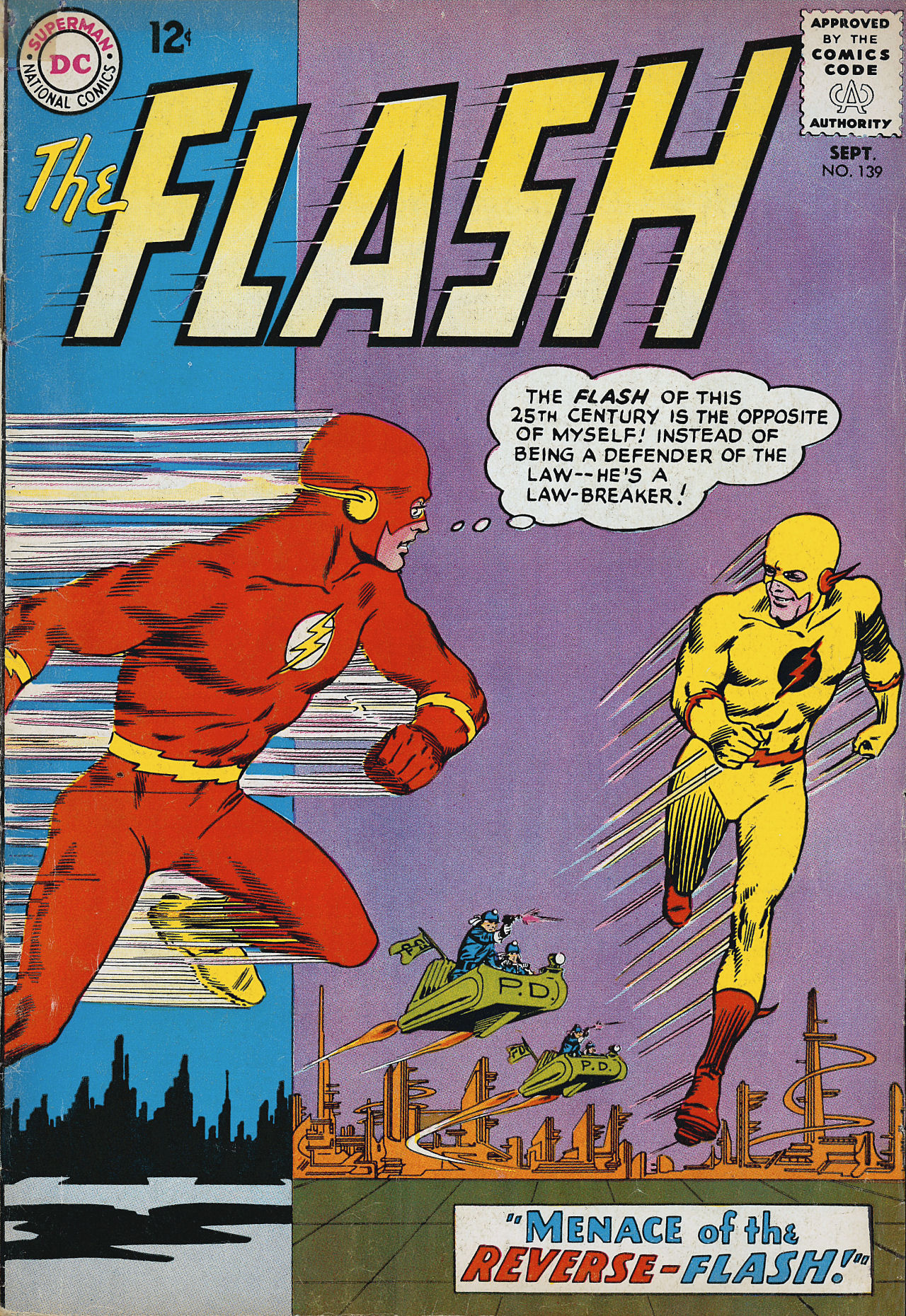


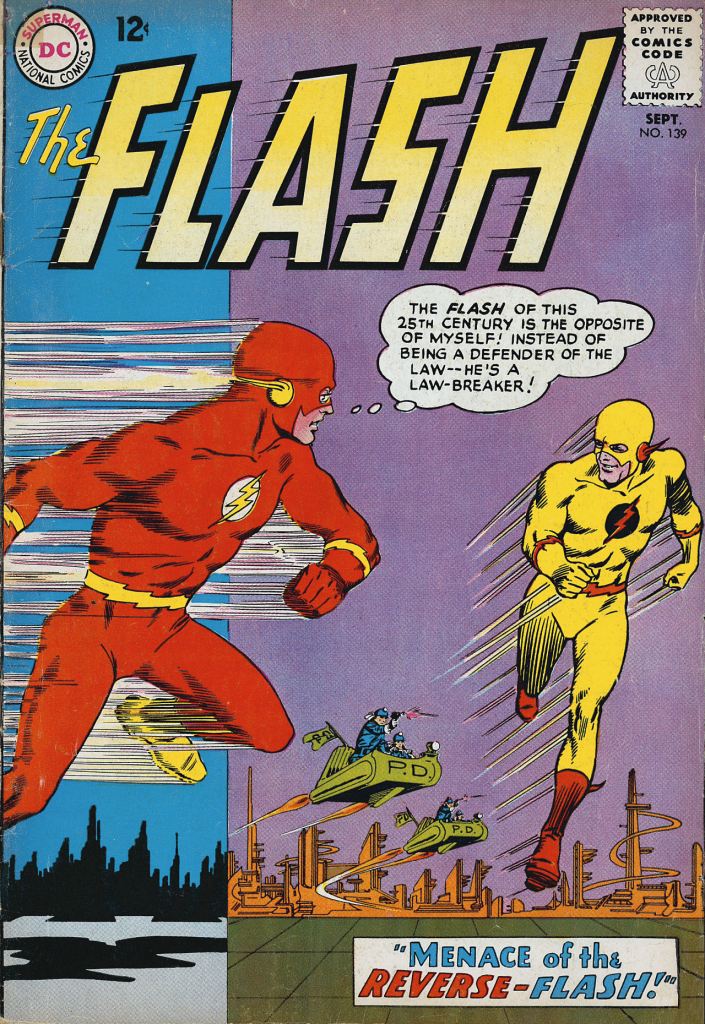
Ed’s Coins and Stamps, the collectibles dealer whose shop was in the Sun-Vet Mall where I had gone to spend a bunch of my sixth grade graduation money was more of the DC shop than a Marvel one in terms of the back issues they had in stock. They weren’t entirely bereft of Marvel material–I can very clearly recall seeing a copy of DAREDEVIL #2 (with its call-out to the guest-appearance of the Thing) displayed as a wall book at one point. But probably because of the reading interest of whoever’s collection made up the initial inventory of the shop, Ed stocked much deeper on DC back issues than Marvel ones. Which explains why, on this particular trip to the store, I wound up with entirely DC books. Among them, this key issue, FLASH #139.
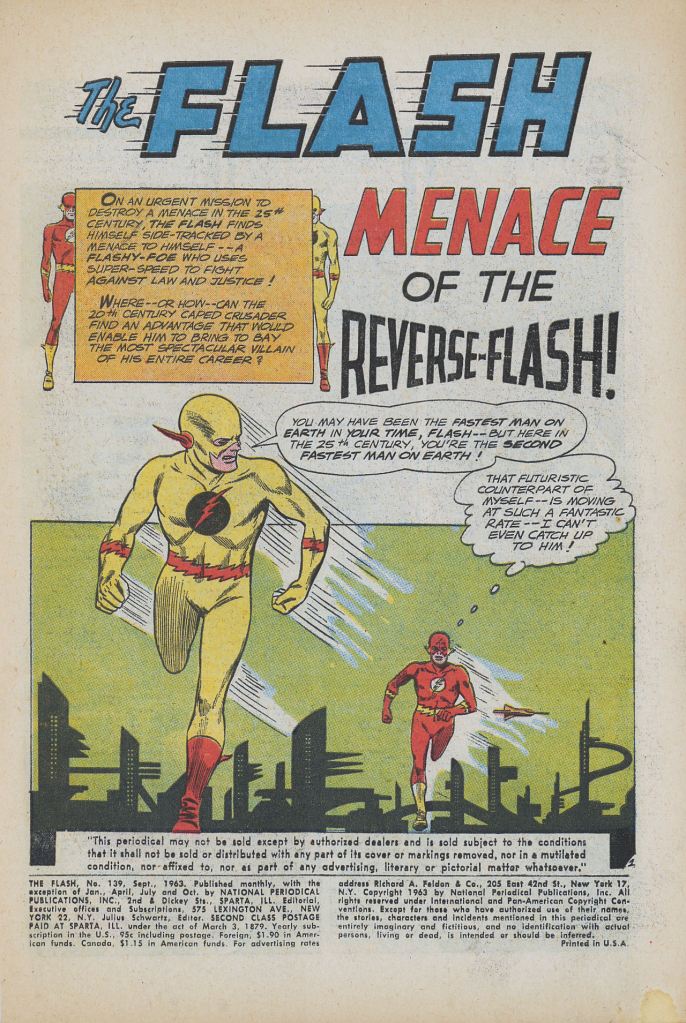
FLASH #139 featured the first appearance of Eobard Thawne, known professionally as Professor Zoom, the Reverse Flash. I was familiar with the character from his more recent appearances and I liked him–he had about the most basic, most obvious fundamental set-up for a super-villain, in that he was a color-reversed version of the Flash himself, armed with all of the Scarlet Speedster’s swift powers. He also came from the future, as more than a couple of the Flash’s recurring foes did, the 25th Century to be precise. He’d been a favorite ever since I read FLASH #225 in my younger days, an issue that for a while I considered just about the greatest comic book I’d ever seen.
So consequently, when Ed had this back issue in his box, there wasn’t any question whatsoever that I was going to go home with it.
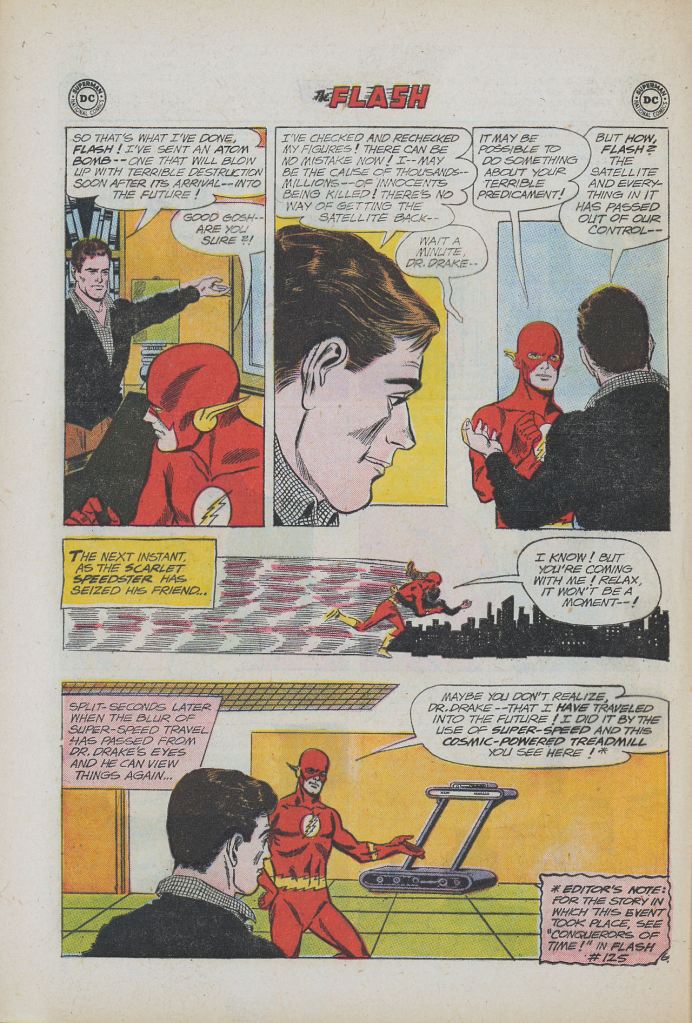
The Flash, and really the work of writer John Broome, artists Carmine Infantino and Joe Giella, and editor Julie Schwartz, were really the thing that sold my absolute love for the comic book medium. These Silver Age stories are undoubtedly silly, but they’re also executed with a kind of straight-facedness that made it easy to believe in them, despite their outlandish plots and use of science as basically magic. A lot of that appeal was the artwork. I know that most don’t love inker Joe Giella’s work over Infantino–certainly Carmine himself was no fan. But to me, Giella was essential in sanding off the rough, sketchy edges of Infantino’s angular pencils into something more attractive. In a way, he was sort of the Joe Sinnott of the strip, giving Infantino a polished, slick line that I found very appealing. Infantino’s pages were always lovely, very design-oriented with swaths of open space with just enough detail in them to feel like a fully-realized world. The beauty was often in the minimalism of the presentation. Sadly, this was a quality that got lost, or at least heavily hidden, a few years late when original artwork sizes reduced.
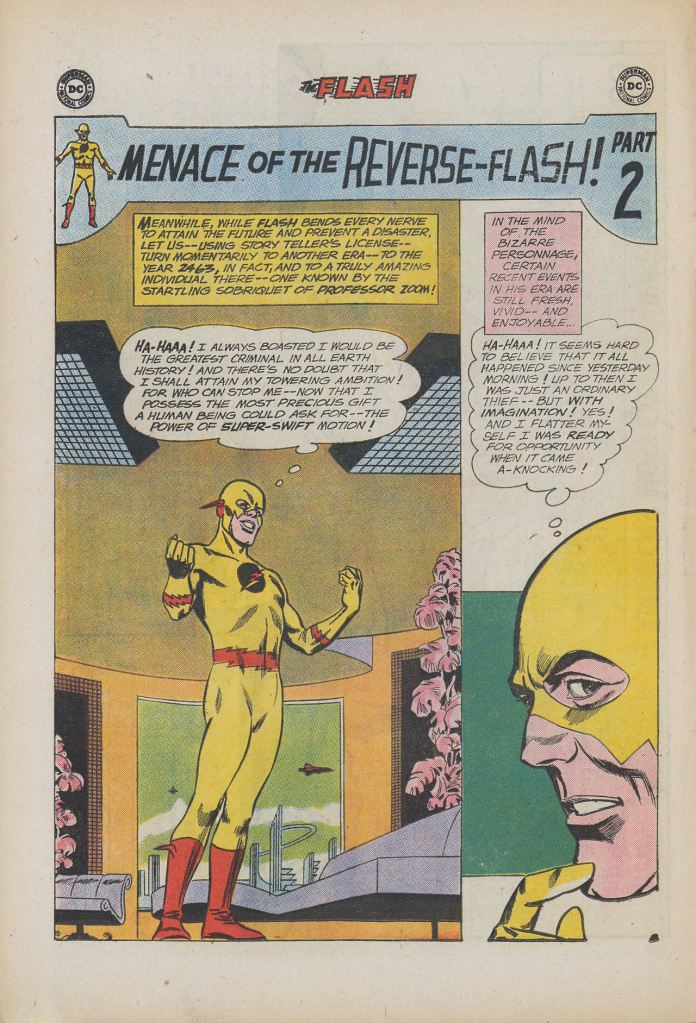
The story in this issue was one of those rare outings for 1963 that took up the entire magazine, so you know that it was intended as something of a quiet epic. It starts with the launch of a Time Satellite, a kind of more active version of burying a time capsule to be dug up by future generations. The Time Satellite was instead fired into the stratosphere by rocket, where it attained the necessary velocity to travel instantly 500 years into the future. Science is magic, remember? Anyway, among the items that are placed in the Time Satellite for future study is one of the Flash’s costumes. Unfortunately, the scientist behind the time Satellite launch works out too late that the Atomic Clock that they’ve included in among the artifacts will be transformed by the journey into an atomic bomb, one that may decimate future civilization. Fortunately, when the scientist, Walter Drake, consults with the Flash about this deadly revelation, the Scarlet Speedster has jus the thing to remedy his worry: he can journey himself into the future of 500 years from today and prevent the incidental atomic bomb from destroying everything. (Which kind of begs the question: why go through all the trouble of launching satellites when you could just have the Flash run the time capsule to the future? But it’s best not to question the story logic of these tales all that much.)
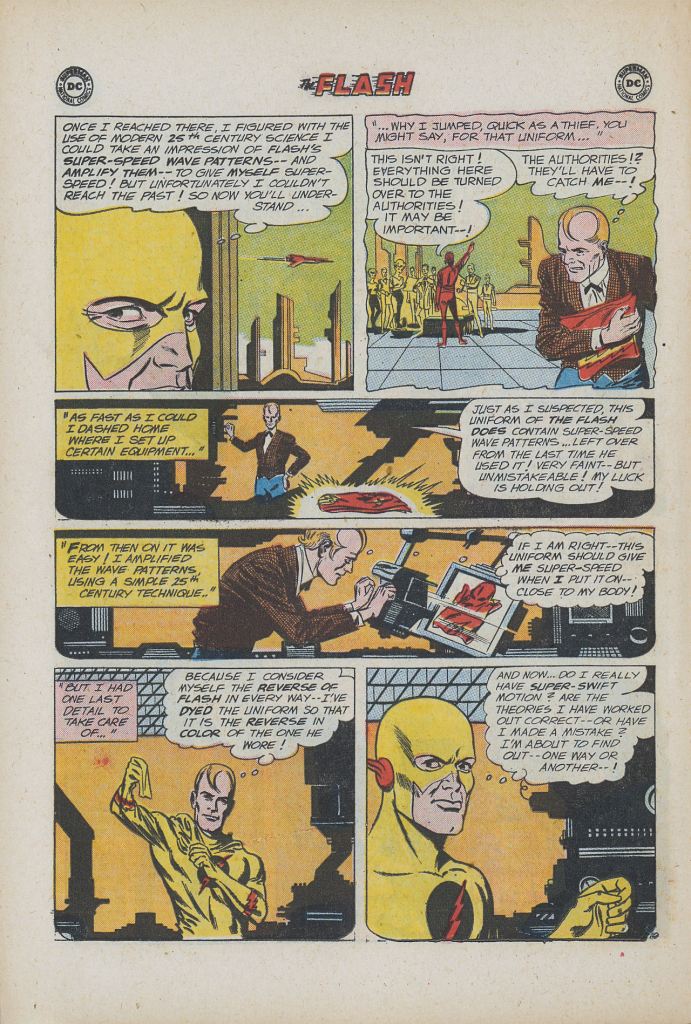
Meanwhile, in the future, prior to the Flash’s impending arrival, we are introduced to Eobard Thawne, professional criminal who has just come into a windfall. You see, Thawne had always been an aficionado of the Flash as a historical figure, envious of his super-speed. He’d developed a process using the super-science of tomorrow that would enable him to duplicate the Flash’s velocity based on acquiring a wave-pattern from the speedster. And the donated Flash uniform, which he swipes from the crashed Time Satellite, gives him just what he needs. Dubbing himself Professor Zoom (a patently ridiculous codename) and dying the uniform to the opposite colors of the Flash’s because he is the lawman’s exact opposite, Thawne succeeds in gaining super-speed, at least while wearing the costume. And he promptly goes on a crime spree, stealing rare Cribi Sculptures that were found in deep space. All of the Flash’s powers, and all that Thawne can come up with to do with them is basic burglary.
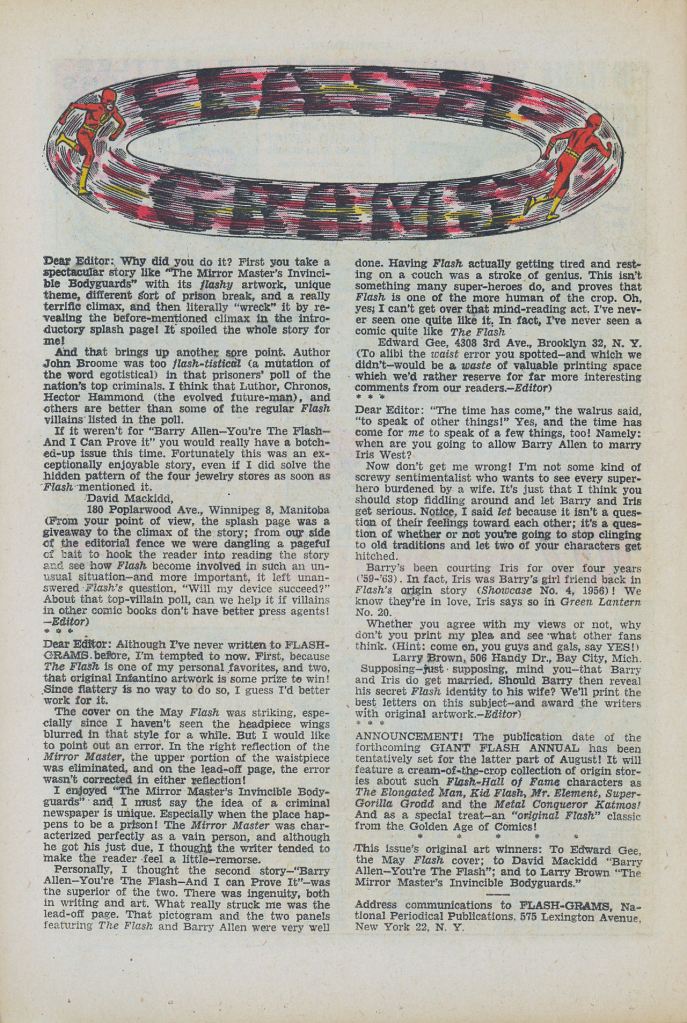
A quick stop-off at this point for the Flash Grams letters page. Editor Julie Schwartz wasn’t yet signing the page (though he’d confirmed his identity on it on a couple of occasions) but he was still printing and answering mail from his readers. And giving those published letter-writers an incredible prize: the actual original art to the stories they were critiquing. This offer didn’t last long, maybe a year all told, but Julie gave away an absolute fortune in Silver Age original artwork in this manner. It wasn’t particularly valued at that moment (and indeed, DC would regularly destroy it to prevent it from being illicitly reproduced–or bringing the artists who drew it any additional revenue from its sales.) but it was still an amazing thing to receive in response to a simple letter. Julie doing so insured that some of this artwork would survive to the present day. Having read a few of these older letters pages where the art was offered, I burned to be able to have such an opportunity to score such a rare and valuable prize for myself.
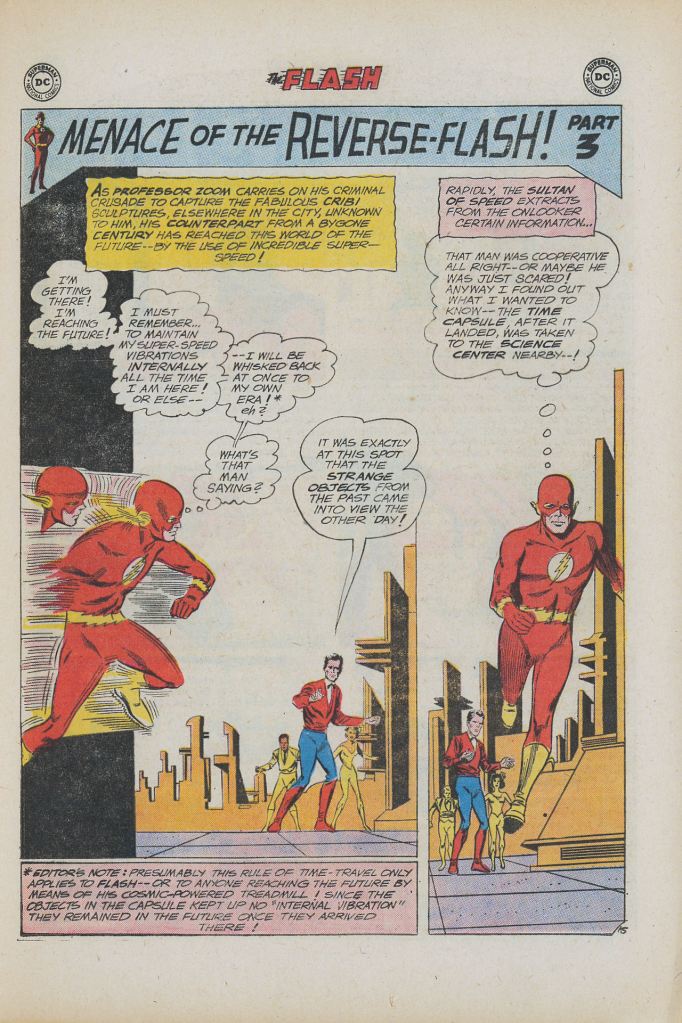
The world of tomorrow is unable to cope with the marauding Professor Zoom, who appears able to whisk off with valued art treasures at his whim. But sadly for the now velocitized Professor, it’s at this point that the genuine Flash of the past turns up in the 25th Century, on the lookout for the dangerous Atomic Clock-turned-bomb. All of the artifacts from the satellite crash have been turned over to a future museum, Flash discovers, with two exceptions: the Clock and his old uniform. Flash is puzzled as to why anybody would want his old costume until he sees reports (on a wall-mounted, scrolling color newspaper of all things) about the crime-wave of Professor Zoom. Figuring that Zoom must have the explosive clock, Flash sets out to bring him to ground. But in their first encounter, Zoom makes a monkey out of the heroic speedster, outracing him with the aid of rockets he installed in his boots for an added thrust. But Flash is able to follow the escaping Zoom’s vibrational trail back to the criminal’s hidden hideout, where the two speedsters resume hostilities.
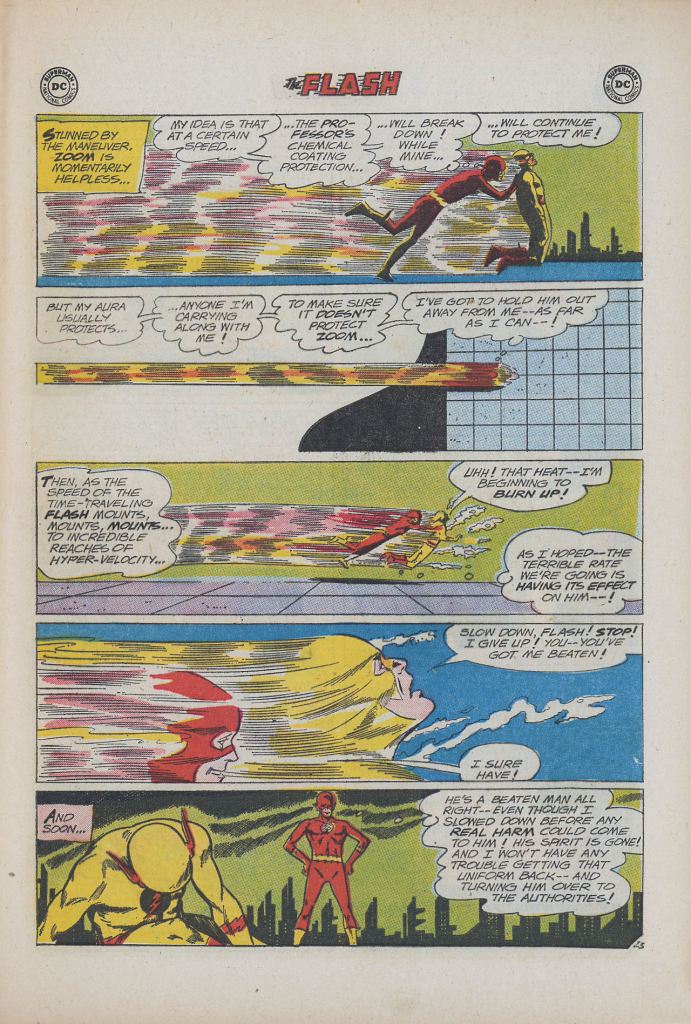
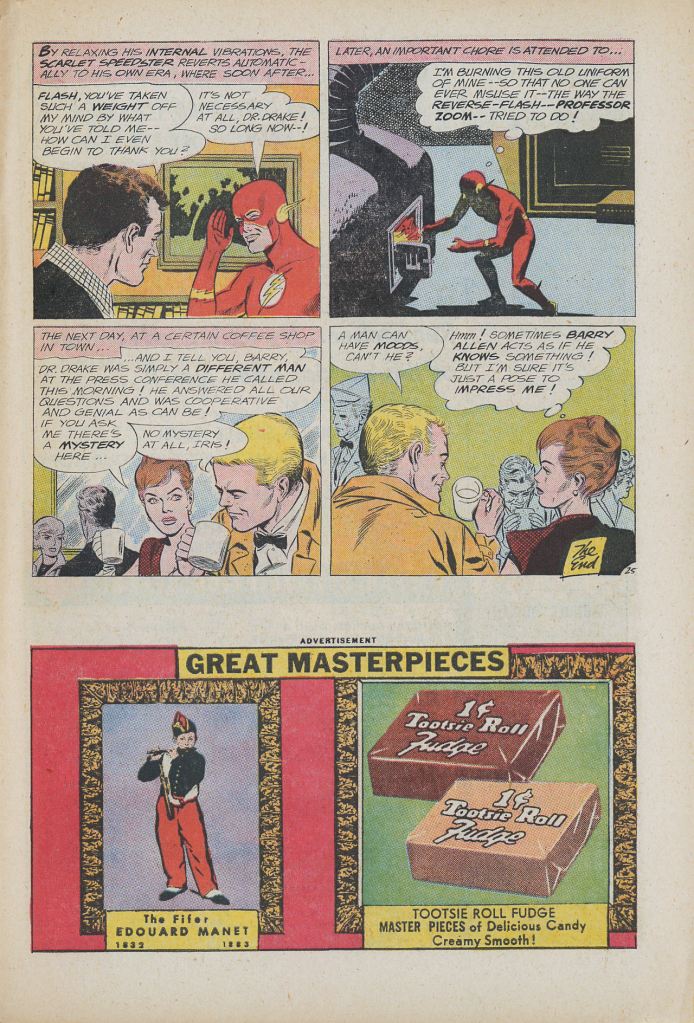
But the pair are at a stalemate, and at a pause in their battle, Zoom explains how he was able to duplicate Flash’s powers and even mimic his protective friction-proof aura with a chemical coating. This is all that the Flash needs to hear. He grabs Zoom and heads off at top speed, holding the felon out in front of himself so he’ll be outside of the protective effects of the Flash’s own speed-aura. As he anticipated, the sustained speed friction begins to heat Zoom up dangerously, burning away the chemical coating that protects him. Beaten, Zoom relents–but it turns out that he doesn’t have the Atomic Clock either! Flash winds up having to zip through the future Central City in a split second to eventually locate the admiring older woman who salvaged it, snatch it up, and race it to an abandoned area in the Arctic Circle where it can safely detonate. Returning to the present, he’s able to assure Walter Drake that his Time Satellite did no harm to the world of the future. And he burns his old spare uniform so that Professor Zoom will never be able to use it again. This turned out to be wishful thinking on Barry Allen’s part, as Professor Zoom became one of the most popular and recurring members of his Rogue’s Gallery.
All in all, it was a really good example of the virtues of the Silver Age DC books, especially the Schwartz ones. The stakes were simple and, while dangerous, not particularly terrifying. The situation the hero had to overcome was framed more as a puzzle to be solved than a physical threat that had to be overcome with force. The artwork was open and clean and attractive, and as easy to follow as a diagram. And the text was pleasant and inviting without being overly chatty. Imagination was more valued in these stories than violence (or even action, really–while there is a fight between Flash and his Reverse counterpart, it plays out more like a race than a fistfight. I think all of one punch is thrown during the entire issue.) You can see that the editorial direction was still very much in reaction to the comic book witch-hunts of the 1950s that led to the creation of the Comics Code. DC had always pushed to make their product clean and Parent-friendly, but in that Post-Code period, they dialed everything back to an insane degree. It’s to the credit of the innovation of the creators of this time that they were still able to find ways to tell interesting super hero adventures when straitjacketed to such a degree.


Tom, how old were you when you read Flash #225? And how old were you when you picked up this issue? Just curious. Both these stories seen quite silly to me, but I’m sure that if I had read them when I was much younger, I probably would have found them to be fun & interesting. As that old saying goes, everyone’s personal Golden Age is when you’re 10 years old, or world to that effect.
Anyway, nice to see some appreciation for Joe Giella’s work. I agree, I felt he did a good job inking Carmine Infantino’s pencils. It suited the art for this series.
LikeLiked by 1 person
I would have been six, maybe seven, when I read FLASH #225, and then 12 when I bought FLASH #139.
LikeLike
Yeah, that makes perfect sense. I was six and a half years old when my parents bought me Captain America #278 in late 1982. I thought it was an amazing book, and I read it over and over again until it fell apart. I enjoyed the handful of comics I got over the next few years. And after I finally started following comics regularly shortly before my 13th birthday in June 1989, the books I bought that Summer and Fall all seemed special & magical to me.
LikeLike
I like “Professor Zoom” as a name for an evil speedster. After all, the material on the Flash that Eobard read in his history books had to have included information about the villains, so he’d have knowingly been following in the tradition of guys with names like Captain Cold and Mister Element. After I’d read this story, I thought of the character as “Professor Zoom, the Reverse-Flash”, analogously with “Superman, the Man of Steel” or “The Joker, the Clown Prince of Crime”.
LikeLike
I just checked comics.org and what I find incredible about Quicksilver’s 13 issues 1997 series was no one thought to have him go up against Speed Demon or the female speedster Black Racer [ Captain America#337 ( January 1988 ). As far as I know the only speedster Quicksilver fought was Whirlwind [ The Avengers#83 ( December 1970 ) ]. He did fight a time-traveler in Quicksilver#2 ( December 1997 ) — Thundra. The whole Atomic Clock to Atomic Bomb is right up there with people who mistakenly think Humans evolved from apes ( Then ask why are there still gorillas/etc. ) when Humans share a common ancestor and Human & the Apes/Monkeys branched off from that ancestor. An Atomic Clock is a clock that measures time by monitoring the resonant frequency of atoms ( wikipedia.org ).
LikeLike
Like I’ve said before I like Black Adam types ( Villains with the same powers as the heroes they fought ): Reverse-Flash, Sinestro, Crime Syndicate of America; Amahl Farouk ( before he got turned into the Shadow King — The X-Men#117 ( January 1979 ) ), the original Power Man ( when he got upgraded to Wonder Man level unfortunately only temporarily — The Avengers#164 ( October 1977 ) ), Red Star Man ( alien Human Torch, only survivor of the Flame People when their star exploded– The Human Torch#35 ( March 1949 ) 1st story ), etc.
LikeLike
Enjoying this wonderful excursion into the early 60’s, I’m again imagining the intriguing choices facing kids and future comic collectors in September 1963. You had delightful fare such as this issue with the delightful villainy of Reverse Flash. But also on the racks were the likes of Spider-Man #4 (first appearance of the Sandman) and Avengers #1 with Marvel offering books that were decidedly different from their DC counterparts. As I’ve said before, what an amazing time it would have been to be a collector.
Then again, who am I kidding? I’d have been all over Tales of Suspense #48 where my favorite character, Iron Man, faced the infamous Mr. Doll!
LikeLike
It’s been a long time since I first read Zoom’s debut story, but I don’t remember rocks in his boots.
LikeLike
“All of the Flash’s powers, and all that Thawne can come up with to do with them is basic burglary.” A common critique of Silver Age villains but it never bothers me — I can buy that someone who defines themselves as “professional thief,” then getting superpowers, would redefine themselves as “professional thief with superpowers.”
Likewise I’ve come to realize villains spilling their evil plans instead of shooting their foe is quite plausible — real-world people can be amazing windbags if they have a captive audience, so why not crooks?
LikeLike
His first time out the original Parasite(Raymond Maxwell Jensen) robbed a bank [ Action Comics#340( August 1966 ) ], he didn’t go full super-villain( vs. super-criminal ) until later stories ( dc.fandom.com ). Did any Flash story show the future using cash? If not, maybe that is why the Reverse-Flash did burglary. Like the Reverse-Flash the original Parasite was brought back when it seemed they wouldn’t be.
LikeLike
I’ve disliked the Parasite as full on monster. It was more effective and very disturbing when the humanoid Parasite stole a victim’s brain that one time. Swan drew the in his usual matter of fact style, which made it worse!
LikeLike
The Parasite I liked was the one in WB’s Superman: The Animated Series ( Feeding Time ). I liked his look.
LikeLike
Sinestro: I will have the Green Lantern ring after your death!
Kyle: Wait! Don’t you want to talk first? Banter back and forth to show me your innate superiority?
Sinestro: No.
— Superman: The Animated Series, “In Brightest Day…”
https://tvtropes.org/pmwiki/pmwiki.php/Main/NoNonsenseNemesis
But a big problem with thief becoming thief with superpowers, is that if they are looking to get money, getting superpowers would seem to offer many more opportunities than just bigger thefts. Now, if it’s a piece of tech like a cold-gun, maybe it’ll take a long time and a lot of hassle to commercialize it, and they want money now. But the Flash’s powers? That’s on a whole different level.
LikeLike
1)There’s a Duck Dodgers/Green Lantern crossover (written by Dini) in which Daffy gets Sinestro off-guard by apparently selling out, then goes “You look disappointed — did you have a big speech prepared on why I should switch to the winning side?” “er, well, yes.”
2)My fan-canon has Captain Cold telling Wally or Barry “Remember the Man-Missile? Fought the Flash once, then told us he was selling his shapeshifting powers to Lexcorp for bigger bucks than we’d ever have. Never heard from him again — we figure he got dissected in their labs.
“And that’s why we don’t go into business.”
Fair point that Flash’s powers have more potential. Of course as Flash 225 also involved stealing a priceless sculpture, maybe Zoom’s into that.
LikeLiked by 1 person
Forgot to say in my original comment that I love the idea of the Cribi sculptures as this random, inexplicable thing that exists. It’s more entertaining than if they gave them an origin, and anywhere as weird as the DCU should have tons of inexplicable stuff floating around the edges.
LikeLike
My problem with the Reverse-Flash is that the idea’s fine but the surface details are bad. Professor Zoom might work as a name for a character who was a professor or at least professorial, but Thawne doesn’t fit that. And “Reverse-Flash” is just dumb. And a yellow Flash isn’t especially menacing-looking.
There’s no drama to the exteriors, just dry Schwartzian indicators.
And I see what you’re saying about Giella, but I’d say he’s more like Mooney than Sinnott — with the caveat that I like Mooney. But where Sinnott crisped up and enhanced pencilers, Mooney softened them, imposing his style on them in a way that could blunt the penciler’s strengths, even as he gave the work consistency and a distinctive approach to faces and expressions.
Infantino was all about abstraction and design, and Julie wanted inkers on him to add back form and detail, and as you note, Carmine didn’t like it. To my eye Murphy Anderson did it richly and well, with Carmine’s energy enlivening Murphy’s work, which was illustrative but tended toward static and stolid. But Giella just weakened the art and made all the faces awkward and bland.
Carmine, or course, would have rather had Terry Austin, but he was still just a kid. But someone who was all about lines and shapes, not forms and feathering.
LikeLiked by 1 person
I was all Kirby/Sinnott and Romita/ rather than Infantino with the big heads. The big heads didn’t work for me.
I think of the name Professor as being aspirational.
Nonetheless, there’s something to be said for these stories that while not fun per se were a far cry from the later issues to come with the psychopath and Iris’ murder.
LikeLike