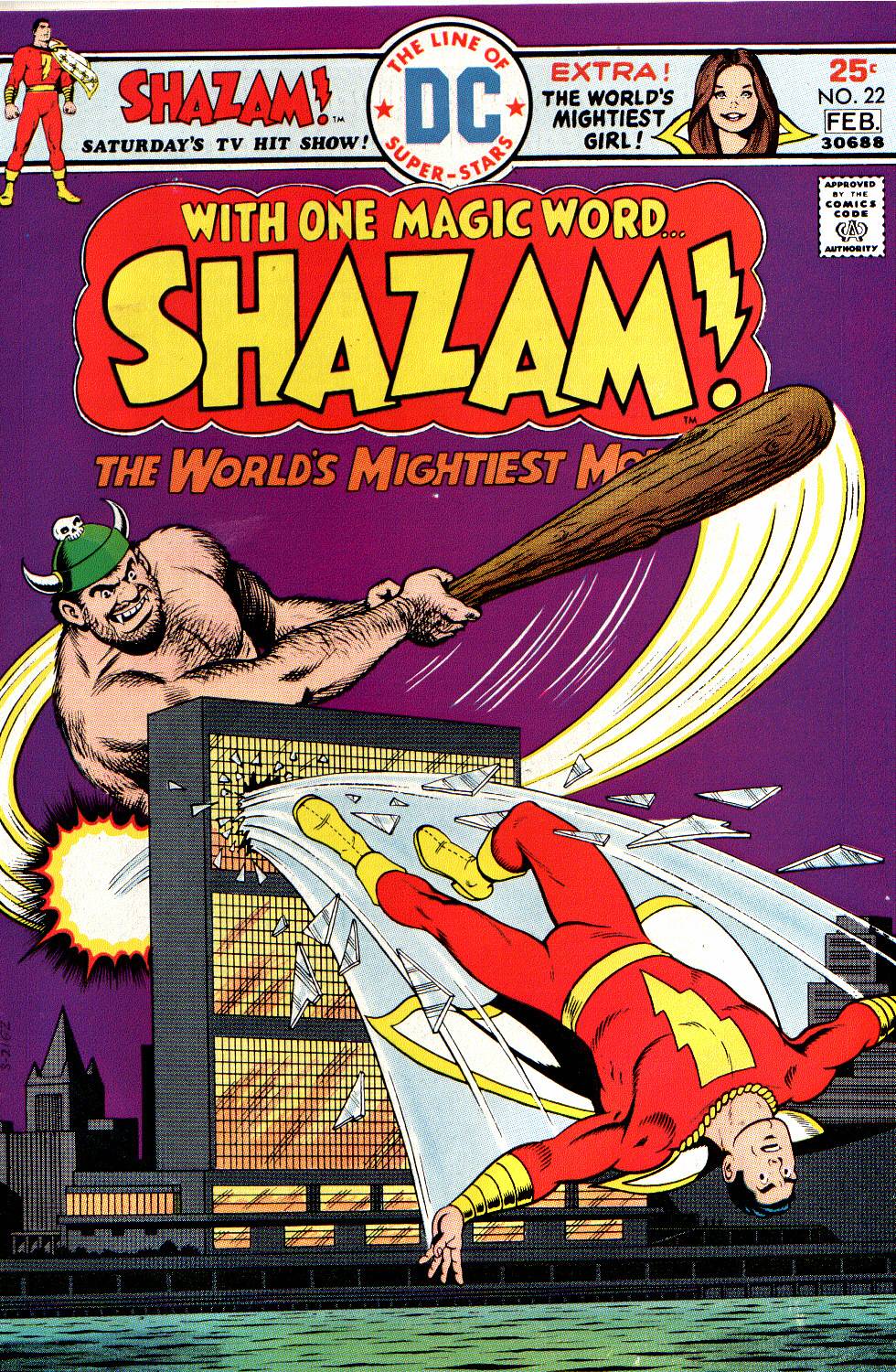


In the fall of 1975, SHAZAM continued to limp along. The once-promising launch of one of the greatest and best-remembered comic book characters of the Golden Age had been reduced to being a quarterly reprint title, kept alive only due to the success of the similarly-named Saturday Morning live action television program. This was something of a mixed blessing, however, as the best stories in most issues of SHAZAM had inevitably been the reprints of Captain marvel’s classic adventures. So ignominious as the situation was, it at least resulted in better material reaching newsstands. Issue #22 was another one that I read for the first time when the entire run was lent to me by my grade school buddy Donald Sims.
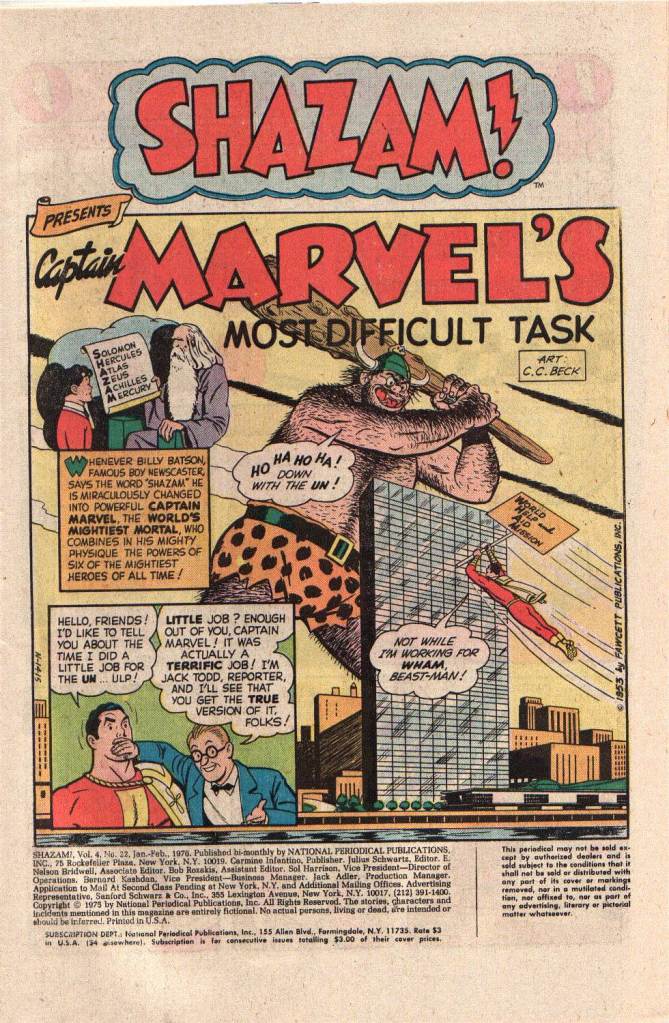
The lead story in this issue put the World’s Mightiest Mortal up against a recurring foe who’d been introduced towards the end of the feature’s life span, King Kull, the Beastman. Kull was a prehistoric barbarian and it was his sworn bloodthirsty goal to destroy civilization and return the world to a primitive state. And he was almost as strong as Captain Marvel himself. The tale was told by writer Otto Binder and artist C. C. Beck, and it was narrated not by Billy or the Captain but rather reporter Jack Todd, who insisted on giving Captain Marvel his proper due for his heroism. You can probably predict the end beat of this story just from this splash page, honestly, but the story is told so earnestly and with so much charm that it really doesn’t matter.
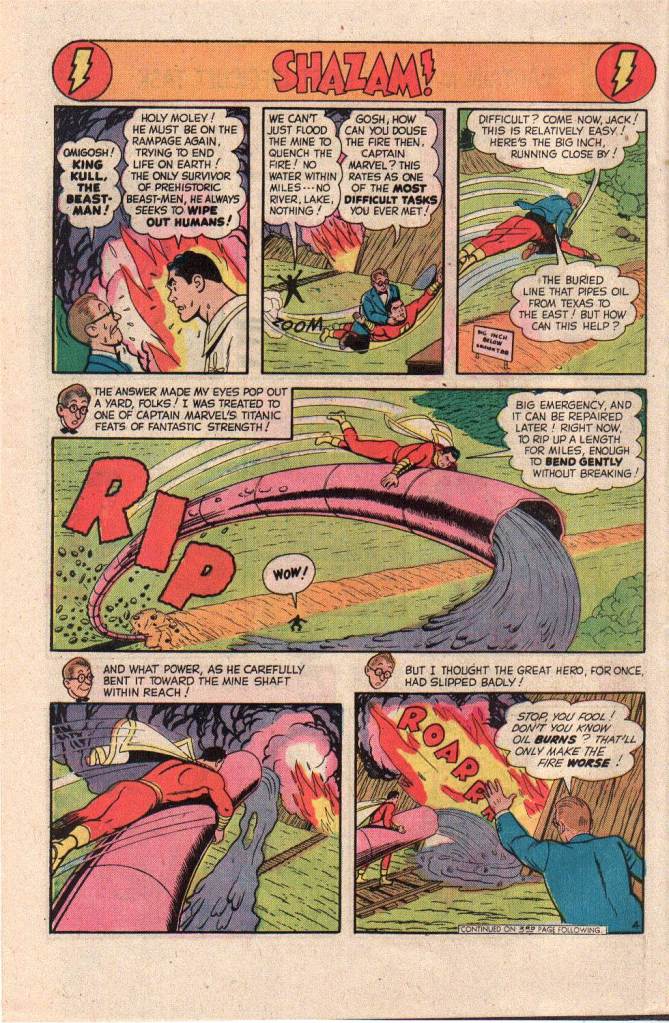
The story opens with Billy Batson visiting the United Nations building in New York for the inauguration of a new program: WHAM, the World Help and Aid Mission. The purpose of this new initiative is to provide needed help to crisis points all around the globe. But the new organization doesn’t have sufficient funding to intercede in all of the hot spots on its list. Fortunately, Billy volunteers to enlist the aid of Captain Marvel in addressing those crisis spots in need, and one thunderbolt later, the Captain and Jack Todd are on their way to the site of a vast underground fire, Todd thinks that putting out this underground fire before it can consume vast coal deposits is an almost impossible task, but Captain Marvel indicates that it seems pretty simple to him. He redirects a massive oil pipeline into the area of the blaze, snuffing it out by cutting it off from all oxygen.
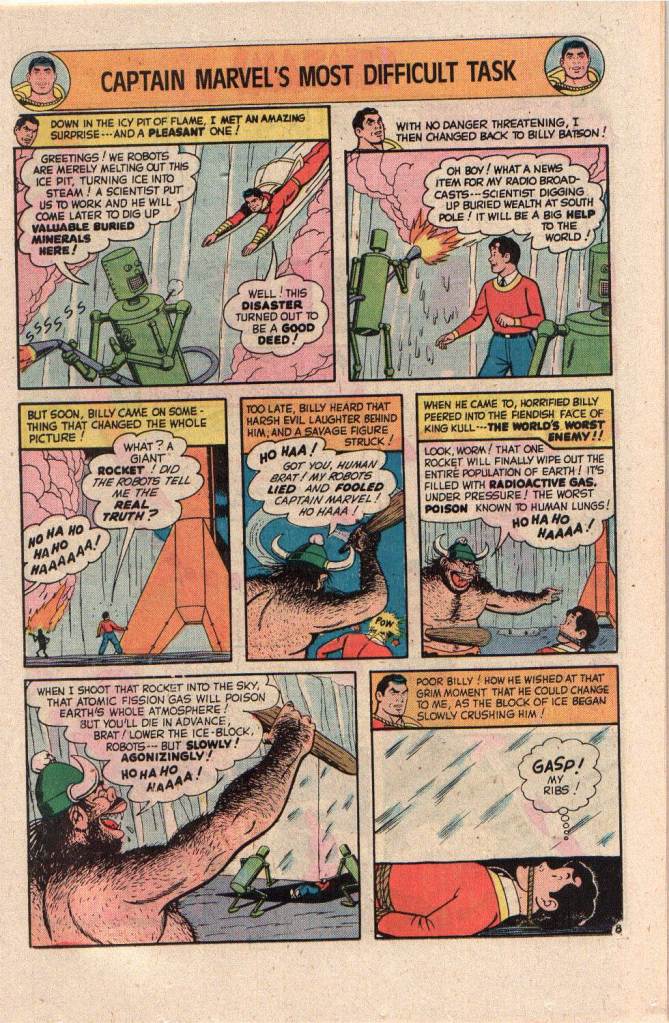
In quick succession, Captain Marvel and Jack race to the sites of two other disasters, with the Captain handling the seemingly insurmountable problems with relative ease. But he shudders to think of a challenge that still awaits him, which causes Todd to speculate on what it could be that causes the World’s Mightiest Mortal such dread. Eventually, the two arrive in the arctic to investigate the final hotspot on the WHAM list, and Captain Marvel leaves Jack at a safe distance while he investigates. When the situation appears to be benign, Cap becomes Billy again so as to report on the situation–only for him to be almost immediately captured by King Kull and trapped under a slowly-descending block of ice that will crush him to death.
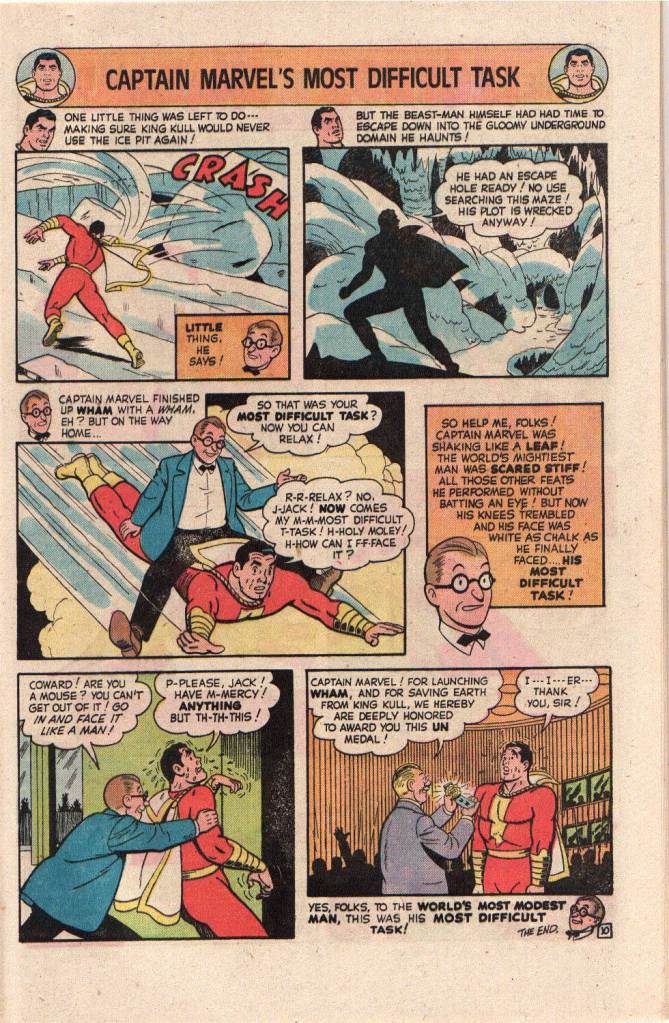
Through his typical ingenuity, Billy is able to free himself of his gag and summon Captain Marvel, who is able to dismantle King Kull’s plan to fire a missile loaded up with atomic gas into the atmosphere, thus poisoning it. But Kull himself escapes–and Captain Marvel is still petrified to face his most challenging task of the day. This turns out to be accepting a medal from the UN in recognition of his deeds of service–the humble Captain is so modest that the thought of being publicly recognized in this manner was enough to make him quake with fear. Again, it’s a relatively obvious final beat given the set-up, but it’s all executed well by Binder and Beck.
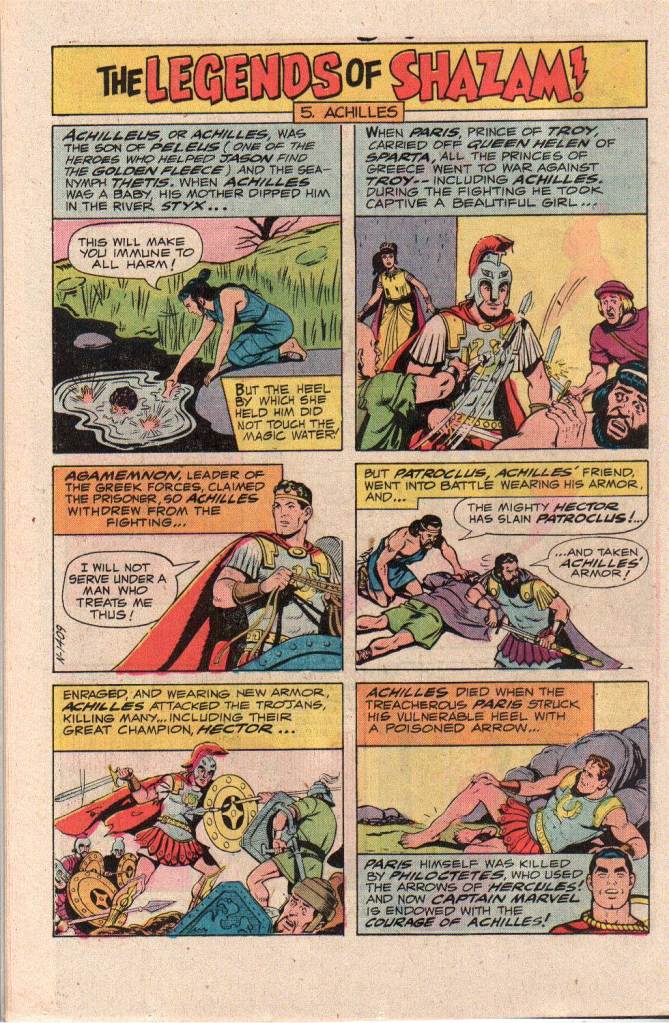
With a spare page to fill, Associate Editor E. Nelson Bridwell built a feature page out of assorted panels originally drawn by artists Kurt Schaffenberger and George Papp for other unaffiliated stories. The page briefly summarizes the heroic stories of Achilles, one of the six Gods and heroes from whom Captain Marvel derives his mighty powers. Bridwell was well-read when it came to classic mythology, so this was a subject almost as near and dear to his heart as the histories of the assorted super heroes he helped to shepherd.
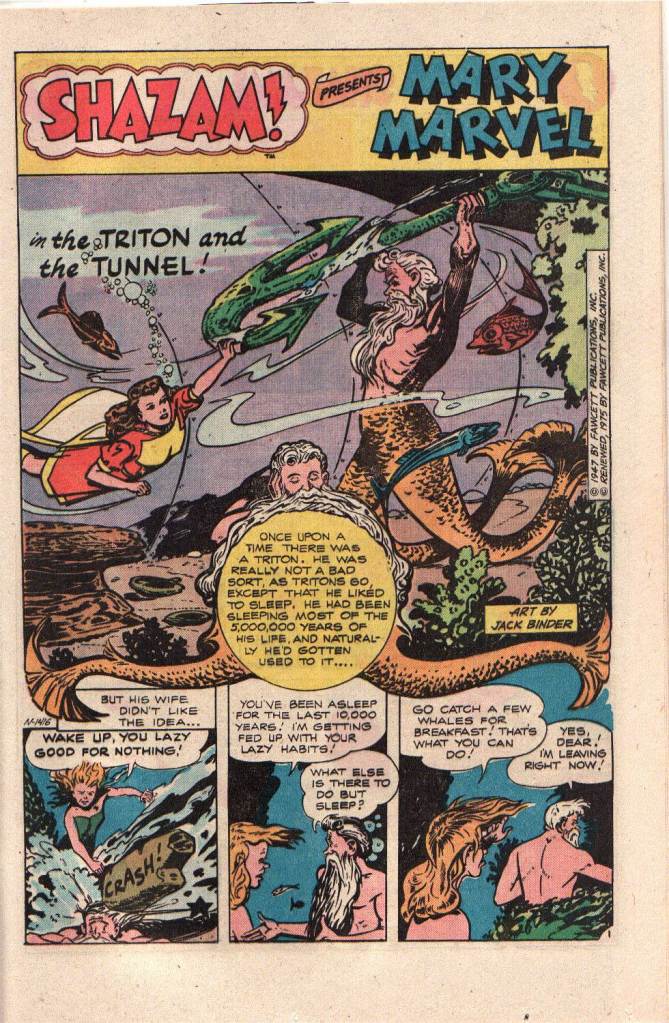
The second story in this issue is a Mary Marvel solo adventure from 1945. It was written by Bill Woolfolk and illustrated by Otto’s brother Jack Binder, who provided a bunch of artwork for the Fawcett line of titles. The reproduction on this story is a bit spotty, which makes it less attractive than it originally must have been. It’s about how a project to build a tunnel beneath the west river inadvertently awakens a Triton, an aquatic demigod. The Triton simply wants to go back to sleep, but the construction project keeps waking him up, causing him to act out against it. Mary Marvel’s stories were typically a bit more fanciful than those of the Captain or Junior, relying just a little bit more on fantasy to give them their own unique flavor.
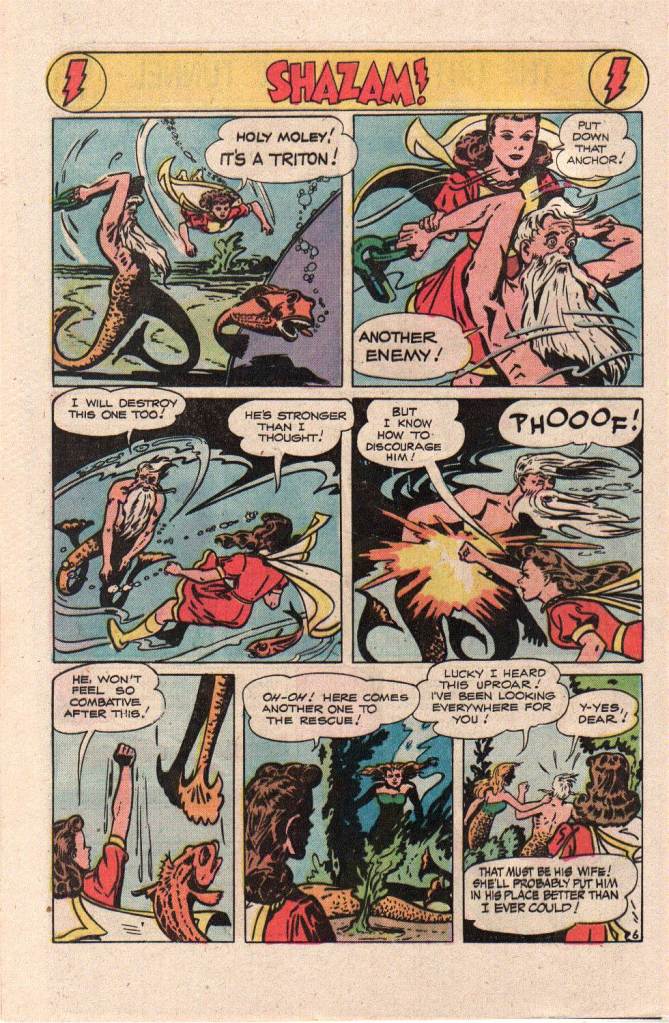
Mary intervenes, of course, preventing the workmen from being harmed by the Triton’s destructive response and eventually confronting the undersea deity herself. It’s a pretty equal fight until the Triton’s wife shows up to admonish him and pull him away from the conflict. Once the tunnel is completed, the architect of the project, Sandy, is free to marry Mary’s friend Louise–who treats Sandy in the same manner that the Triton’s wife treated him. In the final panel, Mary opines that men never entirely succeed in doing exactly what they want to, but that’s all right as the women know what’s best for them.


I think the Mary stories leaned more toward fantasy because they thought these stories would be read more by girls (not a bad guess), and girls liked fairy tales and the like more than socko action and busting stuff up.
LikeLike
That Mary Marvel head on the cover was clearly based on actress Susan Dey of The Partridge Family.
LikeLiked by 1 person
Given he was created by Otto Binder, a pulp writer, I assume that Kull borrowed his name from the Robert E. Howard hero? (Or was that too obscure a character? Did he appear in one story or too by the time the Fawcett Kull appeared?)
For people from upstate NY, you may be familiar with Jack Binder’s work designing the dioramas at the FT William Henry historic site
LikeLike