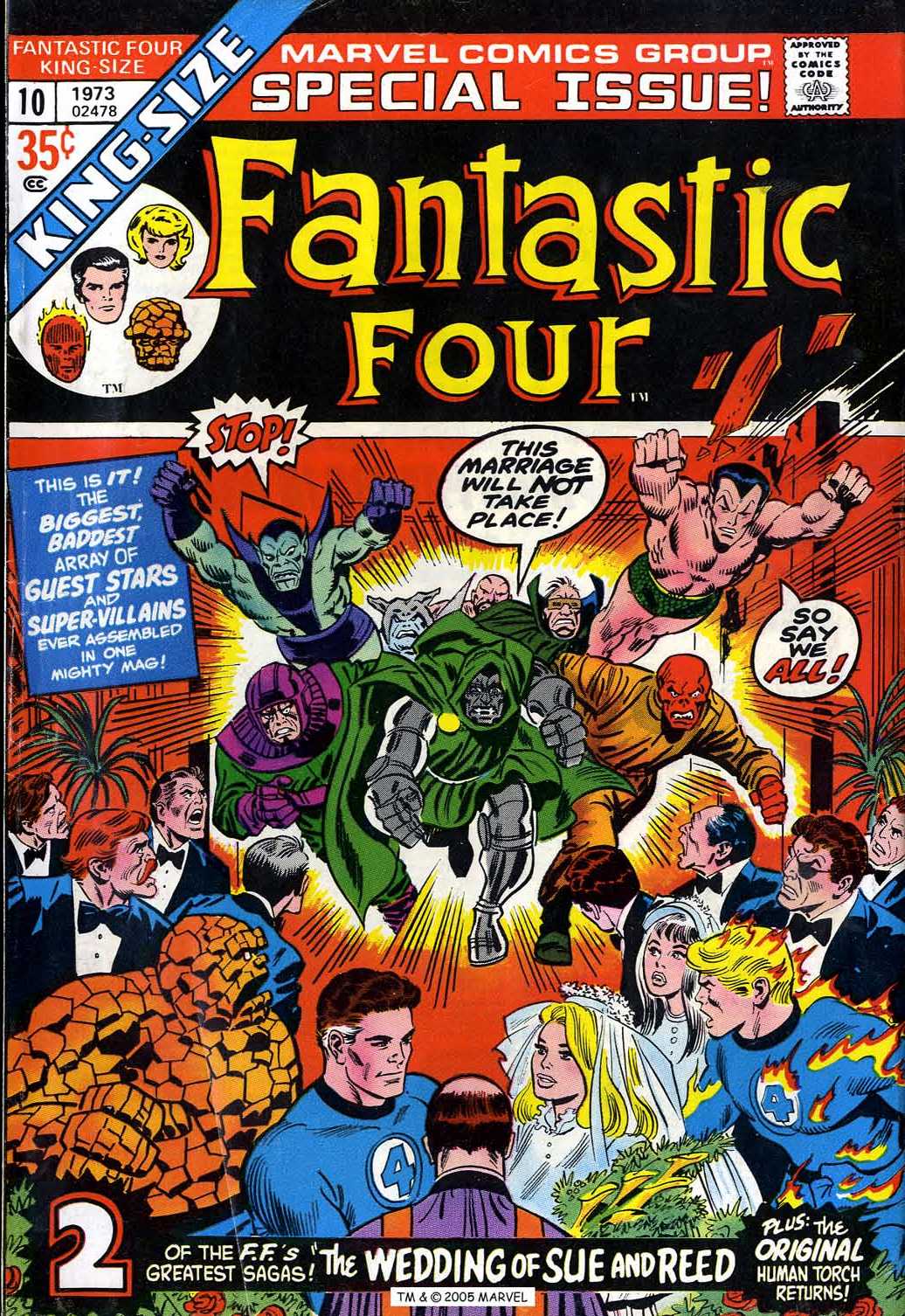


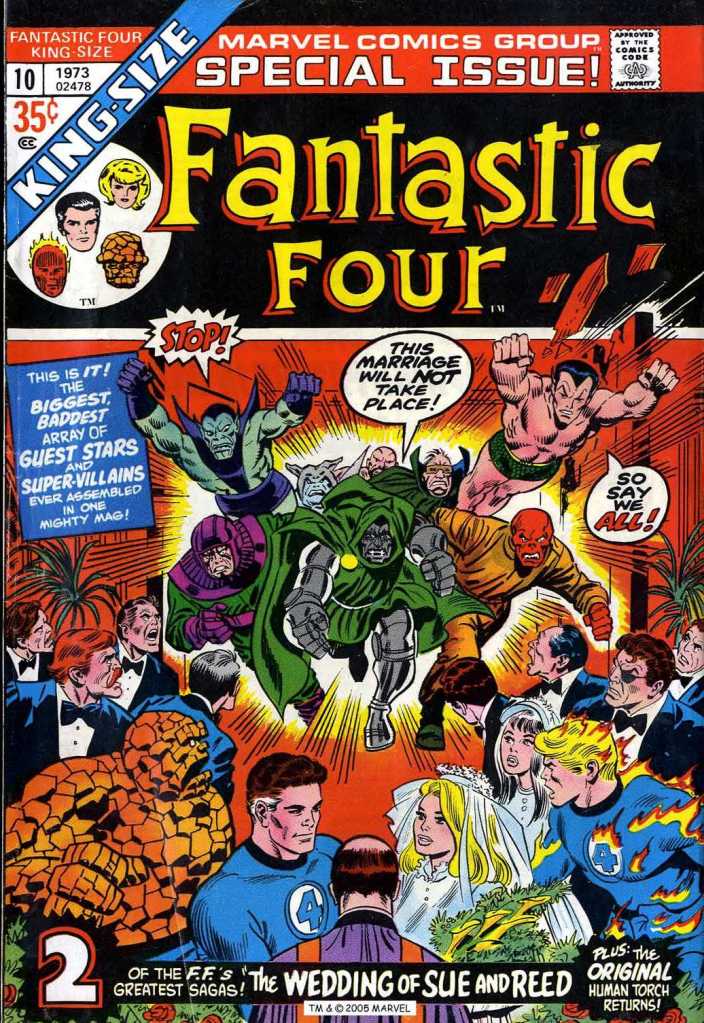
As I’ve mentioned before, my friend David Steckel, whom I’d met through the Sachem School District’s gifted student program, was a much a fan of the Fantastic Four as I was. What’s more, he had inherited a bunch of comics from an older relative who had outgrown them, so he had an assortment of older issues that went back some years. We would routinely loan our books to one another to read, which meant that I suddenly had access to a whole bunch of new Fantastic Four stories. One of the books that I wound up borrowing from him was this FANTASTIC FOUR ANNUAL (or KING-SIZE SPECIAL ISSUE as it was referred to on the cover.) It was an all-reprint affair, and I’d already experienced one of the two stories in it. But the other one was a tale that I was hungry to read, the guest-star-ridden wedding of Reed and Sue. It bugged my eye then and still does today that on this John Buscema/Frank Giacoia cover, Kang’s faceplate has been miscolored as skin.
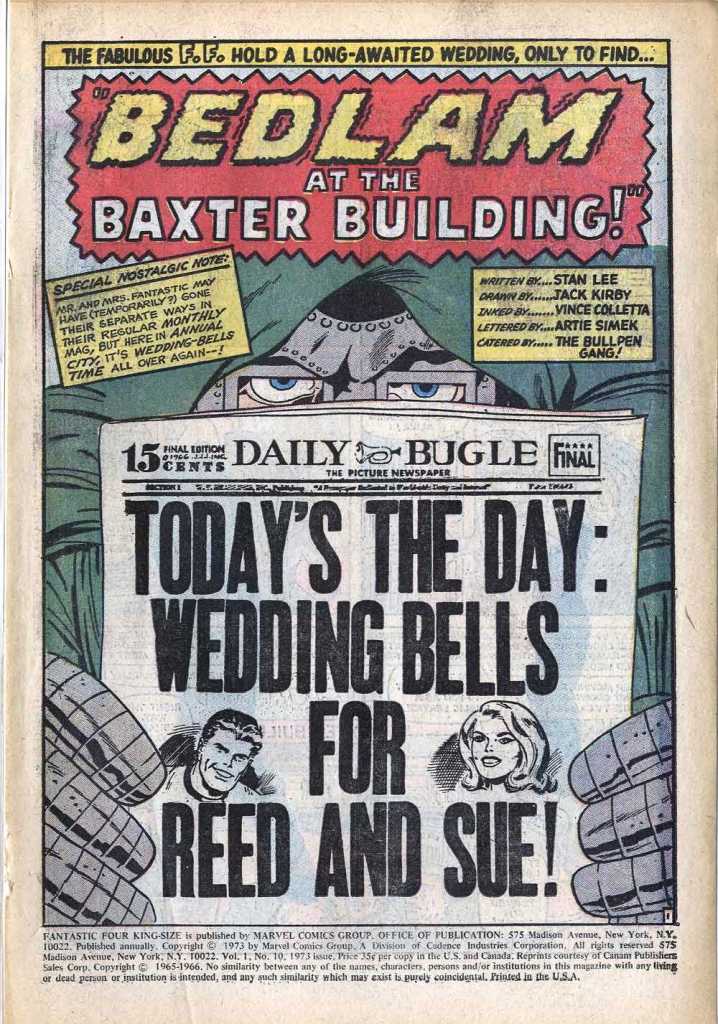
Interestingly, the reprint editor of this Annual made the decision to alter this splash page slightly. In its original printing, the newspaper that Doctor Doom is holding was an issue of the Daily Press, but by this point in time, a masthead had been created for Spider-Man’s paper of record, the daily Bugle, and so they swapped them out. (the price of the newspaper also went up ten cents in the intervening years.)
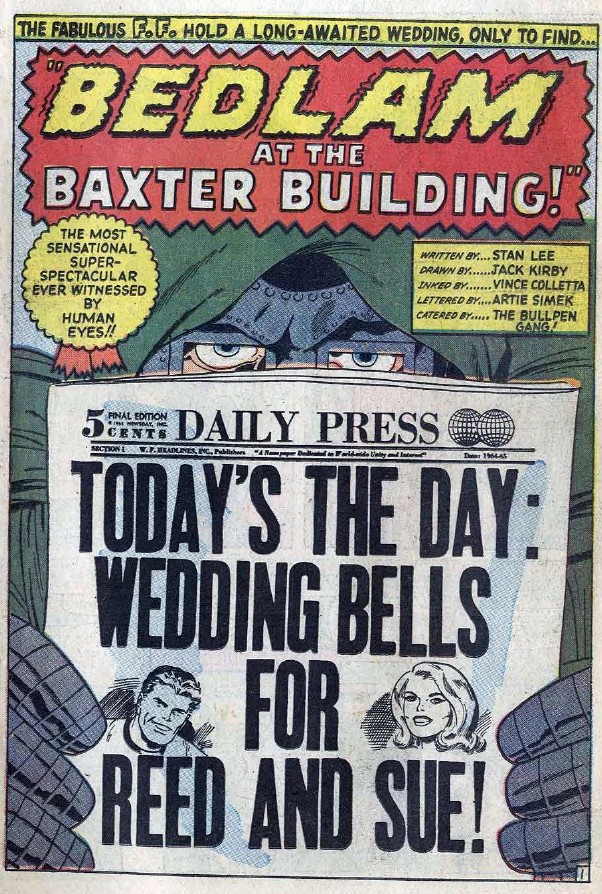
Here’s the splash from its original printing in FANTASTIC FOUR ANNUAL #3.
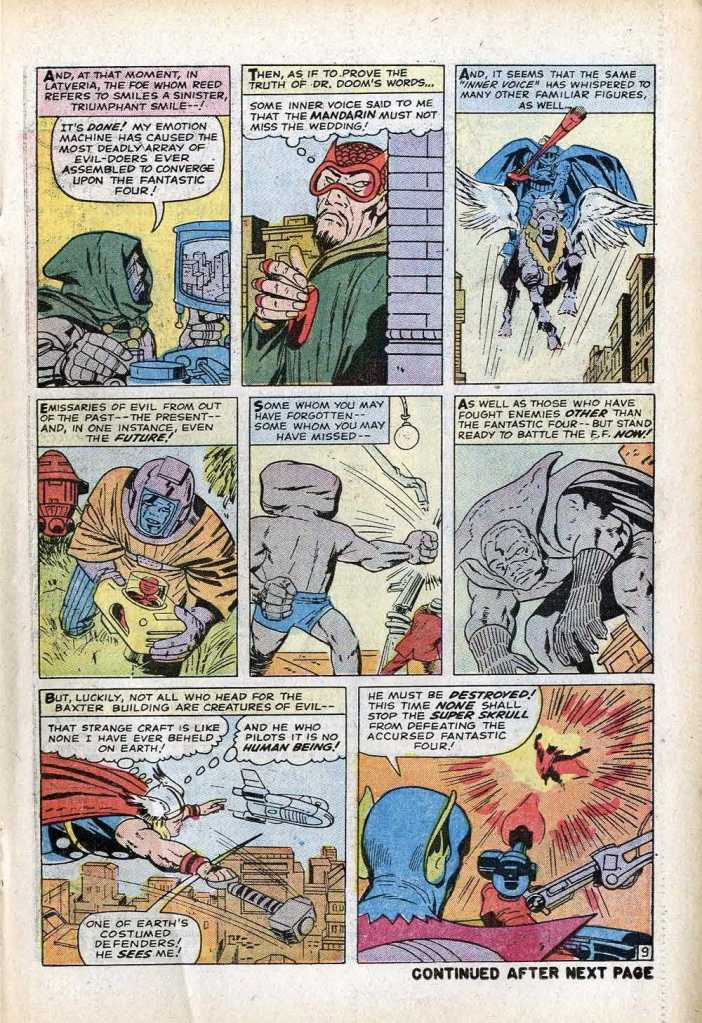
When it was first published, this story served as a sort of a mile marker between one era of the Fantastic Four and the next–as well as for the Marvel Universe as a whole. This was the last story inked by Vince Colletta before Joe Sinnott was brought on board as Jack Kirby’s regular inking partner. Sinnott elevated the look of the series tremendously, so visually it was immediately a lot crisper and more fully realized. Additionally, Lee and Kirby, mainly the latter, began to experiment more with longer-form storytelling, sweeping sagas that would go on for issues, soap opera style, with one adventure leading directly into the next. So this tale, which brought together practically all of the heroes and villains of the time in which it was produced, represented a sort of a Viking funeral party for the freewheeling and playful early Marvel style in favor of something with a bit more grandeur to it.
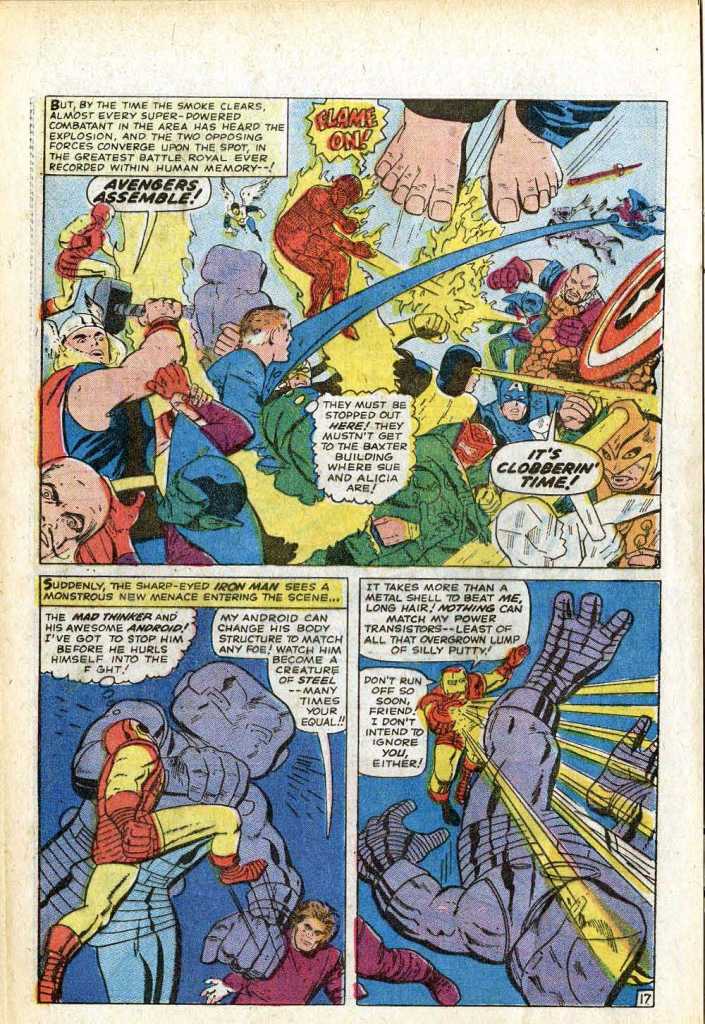
Plotwise, the story is simplicity itself: on the day of Reed and Sue’s wedding, Doctor Doom, whose hands had been crushed by the Thing in his last encounter with the FF, uses an Emotion Charger of his own design to cause pretty much all of the super-villains in the Marvel Universe to attack the wedding. Fortunately for the FF, their guest list includes pretty much all of the good guys who were around at that point as well. The result is a spectacular extended battle sequence that’s more like a carnival than a story. jack Kirby’s supreme skill with choreography is on full display here as he navigates the movements of a sprawling array of characters across a running battle that spans the city, never allowing the reader to get lost. This one Annual is the Rosetta Stone for all of the line-wide event crossovers that would follow in later decades: a single story that brought all of the super heroes and super-villains together for one ultimate fight.
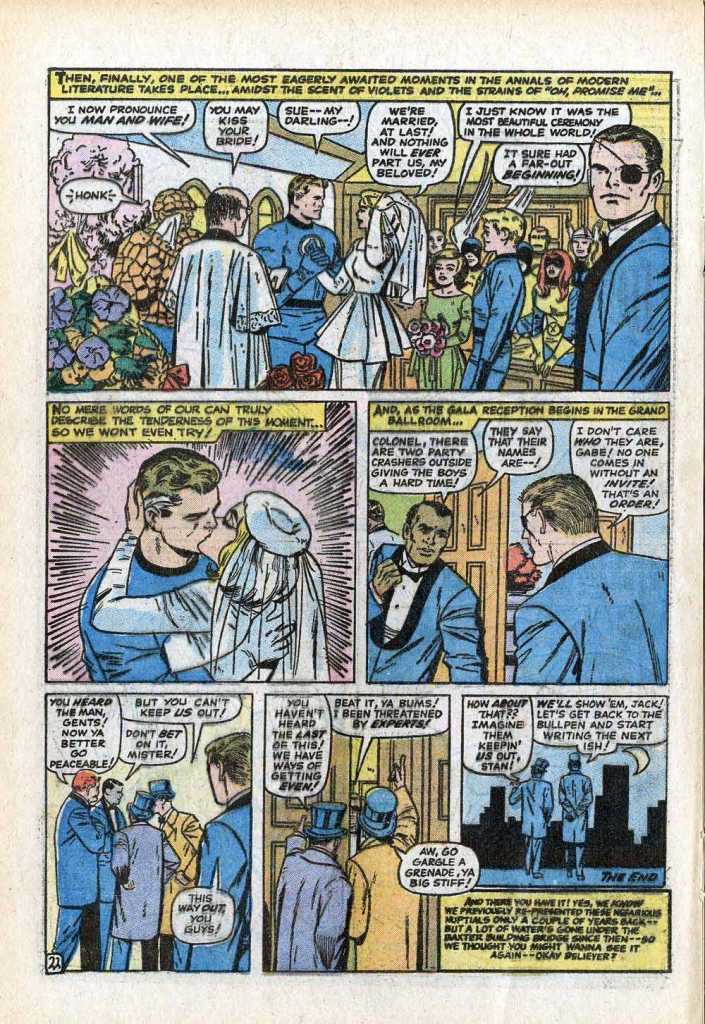
In the end, with the help of the Watcher (who doesn’t himself intervene but who provides Reed Richards with the opportunity to avail himself of the Watcher’s technology) the day is saved and the wedding can come off as planed. Lee and Kirby make a fun cameo themselves right at the end, their faces hidden in the style of the era. As the final blurb indicates, somebody realized late in the game that this story had already been reprinted a year or two previously in the preceding FANTASTIC FOUR ANNUAL #9. But my guess is that by the time they figured this out ,they already had the cover in hand and decided to just say screw it and run the story again. And why not? It’s an incredibly entertaining tale, one that’s dramatic without taking itself too seriously and which is expertly executed on almost every level . (The one real weak point is the inking, which looks as though Vince Colletta was under a deadline crunch. Which is a shame, as one can only imagine what Sinnott might have made of these detail-packed pages had he gotten the go-ahead just a few weeks sooner.)
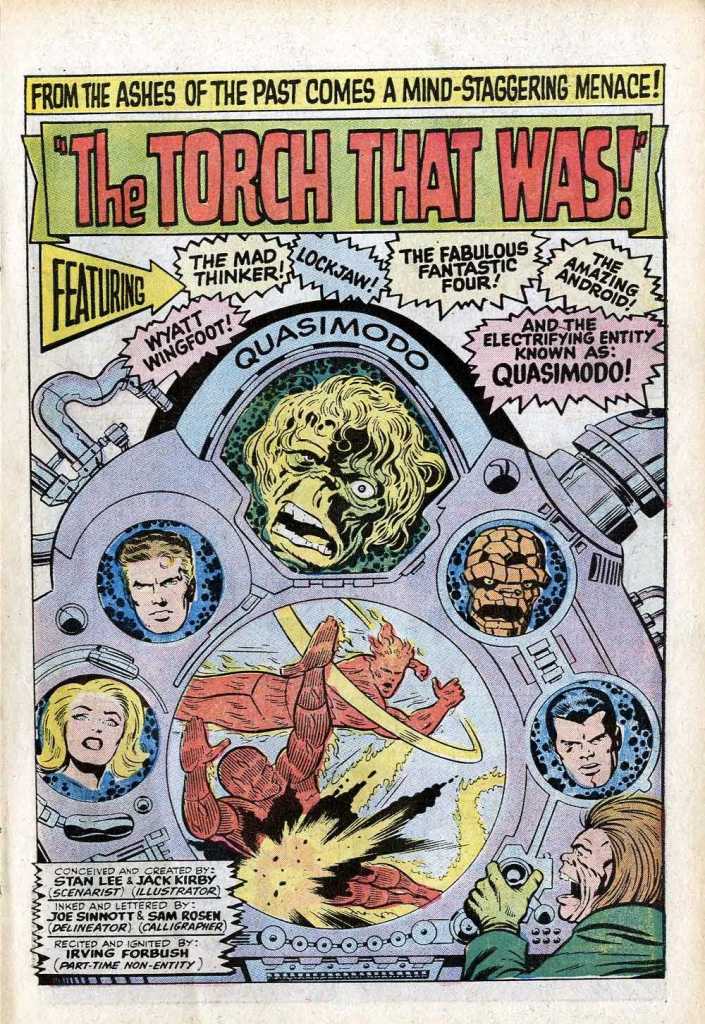
The second story in this Annual was also a significant chapter in the history of the Fantastic Four, as it featured the return of the original 1940s android Human Torch, the namesake of the FF’s Johnny Storm. I loved this tale, but I had previously read it when it was later reprinted in FANTASTIC FOUR #189 during a deadline crunch:
The one thing that’s immediately apparent is what a step up Joe Sinnott’s inking is over Colletta’s. Looking at the two stories is like night and day–remember, they were originally produced just a year apart, so Kirby’s work wouldn’t have changed that dramatically in so short a time. Sinnott crystalized the futuristic high-tech look of the Fantastic Four’s world, capturing and enhancing Kirby’s visual vision for it.
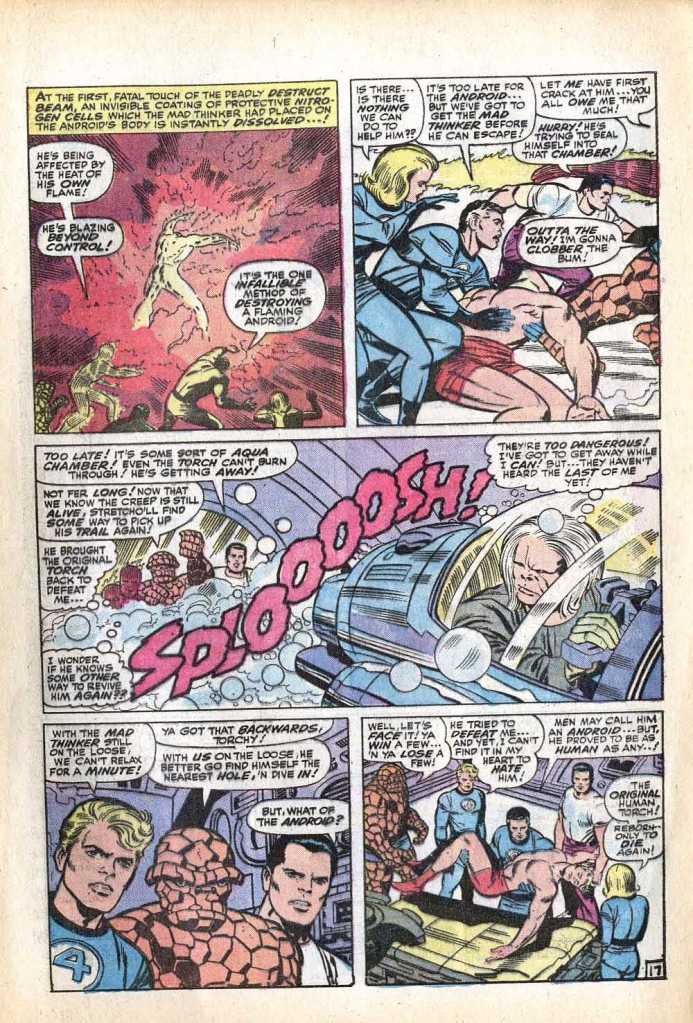
According to legend, this story was produced at the instruction of Marvel owner Martin Goodman, who feared an effort by Human Torch creator Carl Burgos to reclaim the copyright to the original Torch stories that had started appearing in 1939 and which were coming up for copyright renewal. Getting the character back into print would reinforce the fact that Goodman/Marvel was still its owner, and that they hadn’t abandoned the trademark on him. Regardless of the motivation, Lee and Kirby turned out a pretty great adventure, with the Mad Thinker locating the deactivated android Torch and turning him into a pawn to attack Johnny Storm and the FF. But at the last, the original Torch’s nobility comes through and he rebels against his master, causing the Thinker and his computer Quasimodo to self-destruct the original Torch. Years later, Roy Thomas and Steve Englehart would reveal that the Torch’s android body was reconfigured into that of the Vision. (And then John Byrne would dispute that revelation years after that, and Kurt Busiek, Carlos Pacheco and I would re-establish it even later than that. Comics!)
 The Tom Brevoort Experience
Thanks to you, Busiek and Pacheco for undoing what Byrne did, just wish you had undone all of it.
LikeLiked by 2 people
While I liked the Byrne story, I had also liked the earlier work from Steve Englehart on the Avengers. As a result, I also thank Tom, Kurt and Carlos for giving us the best of all worlds.
LikeLike
I didn’t want to completely overturn what John had done, for two reasons:
1. I didn’t want to be a dick about it, even if he seemed to revel in doing so.
2. I didn’t want to say that the android Torch he’d brought back from the dead was an imposter. I liked having him back, but I also thought the Adams/Englehart reveal, which had been editorially approved by the Vision’s co-creator, was good solid character writing, and shouldn’t be overturned, especially not in as sloppy a manner as what John did — at one point, he even had “Professor Horton” lecture Hank Pym on the definition of “synthozoid” and told him it didn’t fit the Vision, even though it was a word Hank had made up himself specifically to describe the Vision.
John didn’t interact with continuity, but with his “vibe” of what continuity should have been, in his mind.
So anyway, I wanted to re-establish everything John had pointless stripped from the Vision, but I also wanted the original Torch back. And since I was doing cosmic timey-wimey stuff, I could do that.
LikeLiked by 2 people
My thanks again for not only an outstanding series with Avengers Forever, but also cleaning up the wreckage left behind in “The Crossing.” Being an Iron Man fan, I was dismayed over every aspect of that story – don’t get me started on Teen Tony and Masque with that mile-long ponytail! – and grateful that not only was said storyline nudged aside, but done so as part of a remarkable series.
LikeLike
I’m glad you liked it, Rick.
LikeLike
I guess being a dick about it isn’t just a John Byrne thing since the person who undid Ms. Marvel ( Carol Danvers )’s origin in Ms. Marvel#19 ( August 1978 — Tiger Shark’s origin in Sub-Mariner#5 ( September 1968 ) backs up her origin cause if human technology can turn a human into a human-Atlanean mutant-shark hybrid then Kree technology can turn a human into a Human-Kree hybrid ) wanted to fix something that wasn’t broken or how many different parents do the Scarlet Witch & Quicksilver have now? Then there is John Byrne’s creation Puck who in a issue of Alpha Flight he wrote had Puck’s thought bubble say he was almost twice as old as Heather Hudson only to have a later writer make him 100 or so years old and not born a dwarf.
LikeLike
Making sweeping reinterpretations isn’t just a Byrne thing; nor is making mistakes along the way.
John has a special aptitude for being snotty and dismissive about it, though.
LikeLiked by 1 person
“Everything you know about ___________ is wrong about” became a popular plotting game in the ’70s – Steve Englehart probably did more than anyone else to popularize it, & I’ve indulged in it myself – & remains a popular resort when trying to make a mark, & raise fan interest, on a property you’ve taken over. Perhaps the greatest instance of it being Alan Moore’s reconstruction of Swamp Thing. No, John was far from the only practitioner, & I don’t see it going away anytime soon.
LikeLike
I think Steve was often a practitioner of “everything you thought you knew isn’t quite what you though, once you look at it through this new lens,” where he’d recontextualize an entire history by building on aspects of that history to say there was something else heretofore unknown going on.
Moore mostly did that with SWAMP THING, except that there were stories that made it clear that Swampy was still Alec Holland — they just generally weren’t stories anyone wanted to remember, so they got Mopee’d away.
John, though, was a practitioner of “everything I thought I knew was right, even if it contradicts what’s on the page,” and after he got to sweep away Superman history — even recent, post-Crisis Superman history — in MAN OF STEEL, he decided he got to do that kind of thing because he was Important.
And many, many other people have joined him since.
So yeah, I don’t think sweeping retcons — whether you take that to mean new continuity slipped into the cracks or new continuity overturning the past — are gong to go away anytime soon, or ever. I just think there are ways to do it well and ways to do it poorly, and John was far too often in the “do it poorly” camp.
LikeLike
Not because you said being a dick about it but I always thought it was a middle finger to Carl Burgos to kill off his character and to add insult to injury turn him into a different character with no memories of his heroic past ( It isn’t like Henry Pym to Ant-Man to Giant-Man to Goliath to Yellowjacket or Bobbi Morse to Huntress to Mockingbird ). Englehart was a dick to Carl Burgos as was who ever gave the kill order for the Original Human Torch. Just like Roy Thomas turning a bunch of Golden Age Heroes ( Strong Man, Spider Queen, Doctor Nemesis, Human Meteor & Volton II ) into Nazi supporters without them being under mind-control or a hate-ray ( Which Timely Comics has — Blue Blaze story ).
LikeLike
I started reading Avengers with issue #51, so Vizh was the first hero that I saw from his introduction and he quickly became my favorite. I enjoyed seeing his development by Thomas and Englehart, especially with Wanda so seeing it all swept away was not something i liked. Byrne basically killed Vizh and the twins and replaced them with something else. And poor Wanda!
LikeLike
Ah, I see. I’d sometimes wondered why you “fixed” the Vision with such a complicated approach. Makes sense now.
I hated Byrne’s “toaster” approach to the Vision. I was even more gobsmacked when he had a six-issue backup in Wonder Woman simply to retcon out the changes to Etrigan since Kirby’s original version.
LikeLike
As someone who’s often been accused of writing AVENGERS FOREVER just to deal with continuity issues, I’m willing to defend John on that front, at least mildly, having not read those issues. We did AVENGERS FOREVER to do a big-ass adventure, and the continuity changes happened along the way as we framed out the story, but to some readers the fact that they happened at all meant they were the only reason the story was done.
It may just be that John wanted to write and draw the Demon, and retconned him in the process. Or maybe not. I don’t really know.
LikeLike
He definitely wanted to write/draw the Demon — he used him quite well in his first year on Wonder Woman. The backup … I can’t see any purpose other than retconning.
LikeLike
John has always been among the many who kind of consider Jack “his” property. (Please don’t take that as seriously as it sounds.) So, generally, if there’s a Kirby character, John wanted to do something with it. The never-published sample he used as his entree to Marvel, pencils only – he showed it to me once – was a, I swear, picture perfect rendition of Kirby’s FF, with no swipes. If you looked closely you could tell it wasn’t Jack, but you had to look closely. His Prestige format OMAC miniseries, widely loathed, took Jack’s version as a leaping off point & went in a wildly different direction, but for my money it’s arguably the best thing he ever did. It wouldn’t greatly surprise me if he just wanted to do The Demon, then decided – as is his wont – to do some continuity fixes with it. (I never read it, so am not really in a position to make any judgments about it.)
I tried convincing DC to let me do a Jason Blood series sans The Demon once, but they didn’t bite. Strikes me as a very underdeveloped character that could be of considerable use…
LikeLike
Yeah, I’d love to write THE DEMON, too, with the right artist. Or even edit it. I think there’s a ton of potential there.
Can’t blame anyone for wanting to write the Demon.
Flipping it all back to the beginning because you don’t like what Moore and Bissette and Wein and Grant and whoever else did is kinda crass. But wanting to write the Demon, I can’t gainsay that, ever.
LikeLike
His OMAC was ingenious. Though my favorite work by Byrne was Generations.
I agree a Jason Blood series could be cool.
LikeLike
I hope this comment shows up in the right spot on the thread. There’s a lot to love about Byrne’s Omac… I think it’s a love letter to Kirby’s version, and I don’t think it really upends anything in Jack’s version. The art is fantastic and there’s a lot of interesting story bits and twists… a lot of honest sweetness to it as well because I think Byrne does good job at fleshing out Buddy Blank having a homelife… Blank is barely there in Kirby’s 8 issue series. Some of the time travel twists don’t make sense when it comes to the faceless agents appearing and dying…but I can ignore that stuff. Where Byrne’s Omac falters for me is in his summation that the world needed WWII to avoid becoming a world full of lazy a-holes. This was rationalized as a legitimate POV because it came from the martial leaning OMAC.. but I think it required some pushback in the story. The same martial OMAC was also lonely and missed his recently dead wife and wanted to live as ordinary guy for decades…so he was at the same time a survival of the fittest type and a sentimental softy. Tough to reconcile the two extremes on the same comic book page imo. But Byrne was swinging for the fences on this one and I think it’s a great series otherwise.
LikeLike
I haven’t read John’s OMAC since it came out and I don’t think I read it at all carefully at the time. So I’ve got no opinion to offer other than I think I remember it looking pretty good.
But if those issues ever resurface in my house — or if DC does a DC FINEST for OMAC — I’ll make sure to set it aside for another read, when I’m better able to read print comics again.
LikeLike
I for one was glad John Byrne liberated the Original Human Torch from the Silver Age Vision [ West Coast Avengers#44 ( May 1989 ) and brought him back in Avengers West Coast#50 ( November 1989 ) ]. Tying the Vison made zero sense since he never had the Torch’s memories ( Hell he didn’t even have Wonder Man’s memories ). I just wish John Byrne has showed the Torch’s insides ( X-Ray or CT Scan to show his bones, muscles — proof that he wasn’t a machine like Byrne said Android’s weren’t or Roy Thomas in the Invaders who mention the Torch as having blood, bones and tissue ). I hated that Stan or Goodman had the Original Human Torch killed off [ Fantastic Four Annual#4 ( November 1966 ) King-Sized Special ] especially since DC Comics had zero problems with the Golden Age Flash [ The Flash#123 ( September 1961 ) ] being active in their then modern comics universe.
LikeLiked by 2 people
I picked up FF#189 ( December 1977 ) and got Reed and Sue’s Wedding when Marvel did a True Believer’s reprint of it, but the Super-Villain part of the Story I first saw in the 1960s Sub-Mariner cartoon [ The Marvel Super Heroes — Sub-Marine episode 12 ( Dr. Doom’s Day, The Doomed Allegiance & Tug of Death — FF Annual#3 & FF#6 ( November 25, 1966 ) wikipedia.org ]– the original X-Men appear.
LikeLiked by 1 person
The X-Men were identified as the “Allies for Peace”
LikeLiked by 1 person
Ahh, but the Vision did have a mental connection to the Torch, in that he had claustrophobic and a fear of water that stemmed back to the Torch being trapped in a swimming pool and entombed in concrete, as established in the Englehart subplots leading up to the revelation. The whole idea was that Ultron had erased the Torch’s memories, but couldn’t erase the emotional substrata.
Later, I established the same thing about the Vision and Wonder Man — Englehart, in WEST COAST AVENGERS, had established that the Vision was bookish and introverted, as Simon Williams had been as a youth, but had no memory of his embezzlements and lies, which allowed him to stay bookish, rather than going down the path Simon had.
I added to that that they had similar emotional connections — just as they were both attracted to Wanda, they both liked jazz and Walt Kelly’s POGO, and presumably more.
So the memories were gone, but ghosts of the Torch and Simon remained as foundations for who the Vision became.
LikeLiked by 1 person
I liked the fix in Avengers Forever that the original Torch could be both active as himself and also be the Vision’s body. “Built from spare parts” is weak sauce.
Byrne’s wiping of the Vision was touted as a “return to basics” but the Vision was never the emotionless robot that Byrne turned him into. Almost from his debut he was more like a smoldering Spock with less emotional control. A lot of none androids have managed to be inducted into the Avengers without getting choked up for instance. That said, I did prefer the Vision of the 60’s and the 70’s to the chuckling suburban dad of the 80’s though.
Almost as bad as the lobotomy was the Avengers tepid reaction to it and a marriage getting dissolved as a result…. when the status quo was that treated Vision as they would any human member… Quicksilver aside.
Since Wanda and Vision’s relationship was a not so subtle proxy for interracial/interfaith marriage it was more than distasteful to hear their relationship referred to as “Wanda and the Toaster.”
LikeLike
Wasn’t it the Vision who taught us, very early on, that even an android can cry?
Suspect Adam Link was more of an influence on the Vision than Spock was, but we’d have to ask Roy…
LikeLike
Yeah, the Vision emotes all over the place in that first story, and Ultron even rages at him for being emotional, thus proving Ultron is emotional too.
It’s hard to believe anyone would think of them as cold and mechanical. The Vision’s as emo as Hamlet.
LikeLike
Suspect the Spock influence was what was behind John’s restructuring, going back to that “Spock as logic unpoisoneded by human emotion” bit that people always remember Spock being, except he was never really like that either, he just put on a good show of it… (It was likely a little too far for NBC to take Spock all the way to Cold Equations territory… Would’ve been interesting if they had… Especially since that was what they were always trying to hint at with McCoy constantly “We’re talking about HUMAN LIFE, Spock!” counterpointing him, tho’ I couldn’t say how many times that bit was really used, & how much it’s something that happened once or twice but got memed into immortality…)
LikeLike
I dunno. It could be.
But it also could be that John was hot for Wanda and never bought into the humanity of the Vision. A lot of what he had to say at the time involved dismissing him as “a toaster.”
LikeLike
Can’t say when I worked with him on Avengers I ever noticed John showing any special interest in Wanda. Doesn’t mean he wasn’t, of course, or didn’t become so when he took over WCA (this was all in WCA, right? I wasn’t paying much attention to Marvel at the time…) but given my interactions of many years with John, admittedly out of date by then, it’s not something I’d’ve thought to suspect of him…
The “toaster” bit wouldn’t’ve been original with him, except in application to the Vision, far as I know. Never watched the original Battlestar Galactica, so don’t know whether they ever used it or the reboot looped it in, but it wasn’t an unknown anti-robot slur in science fiction by the time John would’ve adopted it.
Not suggesting it didn’t amount to lazy, unoriginal characterization, obviously… Let’s see, by that time, it had been continuitied in that Ultron had given the Vision Jarvis’s balls & that’s how he could copulate with the Scarlet Witch (it would’ve been interesting had they stuck with the Vision being an organic but artificial human, & discussed the mechanics of artificial sperm & natural ova, but I’d guess that’d be a bit beyond Marvel’s comfort zone)… then that got retconned out & it was Wanda’s reality altering power that permitted the unusual conception… except the boys weren’t really boys but were pieces of the composite demon Master Pandemonium… except…
Forgive me if any of that’s out of order, but it’s really a great example of wave after wave of writer trying to “clean up” a perceived problem & just gumming it up further for any who follow (or who were following the storyline). John, if nothing else, is a guy who simply can’t leave well enough alone, for whatever reason, but while he’s more high profile than many, he’s hardly alone… (Again, I don’t necessarily eliminate myself from that coterie, at least where Marvel & DC work was concerned. But my reach was nowhere near as broad, at least not overtly…
LikeLike
Yeah, it’s that “anti-robot slur” that makes me question whether John saw the Vision as like Spock…dismissing the Vision as a mere machine doesn’t really square with that. Not that we’re all always consistent or anything.
And, of course, the conception of the twins didn’t need any retcons at all, since it had a perfectly workable (well, by Marvel standards) explanation already, one that had been set up and delivered over a two-issue story.
But, well, comics…
LikeLike
As for Englehart giving the Vision claustrophobia because the original Human Torch was encased in concrete and later buried, well the Vision must be able turn off his emotion chip like Data in Star Trek: First Contact cause the Vision buried himself underground to escape being captured by the 3 Skrulls impersonating Mr. Fantastic, the Thing and the Human Torch [ The Avengers#93 ( November 1971 ) page 21 panel 1 – became intangible to sink into the ground when he couldn’t move is arms and legs — you would think that and being underground would trigger a panic attack had that phobia existed then ]. Then there is his aquaphobia ( fear of water ), the Vision was back handed into that body of water in Central Park by a Sentinel [ The Avengers#102 ( August 1972 ) page 18 panel 3 ] and crawled out later ( Page 19 panel 5 ) and the only thing wrong with him was being weak from the Sentinel draining him of his solar energy. I did notice in issue 101 and earlier issue the Vision playing chess in 101 and sitting in front of a chess board in the earlier issue ( in the 80s or 90s issues ). Timely Comics Human Torch had no problems getting into water [ Marvel Mystery Comics#8 ( June 1940 — fought Namor underwater and was trapped in a air bubble Namor couldn’t pop ), 17 ( March 1941 — Namor tossed him a helmet and the Torch got into the ocean — The Invaders#24 ( January 1978 ) reprint ) and Human Torch#5b ( Fall 1941 ) captured and taken to Atlantis by Namor, later after given a mind-control drug given a helmet and shown the huge under-sea army.
LikeLike
Yes, emotions come and go, in people as well as androids, and trauma surfaces at different times. Personality isn’t a set of pushbuttons.
LikeLiked by 1 person
Maybe it is if you’re a robot…
I was tempted to say a foolish consistency is the hobgoblin of little minds… But at Marvel that’s the Hobgoblin…
LikeLike
I was thinking of the only Marvel hero with claustrophobia that I knew, Storm [ X-Men#102 ( December 1976 ) CBR got this #101 ( October 1876 ) wrong ( see comics.org ) ]; Classic X-Men#2 ( October 1986 “First Friends” — backup story – a purse thief and a dark subway ][ X-Men#116 ( December 1978 – when it prevents her from being able to save Garokk ) https://www.cbr.com/x-men-storm-how-conquered-claustrophobia — X-Men: How Did Storm Conquer Her Claustrophobia? ]. CBR left The Uncanny X-Men#146 ( June 1981 — Arcade & Doctor Doom ) claustrophobic event out.
LikeLike
Storm was whom I was comparing the Vision to. Her an a couple of TV characters whose phobia or trauma has affected them like Storm’s did.
LikeLike
I missed the detail about Pogo but I do enjoy characters having traits that are just random like that (not that it’s random to enjoy Pogo).
LikeLike
I figured if Simon had had bookish traits that the Vision could have inherited, why not POGO? I was a bookish kid and I loved POGO, so it was something I could easily write for them, and it fit.
I’m not a jazz guy, but it struck me that the Vision could enjoy the technique while Simon responded to the emotion, and that suited the scene and the characters too, so there I did a little research.
LikeLike
I didn’t care for Pogo as a kid. I don’t know if it was lack of taste in my youth or that the rhythms were so different from most of the humor strips. Appreciate the heck out of it now.
LikeLike
I woke up this morning realizing that CBR got it right with X-Men#101 as the first time Storm claustrophobia made its appearance ( I should have checked my Classic X-Men — issue#9 ( May 1987 ) ), but it was in X-Men#99 ( June 1976 ) hinted at( She was relieved to get her space-suit helmet off and couldn’t wait to rid herself of the suit. Later after Colossus’s freak-out because of his older brother “dying” in a rocket explosion, when the space shuttle was taking off Storm was trying to calm herself for her teammates.
LikeLike
Steve Grant, yeah it is to bad the Vision, the Original Human Torch and Dynamic Man weren’t left organic cause then we could get stories like Action Comics#466 ( December 1976 ) — Lex Luthor de-ages Superman, Batman and the Flash to boyhood. In the Play R.U.R. the Robots are living creatures of artificial flesh and blood, that later terminology would call androids. In the final Act the Robot Primus and the human woman Helena are the new Adam and Eve ( wikipedia.org ), so the Vision had he been left organic and the Scarlet Witch could have been the Marvel version of them. Like I suggested, Immortus could have been responsible for the Vision becoming mechanical ( Perhaps the Vulture( Isidoro Scarlotti )’s Human Torch & Toro Robots in Young Men#26 ( March 1954 ) Human Torch story, were made from 1940’s era parts and it is this Human Torch that the Vision’s mechanical body was created from and his mind transferred into ). In Immortus was trying to prevent the birth of the Vision and the Scarlet Witch’s kids in Avengers Forever, so a mechanical body normally would do that.
LikeLike
If anyone ever wants to see the impact an inker can make on the overall art, there’s no better example than this issue. While there are times I didn’t mind Coletta, this certainly is not one of them. I agree with Tom that one can only imagine what this story and it’s plethora of amazing characters would have looked like with Sinnott’s final touches.
What also struck me about this story was that it seemed a subtle attempt to promote the X-Men, giving them some prominence amid the Avengers and other characters while limiting Spider-Man. Which makes sense given the struggling sales of X-Men at that time.
LikeLike
I’m not a lawyer, but I’ve read some copyright law and a bit of trademark law, and I don’t think this sentence can be true: “Getting the character back into print would reinforce the fact that Goodman/Marvel was still its owner, and that they hadn’t abandoned the trademark on him.”. I believe the trademark on “Human Torch” would be fine due to the Johnny Storm version. There would be no trademark need to have Golden Age version in print. Copyright is a matter of time since publication. It can’t be “reinforced” by having new stories about a character. The new stories have a new clock, but they don’t affect the length of the clock on the old stories. It’s possible the Goodman wanted to show that the character was still active for some business reason, but I can’t see an obvious law-related need. Maybe it was some sort of declaration along the lines of “It’s ours, see, and you can’t have it”.
LikeLiked by 1 person
Burgos wouldn’t be able to use the name “Human Torch” b/c that would still be in force via the ’60s version, but if the ’39 rendition had not been used, he’d’ve likely been able to abscond with that CHARACTER – the visualization – but under another name. (Let’s say, the Scorcher, or some such.) The same way anyone can now use the Steamboat Willie version of Mickey Mouse – as long as they don’t call him Mickey Mouse. (See: Savage Dragon, now doing basically a recurring new version of Air Pirates Funnies with him.) Or the way various companies like Image & Dynamite have used the 1940s version of Daredevil, but don’t call him by that name.
It not out of the question that Goodman gave that order, especially since he’d’ve been aware of Marvel “stealing” Golden Age characters whose ownership had fallen upon questionable times, like Daredevil & the (western) Ghost Rider. Not to mention that Burgos was involved with the Myron Fass version of Captain Marvel that resulted in Marvel’s version.
LikeLike
Goodman copyrighted Marvel Comics #1 back in 1939. He (or his company) owned the story and every derivative element, including the Hammond character. Unless Burgos could demonstrate that the story wasn’t work-for-hire, there’s no way he could claim termination or renewal rights. There were only two scenarios in which the story might not have been work-for-hire. The first is that the story, like the first Superman one, preexisted the publisher’s interest in it. The second is that there was a clear agreement between Burgos and Goodman that it wasn’t work-for-hire. There is no evidence of either.
LikeLike
Given the general sloppiness of such things at the time, I wouldn’t be surprised if no paperwork at all existed from 1939. Dunno if Burgos joined up once the USA entered WWII, but a lot of publishers used the war as the time to get the paperwork signed, often with the handshake agreement they’d surrender rights back if the creator(s) managed to survive.
At any rate, given this is Martin Goodman we’re talking about, it also wouldn’t surprise me if he just decided it was better to firmly nail things down than have to waste legal fees if Burgos decided to get combative about it, regardless of how shaky any claims may have been. (I would guess, not that I have any information about it one way or the other, that he’d gotten a whiff that might be a real possibility.) And Goodman would’ve known more about what happened in 1939 than we do. (Don’t forget, in 1939 a lot of publishers getting into comics figured it was a flash in the pan quick cash phenomenon that’d dry up in a couple of years, so nailing down IP – not a 1930s term – rights may not have been the first thing on their minds… at least not till DC took Fox to court over Wonder Man in 1940…)
LikeLike
Goodman wasn’t sloppy about the copyright registration. I’m not sure what possible paperwork between Goodman and Burgos you’re referring to, but in a work-for-hire situation it wouldn’t have been required for Goodman to have ownership. Before 1978, all commissioned material is considered work-for-hire by default unless there’s a clear agreement that it isn’t work-for-hire. No paperwork is necessary. If Goodman paid Burgos, Burgos accepted the payment, and there’s no evidence of that first Human Torch story preexisting Goodman’s interest in publishing it, Goodman owns it and the character. It’s ironclad. Burgos could have gone the route Joe Simon and others did, which is sue and occasionally create enough of a headache in legal bills and PR problems to get a money settlement, but unless he had evidence of the sort I’ve described, the courts all but certainly would not have sided with him.
LikeLike
That’d be the question, wouldn’t it? I’m not sure both the Human Torch & the Sub-Mariner didn’t pre-exist Goodman’s interest in publishing them; I seem to remember reading somewhere (which is not always a guarantee of a true story, of course) that it was Burgos’s studio, where Bill Everett also worked, that generated those characters/concepts, & sold them to Goodman afterwards. I also remember hearing about Burgos by the mid-’60s (after he was no longer being given any Marvel work; I believe he briefly drew some of the Human Torch material in Strange Tales, as well as a stint on Giant=Man, but was out by mid-1965, whence he turned to the Myron Fass Captain Marvel series, also giving Goodman some mild headaches around the time of the FF Annual) being disgruntled at not receiving any credit or benefits from use of the Human Torch name. Goodman may have just been in a “better safe than sorry” mood.
At any rate, IF Goodman really gave the instruction to re-incorporate the original Human Torch into Marvel continuity, I’d guess he felt he had sufficient reason for it. If he didn’t give that instruction, there’s no reason to speculate either way.
LikeLike
The Sub-Mariner, at least, was originally meant for MOTION PICTURE FUNNIES WEEKLY, before that project was abandoned. Is it possible that Burgos’ Torch was intended for that as well?
LikeLike
The idea that any commissioned work prior to 1978 was work-for-hire unless there’s a clear agreement otherwise is not as cut and dried as some would like to claim.
This is why there’ve been so many court cases about it, and why the publishers have tended to reach settlements, in recent times.
This is also why movie companies and others wrote amicus briefs when Marvel’s lawsuit against the Kirbys moved toward the Supreme Court — the view of ownership that Marvel was advancing would uproot what they’d been operating on for decades, with music and other rights.
Work-for-hire wasn’t even really clearly defined until 1978 (it was vaguely defined before, good enough for encyclopedia work and the like), but not clearly defined enough that publishers and creators made a distinction between work for hire and an all-right sale — as witness the language on the back of Marvel checks assigning rights to Marvel, which would have been unenforceable as WFH but also specified that it was a rights transfer, which is not WFH.
Goodman was very sloppy about this stuff, but almost everyone was, to one degree or another.
LikeLike
That was my point, yes. Thanks. By & large these guys were very messy about such things, with publishers generally taking it for granted they owned everything outright & the freelancers generally too ignorant or just excited to be working in the field to think it might be any way but how publishers said it was. The legality of it all was far from cut & dried, with virtually no paperwork outside of special circumstances. Even the back of the check “contracts” didn’t arrive until sometime in the early ’70s, did they? As you mention, “work-for-hire” wasn’t even a legal concept prior to the ’78 law. Virtually nothing was tested in court, nothing was on paper. Joe Simon didn’t even believe Goodman really owned Captain America, tho’ there was arguably some grounds for it since Simon was a staff editor when he & Jack created the character. Now work created by a contract employee is generally considered to be the property of the contractor (since in most cases it’s covered by a clause in the contract) but it was far from common practice in 1941, & Joe insisted that even as a contracted editor, what he did with his free time belonged to him.
As you say, none of this was as cut & dried as many now think it was. A lot of it was the interplay of the twin forces of greed & naivete…
LikeLike
Work for hire was a legal concept before the 1978 law.
It was just a messy one, and was applied differently in different industries. What Marvel tried to claim “everyone understood” was something even Marvel didn’t understand, based on the paperwork we’ve seen, and the average freelancer had no idea what the difference was between work for hire and an all-rights transfer.
That’s why groups from other industries started weighing in with amicus briefs in the Marvel-Kirby case — they very much hadn’t used work for hire in the pre-1978 days the way Marvel said “everyone understood” it to work, and it would have had deleterious effects on talent agreements and ownership issues.
The 1978 law nailed down what work for hire was and how it would work from then on, but it did it because it wasn’t a clear standard beforehand — as noted, it worked well in some straightforward applications like encyclopedia writing, but got hazy in more complex ones, where “collective work” wasn’t so straightforward.
Even after 1978, Marvel was still sloppy about work-for-hire — my first POWER MAN script isn’t WFH, for instance, because I wrote it on spec, and the few after that aren’t either, because Marvel didn’t have me sign their general WFH agreement until after I’d written a few scripts.
Marvel has several times sent me contracts to sign that say I agree that any work I did for them in the past was WFH and entirely owned by them, which isn’t the way the law works, and I’d have to explain to them that I wrote JLA/AVENGERS, which is WFH but not entirely owned by them, and so on. So we’d wind up amending the contract to say that any work I did for them under that specific agreement was WFH, which didn’t retroactively claim ownership of things.
I’m never going to try to revert POWER MAN & IRON FIST 90, and for all I know the window for doing so has passed anyway. But it isn’t work for hire. I don’t think some of my early DC work is either, since I didn’t sign anything until I turned in the work.
Publishers weren’t airtight even then, and they were far more casual in previous decades.
LikeLike
Digging a little deeper, it appears the original Human Torch and the Sub-Mariner were created under the auspices of a packaging operation called Funnies, Inc., which was owned by a man named Lloyd Jacquet. (Funnies, Inc. also produced the unreleased MOTION PICTURES FUNNIES WEEKLY, which debuted the Sub-Mariner.) Burgos (and Bill Everett) originally worked for this outfit, not Goodman. So it was still work-for-hire. Goodman commissioned the material for MARVEL COMICS #1 from Funnies, Inc., and purchased the characters outright from them in 1940.
LikeLike
Kurt Busiek sez:
The idea that any commissioned work prior to 1978 was work-for-hire unless there’s a clear agreement otherwise is not as cut and dried as some would like to claim.
It’s cut and dried as far as the case law is concerned. Every time the courts have ruled on this issue, that’s what they’ve said. If I’m wrong, point me to the decision that says otherwise. I’ll be happy to read it.
And just so we’re clear, CCNV v. Reid doesn’t count. That decision’s discussion of the instance-and-expense test with pre-1978 work wasn’t materially relevant to the case at hand, which involved a sculpture produced in 1985. As such, it is what is referred to as obiter dictum, and has no precedental value. That’s the position the appellate courts have taken. In the two instances where considered Supreme Court appeals have disputed this, the Supreme Court refused to hear the cases.
There are only two ways to change it. One is passing a new federal law. The other is getting a Supreme Court ruling that says otherwise. Neither have happened.
Parties in lawsuits reach settlements all the time, and for all sorts of reasons. A publisher’s willingness to settle is not an acknowledgement that the publisher is legally in the wrong, or that they’re worried about ambiguity in the law. In the Kirby Heirs case, the situation had clearly become a public relations problem for Marvel and Disney. They had no reason to believe they were legally in the wrong and would not prevail. They got a summary judgment declaration of the Kirby material’s work-for-hire status that was unanimously affirmed on appeal. The case was all but certainly not going to be heard by the Supreme Court. It did not meet the standard SCOTUS criteria for hearing civil suits, which is a dispute between different appellate courts about the material legal issues. But the case was getting press attention, the Hollywood guilds had gotten involved, and that gave Marvel/Disney plenty of incentive to make the case go away. And you know what, the appellate court ruling against the Kirbys is still precedent. It can be used against any litigant of this sort going forward.
LikeLike
Kurt Busiek also sez:
“Work-for-hire wasn’t even really clearly defined until 1978…”
I laughed when I read this. It’s some weird article of faith among you and your cohort. It’s not true. I was reminded of Marv Wolfman being humiliated by Marvel lawyer David Fleischer when he claimed this in his testimony at the Blade trial. Let’s revisit that exchange.
FLEISCHER: Are you suggesting that the term work-for-hire didn’t exist prior to the change in the copyright law?
WOLFMAN: As far as I know, the term work-made-for-hire did not exist. I may be wrong there. I am not a lawyer but that is what I always heard.
[…]
FLEISCHER: Mr. Wolfman, I’ve placed before you Exhibit 598 in evidence, Wolfman Exhibit 598. The second page of this exhibit is an application for a registration of a claim to copyright. Do you see that? [Wolfman nods yes.] Did you sign that? [Wolfman agrees.] I’d like to direct your attention to the first page of that form, paragraph 3? Would you read the first two sentences of that paragraph?
WOLFMAN: “Citizenship and domicile information must be given. Where a work was made-for-hire, the employer is the author.”
FLEISCHER: Now, you filed a number of copyright registrations throughout your career as a writer; is that correct?
WOLFMAN: I filed them all in the 1960s I believe, yes. But I did file several.
FLEISCHER: This one was filed when?
WOLFMAN: April 10, 1967. They received it May 3, I guess.
FLEISCHER: And you read this form at the time, didn’t you?
WOLFMAN: Yes.
FLEISCHER: And did you read the other copyright forms that are part of this exhibit?
WOLFMAN: Well once I read one. I didn’t read the others, but yes.
FLEISCHER: Does that refresh your recollection about the term work-for-hire?
WOLFMAN: It doesn’t refresh my recollection but it’s obviously there.
LikeLike
I should add that the term work made for hire re: copyright goes back at least as far as the 1909 Copyright Act. Section 62 defines it.
not clearly defined enough that publishers and creators made a distinction between work for hire and an all-right sale — as witness the language on the back of Marvel checks assigning rights to Marvel, which would have been unenforceable as WFH but also specified that it was a rights transfer, which is not WFH.
One other thing. The back of the check stamps mean nothing. The only time I’ve seen them brought up by the publisher in court was when Marvel’s lawyer impeached Marv Wolfman’s playing dumb about Marvel’s pre-1978 W4H policy at the Blade trial. (Just so there’s no confusion, I’m referring to cross-examination other than the quoted exchange above.) As contracts those stamps are unenforceable, and when a contract is unenforceable, it is unenforceable by either party. A corollary of this is that the creative personnel have no legal basis for a claim that a publisher was claiming the transaction was a rights sale. That’s most likely the reason why I have never seen a work-for-hire challenge in the courts–and I have read every one I could find–that argues this. If there is a case that I’ve overlooked, tell me what it is. I will be happy to read it.
What I invariably find in W4H challenges is a claim that the work in question qualifies for what is called the Siegel rule or exception. (It’s named after our friend Jerry.) As with the first Superman story, if the work predates the other party’s interest in publishing it, the work is not work-for-hire. I mentioned the Wolfman case, so let’s use that for discussion. (Mr. Grant, I’ve seen you saying inaccurate things about the Wolfman case online, so please take note.) Wolfman claimed Blade, Deacon Frost, Nova, Janus, and Skull the Slayer met the Siegel rule. However, the court found that the claimed half-page treatment describing Blade and Deacon Frost would not have been sufficient development to qualify for Siegel status. (Wolfman could not produce this treatment, and the court was pointedly giving him the benefit of the doubt that it ever existed. There was considerable evidence from Wolfman media interviews that he created the characters as part of the Tomb of Dracula assignment and not before.) Nova was different enough from Wolfman’s fanzine Black Nova that they were different characters for copyright purposes. The same was true of the Janus featured in a claimed withdrawn spec script for DC relative to the Tomb of Dracula character. Skull the Slayer as published was also so different from the evidence of Wolfman’s original proposal that it wasn’t the same property. Those and everything else Wolfman was suing over were covered by the pre-1978 default rule or the language in Wolfman’s late-1970s writer-editor employment contract.
Those interested in reading the court decision, click the link below.
Wayback Machine
LikeLike
Tom: I admit since falling off comp lists I haven’t followed Marvel Comics all that closely, so let me get this straight –
The Vision, physically, IS the original Human Torch again?
Or was your restoration also undone? Doesn’t Jim Hammond still show up as himself in current day Marvel stories, like every time there’s a reason to reference the Invaders? Was there some later de-restoration or other mutation of the Vision-Human Torch connection?
LikeLike
Steven Grant in Avengers Forever#8 ( July 1999 ) Immortus used the Forever Crystal to create a split in the timestream the resulted in 1 Original Human Torch body for Ultron to find and turn into the Vision [ The Avengers#57 ( October 1968 — Goliath(Pym) says is every inch a Human Being…except that all his bodily Organs are constructed of Synthetic Materials –page 9 panel 3 ) — The Avengers#62 ( March 1969 ) when the Vision could be knockout by drugged wine ] and 1 Original Human Torch body for the Thinker to find and have funeral for and capture Toro whom he then hypnotized into thinking he was the Original Human Torch. I can only assume Immortus is responsible for the Vision being turned into full machine with no organs.
LikeLike
Thanks. I remember the whole “synthezoid” thing from Roy’s Avengers run when the Vision was introduced, meaning synthetic human (w/godlike powers, of course), rather than an android, a robot in human form. The later Neal Adams version of Fantastic Voyage where Ant-Man ventured into the Vision to save him from whatever it is sort of blew that up by picturing the Vision’s internals not as human-style organs but as something of a psychedelic scifi wonderland, but they were also clearly not robotic.
But the Vision, like virtually all characters by now, has been run through the story fodder meatgrinder so much there’s no longer a canonical interpretation. The fate of all franchise players.
Immortus, I take it, is a guy who just loves to have his cake & eat it too…
LikeLike
I just figured upgrades replaced what Pym saw inside the Vision. Besides, wasn’t Jim’s creator unable to duplicate what he’d done? It makes sense that the Vision couldn’t be reconstructed as he was originally.
LikeLike
I have always disliked the “A Journey to the Center of the Android” sequence in Avengers #93. Having Pym show up as Ant-Man instead of Yellowjacket made no sense to me, and to find that the Vision was paralyzed because of a loose cable was a bit much. And this is where Vision as a machine started. I’ve always wondered if this is where Byrne got the idea from.
A big misstep on Adam’s part.
LikeLike
The Steve Who Is Always Right, Jim Hammond’s creator seemed to think he could recreate the Original Human Torch [ Fantastic Four#238 ( January 1982 ) Frankie Raye’s origin — chemicals used in creating the Torch turned her into a Human Torch ] — Enraged at Johnny Storm taking the Human Torch name, Professor Horton threatened to create a new Human Torch. I don’t know if Frankie Raye’s accident used up all the chemicals he needed or if her becoming a Human Torch made him change his mind. The story left me with a Geppetto and Pinocchio vibe, which is why I think Frankie Raye was the last Android grown by Professor Horton and her getting turned into a Human Torch is why he never created a new male Human Torch ( Assuming he could afford to replace the chemicals needed. Whether Frankie Raye was a mutated Human or Android, abandoning her was a dick move on Horton’s part ). Plus we know he can create other Androids [ What If?#4 ( August 1977 ) ].
LikeLike
You know, for all the reprints over decades I’ve never read the wedding issue.
LikeLike
It’s a fun story. I recommend it.
LikeLiked by 1 person
I don’t know which reprint I saw first but I loved it too. Coletta is usually one of the three inkers I liked on Kirby. (Stone nd Sinnott were the other two) This was not his finest hour inking the King though!
LikeLike
I remember picking up this reprint as a kid. I was somewhat new to comics, but I knew most of the guest-stars already (this was probably my first exposure to Dr. Strange). It was a lot of fun seeing them all together, at a time when such mega-crossovers were still a novelty. I also dug the idea that these were not just crime-fighting colleagues, but also friends who would hang out together socially.
I think my favorite sequence is where Daredevil commandeers Hydra’s giant bomb and then turns it on Attuma. There’s a scene you’ll never see in the Disney+ show!
Even as a kid, I thought having the Watcher turn up to fix everything was B.S.. But as Tom points out, it’s a pretty unserious story in the first place, just an excuse for a big Kirby brouhaha, so what the heck.
Looking back, I apparently wasn’t all that impressed with the Fantastic Four themselves, since it would still be a couple years before I started following their title regularly…
LikeLike
One weird thing about the Human Torch story is how Reed vaguely refers to Torch I as if he were as obscure as the Blue Diamond. Of course, when Sub-Mariner shows up, Johnny refers to him as someone he vaguely remembers from old comics. By contrast Captain America was a legend.
I also feel very sorry for Quasimodo, who just wants to be a real boy (even if he turned out to be a very mean boy later).
LikeLike
I actually don’t find that difference too troublesome. I sometimes think about how during WWII, there was basically a triumvirate of Hitler, Mussolini, and Tojo. There’s many comics covers with all three of them. But now, Hitler is still very famous, Mussolini is relatively obscure, and Tojo wouldn’t even be a trivia question. I think it’s quite reasonable that Cap-as-a-character stayed famous in-universe over the years, whether from movies, impostors, or just being a cultural touchstone. But the Sub-Mariner and the old Torch were never similarly so famous, and quickly nearly forgotten. I can well imagine Cap got into all the media when he was active, being well-spoken, well-connected to the US government publicity machine, and an overall “good interview”. The Torch probably just wasn’t good at the connections or the charisma. And can you imagine the Sub-Mariner giving a long interview to a reporter, and trying to be charismatic so the writer wants to promote him? (comedy gold there)
LikeLiked by 1 person
Yeah, but at the time, Reed had served in WWII — in the OSS, no less — and you’d figure he’d remember.
LikeLike
Reed is also a scientist and Horton creating an android would be front-page news in the science community.
LikeLike
It was front-page news in the regular community, too. As was Namor flooding Manhattan, including Ben Grimm’s neighborhood, and more.
LikeLike
You know, someone should write a book showing what that must have looked like from the perspective of an ordinary person in the MU. I think it might be popular.
LikeLiked by 1 person
Well, it’s an idea.
But I think you’d need extraordinary art to get people to pick it up…
kdb
LikeLiked by 2 people
Wasn’t it touted on panel as well by mass media?
LikeLike
Yeah, I think the main message here is that people throwing together comics stories in a hurry to meet deadlines don’t necessarily think their plot points all the way through, & depending on circumstances may not have even had the luxury…
LikeLike
“I think the main message here is that people throwing together comics stories in a hurry to meet deadlines don’t necessarily think their plot points all the way through…”
Also, in this case, that Stan & crew had not yet decided how much of Golden Age Marvel was in continuity any more, and were picking bits and pieces of it to use. Later writers, from Roy on, reintroduced more and more of it until the answer to that question was “Virtually all of it is in continuity, plus these characters had many other adventures, and the modern-day characters have made multiple time-trips to revisit WWII. Oh, and Wolverine is everywhere.”
But Stan, Jack and the others didn’t know that at the time.
LikeLike
Yeah, ppeople tend to forget “classic Marvel” was being made up as they went along. The “Marvel Universe” wasn’t planned, & coalesced haphazardly over a decade. The mistake virtually every wannbee comics universe makes is to try to become “the new Marvel” is to try to orchestrate the whole thing in advance & sell it that way, when letting it grow organically is a lot more fun to experience…
LikeLiked by 1 person
Plus, building things organically lets you react to what works or not.
It’s a good thing Marvel didn’t block out its whole universe, including a big role for Dr. Droom, and no room for Hank Pym, Hawkeye and others when they turned out popular.
LikeLike
Regarding Marvel not having firmed up its connections with the Golden Age, Rick in “Godhood’s End” says he has no idea whether most of the Timely heroes he’s imagining (Angel, Blazing Skull, the Fin, the Patriot) were real like Cap and Namor.
LikeLike
Another possibility for Goodman wanting to bring the original Human Torch back was to see if there was interest in publishing the character’s earlier adventures. The original FF annual was published in August of 1966. Jules Feiffer’s THE GREAT COMIC BOOK HEROES came out the previous November, and either kicked off or was the harbinger for a nostalgia wave for Golden Age comics. The book included a 15-page Human Torch story from 1941. Goodman had begun reprinting Golden Age Captain America stories in April. Why not test the readership waters for interest in the character with the company’s top-selling title? From there, consider the possibility of giving reprint space to original Human Torch stories. This is unknowable, but it seems a lot more likely than legal concerns about ownership of the character.
LikeLike
A few months later Human Torch stories began to be reprinted in Fantasy Masterpieces running in issues 7 to 9 and 11, with issue 10 reprinting an All-Winners Squad story teaming Torch, Cap, Subby, et al.
LikeLiked by 2 people
Just out of curiosity, who did the cover? Those miscreants bursting in look like John Buscema’s work, but the wedding party look more like Rich Buckler…a team effort for reasons unknown?
LikeLike
According to the Marvel Database, it was John Buscema and Frank Giacioa.https://marvel.fandom.com/wiki/Fantastic_Four_Annual_Vol_1_10
LikeLike
I see Dr. Doom likes to start by reading the sports pages first…
LikeLike
So Buscema is to “blame” for sticking Namor into a cover for a story that he does not appear in? (Insert smiley face.)
LikeLike
Come to think of it, though, Kirby also put Namor on the Annual’s cover, possibly because he did that first and assumed the Sub-Mariner would figure in. (Of course he also drew Kid Colt, which was probably just a fun thing.) Stan was probably responsible for keeping both Subby and the Hulk out of the action so that he Stan could hype their current TTA exploits. Though he also might’ve thought that they would take up too much space, the Hulk because of his rampaging style and Namor because of the romance angle.
To Tom’s point about “old fun Marvel,” here’s where the Enchantress turns into Bad Luck Blackie, conjuring up a safe to crush Hawkeye.
LikeLike
Apologies Tom, but I found the comments section to be better than the article
LikeLike
I assume that Kang, the Mandarin, the Enchantress & the Executioner never realized what happened to them or why they tried to crash the wedding of Mr. Fantastic and the Invisible Girl? Cause you would think with his technology Kang could find out and seek revenge of Doctor Doom. Using her magic the Enchantress could. I know she isn’t a Greek god, cause Greek gods in mythology aren’t kind or forgiving to those who slight them. The Mandarin has access to advanced alien technology that might be able to help assuming his mastery is as good as the aliens that created it.
LikeLike
Reed mentions at the end of the story that everyone involved will forget what happened, including Dr. Doom. Our pal Kurt B. made a sly reference to this in MARVELS, where Phil Sheldon says something to the effect of “Gosh, this would’ve been a perfect opportunity for a bunch of supervillains to attack. Funny how that didn’t happen.”
LikeLike
So this story like The Avengers#10 ( November 1964 — first appearance of Immortus ) ended the same way Jim Shooter hated about the 1980s Avengers/JLA crossover ending. Sure there were other things, like heroes who weren’t active Avengers which is a Marvel thing [ The Avengers#100 ( June 1972 ) Has the Hulk ( who hasn’t been an Avengers for 98 issues ), Black Knight and the Swordsman ]. Plus Superman behaving non-Superman like at some point if memory is correct.
LikeLike
FF Annual#3 ( Reed & Sue’s Wedding with Super-Villains attacking ) probably inspired Marvel Two-in-One#96 ( February 1983 ) minus the mind-control: The Thing is in the hospital after his bout with the Champion of the Universe and all his friends ( Other heroes ) have to fend off all of the villains who are trying to take advantage of the situation — comics.org ], Plus Avengers/JLA Book 4 reminded me of it too.
LikeLike
There’s also the Crusher Creel/Titania wedding (I forget which issue) in which the Avengers, assuming all these villains are gathering to attack, strike at them first. It ends up a role reversal of all the “supervillains crash the wedding” story
LikeLike
Norse culture was also very big on revenge — as witness Odin had to kill the blind god Hod for murdering Balder with mistletoe, even though he was tricked into doing it.
LikeLike