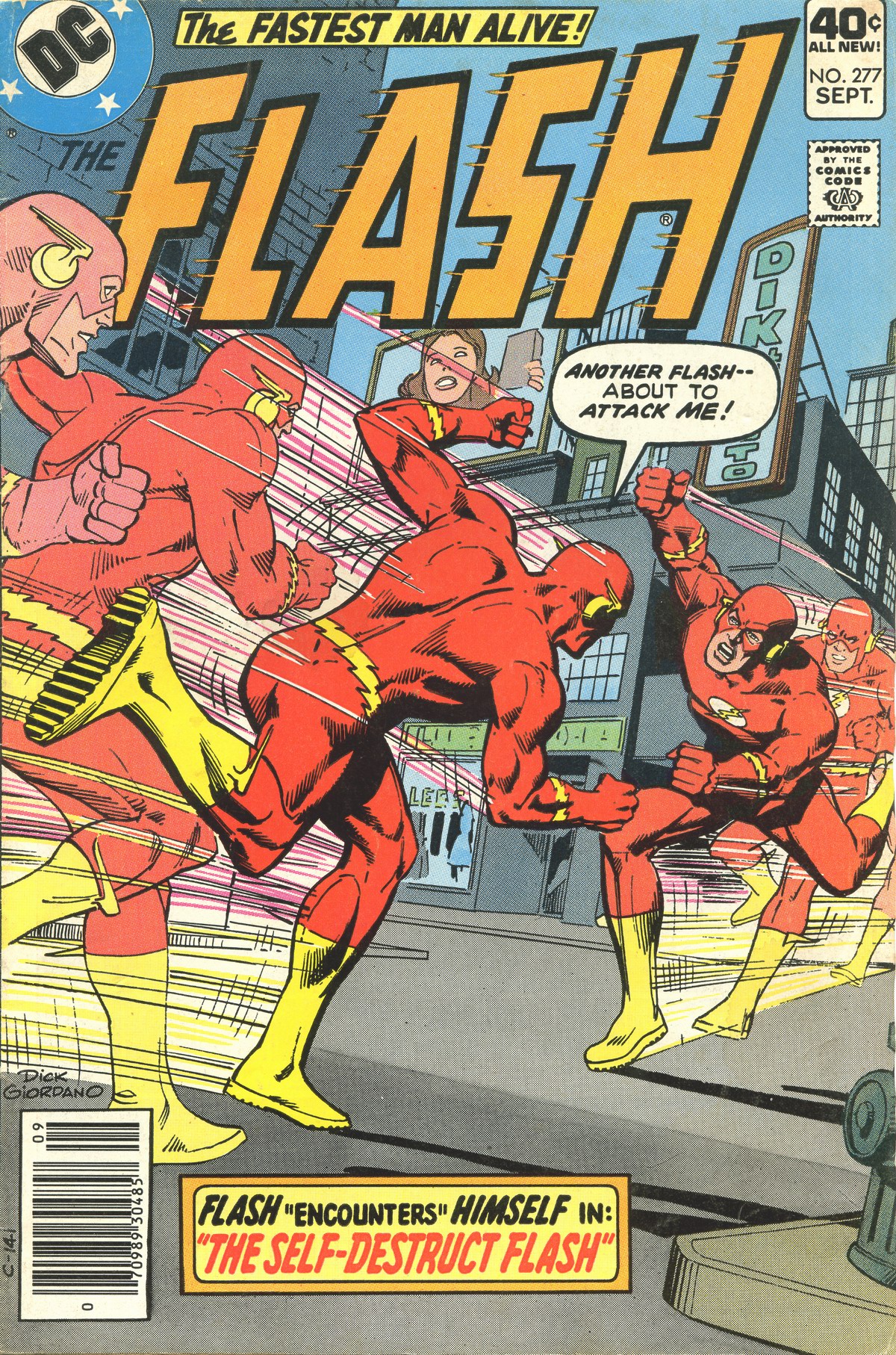


One of the benefits of my newly-opened and newly-discovered source for new comic books, the Stationery Store that had opened in the new strip mall close to my home, was being once again able to find comic book titles that had disappeared from the spinner rack at the 7-11. And so, for the first time in three months, I beheld the cover of a new issue of THE FLASH. As a kid, this had been my favorite series, but as I had gotten older, and with the changes that were wrought as editor Julie Schwartz handed the series over to new editor Ross Andru, I had grown a bit disenchanted with it. But I still loved the character and I still would have been buying it religiously had I had access to it. Ever since I’d allowed my subscription to lapse a year before, it had proven difficult, and I had missed an assortment of issues, much to my consternation. But as I was soon to discover, this time I had missed something much more noteworthy.
You see, writer Cary Bates and editor Ross Andru had decided that the Flash’s safe, secure world needed a bit of shaking up. And so they embarked on a storyline that resulted in the sudden and surprising death of Barry Allen’s wife Iris. Well, at least I assume it was surprising–I have no firsthand knowledge because I happened to miss the issues in which this tragic development went down. So diving into this issue was the first that I had heard about it, and it honestly didn’t seem quite real to me. This wasn’t the sort of thing that happened in the DC books of this period, whose overriding hallmark had been a furious consistency. But nonetheless, it happened, and was treated as a genuine thing. In essence, this was the DC equivalent to the Death of Gwen Stacy over at Marvel, a seismic storyline that changed the series going forward. for about a year, every story in the book would revolve around Iris’s demise and what had happened to her on the night in question, with a couple different red herring pursuits until the truth was eventually arrived at.
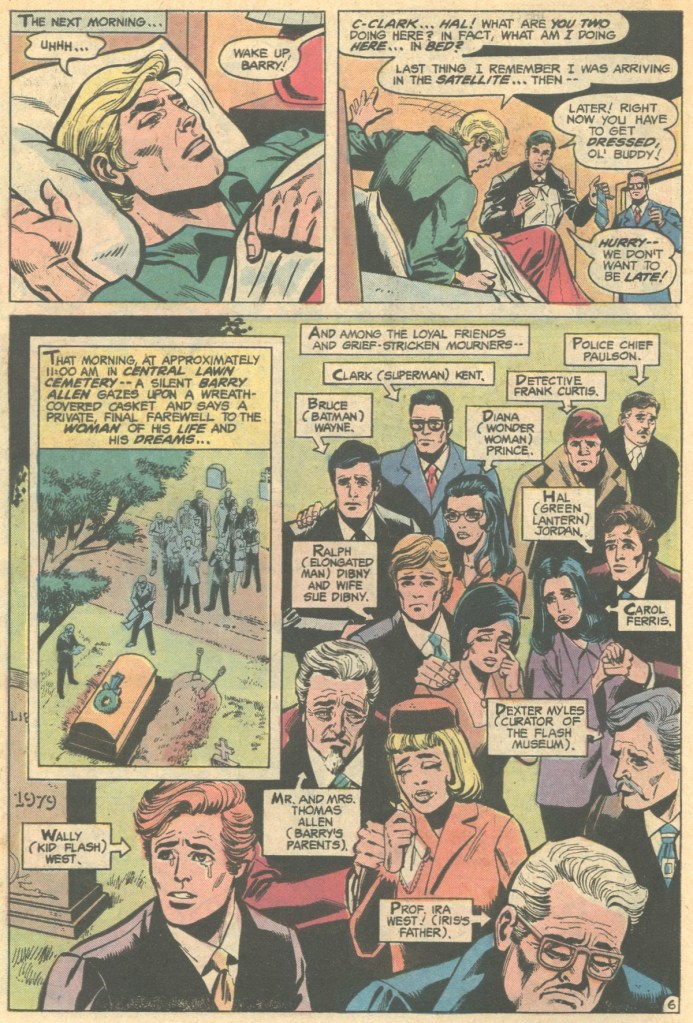
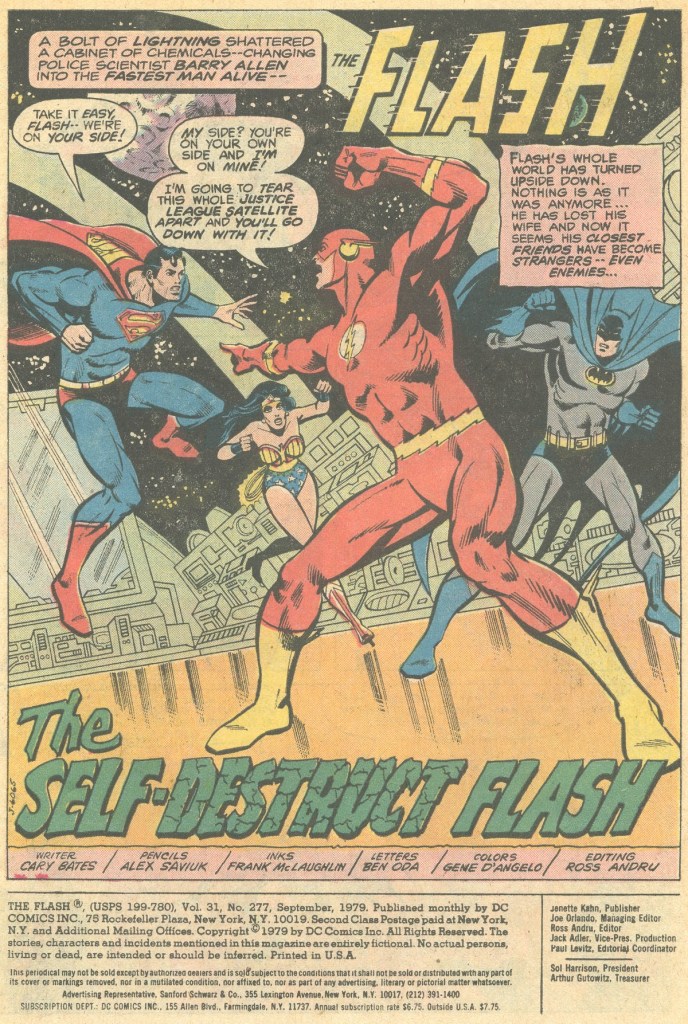
The story picks up in mid-stream, with an out-of-his mind Flash at the Justice League’s satellite headquarters, demanding that the League use its mighty powers to resurrect his dead wife. Flash isn’t in his right mind here–he’s been dosed with a massive and lethal amount of PCP–“Angel Dust” as it was known at the time–and so he isn’t really responsible for his own actions. Nonetheless, he’s still dangerous, and it takes the combined League membership to first contain him and then diagnose what’s ailing him. The dosage he was injected with should have been fatal, but his super-fast metabolism allowed him to survive it. But not certain of Barry’s mental state and with Iris’ funeral being held the next day, the League members form a support team to help their grieving member through this ordeal, and to be on hand should he suffer another flip-out. The funeral for Iris is an understated affair, and feels a bit perfunctory–which is part of what left me feeling as though this entire plotline with Iris being dead might simply be misdirection, and that she’d later turn up alive and well. That would eventually happen, but not for several years yet.
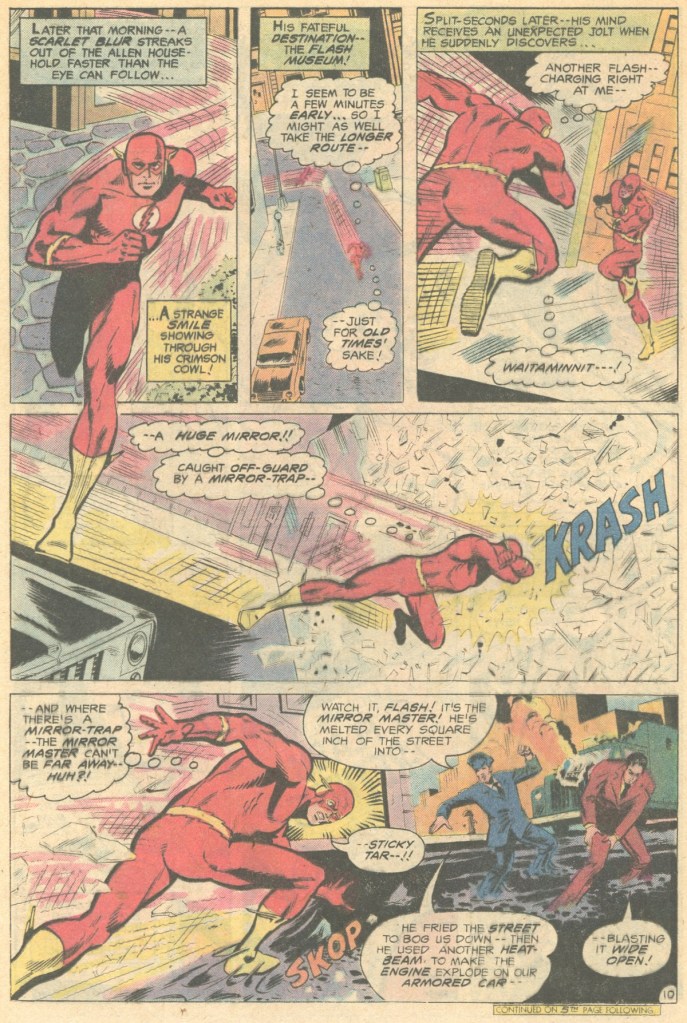
Barry’s spirit has been pretty well crushed by Iris’s death, and so he concludes that it’s time to hang up his super-speed boots (despite the fact that being the Flash had nothing to do with why Iris died, at least that anybody knew about at this point.) He contacts Picture News, Iris’ old employer, and arranges for a press conference at which the Flash will impart some final news to the citizens of central City. Everybody makes the obvious leap that Flash is retiring, and the news of the event begins to spread in that fashion, catching the attention of Melanie, the ESP girl who had been a running fixture in the book for the past several months. She had been obsessed with the Flash and used her mind-powers to bring him to her–only to lose all interest once she’d unmasked him as completely dull and ordinary Barry Allen. Faced with the news of his impending retirement, Melanie resolves to do something about it.
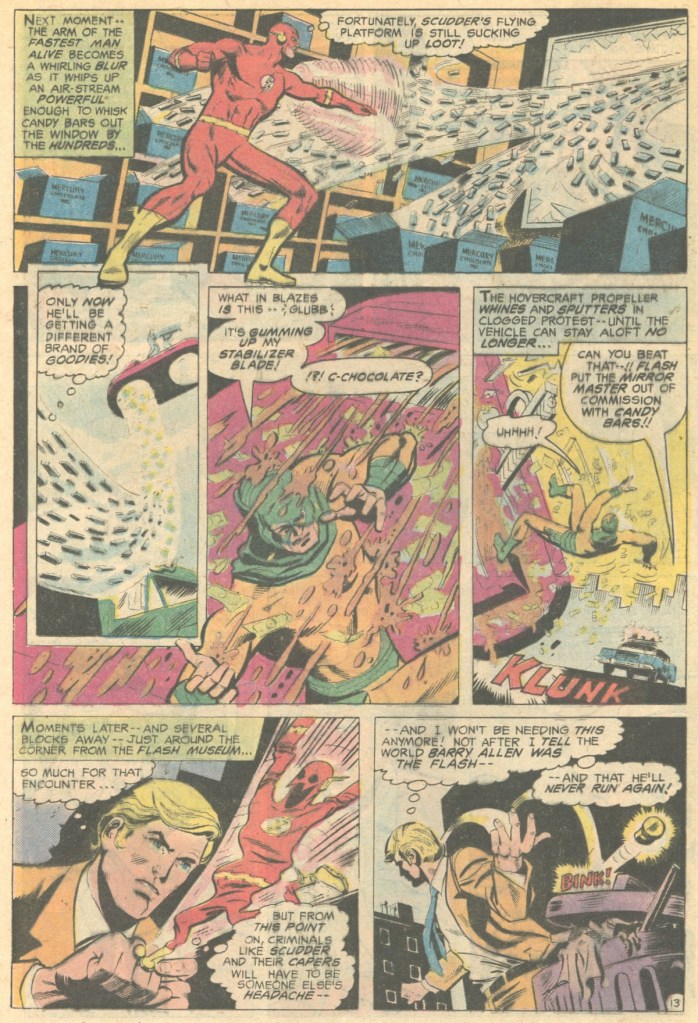
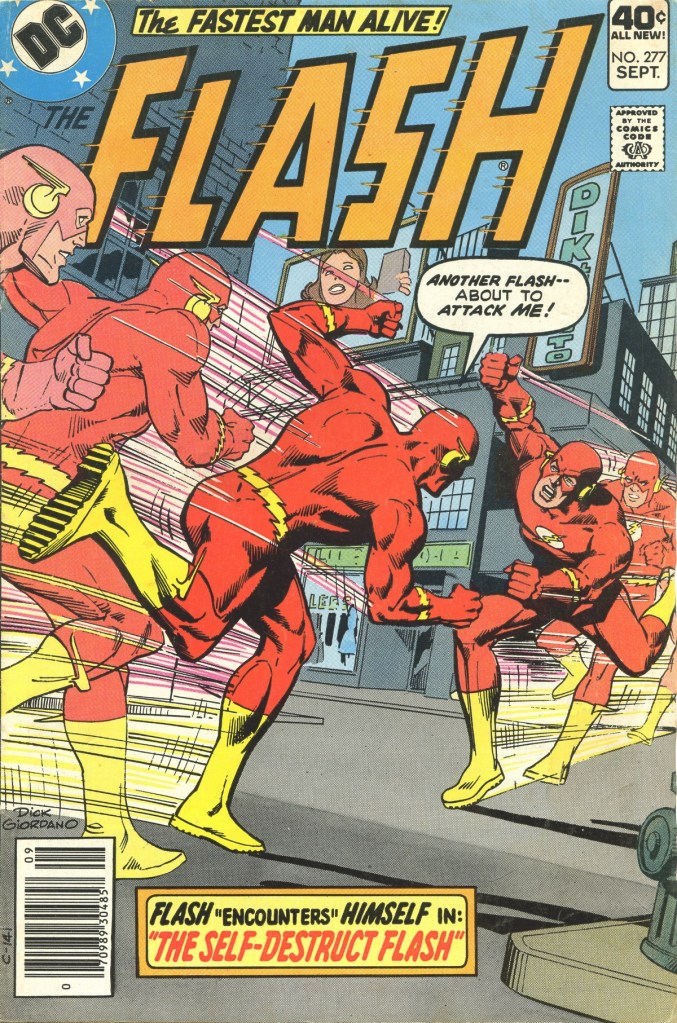
Meanwhile, the Flash runs one last patrol of Central City, running straight into a mirror that has been positioned as a safeguard by the Mirror Master, who is in the middle of a heist (and thus justifying the cover image of two Flashes racing right at one another.) This sequence is transparently here to give the issue a bit of colorful action, but Barry is just going through the motions as he trounces Mirror Master in the way that he’d done a thousand times before. Afterwards, he tosses away his costume-ring, ready for retirement. He intends to use the press conference to reveal his identity to the world as well as announce his retirement–which seems to me like a good way to get all of the Flash’s enemies coming after him directly hereafter, but what do I know?
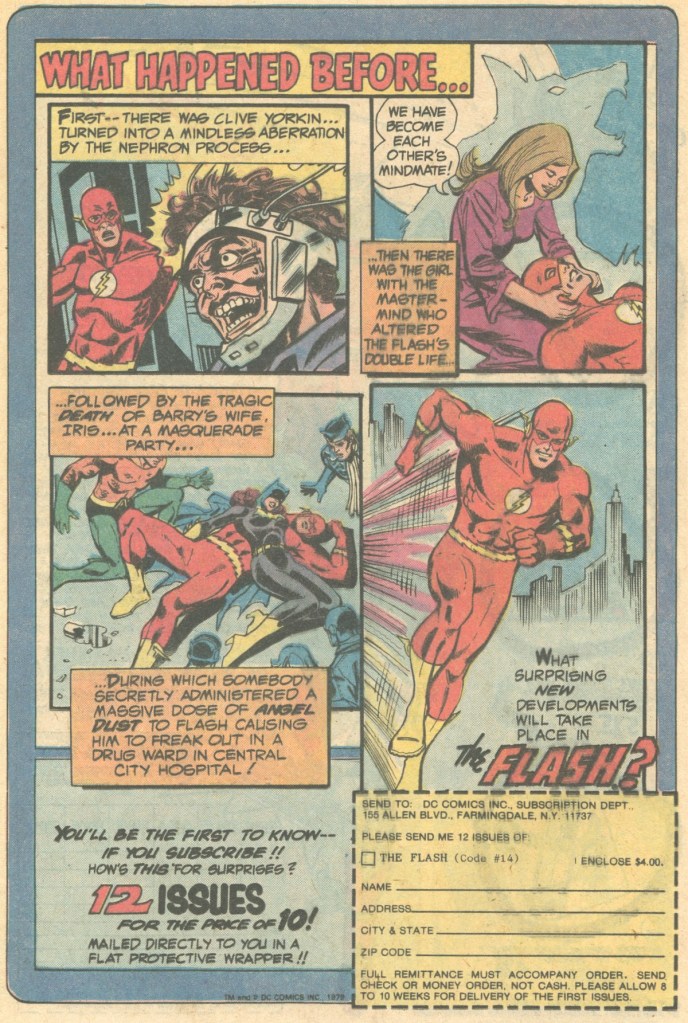
As with BATMAN, this month’s issue of THE FLASH carried a bespoke subscription ad that recapped recent events within the series to make it sound exciting and enticing for potential subscribers. Even with having missed issues, this still wasn’t enough to get me to re-up–especially now that I had a new source for my monthly hit.
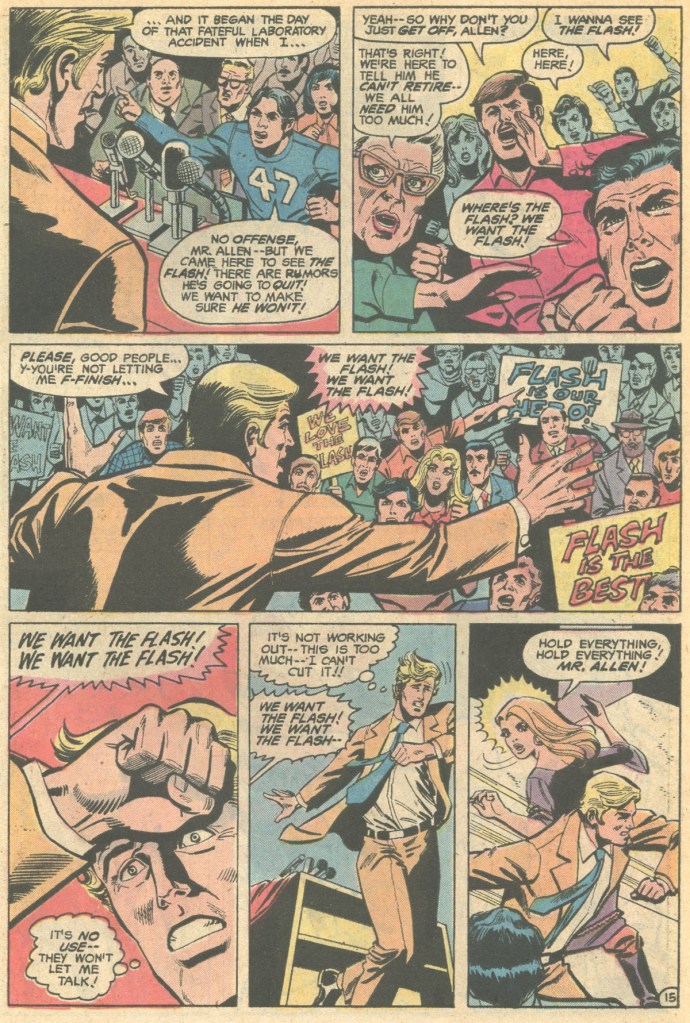
Finally, the hour of the press conference arrives, and Barry takes the podium and begins his spiel to the crowd. But they’ve come here to see the Scarlet Speedster and they aren’t much interested at all in a schlubby police scientist. The citizens of Central City have turned out in response to the advance word that their hero was going to be retiring in an attempt to convince him of just how much they value him and how much he’s needed. The crowd begins chanting for the Flash to appear, not giving Barry an opportunity to speak. Unable to get a word in, Barry has a bit of a panic attack and rushes from the stage–straight into Melanie the ESP girl.
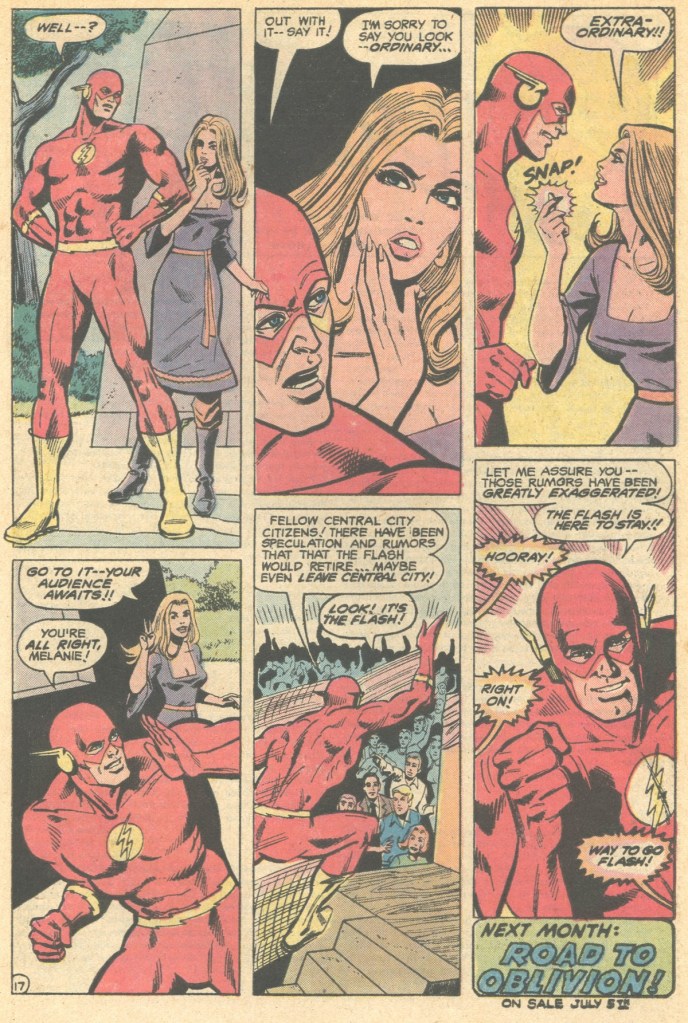
Melanie reiterates what the crowd has been chanting, that Central City needs the Flash. Knowing his true identity, she’s aware of the tragedy that he just suffered, but she tells him in essence to man up and be who he’s supposed to be. She’s also recovered his discarded costume ring and brought it to him. With the finality of a man who knows that the story only has one more page to go, Barry reverses his decision. He suits up as the Flash and heads out to the dais, announcing to all and sundry that the rumors circulating are in error and that the Flash is here to stay. So it’s a very non-traditional issue of THE FLASH, one that attempts to put a lot more emphasis on Barry Allen in the manner of a Marvel title. It doesn’t entirely succeed–due in part to the still-undercooked artwork of relative novice penciler Alex Saviuk–but it definitely doesn’t read like an issue of the title from a year earlier. This is relatively virgin territory for the character, even if the emotional center of what’s going on feels wobbly and a bit perfunctory.
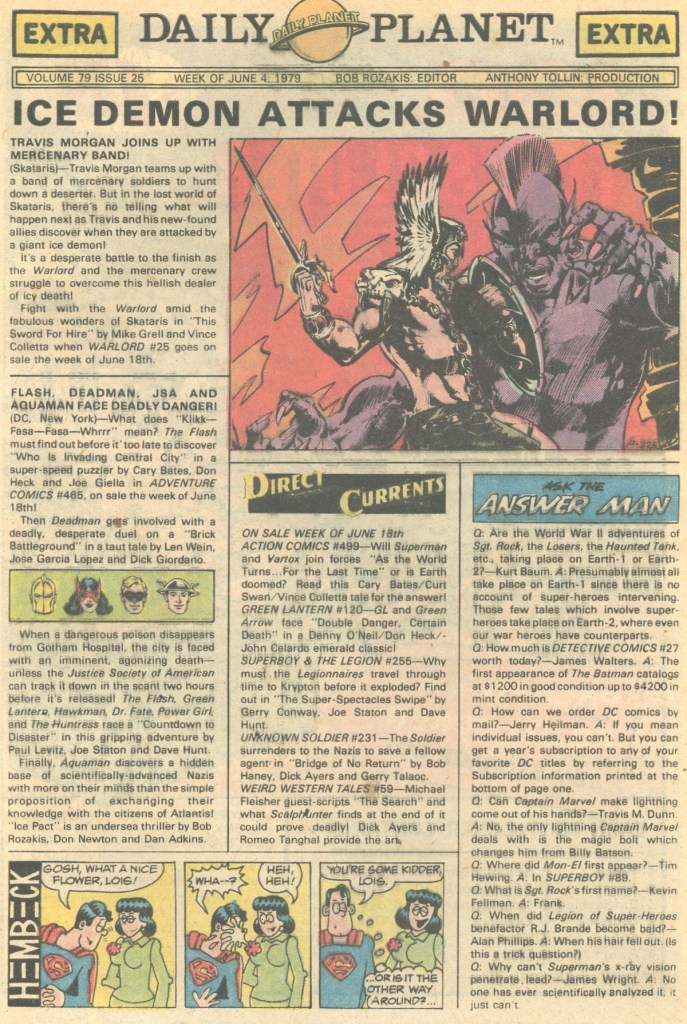
Another week meant another Daily Planet promotional page, with its two regular features: Bob Rozakis’ Ask the Answer Man column and Fred Hembeck’s gag strip. According to Rozakis, in 1979 a mint condition copy of DETECTIVE COMICS #27, the first appearance of Batman, was already worth around $4200.00. Which isn’t but a fraction of what it would change hands for today but is still a good chunk of change for that era.


I liked he Saviuk work better than Heck’s issues. I hadn’t even begun to appreciate what a great artist Heck was at this point but even knowing that now, I still feel Heck was the wrong choice to replace Novick. It wouldn’t matter. Bates was still shackled even if the storytelling chains were different. If he’d been allowed to fully engage the creativity shown in Captain Atom and later on in Marvel’s True Believers, Barry wouldn’t have caught a case of temporary death in Crisis and Wally would have remained the least interesting New Teen Titan.
LikeLiked by 1 person
Bah! The Bates/Heck FLASH is mah fav’rit! I challenges you to a lifetime of bitter hatred!
[And Heck didn’t replace Novick, he replaced Saviuk.]
LikeLiked by 2 people
I see it as they both replaced Novic honestly. Heck had a way of making people attractive and moving naturalistically that I’d yet to appreciate but to my taste, his work was too angular to work for me. Great artist but I preferred him on Steel.
LikeLike
I liked Heck on STEEL, too, but he had largely terrible inking on that book. On FLASH, he got to ink a lot of it himself.
And if you thought Heck was too angular, the return of Carmine must have been a real assault on the eyes — !
LikeLike
I liked Infantino but erroneously blamed the art for Flash’s cancellation. I think it was due to one of my favorite single panels ever in comics. It was in Spider-Woman, Jessica Drew sitting around in a bathrobe with a towel wrapped around her hair. No idea then and now why that stuck with me and so positively but it has.
LikeLike
I’m a late 1976-1983 Heck Fan as well. His style during that time is very much to my liking.
R.I.P. Gerry Conway creator of STEEL The Indestructible Man
STEEL Inkers:
#1 – Joe Giella
#2 – Vinny Colletta
#3 – Joe Giella
#4 – Joe Giella 1st Story Only. 2nd Story was Ortiz pencils/Patterson inks
#5 – Frank Chiarmonte
Unpublished #6 – Frank Chiarmonte
Kurt when you say “I liked Heck on STEEL, too, but he had largely terrible inking on that book.” who do you mean? Or who were you NOT referring to?
https://i.imgur.com/HLOn6ti.jpeg
LikeLike
I don’t like Joe Giella inks in general; I think he’s a bad look over Heck in particular.
Heck survives Vinnie better than some, but it’s still disappointing.
Chiaramonte over Heck isn’t bad, but it looked better on FLASH than on that one published STEEL issue — I think he was being encouraged to add a lot of texture (or maybe he took it on himself to do so), and the result was a fair amount of busy linework that didn’t do anything to enhance the pencils.
On FLASH, Chiaramonte was more controlled, more in tune with what Heck was doing. But Heck inking himself was even better.
I continue to think that Heck should have been given UNKNOWN SOLDIER or JONAH HEX, after JLA. He’d have been happier and it’d have been an improvement on Ayers.
LikeLike
P.S.
Praying House Roy does not steal credit for Steel or Firestorm or Power Girl or Punisher, etc. Dude has no morals, no shame, no honor.
LikeLike
If I’m being honest, I was growing a little bored with the old reliable formula of Flash, so a shake-up was probably in order. But this didn’t land with me at all. I hated that they killed off Iris, hated that Barry was now mopey and depressed. And I super-hated Melanie the psychic stalker and Clive Yorkin the drooling idiot bad guy, who’s plotlines just dragged on and on. I also wasn’t thrilled with Saviuk’s artwork, although looking at it now, I can’t really point to anything “wrong” with it, other than a general lack of excitement (and of course, the unforgiveable sin of Not Being Irv Novick). Like Tom, I hung around out of a misguided sense of loyalty, but I finally dropped the book within a year after this issue.
LikeLiked by 2 people
It was not often back then or ever for a Comic Subscription ad to boldly feature an “Angel Dust” reference. Al least to me it does not seem like a great way to convince parents or grandparents to funding a sub for their grade-school kid.
https://cafans.b-cdn.net/images/Category_450/subcat_149299/itnIiMU9_0304222206121sbpi.jpg
LikeLiked by 1 person
Wow. Nothing tells Granma that her 12 yr old’s grown up more than “Angel Dust” in a comic book. 🤣. Would’ve liked to have been in THAT editorial pitch session.
LikeLiked by 1 person
That splash page with McLaughlin inking reminds me of Dillin on Justice League.
I thought the ad was an interesting idea — it’s just adult. These themes are going to ring with adults and that’s part of why I didn’t Flash.
I continue to be amazed that you remember all these life details. I read hundreds of comics that were more of habit than enjoyment.
LikeLike
Oh, this entire era was a flop for me. The effort to set Barry and Iris at each other’s throats, the Peter Parker-like whoa, Flash’s life sucks storylines … I was more PO’d at Iris’ death as part of this than shocked.
LikeLike
Flash Fact: Too much melodrama in The Mighty Marvel Manner (lite)
LikeLike