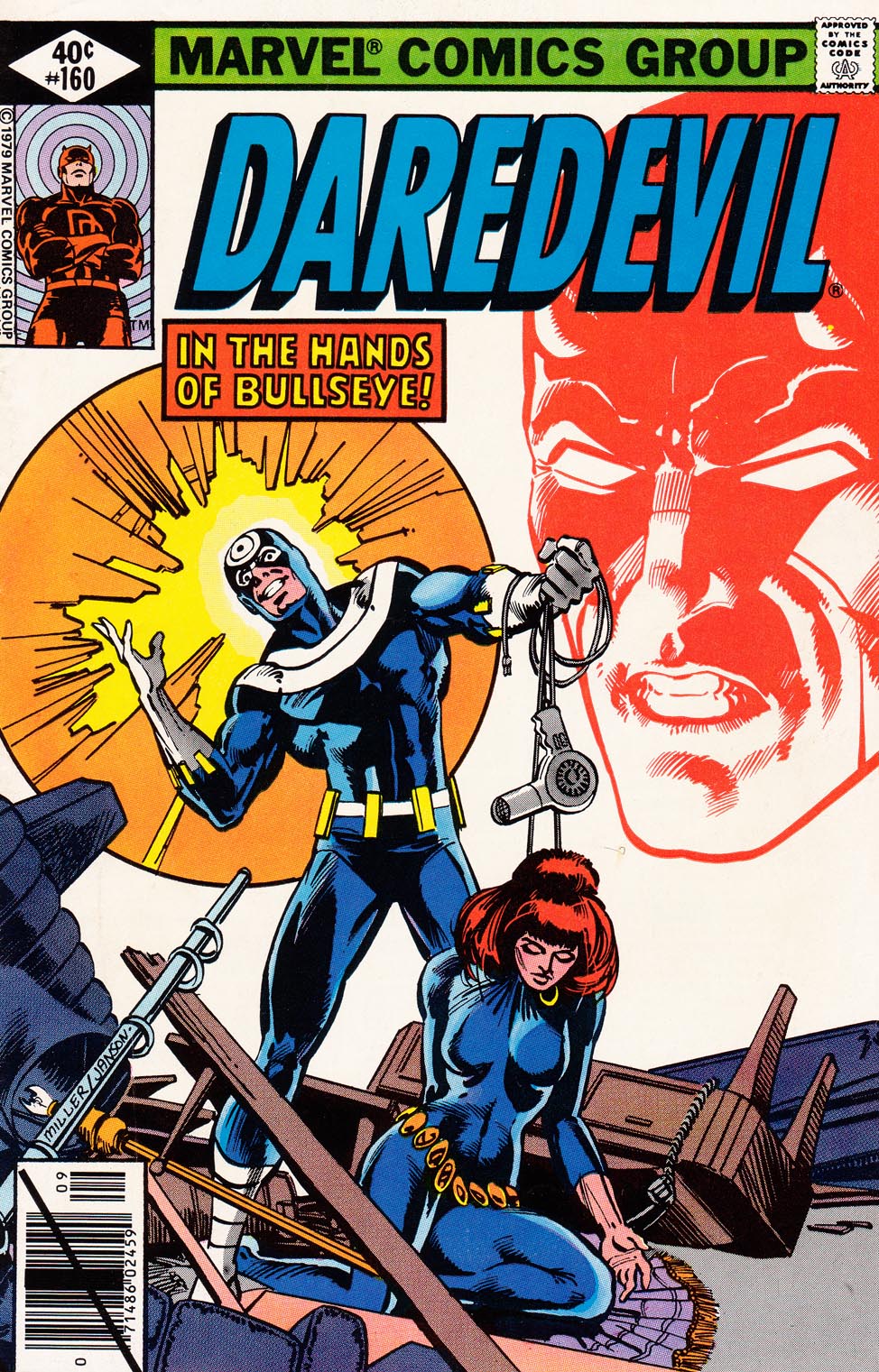


DAREDEVIL was a series that I had been buying and enjoying for about a year, but right around here it started to steadily get better and better–in such a gradual way that you almost didn’t notice it happening. Most of this was down to the arrival of new penciler Frank Miller. As these books were being produced “Marvel style” –i.e with the writer producing a plot that the artist would draw the issue from, then adding in the dialogue and copy after the fact–Miller was able to apply his storytelling chops to the series straight away from the jump. and while he’d only grow more polished and certain about his artwork as time went on, he already had a great sense of moving a story across the page. His skills were accentuated by inker Klaus Janson, whose gritty finish likely shored up some of frank’s weaker drawing in these early days.
Bullseye had been bouncing around in DAREDEVIL for a couple of years by this time, played as a bit more of a typical costumed super-villain. Jim Shooter, when he was writing the series, had succeeded in making the character feel a bit more dangerous, which likely led to his return appearances here and later. But under Miller and writer Roger McKenzie, Bullseye became a truly deadly opponent for the sightless super hero. In addition to him possessing a good set of physical skills to contend with ol’ Hornhead, Bullseye was also treated as something of an ideological opposite number to Daredevil as well–a narcissistic sociopath with a ruthless disregard for human life who was interested in his own prowess and reputation.
For a while now, DAREDEVIL had been shifting its tone, moving away from the template established by Spider-Man of the wisecracking, swashbuckling daylight super hero. Instead, taking a cue from Batman and other similar pulp vigilante heroes, Daredevil began to play more as a dark creature of the night, one of terse intensity. This transition didn’t make the character humorless; in fact, there are some very fun gags scattered throughout this run. But pulling a card from Will Eisner’s The Spirit a little bit, Daredevil’s world got darker, spookier, dirtier. This shift alone helped to make it something special within the Marvel line, most of which was still relatively bright and colorful.
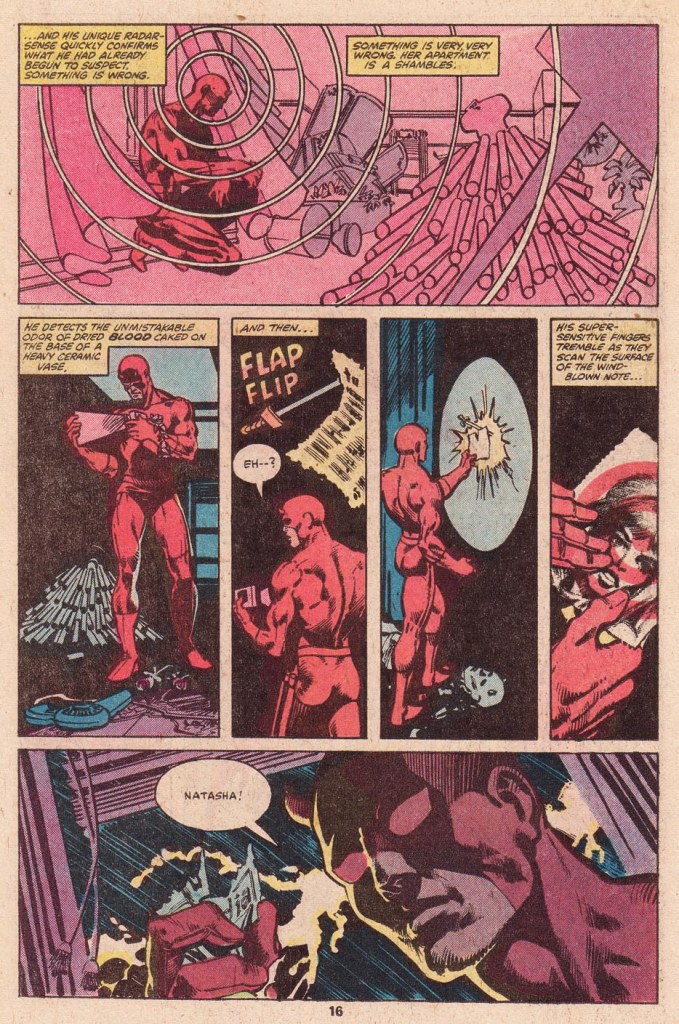
And it has to be said, Frank Miller already has a strong command of pacing across a page. A number of the pages in this early issue have interesting designs to them, or incorporate bits of business that highlight an aspect of plot or atmosphere. Miller would also typically put more panels on a page than was the norm, establishing a staccato rhythm to his stories that he could then puncture with a dramatic moment by going larger. He was also, at least at this point, hewing to most of EIC Jim Shooter’s theories on storytelling, which emphasized a reliance on medium shots with characters fully and cleanly in frame to eliminate any chance of misunderstanding. For a lot of artists, trying to do what Shooter wanted meant leeching a lot of the energy and impact out of their work. For Miller, he found ways to work within the system to highlight what he did best.
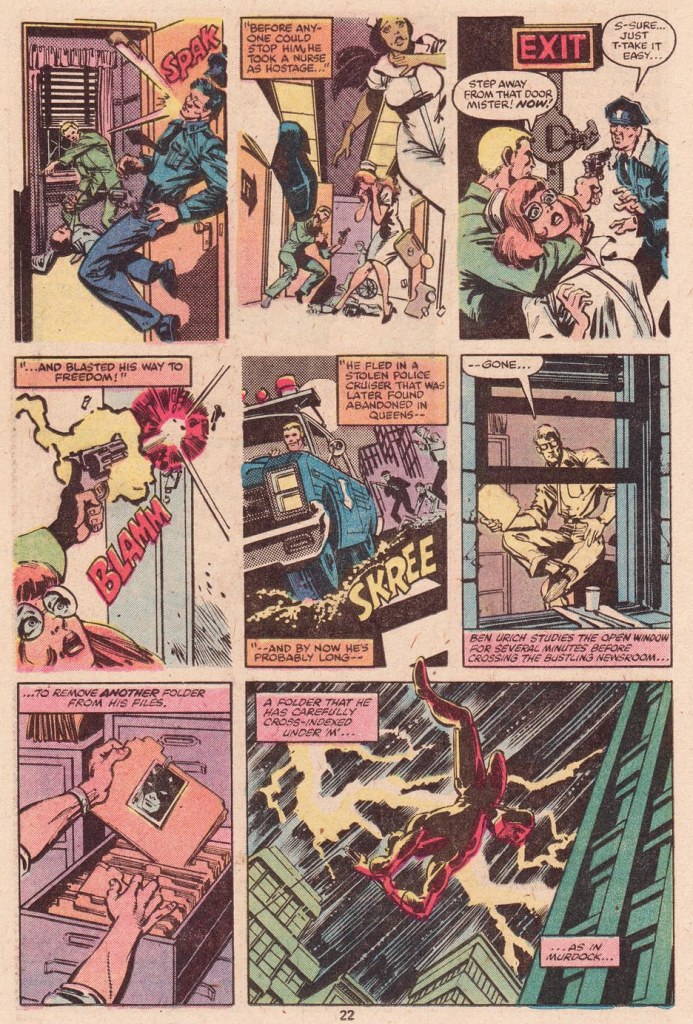
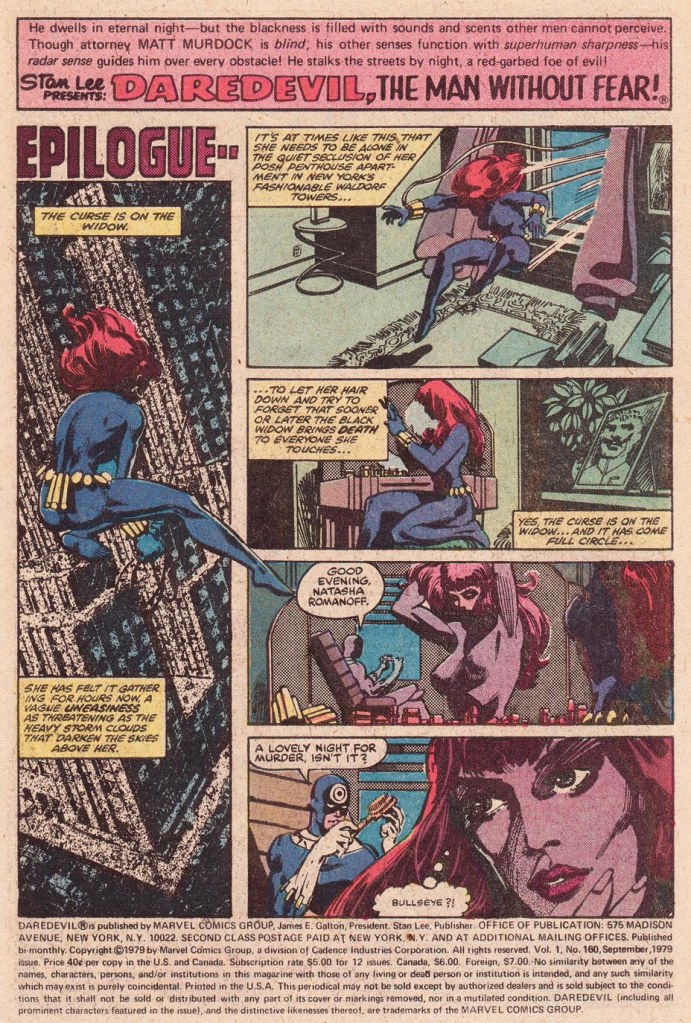
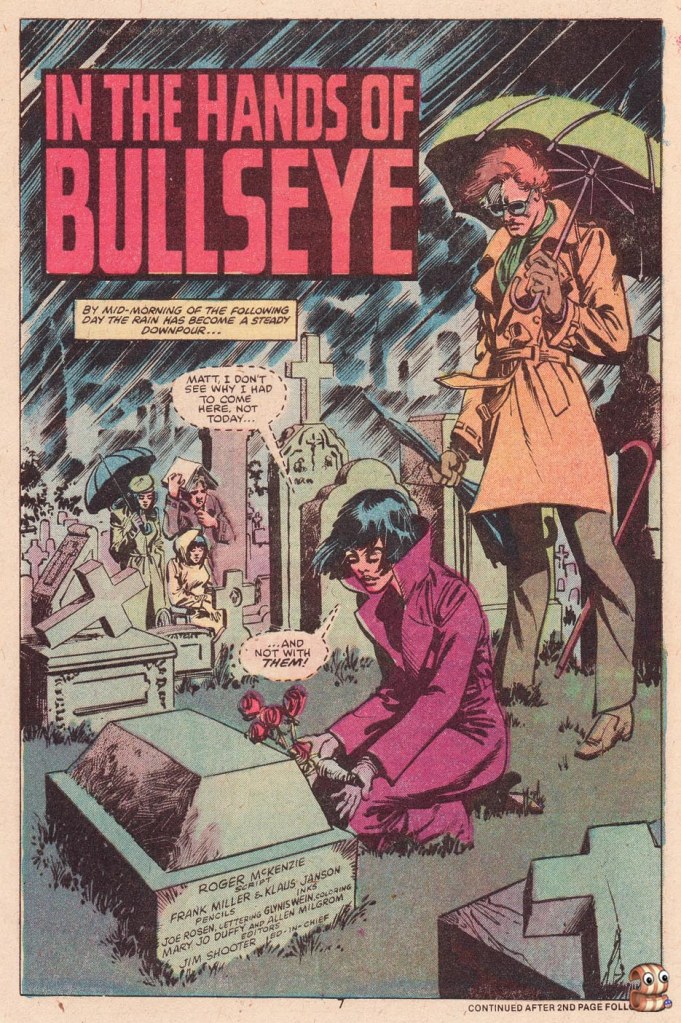
So what goes on in this particular story? Well, it opens up strangely, with a sequence that’s labeled an Epilogue. Natasha Romanoff, the Black Widow, returns to her apartment after a night doing spy stuff or super hero stuff or whatever she was getting up to. But when she arrives, Bullseye is waiting for her, and in a swift and brutal fight sequence manages to defeat her. But Natasha is only a means to an end, and so Bullseye leaves a clue for his true nemesis Daredevil, designed to draw him to Bullseye’s selected arena for their showdown. Meanwhile, Matt Murdock visits the gravesite of his girlfriend Heather Glenn’s father, who committed suicide in prison a few issues prior. Heather has learned that Matt is Daredevil, and she wants him to quit the life. But Matt refuses to do so, leading to an argument between the couple that leaves Matt feeling lonely. So, being a good boyfriend, he decides he’ll drop in on Natasha and see what’s cooking.
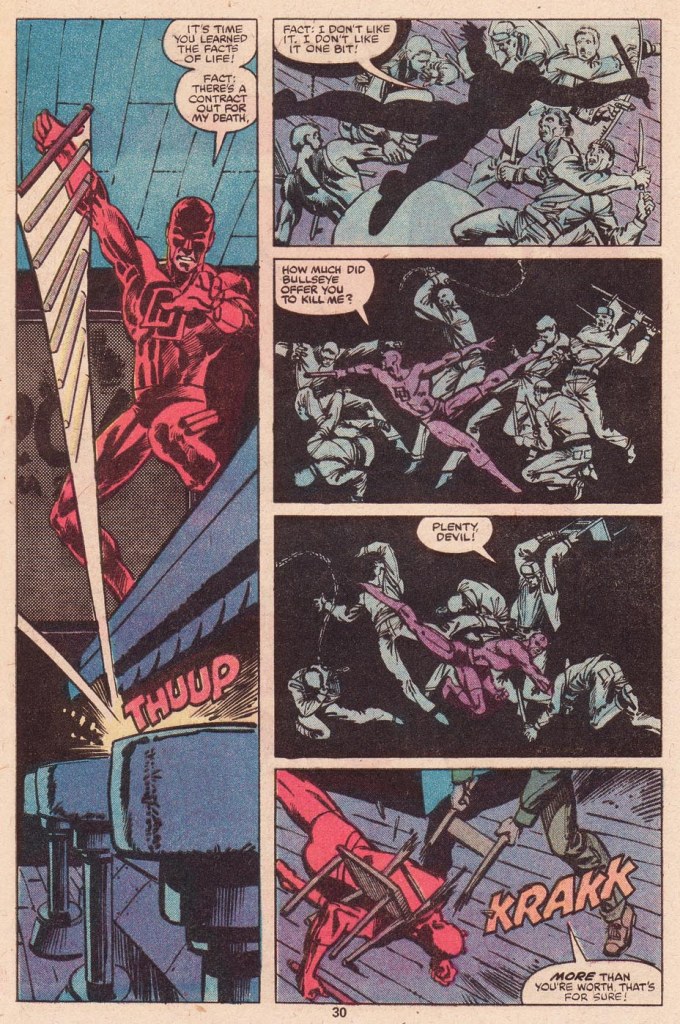
Matt arrives to find the Widow’s place trashed and picks up Bullseye’s clue. This leads him to seek out Daily Bugle reporter Ben Urich for information on how Bullseye is out in the world after his previous arrest. Turns out, he killed his court-ordered psychiatrist and then fought his way to freedom. Attempting to get a lead on Bullseye’s whereabouts, Matt dresses up in civilian clothes, including a low-pulled cap to help conceal his sightless eyes, and visits Josie’s Bar, a known underworld hang-out. Matt questions a stoolie about Bullseye’s connection to crime boss Eric Slaughter, and this causes the patrons of the establishment to close in on him, setting off a barroom brawl with Matt as the target. As pandemonium ensues, Matt is able to shatter the lights, dropping the bar into darkness and giving his the opportunity to change into his fighting attire.
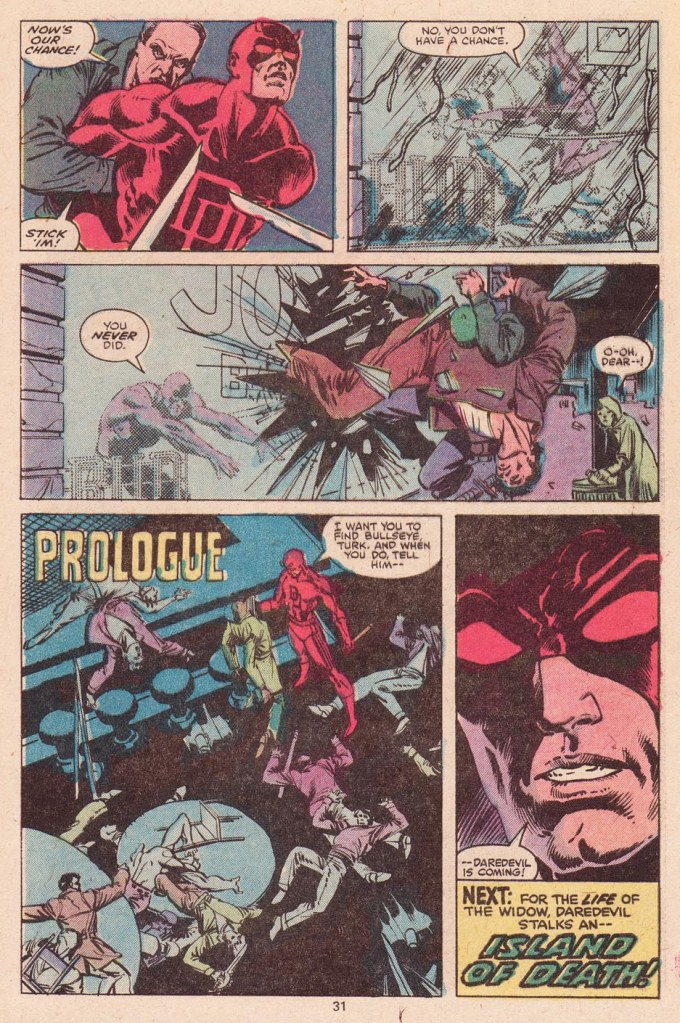
At this point, the remainder of the story is Daredevil beating the heck out of the assorted goons and gunsels in Josie’s Bar, shattering her front window for the first time in what will become a running bit. The lowlife Turk is introduced in this issue as just another crook in the mix, but he’ll return too under Miller as a recurring comedy relief character. And the issue ends on a Prologue, the opposite of how these things are typically oriented, in which Daredevil tells the defeated bad guys to tell Bullseye that he’s gunning for him. To Be Continued.
 The Tom Brevoort Experience
This was definitely an exciting time to be a Daredevil fan!
LikeLiked by 2 people
“He was also, at least at this point, hewing to most of EIC Jim Shooter’s theories on storytelling, which emphasized a reliance on medium shots with characters fully and cleanly in frame to eliminate any chance of misunderstanding.”
It’s also a rule of choreographed action storytelling that goes back at least as far as the Fred Astaire & Ginger Rogers movies. Astaire would insist that the dance sequences be filmed in medium-shot so the audience could fully take in the dancers’ movements and how they played their movements off each other. It does more than provide clarity; it creates drama out of the choreography. It’s a rule of presentation that can seen in film across the decades from Astaire to Gene Kelly to Bruce Lee. As Miller demonstrated, an imaginative cartoonist with strong design skills can put it to use quite effectively on the comics page. If other cartoonists weren’t up to the task, I think that says more about their limitations than the rule’s validity.
LikeLiked by 2 people
Peter Parker, The Spectacular Spider-Man#52 ( March 1981 ) page 6 panel 3 ( Hector Ayala says, “..I came home and found my family murdered, dead…all dead”. Panel 4 shows the White Tiger getting shot multiple times after tracking down his family’s killers ) an now this issue is an example of the stupidity of Super-Heroes identities being publicly known, also my rebuttal to J. Jonah Jameson ( & the writer of DC/Marvel: Superman/Spider-Man#1 ( May 2026 ) BIAS ( Daily Bugle vs. Daily Planet ) ) argument ( LOIS LANE says,” ..has it occurred to you that there’s a reason some of these heroes keep their identities secret?” J. JONAH JAMESON says, “I know ALL the arguments protecting their friends, family, all of it, blah, blah-blah. But if they REALLY have NOTHING to hide, it shouldn’t be an issue. — IT SHOULDN’T BE AN ISSUE???? PPTSSM#52 SAYS IT IS A BIG ASS ISSUE — JJJ loses his argument. Clearly the writer had zero knowledge of either of these 2 issues ( What happened to the Black Widow in DD#160 & the Comet’s family wouldn’t have been publicly known like what happened to the White Tiger and his family ). Back in the Lee-Kirby years when Johnny Storm was either in high school or later at Metro College, wouldn’t parents demand that he be kicked out because they were worried about an FF foe attacking the schools? Plus who would be crazy enough to what to date them?
LikeLike
In yesterday’s review of Marvel’s Greatest Comic Magazine #46, I commented that when the Claremont-Byrne-Austin run hit its peak, there was nothing published that could touch it. Reading this review, I may have to eat those words. Although I did not collect Daredevil during Frank Miller’s run, having read a number of them later, I heartily join the choir in adding my voice to the multitudes praising the remarkable work of Miller and Janson.
LikeLiked by 2 people
I really enjoyed the McKenzie/Miller/Janson run, too.
I can’t argue that the book got even better when Frank took over the writing. But it was very good even before that. It did feel very Batman — sometimes too much so — but since Marvel didn’t yet have many lead heroes who fit that niche, it was a welcome approach.
LikeLiked by 2 people
I think I read somewhere the Miller didn’t like McKenzie’s scripts? Honestly, I didn’t notice much of a shift in tone or quality when Frank initially took over the writing….though as the series progresses, and it becomes more street focused, it goes from being very good to great. Daredevil 158-191 still reads like a complete run.
LikeLiked by 2 people
I believe Miller’s disdain was about the McKenzie issues after this three-parter, which were nowhere as good.
LikeLike
I thought the McKenzie issues had the right tone, the right voice, and when Miller started writing he added both better story ideas and better structure. His work was fresher — while the voice of their stories was similar, it felt like McKenzie was doing a pastiche, and Miller was doing the real thing.
But I’d have been happy to see McKenzie write for any series that could use that kind of voice, from PUNISHER or WOLVERINE to, say, a LOIS LANE more focused on reporting in a world of super-stuff than on nutty romance.
I did get the impression from somewhere — I’m not sure where — that McKenzie was late on deadlines a lot, but I could be wrong about that. But that’s another thing that could annoy an artist who has to make up for lost time.
And of course, what we see in the books is the finished product — what Miller did to the plots in the course of drawing them that may have made them better comics, we don’t know.
LikeLiked by 1 person
To each their own. I have the three-volume collection of the Miller-Janson Daredevil from 20 or so years ago. I’ve occasionally loaned it out with the caveat that after the Bullseye storyline in the first book, it’s no big loss to skip to the second one, which starts with the first Miller-scripted story. I’ve gotten feedback that it was good advice–the first volume didn’t hold interest all the way through.
LikeLike
As a big Batman fan of the time, I agree that the McKenzie/Miller/Janson run did feel a lot like Batman, but Daredevil’s powers and supporting characters gave it enough distinction to stand out (at least I thought so). Frankly, I may be in the minority, but I never cared too much for Miller’s writing, even on the The Dark Knight miniseries, so I didn’t follow Daredevil when he took it over completely.
LikeLike
I had forgotten about the Fleisher/Ditko fill-in on #162. I bought this off the stands, and I recall being pretty excited by it since I think it’s the first new Ditko Marvel story I had encountered. It might be the first thing he did when he returned to Marvel? I dunno. I wish he had done more Daredevil where he inked himself. I wasn’t reading Daredevil regularly yet but that would change with issue 165.
#163, 164, 165, 166 are by McKenzie/Miller and feature Hulk, DD origin flashback, Doc Ock, and Gladiator respectively. Pretty solid comics with dynamic art and stories that at the very least set up story bits in later issues. I recall really liking the Doc Ock and Gladiator issues.
167 is by Michelinie/Miller. Perhaps the weakest of the group but still a good read with very nice art. Intro to a couple of characters that would pop up in Ironman. Not a bad issue by any stretch.
I think the spark for the Miller run in DD was lit before he started writing the series. The Ditko issue is the odd man out visually but it’s still an entertaining comic and it’s arguably more street level than some of the Miller issues.
LikeLike