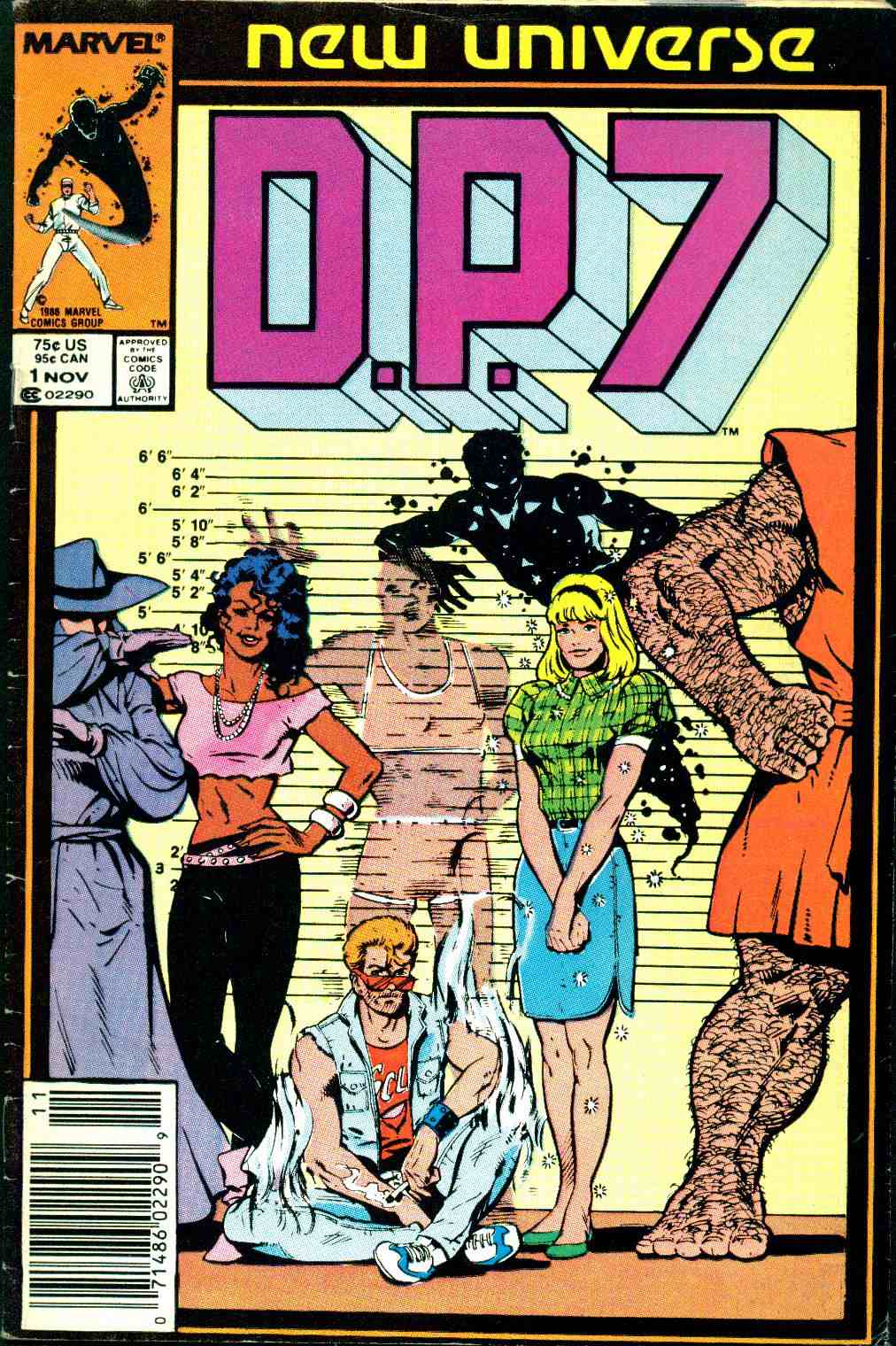


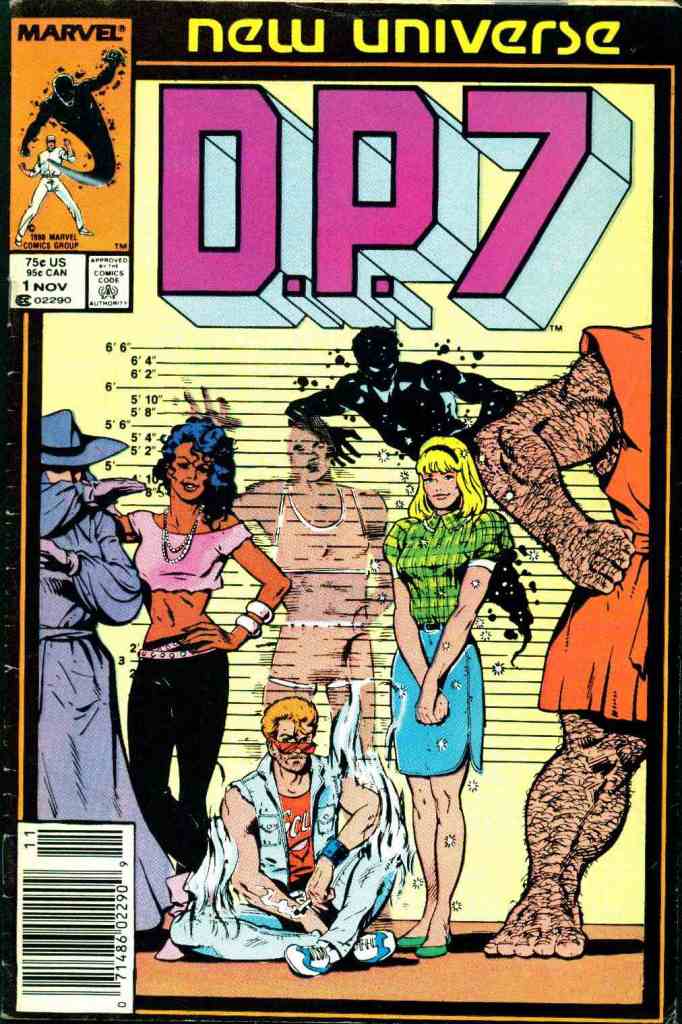
And finally we come to the most consistent and stable of the eight New Universe launch titles, D.P.7. I sampled all eight first issues when they first came out, and D.P.7 was the only book that I continued to follow–though even there, I dropped it after five issues. D.P. 7 was the creation of writer Mark Gruenwald and artist Paul Ryan. The pair had developed a partnership while working on the back half of the well-remembered SQUADRON SUPREME limited series, and so when Mark began to develop what would become D.P. 7, he reached out to see if Paul might be interested in illustrating it. In stark contrast to the rest of the line, Gruenwald and Ryan produced all 32 issues of D.P.7 despite the fact that it too was started on late. But they were both heavily invested in their joint creation.
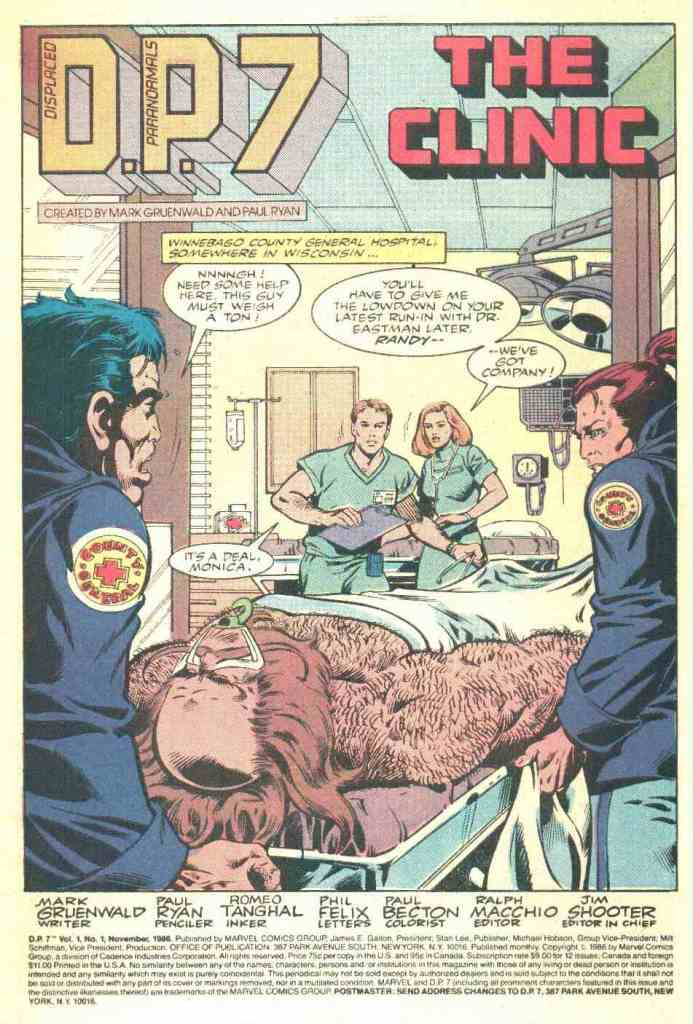
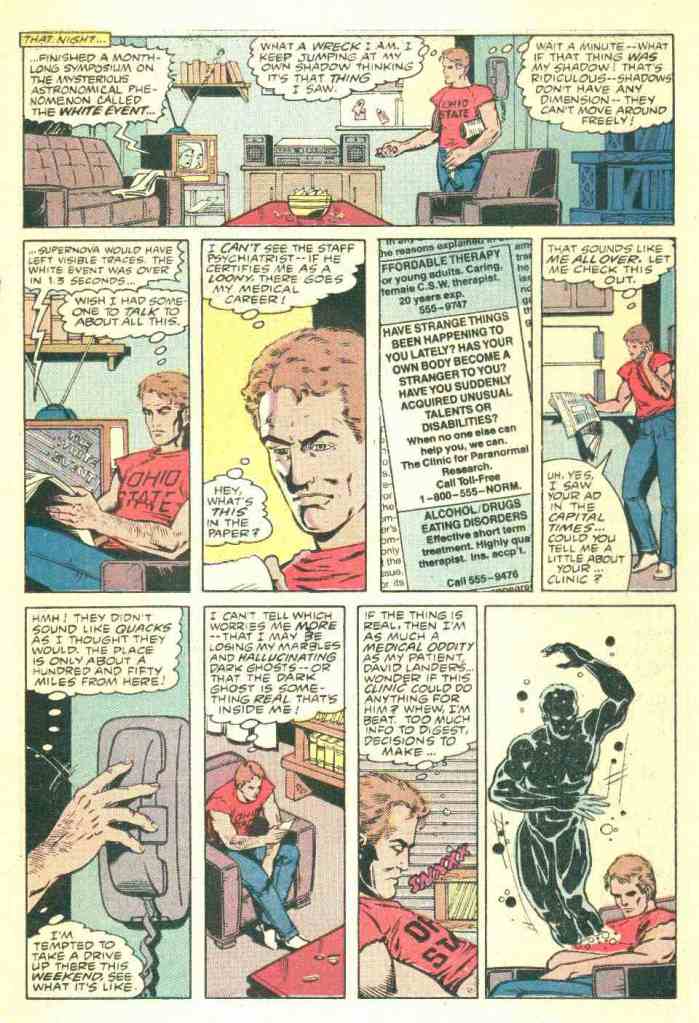
D.P.7 was an extension of some of the ideas that Gruenwald and Ryan had been playing with in SQUADRON SUPREME. In particular, the pair tried to take a more realistic approach to the development and use of super-powers. In their primary cast, most of the disparate individuals who had been gifted with superhuman abilities in the aftermath of the White Event were forced to deal with the drawbacks of those abilities every bit as much as the benefits. This more grounded treatment of the function of super-powers was a bit of deconstruction of the genre that had been gaining traction throughout the 1980s, embodied in the work of authors such as Alan Moore. Freed by the constraints of the New Universe concept from certain tropes of the genre, Gruenwald took the opportunity to push his cast in less cut-and-dried directions. Virtually nobody in the series could be quantified simply as a super hero. The D.P.7 were more like a support group for people dealing with chronic conditions. In that, the series they resembled the most was DC’s Doom Patrol, a fact that didn’t go unnoticed in the fan community. The commonality of the book’s initials and the fact that one of its mainstay characters, Antibody, possessed a power set that overtly resembled that of the Patrol’s Negative Man made comparisons pronounced.
Despite the fact that he was already largely regarded as one of the most ardent true believers in the regular Marvel Universe, and had become the overseer of its upkeep through projects such as the OFFICIAL HANDBOOK OF THE MARVEL UNIVERSE, Gruenwald leapt at the chance to be a part of the New Universe and reveled in helping to lay out the parameters for an entirely different fictional cosmology. In coming up with the premise for the series, which started under the title MISSING PERSONS, Mark performed a detailed analysis of every existing super hero team concept in the field, and deliberately tried to come up with an approach that didn’t overlap with any of them. (Which is ironic given the pronounced similarity to DOOM PATROL.) As the development process continued, the series title morphed into M.P 7, short for Missing Paranormals, before landing on Displaced Paranormals as the source of the series title. (Mark later indicated that he was looking for a title that would feel New Wave) It would probably have been a good idea to include Displaced Paranormals on the cover as part of the logo as was done on the splash page so as to communicate with some clarity what the idea behind the series was. The book’s title isn’t helpful at getting across what it’s about, and the inclusion of a number locked the series into an expansive cast. Trying to maintain a stable group of seven became a genuine hassle, and so Grunwald and Ryan largely abandoned doing so as time went on.
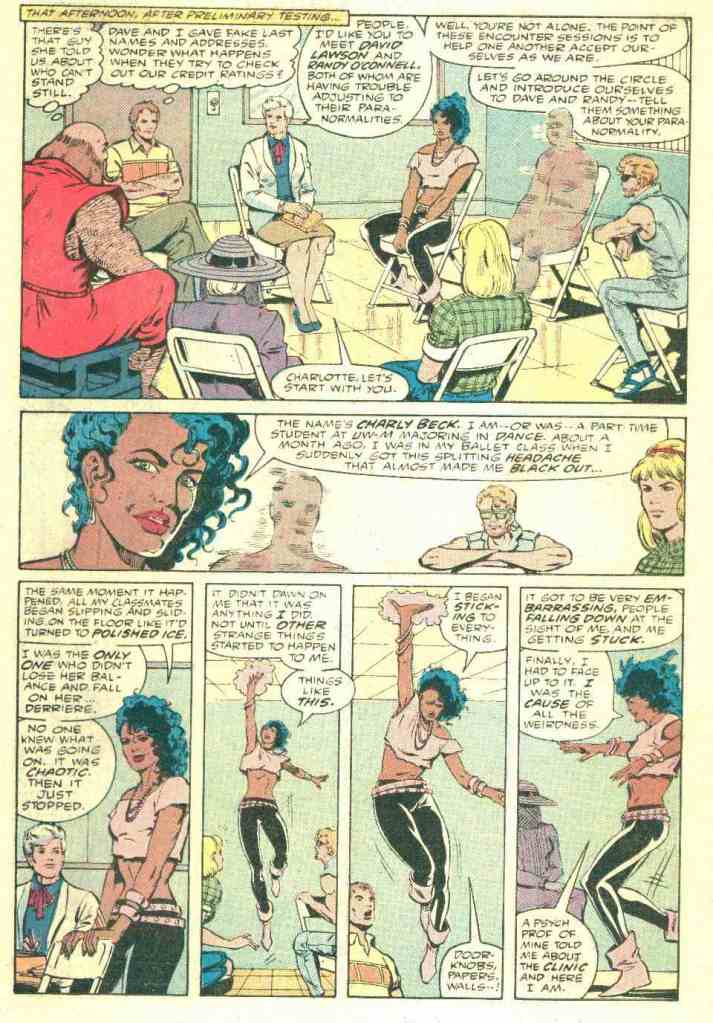
The titular D.P. 7 included Randy O’Brien, codenamed Antibody, who could generate shadowy doppelgangers of himself that would silently fly around and carry out his commands Negative Man-style; David Landers aka Mastadon, who was the victim of a sudden almost debilitating amount of muscle growth and who was consequently strong and durable; Jeff Walters, nicknamed Blur, whose body was in a constant state of motion and who could run at superhuman speeds; Charly Beck, known as Friction, a dancer who could affect her body’s personal friction, giving her the power to stick to things or to glide along frictionless; Dennis “Scuzz” Cuzinski, whose body excreted an acidic compound that could eat through most objects, including the clothing he wore; Stephanie Harrington, called alternately Viva and then Glitter, who can heal and energize herself and others through her sparkling energy field; and Lenore Fenzi, called Twilight, a retired Latin teacher whose body generated an energy debilitating to others. The seven all become patients at the Clinic for Paranormal Research after their abilities first manifest themselves.
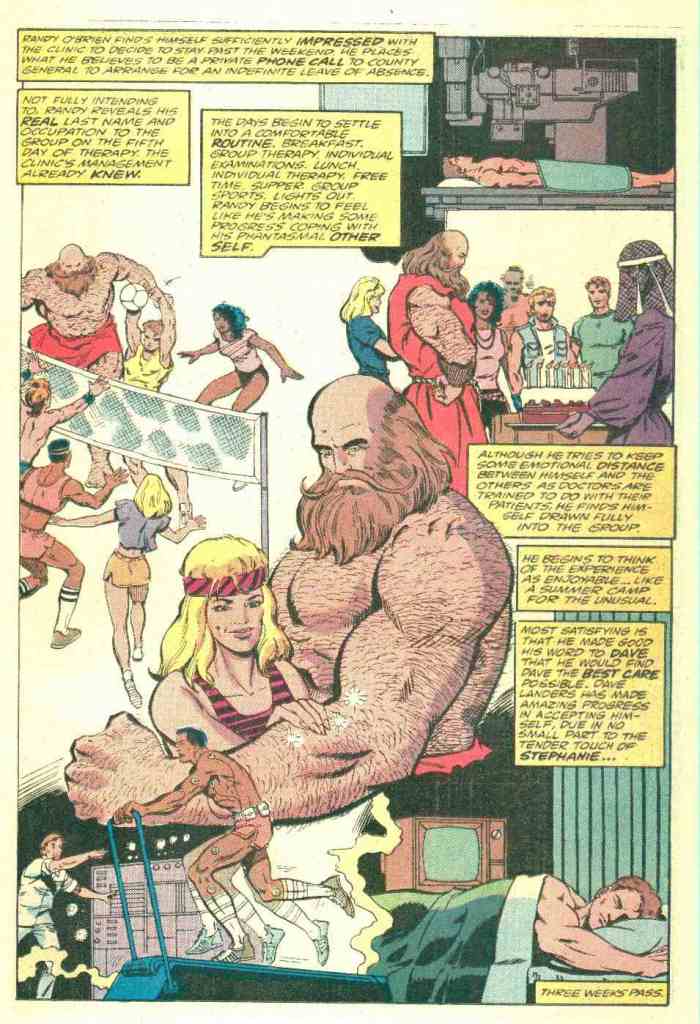
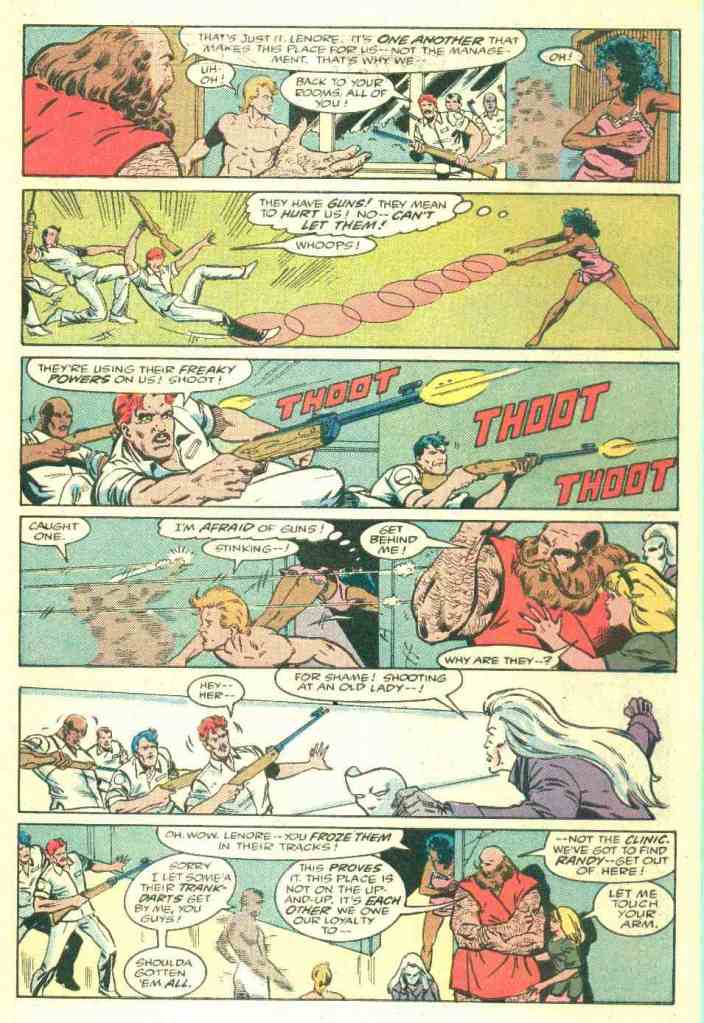
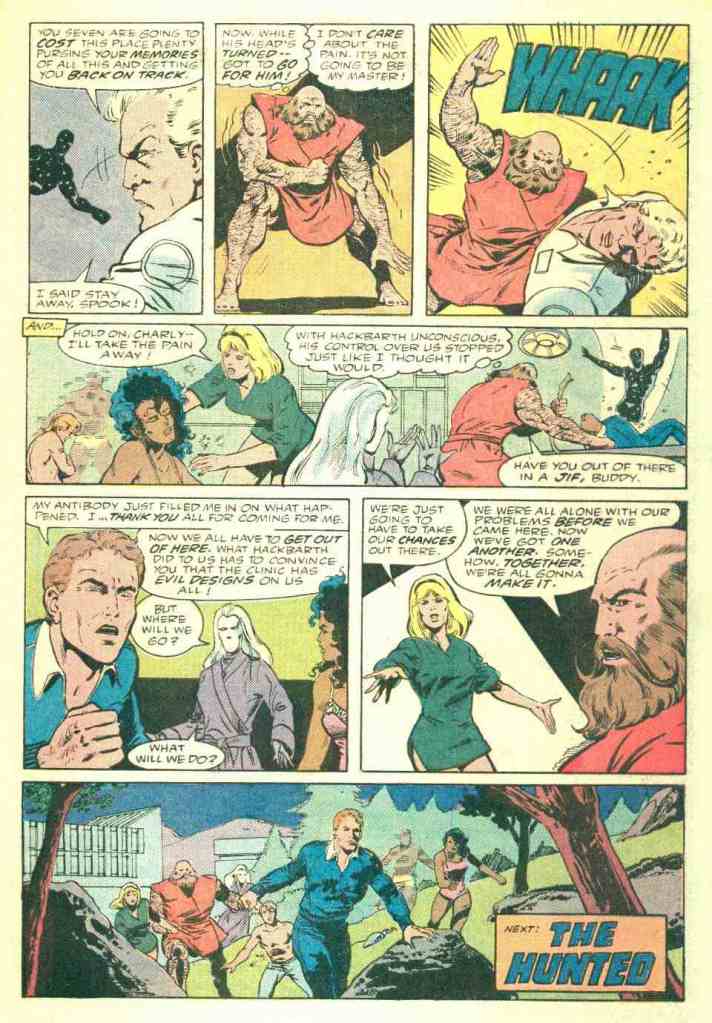
This being a comic book, of course the clinic isn’t the benevolent association that it purports to be. It’s staff, led by Phillip Nolan Voight, is recruiting and studying the emerging paranormals in the hopes of turning them into operatives for the Agency, essentially a private army. As Randy gets suspicious of the motivations of the group’s handlers, he dispatches one of his Antibodies to spy on their activities one evening, and learns that the Clinic is actively attempting to brainwash their patients to make them compliant and controllable assets. Consequently, O’Brien organizes the seven paranormals in his encounter group and they fight their way out of the Clinic, actively going on the run to stay one step ahead of their pursuers. It’s all very similar to the premise and set-up of Marvel EIC and New Universe mastermind Jim Shooter’s future series HARBINGER at Valiant some years later.
if D.P.7 has a weakness, it’s that it’s both extremely wordy and emotionally clinical. Mark was capable of writing material that was more emotional and engaging, but here–possibly in part due to the rules governing the New Universe and EIC Shooter’s insistence on almost diagrammatical artwork that favored a preponderance of mid-shots, Gruenwald seemingly becomes more interested in the intellectual nuance of explaining everything that’s going on rather than the drama and excitement of an action-adventure story. His seven leads are all distinctive in theory, but in practice they all have much the same voice (even with some minor dialects stirred into the mix) and the same manner of thinking about the complexities of their situation. For myself as a reader, the thing that drove me away from the series eventually was that it was so dry, so seemingly lifeless. I liked it a lot more in theory than I did in practice.
D.P.7 was one of the four titles to run the entire length of the New Universe experiment, and following Jim Shooter’s ouster, Gruenwald became the editorial overseer of the line. In that role, he dispensed with those rules that he found to be a detriment to storytelling (such as the need to match the reader’s passage of time such that each issue took place a month after the preceding one) and steering the New Universe away from being the World Outside Your Window of its tag line. His efforts, and those of the creators who worked on those remaining titles, weren’t entirely successful. In a very real way, the end of the New Universe had been foretold in the initial eight releases; it was a dead man walking virtually from the jump, and none of the efforts made to revive interest in it were able to capture the necessary readership. Eventually, after 32 issues and a few limited series and one-shots following them, the New Universe quietly closed up its doors. The characters would reappear in future stories involving the mainstream Marvel Universe (initially in Gruenwald’s own QUASAR series, which began as his and Ryan’s follow-up assignment after completing D.P.7) but none of them reached the heights that they might have.
Taken as a group, the New Universe series had a number of interesting ideas scattered throughout it that simply weren’t permitted the space and time to mature into something long-lasting. There’s the shadow of a good set of books lurking in the background of all of this material. And the failure of this initiative served as a kind of template for Jim Shooter’s future world-building efforts. Certainly the lines he later crafted at Valiant, then Defiant, then Broadway all feel of a piece with the kinds of stories that he was attempting to generate here. Valiant in particular feels very much like the beneficiary of the lessons that Shooter learned while trying to get the New Universe off the ground, like a thematic do-over that was much better realized and executed.


This was my favorite of the line and consistently well done. I don’t recall feeling it was overly dry but it’s been decades.
LikeLiked by 1 person
I thought D.P. 7 felt like “what if mutants, but no superheroes,” and so more like X-MEN than DOOM PATROL, but the quietness of Paul’s artwork felt like Bruno Premiani, so I thought of it as DOOM PATROL 7.
But Mark seemed like the one guy who truly got what Jim was aiming for, in terms of taking a serious SF approach to a super-powered comic that didn’t overturn the world too much, kind of like FIRESTARTER but with more powers. And Mark was semi-ideally suited to writing that kind of book. I say semi, because the problem was, the treatment wasn’t very commercial.
Alan Moore, or other interesting stylists, can take that kind of exploration and make it vivid and engaging, but Mark’s approach tended to be thoughtful but dry, as you’ve noted. And a flashier artist could make up for that some, but that’s not what Jim wanted. So D.P. 7 got to be a book that was a superhero fan’s idea of SF, and trying to dress hip but not really having the fashion sense to do it.
But 32 issues is a decent run, and an achievement to be proud of.
LikeLiked by 2 people
This was the NU title that disappointed me the most. I say that because after Mark Gruenwald & Paul Ryan’s sterling work on Squadron Supreme, hopes were high for this collaboration. I recall reading each page, wanting this book to be something special. Instead, it struck me at the time like being on a date with someone you really wanted to like, but that feeling just wasn’t there. Paul Ryan’s art wasn’t the problem. It was more that there wasn’t anyone on the team that essentially “grabbed” me. Instead, a blandness permeated what should have been an engaging cast. Since I wasn’t following up on any of the other NU titles, I found it too easy to let this one go as well.
On a sidenote, one fun aspect of Tom’s review was that having spent 15 years in Wisconsin, I recognize Dairy State references that Gruenwald placed in this book. I always thought of him whenever I’d go past Oshkosh.
My thanks to Tom for a fond and informative journey back to the summer of ’86 with the debut of the New Universe! My thanks as well as the engaging comments that have followed each review!
LikeLiked by 2 people
I imagine it helped that on Squadron Supreme he wasn’t starting from scratch — established characters as well as their DC counterparts to draw on.
LikeLiked by 1 person
I definitely agree with the opinion that Gruenwald tended to overthink things in this series, much as I liked most of the characters. In the scene shown above, some goons shoot at dancer Charly, and she thinks, “I’m scared of guns!” No s***, Sherlock! All of these civilians-cum-heroes ought to be freaked out by having goons shoot at them, because none of them are trained to engage with armed assailants. Having that line come from any single DP’er, not specifically from Charly, proves a clunker because they all ought to be freaked out from being shot at, though of course they could all respond differently. But as a professional Gruenwald presumably would have known that if he was selling civilians with super-powers, they needed to be able to defend themselves adequately to appeal to the dominant DM audience. The scene of Mastodon having to force himself to strike back is more in the nature of how civilians under such stress might react. It was a good moment, but the fight as a whole still feels a little phony.
There were other clunkers that arose from DP7’s status as what some have called an “overground comic”– that is, it could be a little more mature than traditional Silver Age superheroes but not too mature. There’s another DP story that ends with Charly defiantly telling some opponents, “Big FAT deal!” Every fan who read that knew that “fat” was not what would’ve been the most likely thing to say under the circumstances, but an overground comic couldn’t have used the most likely epithet. I know it’s Hundreds-of -Mondays-Ago quarterbacking, but just having a “blanked out” cuss word might have been more effective, IMHO. Gruenwald did excel in coming up nice bits of melodramatic characterization that kept things percolating.
LikeLike
About the cover: I don’t think there were many super-hero artists at Marvel in the 80’s who could pull off “quiet line-up of characters in street clothes” and make it engaging…. and Ryan doesn’t pull it off here. Obviously they weren’t going for anything explosive or dynamic, but the cover art looks like the actual objective was to make it dull and unattractive… it’s a yawner.
The entire book looks like a storyboard for a cheap tv show to me. Shooter wasn’t looking for “quirky” but I think “quirky” probably would made it more interesting…. though probably not in the style manual
LikeLike
Compare the cover to Love and Rockets # 1…
LikeLike
An excellent cover to compare… same basic cover idea with a very different sensibility.
LikeLike
This was easily my least favorite NU title. Sadly, it was neither a superhero book with lots of action to make up for the lack of depth nor a character driven book to make up for the lack of action. On the upside, it was that much better than Harbinger.
LikeLiked by 1 person
D.P.7 makes the second New Universe team to be on the run and being hunted ( Spitfire and the Troubleshooters being the other ).
LikeLiked by 1 person
The post and the comments capture why I never warmed enough to the book to buy it, even though i flipped through it in stores (which is more than I did for Spitfire or Kickers Inc.).
LikeLiked by 1 person
This is my favourite of the New Universe titles. Of course, my first exposure to the series was actually from a few issues in, after Gruenwald had found the voices of the characters.
LikeLike
I picked up 3 or 4 DP7 issues after the series revamp. I though them good, but didn’t stay on till the end. So not that good, I guess.
LikeLike
In one respect you could say Jim Shooter was ahead of the curve, at least in terms of form, rather than content. Though American comics used to have a lot of adventurers clad in mundane garb, by the eighties most of those had been crowded out by the costumed crusaders. But by the late nineties, translated manga had found its optimal format in TPBs, and then as now, a general audience made bestsellers of a lot of Japanese heroes who, like most of the NU, ran around fighting evil in civvies. For whatever that might be worth–
LikeLike