

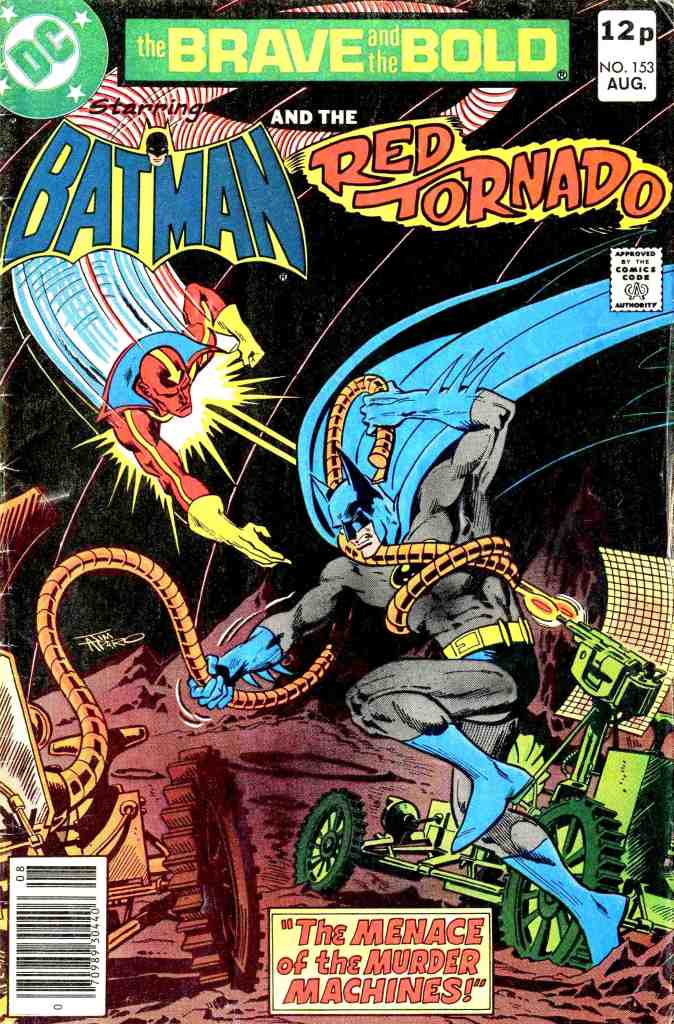
BRAVE AND THE BOLD was still a series that I was lukewarm on, though I’d begun to follow it with a certain amount of regularity. Part of this was that at this point I had enough disposable income to drop on a couple of extra comics each week, as well as the fact (unrealized by me) that the editorship of the title had passed into the hands of Paul Levitz, whose sensibilities were more in line with my own younger preferences. So B & B still felt a little bit strange and discordant to me, particularly in any story written by Bob Haney, who was still the writer more often than not. But it wasn’t as pronounced a feeling, and so I could accept it as a legitimate DC super hero comic in a way that I couldn’t when I was younger. I’m sure some of this was that my tastes were broadening as I got older as well.
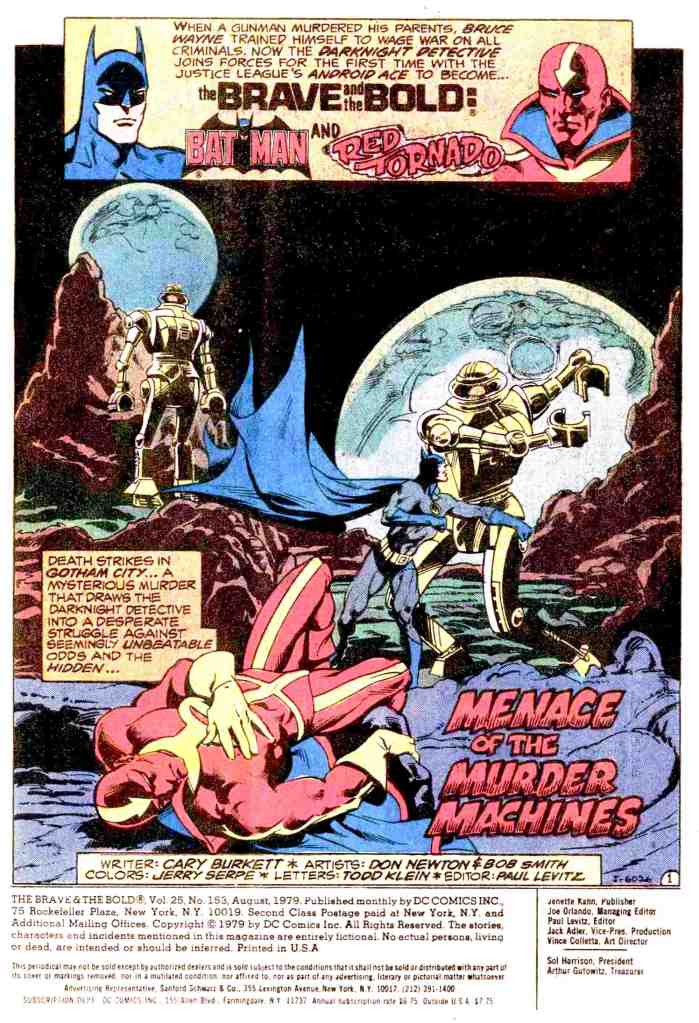
This particular issue, however, wasn’t produced by the typical creative team, but what I must assume was a fill-in squad–either scheduled or pulled from emergency inventory. This meant that one of the great strengths of the title, the always-excellent artwork of artist Jim Aparo, wasn’t in place this time. However, if you needed somebody to fill in for Aparo, you really couldn’t have done much better than Don Newton. Newton is one of those artists who might have become a bigger deal had he lived longer–he passed away at a relatively young age in the early 1980s, missing out on the expansion of the Direct Market. He’d been a longtime contributor to fanzines who had eventually broken in and made good–by following Aparo on Charlton’s PHANTOM comic, ironically enough. So his work was a welcome sight here. It always struck me as having a bit of the flavor of Gene Colan in terms of the construction of his figures and the manner in which he used lighting, but with a bit more control and refinement than Gene’s looser, more impressionistic approach. This made him a good artist for Batman.
The writer on this issue was also different. Cary Burkett kicked around at DC for a number of years in the late 1970s and early 1980s before shifting careers to become a radio broadcaster. He’s probably best remembered for creating the Nemesis series with Dan Spiegel that became a back-up in BRAVE AND THE BOLD a year or two down the line. I must confess that his work didn’t make a strong impression on me, so I remember him as a competent craftsman but not somebody who really stood out from the pack. And this story underscores that fact. It’s a fine potboiler, but isn’t especially memorable–which is to say I once again here didn’t remember much about it before cracking open the book again for this write-up, despite having read it again not that long ago when it was reprinted in one of those DC FINEST collections.
Batman’s team-up partner this time was the Red Tornado, a character that I liked from his appearances in JUSTICE LEAGUE OF AMERICA but who had an odd path to creation. The original Red Tornado of the 1940s was introduced in the Scribbly strip appearing in ALL_AMERICAN COMICS which was written and illustrated by DC editor Sheldon Mayer. That Red Tornado was overtly a comedic character, a pastiche of the mystery men who were then filling the pages of comic books left and right. That Tornado was Ma Hunkle, the mother of one of Scribbly’s neighbor friends, who wound up sewing together a makeshift costume to bail the kids out when they got into trouble, and then kept on doing so. For some reason, in the 1960s, writer Gardner Fox in his last JUSTICE LEAGUE story introduced a new iteration of the Red Tornado. This one was a faceless android who attempted to join the Justice Society so as to destroy it from within. But he’d broken his creator’s control and become his own person–though he was typically characterized as being underconfident and almost childlike in his demeanor, this despite possessing a computerized analytical brain. While he was beset with similar woes as his Marvel counterpart the Vision about his lack of humanity, Reddy was somehow less sophisticated in his longing for understanding of the human condition.
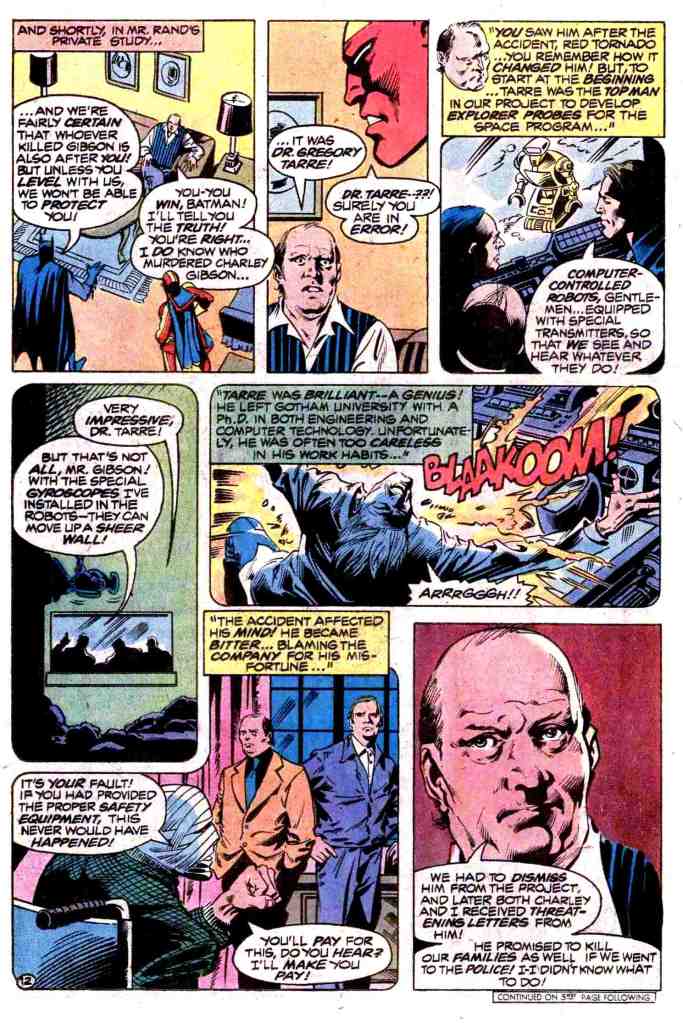
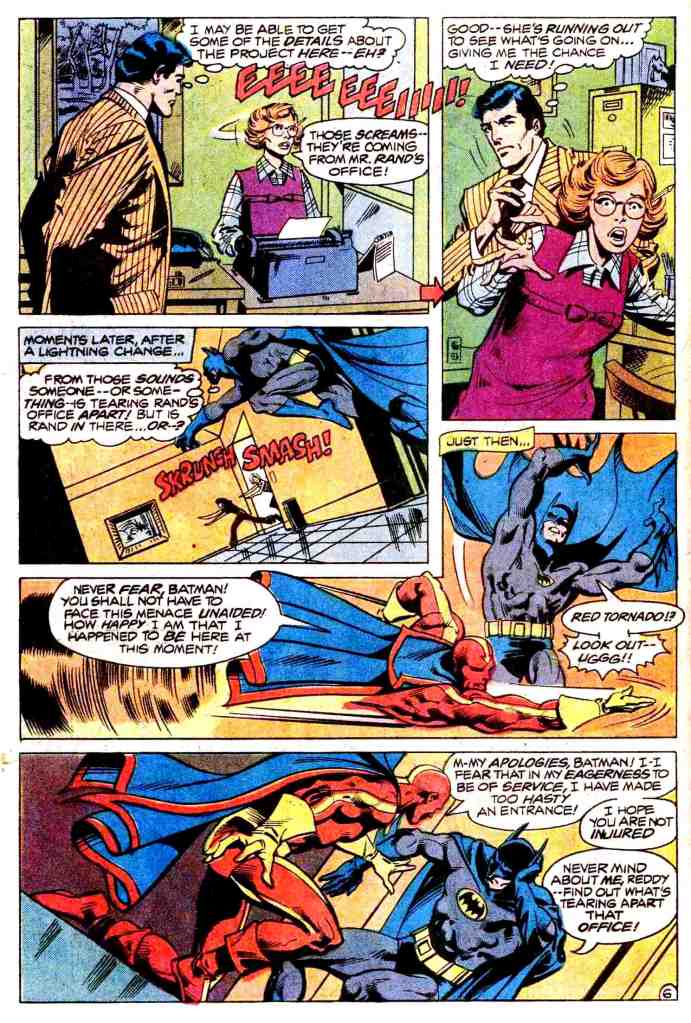
The story opens with Batman being summoned to the scene of a murder by Commissioner Gordon. The victim was apparently killed by something mechanical and inhuman twenty stories up. Ata a charity event that evening, Bruce Wayne notices that the dead man’s partner seems ill at ease, and so he follows the man back to his offices–only to wind up colliding with the Red Tornado as the two crime-fighters race to the rescue upon hearing the partner’s office being torn up by something. Reddy was often depicted as being a bit over-eager and clumsy, and here he berates himself inwardly for getting in the Caped Crusader’s way. The pair finds a group of robots tossing the office, but they’re unable to prevent the mechanoids from carrying out their task. The heroes head out to the partner’s home where he’s lying low, and the man tells them that he’s sure that the person targeting them is Dr. Gregory Tarre, who had been horribly injured in an accident while working on the firm’s space program. Tarre would also occasionally perform maintenance on the Red Tornado when his systems required it, and it’s concerning to Reddy that he has no memory of his reported most recent encounter with Tarre–indicating that his memory banks had been erased of the encounter.
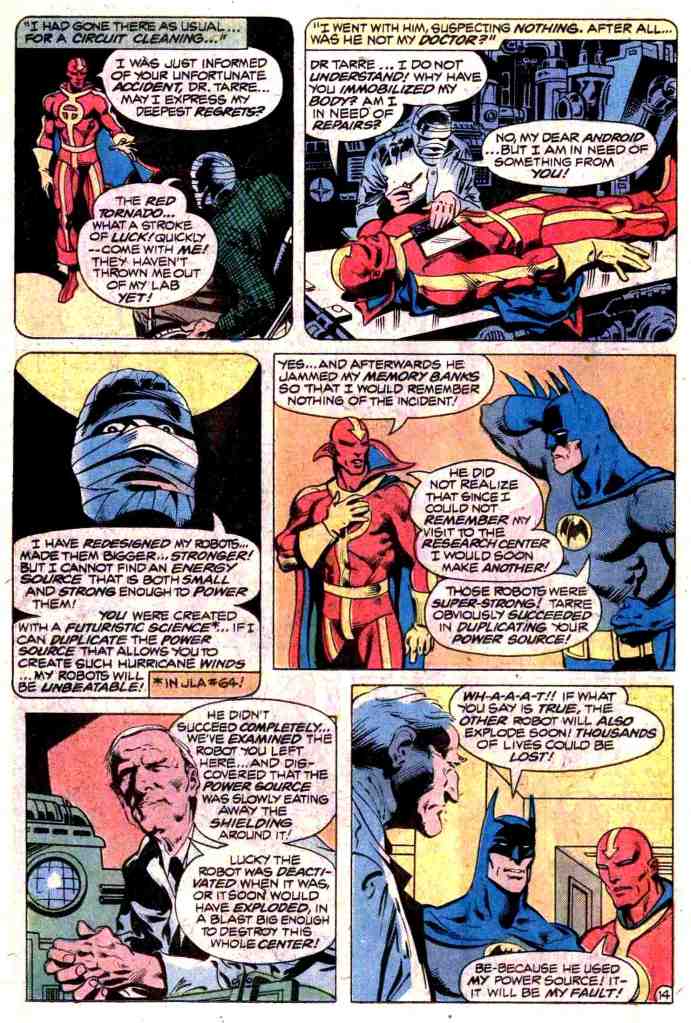
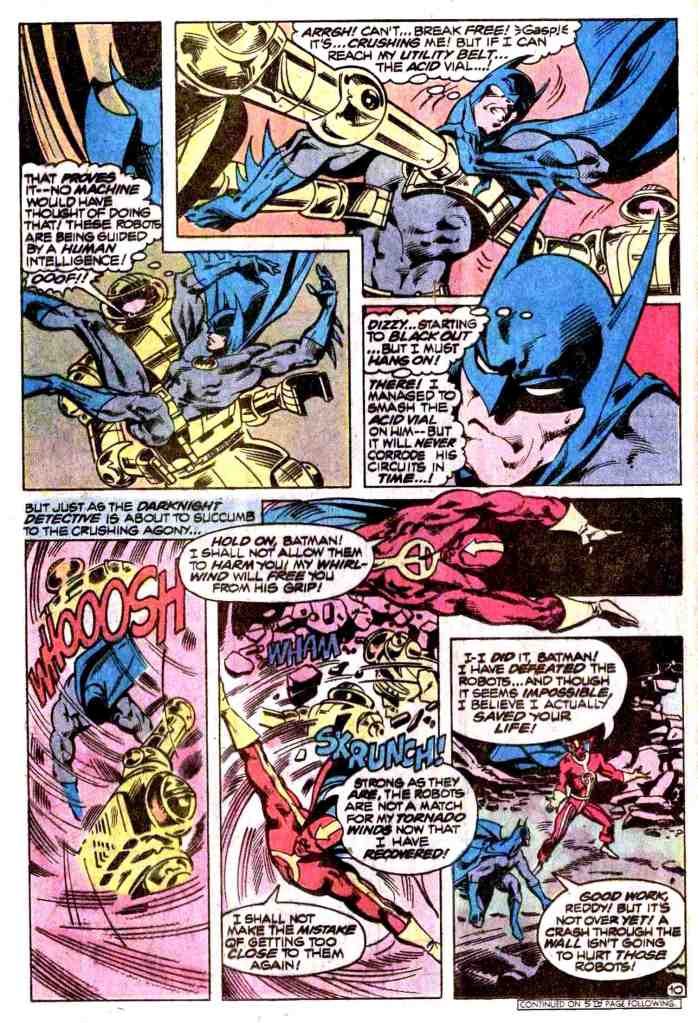
Fortunately, the scientists at the firm are able to unlock Reddy’s mental block, and he suddenly recalls that during their last visit, Tarre had analyzed and duplicated his android power source to energize his robot assassin. But Tarre has done a botched job of it, and one of the scientists informs our heroes that if the robots are permitted to run for too long, they’ll explode violently. This lends a ticking clock to their efforts to locate tarre and stop his plans for revenge. Even with his computer mind and perfect recall, the Red Tornado can’t work out where Tarre is likely to be holed up–but Batman, with his detective’s instincts, reasons that with the main lab denied to him, Tarre would likely default to his previous digs at Gotham University.
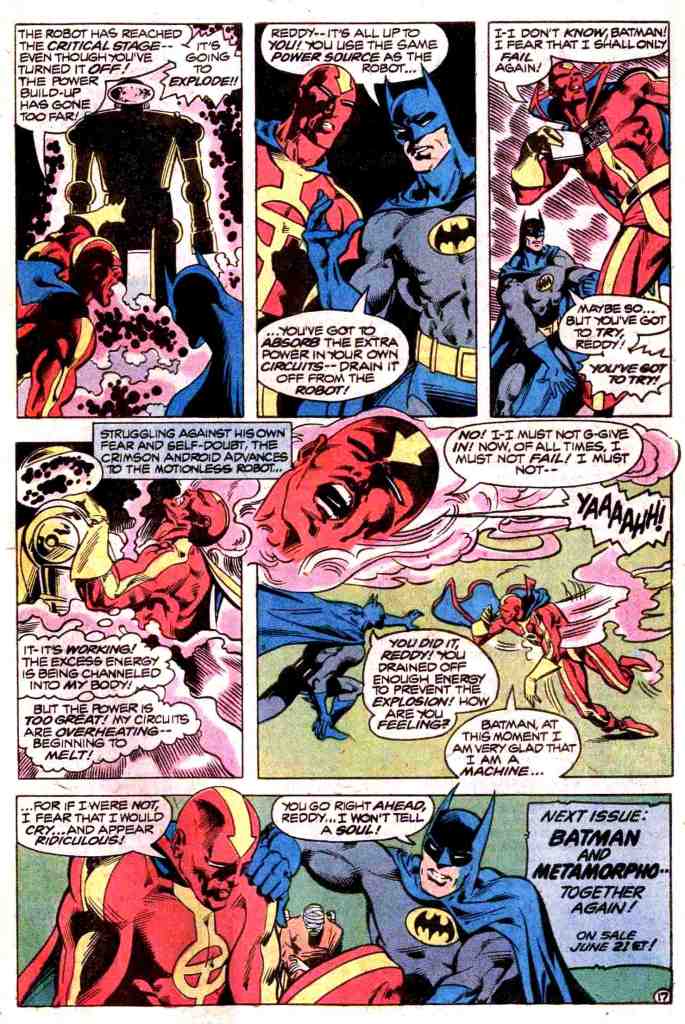
Batman’s hunch is correct, of course, and the Masked Manhunter is able to overpower the wheelchair-bound scientist and switch his robotic killer off. But too much time has gone by and the robot’s systems are about to explode. It falls to the Red Tornado to draw off the excess energy of the power source into his own android body. Which he does. And so the case is closed, in a bit of an anticlimax to be honest.
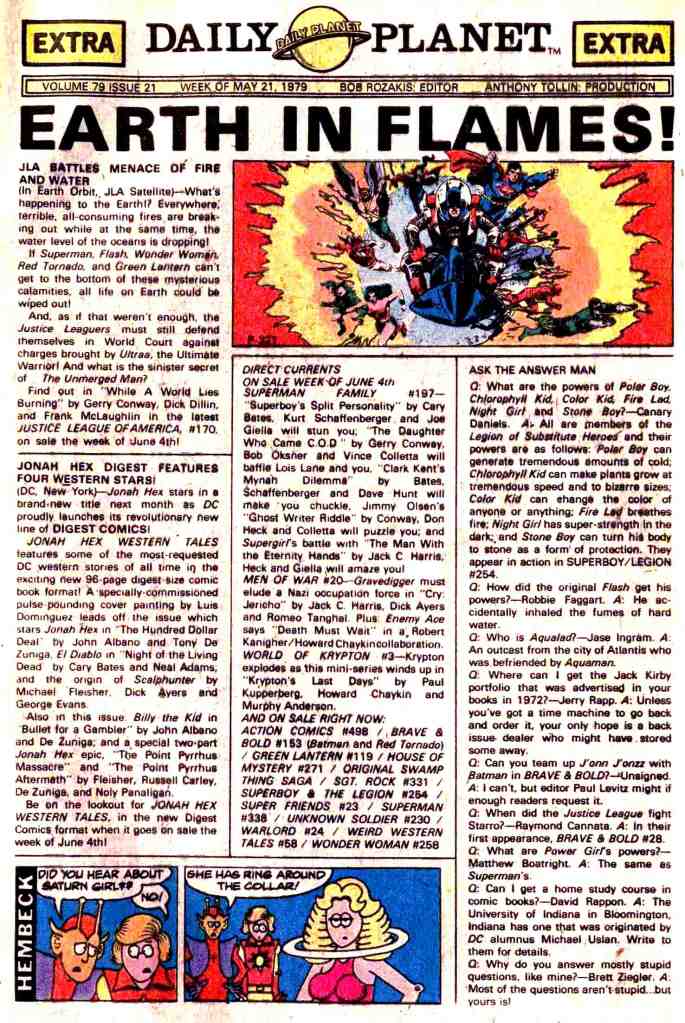
This issue also included the week’s new edition of the Daily Planet promotional page, which as always incorporated a dopey cartoon strip by Fred Hembeck as well as Bob Rozakis’ popular Ask the Answer Man column. I inevitably found this page to be charming as a reader, and when it was eventually discontinued, I was a bit saddened.
 The Tom Brevoort Experience
I missed the Planet page mostly for the Hembeck spot and a little bit for the Answer Man. Rozakis might have been the best at eight page stories but choosing (or creating) questions to be answered he was more hit and miss. A miss definitely was Burkett’s characterization of Reddy. Here we have a cover and interiors by two of the few artists to make that eyesore of a costume palatable and it was all in service of making the character more fumbling and insecure than any JLA issue he appeared in!
LikeLiked by 2 people
I don’t know about that — Red Tornado screwing up and then having to redeem himself was a frequently-used trope in JLA as well. One of the reasons I never warmed up to the character.
LikeLike
Maybe it just seems worse when it’s two heroes instead of a league of them.
LikeLiked by 1 person
If not for the death of Don Newton we might not have gotten Todd McFarlane. Newton took over Infinity Inc. but only completed one issue (#13) before he died with McFarland stepping in for #14.
LikeLike
As someone who was turned off by McFarlane’s ‘art’ on Infinity, that just adds to the tragedy of Don Newton’s passing.
LikeLiked by 3 people
For me, Infinity was the last time I liked his art.
LikeLiked by 1 person
Can’t remember where I put my copy of FantaCo’s Chronicles#4 but I remember it also pointing out similarities between the second Red Tornado & second Vision: Both named after golden age heroes and both being other characters ( Tornado Champion & original Human Torch+ Wonder Man’s brain patterns ) before their current hero identities and both being “androids”. Plus JLA/Avengers similarities. But unlike the Vision back then DC Comics had a habit of damaging or destroying the Red Tornado [ JLoA#109 ( February 1974 ) damaged in explosion ][ JLoA#110 ( March 1974 ) apparently killedin one of the Key’s snares but is saved by the Phantom Stranger ][ JLoA#118( May 1975 ) severely damaged by the Adaptoids ][ JLoA#128 ( March 1976 ) apparently killed again — see his Wikipedia ]. I’m sure that George Perez ( or maybe George was copying other artists ) changed that opening in his chest to a circle.
LikeLiked by 2 people
I get for the sake of the story why Dr. Tarre was created to do maintenance on the Red Tornado, but you would think for security reasons that the Justice League of America would have had Dr. Will Magnus ( the creator of the Metal Men ) do it or Superman ( who is known for creating Superman, Clark Kent Robots; plus I think Perry, Lois & Jimmy robots too ) or the Batman ( who has created at least 1 Batman Robot – Detective Comics#224 ( October 1955 – The Batman Machine ), Batman#109( August 1957 –Three Crimes Against Batman ), Detective Comics#258 ( August 1958 –Prisoners of the Giant Robots! ), Detective Comics#261 ( November 1958 ),DC#281( July 1960 – Batman, Robot! –Batman Robot intro – comics.org ), DC#284 ( October 1960 – The Negative Batman –Batman robot ), and DC#290 ( April 1961 — Robin robot ) )–Facebook ( Batman uses robots in comic books ). the Chief ( Dr. Niles Caulder ) [ The Doom Patrol#121 ( September-October 1968 ) ] was already dead with most of the Doom Patrol, so they couldn’t ask him.
LikeLiked by 1 person
Great point on Magnus. If I recall correctly, Will WAS brought in during an issue of “CoIE” by Wolfman and Perez to troubleshoot on Red Tornado.
LikeLike
Don Newton was one of the most underrated artists of his era. I wish he got more notice these days. His Batman and Shazam work was terrific (although the stories themselves that he illustrated weren’t to my taste). I’ve also always had a soft spot for Red Tornado even though no one ever made him all that interesting as a character.
LikeLiked by 1 person
Todd Klein has been listing the logos he created over the years, over on his blog, and he was rather hard on himself for the one used here:
This is high on my list of least favorite logos. Created for DC COMICS PRESENTS #7. As I recall it was needed quickly, and I didn’t spend much time on it. The letters are uneven and poorly shaped, and the tornado around it looks like it was done with a brush and is not convincing.
(“My Logos A-Z: Rainbow to Robo“)
LikeLiked by 1 person
Thanks for this. I never knew who did those logos on the opening pages. So it was the letterer of the individual issue? Wow. And some they designed themselves, if there wasn’t already an official one in use, like Superman’s? Batman has had so many. Even at the same time, different for “Batman” & “Detective Comics”. Maybe the choice was up to the letterer? Because this Batman logo wasn’t in a later issue, B&B # 156.
Todd’s one of the greats. This Red Tornado logo seems more appropriate for a kid’s gang (well under 18 years old).
LikeLike
If you look around Todd’s blog, he has a great deal about logo design. A lot of DC ones were by Ira Schnapp or Gaspar Saladino, and then later by him.
LikeLiked by 1 person
I wasn’t able to consistently read or collect comics in the late 1970’s. In August 1979 was still only 7 years old (especially if the issue was on sale a few months before the cover date). But I’d get them when I could. Appleton Market outside Elkton, MD (geographically closer to Newark, DE, but still on relatively back or tertiary roads) had them in 3-packs, which is how I had the B&B issues featuring Supergirl, the Unknown Soldier, and the Phantom Stranger.
I missed almost all of Don Newton’s career. Looking back, I’d seen some of his early1980’s “Batman” and “Detective” work (maybe even a couple after he’d died in 1984), heavily inked by an accomplished artist in his own right, Alfredo Alcala. But it was unrecognizable to me as Don Newton’s drawing then, totally overpowered by Alcala, and not really suited to my expectations for what a Batman story should look like. It had a “gothic” or “Baroque”, “horror” element I wouldn’t prefer for every Batman story. Maybe for the Scarecrow. Same for when Alcala inked Gene Colan on the same Bat-books around that same time. And suffocated much of what I’d later come to appreciate about Newton’s own style.
It wasn’t until 1986 or 1987, a few years after I’d moved to DelCo, PA, but before I could drive on my own, when my parents would take me to a rare comic book show. And I’d get to hear comics dealers and professionals muse about Don Newton, who’d died just a few years earlier. He was 50. He’d’ve been 92 this Nov.
In the past 10 years I’ve seen enough of Don’s work to say he’s in my top 10 Batman artists. And I see his possible influence on several artists that came after him. Even in the work of Alan Davis and Norm Breyfogle, to different degrees and sensibilities. They were almost contemporaries in the years they were published, but Don was a bit (20 years?) older than they were.
Probably his best and most frequent inker was Dan Adkins. Clean, clear, and maintained that strong dramatic sense of lighting & shadow that later inkers, like Alcala, seemed to smother in their own distinctive styles. Even the great Joe Rubinstein, who is sometimes cited as a personal fave of Don’s, still left his own strong personal imprint of Don’s work that looked slightly more different than if Don had inked it himself. Adkins was much more faithful to Don’s drawings.
As was Bob Smith, who as far as I know, only inked Don on this B&B # 153 and B&B #156 (Batman & Dr. Fate); an Aquaman story in “Adventure” # 464 (some excellent headshots of the Sea King). And a looser visual rendition on Captain Marvel in “World’s Finest” # 267. I might still give Dan Adkins the slight edge over Bob Smith’s inks. But Bob’s are a close 2nd place as being my fave for inking Don Newton’s work. Bob had a light touch, that seemed to let the pencils shine through as they were. This could work both in favor or against the drawings, as Bob wasn’t as much of an embellisher as Rubinstein or Klaus Janson. So, if it wasn’t already in the pencil drawings, it wasn’t likely to appear in Bob’s inks.
But I think Bob’s style meshed almost perfectly with Don’s naturalistic but still dynamic style. The lighting on the faces and figures, especially. Delineations of shadowed details. Subtle and graceful, just like Don’s drawings.
Cary was a pretty capable writer. This issue read as a bit clumsier than many of his others. The Supergirl of B&B vs. Dr. Light issue was well-done. As were other B&B’s and some “World’s Finest”, a couple drawn by Trevor Von Eeden. I’d rank Cary’s work above David Reed’s, but maybe not as enjoyable as Bob Rozakis’s.
Don Newton would return to B&B in # 156, as I said with Bob Smith, and also writer Cary Burkett and very fine colorist Jerry Serpe.; this time with another lettering ace, Ben Oda. Then again for a Man-Bat story in B&B # 165, written by the perennial Marty Pasko, inked by the excellent Dan Adkins, colored by the elegant Adrienne Roy, and again lettered by Mr. Ben Oda. Both issues edited by Paul Levitz, who edited # 153, too.
Don would also draw “DC Comics Presents” # 54 towards the end of 1982, but cover dated February 1984. Written by Paul Kupperberg on the upward part of his career, well-inked by Dan Adkins, generously colored by 80’s mainstay Gene D’Angelo, and lettered by another legend, John Costanza (not to be confused with the often-cantankerous George on “Seinfeld”). 😉 And edited by a guy almost synonymous with DC Comics and Superman for decades, Julius Schwartz. That issue looked really good. The billed co-star was Green Arrow, but Black Canary also appeared in 2 scenes over 4 consecutive pages.
Looking back, I’d’ve had Don drawing one of the Superman titles years before DC decided to shake them up, and move the decades’ old art team elsewhere. Don and Bob Hall, on different titles. But the fact that it took until after Don’s untimely passing (totally unrelated, obviously) shows that DC just wasn’t ready to make those changes until when they actually did it. And the monumental shift they made with “CoIE”.
LikeLike
Nope, I meant to type that the DCCP # 54 was cover dated 1983.
LikeLike
That Hembeck is one of the best I’ve seen of his. Had to smile at it.
LikeLike
Damn, if I knew Newton died that young, I forgot it. What a loss.
When I read Reddy’s debut in the late Silver Age I was just starting to realize how lonely I felt and therefore identified instantly with him. Been a fan ever since.
LikeLiked by 1 person
He’d only been in the industry professionally maybe 8 or 9 years. As Tom said, he missed the success of the Direct Market. He’d have been an even more respected and better known name. His work would’ve reached a much larger audience.
LikeLike
And he deserved too.
LikeLiked by 1 person