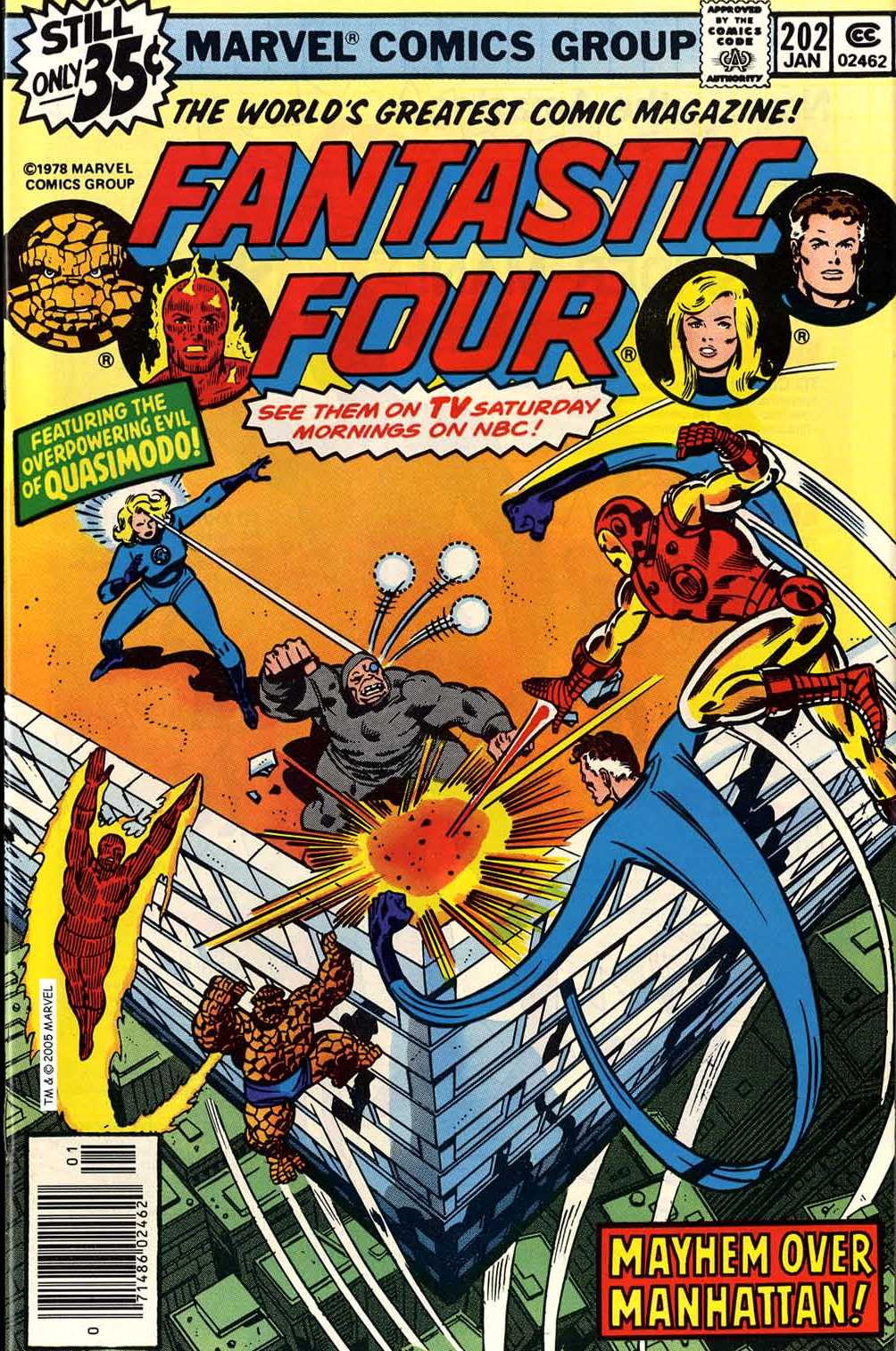


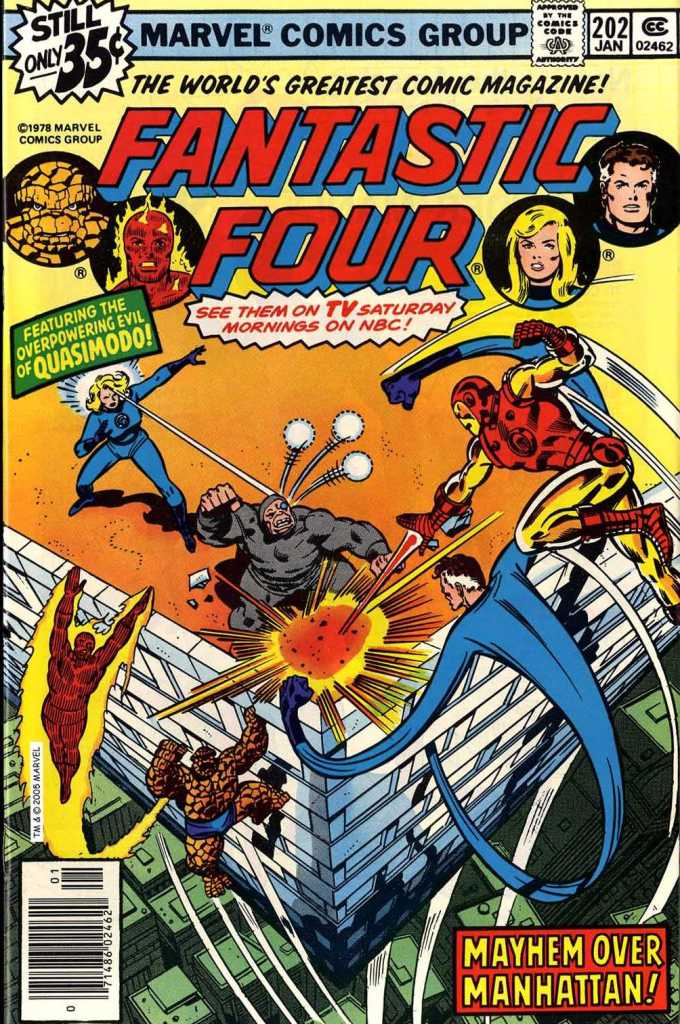
The next week, a new issue of FANTASTIC FOUR was released, thus reassuring me that my having missed the much-coveted issue #200 was a fluke. This was during the period when a new Fantastic Four cartoon series was running on NBC on Saturday Mornings–this was the version that replaced the Human Torch with HERBIE the Robot, and which was storyboarded largely by Jack Kirby and dialogued by Stan Lee and Roy Thomas and other Marvel writers. It was, to put things frankly, a bit of a dog, with lousy animation and pedestrian scripts. But of course, I was an avid viewer. In 1978, there wasn’t enough super hero and science fiction content available to be all that picky. Anyway, the show gets cover-blurbed here in an attempt to capture any new readers who may have seen it. Strangely to my eye, the fact that Iron Man guest-stars in this story isn’t mentioned at all (though he is depicted in the image, of course.) This seems like a violation of the Marvel policy of the era.
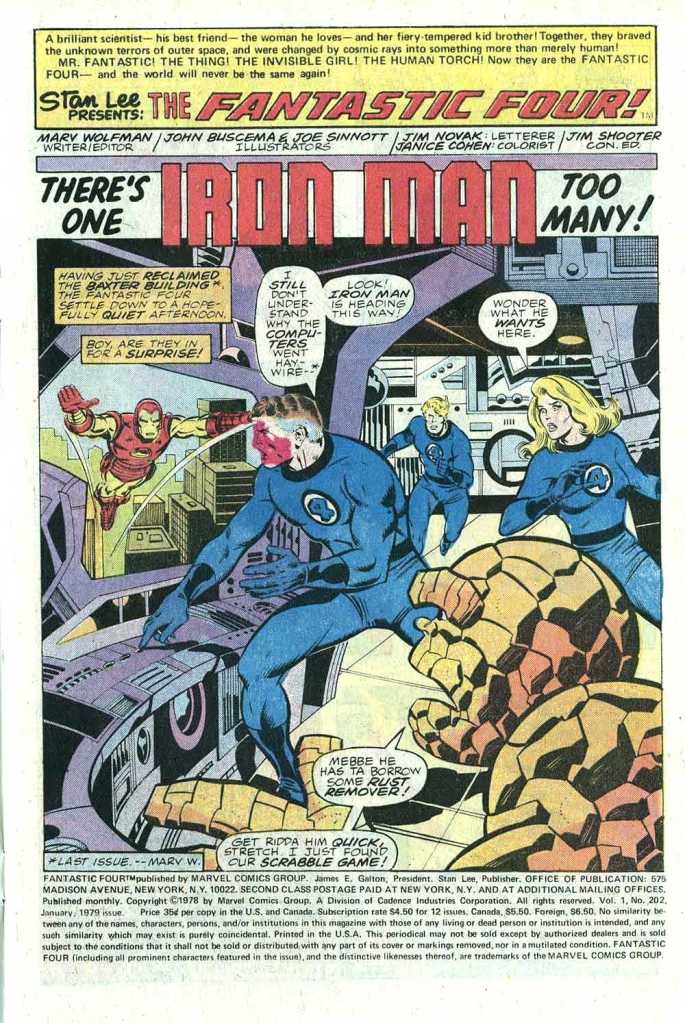
Marvel stalwart John Buscema filled in on the art for this issue, no doubt giving regular penciler Keith Pollard time to recover after the oversized #200. John had drawn the book off-and-on throughout much of the 1970s, so his versions of the characters were spot-on model–and kept even more so by the embellishment of longtime FF inker Joe Sinnott. It’s a nice-looking issue for an artistic fill-in. But the story’s a bit of a dud, a trend that would plague writer Marv Wolfman’s output on the series post issue #200. Still, it was better than HERBIE the Robot, and as a young reader of eleven years, I didn’t really notice much of a difference. So long as you gave me the characters doing cool stuff, I was good.
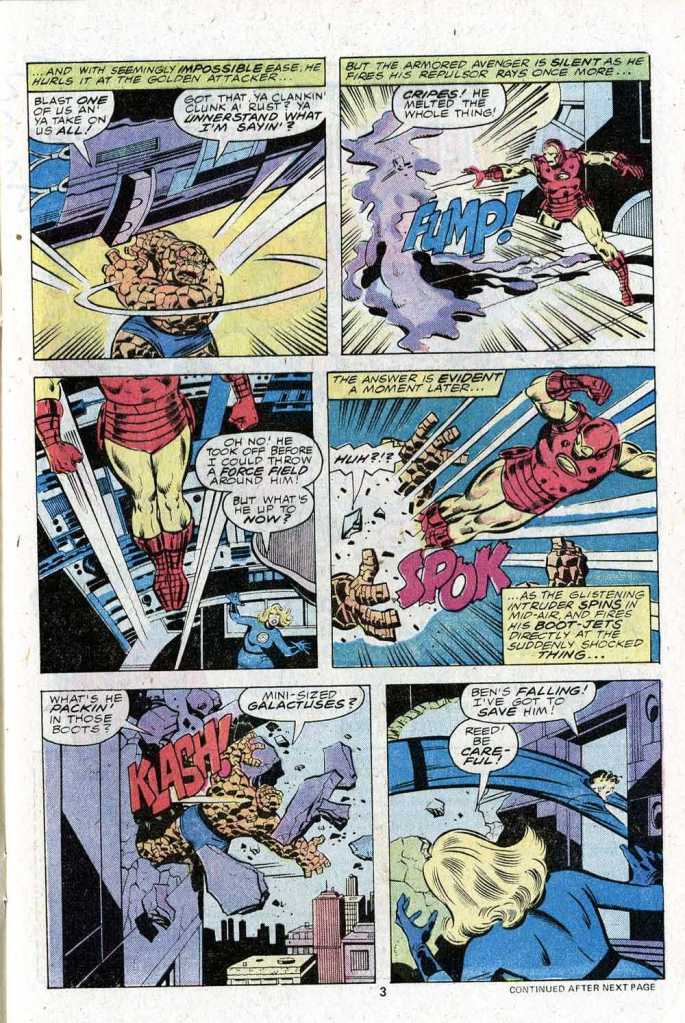
The story opens with the Fantastic Four still puzzling about who turned their Baxter Building headquarters against them when the moment is broken by an alert: for some reason, Iron Man is on an approach vector towards the FF’s location. This shouldn’t be any cause for great alarm, but it becomes one when Shell-Head silently smashes his way into the building and begins to attack it inhabitants. It has to be said that it’s a bit of a shame that John Buscema never drew Iron Man much outside of the pages of AVENGERS, as his version is sleek and powerful and probably just exactly what that series would have needed in the 1970s to pop better. The FF are surprised by Iron Man’s sneak attack, which maybe partially explains why they fare so poorly against him.
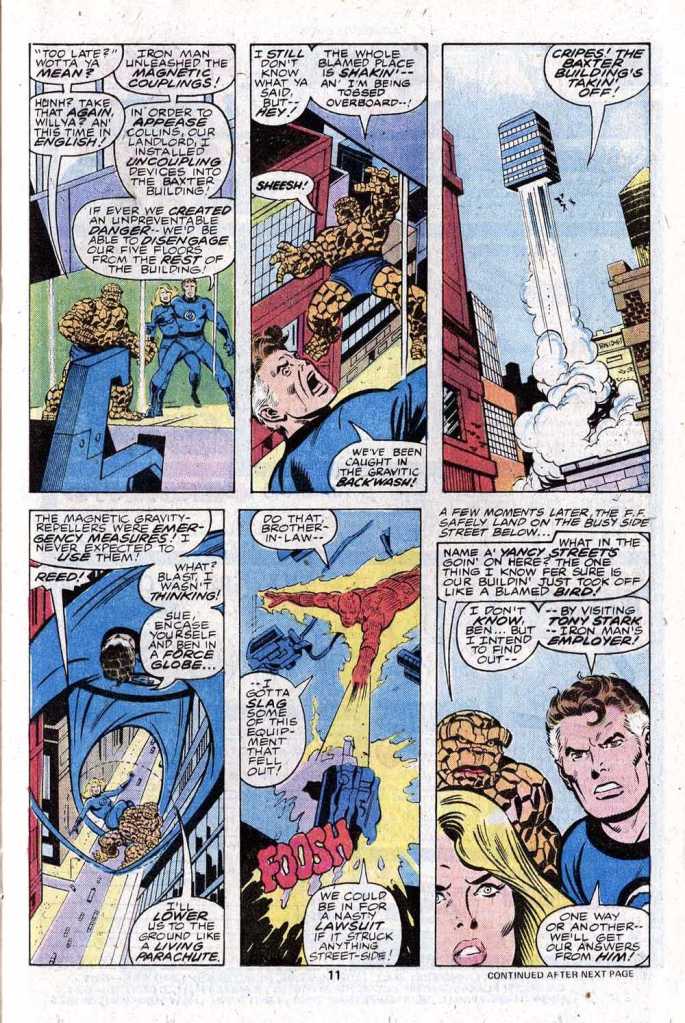
The fight goes on for a number of pages that look like they came right out of John’s textbook HOW TO DRAW COMICS THE MARVEL WAY. Eventually, though, after knocking the Thing out of the structure, Iron Man is able to pull a lever, revealing what is perhaps the silliest aspect of this new version of the Baxter Building: it’s set up so that, in times of crisis, the upper floors that house the Fantastic Four’s home and headquarters can be separated from the rest of the building and shot off into space. As the defeated FF look on, their home goes sailing away from them to parts unknown. But Reed and company know where to begin looking for it: they intend to pay Tony Stark a visit.
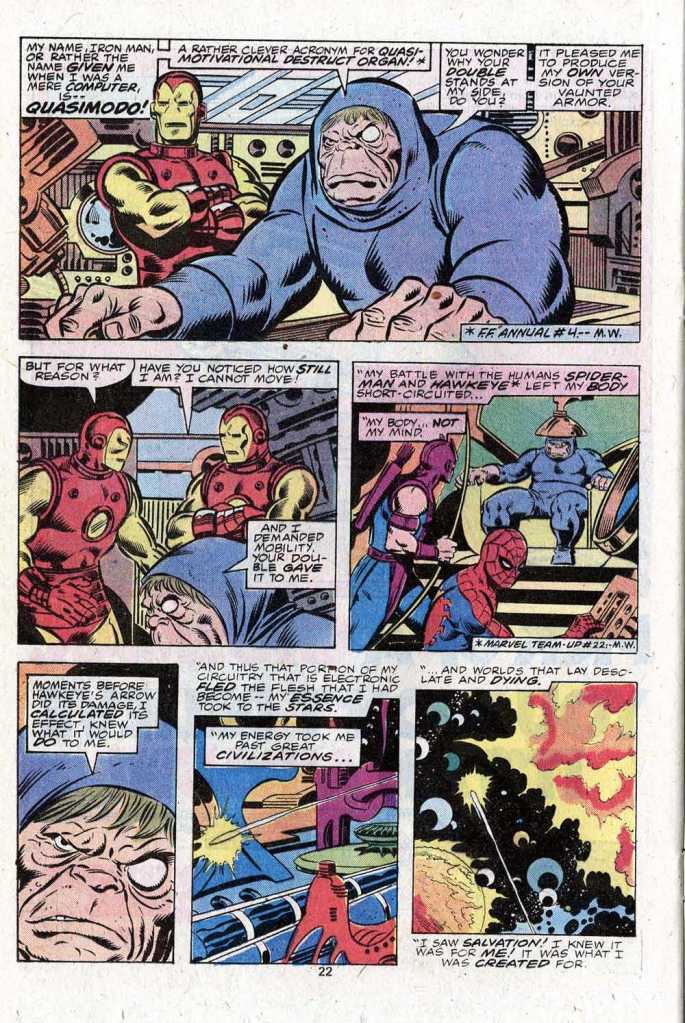
Fortunately, the seemingly-obligatory battle between Iron Man and the Fantastic Four doesn’t happen, as they are ready to believe the Armored Avenger’s story that he was with Tony Stark all day. Nonetheless, Shell-Head chooses to accompany the team as they seek out their stolen building. Using a Proton Tracer to lock on to certain equipment in his lab, Reed is able to follow the trail to a remote island. Throwing caution to the wind, the Thing barrels ahead and right through the outer walls of the Baxter Building, heedless of the warning that the perpetrator will be able to turn all of their security devices against them. That doesn’t happen, though, and the quintet is able to reach the location where the thief is situated. It’s Quasimodo, the Quasi-Motivational Destruct Organ created by the Mad Thinker and given life by the Silver Surfer. And before the inevitable fight breaks out, Quasi is happy to explain to the FF just why he’s stolen their headquarters.
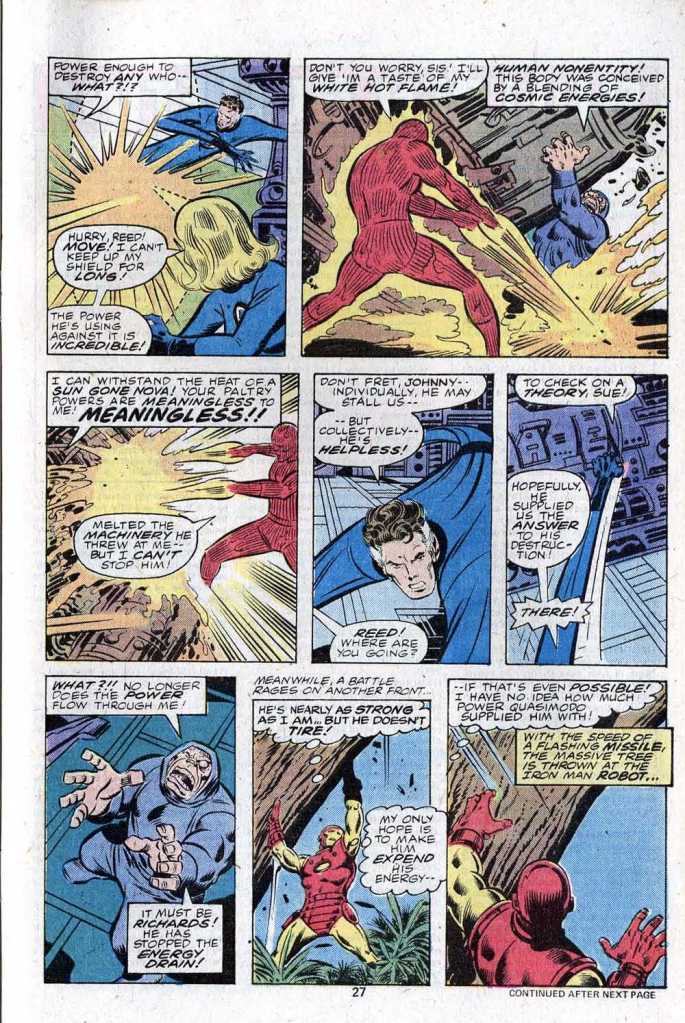
Having been physically paralyzed at the end of a recent bout with Spider-Man and Hawkeye, Quasimodo’s mind was unaffected, and it searched the skies above. There, it detected a far-off world that seemed like a perfect place for him–Marv never comes out and says this directly, but the inference is that this is Xandar, the homeworld of the Nova Corps that the FF will shortly be visiting themselves. Quasimodo wants to reach that world, and he’s detected a starship in orbit around the planet with the same energy signature to it–this would be Nova’s spaceship, which would be taking off for Xandar in another issue of the Human Rocket’s own series. In order to reach it, Quasi needs a rocket like the one the FF have–and in order to get it, he somehow built a duplicate of Iron Man’s armor to function as a servitor. Why Iron Man when he has never encountered the Armored Avenger before is something of a mystery. Anyway, with the plot explained, the two Iron Men hurl themselves at one another while the FF attempt to tackle their old foe.
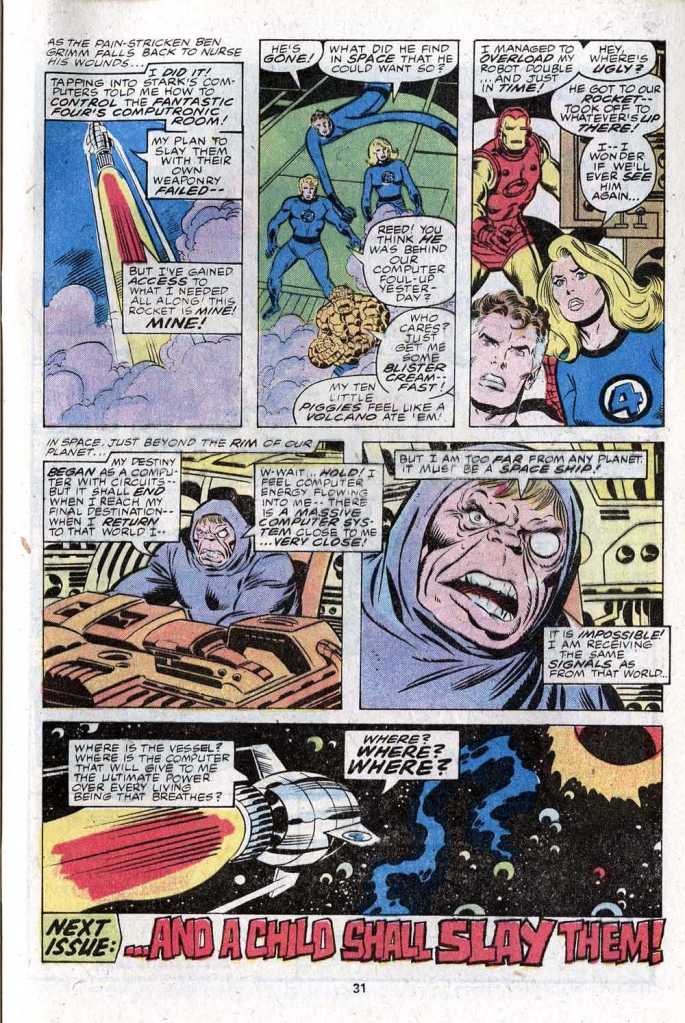
Iron Man is overmatched by his duplicate, who has greater stores of power than he does. So he makes the obvious choice: he feeds his own armor’s power reserves into the bogus Iron Man in the hopes of overloading it–as, indeed, it does. Elsewhere, the FF wage another losing battle against Quasimodo–they were not covering themselves in glory this issue–who is able to escape them and make his way to their rocket launch bay. Despite teh Thing’s best efforts to hold the space ship back by hand, Quasimodo gets away. But as we follow him into space, the signature of the spaceship that he had detected has vanished–an event that tied loosely into what would be to come in NOVA #24. But Marv doesn’t really give the readers any indication of this, and so they whole wrap-up here is a bit inscrutable and unsatisfying. It feels as though this is going to be followed up on somewhere, but it never really is, not Quasimodo’s part in it anyway. Perhaps Marv would have gotten back to him if NOVA had continued on as a series, but it was on the verge of cancellation at this point.
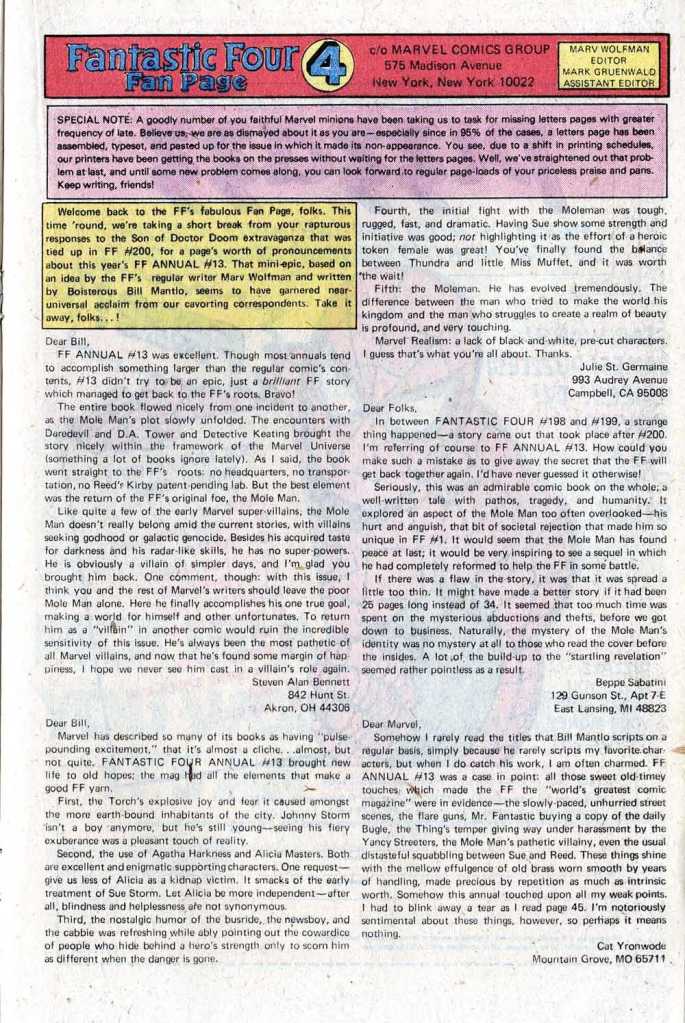
And the Fantastic Four Fan Page this time out includes a letter from Cat Yronwode, soon to be the head editor at independent publisher Eclipse Comics as well as a chronicler of the works of Will Eisner. Seems that she liked the recent FANTASTIC FOUR ANNUAL that we talked about here:


The building becoming a rocket is silly, but 10 year old me thought it was absolutely awesome.
LikeLiked by 1 person
And Beppe Sabatini! He was another lettercol regular … wonder what happened to him?
LikeLike
He’s a software engineer and photographer in San Francisco.
LikeLiked by 2 people
This always struck me as a bad cover, and not just because they didn’t make a fuss about Iron Man.
It’s nicely drawn, or course, but it’s five superheroes attacking a little gray guy who doesn’t appear to be doing anything to deserve it. It seems mean.
It needs different cover copy. Maybe something like:
QUASI: I’ve stolen your HEADQUARTERS, fools!
QUASI: And you can do NOTHING to stop me!
REED: We’ll see about THAT, Quasimodo!
Something to say — hey, this little role-poly gray guy is an actual threat.
kdb
LikeLiked by 1 person
Would our heroes attack if he weren’t a threat? Uh, strike that. 😉 Are they doppeldumplingangers? 😉 (Don Knotts as Mr. Fantastic.) Maybe readers would see this & be more compelled to find out why their heroes are attacking this lone figure, w/o any explanation on the cover.
LikeLike
Do we have any idea how low the sales of NOVA were to merit cancellation?
LikeLike
Do we have any idea how low the sales of NOVA were to merit cancellatio
LikeLike
Do we have any idea how low the sales of NOVA were to merit cancellation?
LikeLike
Nova’s sales were never publicly reported. In between Martin Goodman’s sale of the company in 1968 and Jim Shooter’s ascension to editor-in-chief a decade later, USPS Statement of Ownership affidavits for the titles that debuted during those ten years were not filed. (The affidavits included the average print-run and sales for a series issue during the relevant sales-year.) But looking at other indicators, I’d say the sales fell below 100,000 copies an issue. With the 17th issue, the series shifted from monthly to bimonthly, which at the time was generally a sign of sales declining below a certain threshold. It was cancelled in early 1979 during a time when the Marvel line contracted by about 20 percent. After Shooter took over editorial, Marvel began filing the USPS forms for every ongoing non-reprint newsstand title they published. The titles that weren’t dropped all sold above 100,000 copies an issue.
LikeLike
Tom, Quasimodo’s part is followed up in flashback [ Nova/The Man Called Nova#25 ( May 1979 )]. He provides ( the FF’s ship ) the Sphinx the help he needed to escape ( a small moon ) from his exile in space [ Fantastic Four Annual#12 ( February 1978 ) ].
LikeLike