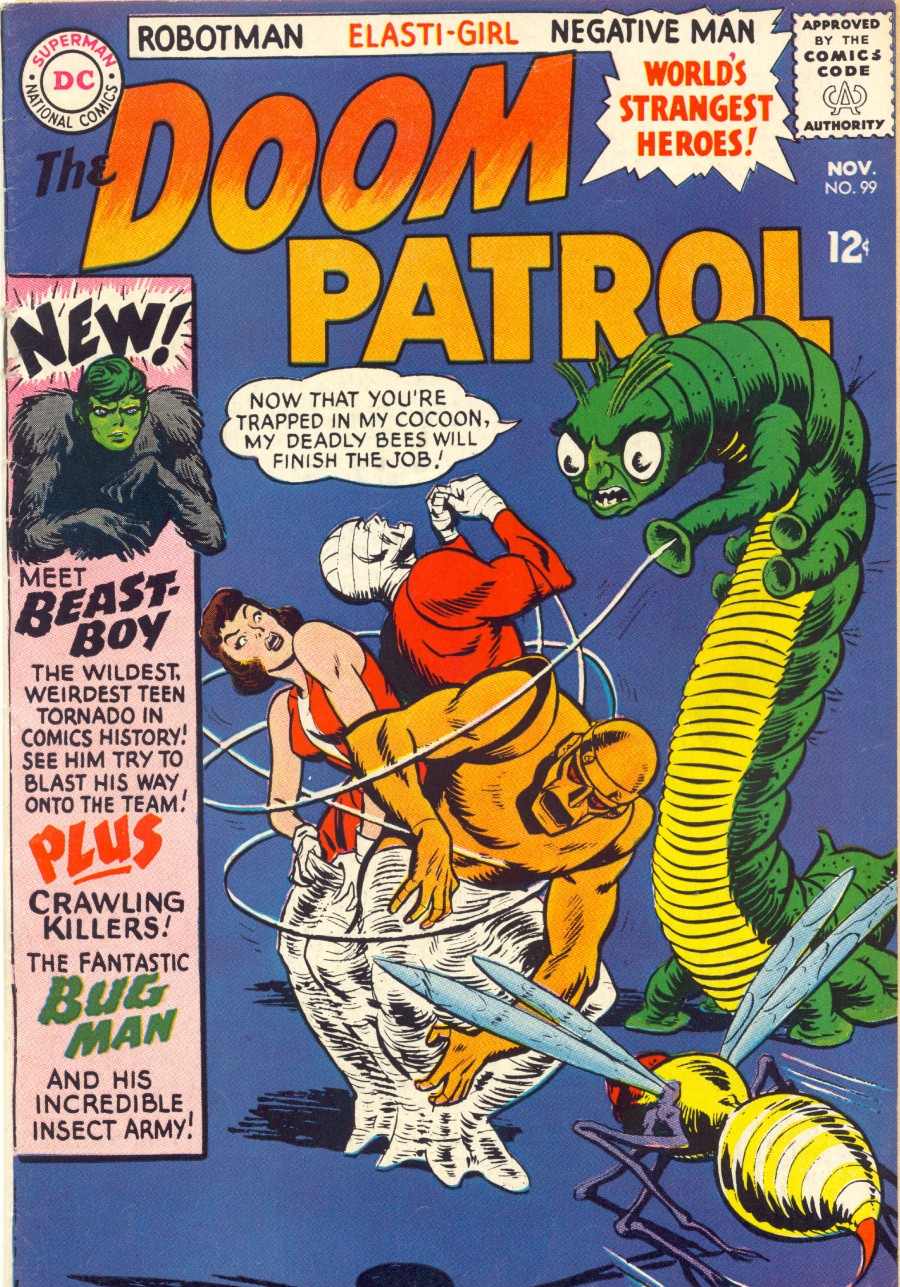


This issue of DOOM PATROL was another that I purchased at Ed’s Coins and Stamps in the Sun-Vet Mall on a Saturday when my grandparents had taken me there. Ed had a big chunk of DOOM PATROL back issues, a group that I was fascinated by, and so I had started by buying #100 and working my way forward. On this trip, however, I chose to also start going backwards, for reasons that will eventually make themselves clear. This particular issue is noteworthy in that it features the first appearance of Garfield Logan, Beast Boy. In just a couple of years, the cost of this issue would skyrocket a bit after the character became a part of the wildly-popular New Teen Titans under the codename Changeling. So I was fortunate to get it when I did.
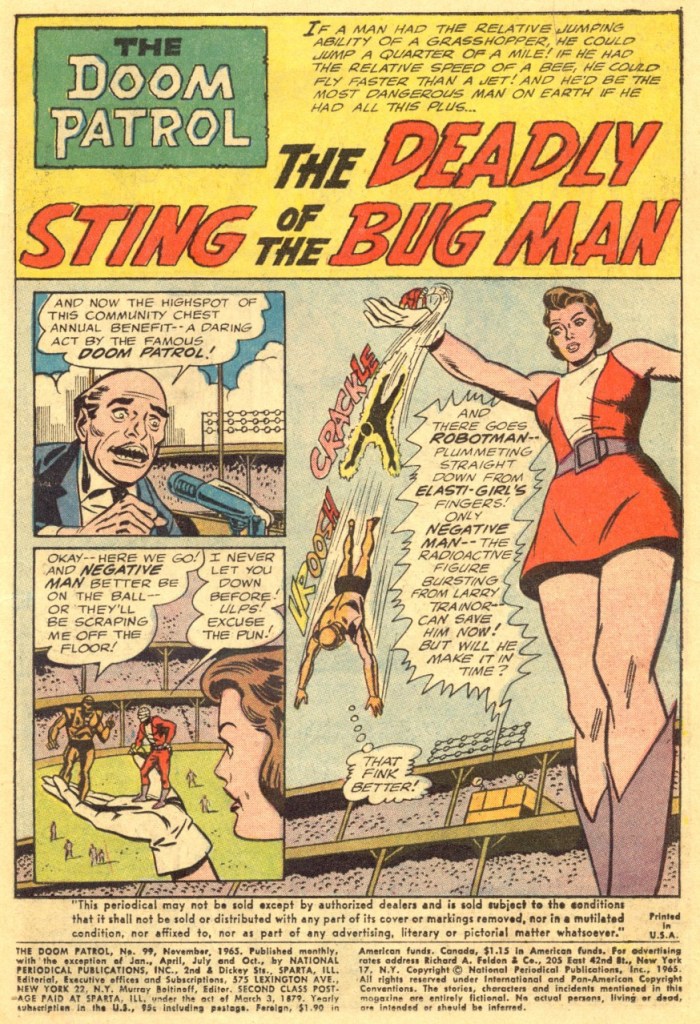
As usual, both stories in this issue were written by Arnold Drake, who had conceived the group as something of a response to the sorts of more character-forward stories he saw Stan Lee building over at rival Marvel. As opposed to the typical DC super heroes, the Doom Patrol members were all reacted to as freaks and oddities, and they suffered from their own individual hang-ups and hardships concerning their powers and place in the world. Regular artist Bruno Premiani wasn’t in evidence this month–I’m not sure why he skipped this issue, whether it was a typical scheduling problem or else something more. But Bob Brown, who was at the time also illustrating CHALLENGERS OF THE UNKNOWN, stepped in for the month to spell him. Brown’s art was straightforward and fine, but it lacked the idiosyncrasies of Premiani’s pages, which at their best lent DOOM PATROL a kind of fever dream reality. This would have been a very different strip if Brown had drawn it regularly.
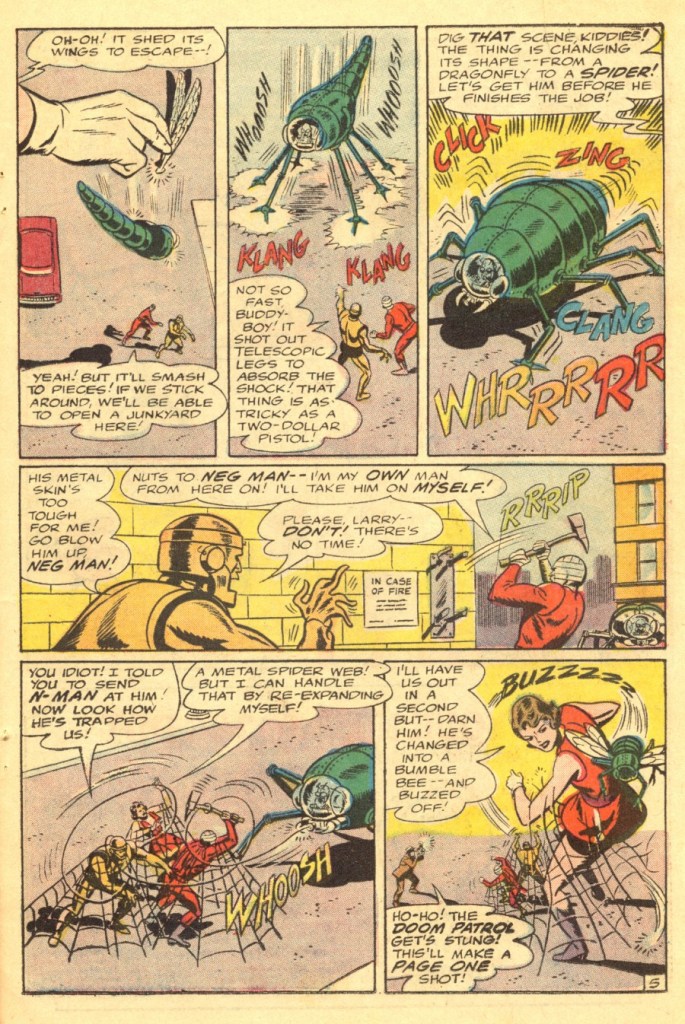
The new villain in this opening story, Bug Man, isn’t really much of anything noteworthy, just another costumed villain who uses robot insects to commit his crimes. The real crux of the story revolves around Larry Trainor, Negative Man. He’s grown jealous of his other self, the radioactive genie that sprints from his body to accomplish awesome feats while Trainor himself collapses to the floor in a limp heap. Trainor is desperate to prove himself, so much so that he refrains from dispatching Negative Man to help Elasti-Girl and Robotman deal with an assault from the Bug Man, resulting in the team getting clobbered. It’s a weird but completely understandable hang-up for Larry to have; he was probably the Silver Age super hero that most people would least like to become.
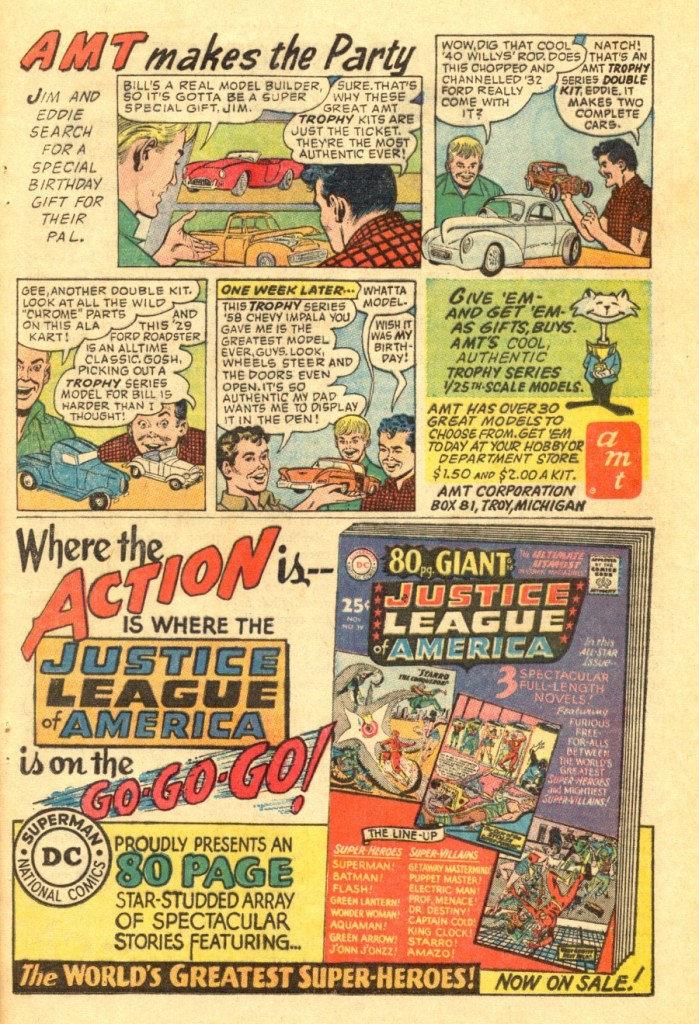
This opener is two chapters long, so at the break point, this half-page ad for an 80 Page reprint issue of JUSTICE LEAGUE OF AMERICA ran. And I instantly wanted it. it would take me years and years before I finally was able to get a copy, and by that point I think I already owned copies of at least two of the stories collected in it in other places. But that didn’t matter–i was still happy to finally get it.
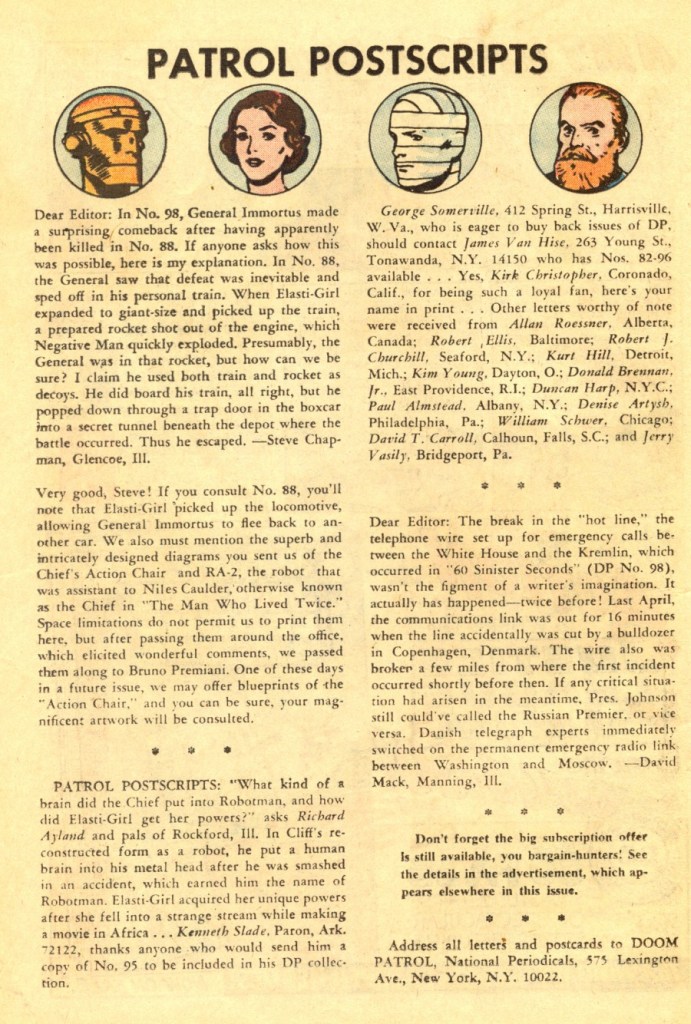
The Patrol Postscripts letters page also runs relatively early in this issue, between the opening and second chapters of the lead story. Editor Murray Boltinoff preferred to run excerpts from a variety of letters rather than do the standard letter/answer style that most other DC editors followed. I wasn’t a huge fan of this approach as a reader–it felt too much like cherry-picking to my younger self. Anyway, among the assorted correspondents here is James Van Hise, who would go on to publish a bunch of books and magazines about comic book history in the years ahead. Here, he’s offering copies of issues #82-96 for sale or trade. Murray featured a regular trading post area in his issues for a time.
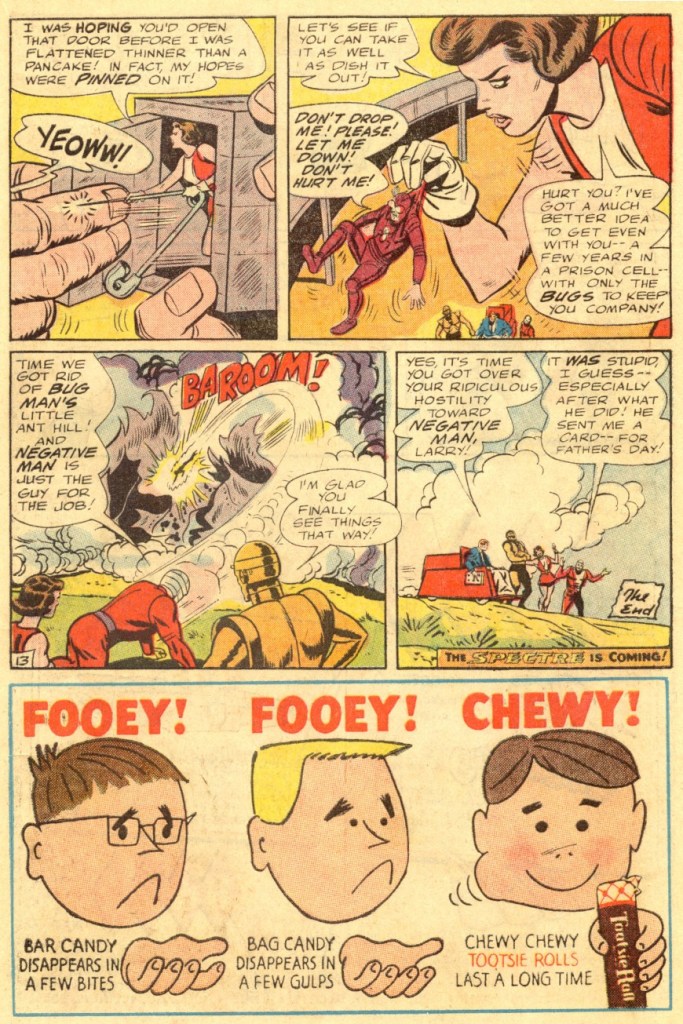
In the end, everything works out fine and Trainor comes to accept Negative Man once more–but not before his reticence causes Elasti-Girl to be captured by the Bug Man and imprisoned in a steadily-shrinking cube that forces her to reduce her size further and further. The Chief is forces to head out in his weapons-laden “action chair” and mount a one-man rescue attempt in response to this development, giving him a rare spotlight as a physical combatant. By the time this issue saw print in 1965, the pendulum was already beginning to swing on DOOM PATROL, shifting it away from pathos and tragedy and more into poppy antics and brash energy. I’ve always felt that the earliest issues of the series were the best as a consequence of this. Still, Larry being jealous of himself is a great idea for a character conflict and remains memorable.
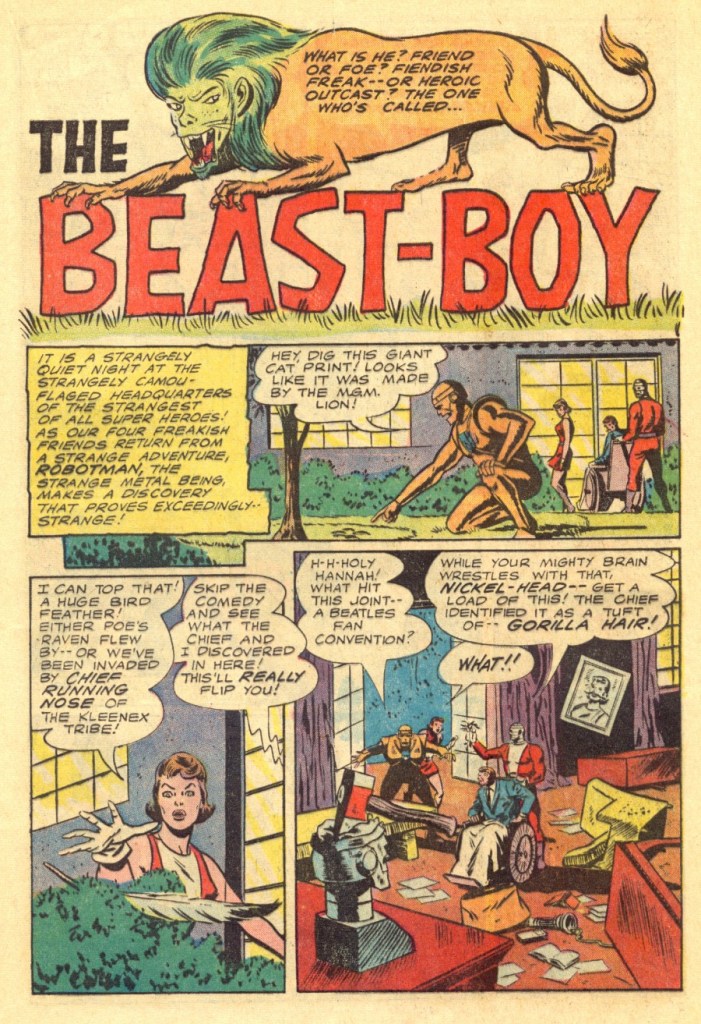
It’s the back-up story that introduces Beast Boy, and writer Drake pretty clearly intends or him to be a somewhat more realistic depiction of a teenager than what was typically found in the comics of that period. Or at least, what Drake thinks a depiction of a typical teenager might look like. The story opens with Beast Boy having paid a visit to the Patrol’s headquarters, trashing the place. The DP were out when this happened, but the following night when Beast Boy returns, they’re all waiting for him. But using his weird ability to transform himself into any animal he can envision, he’s mostly able to stay one step ahead of them in an extended chase sequence before he’s finally caught. Beast Boy sees himself as a fellow freak, and he wants to sign up with the team. But the Chief, Larry, Cliff and Rita are a bit dubious given Beast Boy’s obvious youth.
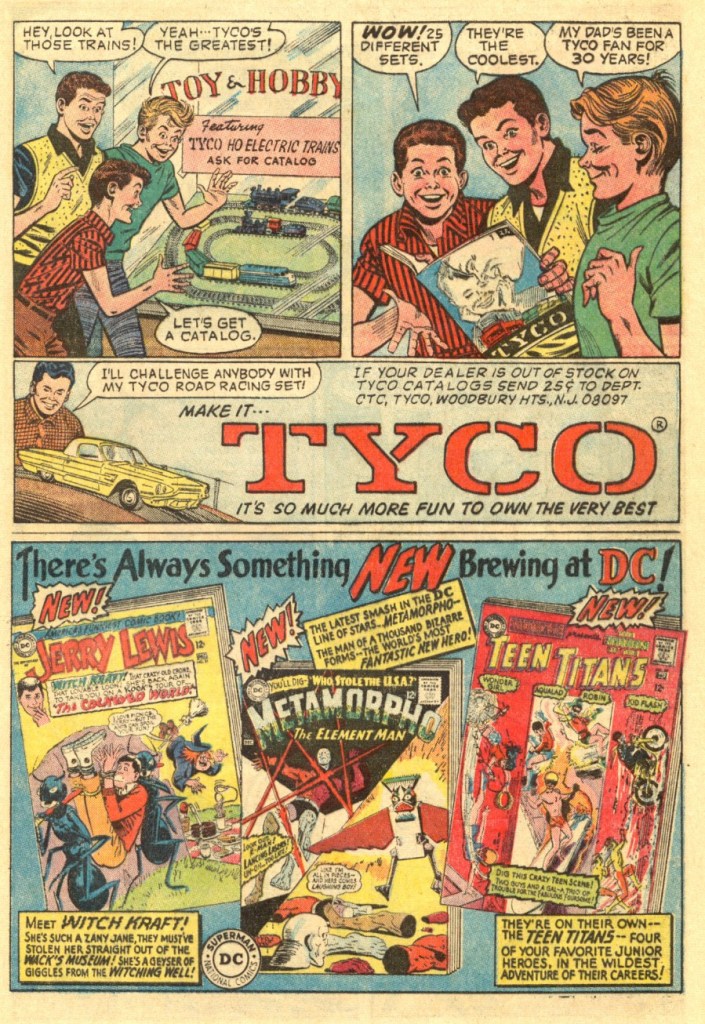
Another half-page house ad runs at this point spotlighting a trio of upcoming DC titles, all of which in their own way were attempting to tap into the zeitgeist of the moment. Jerry Lewis began to expand its cast from the titular comedian to include other recurring characters such as Witch Kraft, Metamorpho was another attempt to bring some personality to a DC hero although the series quickly became so broad that it verged on self-parody, and Teen Titans attempted to connect with young readers on their own level–or at least the level that middle aged writers and artists thought the kids of the 1960s were at.
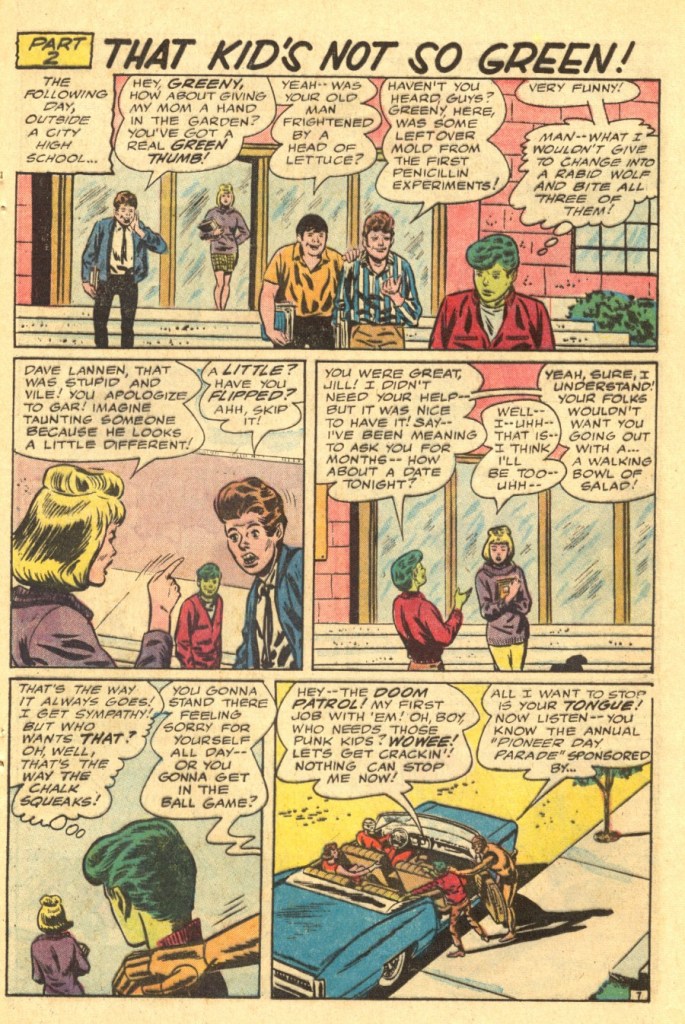
Beyond the fact that Beast Boy had an awesome shape-changing power, his most notable attribute was that he was completely green-skinned, a condition that made living a regular life an impossibility, as we see on this opening page of the second chapter. For no really well articulated reason, while he cannot conceal his chartreuse appearance, Garfield has been keeping his ability to become animals a secret from everyone–which comes in handy when he wants to transition to being a freak super hero. I have to say, I loved the fact that the Doom Patrol typically rode around not in a spaceship or a a Batmobile, but rather a regular old convertible. As promised, the Doom Patrol take him along on a caper where they’re protecting the crown jewels of the Duchy of Dusenberg, which is attacked by masked thieves wielding high-tech weapons.
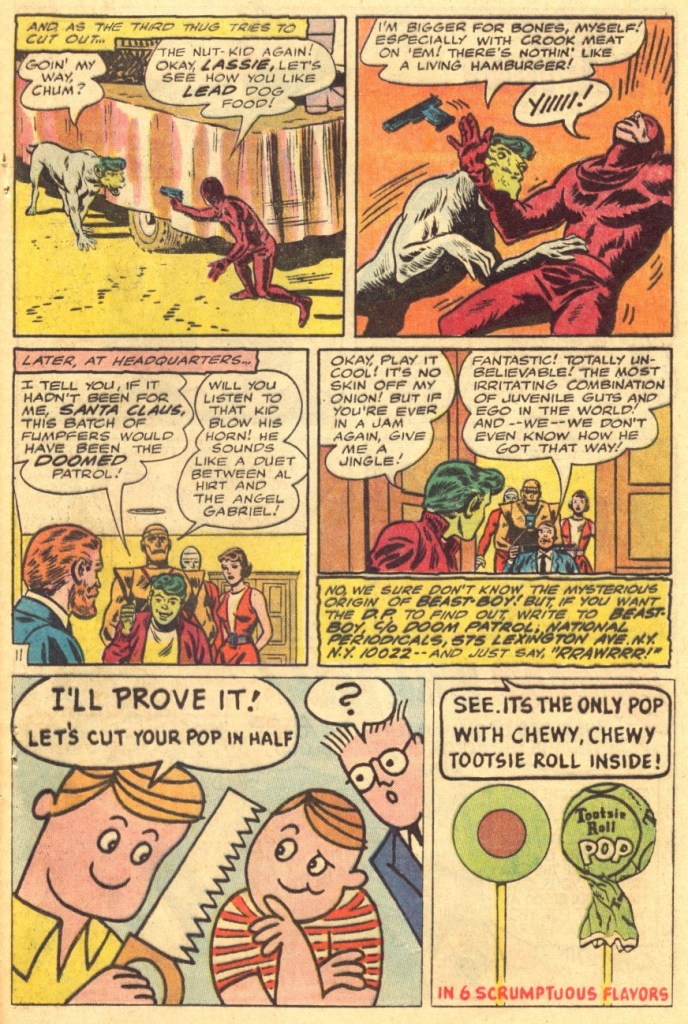
In the fight that follows, Beast Boy gives a good accounting of himself. But he’s so egotistical and overbearing that the Doom Patrol isn’t really sure that they want him around on a regular basis. One gets the impression that either Drake or editor Boltinoff felt the same way, so at the end of the story they turn the question over to the audience to write in and support the return of the character. As this happened in the very next issue, it doesn’t seem like this request for affirmation truly had any bearing on whether Beast Boy would be coming back. And there was still plenty more that Drake had to reveal about his new creation. In a very real way, Beast Boy became the driving force of the series for the next year at least.
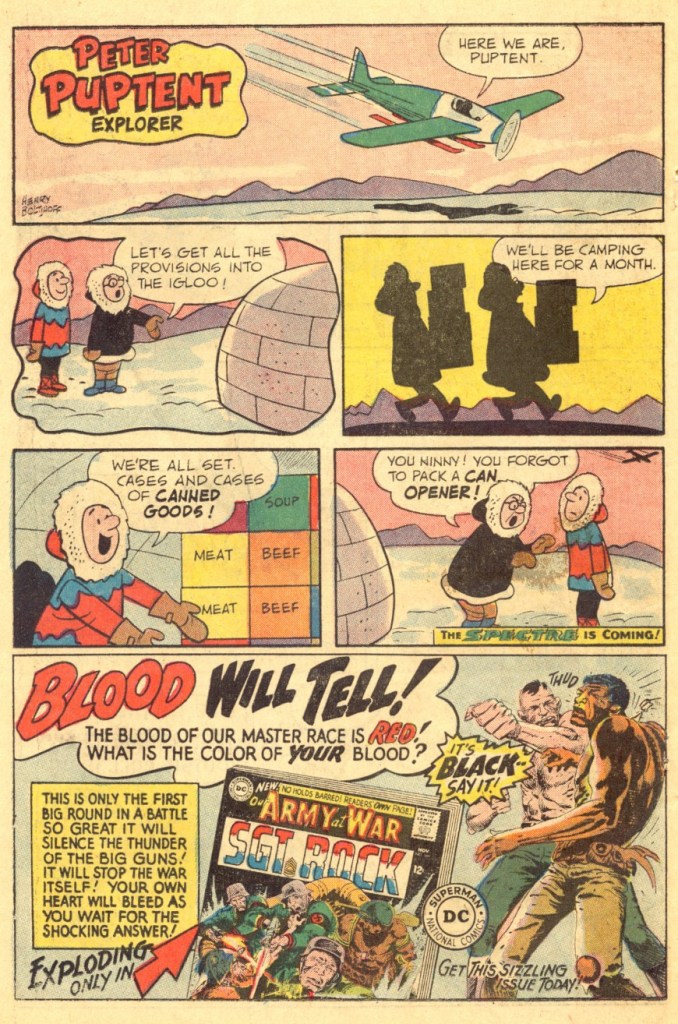
And there’s one more half-page ad before the end of the issue, one promoting a particularly noteworthy SGT ROCK story in OUR ARMY AT WAR. At the time, it wasn’t typical to find a black character in the pages of a DC comic–and in fact, Jackie Johnson’s appearance in this ad represents the only dark-skinned face in this entire issue. The page also runs one of the filler strips that Murray Boltinoff’s brother Henry provided for DC for several years, a little gag page to serve as a palate-cleanser from whatever the main features had been.


I remember as a lad being puzzled by the superficial similarities between The Doom Patrol and The X-Men.
I mean, I’m still not sure who came first, Chief or Professor X?
LikeLike
Same year, different months: Doom Patrol [ My Greatest Adventure#80 ( June 1963 ) ] and the X-Men[ The X-Men#1 ( September 1963 ) ].
LikeLike
Yes, their first appearances were very close together. Just a simple coincidence or something sinister, like company spies?
LikeLike
Almost a simple coincidence.
What’s going on here is that Arnold Drake, inspired by Marvel, set out to create a team of quarreling heroes like the Fantastic Four. And he did — a scientist, a hotshot pilot, a race-car guy and a girl, with a super-brain, stretching abilities, mighty strength and a flying crackling fiery figure.
And around the same time, Martin Goodman, inspired by the sales of FANTASTIC FOUR and SPIDER-MAN, made his usual judgment that if one book was selling, more like it would sell. So Marvel produced the X-Men (which is billed on the cover as “In the sensational FANTASTIC FOUR style!”) and DAREDEVIL (on the cover: “Remember when we introduced Spider-Man? Now we continue the mighty Marvel tradition with…DAREDEVIL!!”). If Bill Everett had met his deadlines, they’d have come out the same month. But he didn’t, and so we got the hastily-put-together AVENGERS in its slot.
But the folks at Marvel, even if they knew Doom Patrol was in the works, had no reason to think it’d be a hit, so they should swipe the idea of their leader being in a wheelchair (and odd thing to think would be popular). And Jack Kirby didn’t need to nick ideas from Arnold Drake, with all due respect to Drake. What’s more likely is that Drake decided to put his super-scientist in a wheelchair because one of the other things he’d been inspired by in the FF is that they were all, to one degree or another, body-horror characters (or at least started that way, though Lee and Kirby backed off of it for everybody but the Thing). Even the early FF villains — the Mole Man, the Skrulls, Doom — are body-horror characters, and that’s a pattern Drake borrowed for the DP villains, too.
Over at Marvel, though, Kirby probably decided to put the X-Men’s leader in a wheelchair because the X-Men were a kid gang, like his earlier Boy Commandos and Newsboy Legion), and having the leader off at a distance, unable to use his super-brain to end all the fights in two seconds, let the kids take the foreground.
Drake also called the DP “the fabulous freaks,” another FF reference, while Kirby had been inspired by pulp SF he’d read, like Henry Kuttner’s MUTANT, Wilmar Shiras’s CHILDREN OF THE ATOM and A.E. van Vogt’s SLAN.
Not only was there no real time for Marvel to swipe the DP, there’s no reason for them to have done so — and if they’d wanted to, the surface detail of the wheelchair isn’t something they’d copy; who wants to rush to be the second guy on the market with a wheelchair-bound hero?
Other things DP fans think point to Marvel having swiped the X-Men drop the DP are one having enemies called the Brotherhood of Evil and the other having the Brotherhood of Evil Mutants, but aside from that making little sense (Stan was good enough at coming up with snappy names for villain groups that he didn’t need to steal one that was about to debut), those two actually debuted the same month; no real time for swiping. And then there’s the fact that the DP and the X-Men had similar uniforms, but in this case the X-Men had their blue-with-a-yellow-wedge costumes from issue 1, and the DP got their red-with-a-white-wedge suits almost a year later, so if anyone copies anyone else where it was DC. The DP had started out in utilitarian single-color suits…like the FF’s uniforms.
There’s just no there there…which Drake even admitted, from time to time.
LikeLiked by 2 people
Was there something in popular media that could have inspired both? Would lead times possibly discount conscious or outright copying?
LikeLike
The New Teen Titans first series was first time I saw Garfield Logan and I don’t remember how many years it would be before I found out in his earlier appearances in animal form his head was the only thing green.
LikeLike
Bug Man’s morphing bug ship predates the Second Blue Beetle’s ship The Bug [ Captain Atom#86 ( June 1967 — second Blue Beetle in Captain Atom#83 ( November 1966 ).
LikeLike
To an extent, Gar’s peers treating him badly for his skin color can be seen as a metaphor for racism, and the Chief has an “I don’t see color” moment.
LikeLiked by 1 person
Hey, hep cool cats, what’s the buzz on the groovy green guy who’s such a downer?
Translation: Hi everyone! Am I the only one who hasn’t ever cared for Beast Boy?
In fairness to the chartreuse shape-shifter, my experiences with him are limited to Wolfman’s writing of him in the Teen Titans. As much as I enjoyed the issues of that series with Perez’s stunning artwork, I kept hoping that Baron Blood, Monsieur Mallah or Trigon would do away with mouthy twerp. While changing into green animals is a cool power, I never could buy how someone who turned into a coyote or condor could still speak.
As for the Doom Patrol, I’ve always had a soft spot for them as misfits. But while I was a young child during the sixties, can I just say that I do not recall anyone in my corner of Oregon speaking like Drake’s characters. But silly dialogue aside, this one does look like fun!
LikeLiked by 1 person
Beast Boy is the best!
But I had the benefit of reading a complete (or near-complete) run of the DP’s Silver Age run, thanks to my friend Richard Howell, and Beast Boy isn’t just a lot of fun, he gets all the cool sub-plot action, too.
LikeLiked by 1 person
Ah, Beast Boy. I was a very good little boy and absolutely delighted by a teen hero being such a wilful, pissed-off smartass. Not that I thought about it in those terms at the time but it felt very much like a road not taken.
A friend of mine talked to Drake many years ago, who confirmed his goal was to right a teen character who didn’t do as he was told.
LikeLiked by 3 people
In the early 1990s, at a comic con in White Plains NY, I actually bought a somewhat dog-eared copy of this issue for around ten bucks. I picked it up because, of course, it was the introduction of Beast Boy, or as he was then better known Changeling. I wasn’t a huge Teen Titans fan or anything, but I was familiar enough with them that the idea of owning Beast Boy’s first appearance was pretty appealing to me. I don’t still have it, unfortunately.
Years later I did get to meet Arnold Drake on a couple of occasions and got the Doom Patrol Archives Vol 1 autographed by him. I agree, Bruno Premiani’s somewhat illustrative European artwork made the series stand out almost as much as Drake’s idiosyncratic writing. I guess Bob Brown wasn’t too bad on the DP book, though.
Fun fact: Drake told me that Grant Morrison’s Doom Patrol run was the only subsequent period of the series that he found enjoyable.
LikeLiked by 2 people
This was just such a delightfully odd series. When I was more active in hunting back issues, I would grab these whenever I could find one cheap. Brilliant stuff.
LikeLiked by 1 person
Back when I was buying DC back issues at my local used bookstore I never looked twice at an issue of The Doom Patrol, or My Greatest Adventure. When DC started their Archives I even bought the first three Doom Patrol volumes. But despite that I still didn’t really like the team or stories. In fact, the closest I have come to liking the team is the TV series. And I only watched the first two seasons of that before giving up.
I just read this issue and neither story interested me. Of the two I like the Beast Boy story a bit more, but that may be because he was the star while the Doom Patrol are supporting characters. I also really don’t like all the bickering between the team members (and Beast Boy). Nor do I like the team’s kneejerk reaction to Gar’s request to join, although Rita does stop herself and changes her mind.
LikeLike
Rita slowly comes to realize that Gar’s not just talking smack about how horrible his guardian is and sets out to get him free of the man. It stretched out over several issues.
I enjoyed the bickering, more than I did most teams of that era.
LikeLike
Regarding the incredible coincidence of the Doom Patrol/X-Men arrival on the scene in 1963—where do ideas come from, anyway? Think of the many times have we’ve read about “sudden inspiration” leaping into a writer’s mind seemingly from out of nowhere. I’m reminded of legendary dancer Martha Graham’s advice to artists: “keep the channel open” (to the spark of creativity). I never subscribed to the idea that some sort of comic industry espionage was behind the almost-simultaneous arrival of the DP and the X-Men on the scene back in 1963. Instead, I simply choose to believe that Arnold Drake, Jack Kirby, and Stan Lee were all talented creators who—even if they were ignorant of Graham’s admonition—always kept “the channel open”. For that reason, it was never hard for me to believe the same flash of inspiration sparked in their minds around the same time. None of them knew where that spark came from but they were receptive to it. And aren’t we glad that they were? Keep the channel open.
LikeLiked by 1 person