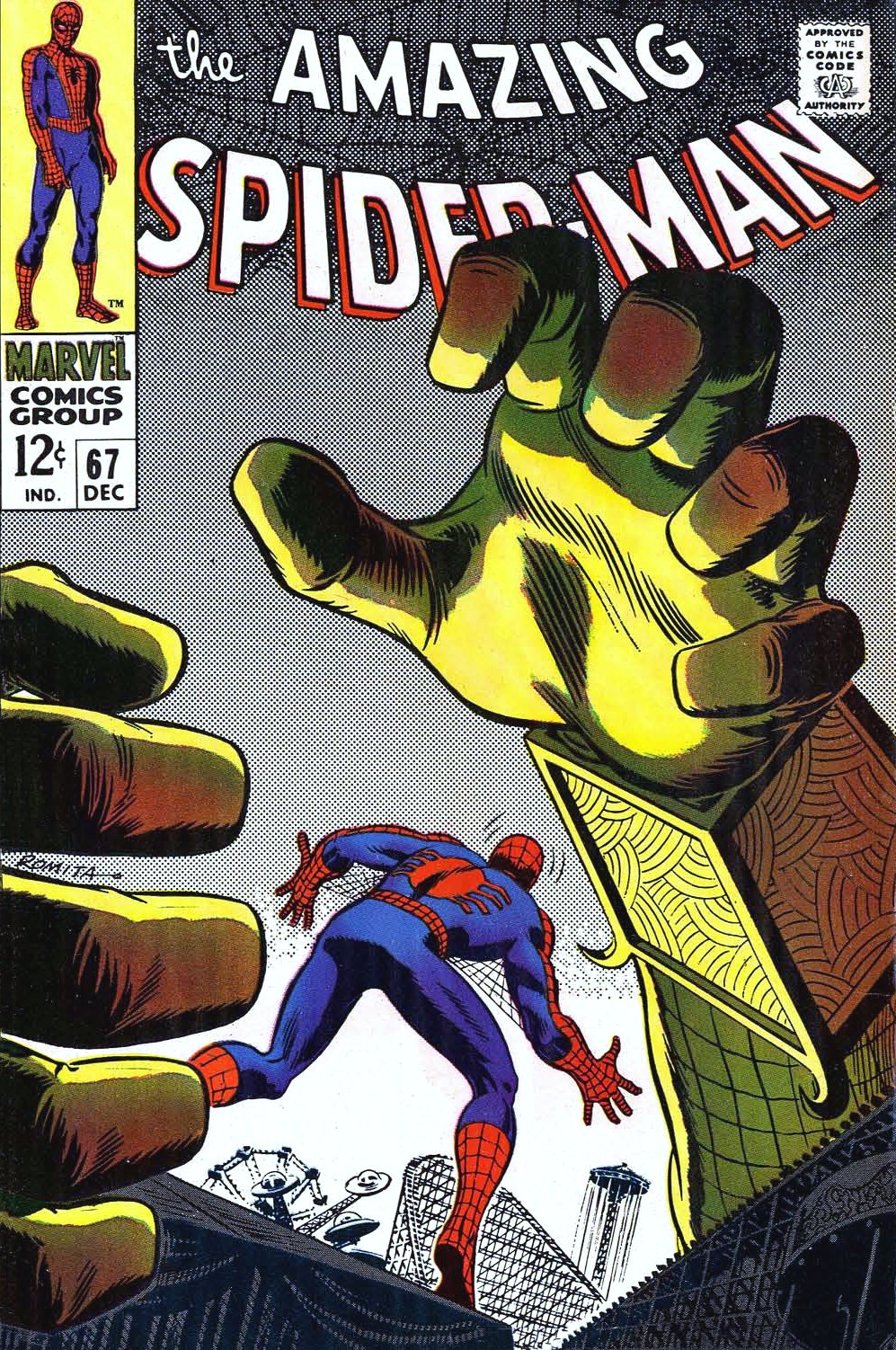


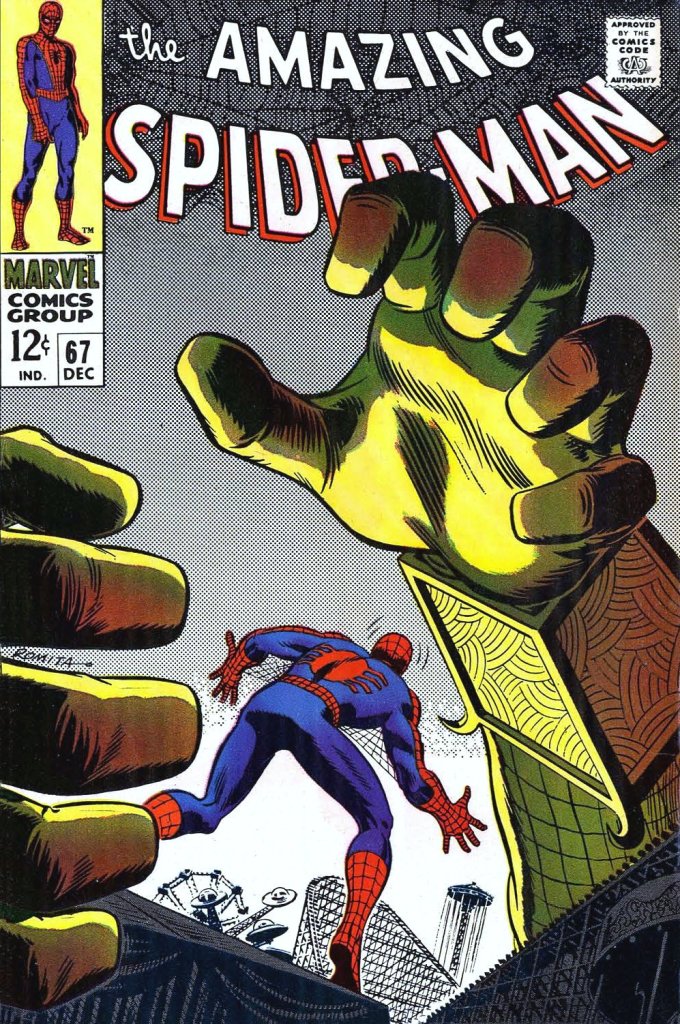
As I’ve mentioned before, my friend David Steckel had inherited a chunk of his comic book collection from older cousins who had outgrown comics, so he owned a handful of issues that dated back to the 1960s. He didn’t have many of them, and they were a bit scattered, but they represented a bit of a gold mine in terms of me getting to experience these classic books. So at a certain point, David loaned me this issue of AMAZING SPIDER-MAN from 1968. John Romita’s use of zip-a-tone on this cover image is a clear tip to when it was produced–after Jim Steranko began employing such things, they swept through the industry of the time. This is a rare cover from the era that didn’t carry any cover copy whatsoever–typically, a Marvel book of this period would at least blurb he story title of the issue or something similar. But this image is dramatic and cool enough that it really doesn’t need it.
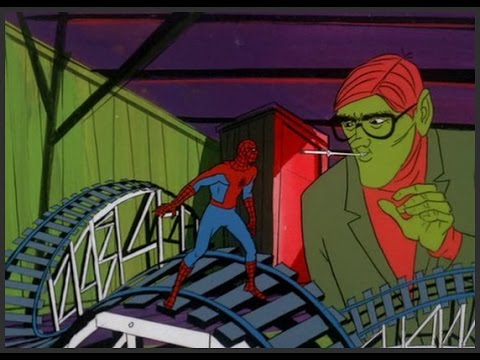
The story is the second part of a two-part adventure, one that I was already familiar with from an unlikely source. Because right after these issues saw print, producer Ralph Bakshi adapted the story for an episode of the Spider-Man Saturday morning cartoon series, which was still running in syndication in the afternoons in the 1970s. For some strange reason (and despite the character having shown up earlier in the series), Bakshi decided to depict the villainous Mysterio not as a costumed figure with a domelike helmet but rather a bespectacled green-skinned movie producer type with a cigarette holder. Weird choice.
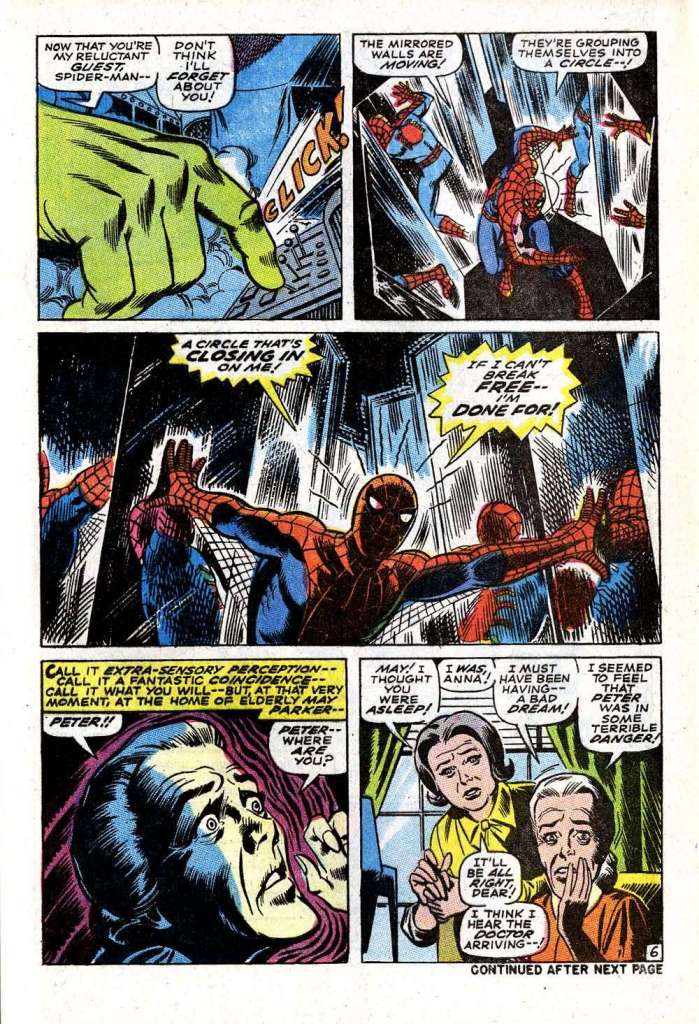
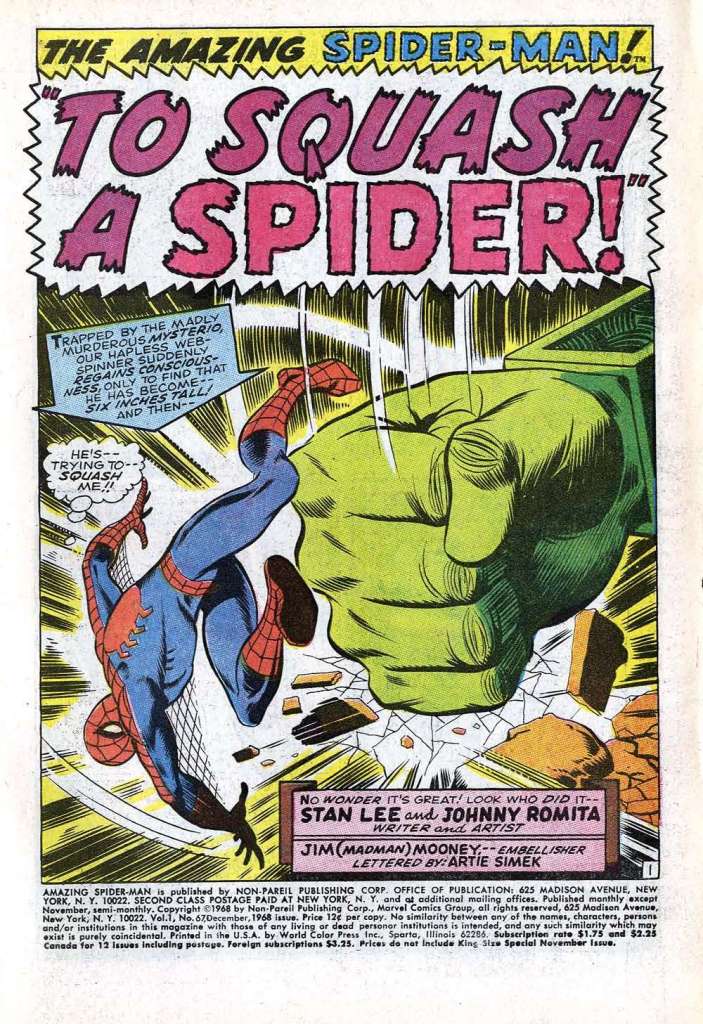
Anyway, last issue Mysterio had lured Spider-Man out to his hideout, where the master of illusions promptly miniaturized his web-slinging foe, imprisoning him inside a table-top model of an amusement part that was on his desk. As this issue opens, Spidey is on the run, dodging blows from his much larger adversary and attempting to stay one step ahead of him. He can’t quite understand why the colossal Mysterio doesn’t go ahead and finish him off, but he’s so focused on staying alive that he can’t really stop and consider the situation too heavily. The artwork on this issue by the combination of John Romita and Jim Mooney is quite excellent. Mooney maintains the beauty of John’s drawings while giving the strip a bit more atmosphere and texture. It’s a really nice combination, especially here where John was providing more than merely simple layouts, a situation that wouldn’t remain that way.
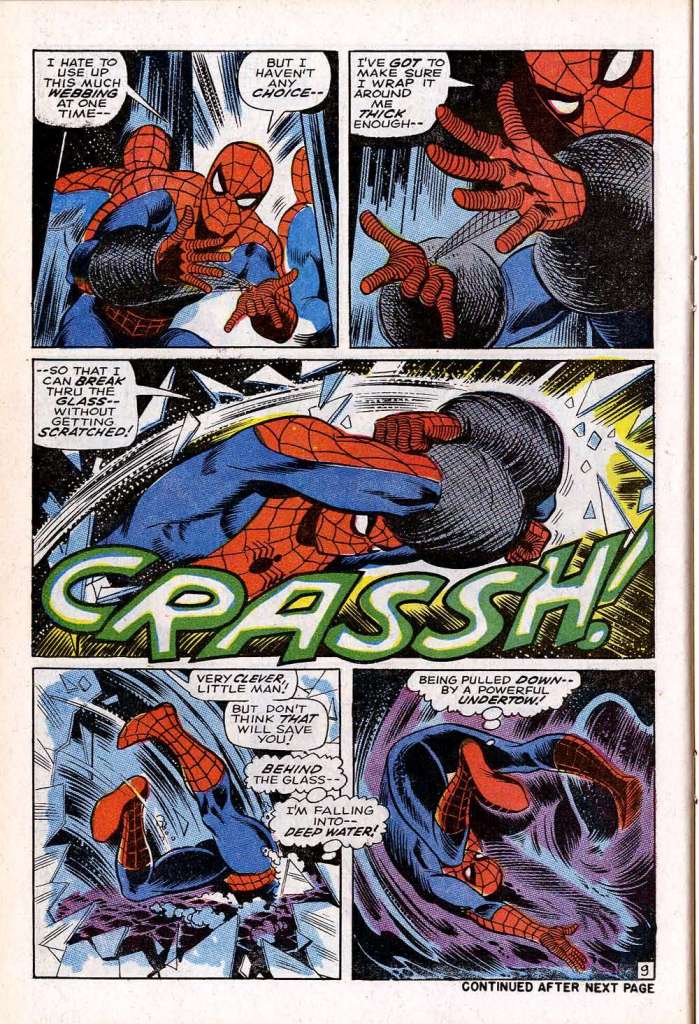
In an effort to elude his pursuer, Spider-Man heads deeper into the amusement park. But this turns out to be a bad instinct, as Mysterio has tricked the whole place out with a gauntlet of deadly traps. The plot is pretty much simply fast-moving action as Spidey finds himself in one dire situation after another, forces to improvise his way out of them and keep going. Along the way, we also check in on the always-ailing Aunt May and the always-blustering J. Jonah Jameson and the Daily Bugle staff. But this is an action story first and foremost.
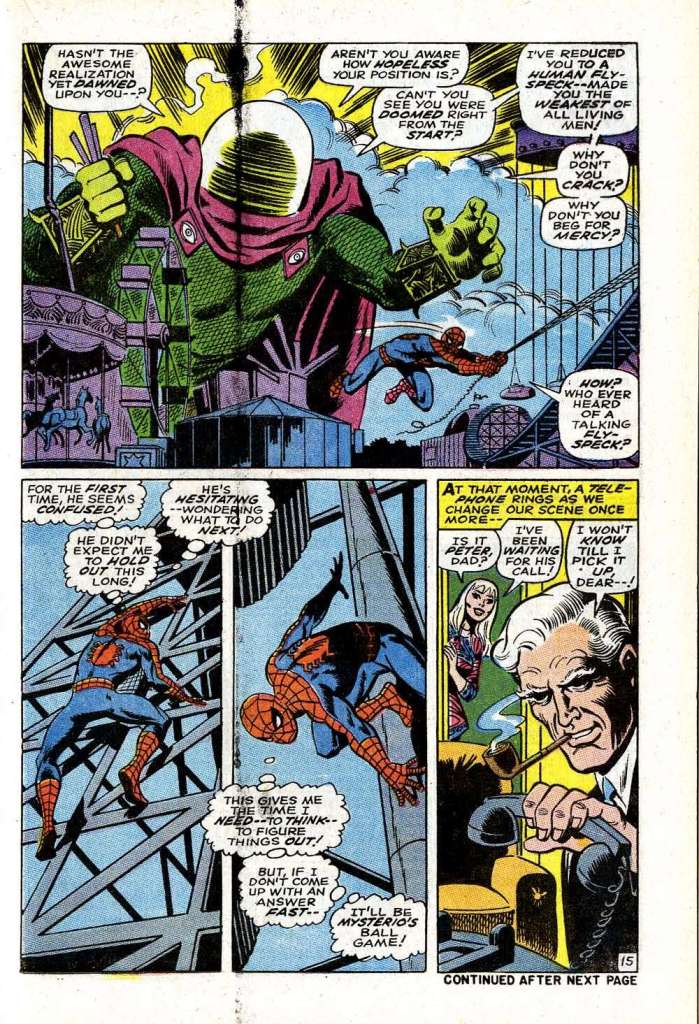
There’s really not a whole lot more to say about the plot, but the execution by Romita is beautifully paced. And Lee is at this point expert in adding dialogue and copy that captures the characters and the drama and also provides an occasional laugh along the way. It’s a polished production, and it’s easy to see why Spider-Man became the most popular title in the Marvel line during this period. Anyway, Spidey outfights and outthinks situation after situation, and he gets the sense that Mysterio didn’t expect him to hold out this long. As he’s getting his second wind, he’s beginning to suspect that something isn’t right at all with this set-up.
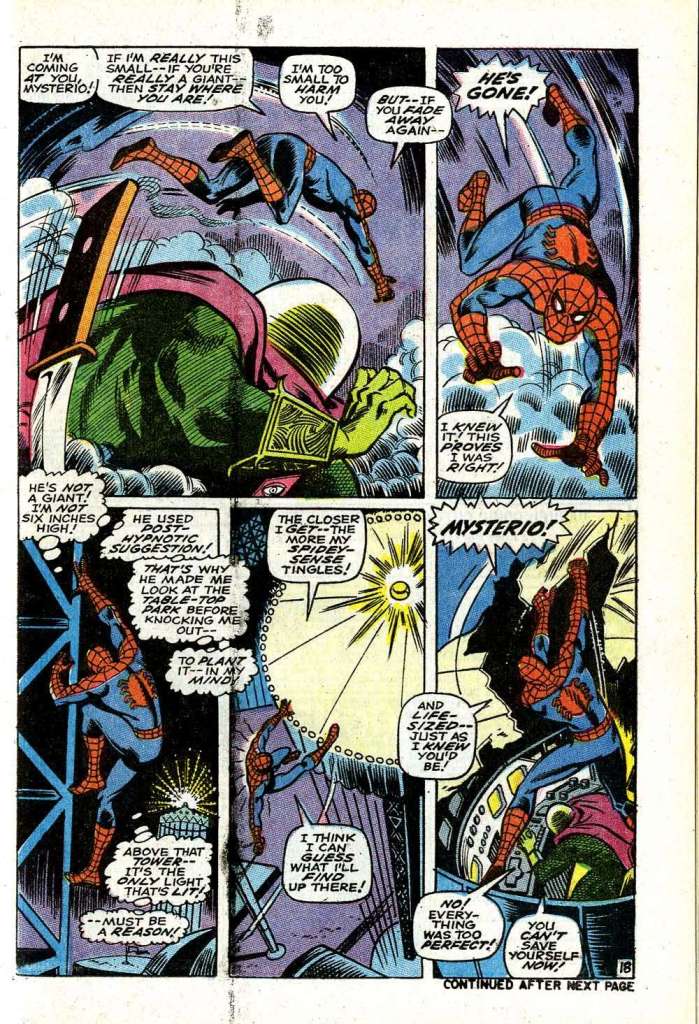
So the web-slinger taunts Mysterio, causing the giant to stab down at him with a massive knife that appears to be entirely legitimate and real. But using it as a springboard, Spidey is able to leap up towards his enemy–and right on cue, Mysterio disappears in a cloud of smoke. Not Spidey knows he’s on the right track–he hasn’t been shrunk down at all, that was all misdirection to disorient him. His spider-sense guides him to a tower at the heart of the amusement park, and breaking into it, he comes upon Mysterio at the controls of the entire set-up.
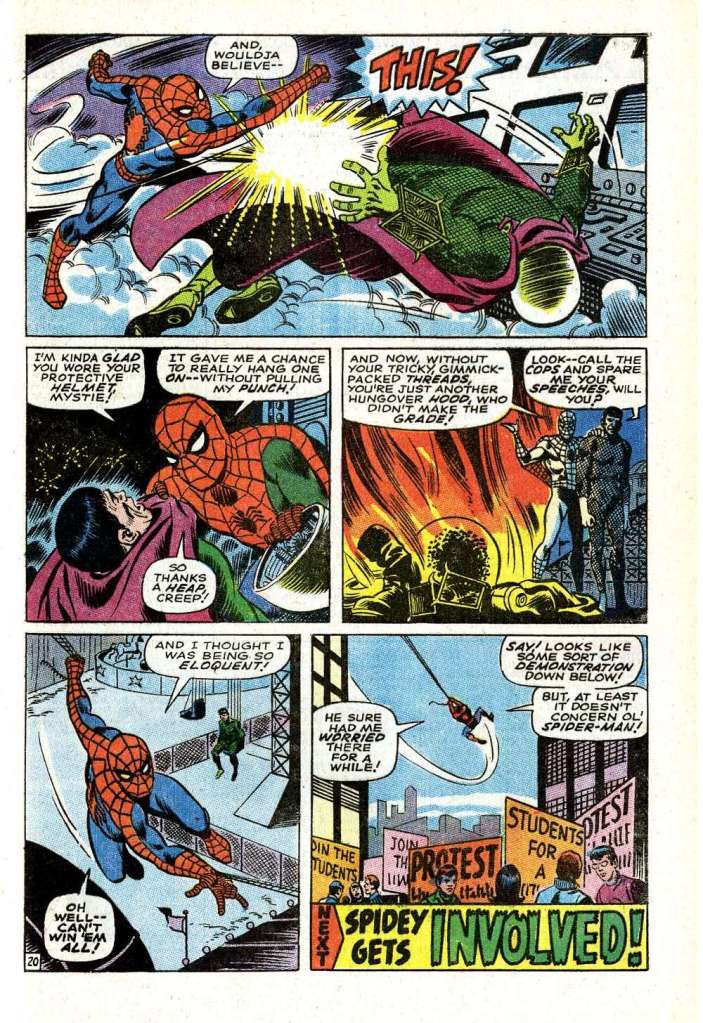
And that’s the wrap-up. Without his tricks and illusions, Mysterio is just a washed-up special effects wizard, and Spidey lays him out with a single punch. The wall-crawler leaves his opponent webbed up for the cops, then swings back towards Empire State University. I’ve always found this final panel to be a bit discordant. It’s clear that Romita was looking to tease the protest storyline that would begin in the following issue, but Lee’s dialogue doesn’t’ do any of the table-setting, so it comes across as an odd note right at the end. But regardless, this was a very entertaining, very fast-paced adventure that, while it wasn’t especially deep, provided the required number of thrills and chills along the way.
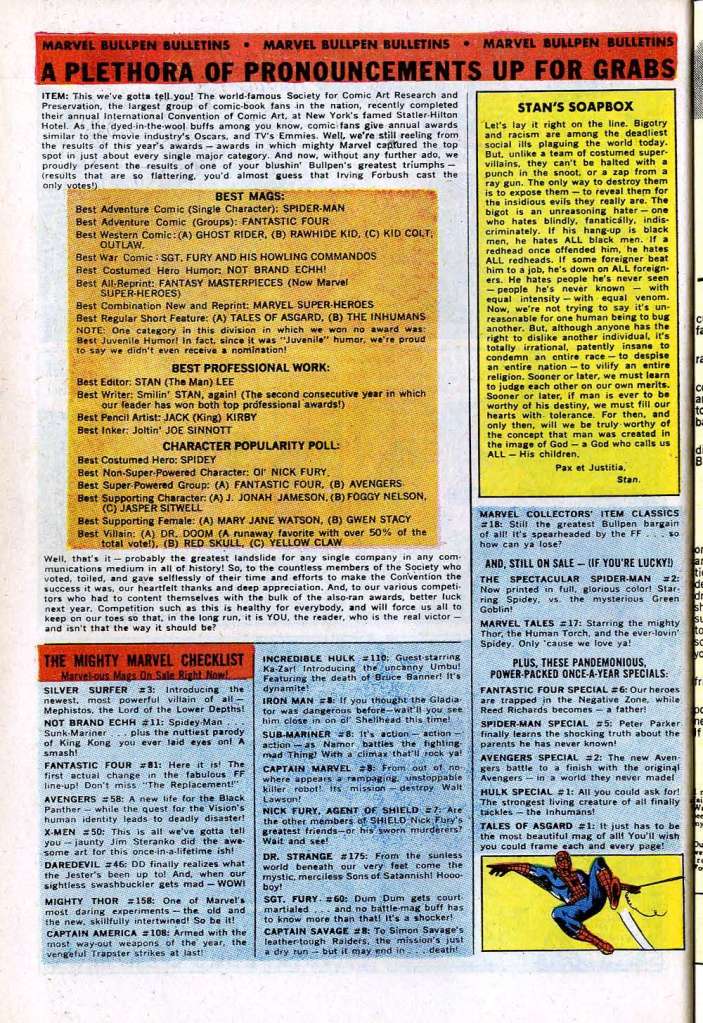
The issue also included an edition of the Marvel Bullpen Bulletins page, which was always a great way to see what else was going on at Marvel and throughout the world at the moment when this comic first came out. Here, Stan devotes a lot of space to the fact that the Marvel line and its characters and creators came out on top in most categories in a recent set of award given out by SCARP at a New York convention. Stan writes about this as though it was akin to getting an Academy Award, but this would have been no more than a few hundred dedicated comic book fans voting here. But it’s all a part of how Stan was able to make reading Marvel comics feel like entering a larger world. This page also includes the much-reprinted Soapbox column in which Lee preaches against bigotry. I tend to think that Stan was sincere in his thoughts here, though he was definitely being influenced by the crowds of young people he was being exposed to when he’d give college lectures and the like. In 1968, people were looking to make a difference and there was a ton of strife in the world and in the community, so it’s kind of amazing that Stan put himself out there even this much .


As time and generations move on, Romita, Sr seems to get less praise than he used to. I’ve seen a majority of comments on several hats where Ross Andru is ranked higher, and Romita, Sr isn’t even in some conversations. I see these pages and think Andru wouldn’t have had this as a reference, a starting point, if Romita hadn’t had his own great run. I know Andru drew fine figures, except sometimes the knees could get knobby, and also very impressive cityscapes. But I think he took a lot from Romita, Sr.
I also prefer Romita’s lighting. His clean but heavy lines. I know Jim Mooney inked this, and Monney’s good, but it looks pretty faithful to Romita’s drawings. There’s a tension, an urgency to the action and facial expressions, in part due to the lighting. He drew a definitive Spidey, and the whole cast, making Peter look cooler than he had, which makes sense since Peter was slowly aging. And that was on the heels of another, the original, definitive version by the character’s co-creator.
Romita, Sr.’s work continues to deserve to be praised, and held up for as great as it is.
LikeLiked by 4 people
You’ll never hear me utter a harsh word about John Romita Sr’s art. I’ve said it before in these comments, but it’s my belief that had he not become penciller for this book, Spider-Man would never have achieved the heights in popularity and sales he reached in the 60’s. That’s not a knock on Steve Ditko,but a compliment on how Romita Sr built on the foundation forged by his predecessor.
LikeLiked by 3 people
While Andru was My Spider-Man artist, that doesn’t take away from the skill of the best Romita.
LikeLiked by 2 people
If I had to pick fave Spidey artists, Mark Beachum is way up there for me. Only a handful of Spidey stories, but they all looked appropriately amazing.
John Romita, Jr, too. He’s had notable Spidey almost every decade going back to the late 70’s, right? Certainly the 80’s, 90’s and onwards.
LikeLiked by 1 person
Also his amazing character design. The look he gave Natasha lasted for years. And his Kingpin design was amazing too (https://atomicjunkshop.com/spiderman-no-more-say-it-aint-so-joe/)
LikeLiked by 1 person
Very true.
LikeLike
I wonder if this issue and Mysterio’s amusement park death traps inspired Arcade and Murder World [ Marvel Team-Up#65-66 ( January-February 1978 ) ]?
LikeLiked by 3 people
I’m always puzzled by how lauded that Soapbox is when Stan’s earlier, far stronger statement against bigotry as the plot of SGT FURY #6 (March 1964) rarely gets mentioned.
LikeLiked by 2 people
That page 9 is so cool. So economical but also so much fun. Tip of the hat to Mr. Romita.
Maybe it’s just me, but I’ve never understood Mysterio as a Spidey villain. This story shows how extreme Mysterio’s illusions can get, but I don’t understand how they work. He falls into one of those villain types where, if you have that much power, why are you messing around fighting a superhero? Or, if you have that much power, how can you possibly be beaten? Illusions as a superpower (esp. if the power is mental/psionic) can work, but only to have you punching an illusion version of yourself. How can a person with (artificial) illusions create entirely senses of 3d space — especially to fool someone like Spidey who has spider-senses? I just never bought this villain. I love the costume!!! but I can’t get it. When Mysterio was put into the Japanese Spider-man (Ikegami Ryoichi) in Shonen Magazine in 1970, he had illusion powers, but they were of the kind like, “Look, I’m over here! Psych! Now I’m over here….”
LikeLiked by 2 people
Mysterio is what I consider a “Saturday Morning Supervillain.” What I mean by that is growing up a fan of the late 60’s Hanna-Barbera cartoons, there was often a villain who attacked the hero(es) with gimmicks, gadgets or various creatures/robots/etc. Space Ghost didn’t duke it out with Metallis. He faced whatever mechical devices his metallic nemesis threw at him. Ditto for the Herculoids, Birdman and so on.
You’re right. In reality, Mysterio offers no real physical threat to Spider-Man. In order to be viable villain – and show off that stellar Ditko designed costume! – he has to use illusion with all kinds of props to fill an issue.
Nothing wrong with this. Indeed under skilled talents like Lee and Romita Sr, this works quite well.
LikeLiked by 1 person
Mysterio might be fighting outside his weight class in going up against Spider-Man but in The Amazing Spider-Man Vol.2#12 ( December 1999 ) he falls to his death impacting a car as Spider-Man fails to save him and later in front of the Sinister Six and right before the big fight, he pulls a dramatic stunt. He pulls out a live pumpkin bomb( the kind Green Goblin uses ) and holds it to his “face”. The bomb detonates, seemingly blowing him to pieces ( I remember a body ) in front of the other villains. As the Sandman is looking at his body he is standing right behind Sandman. I remember thinking that was cool trick how did he do that, were those robots? I was hoping the Official Handbooks would have answered that. If they were robots , the cover of The Amazing Spider-Man#198 ( November 1979 ) has him fighting 5 Mysterios, imagine if they had been robots. A couple of weeks ago I was thinking that to bad back in the 1960s Lee-Ditko didn’t do a Doctor Strange-Mysterio run-in ( In the MCU movie Mysterio came off as an alternate Earth answer to Doctor Strange and I’m thinking of the December 30, 1967 Spider-Man cartoon episode “Magic Malice” — Green Goblin wanting to steal Blackwell the Magician’s spellbooks ).
LikeLiked by 2 people
Although I started reading The Amazing Spider-Man with the Marvel Masterworks reprints, I stopped buying them before they got to this issue, so I hadn’t read this story. Not much plot, but it’s a quick, fun read. I really enjoyed the artwork in this issue (even if I couldn’t help but think that Gwen looked just like Mary Jane, except for her hair color). And that interlude was quite odd in my opinion.
As I’ve recently read several issues out of order it’s a bit strange for me to have already read about Aunt May being hospitalized, and in this issue not yet being at that point. Likewise, reading about Captain Stacy being dead, and here he’s alive and well. And, as I mentioned before, I do like reading about Peter’s personal life, even if he was usually given an excess of problems.
As for Mysterio, I didn’t recall him from his earlier meetings in the title, although I do recall him from Far From Home. So, not the most memorable villain in my mind.
I also just read Stan’s Soapbox and it’s very unfortunate that it’s as true today as it was when it was published.
LikeLiked by 1 person
This was a gorgeous issue. Really strong coloring, too.
LikeLiked by 1 person
In hindsight it sems crazy to me that colorists didn’t listed in credit boxes for too many years.
LikeLiked by 1 person
Stan had to be pressured by the letterers to include them, which is likely why they got “humorous” belittling credits so often. So he probably didn’t want to credit colorists at all, and since it was often not yet decided who the colorist would be on the book when it was lettered, at Marvel and DC, it was an easy reason to leave them out.
I assume we’ll eventually find out that someone griped about it enough to change their minds. Or possibly we already know, and I either just missed it or am not remembering right now.
LikeLiked by 2 people
I was also taken by the dynamic layouts for pages 3 & 10. The still stand out, even when compared to layouts of today’s comics.
LikeLiked by 1 person
John Romita Sr was a great comic book artist. He is, to this day, my favorite Spider-Man artist. I have a print of Spider-Man vs The Sinister Six by Jae Lee, signed by Jae Lee, John Romita Jr and John Romita Sr. It’s a beautiful piece, but honestly – I bought it for the Romita Sr. autograph.
LikeLiked by 1 person
In his masterworks introduction, Romita recalled Lee being (understandably) a little hesitant to accept the idea of a small Spidey, so it seems this was one of his ideas:
“Mysterio is one of Steve Ditko’s greatest feats of character design, and when we embarked on 66 and 67, we decided to have fun with Mysterio’s many tricks. I recall wishing I had Steve’s knack and with those special effects he did so well. I tied myself in knots doing ‘smoke and mirrors’ in my as-close-to-Ditko-as-I-can-style. I also had to sell Stan on the ‘six-inch-high’ Spidey gimmick.”
I enjoyed this issue a lot — and although I was introduced to the cartoon after the comic books, by the time I found this particular story reprinted, I’d already seen the Bakshi version. I agree that the script and art propel it along and make it work despite the fantastic premise.
I must admit, I thought the closing panel also worked well. It made me wonder what it was all going to be about — what were they protesting? How does Spidey get involved? It really made me want to see what it was all about. Of course, it turned out Lee played it safe: they were just protesting about a dorm, so nothing particularly controversial or sensational. But that was all part of the broad appeal of Marvel (and other mass American entertainment) back in the day. It could touch on social issues and use allegory, etc., but it usually played things fairly safe and avoided anything that would really divide or anger a substantial part of the audience. It was part of a unifying culture that brought together readers from many different walks of life.
LikeLiked by 1 person