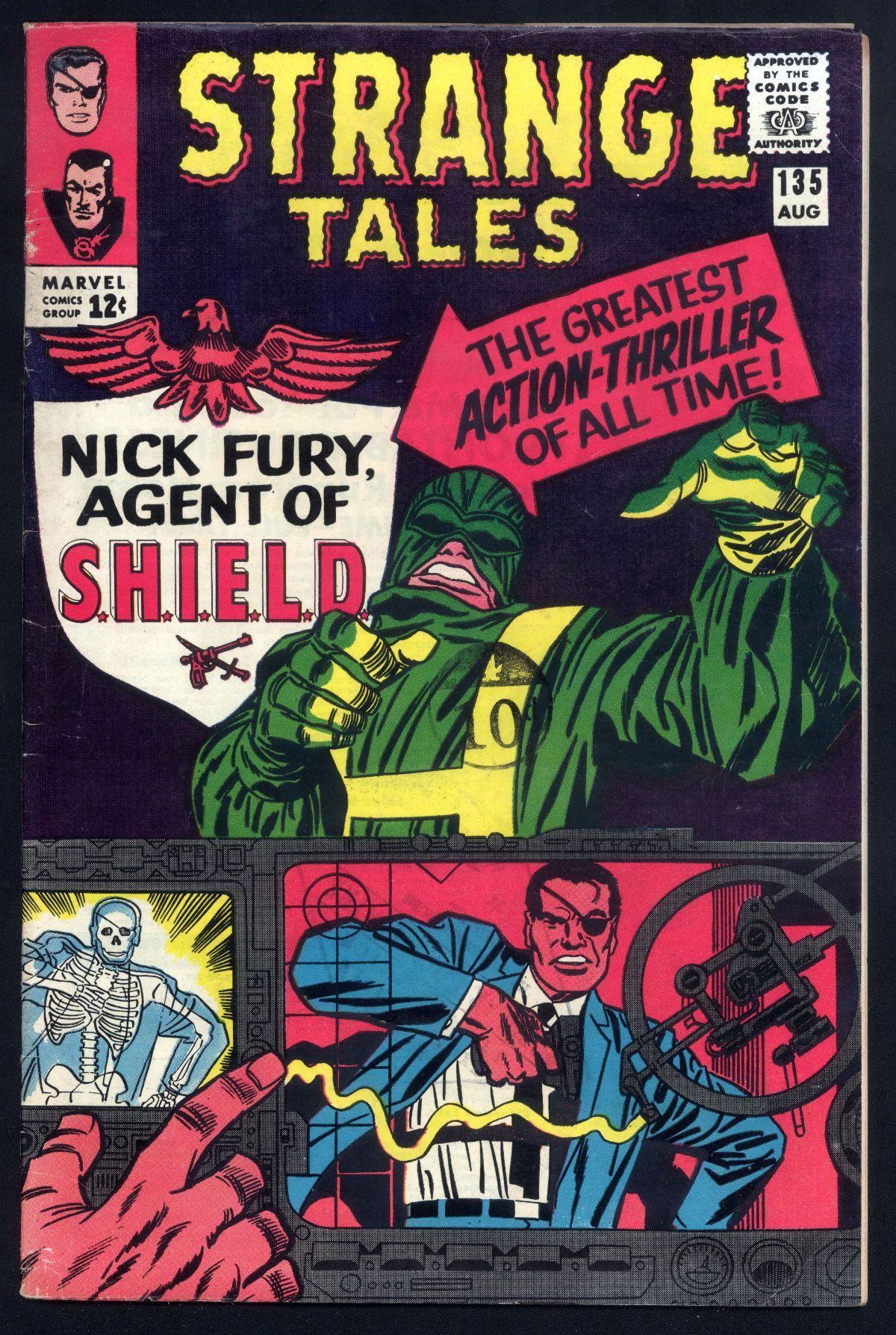


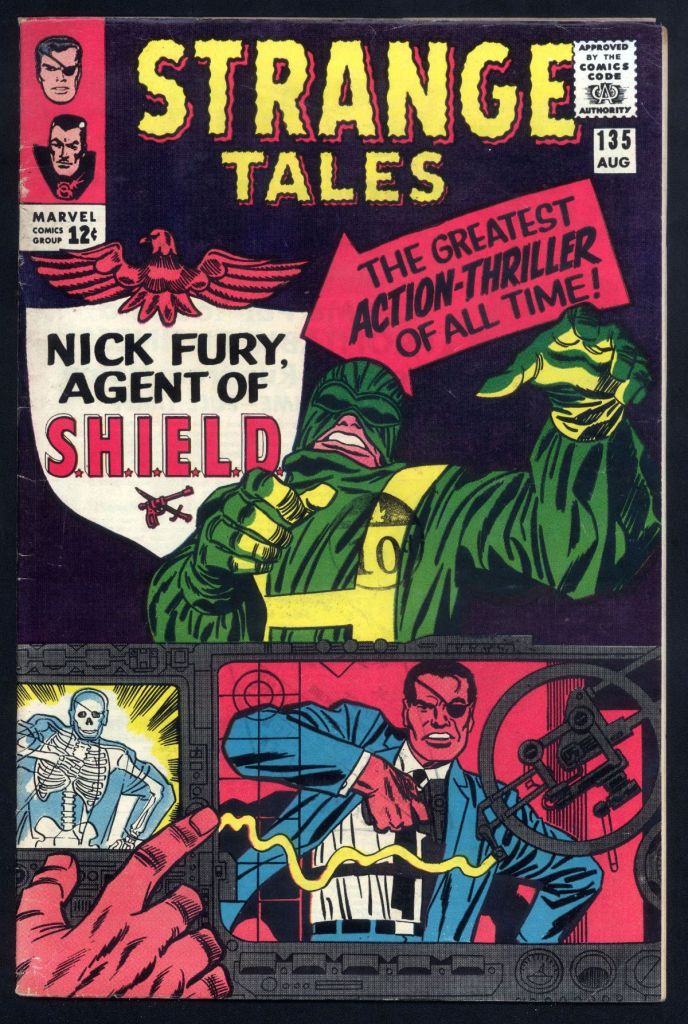
Marvel veteran Larry Lieber has been divesting himself of portions of his collection, and the bounty, listed at Heritage Auctions, has uncovered some amazingly wonderful things. Most recently, a heretofore-undiscovered third penciled page for Jack Kirby’s pitch story for what became the NICK FURY, AGENT OF S.H.I.E.L.D. strip in STRANGE TALES. The first two pages had been kicking around for some time–they had been given over to a young Jim Steranko as an inking/finishing test when he first showed up at Marvel, and they’ve been reproduced in one of Scott Dunbier’s excellent Artist Editions. But this third page shows us a couple more details that allow us to learn a few more things about the development of the strip. So I figure that it’s worth compiling what we now know about it all here.
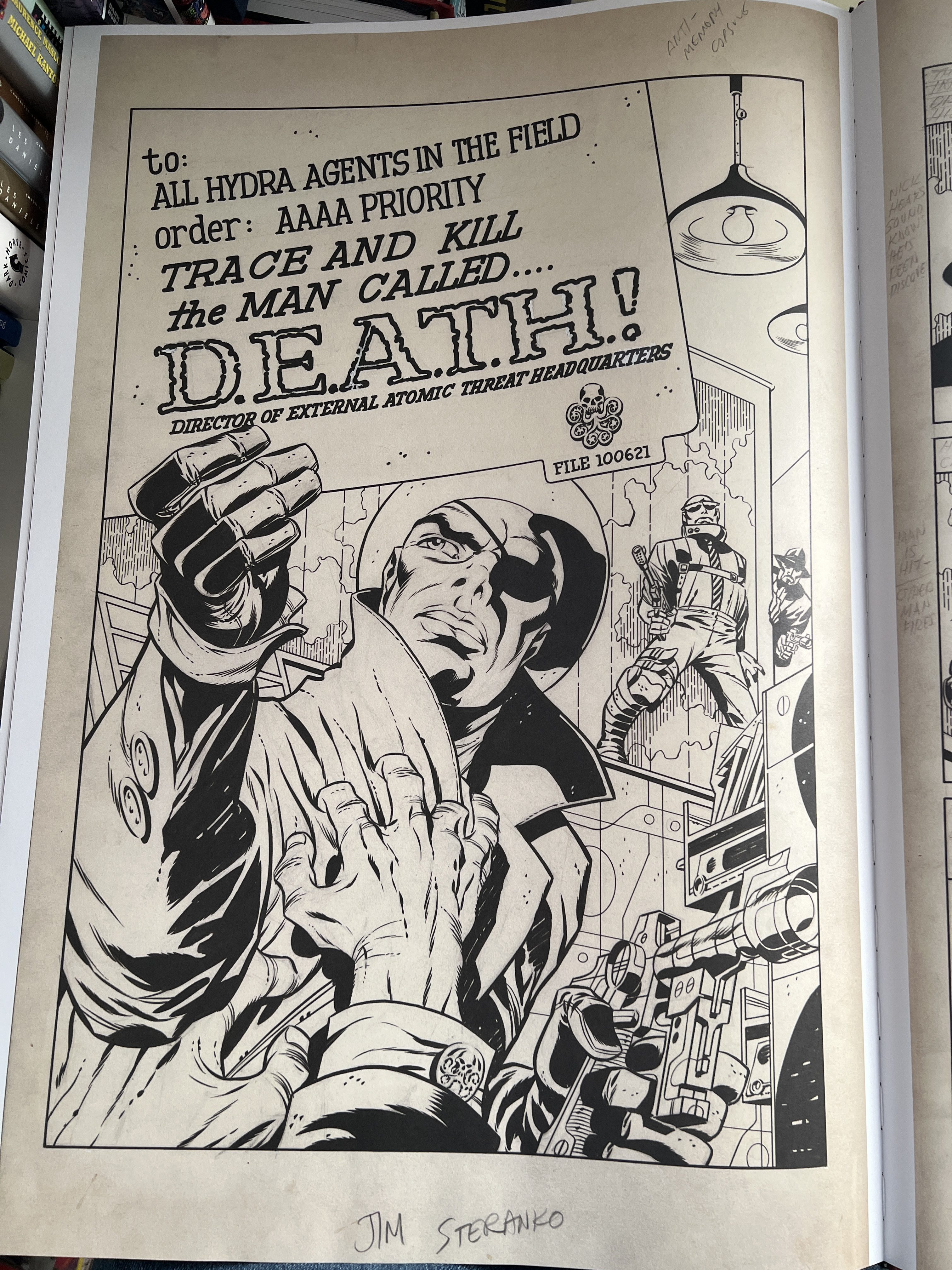
The first thing to know is that it appears that the idea to feature WWII-era character Sgt. Nick Fury in a modern day spy context originated with Jack Kirby. Kirby apparently produced a three-page proof-of-concept strip that he both penciled and wrote himself. This wasn’t intended for publication necessarily, but it showcased his vision for what this series might be about. Kirby’s pitch was titled THE MAN CALLED D.E.A.T.H., with D.E.A.T.H. apparently standing for Director of External Atomic Threat Headquarters, whatever that means. Spies were big business at that time, with the James Bond films pulling in big bucks at the theater and The Man From U.N.C.L.E. a hit on television. So Lee was interested in pursuing the strip, but a few changes needed to be made. Starting with the title. I suspect, though I have no proof of this, that Lee felt that the Comics Code would object to Kirby’s death-laden title, so the organization to which Fury would report was instead christened S.H.I.E.L.D., the Supreme Headquarters, International Espionage Law-enforcement Division. The three tryout pages were never used, and two of them wound up being given to Steranko as a try-out, while Lieber ended up with the third.
As was typical of the manner in which he worked with Lee at this time, Kirby added detailed border notes in addition to his proposed copy. For the sake of clarity, I’m going to reproduce these as we go. This splash page has very little in addition to the title blurbs that Steranko has lettered. The assumption is that Kirby wrote those words, though there’s now perhaps reason to think that Steranko may have made some changes of his own while producing these inks.
There is one stray border note from Jack at the top that mysteriously reads:
ANTI-MEMORY CAPSULE
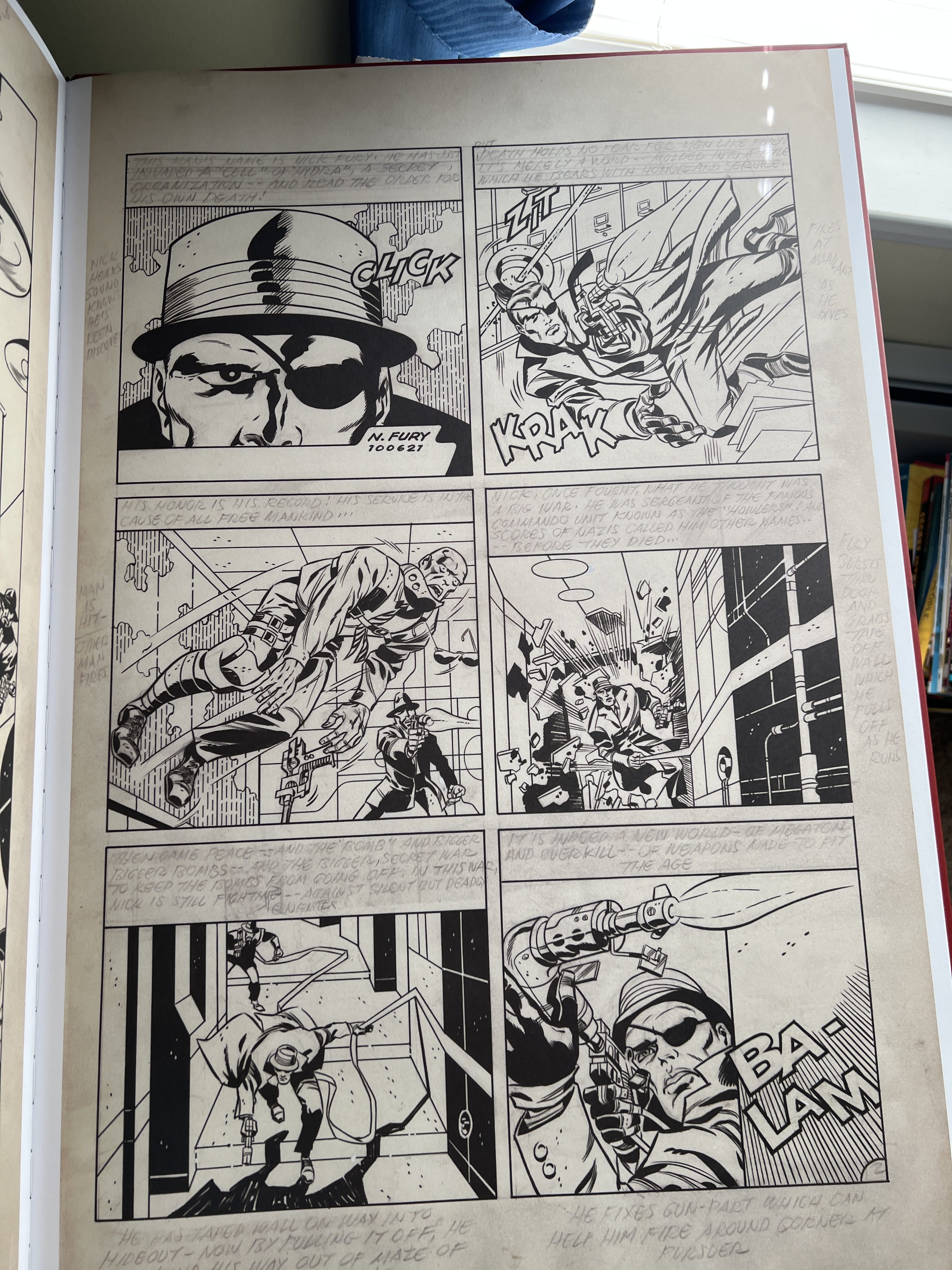
On this second page, Kirby begins to lay out his concept for the strip and its themes:
PANEL 1
THIS MAN’S NAME IS NICK FURY. HE HAS JUST INVADED A “CELL” OF “HYDRA”, A SECRET ORGANIZATION–AND READ THE ORDER FOR HIS OWN DEATH
NICK HEARS SOUND. KNOWS HE’S BEEN DISCOVERED
PANEL 2
BUT DEATH HOLDS NO FEAR FOR MEN LIKE FURY. IT’S MERELY A WORD–MOLDED INTO A TITLE WHICH HE BEARS WITH HONOR AND SERVICE…
FIRES AT ASSAILANT AS HE DIVES
PANEL 3
HIS HONOR IS HIS RECORD! HIS SERVICE IS IN THE CAUSE OF ALL FREE MANKIND…
MAN IS HIT–OTHER MAN FIRES
PANEL 4
NICK ONCE FOUGHT WHAT HE THOUGHT WAS A BIG WAR. HE WAS SERGEANT OF THE FAMOUS COMMANDO UNIT KNOWN AS THE “HOWLERS!” AND SCORES OF NAZIS CALLED HIM OTHER NAMES–BEFORE THEY DIED…
FURY BURSTS THROUGH DOOR AND GRABS TAPE OFF WALL WHICH HE PULLS OFF AS HE RUNS
PANEL 5
THEN CAME PEACE–AND THE “BOMB” AND BIGGER, BIGGER BOMBS–AND THE BIGGER, SECRET WAR TO KEEP THE BOMBS FROM GOING OFF. IN THIS WAR, NICK IS STIL FIGHTING–AGAINST SILENT BUT DEADLY ENEMIES
HE HAS TAPED WALL ON WAY INTO HIDEOUT–NOW BY PULLING IT OFF, HE CAN FIND HIS WAY OUT OF MAZE OF CORRIDORS QUICKLY…
PANEL 6
IT IS INDEED A NEW WORLD OF MEGATON AND OVERKILL–OF WEAPONS MADE TO FIT THE AGE
HE FIXES GUN-PART WHICH CAN HELP HIM FIRE AROUND CORNER AT PURSUER
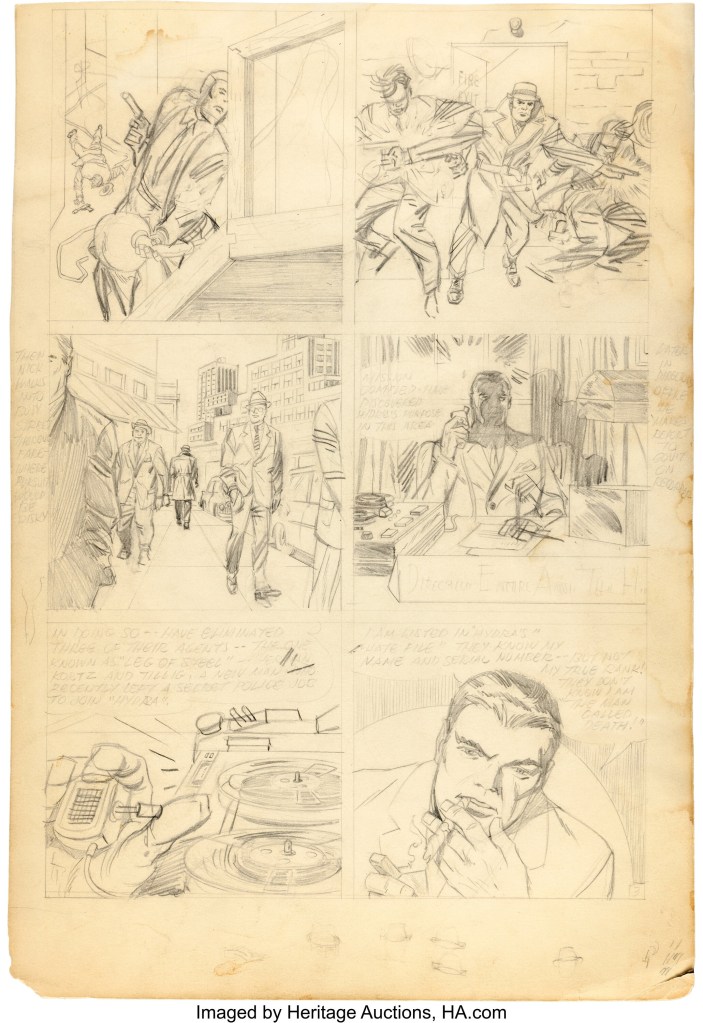
This third page is the newly-discovered one, and it immediately shows that Kirby was penciling Fury as he had appeared in WWII: with two good eyes. Presumably when he inked the initial two pages, Steranko took it upon himself to update Fury to his one-eyed look. And looking ahead to Panel 4, Jim may also have changed the acronym of D.E.A.T.H. as he inked that opening page. Additionally, it’s clear that this penciled page has somebody else’s hand on it, going over Kirby’s lines and tweaking or modifying what Kirby has drawn. This all looks too unskilled to me to have been Lieber, so the perpetrator remains a mystery at this point. The top of the page has been trimmed off as well, likely obliterating more of Kirby’s border notes.
PANEL 3
THEN NICK WALKS INTO BUSY STREET THOROUGHFARE WHERE PURSUIT WOULD BE RISKY
PANEL 4
MISSION COMPLETED. HAVE DISCOVERED HYDRA’S PURPOSE IN THIS AREA
LATER IN DIRECTOR’S OFFICE HE MAKES REPORT TO GOV’T ON RECORDER
DIRECTOR ENTIRE A(illegible) THE H…
PANEL 5
IN DOING SO–HAVE ELIMINATED THREE OF THEIR AGENTS–THE ONE KNOWN AS “LEG OF STEEL”–HERMAN KORTZ AND TILLIG, A NEW MAN WHO RECENTLY LEFT A SECRET POLICE JOB TO JOIN “HYDRA”
PANEL 6
I AM LISTED IN “HYDRA’S” “HATE-FILE”. THEY KNOW MY NAME AND SERIAL NUMBER–BUT NOT MY TRUE RANK! THEY DON’T KNOW I AM “THE MAN CALLED DEATH!”
One gets the impression from this vignette that, rather than the sprawling military outfit that S.H.I.E.L.D. was, Kirby’s initial remit was to have Fury operating largely on his own as a lonely soldier in a covert cold war. So it would have been conversations with Lee and the influence of media like THE MAN FROM U.N.C.L.E. that shifted the eventual strip more in that direction.
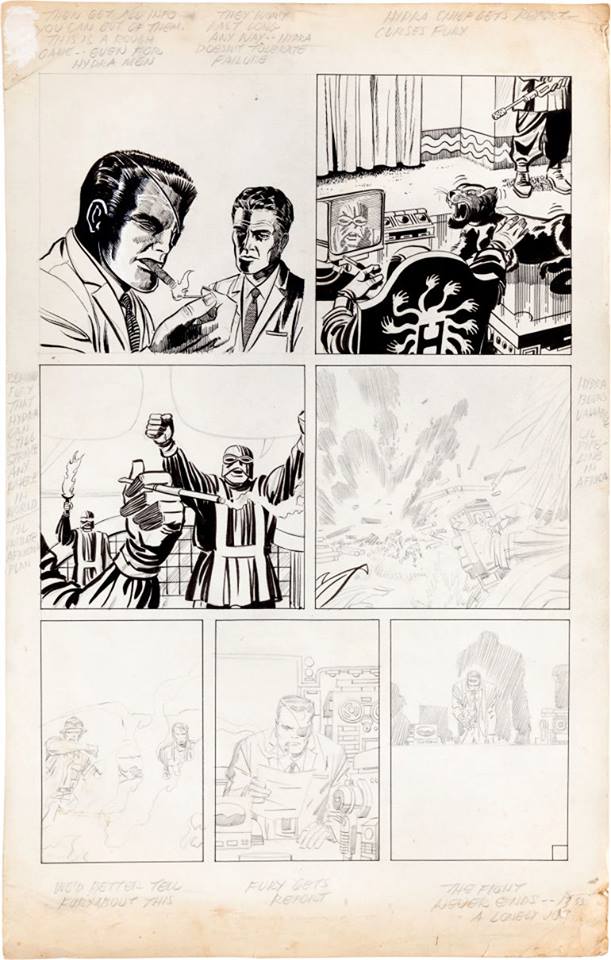
There’s also been this page floating around, on which some aspiring inker took some practice. From context, it appears to be a last page discarded from the NICK FURY, AGENT OF S.H.I.E.L.D. story in STRANGE TALES #135, the opening installment of the feature. But it doesn’t appear to originate with the MAN CALLED D.E.A.T.H. pilot strip. If nothing else, Kirby clearly pencils Fury with his eyepatch on this page, unlike in the D.E.A.T.H. samples.
PANEL 1
THEN GET ALL INFO YOU CAN OUT OF THEM. THIS IS A ROUGH GAME–EVEN FOR HYDRA MEN.
THEY WON’T LAST LONG ANY WAY–HYDRA DOESN’T TOLERATE FAILURE
PANEL 2
HYDRA CHIEF GETS REPORT–CURSES FURY
PANEL 3
REMIND FURY THAT HYDRA CAN STILL STRIKE ANYWHERE IN WORLD
I’LL INITIATE AFRICA PLAN
PANEL 4
HYDRA BLOWS VALUABLE OIL PIPELINE IN AFRICA
PANEL 5
WE’D BETTER TELL FURY ABOUT THIS
PANEL 6
FURY GETS REPORT
PANEL 7
THE FIGHT NEVER ENDS–IT’S A LONELY JOB
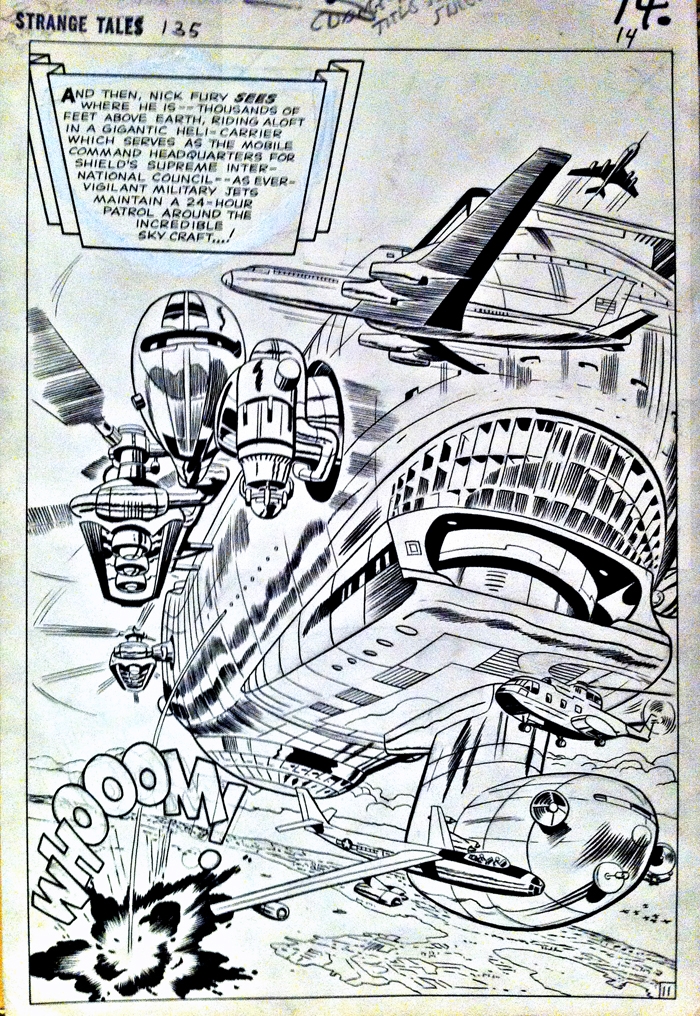
There’s also this page, which was part of that initial S.H.I.E.L.D. story in STRANGE TALES #135. As you can see, that caption in the upper left was originally shaped like the title logo to the strip, and a comment at the top from Lee indicates:
CHANGE TO TITLE STYLE SHIELD
Which seems like it was done, then reversed before the strip sent to print. it makes me wonder if there was some point where Lee was considering making this splash image the opening page of the story.
There’s also a faded partial border note from Kirby at the upper left that reads:
CHAIR BLOWS UP


That gun Nick uses to shoot around corners, I know I have seen either in a TV show ( It was the modern S.W.A.T. tv series –just changed movie to TV series to find it. It appears in 3 other TV series – Standoff, Numb3rs & CSI: Miami ) or Movie a gun that does that. In the real world there is The CornerShot ( wikipedia.org ): The CornerShot’s purpose is similar to that of the periscope rifle and the curved barrel( German: Krummlauf ) attachment on the Sturmgewehr 44 rifle in World War II; it allows its operator to both see and attack an armed target without exposing the operator to counterattack.
LikeLiked by 1 person
Jack Kirby’s original Hydra symbol was different than the later Spectre ( James Bond ) looking symbol.
LikeLike
Probably should have said the symbol on the back of the chair, I just noticed the symbol on the splash page file and cufflink.
LikeLike
Should have mention this yesterday when I thought of it, but Nick Fury as The Man Called D.E.A.T.H. brought to mind him as the Man on the Wall in the Original Sin series( a series I wasn’t a fan of. Also if the Marvel Universe is big enough now for 2 Spider-Men and Captain Americas then it is big enough for 2 Nick Furys. Never understood why the original Ultimate Universe didn’t just make Gabriel Jones the head of SHIELD and kept the Caucasian Nick Fury as a field agent ( a job a real head of an organization like that would never do –be both the head and a field agent) ).
LikeLike
I’ve always wondered if the name change to SHIELD was prompted by De Gaulle’s problems with NATO and SHAPE (Supreme Headquarters Allied Powers in Europe) in the mid 60s, resulting in its being in the news.
France would withdraw from NATO in 1966 and SHAPE would move from Paris to Brussels.
Readers would have been familiar and comfortable with a SH acronym as opposed to the unwieldy DEATH.
Though SHIELD has its own problems in that regard.
LikeLike
I prefer the Kirby stuff to Steranko’s ink job. I might not be the biggest Silver age Kirby fan but I’ll take him over the brief comic artist Steranko. Kirby’s legacy can be seen nearly every month from any number of artists. The only a rtist who took cues from Steranko after his blip of a time in comics I can think of was Paul Gulacy but he improved on that style greatly.
LikeLike
Early Barry Smith was influenced by Steranko as well, but, to paraphrase Monty Python, “he got better”.
LikeLiked by 1 person
This art is certainly fun. I also get what Steve’s saying about Steranko’s brief time in comics – although I enjoyed his style. Big question for me is why didn’t this series catch on? Did they jump on the “spy wagon” too late? It’s my understanding that the Steranko issues were Marvel’s lowest selling at the time.
LikeLike
Very cool stuff. Always a treat to get more of a glimpse behind the curtain like this.
And it’s interesting that Kirby was the source of the Howling Commandos, via that 1950s newspaper strip pitch — which I think also had a grimmer title — and the source of the updated modern-day Fury as well.
LikeLiked by 2 people
Just a thought, “Anti-Memory Capsule” reminds me of Mister Miracle #3 “The Paranoid Pill!”. Thus maybe it was intended as a subtitle for the story.
Though a “memory capsule” is usually a container of historical documents, not a drug, so perhaps it meant some sort of faked historical documents.
LikeLike
I was thinking an anti-memory capsule was something you used to suppress memories, so you couldn’t reveal secrets if captured. Less drastic than a suicide pill.
LikeLiked by 1 person
I was thinking the same thing and my mind went to the Orchid [ Blackstone, the Magician Detective#2 ( May 1948 ) last story–robed criminal, used orchid gas to erase his victims’ memories, opposed by Blackstone the Magician –marvunapp.com — Master List under Or ] and DC Comics Amnesium [ Superboy#55 ( March 1957 ) an alien mineral that induced memory loss –dc.fandom.com –image seen says it emits radiation ]
LikeLike
Could be, though there’s no panel with anyone taking any sort of pill. And this seems fairly hard-boiled within comics limitations. I can easily see Kirby doing a scene where he originally has a captured agent swallow a suicide pill, but it later editorially gets softened to an anti-memory pill. But that doesn’t appear to fit having that phrase as a note at the top of the first page.
LikeLike
It may not be a plot note. Could just be an idea that came to Kirby for later in the story, so he made a quick note.
LikeLiked by 1 person
Or possibly something to erase secrets after a mission? I’ve seen versions of that idea elsewhere over the years.
LikeLike
Although I only watched the first season, that’s the basic premise of Serevence, but, if I recall correctly, it’s an implant that keeps the workers’ memories compartmentalized.
LikeLike
Regarding panel 4: “DIRECTOR ENTIRE A(illegible) THE H…”
In “THE”, the last character doesn’t look like “E” to me, more like “N”.
Maybe the “H” is really “IT”? “A(illegible)” would fit as “AREA”, though the squiggle is indeed very unclear.
But it definitely doesn’t look like “Atomic”.
Conjecture: “DIRECTOR ENTIRE AREA TITAN HQ” ?
LikeLike
“Kirby’s initial remit was to have Fury operating largely on his own as a lonely soldier in a covert cold war.”
Well, he’s the director of something.
Though of course he wound up within for the Supreme Headquarters of a Division where every location of it was also the Supreme Headquarters. I always thought the ones that weren’t the central location should have each been a Branch Office International Law Enforcement Division.
LikeLike
*within = working
LikeLike
Probably why it’s now Strategic Homeland Intervention, Enforcement and Logistics Directorate, if memory serves.
LikeLike
The finished story, with Hydra assassinating multiple LMDs of Fury, works better to show them as a formidable force. Just as Fury spotting and disposing of the bomb demonstrates he’s the right man for the job of heading SHIELD.
LikeLike
Why are we ignoring that it is not the Kirby estate selling early Kirby art after all the fights about not returning Kirby’s art
LikeLike
Because almost nobody cares about the issue. Most of the people who sound off about it don’t really care, either. It’s just an excuse to grandstand and attack Marvel.
A few months back Mark Evanier posted a list of original art that allegedly had been stolen from him. It turned out that 55 pages on the list were ones that had disappeared from Marvel’s Silver Age art inventory before 1980. (Apart from Jim Steranko and Gray Morrow, Marvel didn’t return Silver Age originals to artists before 1984.) The pages Evanier listed included a complete Jack Kirby Fantastic Four issue and a complete Gene Colan Iron Man episode. Where did Evanier get this art? He won’t say, but it all but certainly didn’t come from Kirby, Colan, and the other artists. This was pointed out to people in some high-profile comics forums, and most of the response beyond indifference was anger over this being pointed out at all. Mark Evanier is one of the Good Guys, and that’s that.
I’m not of the view the art was necessarily stolen. I believe that work-for-hire original art was legally Marvel’s property, to do with as they wished, and only returned to the artists out of largesse. If Marvel didn’t consider the art stolen, it wasn’t stolen. But a number of high-profile people publicly took a very different position. But when push comes to shove with the issue beyond using it as an excuse to badmouth Marvel, they couldn’t care less.
LikeLike
Correct me if I’m wrong, but I don’t think there ever was a specific legal judgement in favor of comic book artists owning their original work-for-hire art pages. As I understand it was a shift in industry policies over time as a result of contracts being altered for newcomers like Neal Adams and Steranko to get their art back… and that resulted in fairer practices. Not exactly largesse on the publishers part since it was also a result of pressure and some professional shame, but it wasn’t like all the art in Marvel warehouses was deemed retroactively stolen property either.
LikeLiked by 1 person
To the best of my knowledge–and I’ve looked–there has never been a legal judgment in favor of comic book artists owning their original work-for-hire art pages. I don’t know that any artist has ever even brought suit. The money-for-art transaction for work-for-hire art meets the definition of a sale under the Uniform Commercial Code and related laws, which means the publishers owned it.
Work-for-hire artwork started being returned circa 1973-1974 because it was a way for comics publishers to increase compensation for the artists without paying them more money. I define it as largesse because there was no legal obligation to do so, and there were operations, such as Mad Magazine, that continued to refuse to do returns. There was no shift in contracts. The few written contracts with Kirby, the Buscemas, and a few others didn’t have provisions for artwork return. Adams and the other journeymen, who didn’t have written contracts, didn’t have any arrangement for artwork return, either. Steranko and Morrow were able to get their artwork returned because, as Roy Thomas put it, they were able to “sweet-talk” Stan Lee into agreeing to do so, but I don’t know that anything was agreed to in writing. I doubt there was.
Original-art return became a public issue with Jack Kirby’s conflict with Marvel in the 1980s. Kirby unfortunately took some irresponsible and legally erroneous blather from Neal Adams at face value, repeated it to Marvel in demand letters, and found himself locked out of the Silver Age art returns Marvel began after it was taken private in 1983. While Kirby may not have intended it as such, claims like he only sold Marvel one-time reproduction rights were implicitly ones of copyright ownership, and there was no way the artwork was going to be returned until he backed off those claims in writing. He eventually did, and the matter was resolved in early 1987.
However, while that nonsense parade was going on, Frank Miller, The Comics Journal, and the dozens of professionals who signed TCJ’s Kirby original-art-return petition all took a public stand that the artwork was Kirby’s property and Marvel had no legal claim to it. That’s what I was making reference to.
LikeLike
Probably because the fight wasn’t over whether Larry Lieber should return Kirby’s art, but over whether Marvel should.
Nobody expected Marvel to somehow claw back all the original art that had been given to (or taken by) others, and this piece would almost certainly have gone to Lieber in the mid-60s, long before the fight began, or artwork returns were at all common.
Since this material was almost certainly never paid for by Marvel, they didn’t really have the right to hand pages of it to Jim Steranko to do sample inks on, either. But that, too, was long before the issue came up.
We also don’t know how it ended up with Lieber. It seems unlikely that Kirby would have given it to him, but we don’t know for sure he didn’t.
It would be nice if Marvel had carefully preserved all the originals and had them all on hand to return to all the artists of the day, but they had no plans to ever do so at the time, and no idea that one day they’d need to do so. So stuff got handed out.
At DC, they destroyed art, and gave some away to people who wrote in letters of comment, things like that.
LikeLike
Larry Lieber retrieved Hulk pages that Kirby had torn up and thrown in the bin. Maybe he saved that Nick Fury page from being tossed out, too.
LikeLike
Tongue-in-cheek: Could we just do a version of “land acknowledgment”? Something like “art acknowledgment”:
“We view original pieces of unceded artwork of the Kirbies, Colans, and all other artists who were unfairly treated. Through this acknowledgment, we renew our commitment to continue the process of working to dismantle the ongoing legacies of exploitative capitalism. And we invite you to join us by taking action beyond this acknowledgment by supporting creators’ rights.”
LikeLike
I own Supergirl: Woman of Tomorrow: The Deluxe Edition and it has the rejected original script for issue 6, which is completely different from the accepted final script. However, it’s just that, words, but no artwork. Seeing these original penciled (and partially inked) pages is so much better.
LikeLike