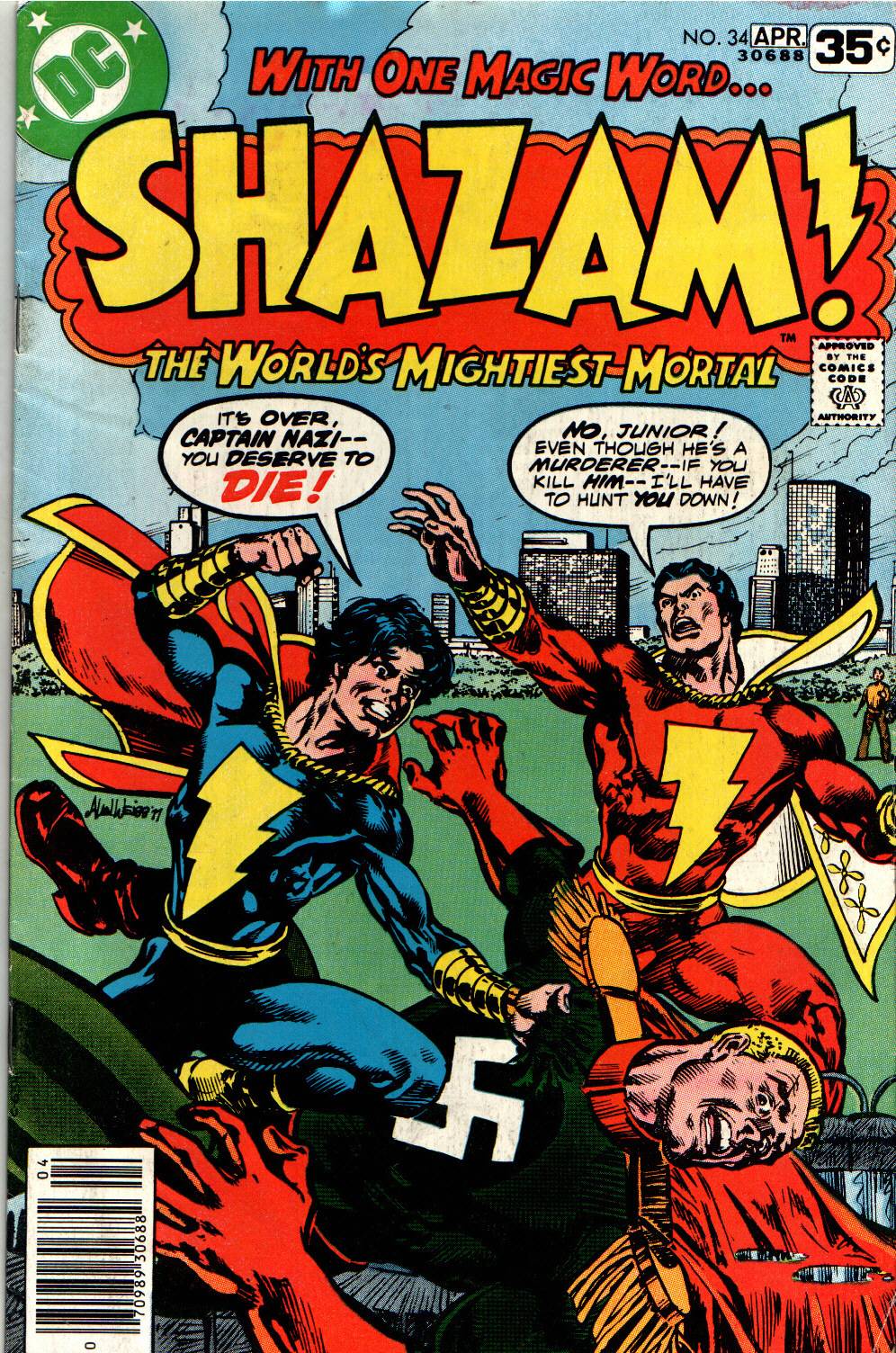


Now this next issue of SHAZAM was something of a shock to the system, and one that was only slightly blunted by the fact that I’d seen this cover in contemporaneous house ads when it had come out. This was right towards the end of the complete run of SHAZAM that I had borrowed from my grade school friend Donald Sims. The art style is completely different, the golden age approach exemplified by C.C. Beck and more recently Kurt Schaffenberger has given way to a more contemporary realistic treatment. And not just that, but an almost aggressive one. Just look at Junior’s demented expression on this cover. It’s as though a regular issue of SHAZAM had taken some mind-altering hard drug.
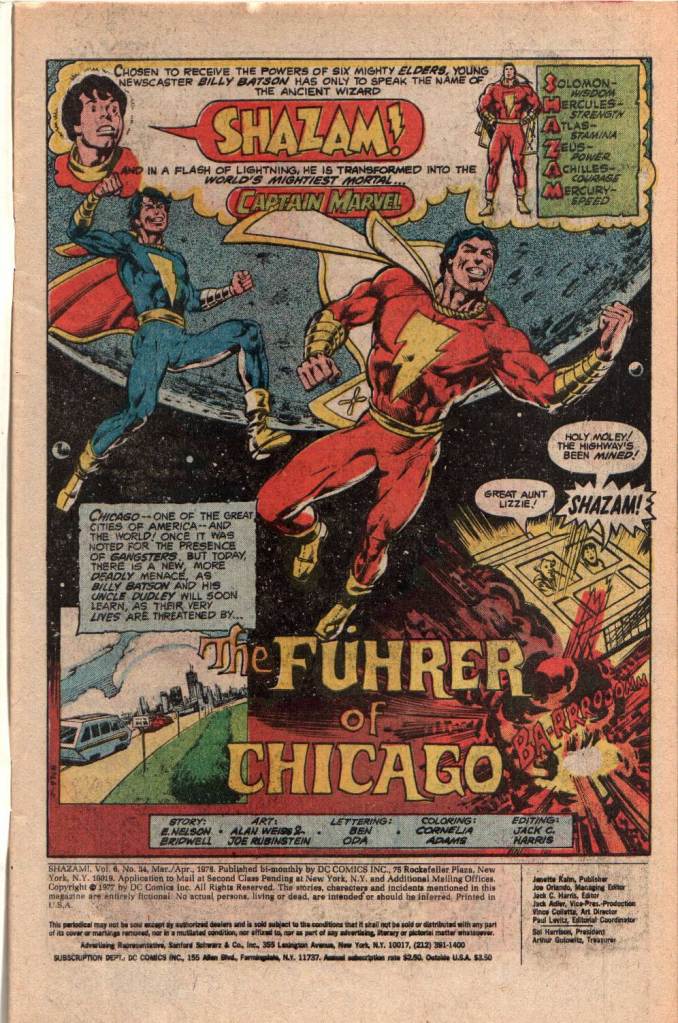
The artist in question was Alan Weiss, an excellent craftsman whose greatest professional drawback was the fact that he was enough of a perfectionist that it took him forever to draw a story. My sense is that Weiss was intended to take over the series as its new regular penciler, but this would be the only issue he’d ever draw. (And, of course, there’d only be one additional issue after this, though the strip migrated over to the Dollar comic-sized WORLD’S FINEST COMICS thereafter.) It was a Hail Mary attempt on the part of editor Joe Orlando to save the book by bringing its style into the present, while also reflecting the live action look of the Saturday morning television series. It didn’t work, but from this point forward, Captain Marvel and his contemporaries were hereafter depicted in the same manner as any other DC feature.
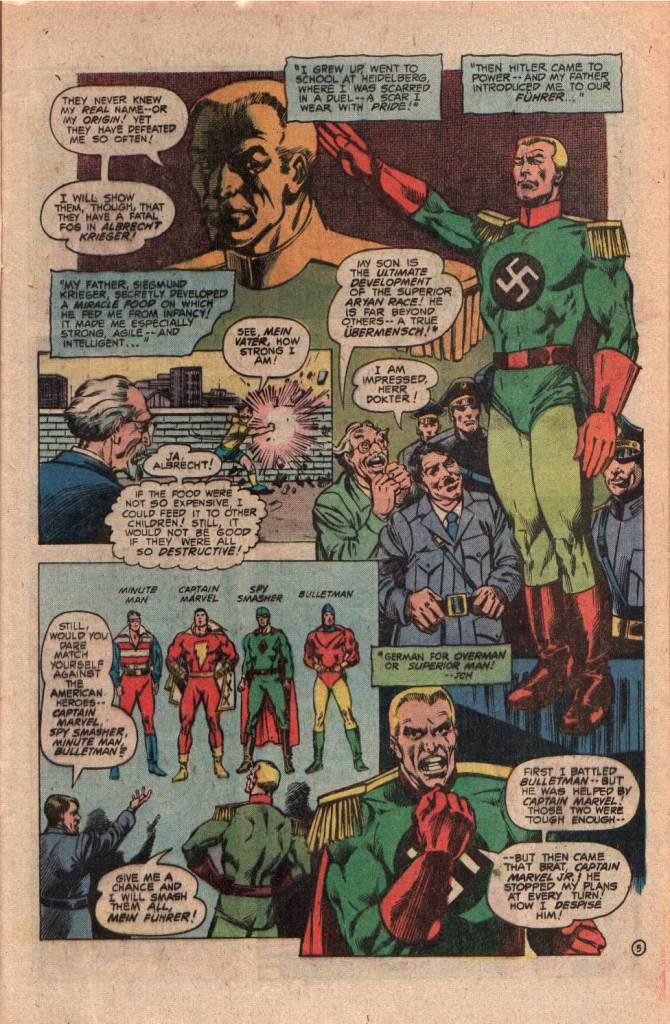
Story-wise, writer E. Nelson Bridwell doesn’t change up his approach any, and I kind of suspect that he hadn’t been told about Orlando’s plan to switch up the art style prior to writing this story. It’s very much along the lines of what Nelson had been doing all along: an adventure in an new real-world city, the return of a classic Fawcett-era villain, and lots of history. The only thing missing is the Eterni-Phone and a consultation with the Elders from whom Captain Marvel’s powers are derived. Artist Weiss does keep one aspect of the earlier approach to the strip: he continues to depict Billy Batson as having dot eyes, which look positively disturbing in most panels, like he’s somehow a mannequin come to life or some such. This aspect did not work for me at all. Weiss’s characters also all tended to be large and muscular, like weightlifters, and so his Cap comes across as a bit muscle-bound somehow.
The story opens on the outskirts of Chicago, where Mentor and Billy’s RV runs into a mile field hidden on a local highway–how the Neo-Nazis responsible set it up there without anybody noticing is never addressed. Summoning Captain Marvel, the Big Red Cheese clears out the minefield. But the RV needs repairs, so Cap takes it and Uncle Dudley to a service station while Billy continues on to their destination at Amalgamated Broadcasting. There, Billy is told that a Neo-Nazi group is no doubt responsible for the minefield, and that the group has come under the sway of a secretive leader known only as the New Fuhrer. This turns out to be Captain Nazi, a golden age villain who was responsible for the series of events that empowered Freddy Freeman as Captain Marvel Jr.
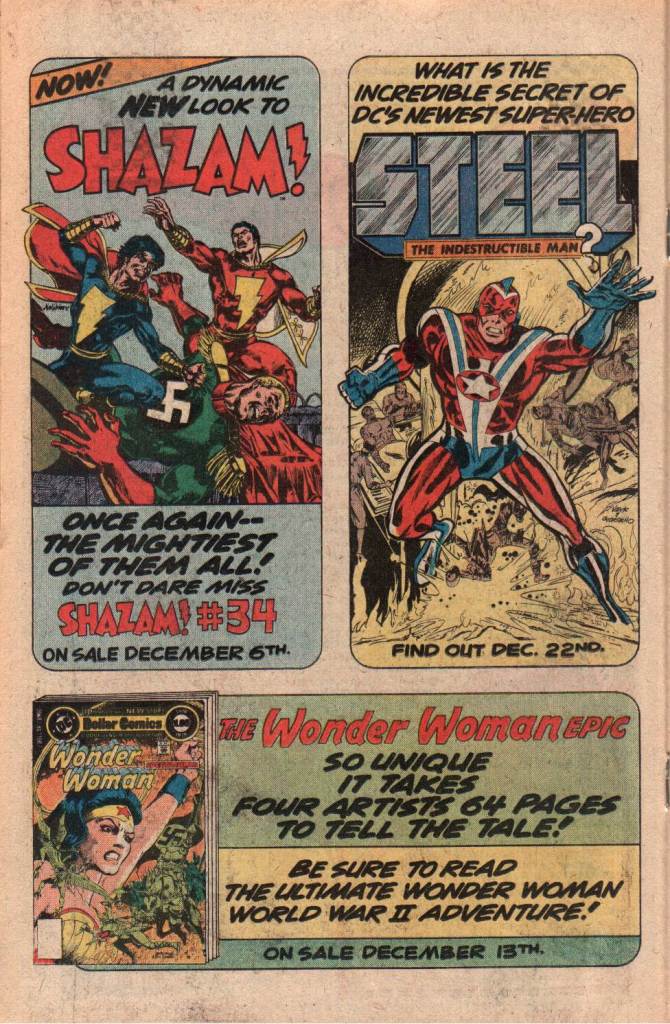
Here from this very issue is the House Ad that promoted the change in SHAZAM, as well as the debut of the short-lived STEEL, THE INDESTRUCTIBLE MAN and the WONDER WOMAN Dollar Comic. all three of these were books that my local 7-11 didn’t receive, so I didn’t get to read any of them until years later.
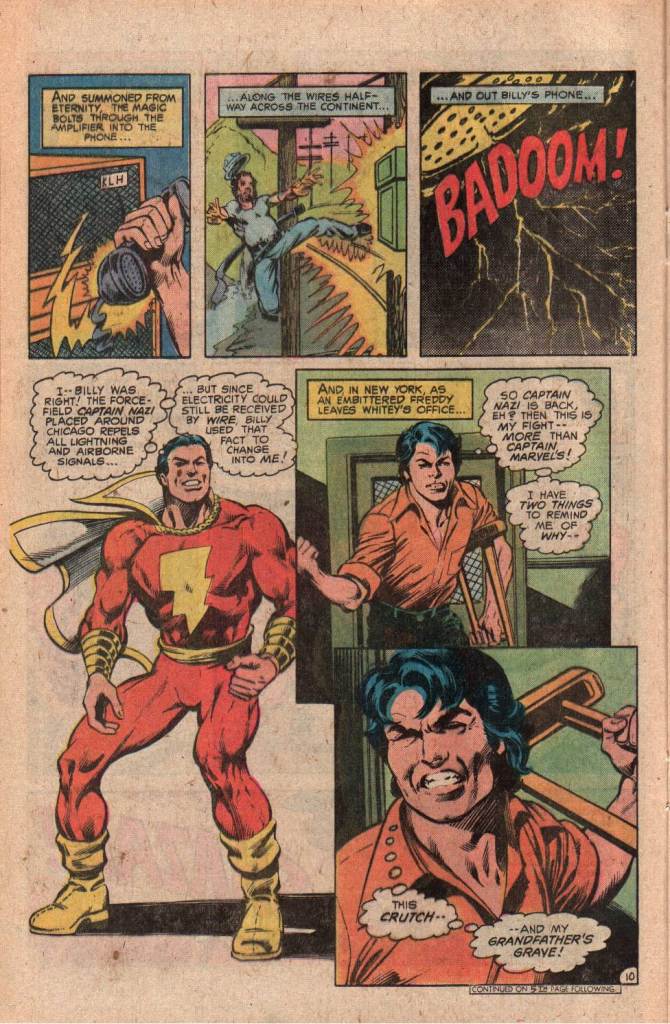
Nelson puts forward an absolutely absurd story about how, having become aware that the Marvel Family and the Sivanas had been placed in suspended animation, rather than proceeding with his campaign to take over the world, captain Nazi put himself into suspended animation as well–“They must not return and catch me off-guard.” Anyway, that’s why Captain Nazi is still around in the present day. He’s also got a plan to seal off Chicago behind an impenetrable force-field–one that even the magic lightning can’t penetrate. But the field doesn’t stop a hard phone line, and so reluctantly, Billy calls Freddy Freeman to tell him what’s going on. Billy’s able to say SHAZAM and have the magic lightning conducted through the phone line to him, materializing Captain Marvel. But Freddy has a burning desire for revenge on Captain Nazi, so he heads towards Chicago as well ready to tear the villainous fascist to bits.
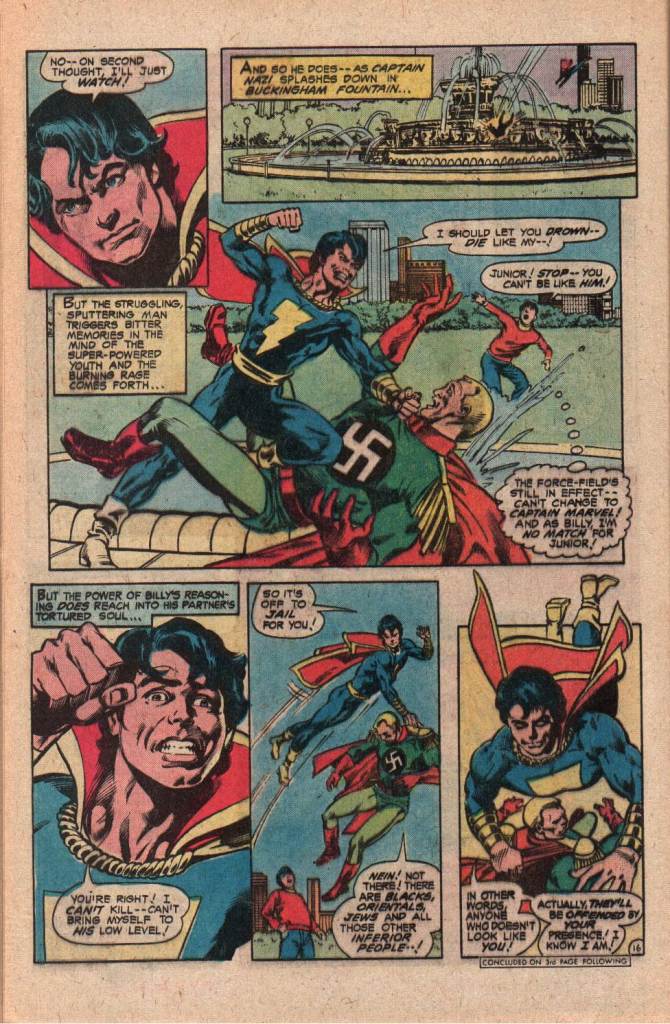
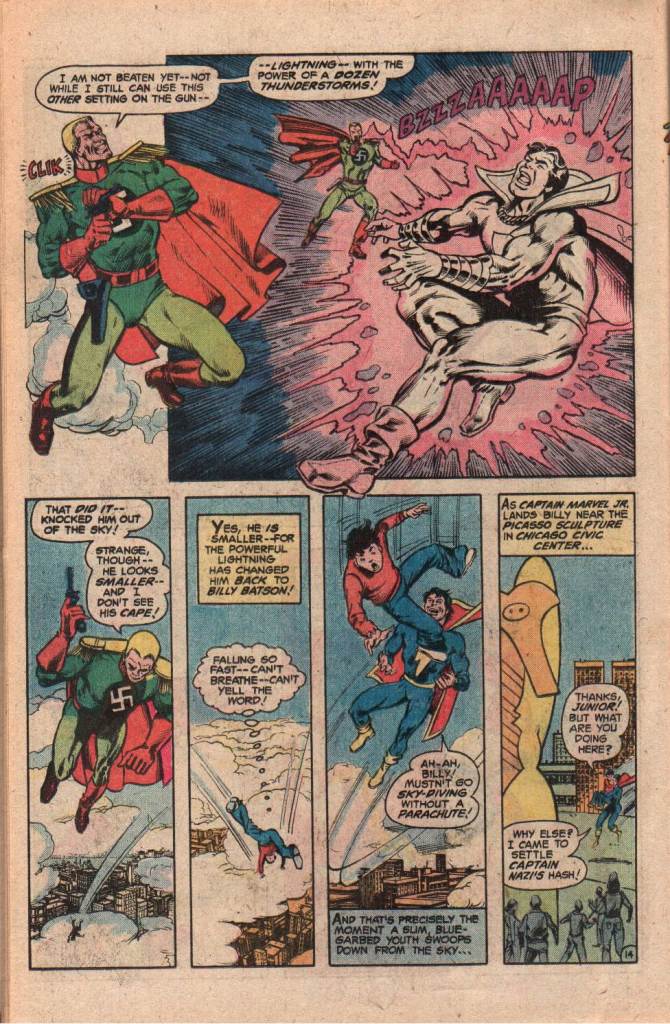
Captain Marvel tracks down Captain Nazi and attempts to clobber him, but the villain is able to remain one step ahead of the World’s Mightiest Mortal due to his flying gas, a genuine 1940s plot device. Nazi also has an electrified weapon which winds up causing Cap to transform back to Billy in midair. Fortunately, it’s at this point that Junior shows up, in time to rescue the falling Billy, who can’t change back because the force-field is still blocking the magic lightning. What’s more, Junior isn’t himself–he’s about ready to kill Captain Nazi despite Billy’s protestations. Junior is able to outmaneuver Captain Nazi’s electricity gun and clock the villain, driving him back to the ground. But in the clutch moment, motivated by nothing much more than his own innate moral goodness and humanity, Junior stops short of slaying his Nazi foe.
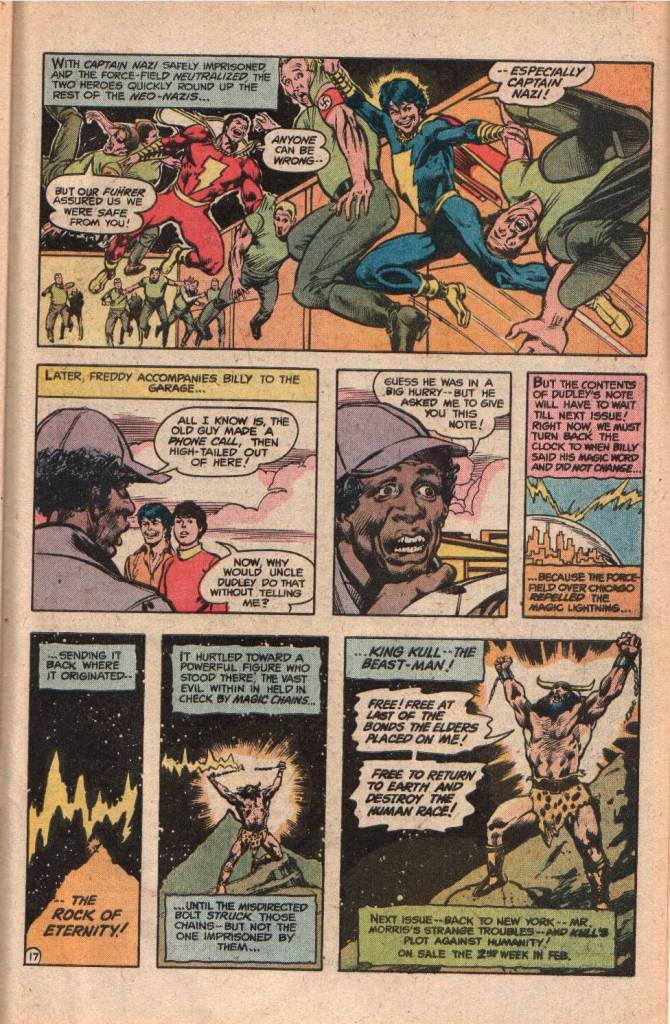
But as the story wraps up, it turns out that there was an unintended consequence of Captain Nazi’s force-field. Because one of the Shazam-bolts that was deflected by it returned to the Rock of Eternity and accidentally shattered the chains of the Beast-Man King Kull, who had been imprisoned there for decades. King Kull would be next issue’s problem, though, because at this point we’re To Be Continued. This is such a strange issue in that it’s something of an uncomfortable mix of Bridwell’s more light-hearted throwback strip and Weiss’s Neal Adams-influenced renderings. I can’t say that I really think it works, though the next artist who would approach the series would be able to strike a better balance. But we’ll see that when we cover SHAZAM ##5 in a few weeks.
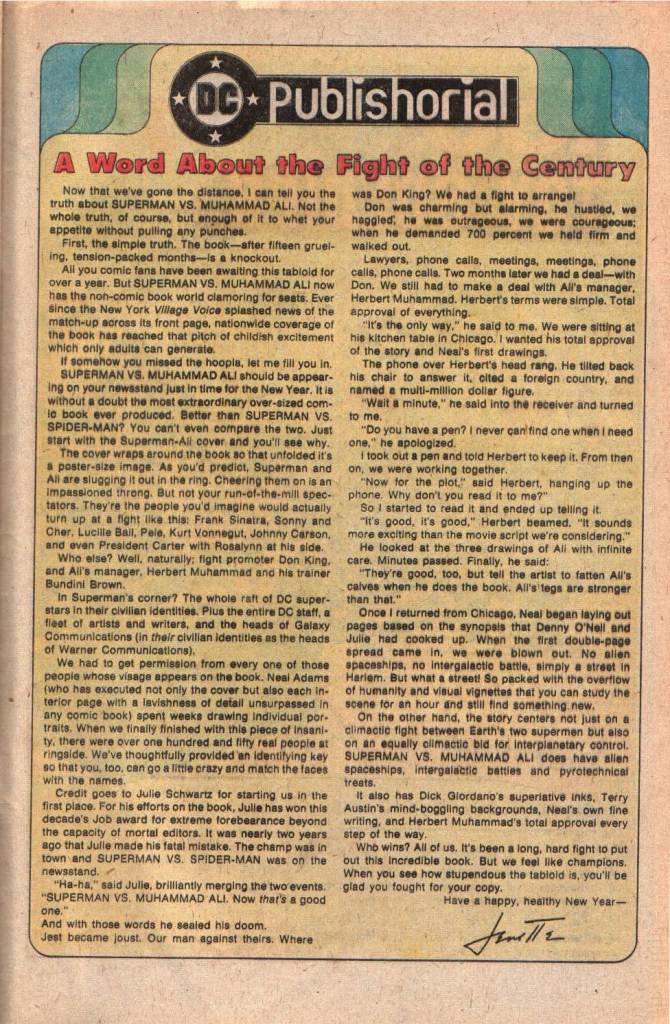
The issue also included a publishorial from Jenette Kahn promoting the then-released SUPERMAN VS MUHAMMAD ALI Tabloid Edition. This is another book that I never saw a trace of back in the day, though I’ve since tracked down a copy. Kahn is effusive in her praise for the project and comes across as just a hair more believable than the manner of bombastic self-promotion pioneered by Stan Lee over at rival Marvel.
 The Tom Brevoort Experience
My first ever issue of SHAZAM, so when I found back issues I was really shocked. I loved the art….
LikeLiked by 1 person
This was a change of epic proportions. It worked for me though the late Don Newton accomplished a similar effect better (insert obligatory but true lament he didn’t last longer and become better known).
LikeLiked by 2 people
I don’t know if I agree that Bridwell didn’t alter his approach at all — it’s hard to imagine a snarling Freddie Freeman swearing vengeance in a typical Schaffenberger-drawn issue, even if he ultimately doesn’t go through with it.
I remember thinking this issue seemed a little desperate…between this and the previous string of reprints, it was clear the writing was on the wall, and SHAZAM wasn’t long for this world.
LikeLiked by 1 person
Make that two comments in a row praising that gorgeous Weiss-Rubinstein art. But I also believe it’s mismatched on a title meant to have a lighter, cartoony appearance. Now put these two talents on an issue of almost any superhero without “cheese” associated with their name and it’s an all but guaranteed winner.
As for the villain, while I know that the Fawcett crew had their origins during the Big One, I still struggle with a Nazi as part the Rogues Gallery of what should be a more whimsical world. But so long as that Nazi as well as any and all of their cohorts are soundly pummeled, I can live with it.
LikeLiked by 1 person
To this day I hold the probably unpopular opinion that this is what they should have done in the first place when they revived Captain Marvel. Apparently, Jack Kirby was the one who suggested that DC bring back Captain Marvel and get CC Beck to draw it. If that’s true, Kirby was wrong. Unless they brought Otto Binder out of retirement there was no capturing that spark of the original and it was always hamstrung by writers (save Bridwell, somewhat) and an editor who Did Not Get It At All.
I think in 1973, Don Newton or one of those up and comers to draw it more realistically) and maybe get Denny O’Neil or Elliott Maggin but have them write it like a modern comic. And that’s kind of what Don Newton did for the last issue of Shazam! and the rest of the run in World’s Finest. And it was great. But it should have been like that from the start.
LikeLiked by 1 person
I’d guess DC was betting nostalgia felt by readers who remembered the original would mean stronger sales. Maybe some in DC editorial thought whatever was appealing to the original audience could appeal to new readers of the same age in the 70’s as the originals in the 40’s. So maybe they’d get older and younger readers. But for me the Golden Age regurgitation paled next to some of the new art coming out then.
LikeLiked by 1 person
They tried something like that in the 1987 “Shazam: A New Beginning”, by Roy and Dann Thomas and Tom Mandrake, with mixed results. To me, Captain Marvel without whimsy or humor seems completely pointless. Maybe the character is just too much “of his time” to ever work in the modern marketplace. In which case, I’d rather see him fade into history than be turned into Wolverine or whatever is popular at the moment.
LikeLike
On seeing Alan Weiss’s cover, even though it’s got his signature alone, it made me think “what if Gil Kane’s breakdowns were finished by Joe Rubinstein”. Then to find Rubinstein’s name in the credit box, inking Wess’s drawings. It’s all a little too sinewy for me. But also not very far from Don Newton’s style, which I really liked. His Captain Marvel is one of, if my single favorite version.
LikeLiked by 1 person
Joe Orlando had been replaced as editor by Jack C. Harris a couple issues earlier. The Captain Nazi story was initiated by Nelson. When Jack called to request a more “emotional” story for issue #34, Nelson suggested he read the script already on his desk. So, both writer and editor were ready for a change.
LikeLike