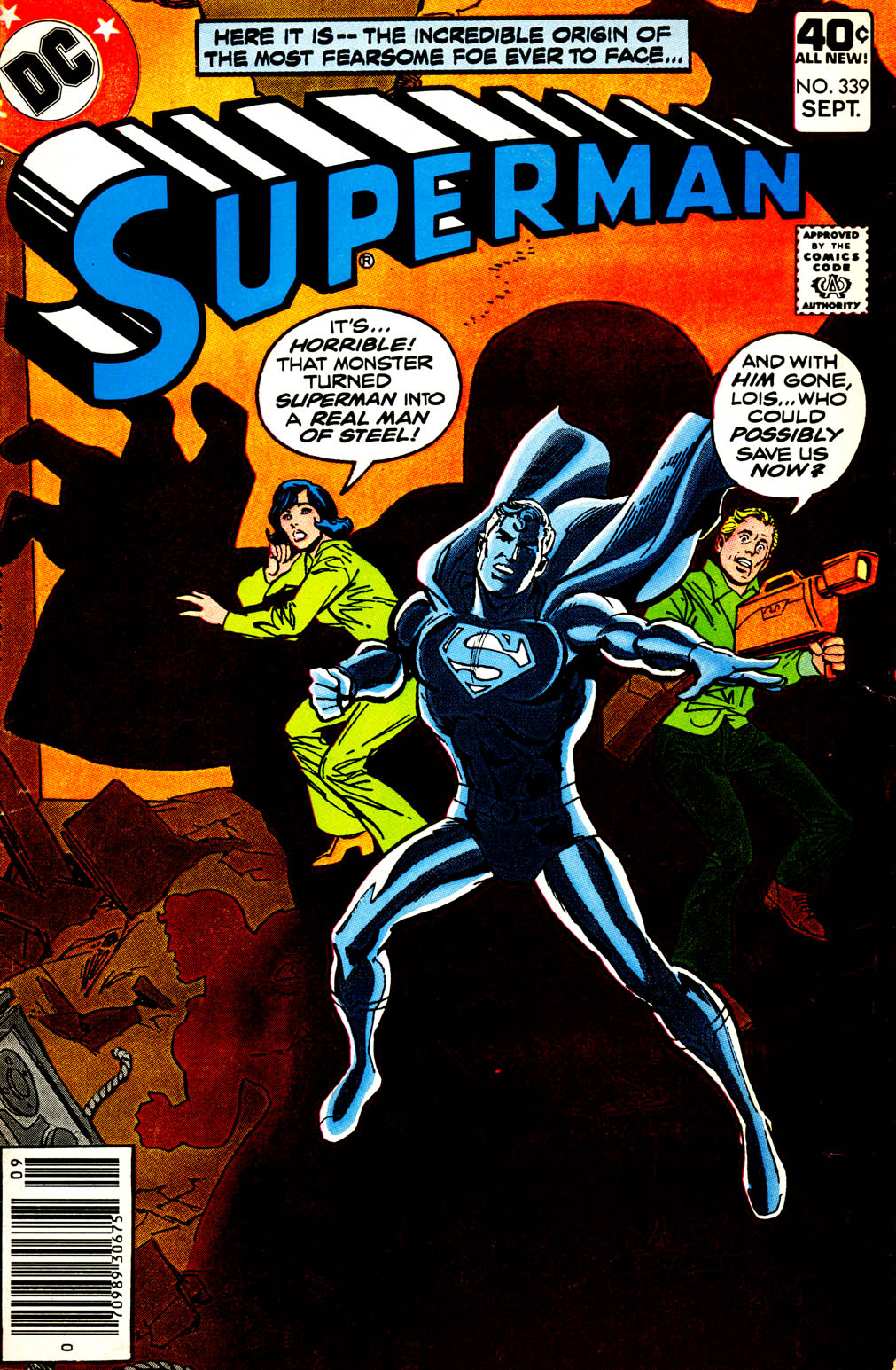


This was another comic book that my household had two copies of. For whatever reason, my younger brother Ken was apparently on a buying spree, picking up his own copies of books that I’d already purchased. And again here, there isn’t anything so noteworthy about this random issue of SUPERMAN to justify that choice apart from the fact that I had bought it earlier. In any event, SUPERMAN was heading into the doldrums a little bit, or possibly I was. With Marty Pasko having departed as the series’ regular writer, the book felt a bit directionless for a long while. And the level at which its stories were being pitched was definitely aimed at a younger crowd than myself at this point. As I got more into the melodrama of Marvel, the more issue-to-issue approach taken by the Superman titles lost a lot of its appeal. The book was always a solid read, but never leapt to the top of my favorites for any week in which I picked up a copy.
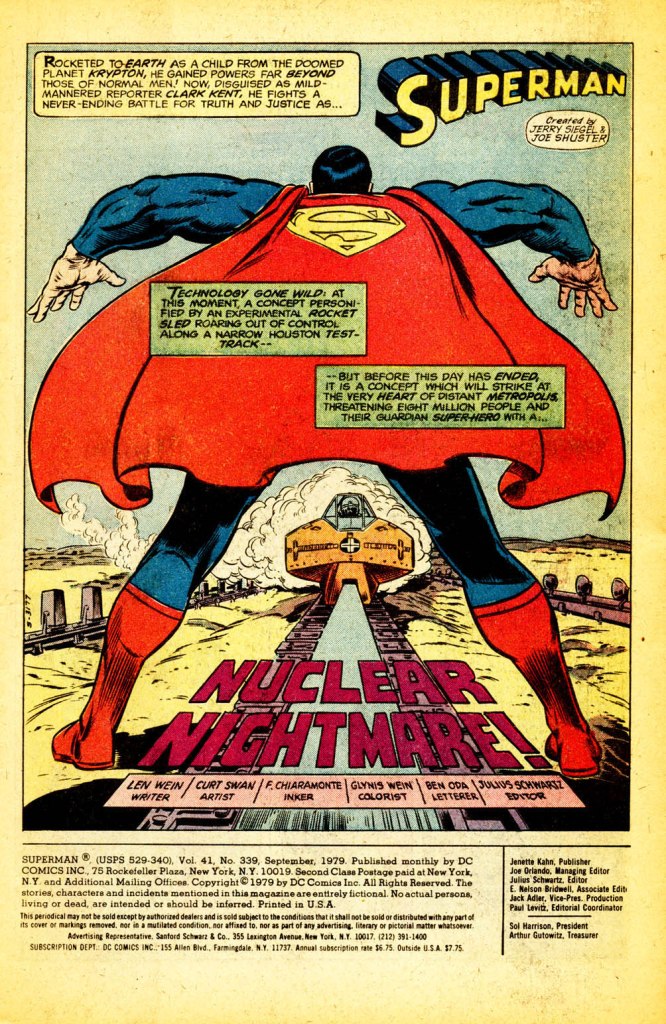
Pasko’s successor on SUPERMAN as writer was Len Wein. Len was a terrific and reliable writer who had quietly been behind some of my favorite releases at both DC and Marvel. But he somehow flew a bit under the radar for me in those days. I had taken note of his longtime friend Marv Wolfman and connected him with books that I liked already, but I hadn’t quite done the same thing with Len yet, even though that was true. As usual, the artwork was handled by Curt Swan, who’d been the Man of Steel’s mainstay for about twenty years at this point. While other people got a chance at the character in assignments here or there, Swan’s work defined the character for decades.
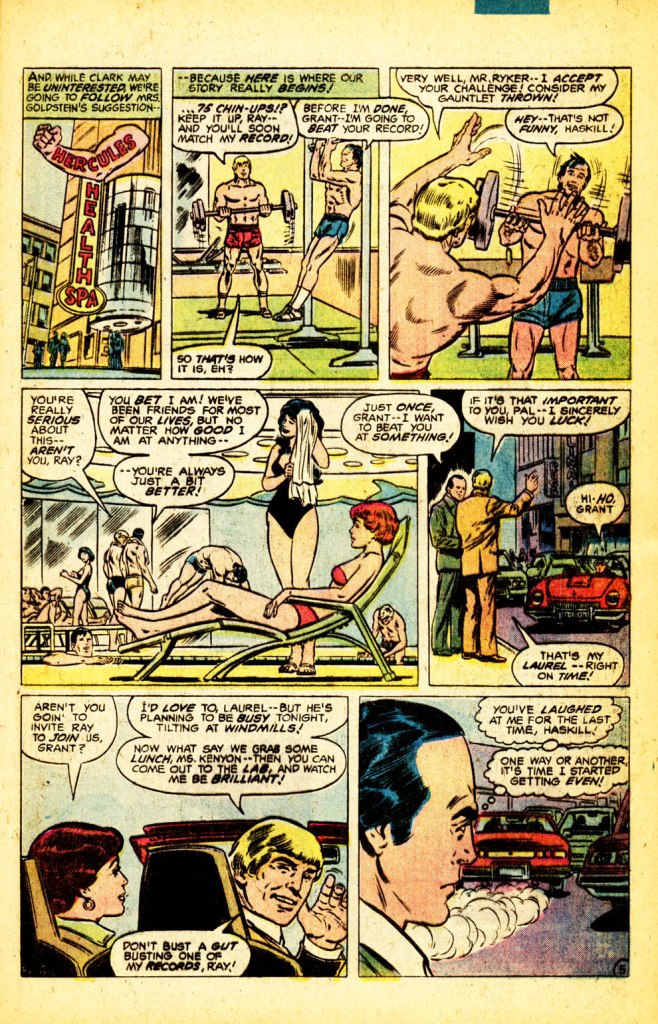
The issue opens with Superman performing a feat unrelated to the rest of the tale, a colorful opening just so that we can see the Man of Tomorrow strut his stuff. Here, he intercedes when an experimental rocket sled goes out of control. Superman is able to bring it to a stop and rescue the operator before heading back to Metropolis to begin his day. Len had introduced a number of other tenants in Clark Kent’s building some years earlier, and here he chooses to bring one of them back: Mrs. Goldstein, the wheelchair-bound Jewish woman who lives down the hall. Clark helps her back to her room while telling her about how he’s working two jobs at the moment, split between his nightly newscast and reporting for the Daily Planet. Mrs. G suggests that he’d benefit from some exercise and suggests that he try out the newly-opened Hercules Health Spa that her nephew goes to.
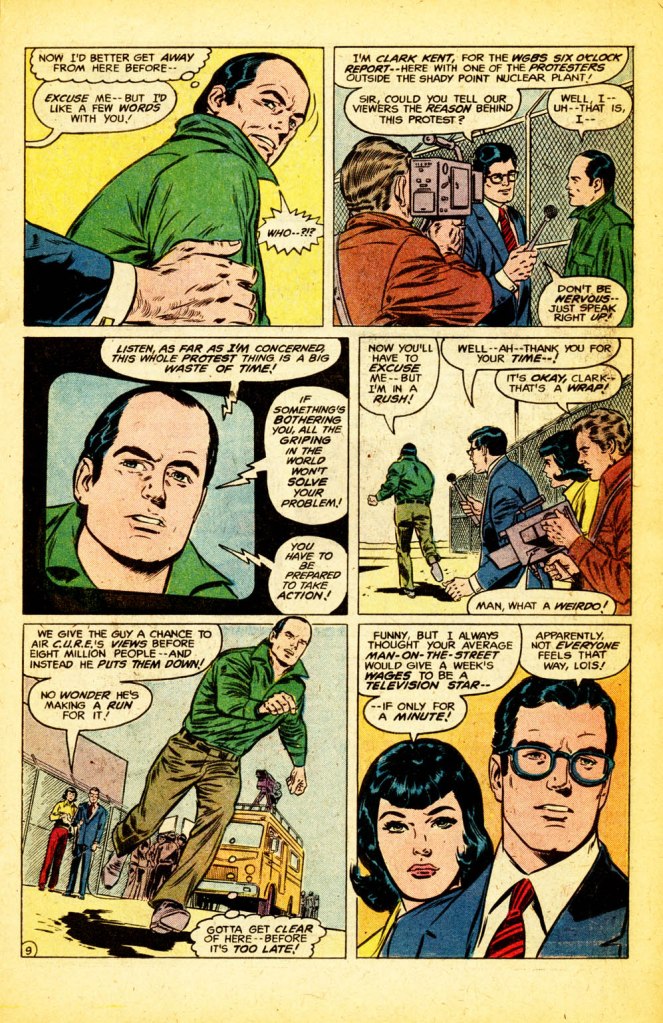
From there, we segue to the just-mentioned Health Spa and focus in on two new characters: Grant Haskell and Ray Ryker. The two are longtime friends, but Ray is just a bit jealous of Grant, who is constantly able to one-up his achievements. Ray is quietly nursing a resentment of his supposed friend, and he’s making plans to redress the situation. Haskell, it turns out, is a scientist working at the Shady Point Nuclear Generating Station which provides electrical power to Metropolis. But the place is being protested by C.U.R.E, the Committee for the Unconditional Regulation of Energy. Ray uses the protestors as a distraction to sneak into the plant and get back out again unnoticed–though before he can take his leave, he’s grabbed up for a candid man-on-the-street spot about the protestors by Clark and Lois Lane. Ray stammers through the piece, not actually being one of the protestors, then dashes away.
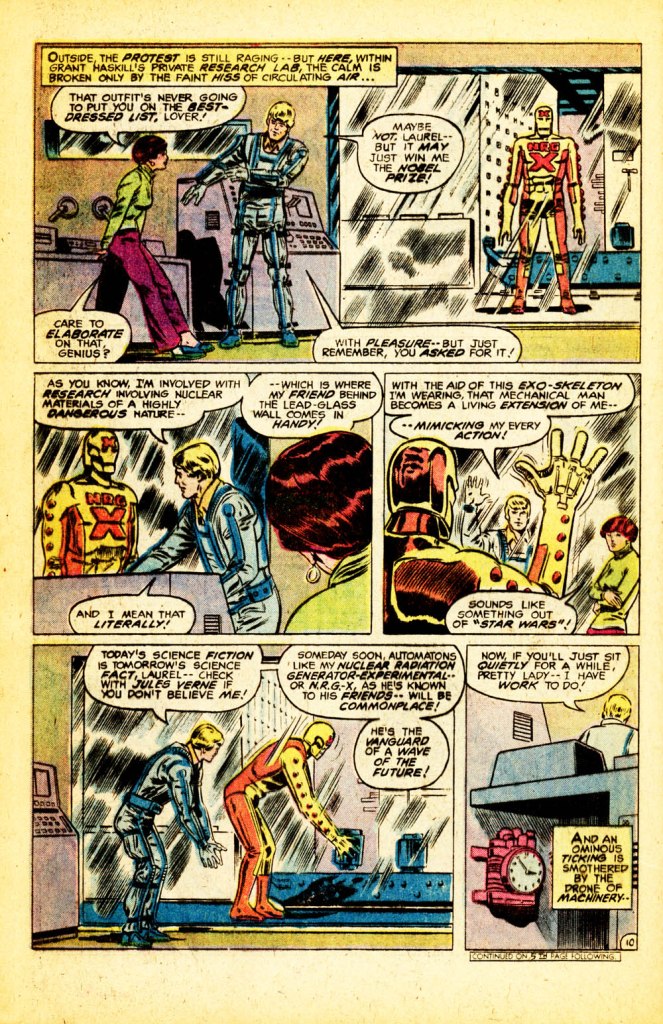
And with good reason. For when we cut inside the building to Grant Haskell’s lab, we learn that Ray has planeted a bomb in the place–clearly he’s a lot more unhappy with his supposed friend than we might have thought. Unaware of the danger, Grant shows off his new creation to his girlfriend Laurel: NRG-X, a robot drone that he can operate from across a great distance. Using the robot, Grant will be able to safely enter the deadly areas of the nuclear reactor to make repairs or adjustments as needed, piloting it remotely through an exo-skeleton that he wears. Unfortunately, while he’s showing off the thing, the explosive planted by Ray goes off in the room.
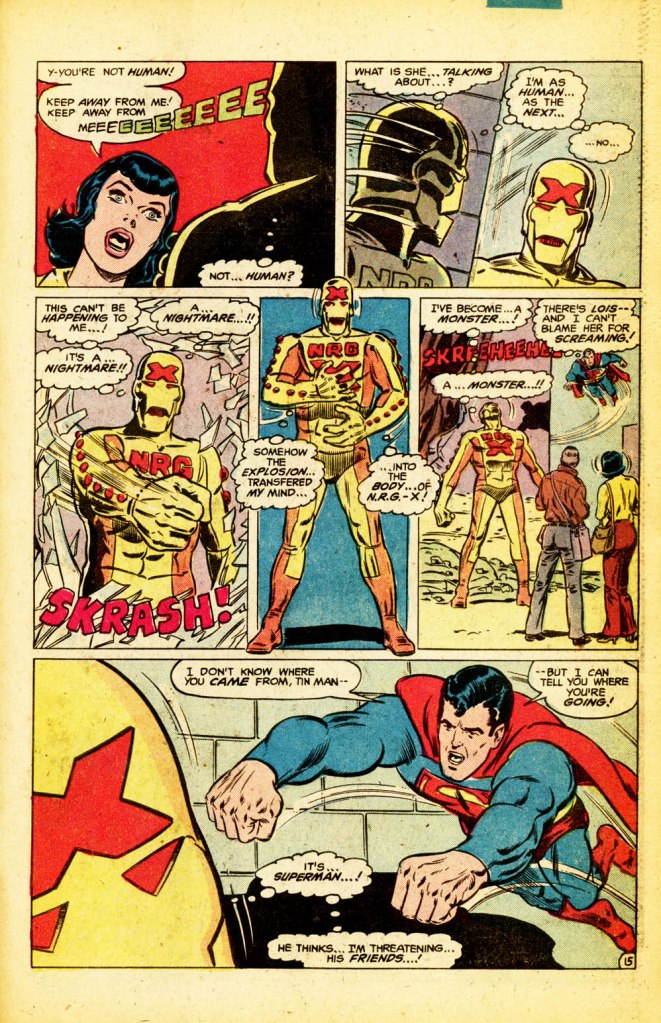
The explosion prompts Clark to become Superman, and he’s able to stabilize the reactor to prevent it from melting down–exactly what the protestors outside have been worried about. Once that’s done. he races into the ruins and pulls out Laurel, who is just a bit shaken up, and Grant, who is now in a coma. Elsewhere, though, NRG-X is thinking and moving, and encounters Lois Lane who has a startled panicked reaction to the robotic figure. Lois’s outcry brings Superman running, and even though the mind that now finds itself trapped in NRG-X isn’t hostile, it’s still forces to defend itself from the Man of Steel’s mistaken impression.
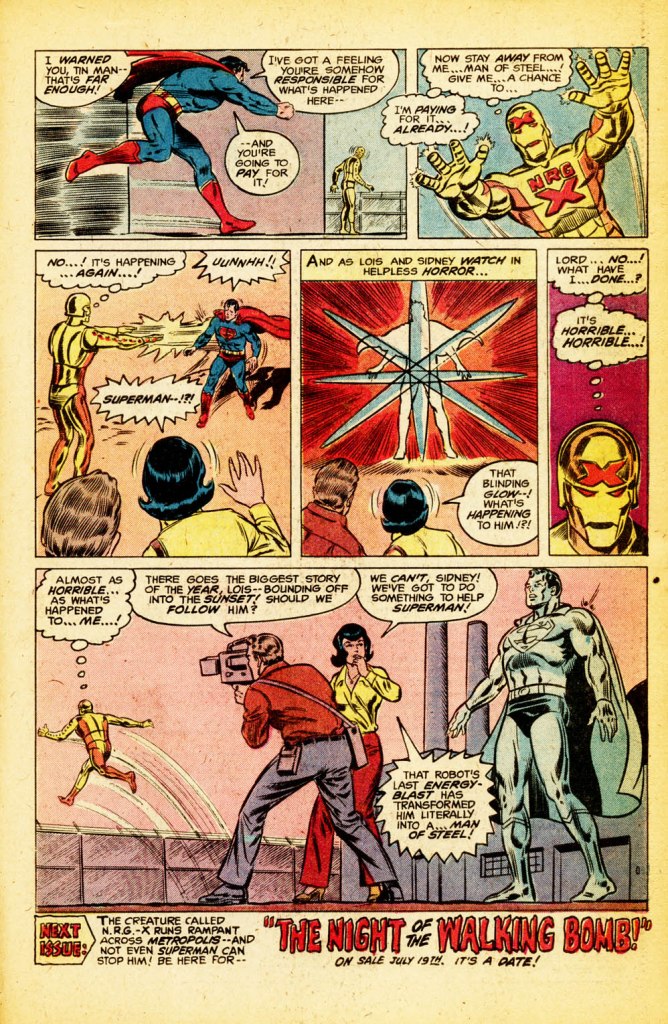
Not only is NRG-X operating entirely on its own, but the explosion has somehow granted it transmutational powers. At a gesture, it blasts Superman back through a wall, and when the Man of Tomorrow gives chase, a second discharge of energy from the robot seemingly transforms Superman into a literal man of steel. NRG-X leaps away off into the night as Lois and her cameraman react, and it’s at this point that the story is To Be Continued. This issue does a thing that I always hated as a reader, where the cover image turns out to be the cliffhanger moment of the story. I always felt cheated whenever that happened (not that I bought this issue because of that situation,. But still…)
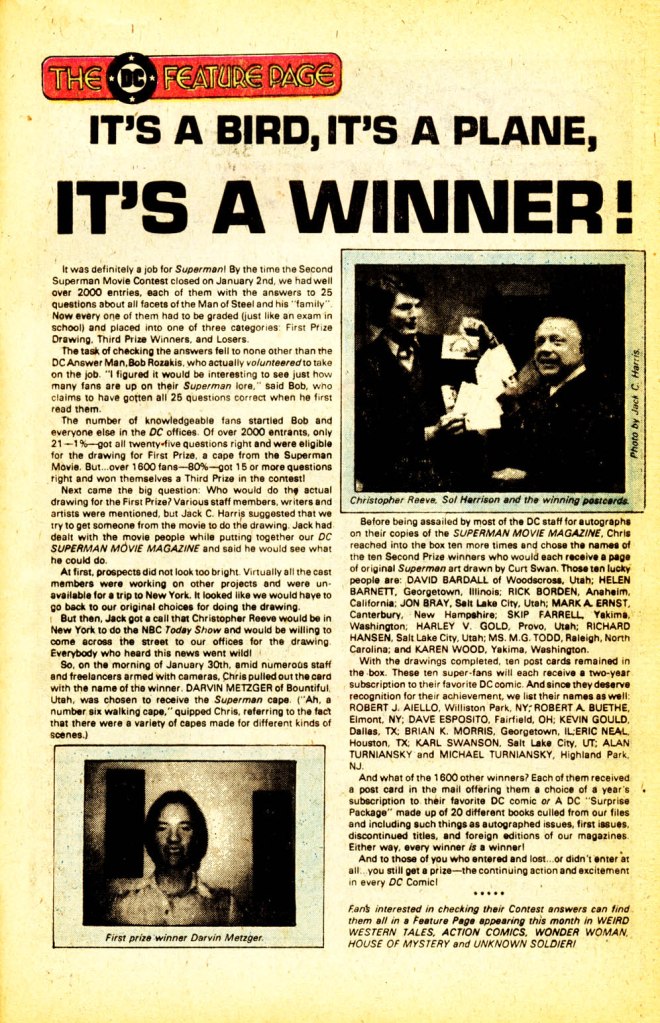
Rather than an edition of the weekly Daily Planet promotional page, this issue instead ran a page announcing the winners of the Second Superman the Movie contest that had played out across the DC books in recent months. Fan Darvin Metzger took first prize after correctly answering twenty-five trivia questions about the hero: a genuine Superman cape worn by Christopher Reeve in the film. Reeve himself was on hand to select the winner from among all of the entries that had correctly answered the twenty-five questions. Unfortunately, the reproduction in the comics of this era is so spotty that the photographs of the event showcased on this page are dark and murky.
 The Tom Brevoort Experience
Everyone did a nice job on this issue — or as nice as they could, since Frank Chiaramonte does a decent but not all that sensitive job over Curt Swan — but I can’t help but think it would have benefitted from being drawn by Sal Buscema.
It’s very much the kind of plotting Len had done for HULK, an Sal was very, very good at bringing the characters and situations to life. Swan’s not bad at it, but…it’s quieter.
It feels a lot like everyone’s doing the job in a professional manner, but no one’s all that excited about it. Though I’ll bet Len was thrilled to be writing Superman, and working with Julie and Curt. The end result just doesn’t show it, much/
LikeLiked by 3 people
I agree, Kurt. Nothing wrong with this issue. But “nice” can be a double-edged sword at times. You correctly allude to the professional but “quieter” art of Curt Swan. Still, the menace and characters appear overly two-dimensional. And while a nice cliffhanger, no one in any part of the multi-verse doubts that the Man of Steel will quickly go from being a physical version of that term and back to his “faster than a speeding bullet” self, tidily wrapping everything up in the next issue. Meaning another “nice” issue over an exciting one.
No disrespect to Len Wein as he was a favorite of mine when I started collecting comics back in 1972. But whenever I come across his work, I think of an alleged comment from his Hulk tenure about preferring the more human interest stories but having to give the audience more of what they wanted. Which for that series was “Hulk smash!” I’m wondering if that was a perception he often faced where he crafted stories more attuned to what he believed the audience of series as opposed to a story that he would have preferred. And if that was the case, I truly wish we could have seen more of that latter vision.
LikeLiked by 1 person
Man, I’d love to be able to look back on some prime Sal Buscema Superman pages. Dang. I’m sure there are loads of fans who wish the business realities back then would’ve allowed for more of our fave creators to work on our fave characters. I know Sal got the chance, at least on Batman, much, much later (both drawing and also inking other artists’ drawings).
And John Buscema drew the 2nd Supes/Spidey crossover (seemed watered down, and the backgrounds were handled by a few others), a “Batman: Black & White” story; part of Steven Grant’s Superman Elseworlds; and “Imaine Stan Lee Creating Superman”.
LikeLike
The first time I came across the name NRG-X was in the letter page of Superman#344 ( February 1980 —Superman vs. Dracula and a clearly supernaturally powered Frankenstein Monster which is the only Frankie could ever be a threat to Superman. Phantom Stranger appears too ). The comics.org for Superman#339 is misleading ( N.R.G.-X ( Intro, villain, MERGED with Grant Haskill ), they should have said his mind was transferred into the robot.
LikeLiked by 2 people
If he’d worked for the FBI he’d be an NR-G-Man. 😉
LikeLike
I didn’t really read credits when I bought this but the change in writers it does explain why I was even less enthused than usual. Completism meant I bought every issue of Action and Superman no matter what and though I would always love Swan’s art, I found out I was less excited by Maggin, Pasko, Wein, and Wolfman’s stories once I learned they were writing the books. Bates was my favorite Superman writer by far. At least with Wolfman I did enjoy his work elsewhere.
LikeLiked by 1 person
I learned to appreciate more of Bates’ style, especially on Superman, as I aged. It started in my teens, with his “Captain Atom”, the first year of which I really liked. And I was puzzled because I’d had enough of the Schwartz/Swan Super-books years before. And wrongly dismissed Cary as part of the “problem”. Re-reading many of stories in my middle-age, especially some of the “DC Comics Presents”, and with artists whose styles better fir my tastes, Cary’s writing strengths are easier for me to recognize.
LikeLike
Did you catch True Believers at Marvel and the Elseworlds where the whole El family escaped Krypton’s destruction? Bates got even better with age and they made me sorry he didn’t do more minis.
LikeLiked by 1 person
This is another one I didn’t buy when it was published and as it’s not online (although DC Universe Infinite has #338 – the 40th anniversary issue), so I can’t read it at this time. I did buy #300, as it was a milestone issue (and which isn’t on DC Universe Infinite). Truthfully, I’m not sure when I started buying the title: I really wish DC would at least put the complete runs of Superman, Action Comics, Batman and Detective Conics online.
LikeLiked by 1 person
Many issues are just not available in “hard copy”.
LikeLike
I wish we had a few more pages from the opening set piece — based on that first splash page, it looks like Curt Swan thinks that Houston is in the West Texas desert, but I’d want to see more to be sure.
(Houston is not in anything remotely like a desert. Houston gets a fair amount of rainfall from the Gulf of Mexico, and has as many trees in its city limits as some entire forests.)
LikeLiked by 1 person
It may just be me, but I still see more than a bit of Curt Swan’s style in some of Michael Lark’s work. I’m reminded of this when looking at the close-up, larger faces Curt drew here. (And there are a few where the supporting male characters look a lot like Clark/Superman with a wig.) 😉 Especially during Lark’s stint on “Gotham Central”. But maybe even earlier, in his “Scene of the Crime” miniseries written by Ed Brubaker. And “Terminal City” written by Dean Motter.
I mentioned this to Lark at an NYC comics show in the Javits Center many years ago. He seemed to have an allergic reaction to the comparison. Almost like asking an Irishman if he was the “wrong” religious denomination. Not literally, like “Hey are ye ‘——–‘?” “What? Are ye a daft idjit er sohmthin’ Awf wit’cha, noh!”
LikeLike