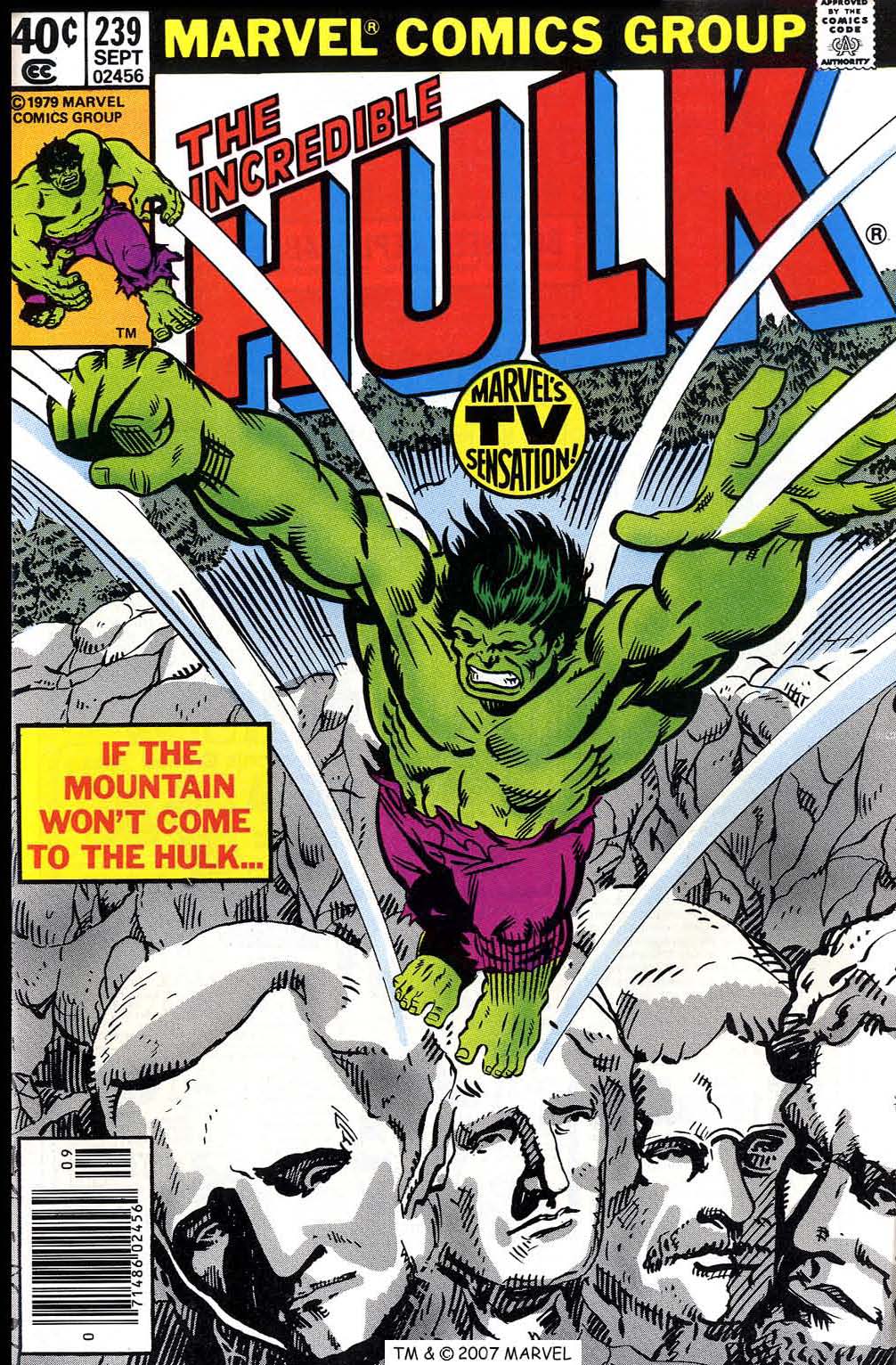


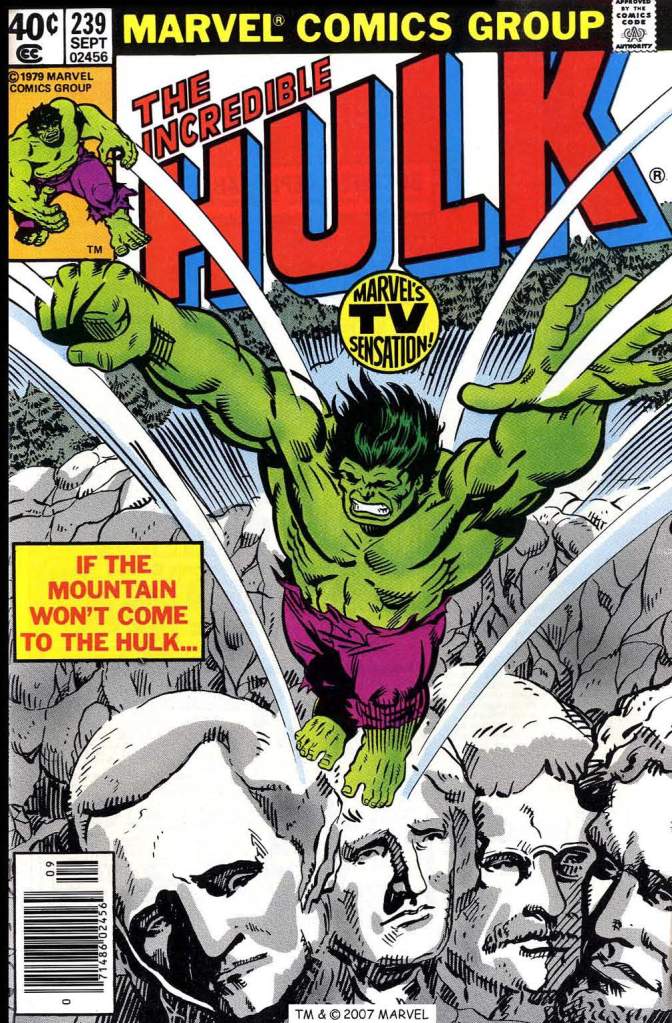
INCREDIBLE HULK had kind of hit its stride for what would remain of the 1970s and the early 1980s. it was a solid and entertaining read, but not anything extraordinary. Well-crafted but forgettable. And much more attuned to the impulse buying audience in terms of not getting too bogged down with ongoing storylines than many other titles, which steered strongly into serialization. It’s not to say that INCREDIBLE HULK had none of those things, but the prevailing wisdom seemed to be that the audience for the title was largely made up of more casual buyers, many of whom may have been drawn in by their familiarity with the live action CBS television program. So accordingly, the book shifted somewhat in that direction. This shift, it can be argued, went on for too long and was responsible for the book being considered a bit of a bore as the fan-driven Direct Market gained greater importance, a series with a limited premise that kept it from becoming anything better. future creators, in particular Peter David, would overcome that sentiment, but it would take a while.
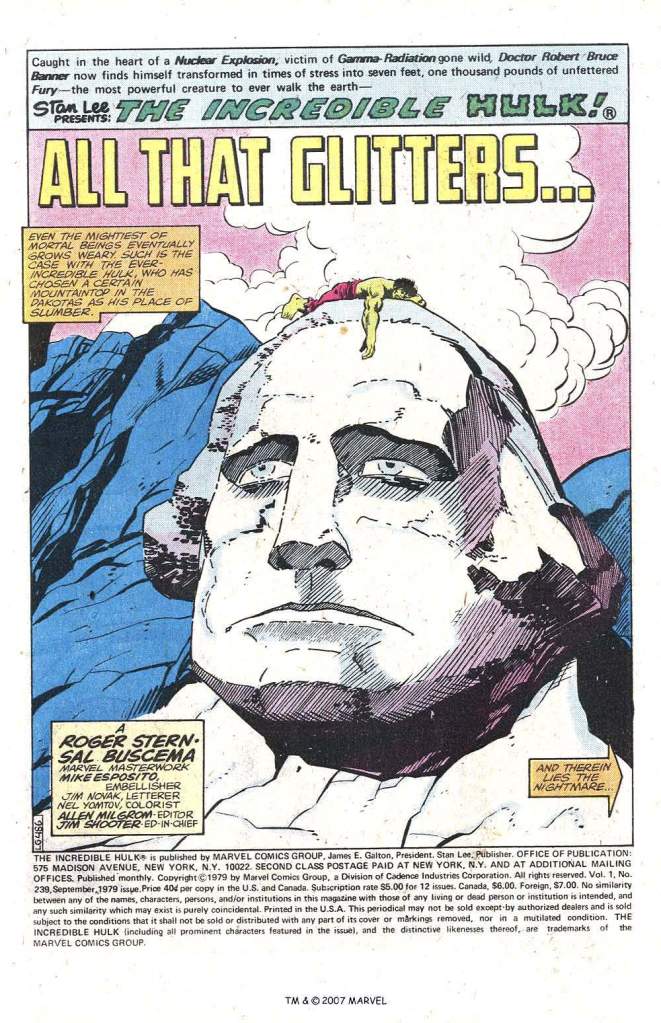
I have to say that this is a brilliant splash page image, one that hooks you into the story immediately, even moreso than the cover. This picks up on last issue’s semi-cliffhanger, in which the Hulk fell into a slumber while situated atop Mount Rushmore, the famous landmark. This gave the authorities pause, as any move to attack the Hulk would inevitably damage the monument–as might the creature himself once he woke up. Now you’d maybe think that a sleeping Hulk would revert back to his more manageable Bruce Banner persona, his rage dissipating in slumber. But that isn’t what happens here, so apparently the Hulk is still upset enough by his recent travails that his gamma-spawned form remains in place even while he sleeps.
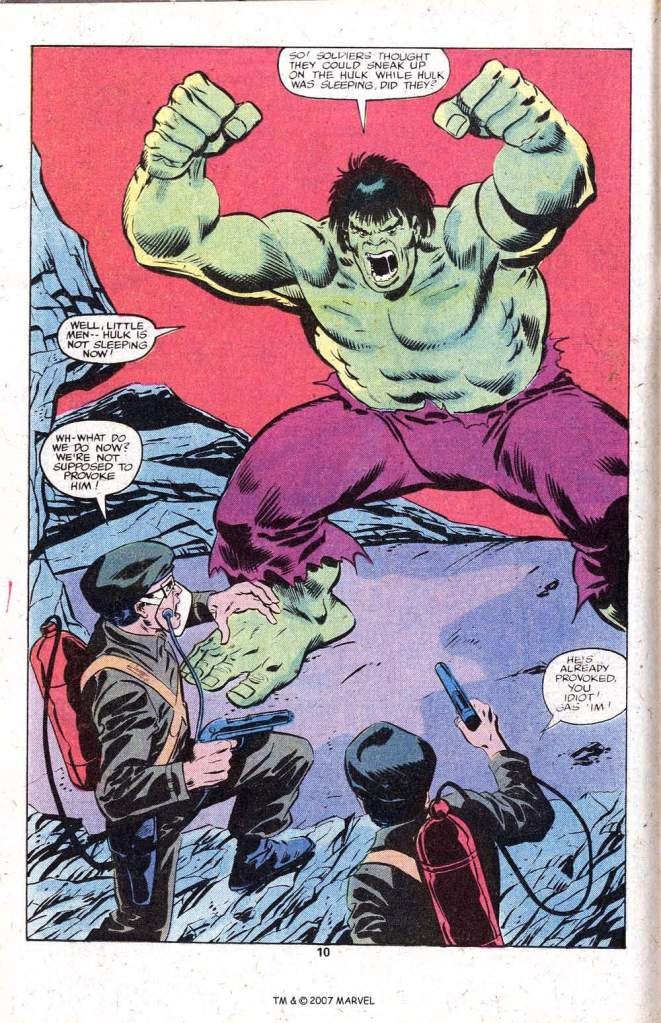
Regular series writer Roger Stern was continuing to have fun exploring the childlike psyche of his unstoppable protagonist. At this point in the continuity, rather than being an alter created by Bruce Banner’s splintered psyche, the Hulk had been shown to be an entirely separate entity from Bruce Banner, and so that’s how Stern continued to depict him. He was in essence a big child, quick to anger but ultimately relatively gentle in his own way, when he wasn’t being provoked (which was infrequently.) The Hulk also had a strange moral core that caused him to do the right thing eventually, even if he was for a time misled by others who wanted to turn his great strength to their own benefit. This was all carried off with the assistance of Sal Buscema, whose depiction of the Gamma Goliath became the standard for the character during this era. The Hulk was Sal’s favorite assignment, and he remained with the series for a long while, giving the book an almost-unequalled visual consistency.
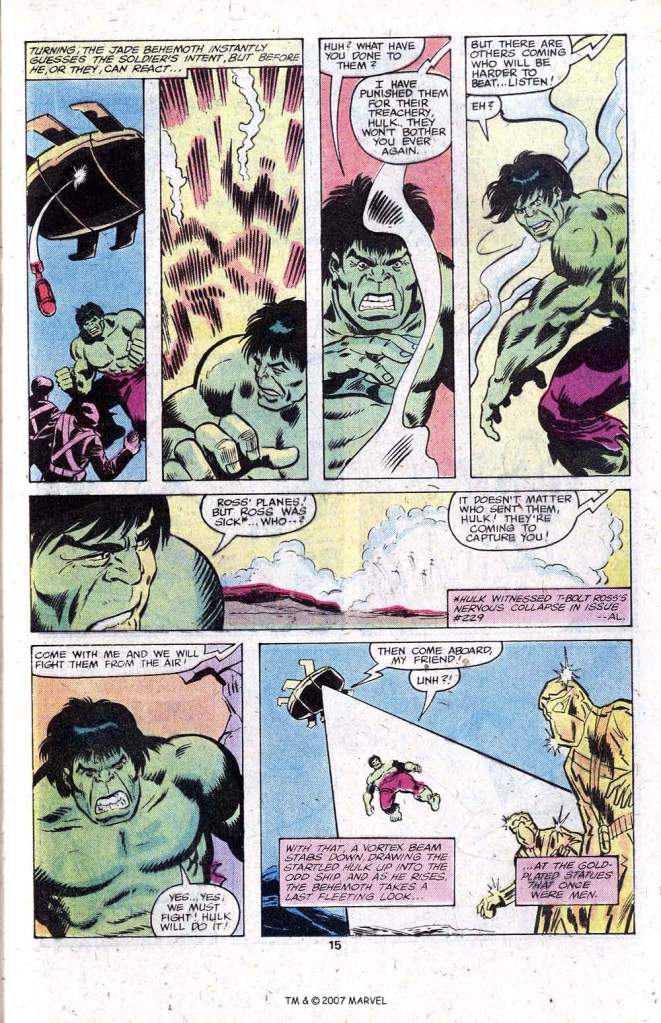
So as the story opens, a military unit from Fort Leavenworth, Kansas is awaiting orders concerning how to engage with the slumbering Hulk–or even whether they should do so at all. They get in contact with Hulkbuster Base in New Mexico, which scrambles a fighter squadron led by SHIELD agent Clay Quartermain. But they’re a half-hour out from Mount Rushmore, and a lot can happen in that time. Consequently, the unit sends a pair of special forces commandos to scale the mountain and reconnoiter the area. Also in the vicinity is Goldbug, a super-villain with a gold motif. The two commandos are packing tanks of sleep gas in the hope of being able to keep the Hulk tranquil, but Goldbug, desiring the Hulk’s help for his next scheme, fires a laser beam that awakens the Green Goliath, placing the commandos in jeopardy. The pair immediately surrenders to the Hulk, which confuses him. But Goldbug shows up and encases the pair in gold, suffocating them, then draws the Hulk up to his flying bug-ship before Quartermain’s planes can arrive.
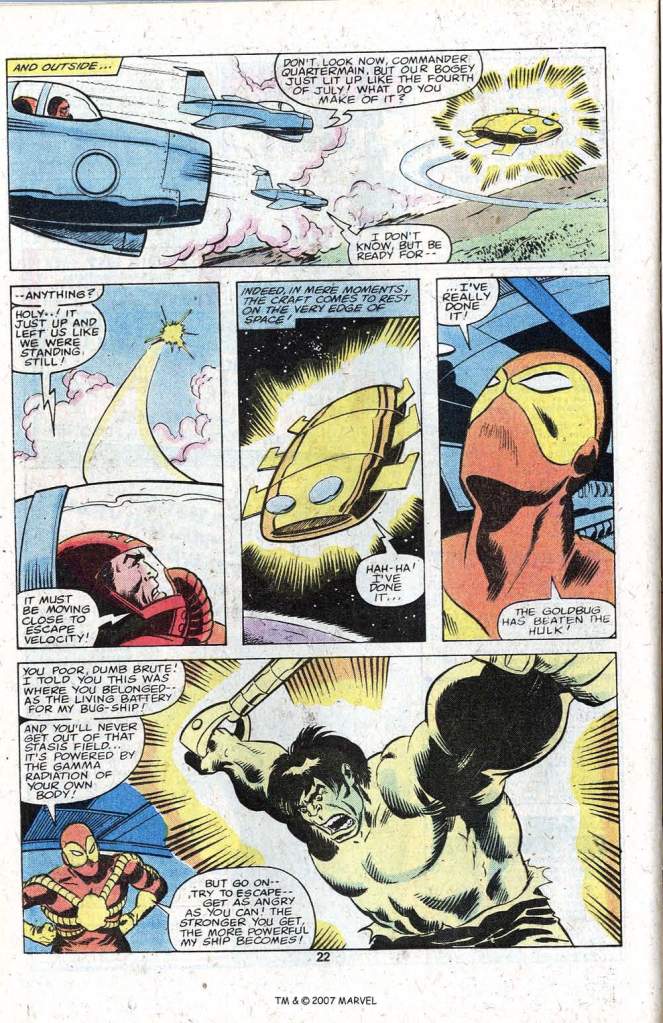
The Hulk really wants to go out there and knock the pursuing planes from the sky, but Goldbug suggests another plan. He extrudes a pair of handholds from the interior of his ship and tells the Hulk that by gripping them, he can share his power with the craft. The guileless Hulk does this, unaware that this was Goldbug’s plan all along–to entrap him and make him the new energy source for his craft. Once the Hulk had grabbed on, he’s encased in a stasis field that keeps him from moving, powered by the gamma radiation from his own body. With the Hulk as his power source, Goldbug is easily able to outdistance the pursuing Hulkbuster Base planes and venture forward towards Goldbug’s true objective: he wants to locate and loot El Dorado, the legendary city of gold.
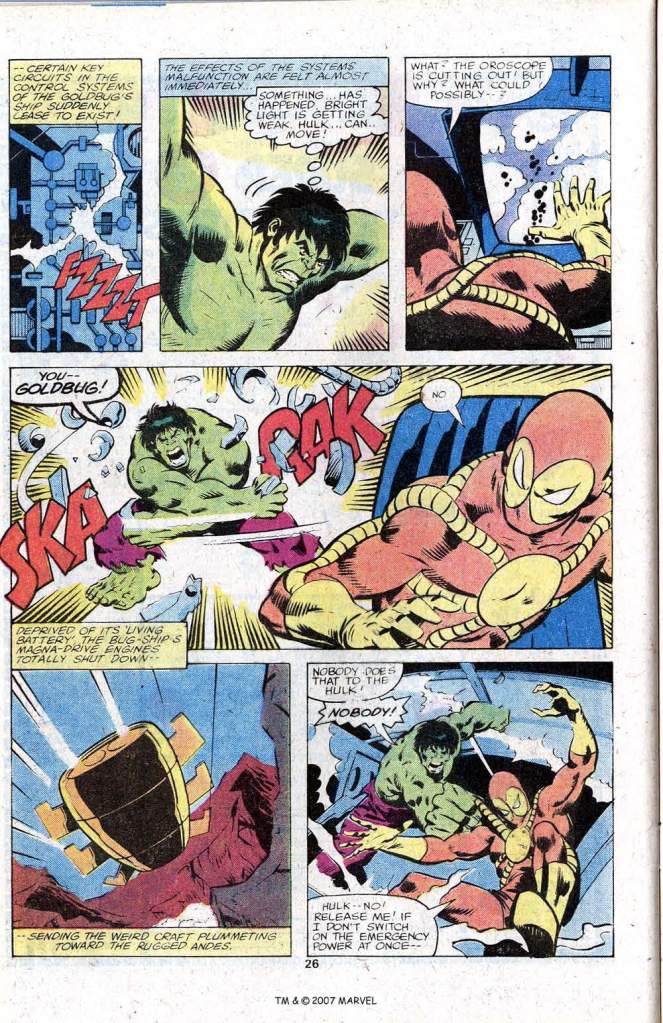
Using his newfound power source, Goldbug is able to locate El Dorado and fly to it. Unfortunately for him, his benefactors in the creation of his latest craft were They-0Who-Wield-The-Power, a cabal of shadowy do-anything plot devices that had been created years previously in the pages of MARVEL TEAM-UP as a way of linking a series of disparate stories that otherwise didn’t have anything to do with one another. The mystery of who and what They were had been lingering for some time, and so Stern has decided to deal with that question and wrap up the dangling plotline. As Goldbug approaches El Dorado, They indicate to one another that he’s done what they desired, bringing the Hulk to him, and they short-circuit the equipment in Goldbug’s ship that’s preventing the Hulk from escaping. So the brute breaks free, and in moments the bug-ship is destroyed, a byproduct of the Hulk’s rage.
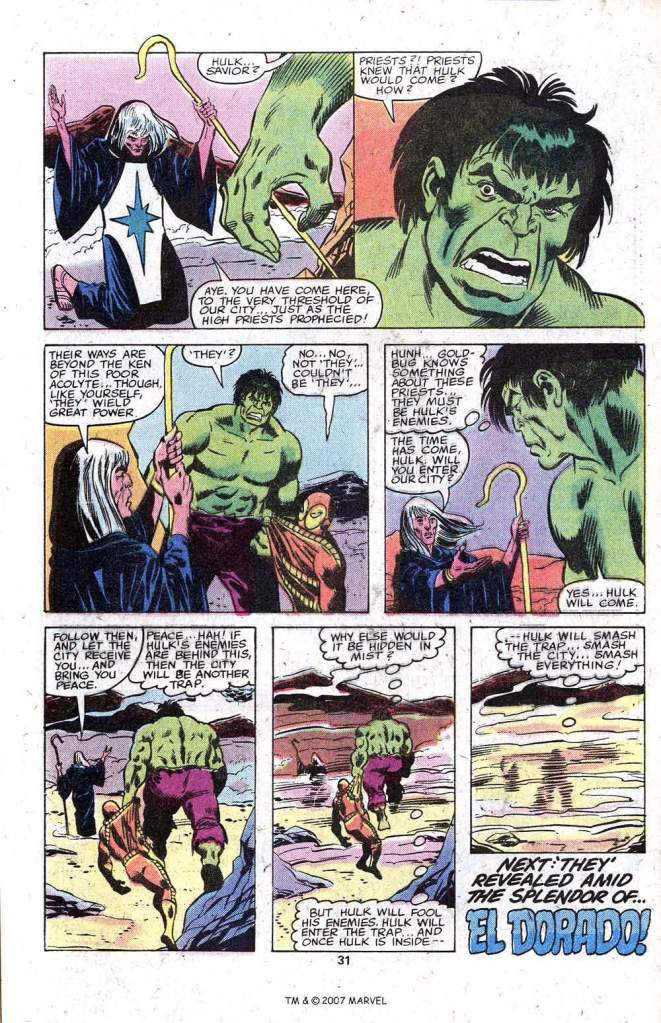
But the Hulk and Goldbug are fine–a leap from the Emerald Behemoth carries them to the ground far below. The Hulk intends to smash Goldbug into paste, but he’s interrupted by the appearance of an Acolyte of El Dorado, who greets the Hulk as a prophesied savior. The High Priests of El Dorado had foretold his coming–Goldbug realizes that this is They, the ones who provided his technology, and he’s terrified at the prospect of coming face-to-face with them. But even though he has misgivings, the Hulk allows himself to be led through the mists towards concealed El Dorado, and that’s where this issue is To Be Continued. All told, it’s something of a slight issue, where a bunch of stuff happens but none of it is particularly noteworthy or meaningful.
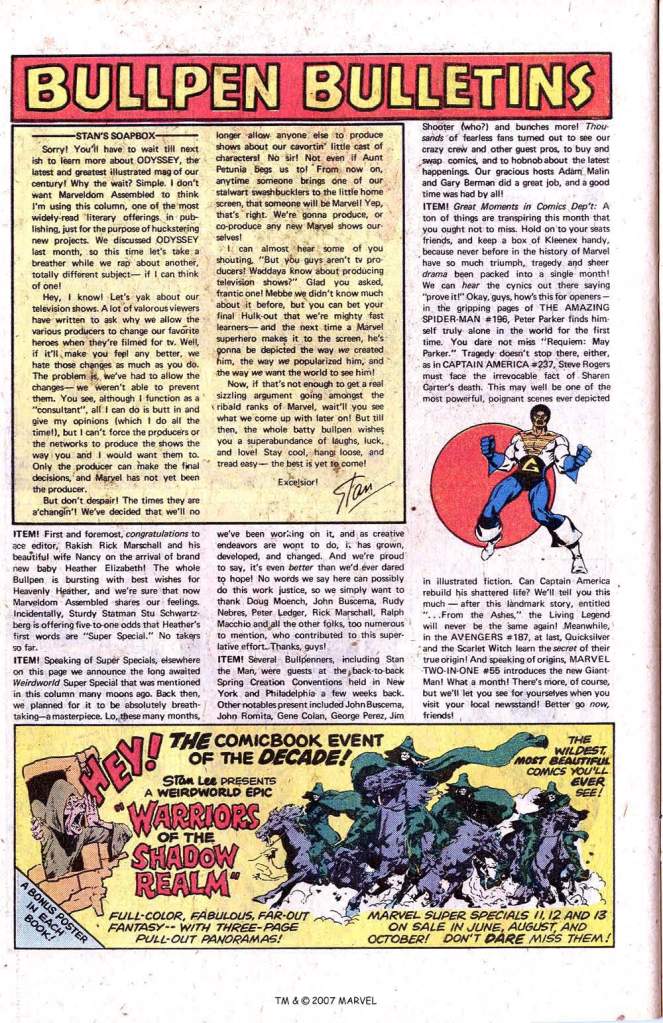
The Bullpen Bulletins page for this month has Stan Lee plugging the impending ODYSSEY magazine briefly before going on to promise that Marvel’s television productions will henceforth be at least co-produced by Marvel, allowing greater fidelity to the source material. In essence, this was a stealth announcement about the founding of what would become Marvel Productions, the animation house run by Marvel throughout the 1980s. Unfortunately, Stan’s hopes for greater adherence to the comics turned out to be so much wishful thinking for the most part. But Stan himself did get to narrate a bunch of what the outfit produced. There’s also the typical gossip about the creators attending conventions and experiencing weddings and childbirth, as well as specific plus for a variety of upcoming Marvel books. While this page was becoming a bit of a shadow of its former self, and there’s a sense that nobody is putting an whole lot of effort into it anymore, it remained an important part of the reading experience for me. This was the closest I could come at the time to being an insider in the field, so these glimpses into the inner workings were something I enjoyed.
 The Tom Brevoort Experience
Just like yesterday’s Avengers story, this one dropped during my “sabbatical” from comic collecting. However unlike that notably impressive book, this one would not have brought me back into the fold. Tom sums up it perfectly. Nothing wrong with the story or art. But also nothing new under the sun for the big green guy. I’d parted company with the Hulk not long after Jarella bit the dust, tired of what I considered a “sameness” to it. I never warmed up to the TV series for that same reason. Everything seemed so predictable.
Even when I returned to avid collecting, The Incredible Hulk never quite grabbed me. I could see that Bill Mantlo was trying to insert some creativity with Banner being in control as well as the first appearance of Rocket Raccoon. Nor did I ever mind Sal Buscema’s art on the book. But it wasn’t until I followed John Byrne from Alpha Flight that I purchased this series again. And of course that particular run didn’t last long. However, the combination of Peter David and Todd McFarlane brought on board a few years later where I remained until the former’s unfortunate departure.
LikeLiked by 2 people
Two years earlier aliens ( K’rill & N’gll — 2 Deonists from Deo, the 5th in the Denebola System ) would kidnap Odin to use as a battery [ Thor#262 ( August 1977 –kidnapped earlier this issue explains why ] and they were draining him dry. Ten years after this Hulk story Beta Ray Bill would be captured by Captain Orack [ Thor#411-412 ( December-Mid-December 1989 ) 2nd story “The Psychic Slaveship of Space!” & “Freedom is Only a Choice Away!” ] to power his spaceship by feeding off the psychic energy of all the captives ( A human looking captive in a costume that reminded me of DC’s Captain Comet is why it is memorable ). Ten years later The Matrix ( 1999 ) would be released and Humanity are used as batteries by the machines. I keep thinking there is some other comic book character that was used as a battery. I like the original concept of They-Who-Wield-Power — Marvel Team-Up version( Game players ).
LikeLiked by 1 person
Not bad for $0.40. Disposable, maybe, but lots of comics were meant to be. Perfect for younger readers. Sal was a definitive Hulk artist. Personally, I’d’ve had Klaus Janson or Dan Green ink it, just for some extra visual energy. Nothing “wrong” with Mike Espsito’s inks, though. Quick entertainment. As Tom said, it wasn’t meant to be groundbreaking. Hulk’s time for that would come, though, in another, what, 8, 10 years?
LikeLiked by 1 person
Peter David’s long run on the Hulk began in 1987. Byrne’s short, but enjoyable, time at the plate was in 1985.
LikeLiked by 1 person
I did like a few issues by Byrne. Especially the issue with Wonder Man, Iron-Man, Herc, Namor, & Doc Sampson.
Peter David, Me McFarlane (wasnt into his art much), then Erik Larsen? I preferred Jeff Purves. And then, of course, in 1990 (?) Dale Keown (spelling?). Good times.
LikeLike
I came aboard with Keowen. I have disliked McFarlane’s art since Infinity Inc and have bought nothing by him since.
LikeLiked by 1 person
Byrne’s short runs on Hulk and West Coast Avengers are some of my least favorite runs of his.
LikeLiked by 1 person
McFarlane’s “Infinity , Inc” was rough. Maybe in part due to mismatched inkers. I did like his Dr. Fate issue of “All-Star Squadron”. Different and dynamic..
On “Batman: Year 2” he was inked by Alfredo Alcala. A strong artist on his own. Not the best combination. Maybe editor Denny O’Neil thought Alcala’s inks would be a familiar stabilizer. Or a surprising mix, like chocolate and peanut butter. Instead of mustard and peanut butter.
Todd’s layouts on both were dynamic. His Spidey and then “Spawn” sold millions.
And I only bought a very few of his issues. Zero of Spawn. For sll the crazy poses & distorted faces, I missed seeing the basic fundamentals of drawing. All the scribbly detail you can fit in won’t compensate.
But we can say that Todd was an artist who went to “Infinity”, and beyond…
LikeLiked by 1 person
What I didn’t like about John Byrne’s short time on the Hulk was the same thing I didn’t like about his Namor the Sub-Mariner, that he never used any of their old foes. In the case of the Hulk he could have used the Mandarin [ I. Hulk#107 ( September 1968 ) ], Maximus [ I. Hulk#119 ( September 1969 ) ], Kang [ I.Hulk#135 ( January 1971 ) ], Doctor Doom [ I Hulk#143-144 ( September 1971 ) ], Tiger Shark [ I.Hulk#160 ( February 1973 ) ], Juggernaut [ I.Hulk#172 ( February 1974 ) ] or any other foe that wasn’t created for the Hulk that he only fought once. He did use 1 Sub-Mariner foe, Plant Man [ Sub-Mariner#2-3 ( June-July 1968 ) in Namor, the Sub-Mariner#19-25 ( October-April 1991-1992 ) ]. Plus Namor having fought the FF so many times it would good to see him finally fight the Super-Skrull [ Namor, the Sub-Mariner#16-18 ( July-September 1991 ) ]. I was only counting Namor’s Sub-Mariner ( 1968 ) series foes not his The Invaders series foes ( Master Man and Warrior Woman ).
LikeLiked by 2 people
It’s an intriguing argument about Byrne’s run. But ultimately, it’s a hard to determine. I say that because his run was cut short. Your point is correct for those few initial issues. But it’s also clear that John Byrne was in for the long haul. I know he talked about bringing back the Metal Master and Ringmaster. But we’ve no idea what other antagonists were on his menu. That’s a key reason for my disappointment with the brevity of his tenure on the Incredible Hulk.
LikeLiked by 1 person
At least during his tenure on the Hulk he didn’t devastate a character and couple based on personal feelings rather than what was good for the ongoing narrative. I have wondered if he had some end game that wouldn’t have left Vision and Wanda in a horrible position for years. Not that I’d believe anything he’d claim today. Byrne’s long-term recollections always sound like revisionist history. (That’s a hint for Mister Busiek to step in if he heard anything substantive back then)
LikeLiked by 1 person
The interview with Byrne that I’m referencing actually took place prior to his moving onto the Hulk. Not saying every word of it could be confused with Gospel, but his ideas for the Hulk would seem accurate. Again, I wish we’d have had his complete run to later discuss. And yes, I always appreciate any insights from Kurt.
LikeLike
The first time I saw the Metal Master was watching The Marvel Super Heroes ( 1966 cartoon ( Hulk ) –reruns ) and my first and only book with him in it was Rom#30 ( May 1982 ). According to wikipedia.org he appears in Black Bolt#5-6 (November-December 2017 –Metal Master decides to atone for his past crimes )
LikeLiked by 1 person
I loved this series mostly due to Sal, my favorite Buscema. You knew it would be a fantastic, fun read no matter who wrote it and whoever inked it. Well, except for McLeod. Love that man’s inking everywhere else and his rare pencils but did not like him inking Sal! I was also always lukewarm on Weinbut thanks to Sal, I enjoyed his run as much as I did Stern’s. BTW, did Sal ink the title page himself? Pure Sal art had a certain beauty and energy and that’s what I’m getting from that page.
Speaking of Wein (and someone else mentioning Jarella sparked this thought), did the man ever tell anyone how he would have brought Jarella back? I still semi mourn that character.
LikeLiked by 1 person
Did Bob Mcleod’s inking just change the look of Sal’s drawing too much for you?
Was Mcleod related to “The Highlander”? 😉🙏
LikeLike
I had this issue and I recall kind of digging the Goldbug character as a dirtbag that had a moral limit of what he would tolerate….cause I think he eventually takes on Tyrannus? Nice visual too. Did he ever come back?
Despite Stern’s efforts here I think They Who Wield the Power didn’t land as well as antagonists.
LikeLiked by 1 person
I enjoyed Roger’s run on the series — maybe not as much as Len’s, but it was fun and kept things hopping.
But man, was the revelation of who They were a wet fart. All those years of mystery…for that?
Pff.
LikeLiked by 2 people
This is funny- I’m using the same source you’re using to read old Hulk comics. The 2007 Marvel DVD “reprints” of old Marvel comics, directly from scans of the comics, is IMHO the absolute best way to read any pre-1990 material. I wish these scans were available on the Marvel Unlimited site.
You can tell these are from that DVD set because of the @2007 Marvel stamp on the bottom of the issue. I’m not endorsing this eBay sale, but this is what the set looks like for those curious. The issues are saved on a few data DVDs. You use a CBR/CBZ reader to read the comics.
https://www.ebay.com/itm/800186574465?_skw=marvel+dvd+hulk+cbz&itmmeta=01KWWFJK0FB49SWX93FRV6QME4&hash=itemba4ed62681:g:JlMAAeSw6tJqMImA&itmprp=enc%3AAQALAAAA8GfYFPkwiKCW4ZNSs2u11xCy9NJcH3UEnD1JGOGwj7GQdd%2F0Ph%2F3zrJPaWxTjESEkhiYhuX9PJQNLurbaMzmtyQm%2FSKKrw%2B6ca1q3jIMMNgPLIoC07j%2F7nm07vyHdNlZkmdz7KM2EkvhKfsZFOW8%2FI8xJA4WM6flI4Pv5d3AgxAnFWbeoC6S4tQ2BYuDVfap14pA2YSy%2F3E96McOPW596vzehUyXJtQVsj56O92bz7DLdp9XGYneVMQ%2FuK6tawgMGNdcrLYv3xFgj9UceAAgCvKjuYi%2BLeq9fpGEZVStjVmrXp71LiA0b7nvr%2BlOxg9l8A%3D%3D%7Ctkp%3ABFBMvrHKj-dn
LikeLike
The 2007 scans were sadly whitened via “photoshop”. Those late 70s comics were printed on paper not much better than newsprint. The borders were never white to begin with. In additional fine detail is lost when the pages are brightened to make the borders appears white.
LikeLike
Maybe my copies are different, but having gone through a few hundred Hulk comics, I didn’t notice any discernable whitening or loss of fine lines, at least compared to the process used to make modern-day reprintings of the material. Short of shooting from the original artwork, which has already deteriorated, or whatever negatives still survive, I suspect these are as good as we’re going to get, although I haven’t scrutinized the Taschen reprints of the 60s books.
LikeLike
many scans done by the “scanning community” are excellent bu many are not. Bottom line: If it’s a late 70s/very early 80s Marvel and the page borders are white then it has been touched up!
As for original art, very little has deteriorated the primary problem is obtaining scans as it’s scattered across collection on several continents. Go to http://www.comicartfans.com and take a look around you will see very little that has aged. Exception being Kane’s thin marker work.
LikeLike
These scans I mention weren’t done by the “scanning community”, but rather Marvel themselves, and are pretty good. Some of the scanning community scans are, as you say, very good, and some stink. It’s also really hard to get good scans on comics from the mid-to-late 80s to the early 90s because many so terribly printed.
I get that the original art may have had great linework, but I doubt much of that showed up in the printed comics.
LikeLike