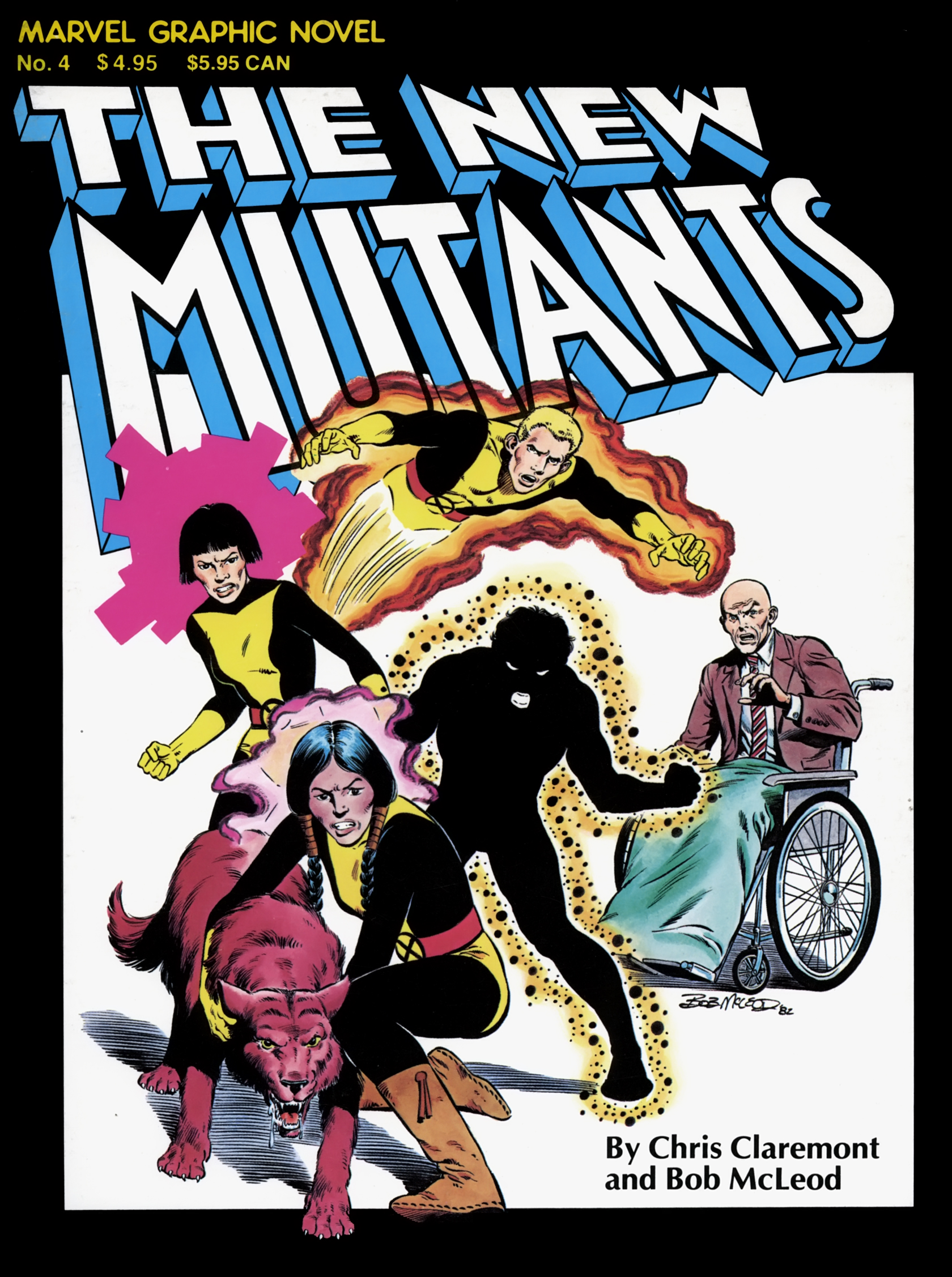


When it was first launched, there was a veneer of respectability about the MARVEL GRAPHIC NOVEL line. Based on the format of European albums, these books were a place where creators could tell stories that were a bit more sophisticated and adult-oriented than the typical Comics Code-approved fare that filled the pages of the monthly Marvel line. Even with the first such book being devoted to Captain Marvel and his demise, that was still the feeling the line had–after all, the Death of Captain marvel wasn’t the kind of thing that you’d see in the regular comics. All of that went away, though, with the release of this fourth installment, which featured the debut of the long-anticipated spin-off to the uber-popular X-MEN series. There was no hotter title in the Direct Sales Market at the time, so deciding to launch this spin-off feature in a $4.95 format was seen, at least in my circles, as a pretty naked cash-grab. It didn’t matter that the book was mostly pretty fine, it was simply the idea of it that soured people.
The push towards the New Mutants had been going on for some time, and came from a few disparate sources. One of them was editor in chief Jim Shooter, who held to the belief that the premise of X-MEN was that it was about a school for mutant super heroes. Chris Claremont, though, was of the belief that the series had outgrown those early roots and was now far more about “Protecting a world that hates and fears them.” Either way, Chris and his artist collaborator at the time, John Byrne, began to try to appease Jim. They planned to introduce a second team of young mutants, a new class who could take up the “school for mutant super heroes” mantle, this leaving the more established characters to continue doing the sorts of things that they had been doing. Kitty Pryde was introduced with the notion that she’d be the first of this second wave of X-Men, and another character called Caliban was conceived, though never realized before Byrne left the title. (Shortly thereafter, a similar-but-different character named Caliban was introduced by Claremont and Dave Cockrum.)
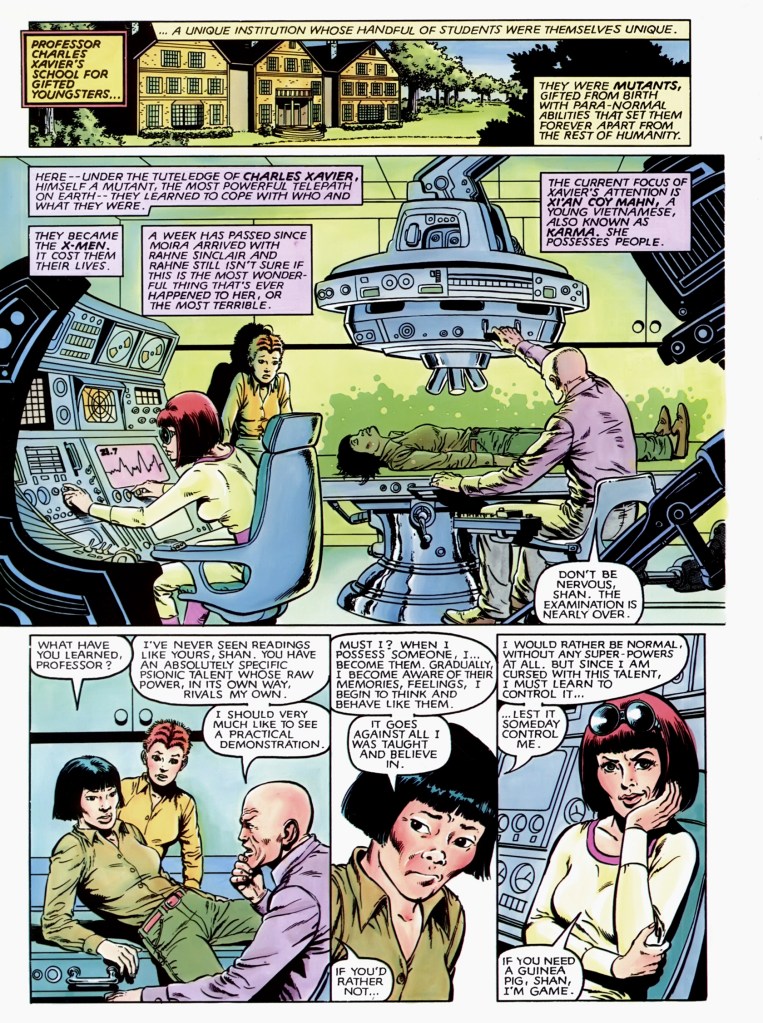
But the idea of launching a second team never quite went away, and especially in all of the energy surrounding the aftermath of the incredibly popular Dark Phoenix Saga that had made X-MEN a craze among comic book readers the likes of which hadn’t been seen in several years, there was a drive to be able to get more out of the property than merely a single monthly title. New incoming editor Louise Jones Simonson made it a priority to get a second series up and running. Already, one prospective character had been introduced by Claremont and popular artist Frank Miller in MARVEL TEAM-UP #100, Karma, and after a few false starts with other artists, Louise was able to pair Chris up with artist Bob McLeod to create the balance of the cast of the book that eventually became know as NEW MUTANTS.
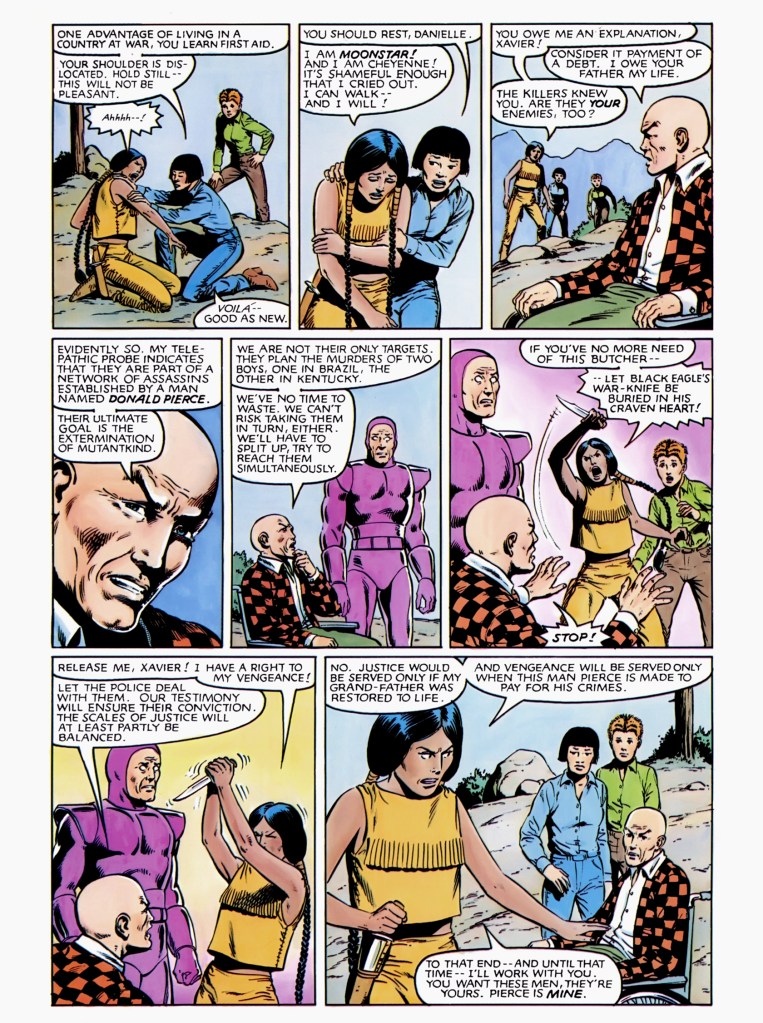
As with the All-New, All-Different X-Men, the notion here was to have a diverse and international cast. So Claremont and McLeod conceived of four additional characters: the Cheyenne Dani Moonstar, known initially as Psyche but shortly thereafter renamed Mirage; Wolfsbane from Scotland; Sunspot from Brazil; and Cannonball from Kentucky. Karma, from Korea, was also added in. The notion of using the original black-and-yellow X-Men uniforms was a holdover from the John Byrne conception, but it made a lot of sense. These new pupils of Professor Xavier would be younger than the current X-Men, more in line with the original team in terms of age when it was first introduced. Initially, the book was simply going to launch with an oversized first issue, but at some point–possibly because other material intended for the MARVEL GRAPHIC NOVEL series was encountering production delays–the decision was made to debut the new series as a MGN first, then spin out a monthly title thereafter.
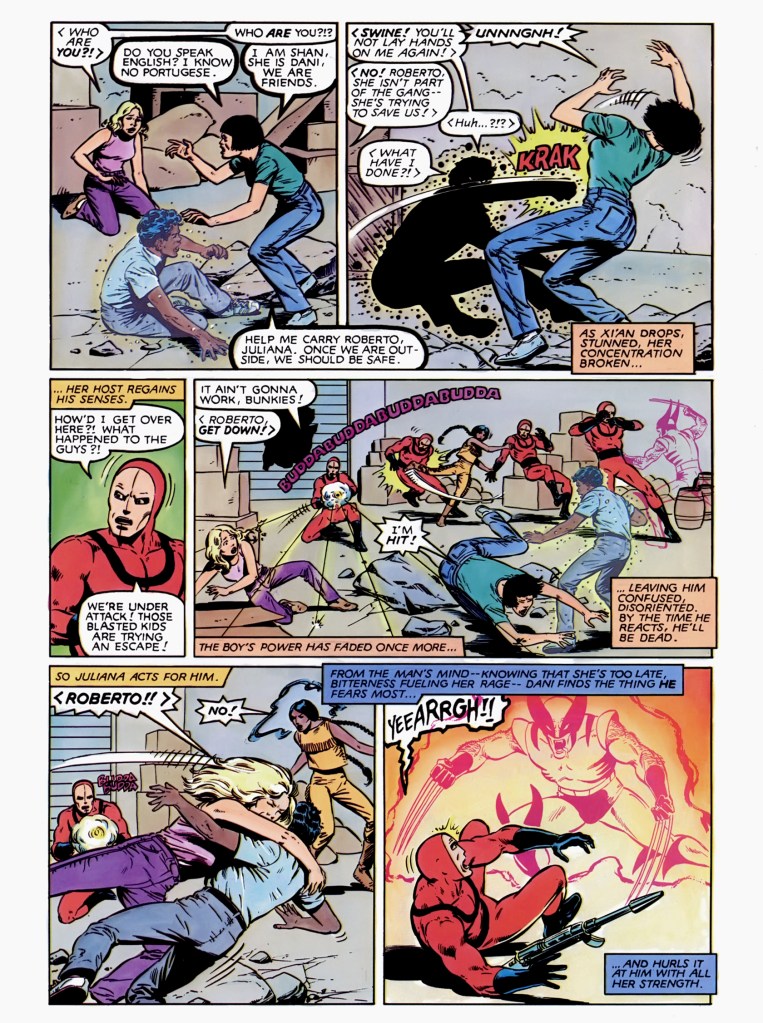
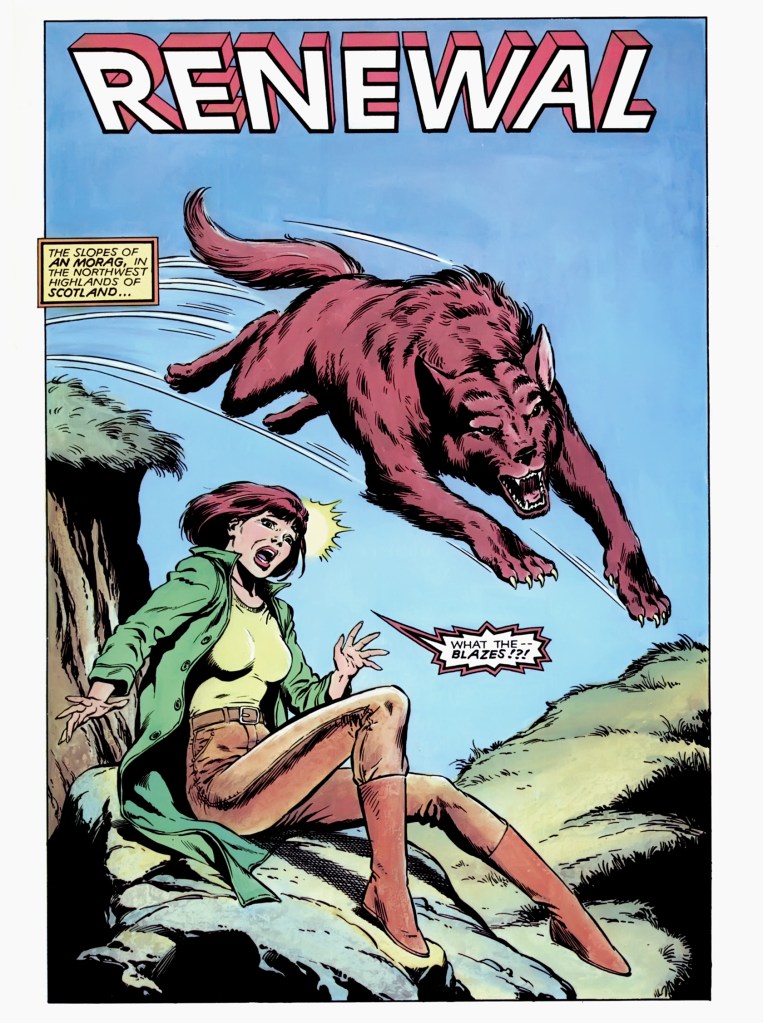
At the time of the events of this story, the X-Men were believed to have perished by Professor Xavier and his associate Moira MacTaggart. Instead, they were off in space dealing with the threat of the Brood–but this gave the space for the Professor to start again with an entirely new crew. The opening half of this book is dedicated to introducing the newcomers one by one: Moira encounters Wolfsbane in Scotland, where she’s on the run from a violent mob. In Rio De Janeiro, Sunspot’s powers first manifest during a soccer match. A cave-in in the mines of Kentucky cause Sam Guthrie’s Cannonball abilities to activate, propelling himself and a fellow miner to safety. And in Colorado, Dani Moonstar’s grandfather informs her that he’s arranged for her to receive training from Professor Charles Xavier in New York. All of this is observed by a vengeful Donald Pierce of the Hellfire Club, who sees opportunity in these new emerging mutants.
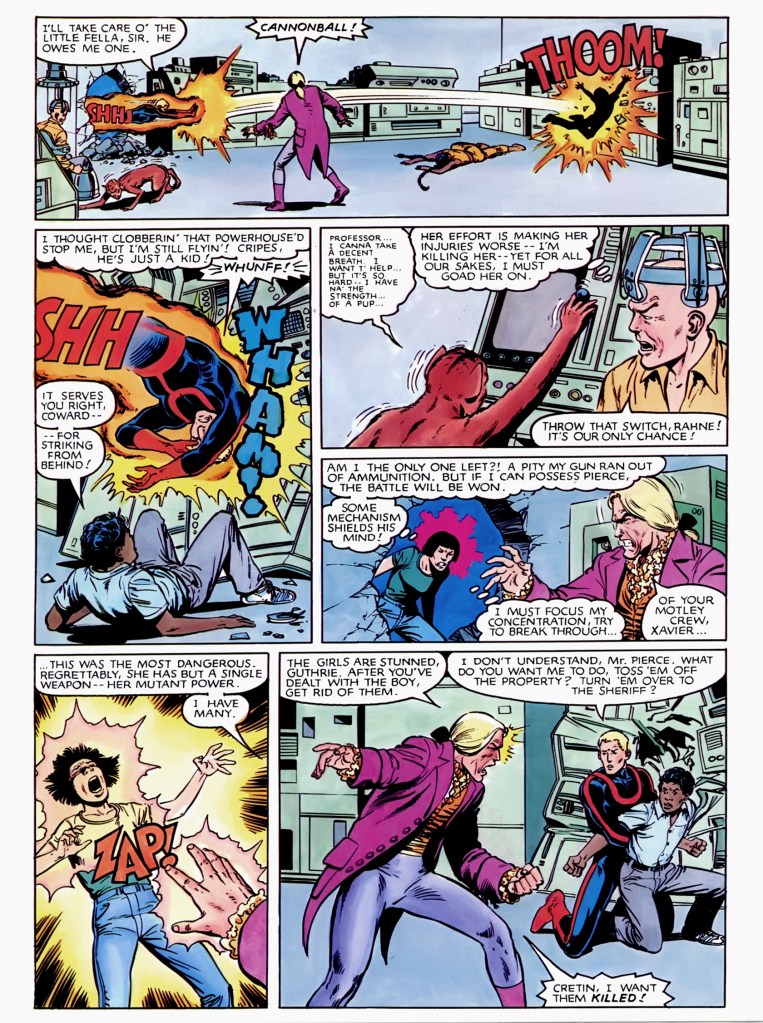
These disparate threads are pulled together as Pierce moves to capture or recruit the New Mutants even as they one by one encounter both Professor X and each other and form connections. Cannonball winds up working for the Hellfire Club, at least until Pierce reveals his true hateful colors, at which point he refuses to go along with murder and switches sides. Sunspot’s girlfriend Juliana is killed in the crossfire while attempting to protect him, giving him ample motivation to want revenge on Pierce and his minions. Eventually, all roads lead to a blow-out at Pierce’s makeshift headquarters in Kentucky where the five untrained kids prove their courage and their moxie by bailing out Xavier and saving the day. As much as Xavier claims that he’s not looking to put together another class of young X-Men, he can’t seem to argue with the results.
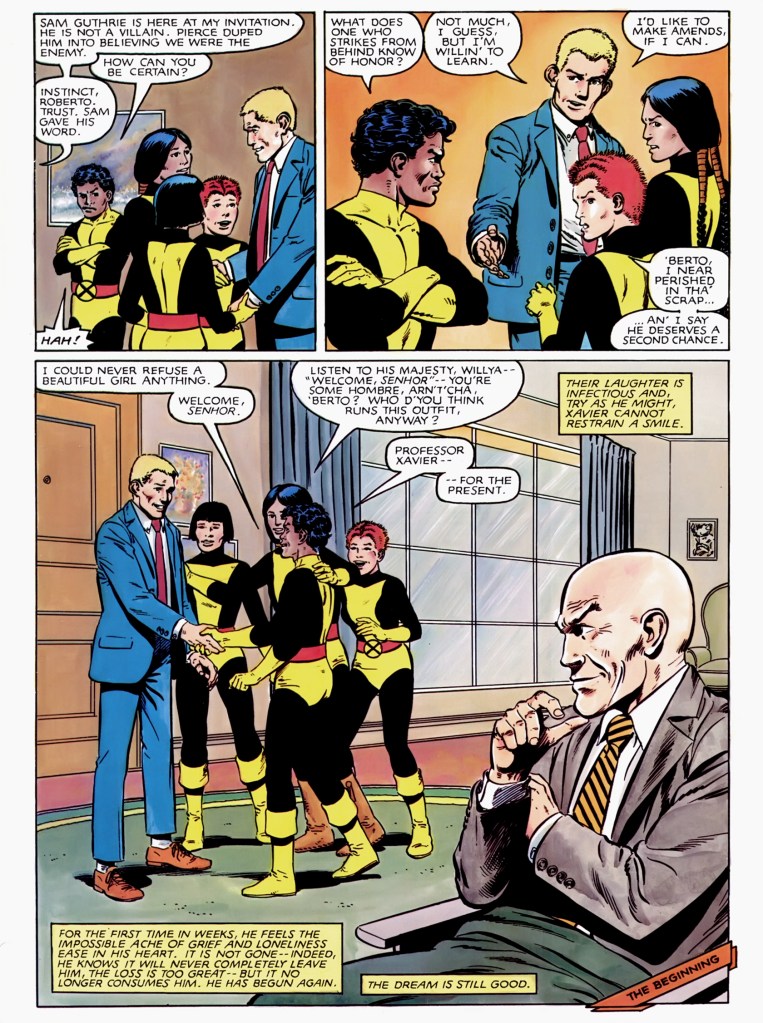
It’s a pretty sure-footed pilot episode, for all that the five New Mutants aren’t quite as interesting or visually distinct as the All-New X-Men. By this point, Claremont had honed in on what he felt the key aspects of the series were all about, and he worked to make those themes of intolerance, bigotry, race hatred and self-doubt a central part of the stories going forward. Still, NEW MUTANTS didn’t really ignite as a series until the arrival some 18 issues into the run of artist Bill Sienkiewicz, who brought a shocking contemporary style to the storytelling, separating it from everything else that was on the stands at the time. The book immediately went from being a somewhat lukewarm junior version of the X-Men into something more unique and fascinating. I liked this initial Graphic Novel (apart from the price) enough to start following the eventual series, but I only lasted on it for about three issues before financial considerations caused me to scale back sharply on the number of comics i was purchasing. So I missed out entirely on Sienkiewicz’s arrival.


I bought this years after it came out…just too expensive! I bought all the regular series for a few years though. But I never thought the New Mutants lived up to their promise from the first three issues. I wanted the high-school kids dealing with normal life while saving the world, and the book changed to far-out adventure with no typical school or daily life drama.
Bob McCleod is one of my all-time favorite artists! His best New Mutants work may be the annual he drew! And his premature leaving the regular series was mostly to blame on the first issue suddenly turning into a graphic novel, which put him way behind schedule…
LikeLiked by 1 person
I loved this OGN! Most of the line didn’t interest me but this one ignited a lifelong enjoyment of these five plus Magik, coincidentally my favorite Marvel character. The price was the price and I could afford it so I bought it. I think McLeod was a much better inker than artist and while I don’t regret my favorite Buscema taking over, he did do an excellent job during his tenure into giving visual depth to Claremont’s excellent stories.
LikeLiked by 2 people
OMG, a second mutant team? I thought that was so cool at the time, little knowing …
“Bill Sienkiewicz, who brought a shocking contemporary style to the storytelling” Shocking is the word. I endured about two issues of what I found an eye-gouging style and then dropped the book. Unlike Neal Adams (didn’t care for his style at first, either) I don’t like him any more when I look back at that era — though I concede I’m a minority on that point.
LikeLike
My reaction as kid was same as yours to Sienkiewicz’s New Mutants.
Over the years I’ve truly come to truly appreciate his art on the title, however while its amazing art IMHO it does not do the story telling in those comics any favors.
LikeLike
I’m a minority too but flipped. I didn’t like Adams then or ever.
LikeLike
TOM, correction on Karma’s country of origin: Vietnam ( went to marvel.fandom.com to check if my memory was correct ) is where she came from not Korea ( North or South ).
LikeLike
The New Mutants ( 2020 ) movie was on TV late last night ( Also have the DVD ). Have this graphic novel too.
LikeLike
I had a similar reaction — I liked the idea of the school returning, and liked the idea of a group of kids mixing school life and adventure. And I like Bob McLeod’s art.
But I hated the idea of launching the book in a GN — as did the nascent Direct Sales department, which at the time was Mike Friedrich but would soon add Carol Kalish. Mike, if I remember correctly, pointed out that while launching an X-title with a GN would make big profits as a GN, it would result in much lower sales numbers than a more conventional launch, because the price and format (and limited distribution) meant it simply wouldn’t reach as many readers as a double-sized first issue.
But they did it, in part because something was running late — in my mind there’s a faint idea that maybe the contracts on STAR SLAMMERS or FUTURIANS or something were taking longer than expected — and it made a lot of money, but a lot of readers came to NEW MUTANTS 1 without having ever seen it. And if I remember correctly, NEW MUTANTS 1 wasn’t written as if readers might need a backfill on the events of the GN; it read like an issue 3 or 4.
I wasn’t too upset when Sal took over the pencils, but when McLeod left as inker, too, and they brought in Tom Mandrake, I just didn’t like what the book looked like. Tom Mandrake’s done a lot of wonderful comics in the years since, but he’s much better as an artist on his own than as a finisher of very-Marvel-standard layouts.
And so I dropped the book and missed the Sienkiewicz arrival, too.
I think it may have been a mistake to start off a new X-book looking so traditional, when the main book was more cutting-edge, aimed at sophisticated readers — but I don’t know which artists were tried out before Bob, or why they didn’t work out.
I do know Bob wanted to pencil, and was frustrated that the deadlines didn’t really allow it. I wonder if he might have been better off at DC, where they published a lot of 8-10 page stories, and he could have been given material to do that didn’t require him to hit a 22-page deadline monthly. Could have been an easier way to ease into the job of a regular penciler, with some time to think and grow into the craft.
LikeLiked by 4 people
His ink line would have been a very good fit for Ironman after Michelinie/Layton left. Just saying.
LikeLiked by 1 person
Sure, if he wanted to ink rather than pencil, or if he could hit that 22 pages per month deadline doing both.
LikeLike
If memory serves, NM#1 was essentially a continuation of the GN. I recall purchasing both at the same time or perhaps a few days apart. I also believe that at least part of the reason Bob McLeod landed the series had to do with getting into the good graces with then X-Men editor Louise Simonson for his fill-in work on X-Men #151-152.
LikeLiked by 1 person
“But they did it [as a graphic novel], in part because something was running late — in my mind there’s a faint idea that maybe the contracts on STAR SLAMMERS or FUTURIANS or something were taking longer than expected”
My recollection is that both STAR SLAMMERS and X-MEN: GOD LOVES, MAN KILLS were both running behind schedule and wouldn’t be ready in time to meet the printer deadline. Marvel had to send something to the printer or forfeit the reservation deposit, and it was decided to go with THE NEW MUTANTS launch.
LikeLike
The Sienkiewicz run was the only time I was interested in this team….though I think I liked the art more than the stories or the characters. I recall flipping through this graphic novel when it came out and declining to buy it. I think the art shown here is well inked and professional, but the storytelling and drawing are not particularly dynamic.
LikeLiked by 2 people
The attraction of the New Mutants was lost on me from the get go. Duller than dull and it never got better.
LikeLike
What a nice group of kids! Wonder what ever happened to them?
Does this review ever bring back the memories! Like many others, I wasn’t keen on the price of the GN – taking a stiff bite out of my budget. But with my world at that time revolving around a Claremont/X-Men sun, no way I could go without it.
Although I had no complaints about Bob McLeod or Sal Buscema, I had to admit that Bill Sienkiewicz took the art on this series to unexpected heights. Of course, I also found his style rather jarring at the outset.
Of course, with Chris Claremont being Chris Claremont, every character went through a multitude of changes during his tenure with some working better than others (never cared for Mirage as a Valkyrie). I was also saddened to see so many of them discarded with the advent of X-Force and the 90’s.
Going back to Tom’s review, I have a link to John Byrne’s idea for Caliban. It would be interesting to visit that alternate timeline where he and Claremont worked together to launch the second book.
LikeLiked by 2 people
I wonder if John Byrne’s Caliban was the energy projector on the team? Cause I know I had mixed feeling on the power set of the group seen here. Don’t know why they just didn’t turn Karma into Marvel Girl ( Jean Grey ) — meaning MG started out just a telekinetic then gained telepathy, so why didn’t just add Mirage’s powers to Karma and give Danielle Moonstar different powers like say projecting energy. The orginals had 1 energy projector on the team — Cyclops.
LikeLiked by 1 person
You bring up a good point, John. Although Sunspot, Cannonball & Wolfbane’s powers made sense, I wasn’t as keen on Psyche & Karma. While they made a decent visual, their talent seemed rather limited.
LikeLike
I have to admit to being a hater of Bill Sienkiewicz’s art on the New Mutants. I tried it for 3-5 issues but it wasn’t fun to try to read and figure out what was going on. Dropped the title after that.
For some reason, Cannonball really clicked with me. A kid who drops out of school to go work in the coal mines because his family needs the money to survive. Which was true for pretty much most coal mining towns across the world for centuries. He has little control over his power, he can only go mostly straight and has problems stopping when he wants to, and is invulnerable while cannonballing but vulnerable when he isn’t. He was bigger than the other kids, and clumsy too. A classic “Bull in the China shop” character.
I never really saw any of his other appearances.
LikeLiked by 2 people
Wow the New Mutants. In my view these characters have developed into some of the best characters in the MU. The GN is a good read with Claremont at the helm, nobody writes X-material like him. Magik later on is a great character too. For me as the series developed It became better than the X-Men. Love these characters!
LikeLike
wasn’t Jim Shooter against the book for a while? I remember someone quoting hin saying no one wants to read about the Legion of Substitute Heroes
LikeLike
I don’t know if Jim Shooter had problems with the NM’s but it sounds like something he would do. I remember enjoying Louise Simonson’s work on the book who also created Power Pack. New Mutants in the 80’s also has some beautiful art by Bret Blevins.
LikeLiked by 1 person
According to Louise Simonson, neither she nor Chris Claremont wanted to do a X-MEN spin-off series. Jim Shooter told them they were in a right-of-first-refusal situation. If they wouldn’t do a spin-off series, someone else would. The bottom-line argument for doing a spin-off series was too great. So Claremont and Simonson put the series together.
What Shooter was against was a proposal by John Byrne about midway through Byrne’s run that the school concept be reinstated in the X-MEN title by adding student characters who would make incidental appearances and occasionally have an issue for an adventure of their own. There wouldn’t be a separate series. Shooter thought “Legion of Substitute X-Men” issues would be off-putting to the readership, and I can’t imagine Claremont liking it, either. The only part of Byrne’s idea that made it into the comics was the Kitty Pryde character.
LikeLiked by 1 person
ah thanks
LikeLike
I was just thinking, back in the early 1980s the idea of paying $4.95 for a comic book was considered pretty outrageous. Now in 2026 I think that’s the cover price for a lot of regular Marvel and DC releases!
Anyway, I bought this one as a back issue in the early 1990s. I enjoyed it, and later got it autographed by Chris Claremont & Louise Simoson. But I do agree with the criticisms voiced in the comments that it was an odd way to launch the ongoing New Mutants book, and I’m sure a number of readers didn’t get the graphic novel, meaning they missed the vital introduction of the characters & set-up of the series.
LikeLiked by 1 person
Have pity on the UK kids. We could not get the OGN or issue 1 (double size issues and annuals only started getting newstand distribution a couple of years later). So I started with 2. The UK fanpress was scathing about this being in the GN line and Marvel was fast losing credibility over here anyway. I stuck with the book, despite the substandard art after McLeod left. I loved Sienkiewicz, but Claremont’s scripts just did not do it for me so I gave up around issue 30.
LikeLike
It’s interesting that DC kinda-sorta followed this strategy of using a graphic novel (or Prestige Format mini-series) to launch a regular ongoing series a few years later (Grell’s The Longbow Hunters, Truman’s Hawkworld, Chaykin’s Blackhawk, and Ordway’s Shazam!). I think the key difference is that DC made their kickoffs prestige events (in terms of story, art, design, ambition), whereas this (I’ve never read it) seems like just another issue of just another comics series, despite the higher price point.
LikeLike
I was very excited about the notion of an X-Men spin-off book, and the house ad for this got me very excited. But it was a while before I got the graphic novel, I began with issue #1 of the series. I felt up to speed pretty quick though. What I really remember is loving issue #2 where they take out a bunch of Sentinels. I thought, “Whoa, these kids are tough.” And then they never impressed me ever again after that. The next few issues had them fight ONE Brood (the X-Men were fighting hundreds of them in space at the time), an obscene phone caller (to be fair I kind of liked that one as character development for Sam), Silver Samurai, Viper…and the final straw, Axe. Issue #7 the villain was Axe, who was literally Mr. T with an axe. And he gave them a hard time. And I quit after that.
Although I popped back in for impulse buys once in a while, including Bill Sienciewicz’s final issue, because I learned they brought back Karma after being missing for years. I always liked Claremont’s years-long running subplots.
LikeLiked by 1 person