

Not being satisfied with my haul from Ed’s Coins and Stamps and still having a bit of grade school graduation in my pocket, later on that week I embarked on a long bike ride into Ronkonkoma, to Bush’s Hobbies, another back issue outlet that was within riding distance from my home. As it turned out, this visit caused problems as, later on in the week, my father flipped out at how I’d spent most of the money I’d been gifted. He was, historically, terrible at saving money, but having seen my grandmother having to struggle to make ends meet after my grandfather suddenly and unexpectedly passed away, he tried mightily to instill good saving instincts into his kids. Which pretty much worked–I’ve saved well over the years. But at that particular moment, it meant that I got botched out pretty thoroughly and even grounded as I recall for simply spending money that was mine in the exact same way that he would have. Childhood, am I right?
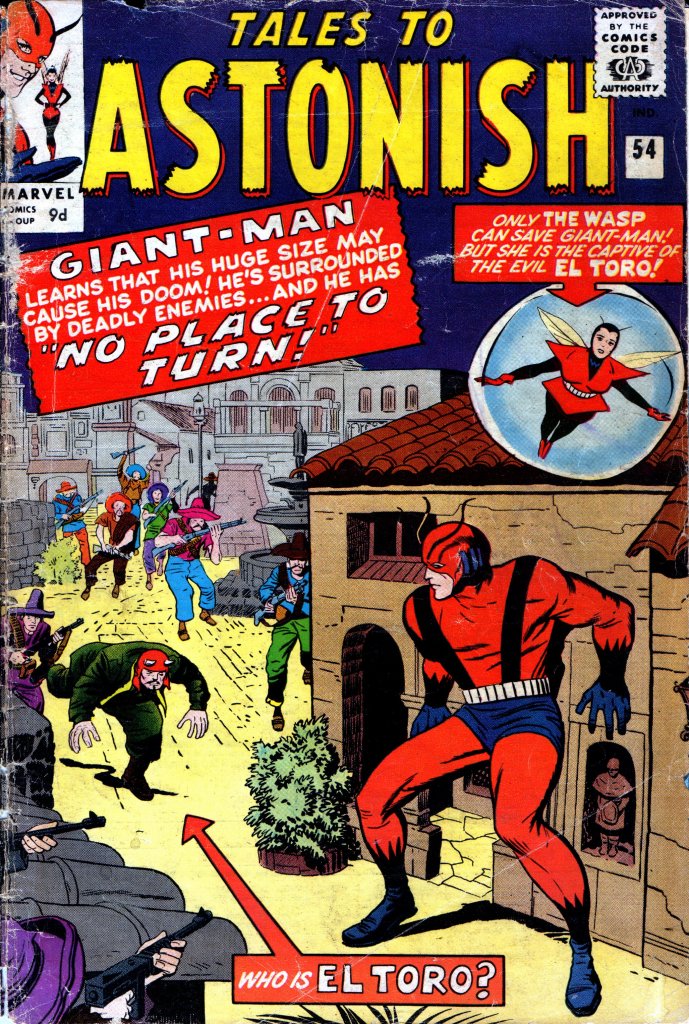
Anyway, Bush’s Hobbies was located in a little strip mall and was devoted to all sorts of collectibles, primarily coins, stamps and sports cards. But comics were a part of the mix–back issues only, at this point the Direct Market was only beginning to form, and so stores such as this one didn’t bother handling new books. But they did have a wall’s worth of back issues, most of which were reasonably priced. I can remember seeing books such as FANTASTIC FOUR #6, FIGHTING AMERICAN #3 and AVENGERS #93 on the wall above the boxes, all priced well beyond my spending range. But it was tantalizing simply to see them. Anyway, I was very much interested in the age of the comics i bought, often trying to find the oldest comics that I could afford to pick up. Which is what led me to this issue of TALES TO ASTONISH. This was a genuine formative Marvel Comic from the very beginning, so it was like catnip to me. There was then limited interest in Ant-Man/Giant-Man, so these back issues went for cut-rate prices, which put them squarely into my cost range.
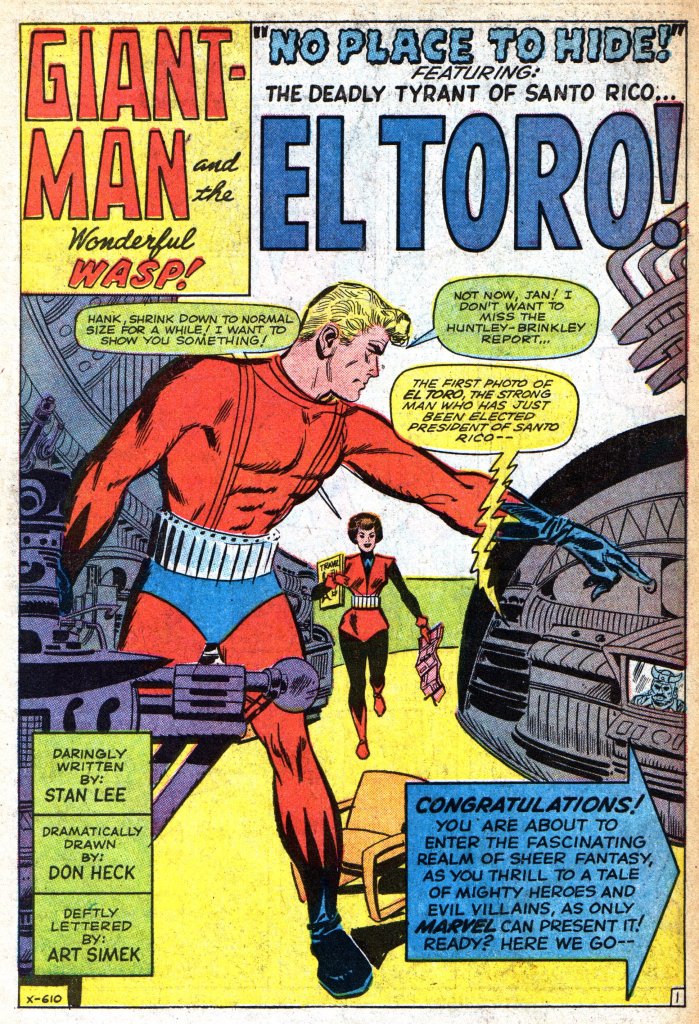
Giant-Man, and Ant-Man before it, was a troubled series, one that was a favorite of Marvel’s publisher Martin Goodman but which never quite caught on with the reading public at large. Consequently, editor Stan Lee retooled it constantly, giving Hank Pym new partners and new powers and new costumes until eventually accepting reality and wrapping up the strip in favor of the more popular Namor. But to me, there was something mysterious and compelling about these Giant-Man stories. I knew Hank Pym as Yellowjacket and had seen him as Goliath in reprints, and even as Ant-Man in one notable AVENGERS story. But there was something about Giant-Man’s design that I liked. By the time of issue #54, Stan had stopped jobbing out the writing of the strip and taken over the scripting chores himself, so this outing feels a bit more typically Marvel than a lot of the previous stories. The artwork was by Don Heck, an underappreciated artist who here got to ink his own pencils, which usually resulted in a good final product.
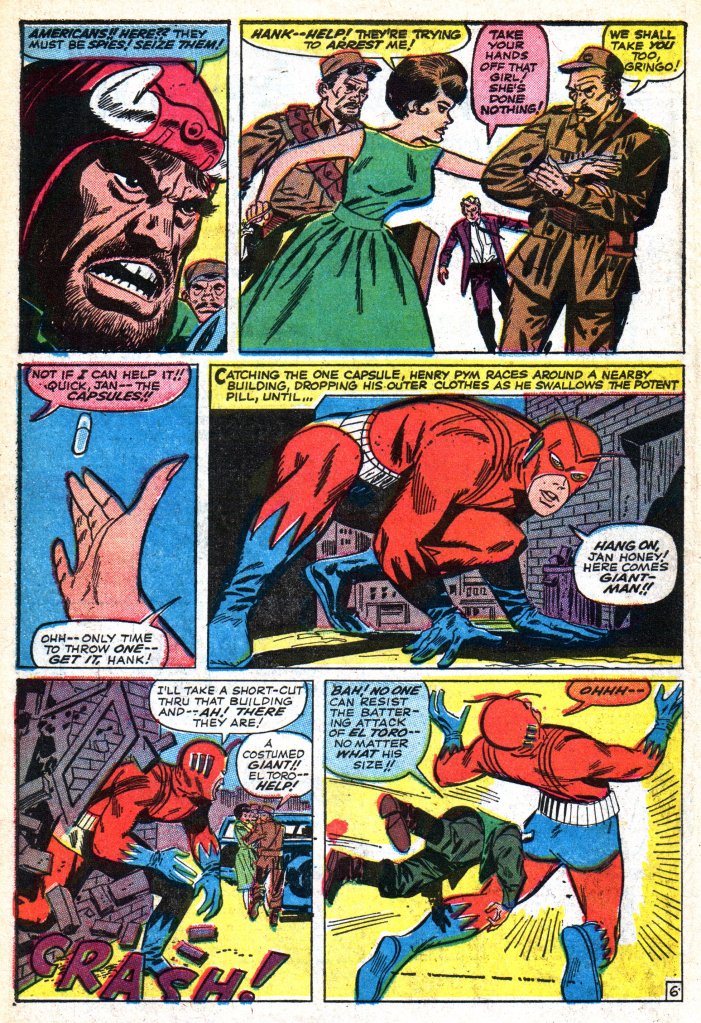
The story itself is a piece of period doggerel. In it, Giant-Man and the Wasp are summoned to Washington DC by the Feds, who want the Master of Many Sizes’ help concerning the nation of Santo Rico. They feel that the recently-held elections were rigged, resulting in the Communist-sympathized El Toro becoming El Presidente and instituting marshal law. Hank and Jan are to sneak into Santo Rico, determine if there is a Communist plot behind it, and then either report back or break it up themselves. Being an idiot, Hank gives the pair’s supply of size-changing pills to Jan to carry across the boarder, saying that “In case I’m searched, I wouldn’t want them to be found on me.” Yeah, Hank–but what if they search Jan, too, you’re good with her being caught red-handed? In any case, the bad guys are on to the American spies straight away, and capture Jan–but not before she’s able to throw Hank a single size-changing capsule. Hank becomes Giant-Man, but he’s stuck at a single size of about 15 feet.
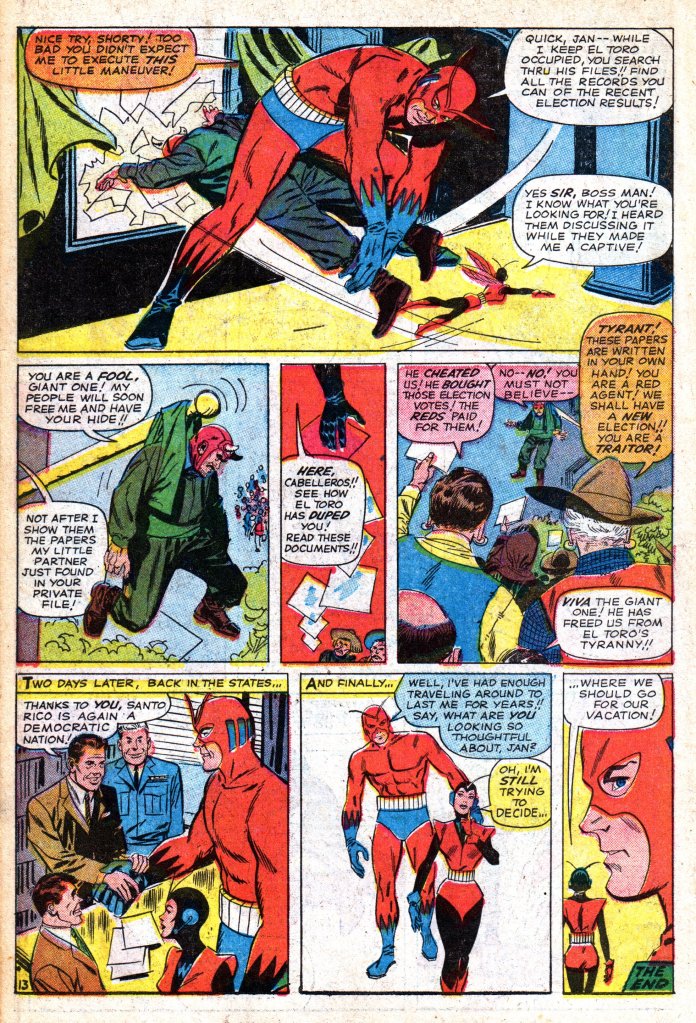
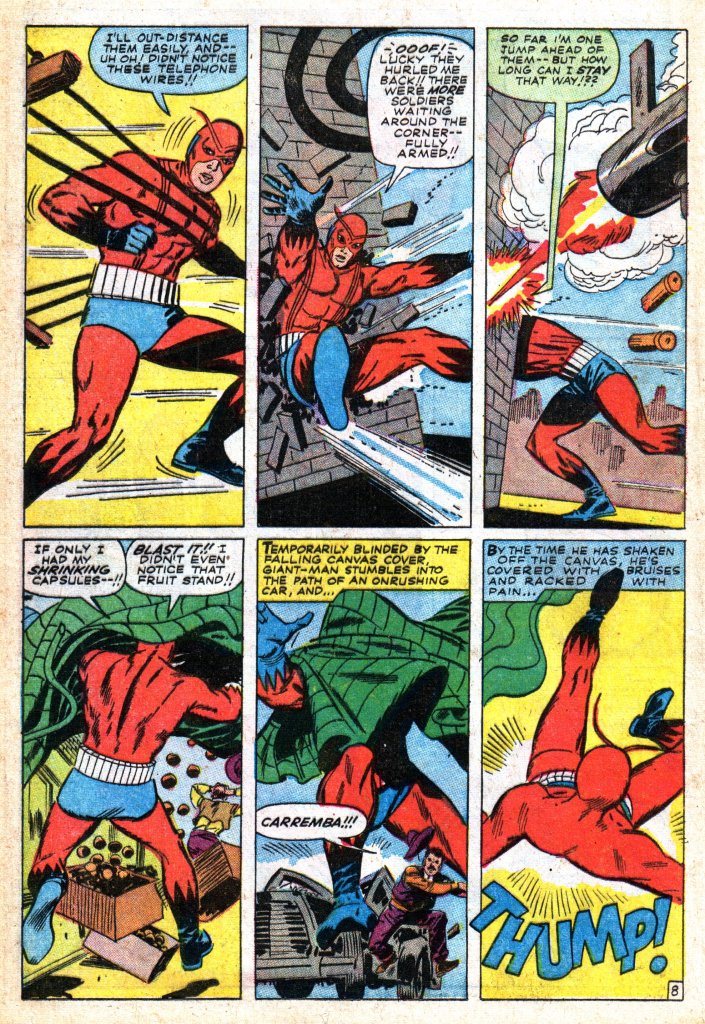
One of the factors that may have held back the Giant-Man strip is how often the hero is presented as an absolute klutz. And that’s what happens here. Giant-Man is large and clumsy, getting himself tripped up by the environment and swiftly finding himself on the run, his increased strength only a so-so weapon against soldiers who can shoot at his massive frame. Eventually, though, the oversized Avenger is able to locate his captive partner, retrieve their size-changing gear and then kick El Toro’s ass, proving that El Toro bought his election and restoring freedom and democracy to the region. And all in only 13 pages, too! It wasn’t a great story, but for this series it was among the more fun adventures the character had in recent months. So I didn’t regret picking it up (especially because it only cost me in the neighborhood of $3.00) years later, Kurt Busiek and I would use Santo Rico in a couple different stories beginning in an issue of NIGHT THRASHER. So viva the gigantic one!
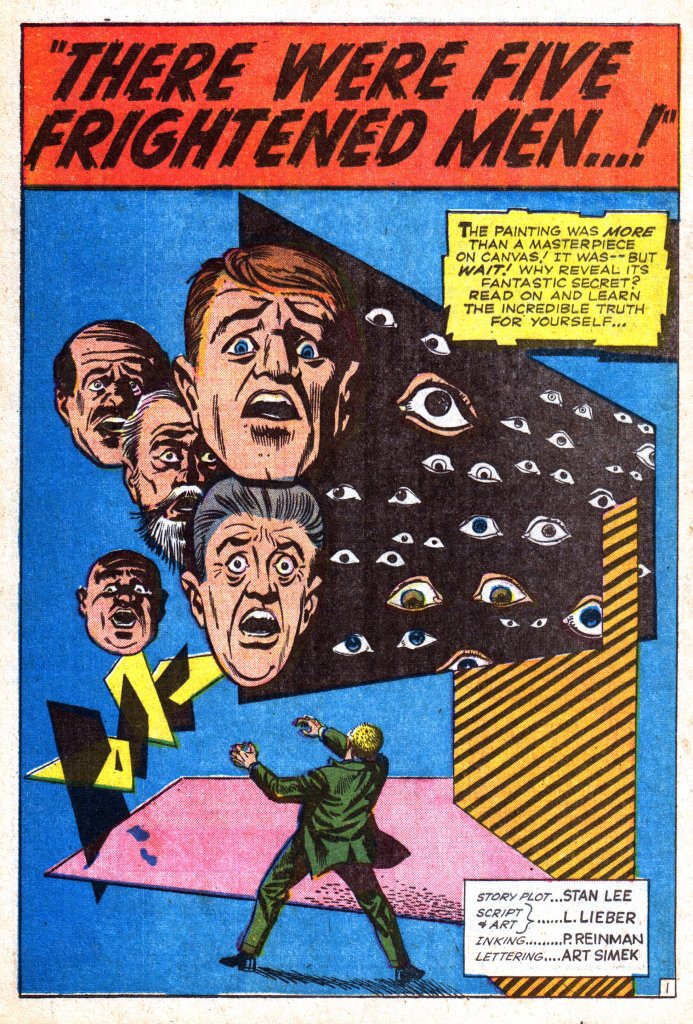
The Marvel super hero stories hadn’t entirely taken over the whole of the assorted mystery/suspense titles, and so the back half of this issue was dedicated to a pair of short stories of this type. The first one was the work of writer/artist Larry Lieber, with inking provided by Paul Reinman. The art on this story is a bit stiff and workmanlike, but this splash page is pretty terrific. The story is about an art thief who steals a particular painting depicting five frightened men from a mysterious gallery. But of course, it’s a magic painting that winds up swallowing him whole–so when the piece is returned to the gallery, it now shows six frightened men. Twist!
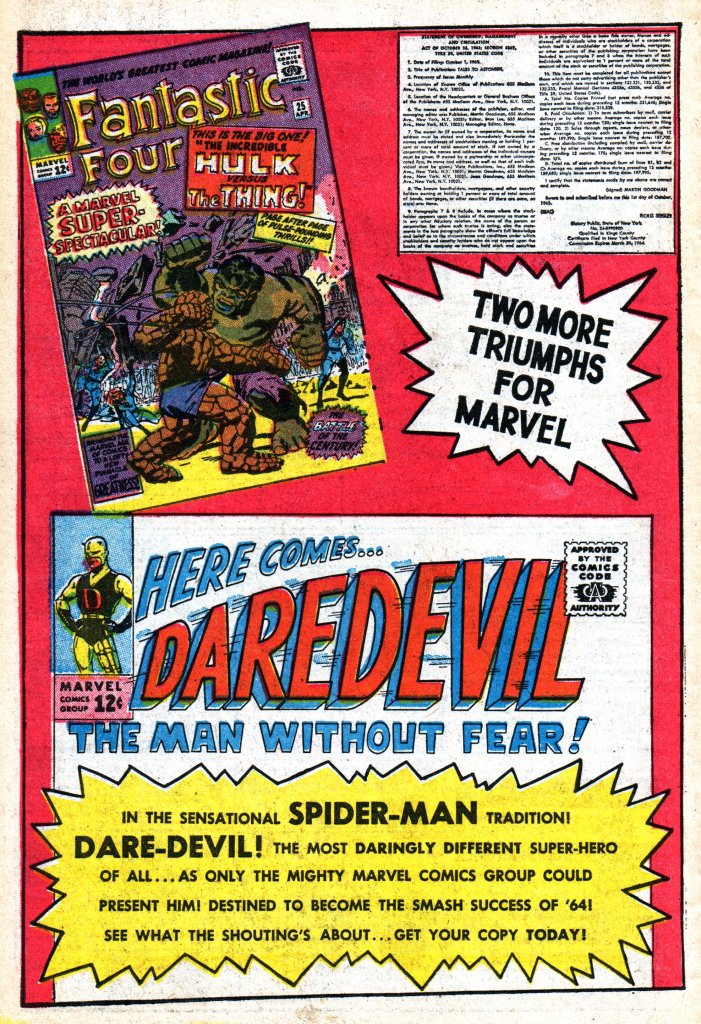
There weren’t many house ads in this issue of TALES TO ASTONISH, and it wasn’t yet running a letters page. There was only this one, which doubled as a place to run that year’s Statement of Ownership. According to the text, TALES TO ASTONISH had been selling 187,995 copies on a print run of 318,339, giving it an efficiency of 59%, which seems pretty good–especially considering that this was among the weaker-selling Marvel titles of the era. Also, you can see that DAREDEVIL was still in a bit of a state, and here Stan works to promote the new title despite the fact that he still doesn’t have a completed first issue cover to showcase. The eventual DAREDEVIL #1 cover would be a bit of a patchwork job, with contributions from an assortment of different artists. Also, the dark coloring on that FANTASTIC FOUR #25 blunts the impact of what must have been one of the most exciting comic book releases of that year, the first full-on Hulk vs Thing battle.
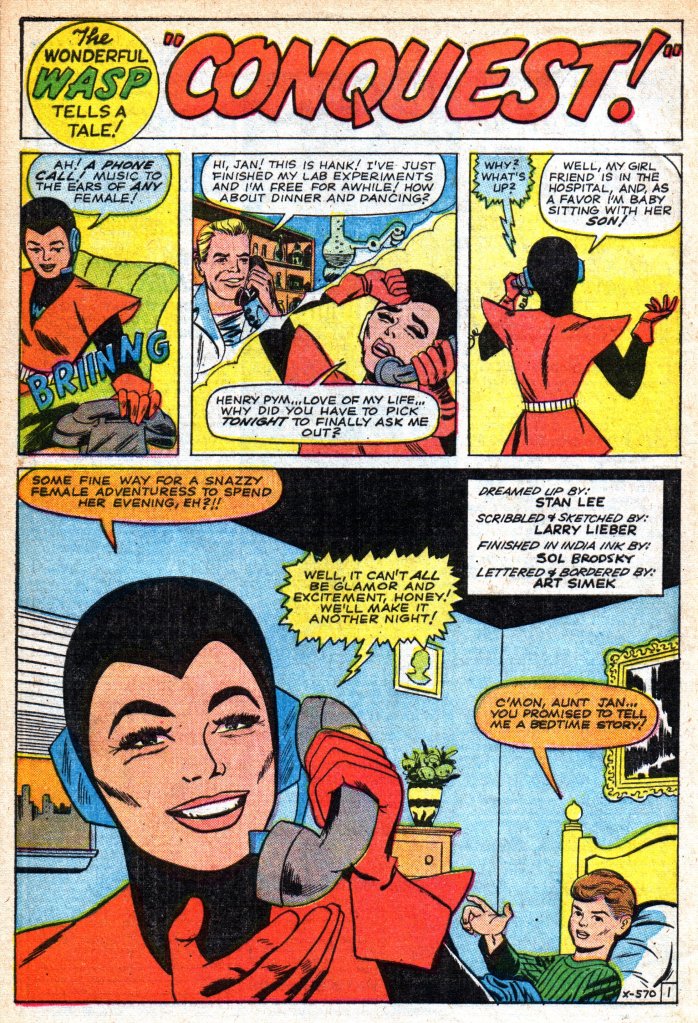
The final story in the issue was a bit of a hybrid; Stan has started doing this in the mystery titles as a way of perhaps generating a bit more interest among the super hero audience for them. So the bit here is that the story is being told by the Wasp to a sick child that she’s babysitting for a friend. It too was both written and drawn by Larry Lieber, with Sol Brodsky supplying the inking. It’s about the vainglorious ruler of an alien civilization who wants his people to idolize him, so he leads them in a successful war of conquest against a nearby planet. But in doing so, his existing citizens wind up having to subsidize the conquered planet, and they consequently blame the king for the downturn in their circumstances. So having conquered a world, the King has lost the respect and admiration of his people, the very thing he was attempting to increase–Twist! The kind in this story wasn’t any more interested in this tale than I was. Still, it was perfectly fine formulaic fluff.
 The Tom Brevoort Experience
Jan Babysits in her Wasp costume…WTF?
LikeLiked by 1 person
Were their identities known? I’d say no based on their first return to the Avengers roster. Maybe her friend and her son knew and he begged her to babysit dressed for battle? Yeah, I got nothing.
LikeLiked by 1 person
No, if I remember correctly, their identities weren’t public at that point.
LikeLike
And given that the phone call comes in on Jan’s landline (the only kind of line back then) she has to have brought the kid to her place instead of babysitting him at his home. Seems implausible.
LikeLike
I hid most of my purchases from my parents well into adulthood. Having grown up in the Depression, the idea of converting money into joy was an anathema to them, especially my mother. She always felt that disaster was just around the corner and that all resources should be husbanded against the coming deluge.
LikeLiked by 2 people
When Santo Rico showed up in either the first or second issue of the Avengers-JLA crossover the only reason I knew anything about it was Marvel Legacy: the 1960s Handbook.
LikeLike
Giant-Man ( “If only I had my shrinking capsules..!!” – page 8 panel 4 ): Me, if only Giant-Man’s odd looking belt was used for holding growth and shrinking pills. Plus why didn’t they go to Santo Rico in insect size to do their investigation for the U.S. government?
LikeLike
Stan Lee had said later on one of the problems with Ant-Man was that the art didn’t take advantage of a full figure of our hero surrounded by giant versions of things small to the rest of us. Too bad his editor never told the artists this at the time, eh?
LikeLiked by 1 person
I think the real problem with Ant-Man was that shrinking is just not that impressive a super-power. The image of a man standing next to giant props is visually interesting, but it makes the hero seem weaker, not stronger (cf. The Incredible Shrinking Man, Land of the Giants, et. al.). That Atom over at DC had a similar problem: He was always getting caught in predicaments that would not have been an issue if he were normal-sized (strapped to a hand-grenade, stuck to a tire on a moving car). At least part of the appeal of superheroes is the displays of awesome power, and Ant-Man didn’t have much to show. I think the movies did a better job showing the tactical advantages of being able to shrink and grow quickly in a fight. But even then, when they really needed him to throw down (Civil War, Endgame), they put him into Giant-Man mode.
LikeLiked by 2 people
You forgot that The Avengers#161( July 1977 ) and Marvel Premiere#47-48( April-June 1979 ) demonstrated the threat an Ant-Man can be in a fight. Similar fighting style to a teleporter or someone with phasing/intangibility powers.
LikeLiked by 2 people
Ant-Man’s power of “ant-control” is underrated and rarely used to its full extent, maybe because it shades into horror. In Avengers #275, he has a bunch of ants swarm over Titania. She freaks out, not because they can hurt her at all (I believe she’s way too durable), but apparently because having a swarm of ants all over you is primally terrifying. Using that against standard humans, where the ants can do damage, is even more scary. Moreover, even if the opponent is tough or protected enough not to worry about it, having ants crawling all over their face is going to be distracting and impede their vision at the least.
Shrink-and-grow makes for flashy fighting. But why expose oneself to punches if you don’t need to do so? A shrinking character could just do something like get into an opponent’s ear canal, and start beating on them from literally inside the opponent’s head. Though again this starts looking like horror. But even something very simple like landing on opponent’s neck while in shrunk form, then switching to unshrunk form, should immediately take down any normal human.
Maybe a shrinking character would work well in a team book in being a very effective, even brutal, combatant, without the whole book being constrained by the other limits of the shrink concept.
LikeLiked by 1 person
Replying to Seth Finkelstein’s comment, the original Ant-Man was extremely effective in Avengers #161, where he managed to fight against the rest of the team all on his own for several pages. However, that was when he was being mind controlled by Ultron. Definitely not an auspicious occurrence that one of Hank Pym’s most effective outings was when he was not in his right mind. Anyway, I’ve always felt that Scott Lang ultimately made a better Ant-Man than Pym. Maybe it’s because, as Kurt Busiek suggests below, Scott wasn’t a scientist, but rather more of an everyman, plus even before the MCU he had a sense of humor.
LikeLike
The Atom, was, however, an effective fighter. Even now, when I know 180 pounds of Atom swinging a man around would probably tear his arm off, I love watching those old stories. And after all, Batman ended up in just as many deathtraps — having Atom face smaller ones made him more interesting for me.
LikeLike
I hated that Ant Man vs. Avengers story. It did not convince me he was a serious power player, it just convinced me Shooter put his thumb on the scale. Plus it was one of a string of “one man beats up the Avengers” stories which made me dislike it more (though it wasn’t as bad as the forgettable Atlantean Tyrak taking the team down).
LikeLike
When I look at what Gil Kane accomplished on the Atom that way, Ant-Man looks like … well he never looked that good.
LikeLiked by 1 person
I could be wrong, but I seem to recall finding one of those circulation things that showed that Astonish with Giant-man outsold Suspense with Ironman…at least for a bit? Ironman was likewise a feature that would receive tweaks turning the early days though unlike Hank and Jan, it had most of the essential parts of the feature down by the time of this issue. Hank would keep getting off and on again power boosts and downgrades, new costumes, and blink and you miss it gear. The rotating artists didn’t help. Ant-man at the very least had a cool costume…. the Giant-man outfit has no real concept of it’s own… it’s Ant-man with a standard cowl and a pair of suspenders that he wears with a belt. He doesn’t get a decent outfit until Avengers #28.
That said… I love the Essential Ant-man book that collects the entire feature. Even if the stories aren’t the greatest it’s cool to see Stan and crew throw everything against the wall (except a supporting cast) hoping it would stick.
LikeLiked by 2 people
Regarding the house ad for FF #25. Yes, it’s hampered by the dark coloring, but also by the mis-registration of the red plate. This was a common problem during this era, as ruby red lips may have slipped to appear as a slash across the chin in some books, or be shifted to the left or right, muddying up the images and making them look as cheap as a comic book was. Don’t know what solved or straightened out this printing error that was so common, but Marvel books started to take off shortly after this point…about when Chic Stone’s inking comes over Kirby’s FF… and the continued story-lines lead to continued story arcs.
LikeLiked by 1 person
Being a die-hard Iron Man fan, I owe Ant-Man/Giant-Man and Wasp big time. Not only for having a series that often sold less than his book, but most significantly for having an even worse Rogues Gallery. Think about it. Egghead. Human Top/Whirlwind. That alien who erases people. Even Mr. Doll and Scarecrow don’t look so bad compared to that crew.
I also agree with others that a lack of imagination worked against our heroes in Tales to Astonish. Imagine if both characters could grow or shrink at will. Or if select body parts – like legs or fists – did the growing. Also consider Hank’s genius combined with Janet’s savvy and bank account. That would had them invited to more distinguished superhero parties.
Although Don Heck will never be a favorite of mine, I agree that having him ink his pencils resulted in a better overall art job. Shame he didn’t have a better story to work with.
Lastly, I find it quite ironic that these two characters as well as my guy, Iron Man, who could barely keep their series afloat are household names.
LikeLiked by 1 person
Of course, it took nearly half a century for Iron Man and Ant-Man to become household names. Amusingly, back in the 1980s, one of my roommates who didn’t read comics was vaguely familiar with the Fantastic Four from cartoons, but he referred Ben Grimm as “Rockman”. Somehow, that name he made up as based on Grimm’s rocky appearance was easier for him to remember the character by than “the Thing”.
In those early years of Marvel, seems clear that Stan was overstretched as chief writer/editor. The most successful series, Fantastic Four and Spider-Man, had the benefit of artists who were also keen plotters and had a keen interest in the series, but Kirby himself was also overstretched up through ’65 or so, when he took over the plotting as well as the art on Thor and turned that mag (still Journey into Mystery) around. Larry wasn’t a particularly gifted writer for super-hero comics and none of the old school writers Stan tried out didn’t quite get the tone or style that he was trying to set for Marvel and even Roy Thomas, when he came aboard, took over a year to really get reasonably good. In 1965, I don’t think there was anyone available who could have figured out a way to boost reader interest in the adventures of Hank & Jan. Compared to what was going on in the FF and Amazing Spider-Man, Giant-Man & Wasp seemed hopelessly passe. Still, good or bad, all those old stories laid a foundation later writers & artists could build upon.
LikeLiked by 1 person
Based on everything I’ve ready, your assessment is “spot on” with a cherry atop it! I’m also chuckling at your friend from the 80’s as one of my college roommates (Go Wolves!) used to see me reading The X-Men and which one is called the “X-Man”? Ironically, such a character existed a decade later.
LikeLiked by 1 person
Poor Hank never got a break. I always wished that Stan would have used him in the 1966 Marvel animation instead of Namor. Love those early TTA stories. Especially when he was Giant-Man. He had more material than Namor did at the time.
LikeLiked by 1 person
I think there were two big problems with Hank as Giant-Man:
1. When you’ve got a big strong guy being bashed around by a much smaller guy like El Toro, it looks dopey, like the hero is incompetent. Giants can works well against big foes or against groups of normal-sized foes, but a single human sized guy who can’t fly or shoot energy bolts or anything — nah. El Toro can look compelling against a normal guy, but if Giant-Man has trouble with him, it just makes Giant-Man look bad.
2. Big strong giants are built to use their strength; it’s the really satisfying thing giants can do. So a scientist-giant, whose first thought on facing a new foe is “Wait! Let’s hear him out!” just doesn’t sing. This was a problem with Black Goliath, too. Let the scientists have other powers; let the giants enjoy plowing into crowds of thugs or busting stuff up. This is why Clint Barton was the best giant hero of Marvel’s Silver and Bronze Age; he had fun being a big strong guy. He’s better as Hawkeye, and should be Hawkeye. But he was better at being a giant than Hank Pym or Bill Foster.
[This last bit is why I had so much fun writing Atlas in THUNDERBOLTS, and why his outfit was red and blue — he was very consciously influenced by Clint as Goliath.]
I think a tiny hero can work, and a tiny smart hero even moreso, but both DC and Marvel have struggled to sell Ant-Man and the Atom. But I’m not sure it’s different powers they need, just artists who can make the size-differential thing look good (Gil Kane was good at that, and Kirby was, too), and a writer who can give them livelier personalities.
A little hero needs charm and humor, I think, an outsize personality to stand out more, to make us root for the guy because he’s likable and engaging. Sadly, Hank Pym and Ray Palmer were both pretty dry, while the sassier and also-small Wasp stood out, even among more-powerful Avengers. If Hank (or Ray) had been more like Spider-Man, they might have found more success.
Movie Scott Lang has the humor and charm, for sure — I tend to think they keep making him big in the movies partly for the drama, and partly so you can see him in the crowd. Little-guy camera angles can work well in solo stories, but they need a solo focus, and are harder to pull off in group stories.
LikeLiked by 4 people
Can’t disagree with any of that. Underscoring your summation is that in the MCU, it was the fun, more engaging Scott Lang character who took the lead Ant-Man role with Hank Pym essentially relegated to being a crabby scientist-former adventurer.
LikeLiked by 1 person
Marvel was very astute to make sure that movie Hank’s adventuring days were in his past and that his arc was losing and rescuing his long lost wife… and that his only costumed id was Ant-man. It sure avoided the potential pitfall of having a young Hank and Jan as the centers for a movie franchise, and a chunk of the audience bracing for it do go very dark whenever they argue onscreen. I think it was of clear concern since Yellowjacket ended up as an identity adopted by the bad guy.
LikeLiked by 1 person
Once again, no disagreement from me.
What I would say is that if I could change any aspect of Marvel Comics history, it would be that time that Hank Pym slapped Janet. I’ve heard all the various explanations from those involved. But regardless, in my mind, it ruined Hank Pym as character. Or at the very least damaged him in a manner that’s nearly impossible to for future writers to properly resolve.
LikeLike
The problem with The Slap is that it’s the single most iconic moment in Hank’s history. Peter also slapped MJ but it’s a blip because there’s so much other story to mine for drama. Even creating Ultron didn’t stick as much because Hank was rarely involved in a meaningful way in most Ultron stories. Hopefully someday a writer will be inspired to craft a story as iconic to save Hank. So far, at least Englehart and Slott took their shots and both attempts failed to move the needle. And does anyone believe Shooter didn’t ask for the image we got? He meddled with many other plots that didn’t set well with him and he was a power at Marvel and yet he didn’t have that panel edited? Unlikely.
LikeLiked by 1 person
Even if you believe that Shooter didn’t ask for the slap to be quite so overstated, that’s not the image that matters the most. Replace it with less of a roundhouse slap, and you’ll still have the sequence at the end where Jan takes off her sunglasses to reveal her black eye.
There’s no way that wasn’t in the plot — not only would Hall not have invented it on his own, but it’s the twist that gets Hank to trigger the robot to attack; it’s a key structural moment of the story.
And it’s that moment, the reveal that Hank gave his wife a black eye, and the Avengers’ reaction to it, that cements the idea of Hank as an abuser. Peter Parker backhanded his (pregnant!) wife across the room, but she’s uninjured and there’s never a follow-up scene where Peter’s friends and colleagues see the evidence that he belted her and react in sorrow and judgment.
The Peter Parker bit is just an overblown action moment, forgotten by the next scene. The Hank Pym bit is a deliberate moment intended to lead to the reveal of injury and the judgment of the Avengers that turns the paranoid Hank toward villainy.
One’s an accident by an artist who resorts to cliche poses. The other’s a key plot moment with a follow-up in the same issue, and then further follow-ups, all clearly intentional. The issue simply doesn’t work as a story without Hank injuring Jan and the Avengers seeing that he’s done so.
Any claim that the artist misunderstood the plot and made it all up himself is nonsense.
LikeLiked by 2 people
All of which circles back to my point that that single action essentially destroyed one of the founding characters of the Marvel universe. Much as I disliked the Avengers story with Hank Pym breaking bad, every other action could eventually be corrected in some manner. But not one that reveals him to be an abuser. Nor should it. But for me, it’s so needless when Hank Pym’s failings could have been portrayed so many other ways if that was the intent.
Any comic book of any reasonable duration will have cringeworthy moments that are later corrected. (Kudos on your work restoring Tony Stark after the Teen Tony & Crossing debacle!). But poor Hank Pym has never been able to move past that moment.
LikeLike
While I wasn’t a big fan of Englehart’s WCA, I certainly appreciated his work on rehabilitating Hank Pym. And huge props for Dan Slott’s work with him in later Mighty Avengers stories – along with Kurt’s work in the Avengers.
LikeLike
Yep. And movie Scott Lang is very Spidey-like — charming, jokey, emotionally torn between family and duty. He’s enormously sympathetic, which helps make him a vivid, attention-getting character even if he’s tiny.
LikeLiked by 1 person
On the plus side, DC had the sense to keep Atom’s adventures small-scale — he spent much more time fighting ordinary-but-clever crooks than Flash or GL.
And I do enjoy his relationship with Jean. She’s a smart lawyer who’s independent enough one story suggests she might (gasp) keep working after she has kids. They were more amicable and affectionate than most couples and next to Adam Strange and Alanna, get my vote for “most likely to be banging” in that era.
LikeLiked by 1 person
I don’t really agree — I think the Atom needed to be fighting fewer guys in suits and more supervillains. Not necessarily world-threatening super-villains, but colorful villains like Spider-Man, Batman and the Flash had. And he could have been a lot less Gardner Fox and a lot more of a big, expressive personality.
The relationship with Jean was amicable but weird — built through the Silver Age on the idea that she wouldn’t marry him until she’d proved herself as a lawyer, which was a convenient plot point but it wasn’t rooted in personality; she seemed no more ambitious than the other girlfriend characters, and yet she’d set this weird rule.
And then when she did marry him, it was in a story that involved her going crazy, which had fatal repercussions in the future. But by then, his solo series had already died — done in, I’d say, by him being a small-scale hero with minimal personality. It doesn’t seem surprising that readers preferred the louder, flashier (no pun intended) heroes.
LikeLiked by 1 person
Poor Jean really got the shaft post-Silver Age, yes.
We disagree on the Atom, but that’s what makes horse races. I didn’t think Jean’s desire to get their careers started before marriage was madly ambitious, just practical, particularly if they’re thinking of having kids.
While I wouldn’t have objected to some colorful costumed foes, outside of Chronos the Rogue’s Gallery was C-list, as Ryan Choi once observed (Bug-Eyed Bandit, Ion Mask, Panther Gang). So more costumes might not have helped.
LikeLike
Yeah, when I say the Atom needed more super-villains, I mean _good_ super-villains.
LikeLiked by 1 person
One thing I did like about Giant-Man is that he’s constantly shown training and developing himself. It’s unusual to see that in someone other than the non-super Batman/Captain America types.
LikeLike
I suspect that was an easy way to demonstrate his powers right up front, when the actual story hadn’t really started yet.
LikeLike
Hadn’t thought of that but you’re probably right. Heck did that a lot in his Iron Man work — villain spends a page or two standing in the lab showing off his gadgets. Knowing Heck disliked having to plot Marvel method (not that I blame him) I assume it’s partly that a page like that is a page without any plotting required.
Worked better with Giant Man.
LikeLike
This touches a bit on your point that Giant-man looks dopey fighting a little guy: but I think growing large might generally be a better power reserved for bad guys? The Thing, Hulk, Thor, Hercules, Ironman, Spider-man, etc all have good to great track records knocking out much larger opponents. They still look good even if they struggle or beaten by a much larger opponent, but a giant super-hero has to struggle regardless of the size of their opponent.
LikeLike
I don’t think being a giant should only be for bad guys, but I do think it works better in a team than solo. Teams generally fight foes powerful or numerous enough that there’s stuff a giant can do and look good — and a giant is a nice visual and a fun power-fantasy, so I think they’ve got a place.
Colossal Boy worked fine in the Legion, Atlas worked fine in the Thunderbolts…I just think you need the right kind of personality, and to be careful picking villains. You can even use the way a giant fighting a normal-sized guy can look like a bully to turn a crowd against your hero, that sort of thing.
You need to be aware of the strengths and weaknesses involved in that visual, and use them intentionally and well. But you kind of need to do that with any power set; it’s just a bit blunter with giants.
LikeLike
I have similar thoughts about characters who turn insubstantial such as Vision, Phantom Girl and Shadow Thief. It’s a useful power for a hero but “You can’t hit me, I can hit you” is more effective with a villain.
“Steal, Shadow — Steal” was I believe my first encounter with that particular power and the Shadow Thief seemed monstrously unbeatable.
LikeLike
The thing about powers like that is, heroes need weaknesses, or the struggle isn’t dramatic. So there are ways to disrupt the Vision that don’t work on the Shadow Thief, because it suits the drama and action better.
But this is why I always had trouble with the Sandman (the Marvel one) as a hero. Personality-wise, I loved it, but he’s really, really hard to find casual vulnerabilities for.
LikeLiked by 1 person
“Consequently, editor Stan Lee retooled it constantly, giving Hank Pym new partners and new powers” In one story, Hank acquires the ability to enlarge and shrink other living things at will. It never came up again.
A friend of mine pointed out Jan’s storytelling — as they appear to be yarns she made up — is one thing that could have made her more interesting. She’s obviously got a flare for fantasy tales that she could have tried turning into a career. Like the story that established she’s a jazz buff, nothing came of it.
LikeLike
I’d love to see an Ant-Man/Giant Man Omnibus. It seems like one of the blind spots in Marvel’s Silver Age omnibus collection.
LikeLike
It’s quite true that the Second Jan Slap is the one everyone remembers, because he done did it before during the Kree-Skrull war. Roy T had Yellowjacket and Wasp stumble across Kree Menace #158, and because Roy wanted the two characters to separate for plot-reasons, Hank just backhands Jan into dreamland. Hmm, and in the debut YJ story, Jan tries to hit YJ (not yet knowing his ID) and he threatens to “paste” her. And Sue thought Reed paternalistic (according to Byrne).
I’ll be the one to point out that Doll Man is still the champ eentsy-weentsy hero, lasting close to 15 years.
LikeLiked by 1 person