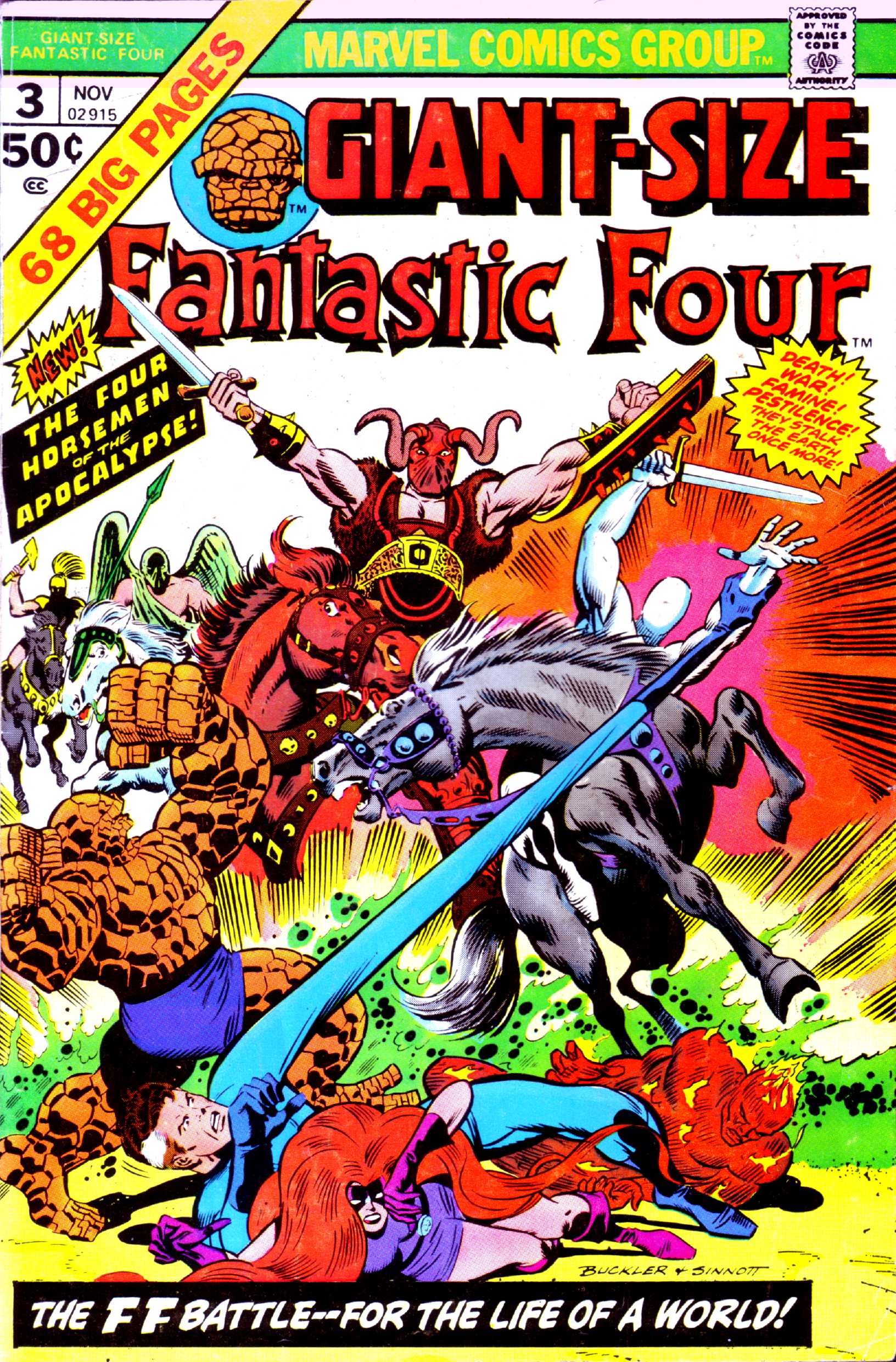


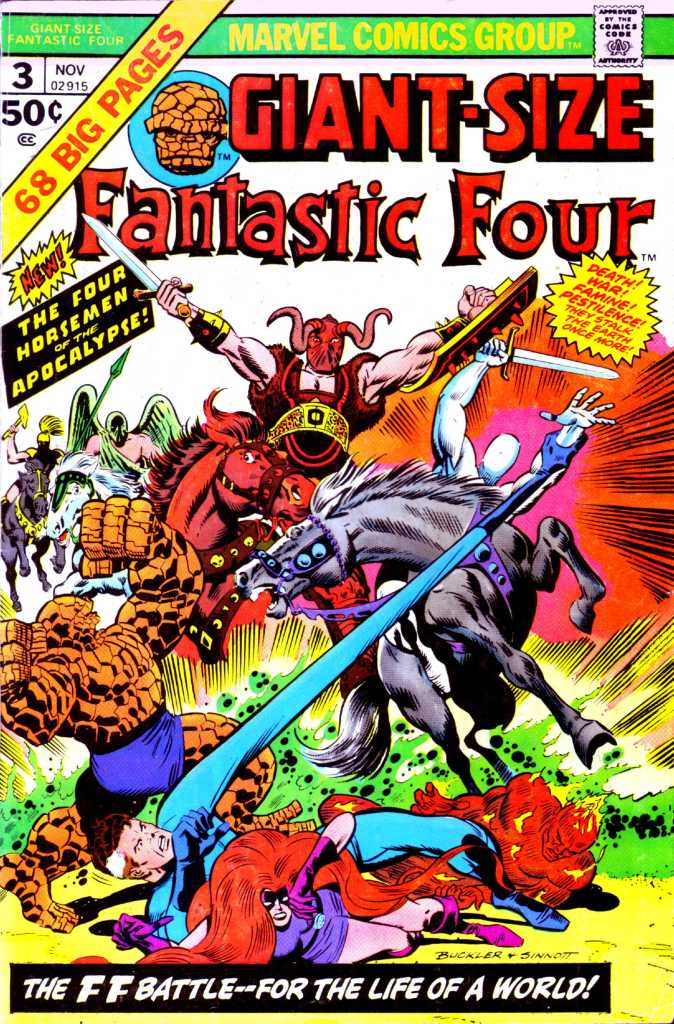
My buddy David Steckel and I were both enormous fans of the Fantastic Four, which was one of the things that brought us together in the first place. So we’d regularly let one another borrow and read the assorted issues that we had that he other did not. Which is how I wound up taking this issue of GIANT-SIZE FANTASTIC FOUR #3 home with me at one point to enjoy. This was the only issue that David had in his collection (much of which he’d inherited from some older relative who had outgrown comics) so it was weird and novel to me–like an Annual but definitely not an Annual. Steckel had a few issues of GIANT-SIZE SPIDER-MAN as well, which helped to contextualize this book to me as something that had been part of a now-discontinued line at one point. But how it fit in, I had no real idea.
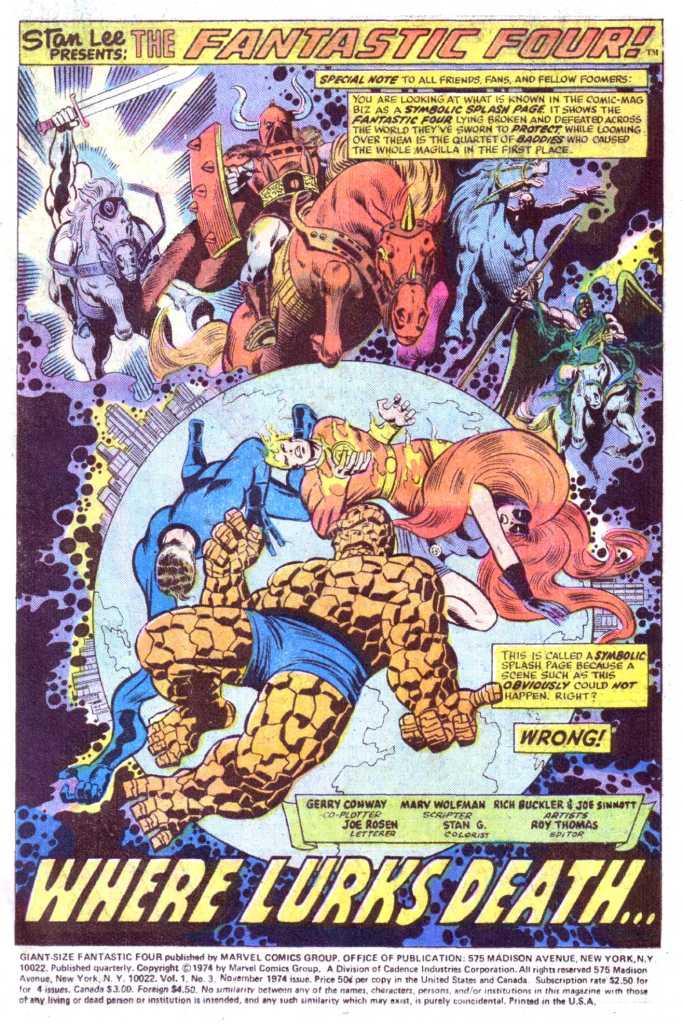
I’m pretty certain that it was in the pages of this GIANT-SIZE that I got my first look at the somewhat off-brand Fantastic Four of the years immediately preceding when I had started to follow the book. In this period, Medusa had replaced Susan Storm, who had grown estranged from her husband Reed and had left the team. Also, Johnny had started wearing a red FF costume in emulation of the Golden Age Human Torch, which even then I knew had to have been a Roy Thomas-driven decision. Consequently, this period, which fell between the time of the stories being reprinted in MARVEL’S GREATEST COMICS and the present was fascinating to me, for all that I didn’t entirely love the couple of stories i was able to sample from this period, this one included. It felt like a relic of another era, even though it had been published in 1974, a time when I was already reading comics, albeit exclusively DC’s at that time.
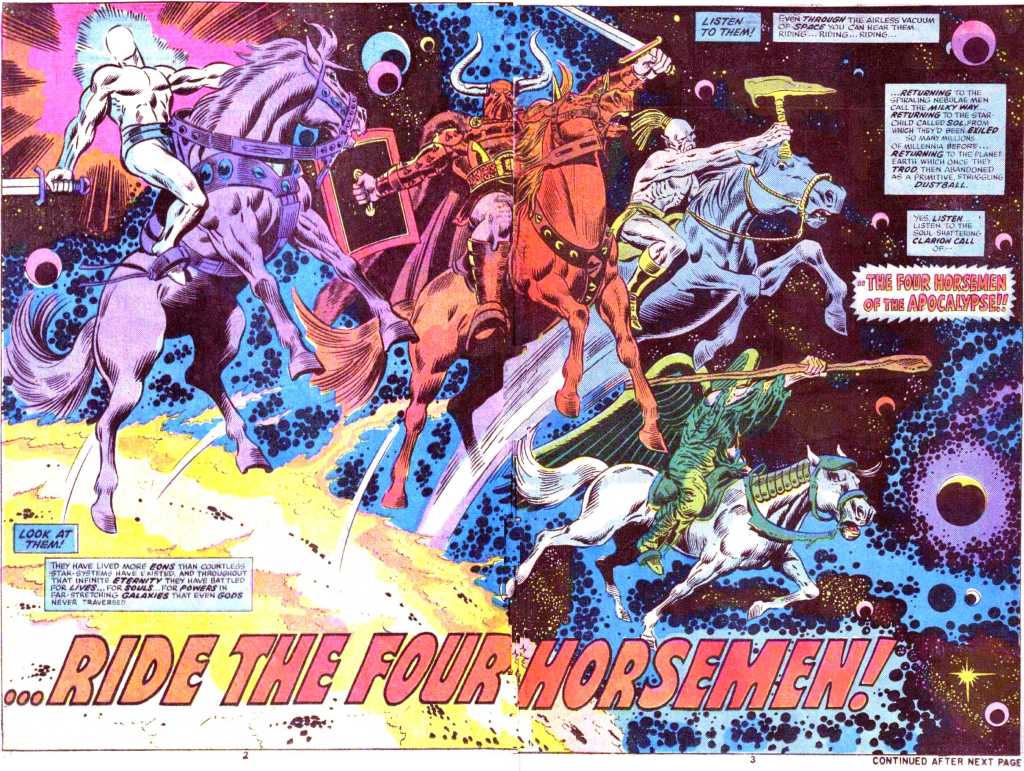
The story in this issue was co-plotted by regular writer Gerry Conway, who had taken over from Roy and who continued to push the series forward. He was pushing in a bit of a wrong-headed direction in my opinion, but give him points with not being content to stick with the established status quo. Marv Wolfman, then at the outset of his Marvel career, co-plotted and scripted this adventure. And it’s a bit of a strange thing, as there really isn’t any concrete explanation given as to just what the titular Four Horsemen of the Apocalypse are. Are they aliens? Gods? Cosmic beings? The text really doesn’t specify. So as usual, just roll with it–they’re badass guys who ride horses through space and who each represent one of the biblical plagues that will precede Armageddon. And the Fantastic Four are going to punch them.
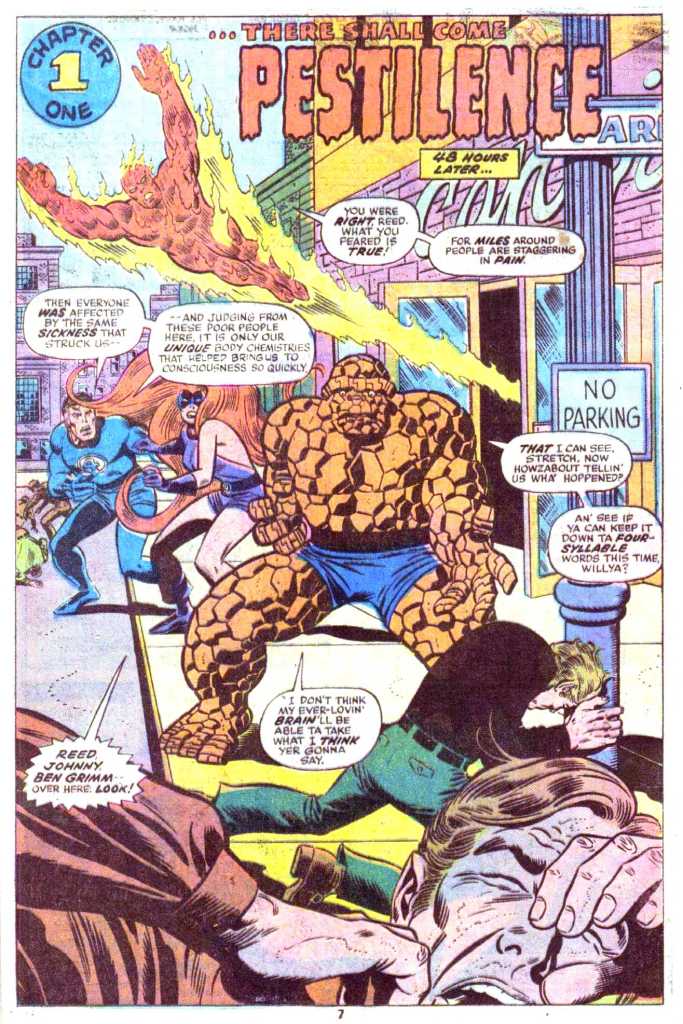
The artwork on this oversized special was the work of penciler Rich Buckler and inker Joe Sinnott. Buckler is a cartoonist who started off showing a great deal of promise, but who quickly fell into a pattern. He had proven adept at aping the visual style of Jack Kirby (often swiping Kirby figures and poses directly in his work) so he was encouraged to steer into that style on FANTASTIC FOUR. so his work often felt like a weak cover band that didn’t have much to offer on its own. (Rich would simultaneously swipe Neal Adams figures on his other assignments. Occasionally, he’d swipe both masters on the same page, leading to a weird visual discordance.) Sinnott did his typical masterful job of keeping the final product looking slick and attractive–he had inked many of the pages that Buckler was using for inspiration, after all, so he was in familiar territory.
The story opens with the aforementioned Four Horsemen returning to Earth after eons away. They promptly move to reclaim the planet, due to the fact that “is the nexus–the celestial center of the civilized worlds”. Which sounds good, if utterly vague. Anyway, to conquer all of the other worlds they’re after, Earth has to be taken first. So Pestilence puts the entire population to sleep for two days with his Coma-Pox, giving all of humanity terrible nightmares. Upon waking, there are riots everywhere, and the Fantastic four take to the streets of Manhattan to try to bring about order. There, they’re attacked by a bunch of random demon-monsters without explanation, who are working for Pestilence, who has set up on top of a skyscraper. Pestilence gives the FF a detail-laden but ultimately sketchy account of the Horsemen’s history before Ben Grimm is able to punch him into oblivion. Reed helpfully explains that Pestilence was simply a disease, not a living being that Ben just killed. Whew! No moral gray area after all, thank the Comics Code!
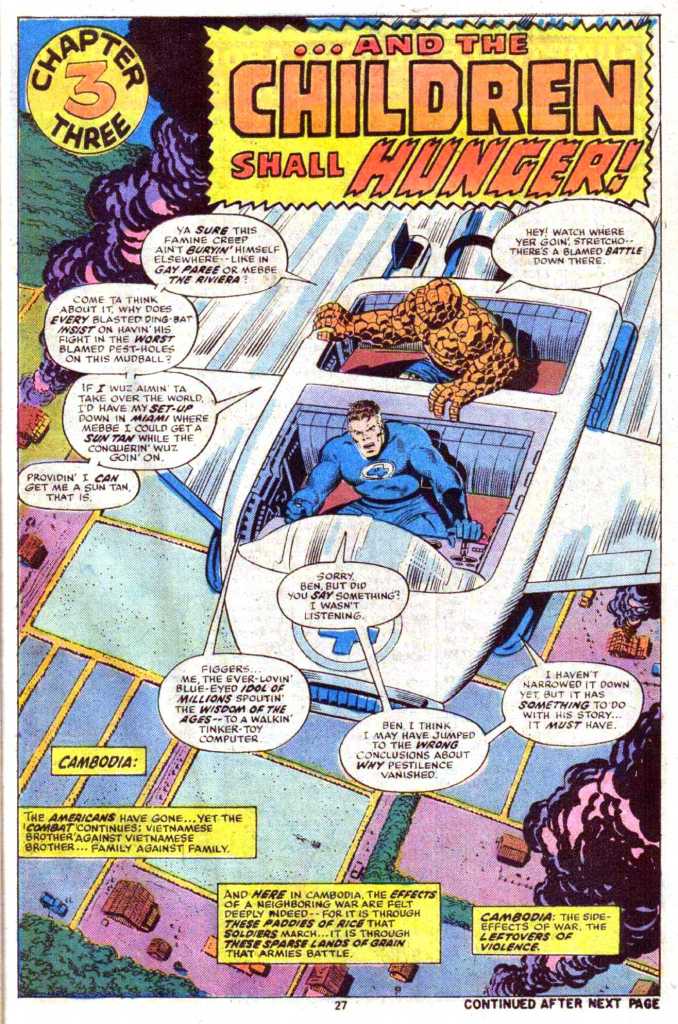
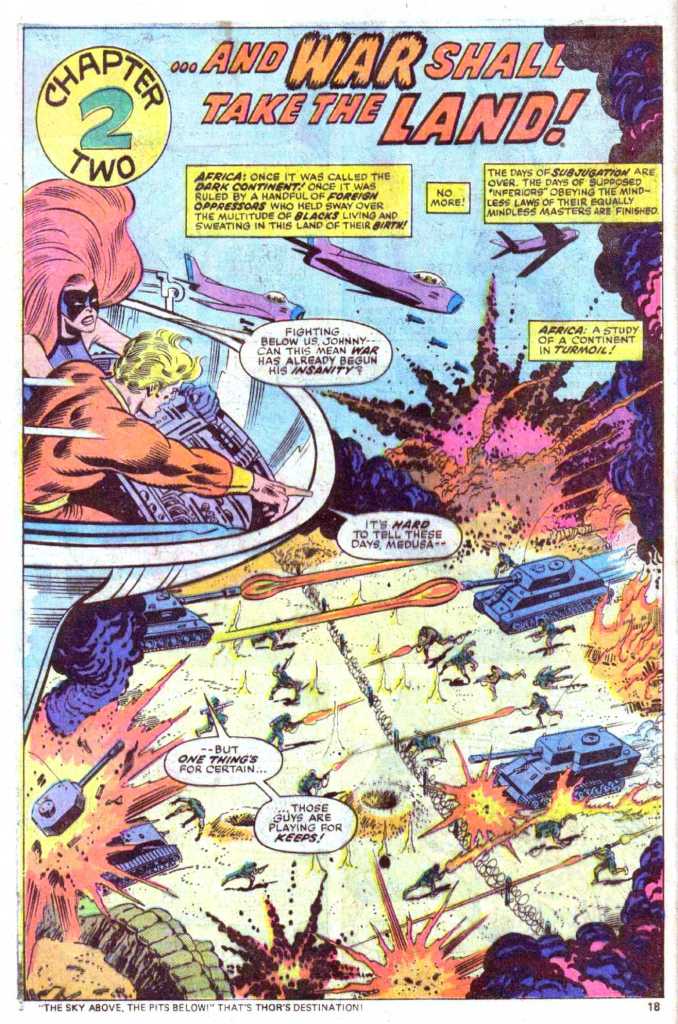
From there, the FF split up to go after the next two Horsemen, War and Famine. The Torch and Medusa head to Africa where a massive military conflict is taking place. Johnny and Medusa ae, after a setback or two, able to unseat War and remove his helmet–where they find that his visage changes into the likeness of each of them–war is, after all, in all of us. Then he disintegrates just like Pestilence. Meanwhile, Reed an Ben have gone to Cambodia, which is suddenly experiencing a debilitating famine–this despite the presence of food, which nobody can seem to see. Reed and Ben force one guy to eat the rice that’s in front of him, thus breaking the spell and bringing Famine to them. And when Reed wraps Famine up in his elongated body, Famine also disintegrates. But more important life lessons are learned.
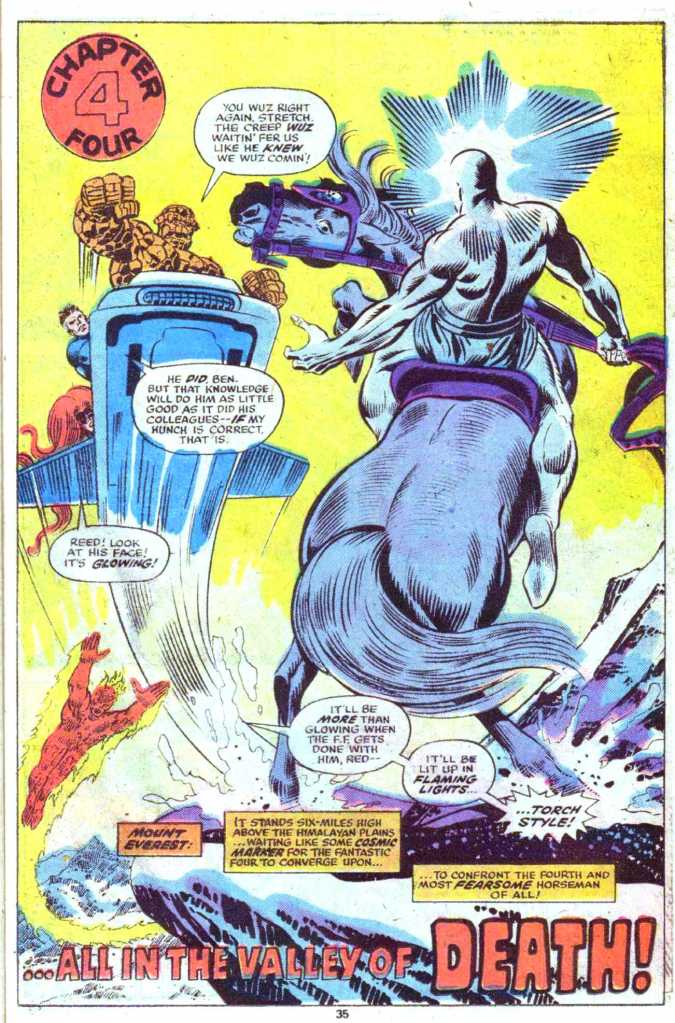
Then it’s into the home stretch as everybody converges on the big magilla, Death, at Mount Everest. Death conjures up the death-images of the FF to do battle with them, but Reed is smart enough to have them all trade foes so they aren’t coming into contact with their own demise. In the end, Medusa throws the Thing’s death into Death itself, causing it to vanish as well, and Reed explains half-heartedly that the race that had banished the Horsemen eons before must have left a failsafe in place should they return–one that they activated simply by battling the Horsemen. Yeah, sure, Reed. if you say so. But, hey, the story is wrapped up, so that’s something. It contained a couple of memorable moments, but the big takeaway for me was just how slipshod the plotting seemed to be. The rules of engagement seemed to be whatever the story needed them to be at any given moment and the victory conditions just kind of happened after a requisite number of pages had been reached. In other words, i found this issue to be profoundly underwhelming, for all that it featured my favorite team.
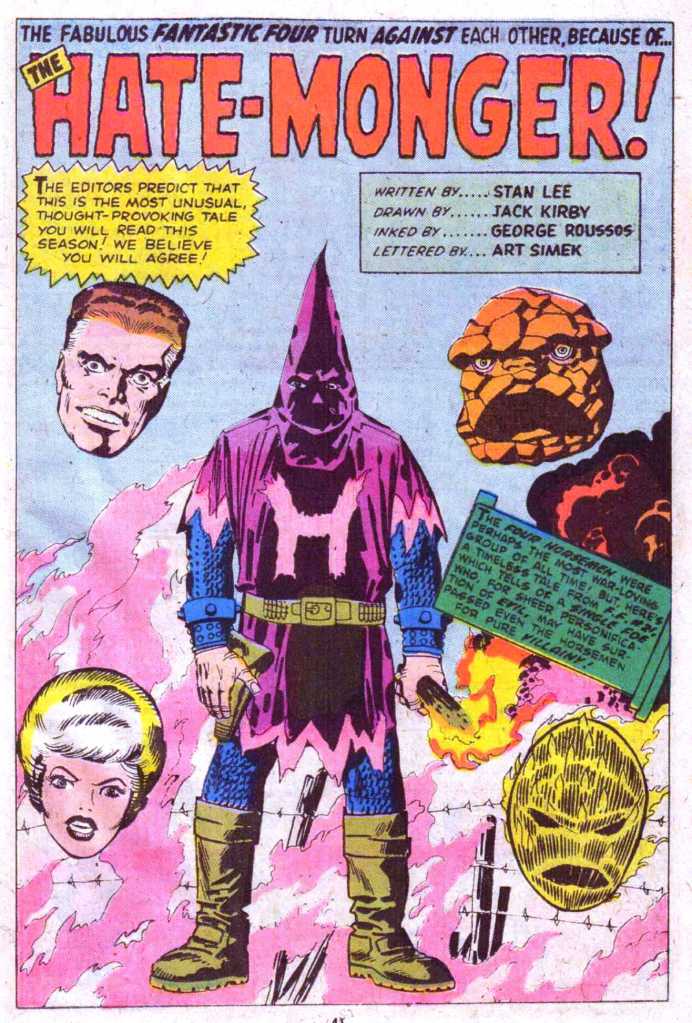
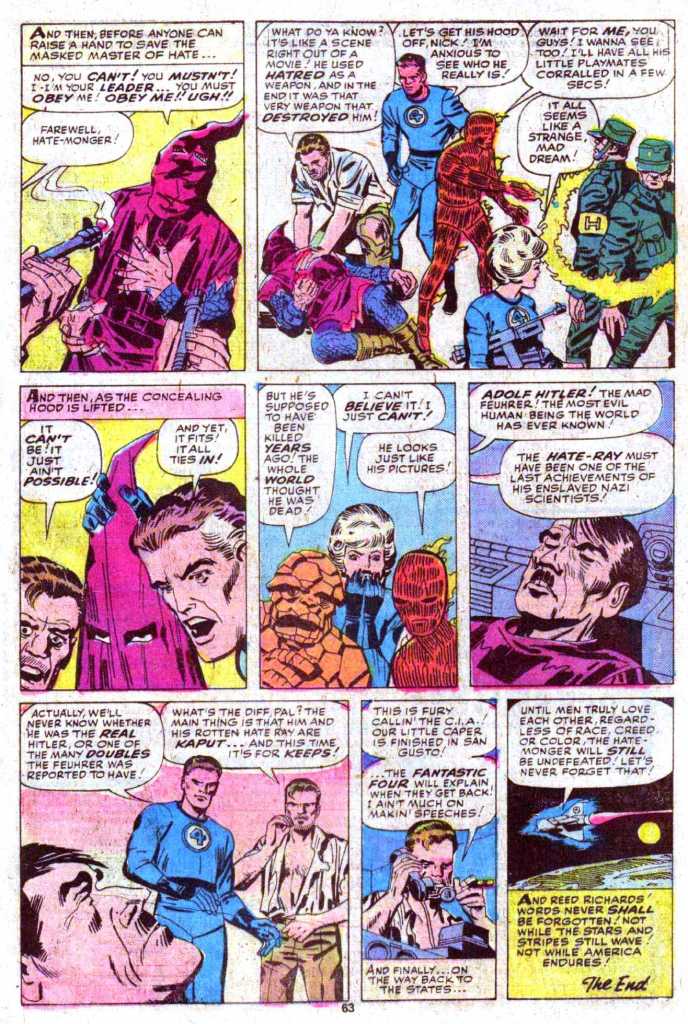
But there was a back-up reprint story, and that one was better. Stemming from FANTASTIC FOUR #21, it showed the FF falling under the sway of the H-ray of the Hate-Monger, a bigot and dangerous demagogue. Also helping out was a pre-SHIELD Nick Fury, who was stated to be working with the CIA as he had since WWII ended. (He had already been promoted to Colonel, though.) The action moves to the small nation of San Gusto, which the Hate-Monger is trying to take over as the hub of a potential empire. But the FF and the old Howler clean his clock, and on the final page, after he’s been killed by a hate-crazed subordinate, the Hate-Monger is unmasked as Adolf Hitler himself! This was a popular end beat in a lot of stories post-WWII, and here scripter Stan Lee adds in some copy to at least raise the notion that he might just be one of the Fuhrer’s many stand-ins rather than the genuine article.
 The Tom Brevoort Experience
Thanks to the late Mark Gruenwald the Four Horsemen of the Apocalypse turned up very much alive on the Strangers Lab World ( clearly he made them disappear in this issue ) [ seen in Quasar#14 & 16 ( September 1990 & November 1990 )]. Also the Horsemen got linked to the 4 aliens ( Froh, Donar, Loga, Hilda/Brunnhilde ) seen in the first 2 Invaders issues [ The Invaders#1-2 ( August & October 1975 ) — to bad the Stranger didn’t teleport them away too ] and their race identified elsewhere as the Axi-Tun ( seen in one of the FF Handbooks )— another Marvel alien race that produces super-powered beings like Marvel Earth.
LikeLiked by 1 person
Conway gonna Conway. The Giant-Size line was generally a flop. They were either quickly assembled one offs or contained storylines that had nothing to do with the main book. The only exception was Avengers, where Engelhart masterfully weaved his greatest story through it and the main title.
LikeLiked by 2 people
I really liked Gerber’s Defenders and Man-Thing GS books.
Lier Englelhart, he tried to use them to expand the story in the monthly book.
LikeLiked by 1 person
I reread Defenders semi recently and it seemed like the GS issues were kind of off on their own. Haven’t read Man-Thing so I can’t comment on them.
LikeLike
I thought Gerber used GS-Defenders to either tie off old story lines or to launch new ones.
GS Defenders #3 sort of was the last Len-Wein-type Defenders story and a sort of a valedictory for Gerber’s Daredevil run. GS Defenders # 4 set up his new line up for the Sons of the Serpent arc (with Yellow Jackett and the unfortunate fate of Trish Starr giving Nighthawk more gravitas). GS Defenders # 5 set up the Guardians of the Galaxy story.
GS Man-Thing #1 was a longer Mike Ploog collaboration, in line with but longer and more complex than their monthly book. GS Man-Thing #2 was sort of a filler. GS Man-Thing #3 was tying up the admired Dakihm the Enchanter/Jennifer Kale stories. GS Man-Thing #4 set up the A Book Burns in Citrusville arc GS Man-Thing # 5 was almost a valedictory for the character, letting other writes get a shot . . . .
Englehart used the format best, but Gerber seemed to use it innovatively as well.
Other books GS books (GS Conan, adopting Hour of the Dragon, or GS Spider-Man, being a team-up book) could not do it, as they had another intent.
LikeLiked by 1 person
I bought this as a back issue a while back. I agree that the story by Wolfman & Conway has some pretty dodgy plotting, but I really liked the art on this, especially the cover, the opening splash page, and the double page spread of the Four Horsemen galloping through outer space. I later got my copy autographed by Buckler and Sinnott.
LikeLiked by 3 people
Back in the day, I’d gotten the 35 cent predecessor of the 50-Giant-Size Mags, Giant-Size Superheroes featuring Spider-Man taking on Morbius and Man-Wolf, and which also included Ditko’s page-size illustrations of Spidey’s rogues gallery as of 1964 when ASM Annual #1 was published as well as a humorous take on how Lee & Ditko “created” Spider-Man – or at least one particular Spider-Man story. I forget if the regular mags were still 20 cents or had already gone up to a quarter by then, but it wasn’t too much for me to splurge on a 35 center at the time. However, I balked at the 50 centers. By the limits of my budget, getting one of those would mean I would have to leave two regular mags I’d otherwise want to get. Oh, I really wanted some of those, particularly G-S Avengers #2, featuring the death of the Swordsman. But I reluctantly had to leave it on the racks. I never even saw G-S Avengers #s 3 & 4 at the time they were published (but got all of them many years later).
As to this G-S FF, I thumbed through it on the racks but put it back. At the time, I thought the idea of our fabulous FF taking on the embodiments of these ancient banes of humanity referenced in the bible sounded somehow cool. But although the art was very appealing, the overall story itself seemed somehow off. And just that quickie judgment 52 years ago shaded my inclination to never fill that particular Giant-Size gap in my FF collection — but then, I never got any of the other G-S FFs or G-S ASM for that matter. To my adult self, they didn’t seem all that essential, at least not as much as the G-S Avengers and Defenders mags, which all seemed more integral to respective runs of Englehart & Gerber on the regular mags. Conways’ GS-FF & ASM seemed as if they might just as well have taken place in another universe as in regular Marvel continuity, even with Medusa and Johnny’s red uniform. I didn’t dislike Conway’s runs on ASM & FF, although it appeared he had a thing for “killing” off baddies in many of his stories, as well as using stand-ins for some of Spidey’s classic villains. Harry as the new Green Goblin was understandable, but a 3rd version of the Vulture and a new Mysterio??? Over in the FF, Conway inherited the tense stand-off between Reed & Sue actually begun by Stan within his last couple of years on the title and built up by Roy during his brief run. Of course, Gerry brought it nearly to a head with Sue serving divorce papers on Reed and set to swim off with Namor before having a change of heart that seemed a bit of a cheat, but, hey, comics!
Anyhow, your review of this particular mag reinforces my earlier view of this story as not that well thought out or executed and taking some rather simplistic views of some serious real world problems that no amount of super-heroics could resolve – anymore than Superman could really have rounded up Adolf, Benito and Tojo and thereby ended World War II. Of course, neither Conway nor Wolfman could have imagined how truly horrible the situation in Cambodia would become. Overall, the story seemed an ambitious effort that didn’t really come off. There’s a good reason why most times, fantasy works such as comics, aimed primarily at youngsters, including young adults as well as minors, typically avoid stories dealing with the sort of real-world problems of disease, hunger, war and death. Outside of the realms of fantasy, fictional characters can’t beat any of them. Oh, sure, comics writers could deal with them in limited ways, and pretend that, for example, the original Human Torch killed Adolf Hitler, but even then only after tens of millions of people had been killed by warfare, starvation and outright murder under the Holocaust and nothing could undo any of that. And even during the height of the Cold War, no one pretended that any super-hero had taken out Stalin and brought freedom and democracy to the Soviet Union.
It was remarkable that Starlin was allowed to kill off Captain Mar-Vell, not in the midst of heroic battle, but a victim of cancer, albeit due to exposure to a deadly toxin while battling Nuklo. He beat Nuklo, but nothing could beat the cancer, not even the most brilliant minds of the Marvel universe, not alien technology or even magic. Disease took Mar-Vell just as it had taken Starlin’s own father and although I loved the character, I am glad that thus far Marvel Comics has refrained from bringing him back from the dead – as has happened with so many other characters, several times with a few, over the last 50 years.
Just a few thoughts aroused upon reading your overview, Tom.
LikeLiked by 3 people
I agree on Mar-Vell, a great tribute to Starlin and his intentions. I liked Mar-Vell. Maybe the sales were low enough that Marvel sales could do without his book. It’s surprising, and under the circumstances, admirable that he was allowed to stay dead (with a few sneaky deceptive cheats like having a Skrull impersonate him). Fortunately, Mar-Vell’s not needed, and his legacy helped fuel other characters. I wonder if he’d have been as popular as Peter Parker or Wolverine if he’d have ever stayed dead.
LikeLiked by 3 people
I do think killing off Norman was the right call. Every added time Peter made Norman forget his alter ego, it felt more strained — smarter to end it.
LikeLiked by 2 people
Actually, it was Nitro, not Nuklo, who did in our beloved Captain. And yes, you nail precisely why fantasy and reality in comic books have a challenging dividing line.
LikeLiked by 1 person
After collecting comics rather sporadically from about the age of 5, while living in Japan (or, more accurately, taking whatever my parents purchased for me and my brother) in the late ’60s and getting dosages of both DC and Marvel, by the time I’d turned 8 in 1970, I’d developed a strong preference for Marvel. I think what appealed to me was the greater sense of drama, the imperfections of the heroes, and the sense of each issue being part of a larger tapestry of stories rather than just one story of no great consequence. I did hate missing issues following those with a dramatic cliffhanger, but by then I’d also found most done-in-ones too boring and repetitive. Marvel’s soap-operatic aspects managed to suck me in! During that period in 1969 to ’70 or so, when Marvel went to all done-in-ones, my family did quite a bit of moving – from Japan to Massachusetts then to Texas and finally to Long Beach, CA, and I didn’t get enough comics during that period to really notice the brief change. Much later, when I read several of them, through reprints or originals, I found most of them really subpar products.
Now, admittedly, in Marvel’s early years, ’61 – ’64, Marvel produced many great one-issue stories that were great, but also many that were not so great, and at least a few that were really bad, more so on those that only took up half or less of the comic. But even many of the better done-in-ones had running subplots, such as Ben’s despair over his transformation and his jealousy over Reed & Sue’s relationship, and then his budding romance with Alicia and Sue’s infatuation with Namor. Even FF #51, while a classic done-in-one, had more emotional impact (IMO) after having read FF # 50. I’d gotten a reprint of #51 circa 1972 and at the time seemed a bit weird to me. It wasn’t until years later that I read the portions of the Galactus Trilogy reprinted in the 2nd Marvel Treasury Edition that I came to more appreciate the depths of Ben’s melancholy and the misunderstanding that led him to believe Alicia was ready to dump him for the Silver Surfer. That’s when the story really clicked for me. Being even just a bit older and wiser and more appreciative of Ben Grimm’s emotional swings over his condition as well as the bitter jealousy that motivated the unnamed baddie who “cured” Ben simply to take on that condition for himself and use it to try to destroy Reed Richards but then came to realization that Reed was a better man than he’d presumed and opted to save him at the expense of his own life. Enough emotional depth just in the one issue with no cliffhanger, but I came to appreciate it more within the context of what had come before.
LikeLiked by 1 person
Just as a reader, I wonder what a Curt Swan & Joe Sinnott art job would’ve looked like. I’m not a huge Swan fan. I do respect his consistency and longevity. He could tell a story very well, and convey character emotion. But those are two long-time, high-profile pros who may have never worked together on a book. I think most of the other inkers who worked on Swan’s DC pages also worked for Marvel, many likely inked Kirby.
I also think Buckler drew a lot of great covers, and I’m partial to the ones inked by Dick Giordano for DC.
LikeLiked by 1 person
Swan & Sinnott had a piece in the SUPERMAN: THE MAN OF STEEL GALLERY in 1995.
It looked pretty good.
LikeLiked by 2 people
Thank you, Kurt! 🙂
LikeLike
I have an odd fondness for the Horsemen as fictional characters but they’re hard to do right. This issue is a good example. It looked entertaining when I skimmed it in the store but close up …yeah, I see the flaws.
LikeLiked by 2 people
Giant-size Avengers #2 might be the single greatest issue of Avengers….at least to me anyway. #3 is no slouch. As for this GIant-size Fantastic Four… it’s been years since I read it but I remember liking it quite a bit. I was oblivious at the time that Buckler was cribbing Kirby but I thought the art with Sinnott looked pretty lush. Other Giant-size issues of note are GS Defenders 2 and 4.
There was a lot of reprint material in the GS books… like the DC super spectaculars. It never bothered me much since I loved the older stuff.
LikeLiked by 5 people
I’m in complete agreement with you, David, in regards to Giant-Size Avengers #2. The story was totally riveting and remains one of Dave Cockrum’s finest moments.
LikeLiked by 3 people
It’s a beaut! The uncredited Neal Adams’ inks towards the back don’t hurt. As mentioned above… it also fits within the regular monthly book storyline seamlessly.
On a separate note: When I finally had a copy of Avengers #2 to compare I was surprised how much was cut from the reprinted Space Phantom story… something like 15 panels or 2 pages worth.
LikeLiked by 3 people
GIANT-SIZE AVENGERS 2 is the best Avengers issue ever. No contest.
LikeLiked by 4 people
With the Swordsman, Mantis, Rama-Tut, and Kang? Written by Stve Englehart Drawn and inked by Dave Cockrum. Bill Mantlo’s credited with “coloring”
LikeLike
And the build-up to the fate of the Swordsman, really from issue #114 when he was accepted as a member of the team, despite his sordid past, was compelling, IMO. His efforts to make up for his past mistakes and to prove himself worthy of both their trust and Mantis’ love, and his growing emotional turmoil as Mantis grew “tired” of him, were fascinating. All leading to that final moment of sacrificial heroism and his dying lament that his life had been a failure. Tremendous writing and art.
LikeLiked by 2 people
Far as I know.. that original Mandarin-powered sword hasn’t been seen since Englehart’s run on West Coast Avengers.
My point is (no pun!) is that thing is just laying around (buried for a while) and you don’t even need to be a good swordsman to put it to use. Seems like something the Dreadknight or Imus Champion would want.
LikeLiked by 1 person
Ironically, my first Fantastic Four comic was Gerry Conways’ first issue. They weren’t the team I’ve so loved in that old Hanna-Barbera cartoon, but still, there was also enough going on to earn my hard-earned dimes.
By this point, most of the fun of the Giant-Sized editions were the reprints to fill out the comic. Why look at Rich Buckler’s attempts to be Kirby when I could see his actual art when it was vibrant engaging! Sure, it wasn’t what I wanted in my current comics, but I most certainly noted and appreciated the energy he and Stan Lee brought into those old stories.
And when Johnny and Medusa hooked up decades later, hey, I saw it coming!
LikeLiked by 1 person
This was my first Fantastic Four issue. I bought it because I assumed that it was a one and done story. I had tried to pick up a few Marvel issues and they were always in the middle of a story and that bothered me. This was a good intro for me into the FF world and I was able to jump in with both their own book and the Marvel’s Greatest Comics reprints.
Of course, around the same time, I picked up Giant Size Avengers 2, which was most definitely not a one and done, but I did backtrack enough to grab Avengers 129 for some background.
LikeLiked by 3 people
Drat, got Nitro & Nuklo mixed up! Thanks forcthe correction.
LikeLiked by 1 person
Although our backgrounds could not have been more different – with me living in the same small town until I moved away to college – our comic book discoveries are remarkably similar. As I share on my Iron Man blog (About | Iron Man), it was when one of my grandmothers gave me a copy of Iron Man #45, I was immediately sucked into that same drama and flawed characters. That it also touched on current issues made that comic book appear more “adult” than the issue of Superboy that she also purchased. (That latter comic did spark my interest in the Legion of Superheroes.)
Those seemingly more “mature” aspects also made it worth the hassle of trying to secure that next issue and so on. That said issue of Iron Man also had the lovely Marianne Rodgers in a bra and panties for a couple panels didn’t hurt matters either – although it seemed almost scandalous to my 11-year-old eyes.
LikeLiked by 1 person
I’m liking the art on this one regardless of inspiration. Sometimes when there are various plotters/writers it’s a sign of trouble.
LikeLike
Jim Sterenko wrote on Twitter around the time Rich Buckler died that this was a very dynamic bit of work.
LikeLike
Actually, it would be a bit odd for Fury to be an O-6/Colonel even if he had been commissioned in 1945 (instead of in Korea) on1963.
An “Operator” being ‘seconded” to the CIA was not unusual but the time line was off. I guess this kind of thing was starting to hit pop culture then, with the rarly Bond films and Robin Moore,s Green Berets book about to come out in 1964.
LikeLike