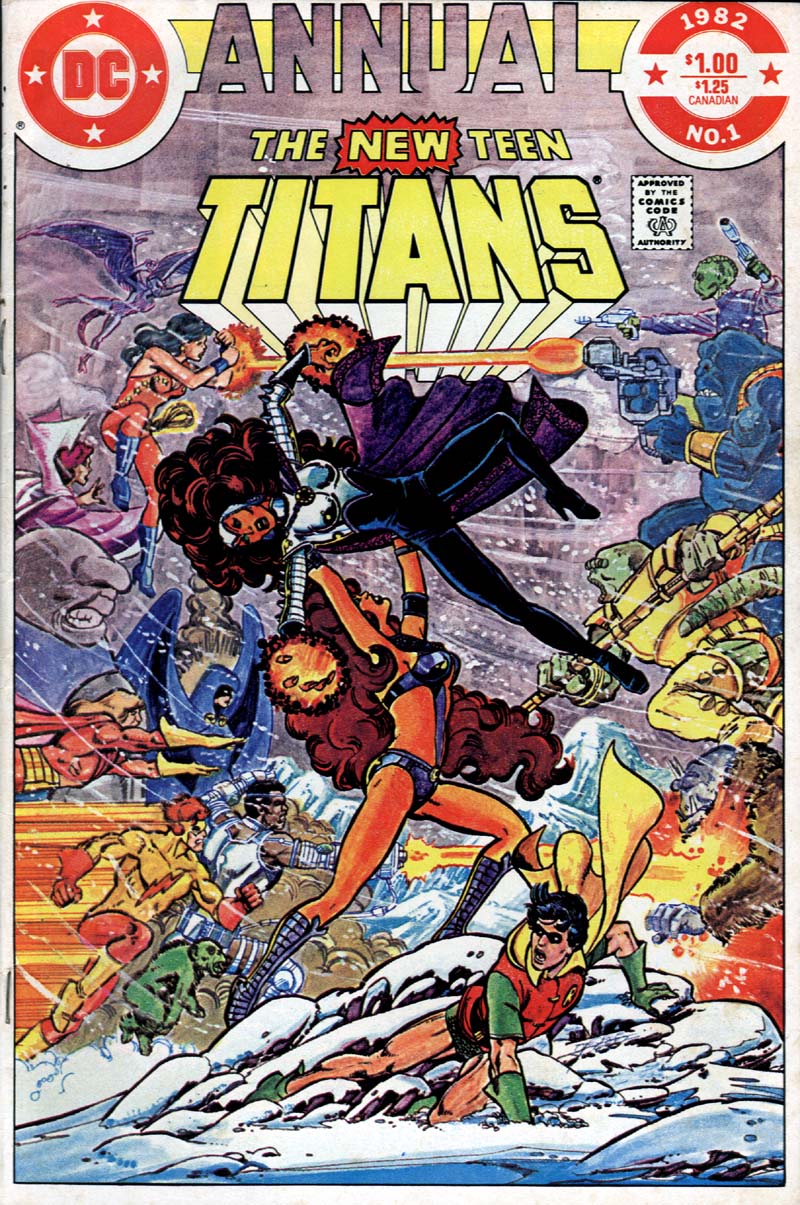


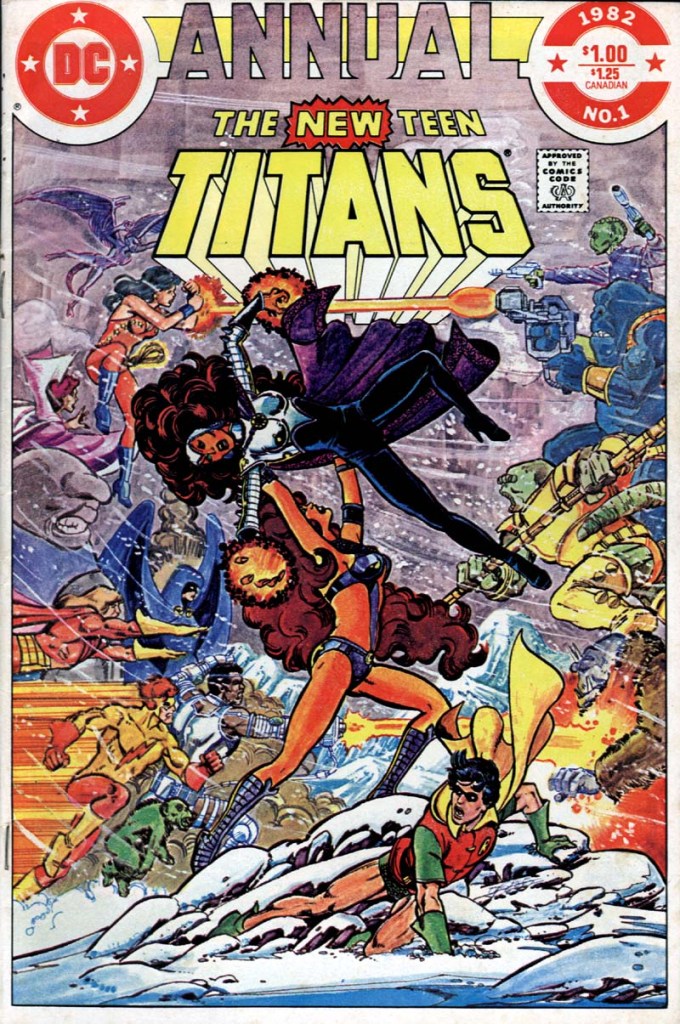
In 1982, there was no comic book that I thought more highly of than NEW TEEN TITANS. It was a perfect synthesis of all of the elements that I liked in both the Marvel and DC titles of the day, a time when the two had very different flavors. But NEW TEEN TITANS bridged that gap, and pointed the way to a revived future for DC. And I was far from the only person who felt this way. NEW TEEN TITANS was a monster hit practically from the jump. It quickly became DC’s best-selling title and did especially well in the Direct Sales marketplace where it sold to more dedicated comic book fans. This first Annual came out at the end of the book’s second year and worked as a finale to a big multi-part storyline. In other words, it was the kind of event that Annuals had been designed to be at the outset, though over the years they had often become merely another issue of a given series.
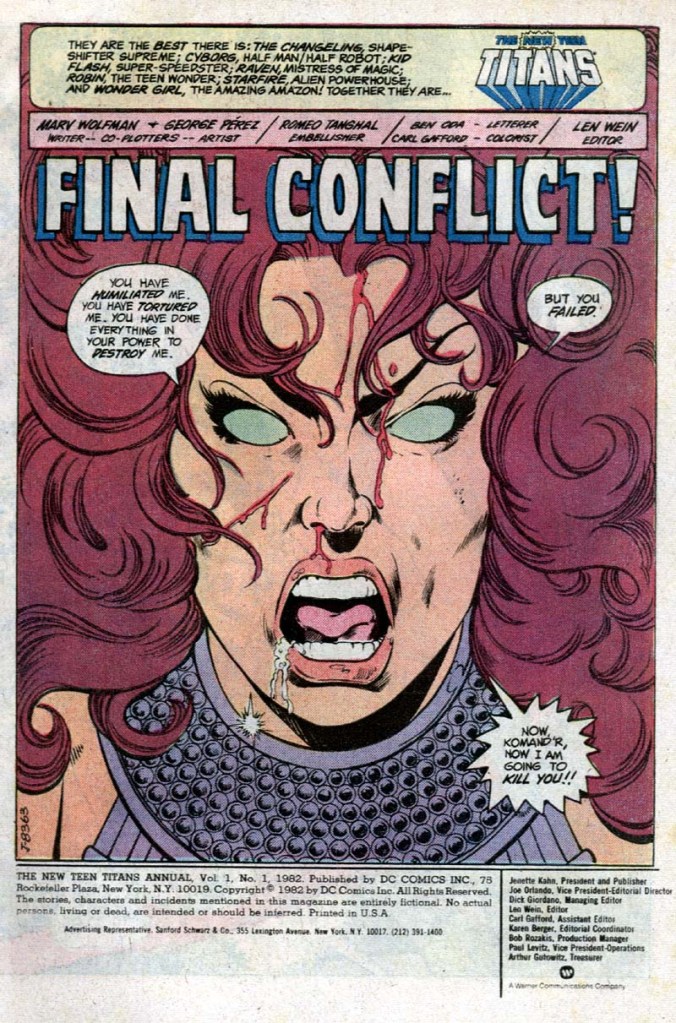
NEW TEEN TITANS was the brainchild of three people in particular: writer Marv Wolfman and his longtime friend editor Len Wein, and artist and co-plotter George Perez. All three men had come back over to DC from an extended stay at Marvel, and they brought a bunch of the Marvel sensibility with them. Before the launch of NTT, the previous TEEN TITANS series had been seen as a something of an embarrassment by the DC brass. DC Publisher Jenette Kahn reportedly gave it the axe despite it not selling that badly because she thought its content was lackluster, and she apparently had to be talked into launching a new iteration of the series by Marv and Len. They did so by assuring her that what they had in mind was a complete reinvention of the concept, including the creation of a bunch of entirely new characters.
Of the established Teen Titans, Marv and George picked up only three: Robin, who was cast as the confident but conflicted leader struggling to get out from under the shadow of his mentor Batman, Kid Flash, who was a reluctant hero at this point who’d been dragged back into the fold by his friends but who was looking for a more normal college existence, and Wonder Girl, who was a bit of a pivot point among the rest of the cast, and who was as capable as her mentor Wonder Woman though a lot more down-to-Earth as well. Marv and George also brought in Beast Boy , the animal shape-shifter from Doom Patrol, whom they rechristened Changeling and gave a fun-loving and slightly obnoxious personality. To this mix they added three additional brand new characters; Cyborg, an athlete whose scientist father had rebuilt his damaged body into a machine after a near-fatal accident, Starfire, the exiled warrior princess of another world who was hot-blooded in both love and war, and Raven, a manipulative and mysterious empath who brought the group together to battle her satanic father.
The new characters in particular were running mysteries, and as with the All-New X-Men over at Marvel, the readership learned more and more about who they were and what their backstories involved as the series went on. This meant that for these first two years, there was seemingly always more to discover about these new, exciting characters. At the time of this Annual, the spotlight had shifted over to Starfire, whose domineering and deadly sister Blackfire had appeared on Earth to reclaim Starfire in her bid to take control of a galactic consortium. The New Titans were aided by the Extraterrestrial Omega Men in pursuing Blackfire into space, and by the point of this story, were enmeshed in an all-out war for control of the Citadel, the ruling body.
Special mention needs to be made concerning the artwork of George Perez. I’d first encountered it in the very first Marvel comic that I had bought, FANTASTIC FOUR #177, and George quickly became my favorite super hero artist in the field.
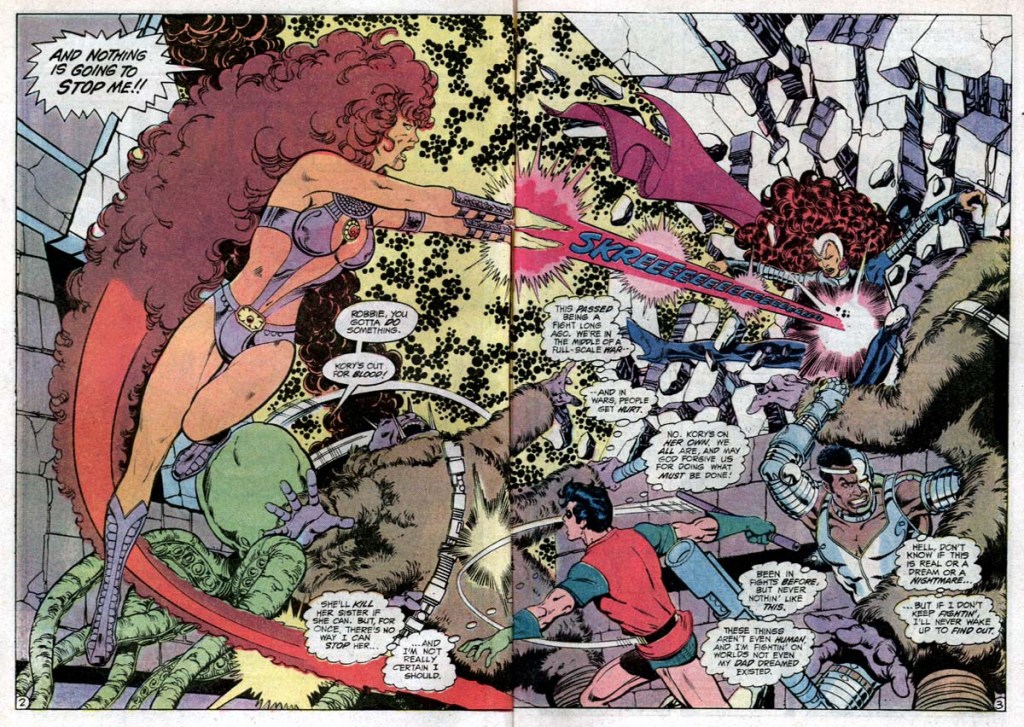
This was due to a number of factors, including his facility with huge groups of characters, his detail-oriented style, the manner in which he broke down a page (often employing more panels than the average artists of the time) and a design-oriented sensibility that made his work utterly appealing. He’d grown more and more skilled over time, but especially on NEW TEEN TITANS, a title that he felt a greater-than-usual personal ownership of, having co-created many of the characters, his skills improved dramatically. As did his output. Not only did he produce all of the monthly issue of NEW TEEN TITANS in 1982, but he also penciled this Annual as well as the TALES OF THE NEW TEEN TITANS limited series that shed further light on the backgrounds of the newcomers. While he did much of this work drawing only breakdowns (as he did in this Annual, allowing inker Romeo Tanghal to provide the final finish) his style was already so solidified that it connected even in this stripped-down version.
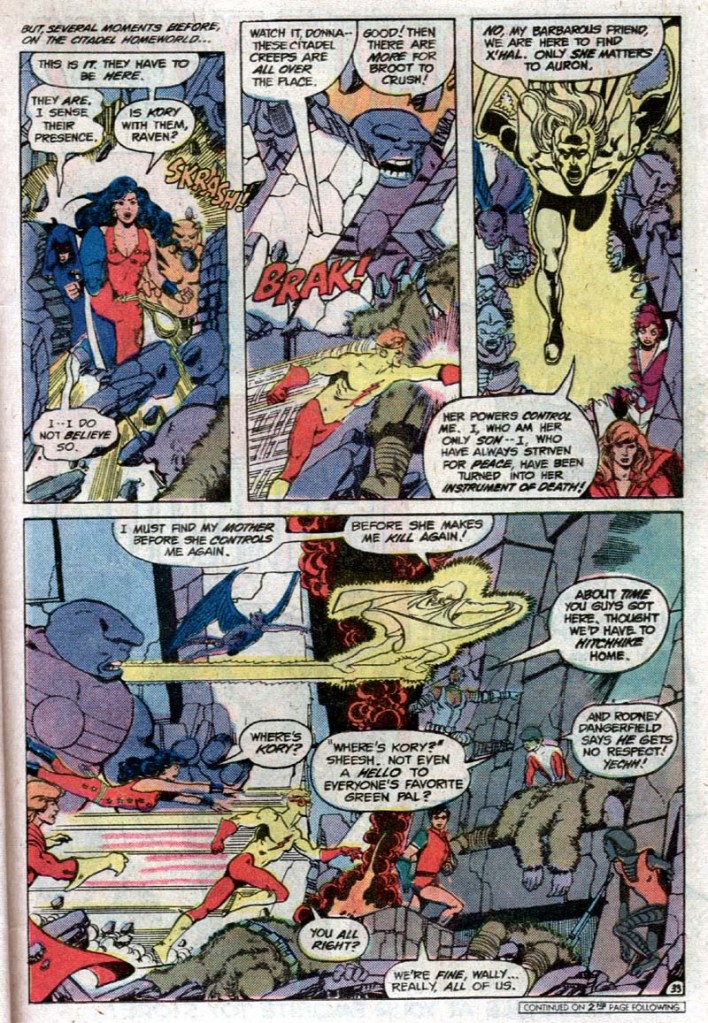
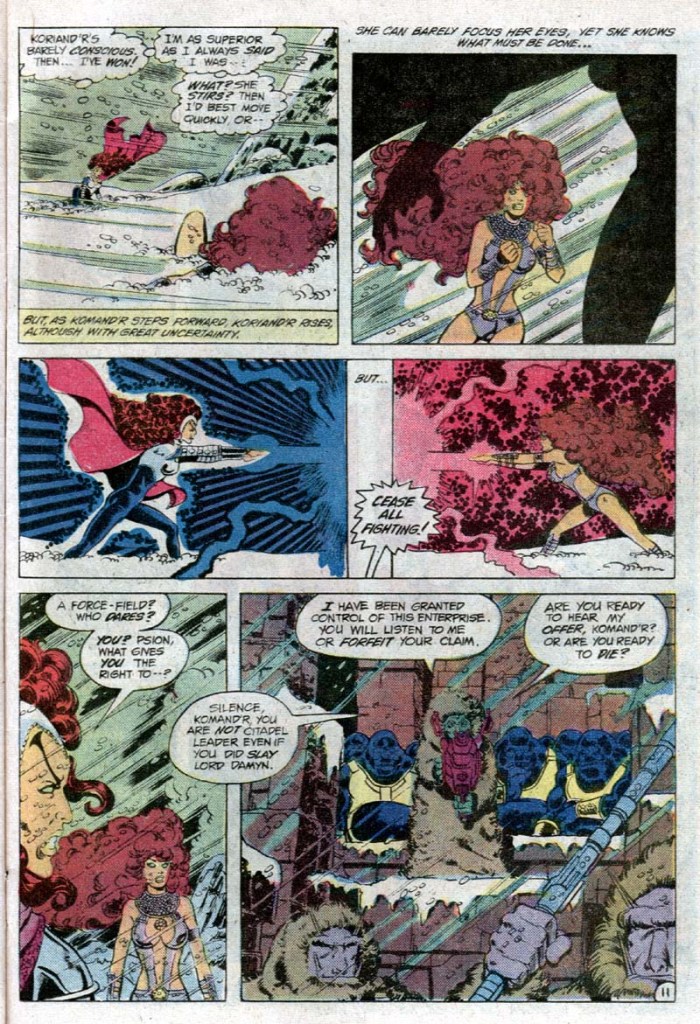
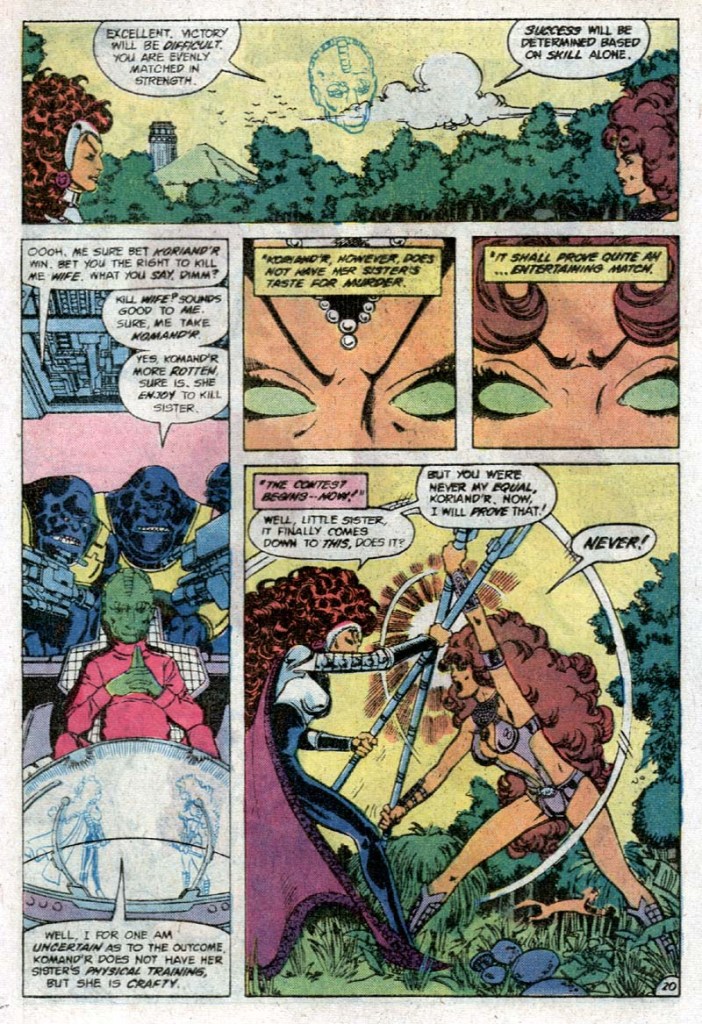
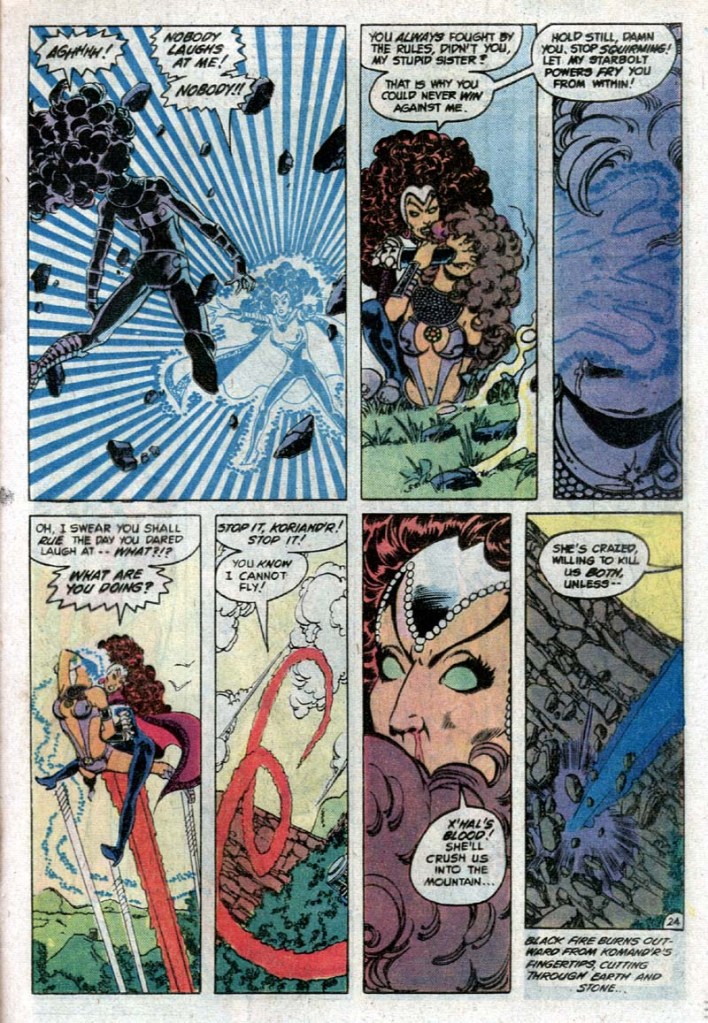
By this climactic chapter, the Titans have reunited with Starfire and are enmeshed in the battle for the Citadel. But the true showdown here is between Starfire and her sister Blackfire. The Psion representative of the Citadel gives the two sisters the opportunity to battle to the death, with the winner securing either mastery of the Citadel for themselves or else the survival of their homeworld of Tamaran. So the pair fight it out while all around the other Titans are themselves battling on assorted fronts as well. But this is Starfire’s moment. And ultimately, after a sprawling and brutal battle, Blackfire winds up causing her own downfall as she sets off her starbolts in a volcanic area, causing an enormous backlash that clobbers both sisters–and from which only one is salvaged when the dust clears.
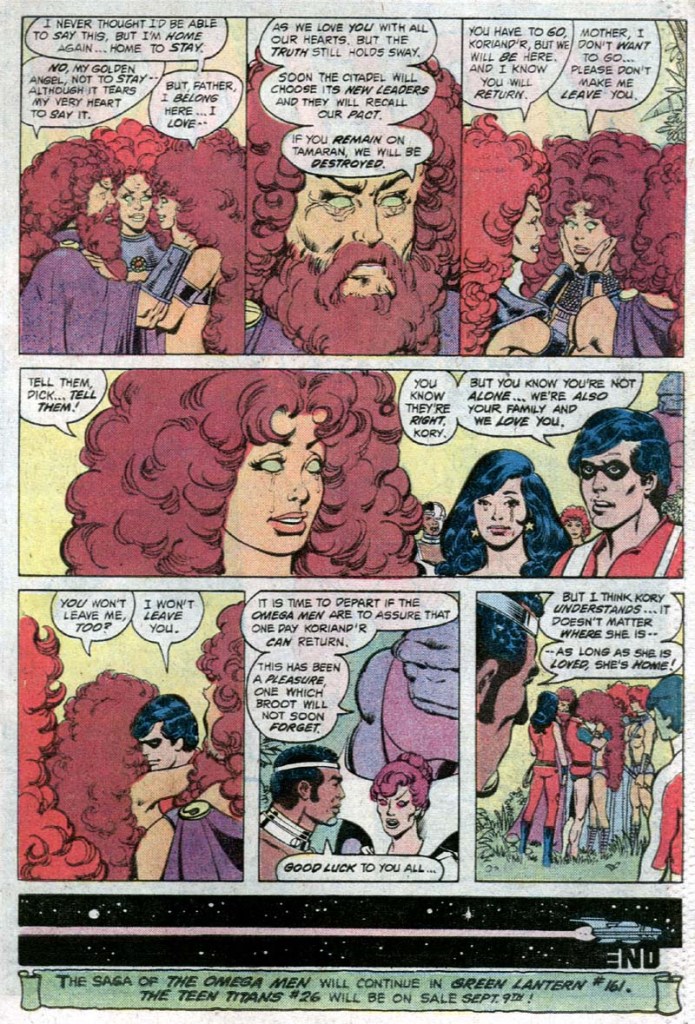
In the aftermath, Raven is able to use her empathic powers to heal Starfire, and Koriandr is reunited with the parents and brother that she thought had been killed. It’s a big emotional moment, which was one of the things that helped separate NEW TEEN TITANS from much of the rest of the field, its willingness to go all-in on emotionalism. However, the agreement that had caused Koriandr to be sent into exile in the first place is still in force, meaning that she’s going to have to leave her brethren behind and go back home to Earth with the rest of the Titans. Which feels maybe just a bit perfunctory as endings go, but after several months of this storyline, it seemed like it was time to move on to something new.
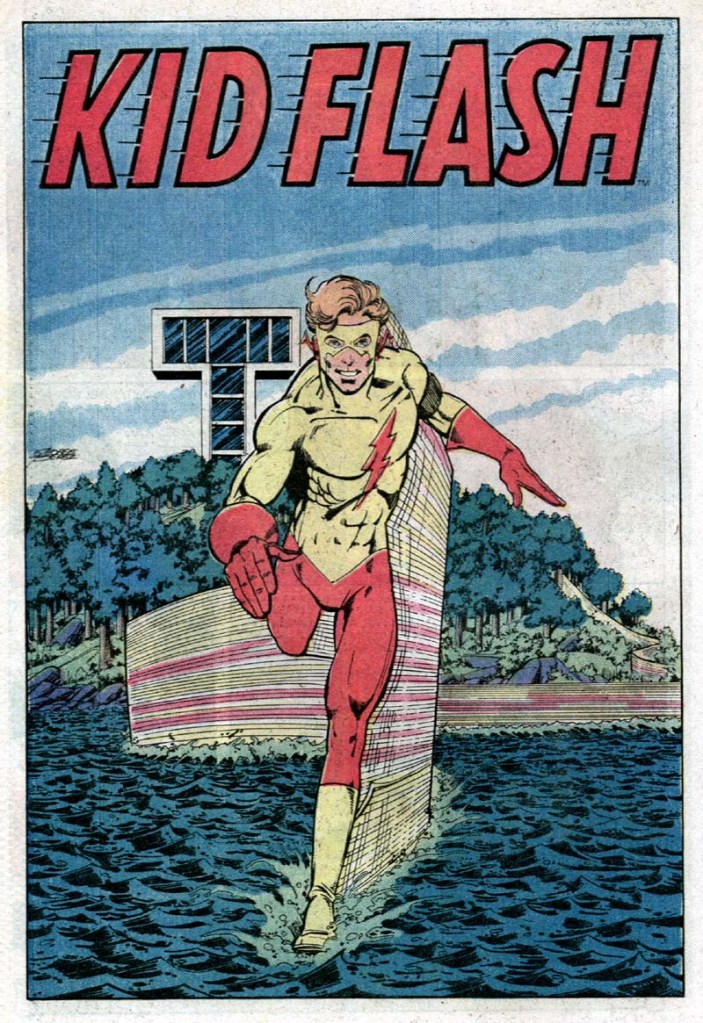
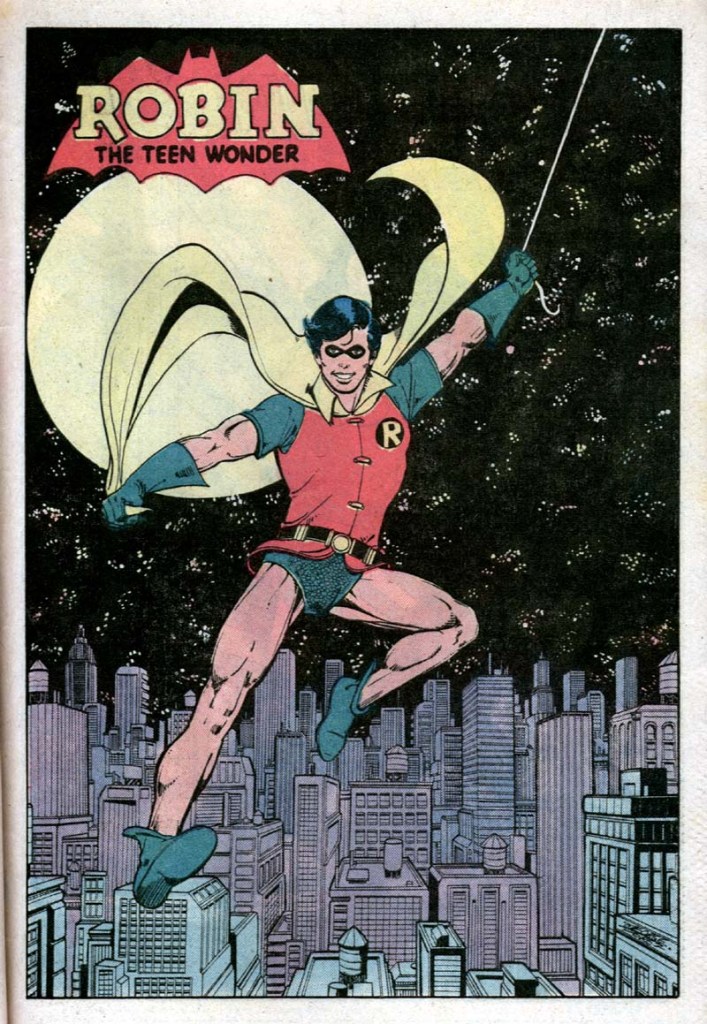
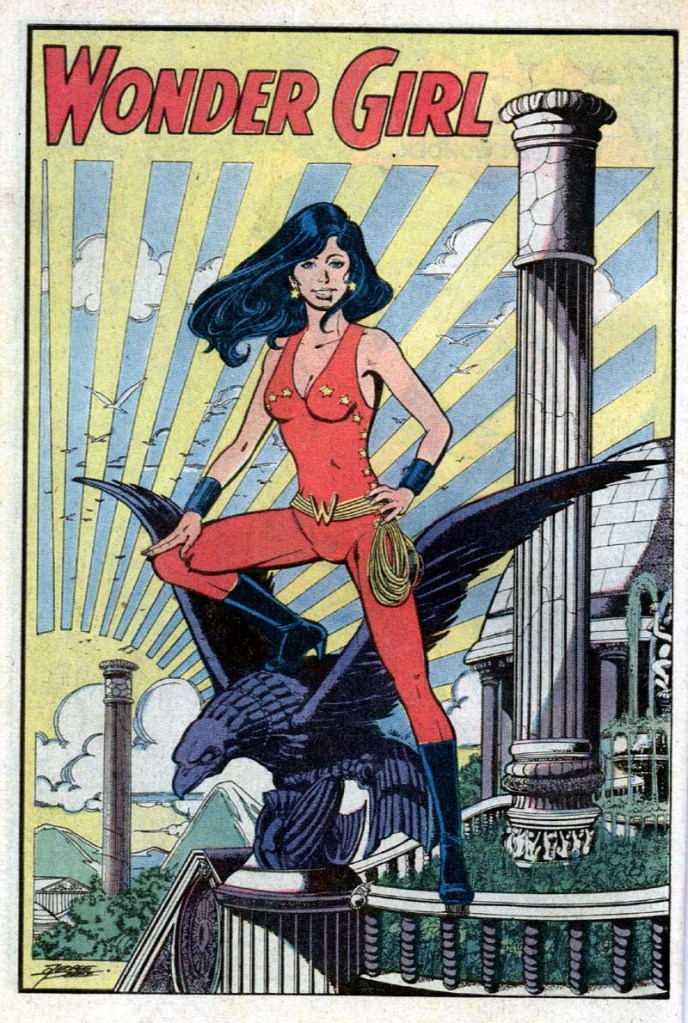
The Annual closes out in a trio of pin-up images of the three original Titans members, these inked as well as penciled by George Perez. For all that he had any number of good inking partners over the course of his career, George always remained his own best inker, and so these showcase his attention to detail and his sharp design chops.
 The Tom Brevoort Experience
I confess I didn’t follow this series until “The Judas Contract” issues. I was certainly aware of it. What threw me off was the difference between the only-Perez pencil-and-ink covers and the Perez layouts-only interiors. The inside didn’t look half as good as the outside, and I foundit off-putting. The “Judas Contract” issues teamed Perez with Mike DeCarlo, who looked a lot better with him than Romeo Tanghal. I then began to see the series in terms of Marv Wolfman’s scripting, and that run with Perez on the title is the best work he’s ever done. I wish I’d bought an issue earlier than I did. It was certainly a series worth following.
LikeLike
“and gave a fun-loving and slightly obnoxious personality.” Gar always had that. Part of what made me like him in Doom Patrol, as he was wildly different from most kid sidekicks, and from me (but a part of me, apparently, would have liked to be as mouthy as he was).
LikeLike
The X-Men/New Teen Titans crossover brought me onto this series. That actually meant my first issue came right after this annual – although I quite willingly sacrificed either a pint of blood or some of my beer bottle money to purchase it on my meager college budget.
Although I remained on the series for several years, I found it remarkably uneven. Not in terms of the art. Oh, hell no! George Perez was at the top of his game, delivering stunning page after stunning page. Where I struggled was more with Marv Wolfman’s writing. Some issues worked quite well – such as anything with Brother Blood. Others less so. (And am I the only one who found Donna’s relationship with that older guy a bit … off putting?)
Put it another way, look at how much was lost in this title once George Perez left it a couple years later.
“The Judas Contract” issues were the highwater mark for me. An absolutely thrilling storyline just as I’d been ready to drop the title.
I get completely where Tom’s coming from in his review and acknowledge my bias being a die-hard X-Men fan, but part of always wondered if this was the title that tried too hard? And in all fairness, I’m guessing my assessment would be different had I ever obtained the issues prior to #20.
LikeLike
I know I enjoyed the Marv Wolfman/George Perez era of The New Teen Titans. When Blackfire captured her sister Starfire and was torturing her, I hadn’t felt this much anxiety for a hero’s well being since Magneto made the X-Men helpless [ X-Men112 ( August 1978 ) –the wait for the next issue to see how they would get out of it ], the Hellfire Club captured the X-Men ( minus Wolverine ) [ X-Men#132 ( April 1980 ) and years later This Year’s Girl ( Buffy the Vampire Slayer – 4th season 15th episode February 22, 2000 — Faith switches bodies with Buffy at the end of the episode — the wait for Who Are You? couldn’t come fast enough ). Not a lot of bad guys that made me hate them, but Blackfire was one.
LikeLike
One thing I didn’t like about Blackfire was she was almost ( she couldn’t fly like the rest of her people ) Starfire’s Black Adam/Reverse-Flash.
LikeLike
SORRY I MEANT, One thing I DID LIKE ABOUT BLACKFIRE was…
LikeLike
I started reading comics regularly in mid- to late-1984, just as George Perez was leaving the Titans, so I got into this series mostly through back issues over the next several years, acquiring a mostly complete run of the series. Up until I stopped buying comics regularly in 1990, I would have reflexively said that this was my favorite series. But having revisited it the last few years via Omnibuses and Deluxe Editions, I feel it’s definitely a product of its time. It’s good, but that ongoing, never-ending, soap opera-style of storytelling that Wolfman liked feels very dated to me 40-plus years later.
To that point, it’s interesting to reread the Wolfman-Perez Titans run of the early ’80s and compare it to the post-Crisis work that others were publishing at DC just a few years later (Watchmen, TDKR, V for Vendetta, Batman: Year One, The Longbow Hunters, The Question, Hawkworld, Chaykin’s Blackhawk, World’s Finest, Cosmic Odyssey, Black Orchid, Twilight, ‘Mazing Man, Perez’s Wonder Woman, Killing Joke, Adam Strange, Arkham Asylum, and the early Byrne Superman). There was a seismic shift in storytelling styles, and those other titles that I mentioned have, in my opinion, aged much, much better and, to this day, feel way more modern than Titans does in comparison.
I also think that Titans suffers in retrospect because it actually had a natural end point (the Trigon story in the first five issues of the Baxter series). Narratively speaking, there was really no point in continuing the series beyond that, and I think the stories that followed over the next several years reflected that lack of compelling narrative purpose.
In the 1980s I was a huge fan of Perez’s artwork. Looking back now, it’s kind of staggering just how fast he matured and developed as an artist. I think his Titans work was (and remains) good, but he got so much exponentially better on Crisis, History of the DC Universe, and especially Wonder Woman (I think his first 24 issues of WW are his magnum opus). For me, his maturation as an artist really began on The Judas Contract when he was inked by Dick Giordano. To me, it seems like Giordano’s inks streamlined and tempered some of Perez’s more manic artistic indulgences, and everything Perez did post-Judas Contract had a more mature visual sensibility. And, as someone else in this thread mentioned, I also didn’t think that Romeo Tanghal was a good pairing with Perez. Their styles just seemed too incompatible with one another, with Tanghal’s inks sometimes making Perez’s work feel like coloring book artwork (for what it’s worth, I was never a huge fan of Perez inking himself–too much visual fussiness that made the artwork feel stiff and labored).
All of that said, having just reread a few months ago the newly remastered Deluxe Edition of The Judas Contract (the remastered artwork, using new scans of the original artwork for much of the book, makes all the difference), I do feel that that story in particular still holds up quite well. And my criticisms above notwithstanding, I do still have a lot of lingering affection for this series. Unlike a lot of the post-Crisis books that I mentioned above which I think still feel fresh and modern 30 to 40 years later, Titans was more of a transitional book bridging the gap between the Bronze and Iron Ages. So, despite its flaws, it’s still a historically important and significant book.
LikeLike
I consider the Judas Contract story arc the high point of the ’80s Bronze Age. It is a masterpiece of the art form and I remember feeling it felt less like reading a comic than watching a Sidney Lumet crime thriller. To be honest it was downhill for mainstream comics after that because but the late ’80s I was exclusively reading indie titles and foreign graphic novels.
LikeLike
I realized that the pin-up art of the original members was done because they didn’t have chapters in the “Tales of…” series that featured a cool cover for each of the “new” members. (Gar was kinda new, since he was an old character but now a full-time Titan.)
LikeLike