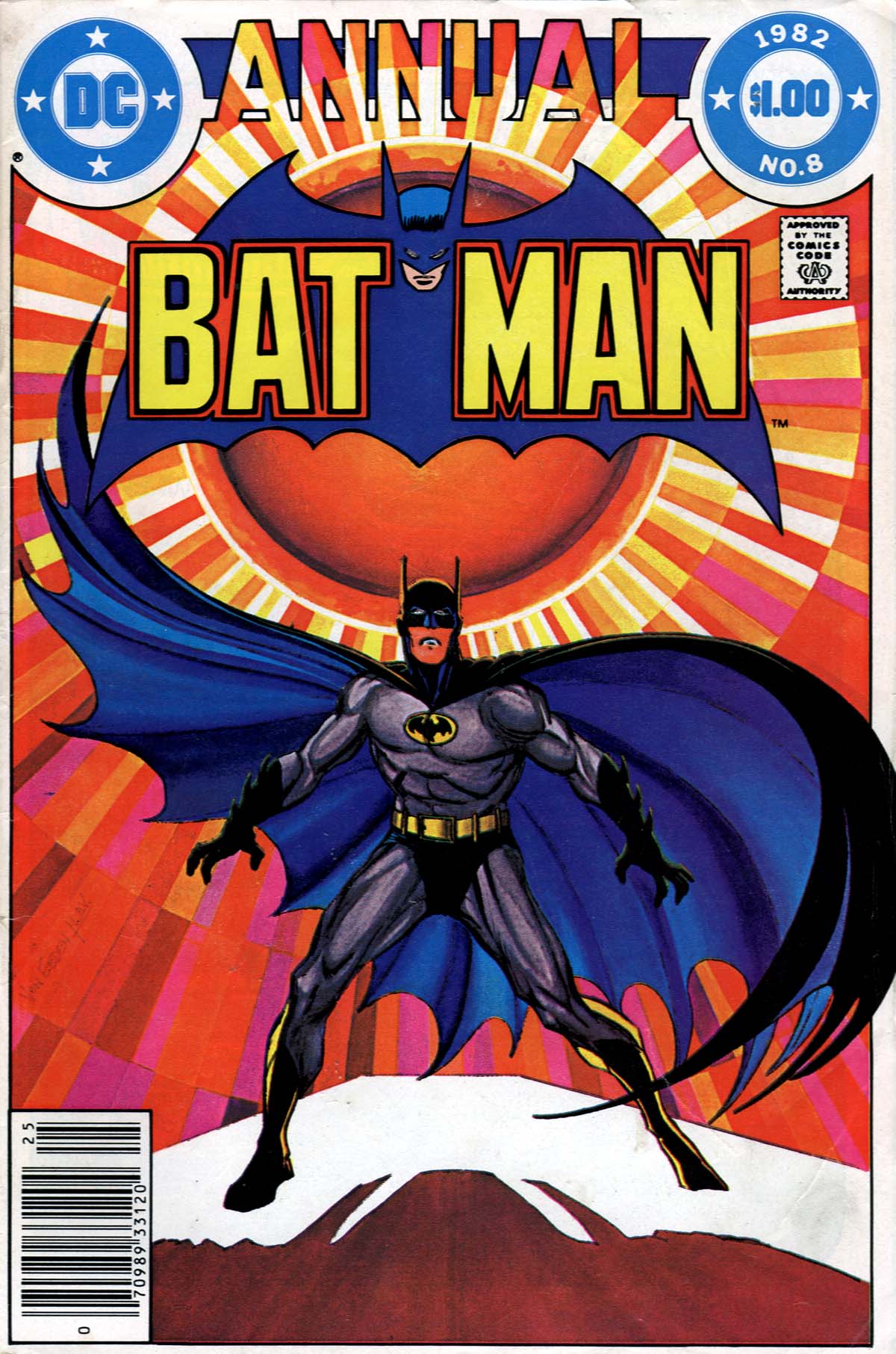


I’m not certain after all these years where I might have read about it, but by 1982 I was more plugged into comic book fandom than I had been and was reading the occasional fanzine and promotional magazine. It might even have ben spotlighted in Dick Giordano’s editorial Meanwhile column. Wherever I saw the notice, I had been alerted that the work done by artist Trevor Von Eeden on this BATMAN ANNUAL was a real knockout, so I was on the lookout for it. I knew Trevor mainly from his early career work on BLACK LIGHTNING, where he was a fine but undistinguished young artist. But those advance notices were correct, this was a pretty nontraditional art job that really leapt off the page. At the time, comparisons were being made to the work Frank Miller had been doing on DAREDEVIL in terms of its innovativeness. Sadly, in part due to some institutional racism, Trevor never quite exploded the way Miller had before him, and his work slid back towards the more traditional in the coming years. But this one Annual is a stand-out.
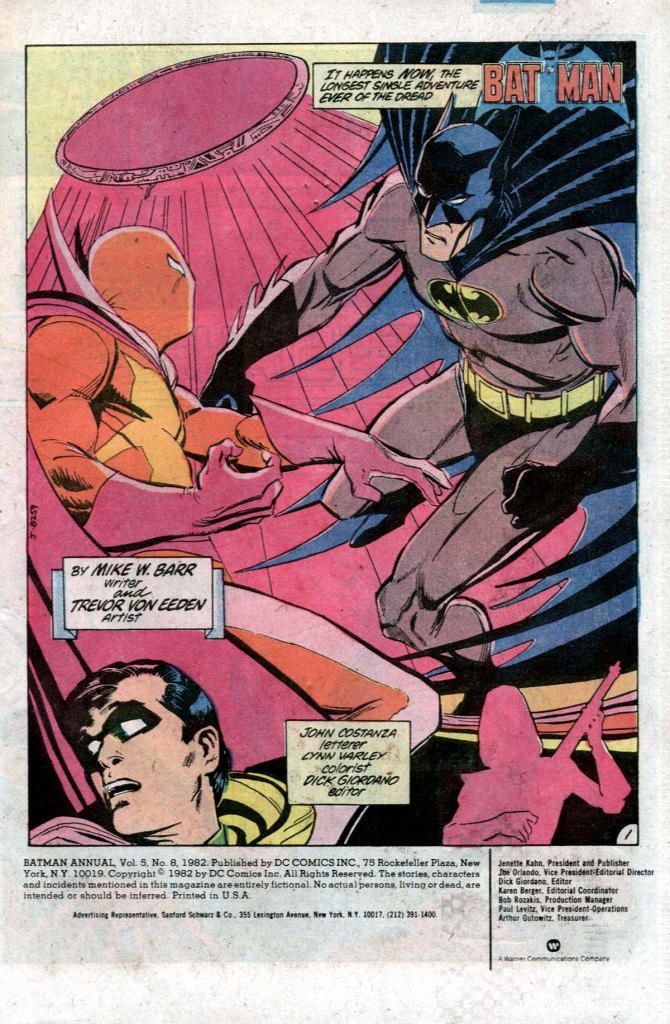
Story-wise, it’s a solid but not particularly outstanding Batman adventure written by Mike W. Barr. It’s very much a James Bond film starring the Masked Manhunter, owing just a little bit to MOONRAKER. Barr’s version of Batman appealed to my sensibilities in general, whether he was working with Alan Davis on DETECTIVE COMICS or writing the Cowled Crusader alongside the Outsiders. The selling point of this tale was the fact that, at 42 pages, it clocked in as the single longest Batman story ever told in a single issue, at least up to this point. And it was good, don’t get me wrong. But the real show here was really Von Eeden’s stylings, and the manner in which they were enhanced by color artist Lynn Varley.
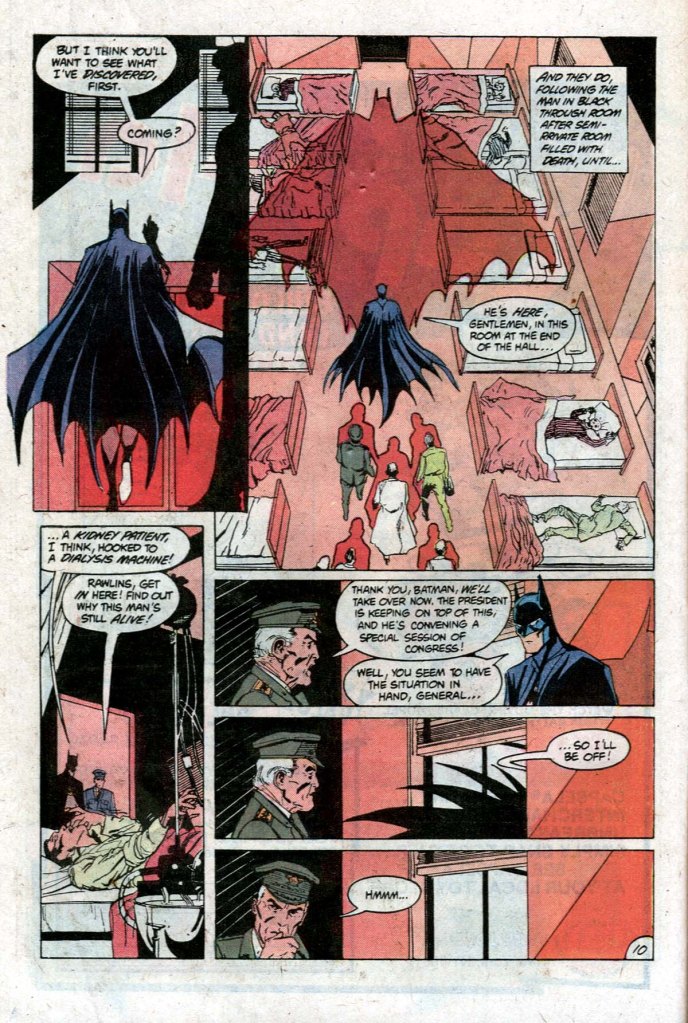
The story involved the hooded Messiah of the Crimson Sun, who scorches a small farming community off the face of the Earth as a test of his power, then threatens to do the same to Gotham City if his demands aren’t met. Batman, of course, gets involved, journeying to the site of the destroyed town. He finds two survivors there: one, Seth, who claims to have been untouched due to his undying faith as a member of the Children of Adam, and a second one, a kidney patient hooked up to a dialysis machine, unnoticed in a nearby hospital. Batman arranges for Robin to take the place of Seth, pretending to be released by the soldiers stationed to cordoned off the area so that he might be able to infiltrate the Children of Adam cult and get to the bottom of things.
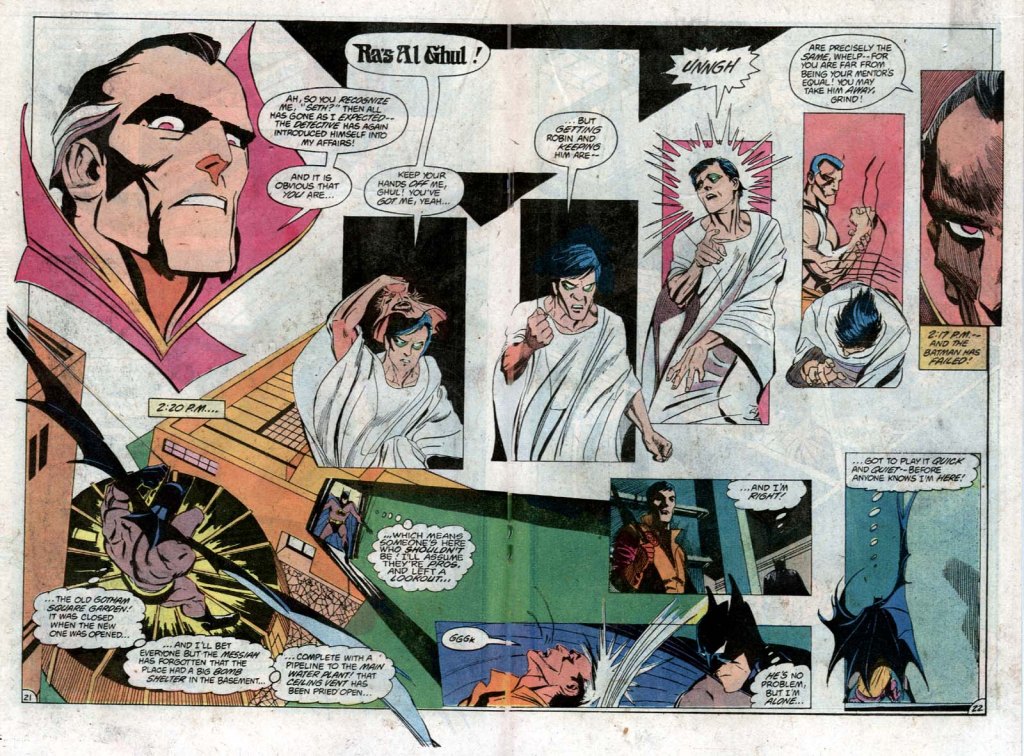
Batman is able to work out that the thing that both the kidney patient and Seth had in common that allowed them to survive was that neither of them had drunk the water, which must have contained a compound that was activated by direct sunlight. At the same time, Robin in the guise of Seth is brought before the hooded Messiah of the Crimson Sun, who reveals himself to be Batman’s old enemy Ra’s Al Ghul. Ra’s, of course, is already on to Robin’s deception, and his men clobber the Boy Wonder. Then, in true Bond villain fashion, Ra’s and his guards take off for an orbiting space station headquarters, from which he can cause the Crimson Sun weapon to fire at Gotham City below.
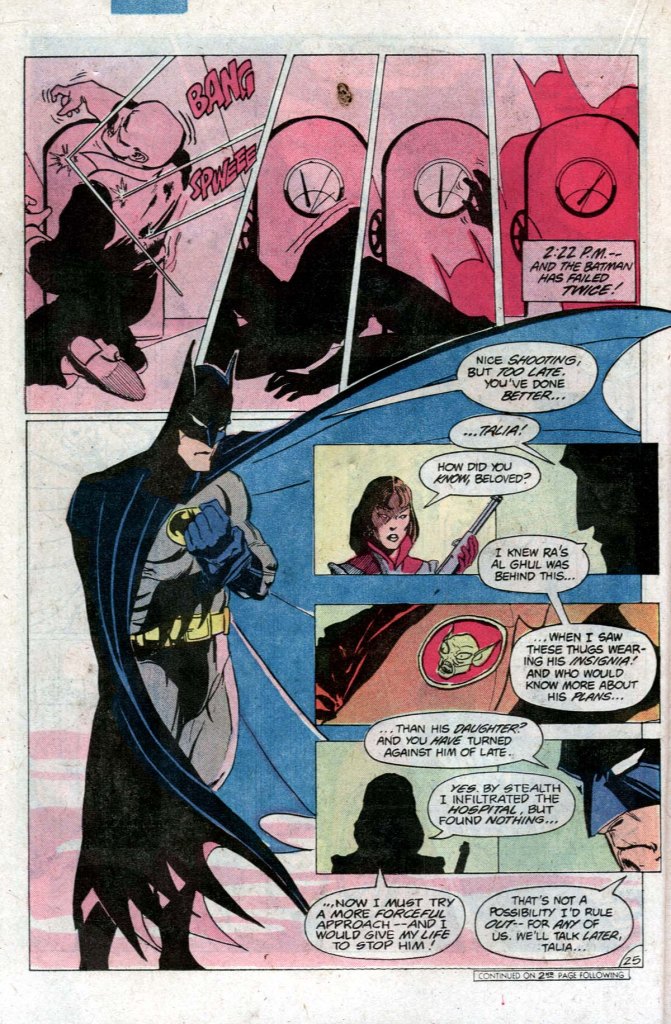
Batman himself is just a few steps behind, and he infiltrates the Children of Adam cult headquarters in the Gotham equivalent of Madison Square Garden, where Ra’s has been using an underground connection to the Gotham water supply to release his activating agent into it. The Masked Manhunter battles his way through Ra’s men, and is helped at one point by the sudden arrival of Talia, who has turned against her father and wishes to assist in Batman’s quest. But the pair are too late to prevent the agent from being released, so there’s only one option left: venture into space themselves and stop Ra’s at the source. The General who oversaw the quarantining of the stricken farm city is able to pull strings to get Batman and Talia a one-way shuttle trip into orbit,
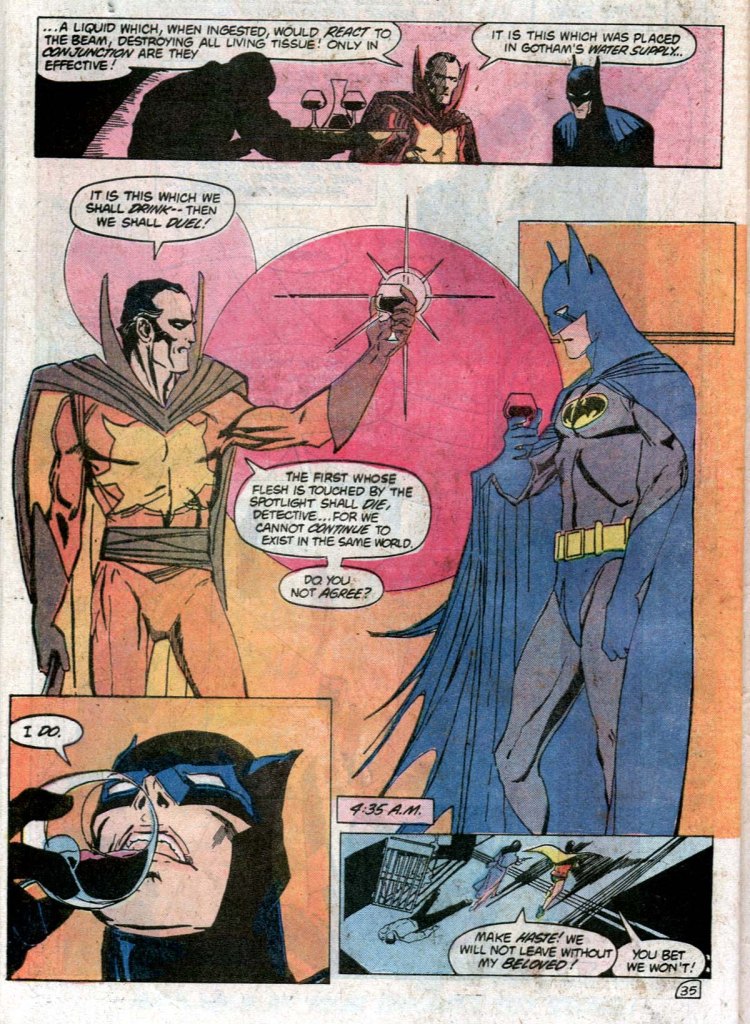
The General intends to launch missiles at Ra’s space citadel before the deadline is up, but Batman is hoping to rescue Robin and stop Ra’s without that being necessary. So he’s on the clock here. Talia is able to get them access to the station, and she moves to release Robin while Batman head to confront Ra’s. The two men agree to a duel: they’ll each imbibe the catalyst agent then battle on the periphery of the Crimson Sun spotlight. The first to fall into it will be disintegrated, as everybody in Gotham will should the loser be Batman. The pair battle it out for a solid hour, with Robin and Talia showing up and contending with Ra’s men. But that that point, we’re almost at the deadline hour, and so the General’s missiles strike the base, and all efforts turn towards escape rather than victory.
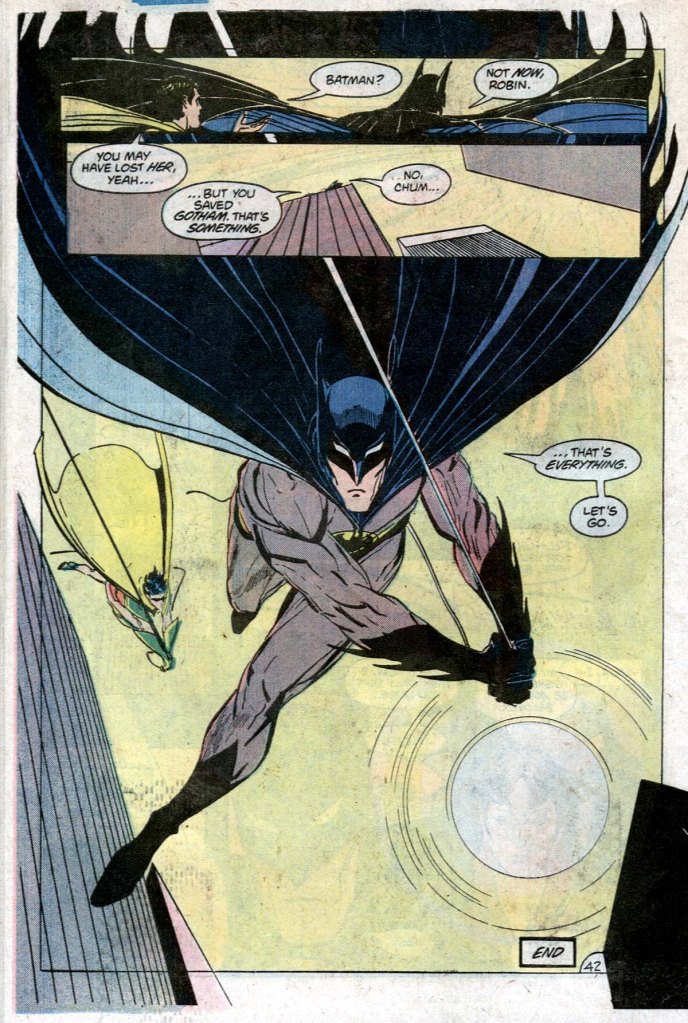
Batman and Talia’s shuttle has been destroyed by this point, but the Gotham Guardian took a precaution earlier, wiring up a remote control in Ra’s own escape shuttle. He triggers it to return to get them–and it inevitably turns into the red solar filter, thus activating the agent Ra’s had drunk and incinerating him. When Robin exclaims that Batman has killed Ra’s, the Masked Manhunter replies, “Have I, Robin?” Um, yeah, you have, Batman–setting aside the manner in which super-villains can routinely cheat certain death. Anyway, Talia is understandably upset about this turn of events, and once the shuttle lands, she tells Batman to get the hell out. And he does–he and Robin swing off to new adventures in the final shot, Gotham having once more been rescued.
 The Tom Brevoort Experience
Just curious, but was the letterer John Costanza related to the Fawcett comics artist Pete Costanza?
LikeLiked by 1 person
Apparently not, no.
LikeLike
Maybe George Costanza? 😉
LikeLiked by 1 person
At the time, Von Eeden’s style was a little too “out there” for me. But looking back, it really is a great-looking book.
LikeLiked by 2 people
I bought this as a back issue about a decade ago. And I agree, it contains some of the best work Trevor Von Eeden has done in his career. It probably helps that he was allowed to ink his own pencils. Good coloring by Lynn Varley, as well. I believe von Eeden and Varley were actually dating when this annual was being created.
LikeLiked by 2 people
Oh wow! What I wouldn’t give for a time machine back to 1982 where I would tell myself that I needed to buy this comic and savor every panel! Being a college student at that time, comic purchases were limited due to a tight budget, but I would have gladly quaffed generic beer a few nights to be able to add Trevor Von Eedon’s stunning work to my collection. I could have dreamed about a stunning brunette calling me “beloved.”
LikeLiked by 1 person
Are this year’s DC Annuals the first DC Comics with planted covers?
This might be my first Von Eeden comic – unless Green Arrow came before this. If anyone from DC is listening I’d like a DC Finest Green Arrow volume that covers that mini and as many of the GZ backups from after he got the Neal Adams costume as they can fit in a book.
I was super enthused about Thriller because of his work here and on the Green Arrow mini.
LikeLiked by 1 person
I always enjoyed Von Eeden’s work, particularly an earlier issue of Batman he did….can’t remember what number at the moment…but his work always stood out to me. This one was a bit of a jolt to me upon purchase, such a change from what I’d seen from him previously, but I’ve come to appreciate it over the years. I hate he never caught a break like he should have.
LikeLiked by 1 person
Tom as soon as I read MOONRAKER my mind went to Ra’s Al Ghul. I thought this seems like a Ra’s Al Ghul plot and Moonraker like plots by Fu Manch mentioned in the Deluxe Official Handbook ) Shang-Chi ) and Centurius. Trevor Von Eeden did great job on this and I wish if I had seen in a back issue box or when it came out I picked it up.
LikeLiked by 1 person
My memory of this is that I really liked the art, but thought it was unaccountably bright — not really enough shadows for a Batman story.
I also didn’t think I liked the story much, but realized later that I think it’s just a mismatch — Barr’s trying to tell a purplish story and Von Eeden has no interest in bringing out the pulp aspects visually; he just wants to do his striking design thing.
But with a little encouragement and editorial direction, and a writer who wanted to (or knew to, since Barr may have written this script without knowing who would draw it), Von Eeden could have been a strong and popular stylist of the era, instead of being shunted off to the side, treated disrespectfully, and more or less chased off. He still managed to do some amazing work, even so.
LikeLiked by 1 person
Von Eeden was a favorite from Black Lightning and catapulted in my esteem with this and other work. If he had done more he’d probably have beaten Colleen Doran to become the first artist I would follow no matter what I thought of the character or writer.
LikeLiked by 2 people
I don’t know if Von Eeden was great with deadlines or not, but he had all the talent in the world to be a major player at this time. His Green Arrow is wonderful, as is the Batman Annual. It’s a shame his career never really took off after this. It seemed like DC was moving him along to be a superstar, but I’m sorry to hear that race played a role in holding him back. His work on Thriller was suitable for the content, but I think most fans passed on that series, thereby making him go unnoticed for a time as well.
LikeLiked by 2 people
I’ve read some articles and received some emails from Trevor on his career. Mark Waid’s quoted as saying back when he (Mark) was a DC editor (late 80’s to early 90’s?), he saw Trevor knock out art pages in Mark’s office to meet a deadline. I don’t know the details, if Trevor was a last-minute replacement on the assignment, or if it were other circumstances. Trevor recounts an incident early in his career about DC staffers trying to trick him to sit in a collapsing chair. He declined, and someone else fell victim. When Trevor started on “Black Lightning was aged 17 going on 18. That’s young. I know Shooter was 13, Conway was 15. But 17 is still young enough that the veterans in the business can really impact a kid, so there should be a sense of responsibility to look out for them. Shooter’s said publicly that his editor at Dc was pretty tough, bordering on (or maybe qualifying as) the verbally abusive.
Trevor also took a long break from mainstream comics when he worked for Neal Adams’ Continuity Studios. He drew some of those books; I remember being disappointed by his work on something like “Urth 4”. It didn’t look anything like the kinetic, ground breaking innovations he explored years before. Trevor said he was told to imitate Neal’s style, so he had no passion for that work. But that drawing Continuity’s comics was a faster path to the better paying advertising assignments Continuity would assign.
LikeLiked by 1 person
I really liked his Black Lightning work, especially his version of Kirby’s take on Superman and Jimmy Olson. He mostly seemed to be having fun doing that book as a still very young artist, who seemed to like the stories.
I saw his work on Thriller later and I was impressed by how he combined great design with clear story telling, showing growth as an arist.
I have heard he had tsouris at Marvel under Jim Shooter for his design predilections, but he seemed to have effectively internalize what Shooter had to say, making his own work stronger.
LikeLiked by 1 person
I first saw this annual new in the magazine section of the College Square Shopping Center’s Pathmark Supermarket, in Newark, DE. Maybe Tom knows where I mean. Across the street (Rt 72?) from the Newark Library, with that bronze statue of a reclining young Abe Lincoln. I would’ve been about 10 years old, so I was unable to buy it. But I remember thinking it didn’t look anything like any comics I’d ever seen before, certainly unlike my perceptions of Batman.
My first recognition of Trevor’s work was on “Batman & the Outsiders” # 15 (set at the ’84 L.A. Olympics, vs. Maxie Zues’s New Olympians), and I’m still blown away by it. It forever changed my perception of, and expectations for art in comicbooks. I’d remember Trevor’s name ever since. And look for his work wherever I could find it, which wasn’t enough. It’d bee years before. I’d find back issues of his back-stories in “Detective Comics” and elsewhere. I made The Green Arrows, especially had some great art. Especially the few inked by Larry Mahlstedt, which really tightened up Trevor’s work & created something unique, while keeping Trevor’s kinetic figures and dramatic sense of lighting. Bob Smith did a fine job on a story over Trevor’s drawing, too. But my favorite was Trevor inking himself, especially on the 4-issue Green Arrow miniseries.
I think it took me 20 years to find a copy of this annual in good condition. I was happy to find it. I loved Mike’s BatO. I’ve since found a lot of Trevor’s early 80’s comics. His “World’s Finest” back-ups, and 2 issues where he drew the main feature with Superman and Batman. I read an interview with David Mazzucchelli in which he really loved Trevor’s “bold” layouts in those.
Miller & Mazz’s “Batman: Year One” might be my favorite Bat-story. And Mazz’s art is a huge part of that. Might also be my fave depiction of Batman. And colored very epressively by his wife, Richmond Lewis. So I’d hate to have never seen his work on it. But it’s interesting to imagine if it had been drawn by the first artist Frank asked to do it; Trevor Von Eeden. But again, “B:Y1” had such an impact on me, I wouldn’t have wanted it any other way than how it came out.
I’m glad Tom called out the institutional, systemic racism Trevor had to put up with for decades through his career. It was cool to know Trevor got to have a short speaking role, along with Black Lightning co-creator Tony Isabella, on an episode of the TV show adaptation. I think they played 2 judges on a panel that ruled on BL’s trial. I’ve seen still, but never watched an episode.
Trevor was in that class of artists that changed comics towards the end of the Bronze Age, and opened new possibilities for the times as they unfolded. I rank him up there with Sienkiewicz, Janson (who’d been around almost a decade by the time this annual was released), and paving the way for guys like Tony Salmons, Mark Badger, even Mark Beachum. Expressionistic, impressionistic, kinetic. Sienkiewicz & Beachum could get even more naturalist when they wanted (those guys are art virtuosos). But I still rank Trevor really high, too. Some of his older work is still among my favor favorite comicbook drawing art, ever.
LikeLiked by 2 people
I bought this comic when it came out. Always loved the Annuals.
LikeLike
Early 1980s Trevor von Eden (this annual, Green Arrow mini-series, Batgirl backups in Detective) was pretty great.
LikeLiked by 1 person
With all this praise, one wonders why DC won’t do the blindingly obvious and release a collection dedicated to his work.
LikeLike
Barr was fine with Batman leaving folks to die, at the end of the first Outsiders arc Geo Force just tosses the villain off a wall to be torn apart by a mob and Batman basically nods.
Did they ever explain how Ras Al Ghoul survived this one?
LikeLike