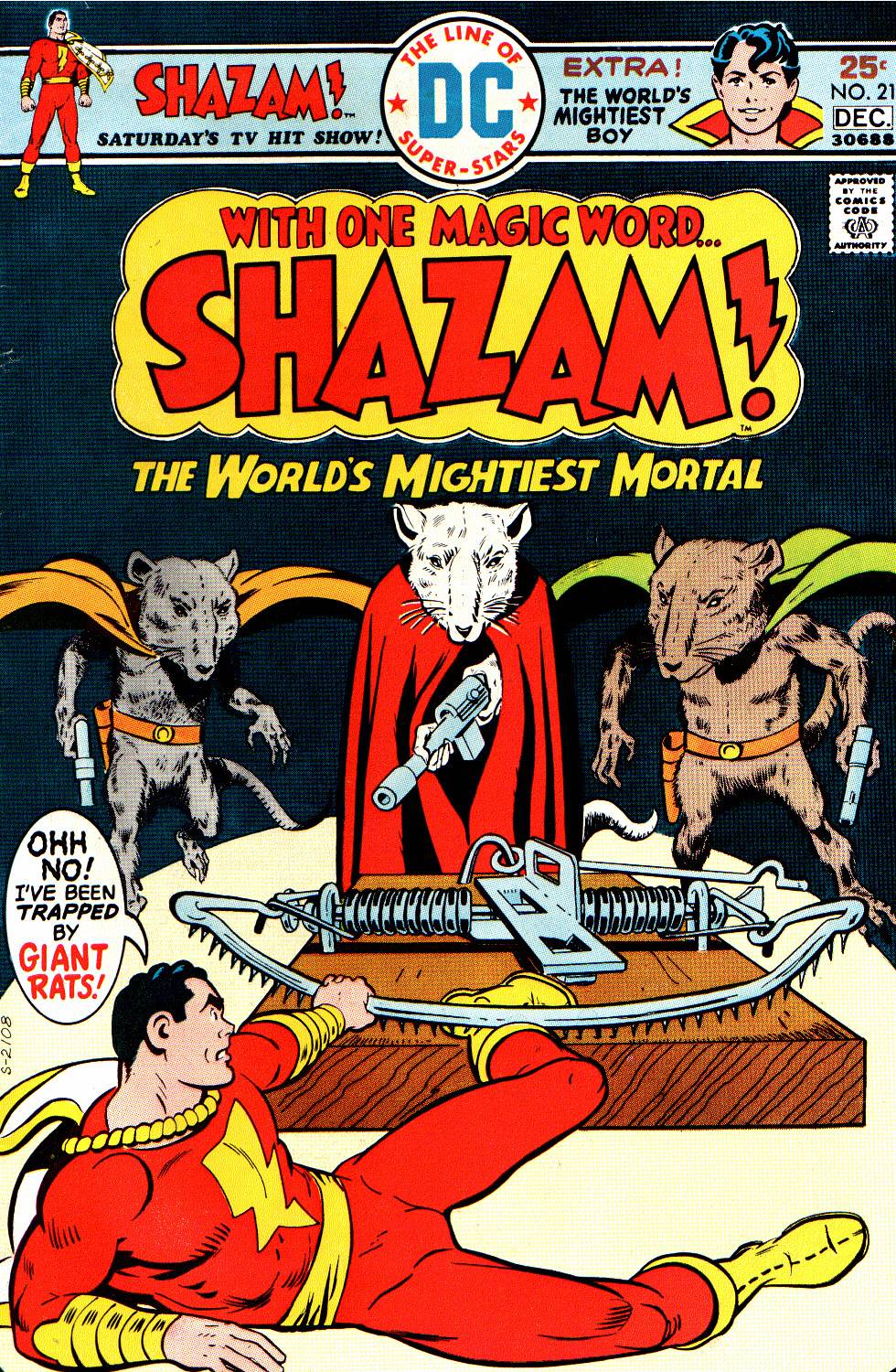


And finally we arrive at the nadir of the SHAZAM run that I was experiencing all at once thanks to it having been loaned to me by my grade school buddy Donald Sims. Sales on the series had clearly been poor, and yet the character was starring in a successful Saturday morning live action series. Consequently, DC didn’t want to cancel the book. So they did the next best thing: they reduced its release frequency to quarterly and they had the title go all-reprint. In some ways, this was wise, in that the modern day Captain Marvel tales that had been coming out were qualitatively inferior to the character’s classic adventures. And I have to say, this Bob Oksner cover is pretty lousy. Oksner is usually a terrific artist, but for whatever reason, DC’s covers in 1975 were all fairly terrible, and this one is no exception. It’s silly and stiff and entirely unappealing to my eye. So it didn’t do much to help keep the book selling.
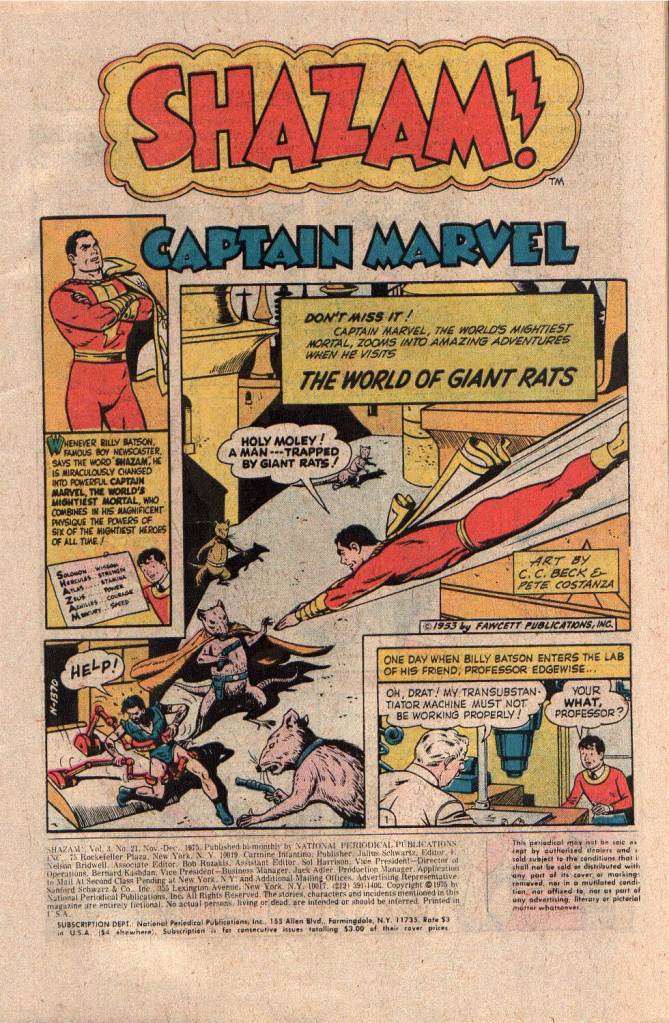
Fortunately, the story that the lame cover was illustrating was actually worlds better than it made it seem. It was the work of writer Bill Woolfolk and artists C.C. Beck and Pete Costanza and it was from a 1953 issue of CAPTAIN MARVEL ADVENTURES. The story opens with Billy Batson’s scientist friend Professor Edgewise attempting to send objects into the distant future and retrieve them. Each time he gets them back, they’re covered in giant rat footprints, with no sign of human feed at all. This leads him to believe that humanity must have perished at some point in the not-too-distant future. Billy calls upon Captain Marvel to journey into the future and find out the truth about what lies ahead for mankind.
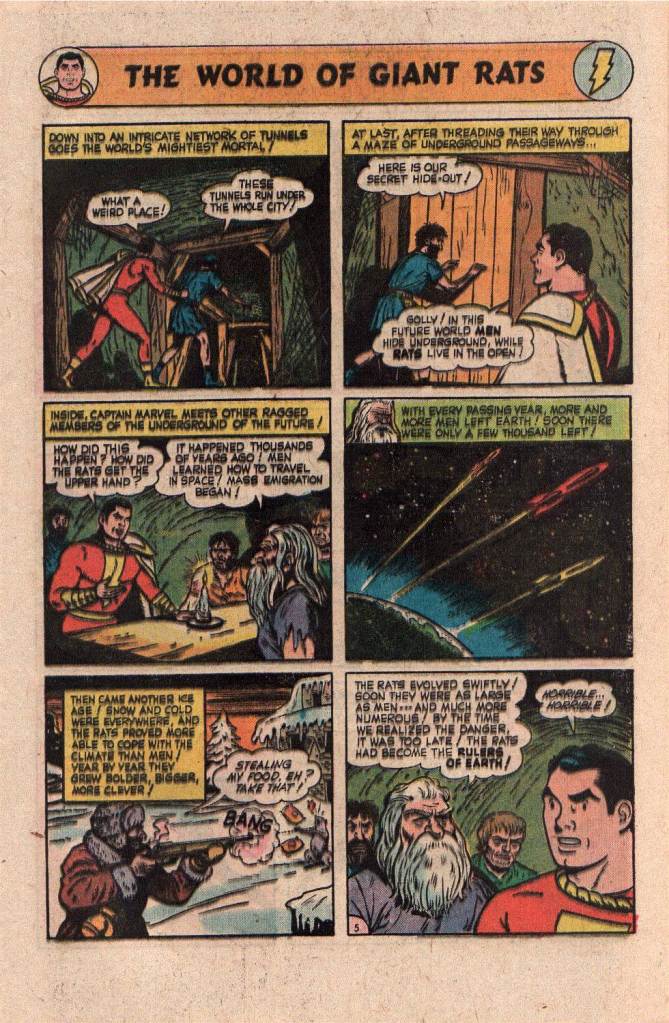
Circling around the Rock of Eternity, Captain Marvel soon arrives in the world of the future. There, he discovers a civilization of giant anthropomorphic rats has displaced humanity. The small number of remaining humans are caught as household pets. Captain Marvel frees one such man from a human trap, and the man takes him into the walls to a hidden enclave where the remaining human beings hide out. There, he learns that most of the human race left Earth for the stars, but those that remained had their numbers culled even further by an ice age–and when all was said and done, rats had ascended to become the dominant species on the planet. The remaining humans have a plan to capture Mork-El, the leader of the rats, and Captain Marvel decides to assist them in their operation.
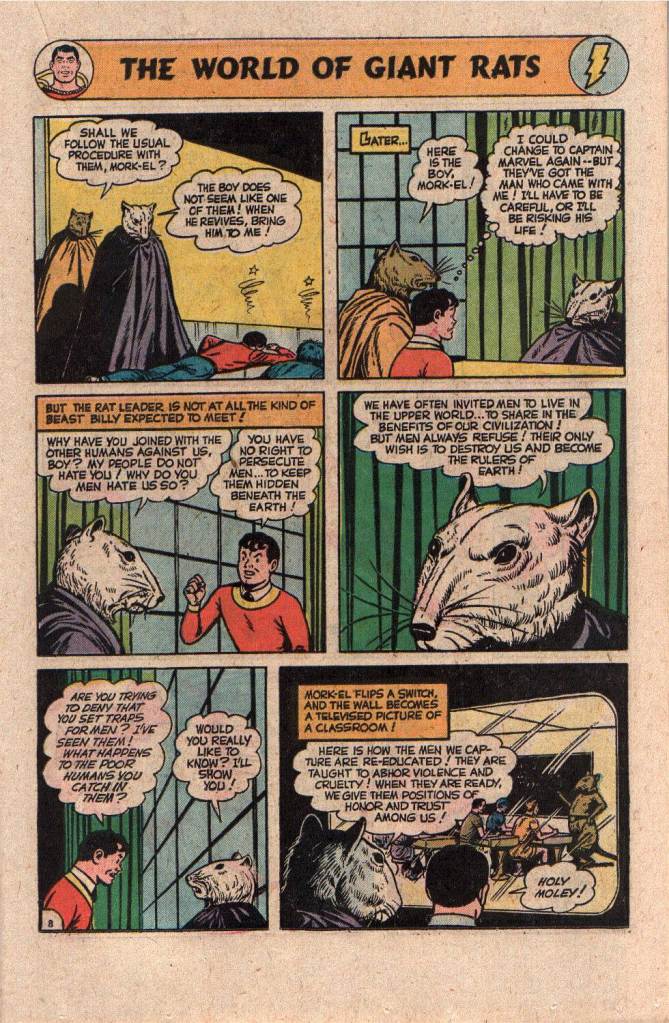
Captain Marvel goes with the humans to raid the rat capital city, and he’s interested to see that the rats aren’t using lethal force against their attackers. But in a one-in-a-million accident, an electrical discharge from a security apparatus has the effect of magic lightning on Captain Marvel and he transforms into Billy Batson in midair, crashing painfully to the ground where he is swiftly captured. But Billy finds himself treated humanely, and he dialogues with Mork-El, learning that the rats had offered friendship to the remaining humans who refused all of their entreaties. They were obsessed with wiping the rat civilization out. The man who had accompanied Captain Marvel escapes, taking with him a Nitrogen Shell, an explosive many times more powerful than an atomic blast. Billy summons Captain Marvel at this point before events can spiral out of control.
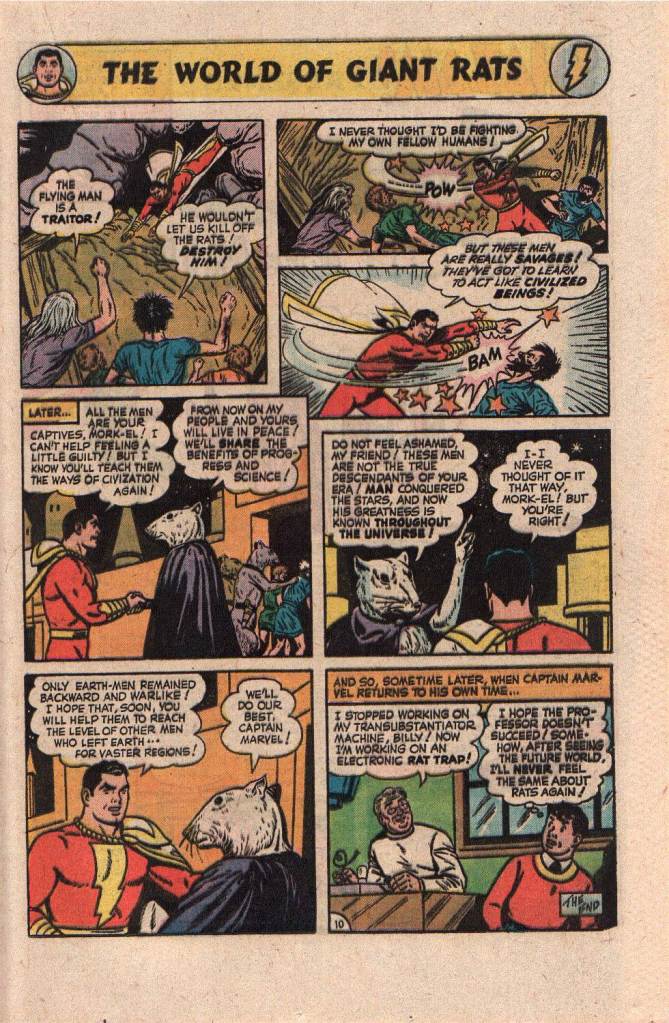
Captain Marvel is able to arrive in time to snatch up the Nitrogen Shell and carry it far from earth, where it can detonate harmlessly. But he’s now considered a traitor by the other humans, who attack him. Bad move, as Marvel mops them up, turning them over to the more civilized rats for rehabilitation. Mork-El tells him not to feel badly about the future men, as the true successors to Captain Marvel’s time were the humans who left Earth to go out among the stars. In the end, Billy can’t really tell Professor Edgewise anything about what he learned in the future, and so the scientist moves on from developing his time technology to attempting to perfect a better rat trap. D’oh!
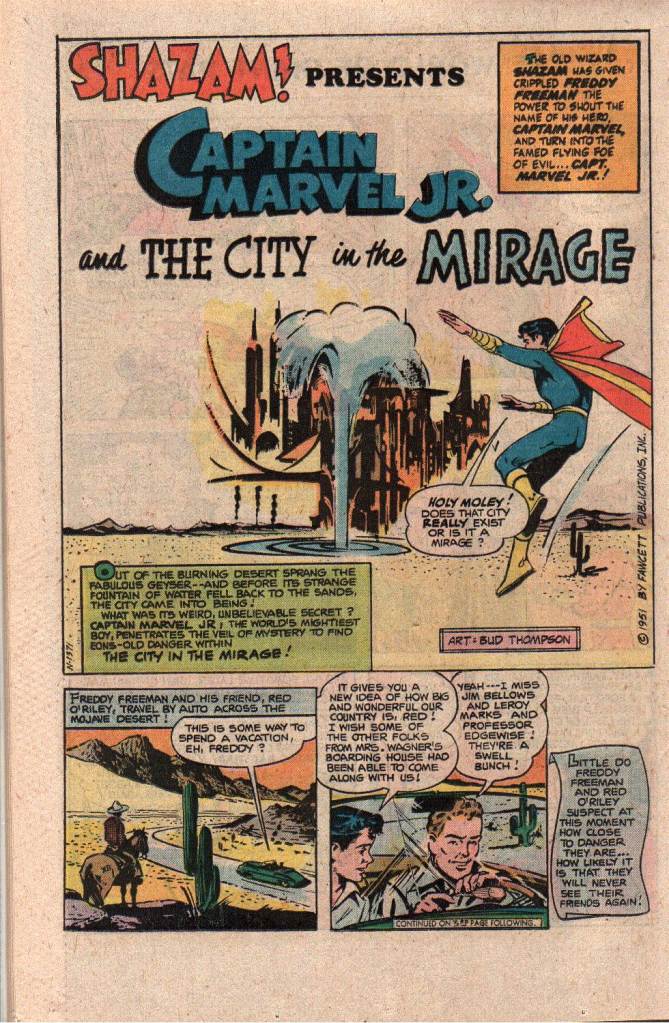
Bill Woolfolk also wrote the Captain Marvel Jr. back-up tale that fills out this issue. It was from 1952 and was illustrated by Bud Thompson, who had become Junior’s regular artist towards the end of his golden age run. In it, Freddy Freeman and his friend Red O’Riley are taking a vacation in the Mojave desert when they come across a geyser through which a spectacular city can be seen, like a mirage. Plunging through the geyser, they find themselves in a strange city from out of history. After a bit of a chase, Dakmore, the leader of this world, tells them that it had one been the pinnacle of civilization in barbarian times, and so in order to protect themselves, the people of the city used their technology to shift it into another dimension accessible only when the geyser went off. They’ve been there for 138,000 years.
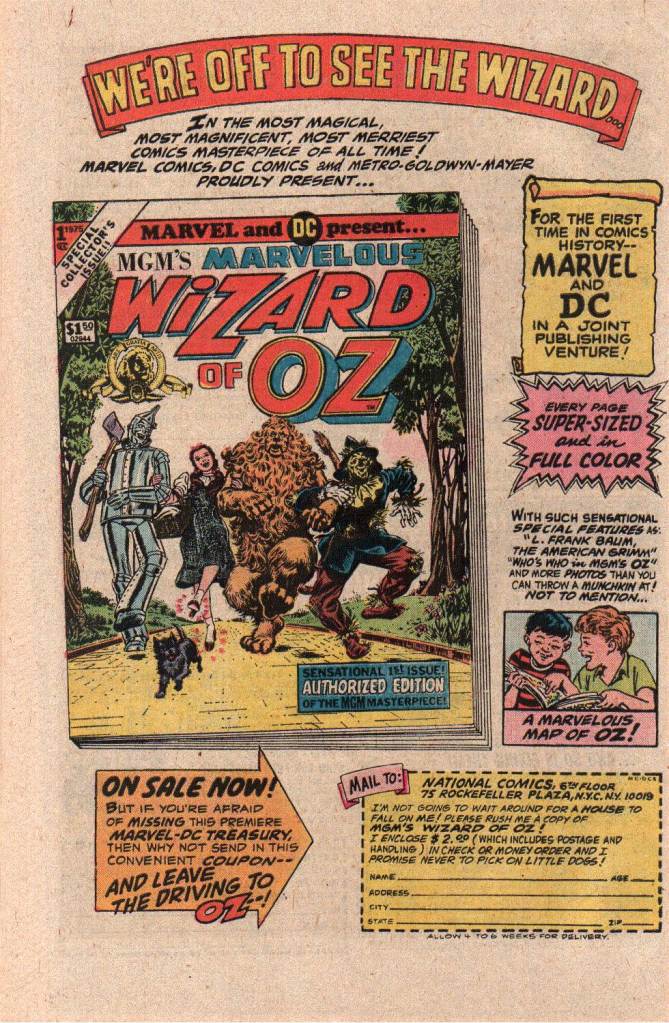
A quick sidebar here as we get a full-page ad for the WIZARD OF OZ Treasury Edition that was a co-production between Marvel and DC, the first such project to come into being. The book was mostly produced by Marvel talent but it was promoted by both companies, who shared in the profits. The endeavor also made the eventual Marvel/DC crossovers more likely by illustrating how well the two firms could work in tandem with each other.
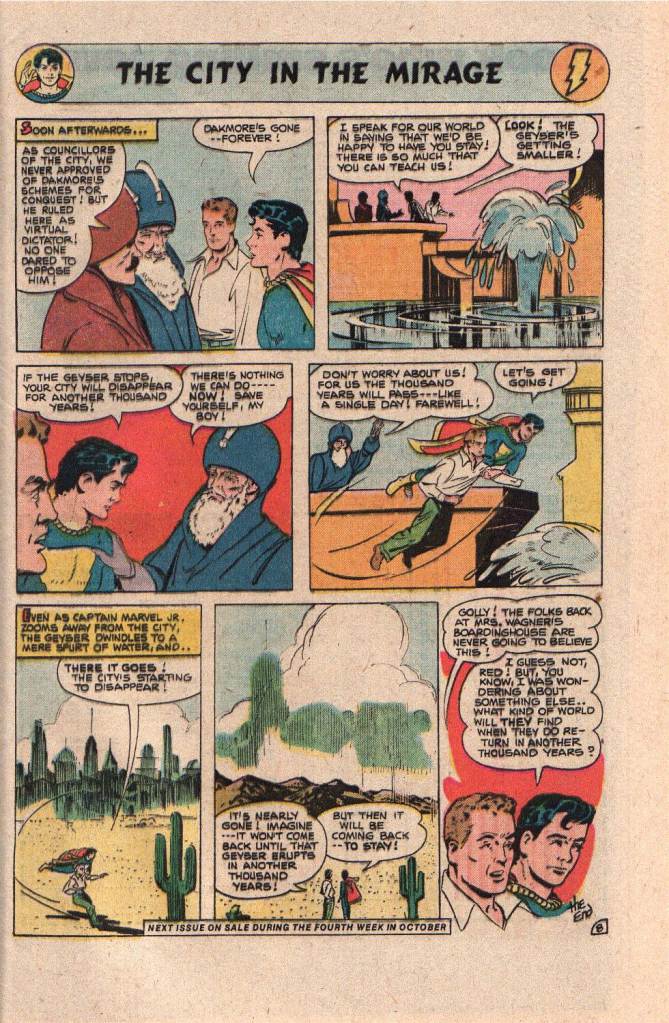
But it turns out that Dakmore is interested in world conquest, and it’s only the fact that the geyser opens in the midst of a barren desert that has prevented him from using his super-science to enter the material world and conquer it. Now that Junior and Red have let him know about man’s civilization, he’s ready to do just that. Sadly for Dakmore, Junior swiftly dismantles the would-be conqueror’s robot army, and proves to be impervious to his proton disassembler. What’s more, Dakmore is caught in the blowback of the disassembler and he’s bloodlessly disintegrated. At that point, Junior and Red have to race back through the geyser before the portal back home closes for another thousand years.


I can’t imagine there was any kind of crossover from the audience of the TV series and the audience for this comic book. The TV show was the ABC Afterschool Special starring a superhero. The comic book was absurdist fantasy-adventure played straight. I’m not sure the approaches can be reconciled, but the comic book didn’t appear to even try.
LikeLike
I think in a few issues Shazam! tries to emulate the TV series and also the stories from the 1940’s where Cap would visit some big city and meet the local distributor for Fawcett comics.
These reprints are swell.
LikeLike
Yes, that was done both to make the comic more like the TV show and in hopes of flattering the local distributors into doing a better job of racking SHAZAM in their cities, improving sales city by city.
It struck me as not quite as dumb as the DC Comicmobile, but pretty small-scale nonetheless.
That Marvel idea they never used for X-MEN, where they build an international team of heroes from the nations where Marvel’s international licenses were strongest, that was a better idea.
But not for SHAZAM.
LikeLike
Kudos to Donald Sims with whom these Shazam review posts would not have been possible
LikeLike
I always enjoyed the reprints more than I did the new stories….loved the 100 pagers…..but I had moved on by the time these issues rolled around. Now, I absolutely loved the series that subsequently ran in World’s Finest and later the Adventure Comics digest.
LikeLike
I remember being disappointed this was not a cross over into the world of Kamandi, a fairly successful Jack Kirby book being taken over by The late Gerry Conway at this time.
Julie Schwartz did some thing similar in Superman a month or two later. The CPT Marcel crossover might have been interesting, especially in light of the much improved previous issue.
LikeLike