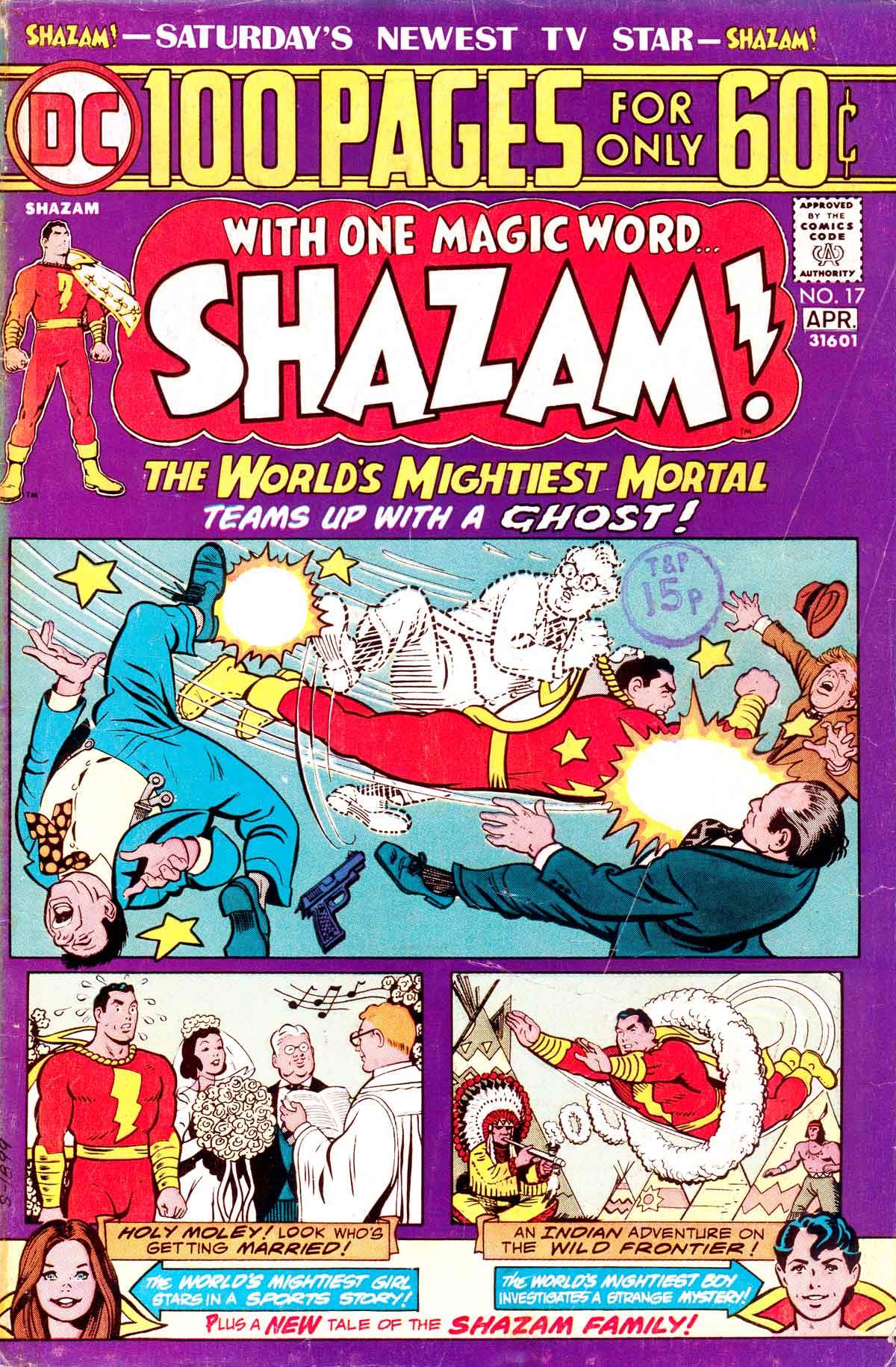


Continuing with my read-through of the complete run of SHAZAM which I’d borrowed from my grade school friend Donald Sims, who had inherited it from some older relative who had outgrown comic books. The next three issues were all ones that I already owned and which I’ve written about previously:
It was during this run that a change came over the covers of the series. DC had initially been forced to title their series SHAZAM because while the character had lain fallow, rival publisher Marvel had established a trademark to the CAPTAIN MARVEL name. But for the book’s first year, it ran with the subheading THE ORIGINAL CAPTAIN MARVEL. Well, somebody on the Marvel side finally noticed and sent DC a Cease and Desist communication, resulting not only in the elimination of that tag line but any mention at all of the name Captain Marvel on the covers from here on in. As you can see on this cover, Billy, Mary and Freddy are all referred to as the World’s Mightiest Whatever rather than by their actual super hero names. Using them on the insides was fine, but DC could no longer display those names on any covers.
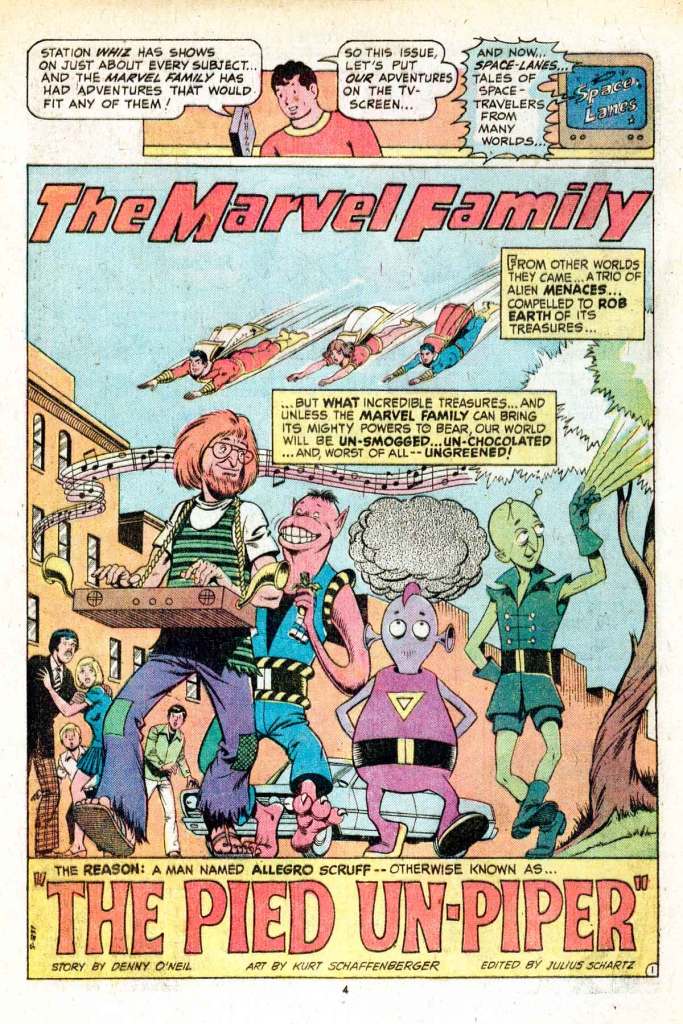
This was also the final issue of SHAZAM to be released in the 100-Page Super-Spectacular format, a format that I truly loved. So I would be sad to see it go, especially as it meant that the somewhat-lackluster new stories that editor Julie Schwartz and his creators were presenting were backed up by far superior reprints of classic Marvel Family tales from the 1940s and 1950s. The opening new tale in this issue was illustrated by Kurt Schaffenberger, a DC mainstay who had worked on the Captain for Fawcett back during the Golden Age, and was thus a really good fit. The story, though, is more of writer Denny O’Neil’s written down fluff about a quasi-hippie, Allegro Scruff, who had built a musical instrument that allows him to exert his will over others like a modern day Pied Piper. But after his efforts are unappreciated, he becomes an inadvertent menace. The story also involves a group of aliens who are stealing the color green from throughout the world. The Marvels solve their problem by fitting them all out with glasses with green-tinted lenses so that everything would thereafter appear green to them. Schaffenberger’s work elevates the dopey material, though, making the entire thing palatable. Even moreso than Bob Oksner, he really had the right flavor for the strip.
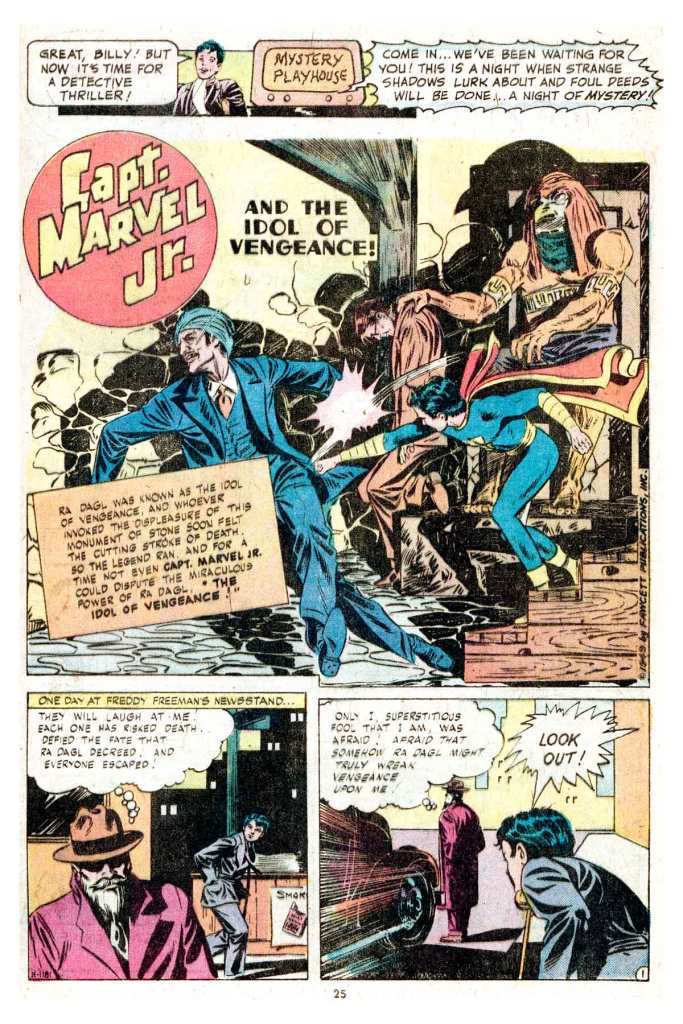
But then it was time to get to the good stuff–the reprints! They led off this time with a Captain Marvel Jr. story written by Bill Woolfolk about a supposedly cursed idol that brings disaster onto the scientific group that’s attempting to study it and ferret out its secrets. Of course, one of the men is secretly bumping off the others so that he can have their discovery all for himself, using the curse as a cover for his assassinations. Junior sorts this all out in seven pages. The artist on this story is uncertain, but they follow in the format established by Mac Raboy, who made Junior’s depiction a bit more quasi-realistic than the other Marvel Family series.
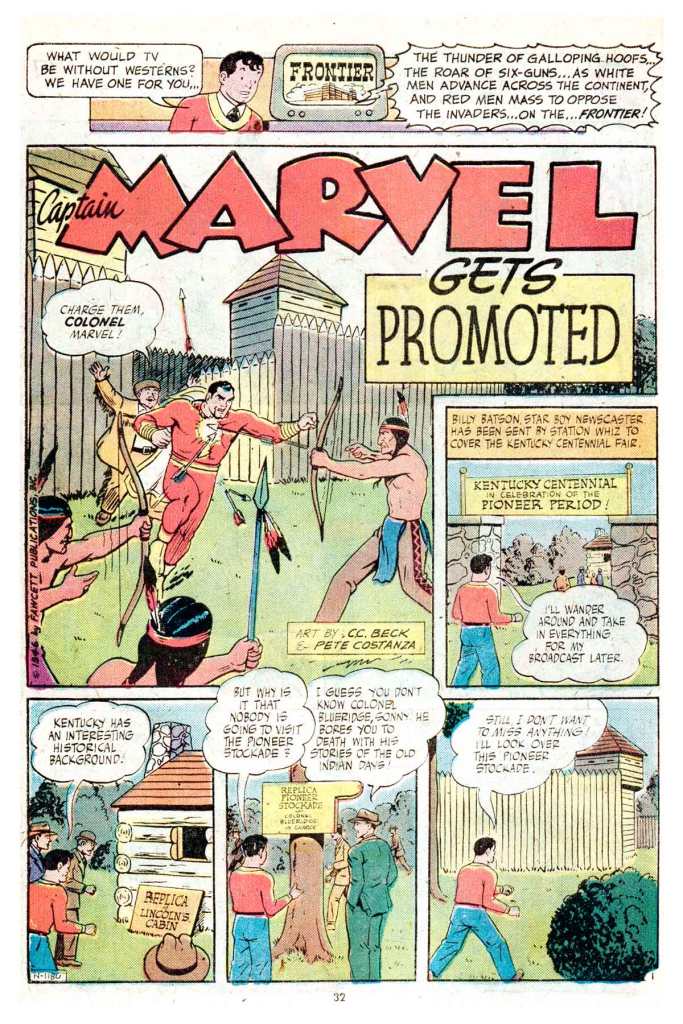
Otto Binder and Pete Costanza put the next story together, one in which Captain Marvel receives a battlefield promotion, becoming for a short while Colonel Marvel. It’s the doing of Colonel Blueridge of the Kentucky Centennial Fair, whom Marvel saves. But Blueridge takes a blow to the head and imagines that he’s actually back in the frontier period the exhibits are meant to commemorate. The Captain-come-Colonel has to keep him out of trouble for the duration, as well as defusing an explosive situation with a local Native American tribe that feels a bit coincidentally shoe-horned in to give the story a bit of action. A fun premise, not the best execution in the world.
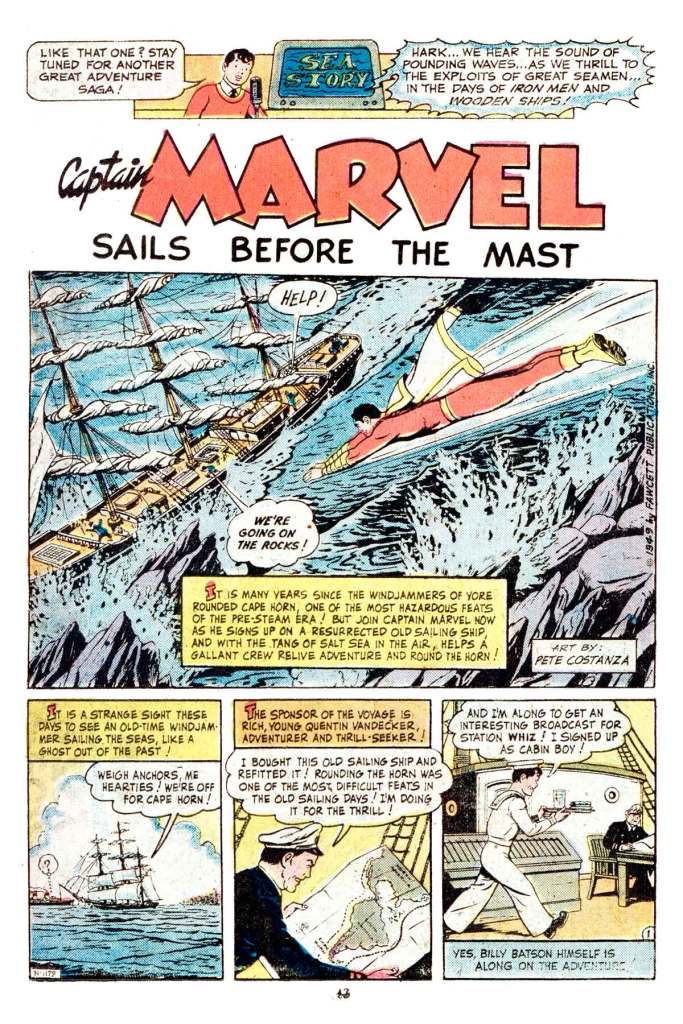
The same creative team contributed the next reprinted story, in which Captain Marvel finds adventure aboard an old-style windjammer. I’m sure that lining up these SHAZAM 100-Pagers was a bit of a trick, given that they had to be built out of whatever reproduction materials Fawcett was able to provide DC with after all of these years. Anyway, the ship’s commander Captain Bryce, leads his men and his ship into danger trying to earn a hefty bonus for himself. Marvel’s efforts to intervene are stymied by the fact that, by naval law, a ship’s captain is the highest legal authority on the open seas. It ultimately turns out that Bryce had forfeited his license before embarking on this venture, giving Marvel all the space he needs to finally flatten the guy.
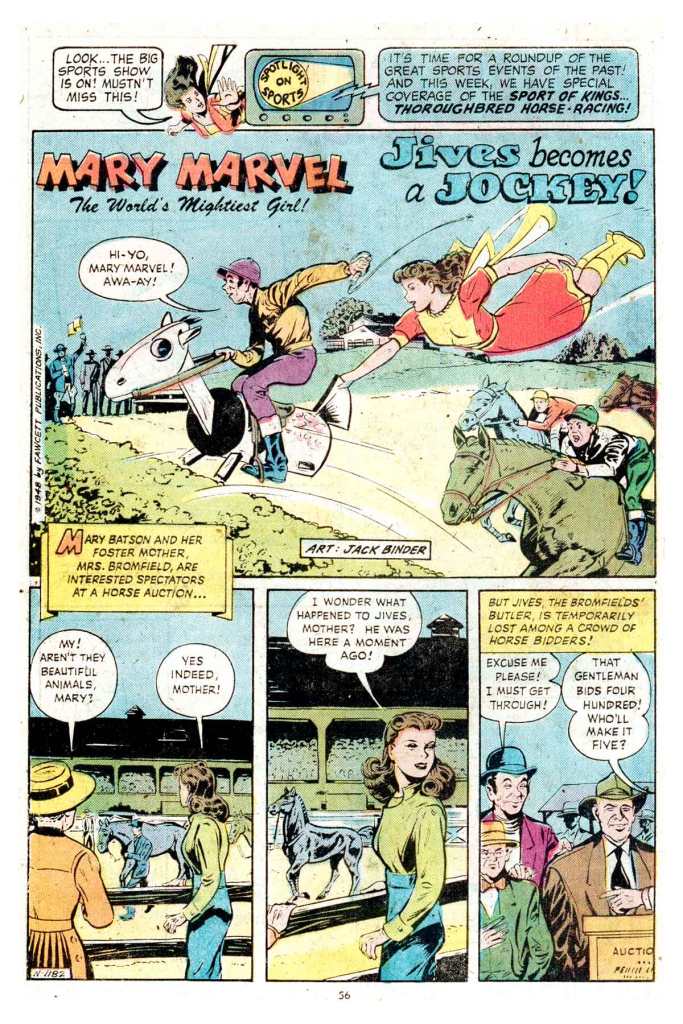
Next came a Mary Marvel adventure by Bill Woolfolk and Jack Binder. Mary’s stories tended to skew a bit more towards fantasy and the fanciful. In this story, Mary’s butler Jives accidentally purchases a racehorse while out at the track. Jives is determined to make good on his mistake by running the horse in the local steeplechase, and Mary needs to keep him out of trouble when he’s targeted by crooks who have their own plans for that contest. Jives wins out in the end, but can’t wait to unload his horse after that, so sore is his backside from the frantic ride.
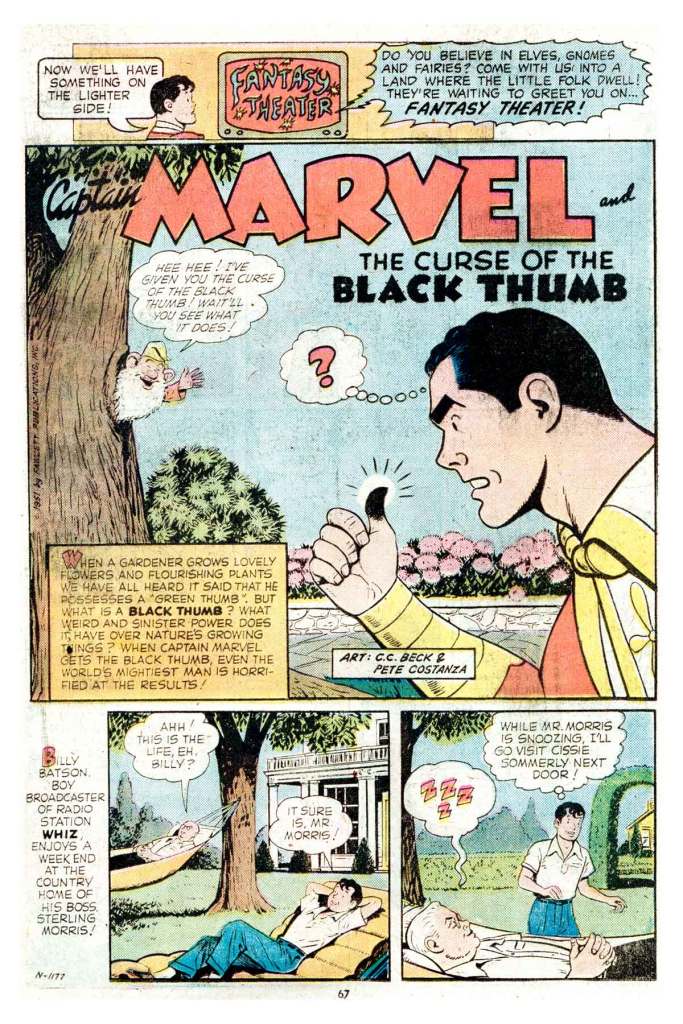
In the next tale, produced by Otto Binder and C. C. Beck, Billy Batson’s neighbor Cissy Sommerly accidentally disturbs the home of a garden gnome while working on her garden, and the creature curses her with a Black Thumb that causes any plant life she comes into contact with to wither and die. When Captain Marvel tries to intercede on Cissy’s behalf, he too is stricken with the same curse. But after Marvel offers to rebuild the gnome’s home and also saves him from a ravenous fox, the critter relents and dissolves the curse, restoring everything to normality.
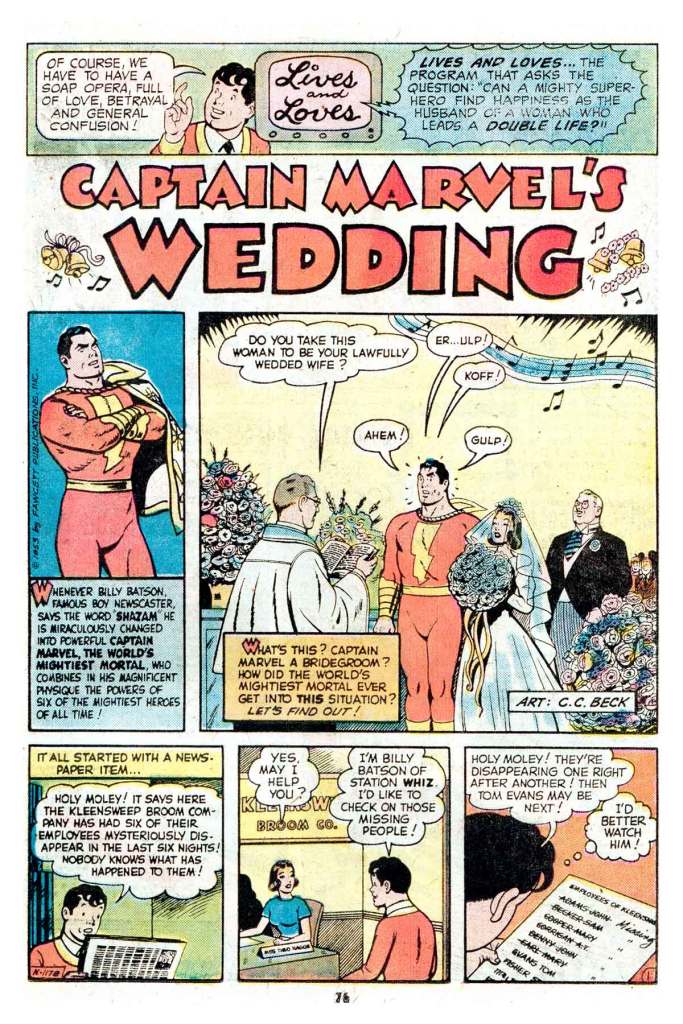
Because most of these classic Marvel stories were relatively short, you got a lot for your 60 cents in this format. The next one came from the final issue of CAPTAIN MARVEL ADVENTURES in 1953 and was done by Otto Binder and C. C. Beck. It involves an old witch trying to trick Captain Marvel into marrying her by posing as the demure receptionist for a broom manufacturing company where the witch has been abducting the employees. Marvel is able to dodge his nuptials by stalling the ceremony until after midnight, at which point the Witch’s spell of concealment wears off and she’s revealed as the horrible hag she truly is in front of the entire congregation.
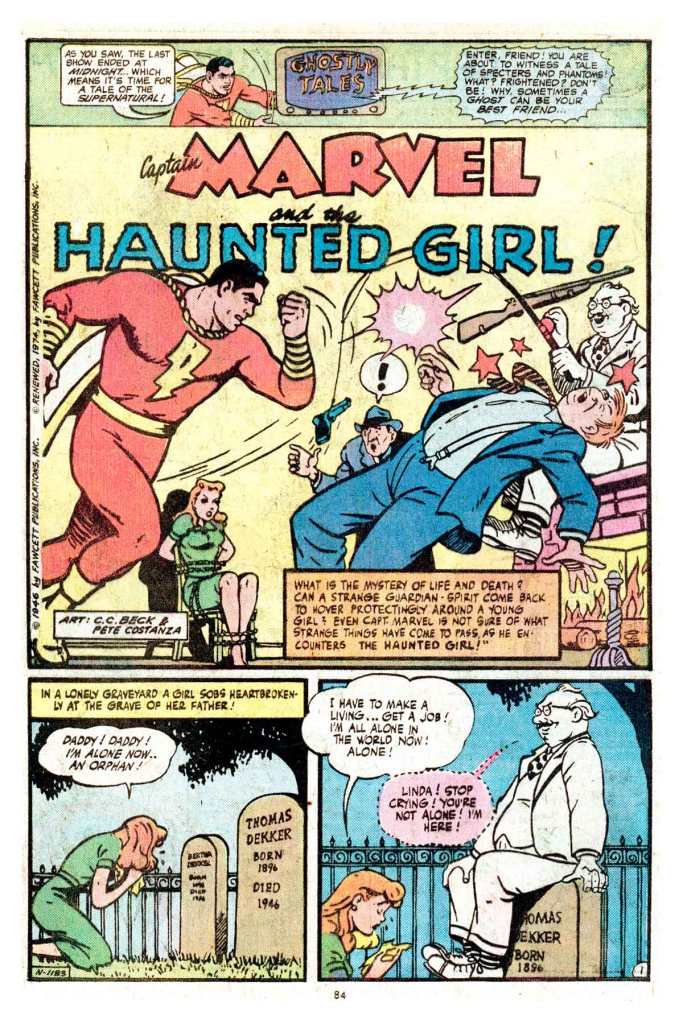
The final story was the one spotlighted on the cover, but unfortunately it suffered a little bit from spotty reproduction–the linework is a lot heavier and blotchy. But it’s still a charming piece by Binder and Beck about the ghost of a young woman’s recently deceased father who sticks around haunting people until he can be certain that she’ll be all right without him. Captain Marvel, of course, lends a hand even though he can’t see the ghost himself, and the spectre returns the favor when Billy is captured and about to be executed by crooks.
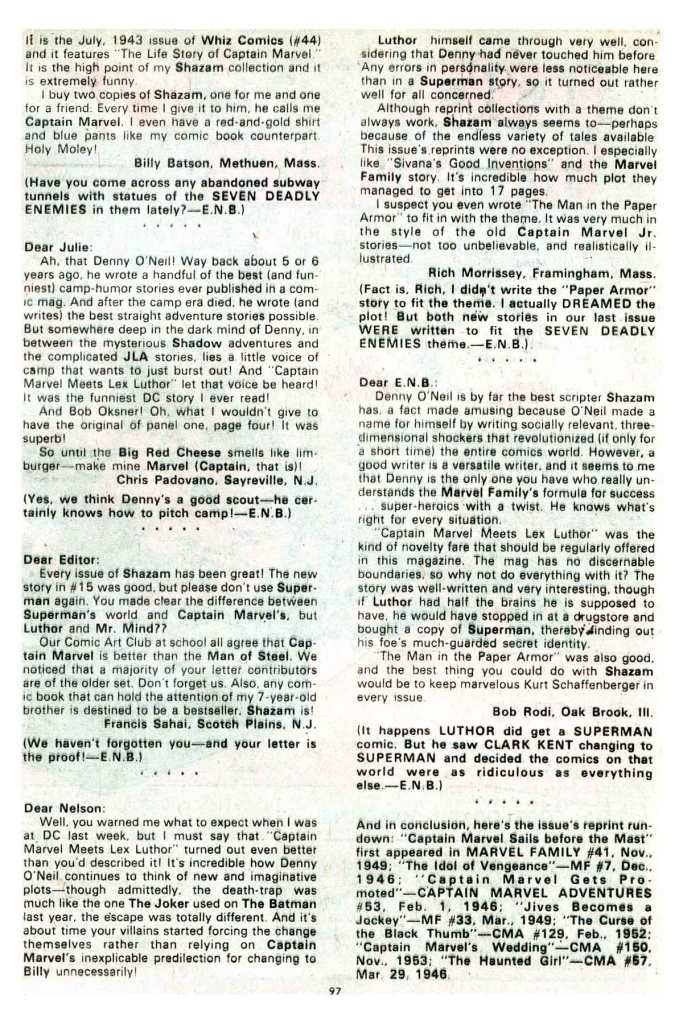
The two-page letters page in this issue included a missive from future author Bob Rodi, in which he asked a very good question about a recent story in which Lex Luthor found himself transported to the world of Captain Marvel, in which both he and Superman were only comic book characters. Editor Schwartz’s assistant E. Nelson Bridwell answered perfectly.
 The Tom Brevoort Experience
There’s a very different feel to these old stories — they aren’t really “about” the superhero, if that makes any sense. It’s a ghost story, or a western, or whatever that just happens to have Captain Marvel in it.
I had to laugh when I saw the intro to the “Black Thumb” story has a tv show called “Fantasy Theater” — years later, I published several issues of a zine with that same name. Perhaps I subconsciously remembered it!
LikeLike
The road on how I finally got there: So last week I was thinking about last weekend’s 2000 AD comic and how The Godfather and Planet of the Apes inspired the bad guys. This made me think about the original Star Trek series episode “The Immunity Syndrome” ( Season 2, Episode 18 — energy-drain, giant single-celled organism ) and the similar threat in Alan Davis’s JLA: Another Nail#1-3 ( July-September 2004 ) or how Star Trek: Enterprise season 2 episode “Regeneration” ( Captain Archer’s crew encounters the Borg, but it started on Earth in the Arctic when a research team finds them frozen ) and Alpha Flight#9 ( April 1984 — in an isolated research station, Dr. Langkowski is invited to study an odd cosmic radioactivity phenomenon, when the scientist looks in, the Fantastic Four’s the Thing is “beamed in” ( Super-Skrull in disguise ) — comics.org for words ) — reminded me of The Thing from Another World ( 1961 )/The Thing ( 1982 film ) which I believe John Byrne made reference to the movie ( If my memory is correct ). The Super-Skrull led me to CAPTAIN HERO [ Power Man and Iron Fist#111 ( November 1984 ) –retcon in Namor The Sub-Mariner#25 ( April 1992 ) of Captain Hero ( Bobby Wright a 12 year old — possessed superhuman strength, durability, could fly, turn invisible, intangible, shape-change ( into adult Captain Hero & Dr. West ) could supposedly control all the molecules of his body — Most of these powers can be explained through the Super-Skrull’s own powers ( ME, except how he flies without a flame trail ), but Master Khan must have added some of them, such as intangibility — comicvine.gamespot.com ) as the Super-Skrull in disguised with his memories altered by Master Khan ] and that made me remember another child hero in an adult body, RAGE ( Elvin Haliday — age 13 ) who’s co-creator Larry Hama says was inspired by CAPTAIN MARVEL ( Billy Batson ), while his grandmother Edna was inspired by Spider-Man’s Aunt May — Hama did not intend to make Rage African American, but realized that the ethnicity fit his character and changed other aspects of Rage to make him work.
LikeLike
I remember these 100 pagers with fondness, since it was my window into the Golden Age Captain Marvel, who for a time, outsold Superman. If the writers only hadn’t been forced to admit that they told to steal Superman stories and rewrite them as Captain Marvel stories.
We might have gotten 1 or 2 more Captain Marvel movie serials, a radio show and maybe a TV show to compete with Superman in the 1950s.
LikeLike
Heck, maybe a newspaper strip too!
LikeLike
I have a thought experiment I go to once in a while where I posit a world where National got the rights to Captain Marvel and took over publishing that line of comics.
LikeLike