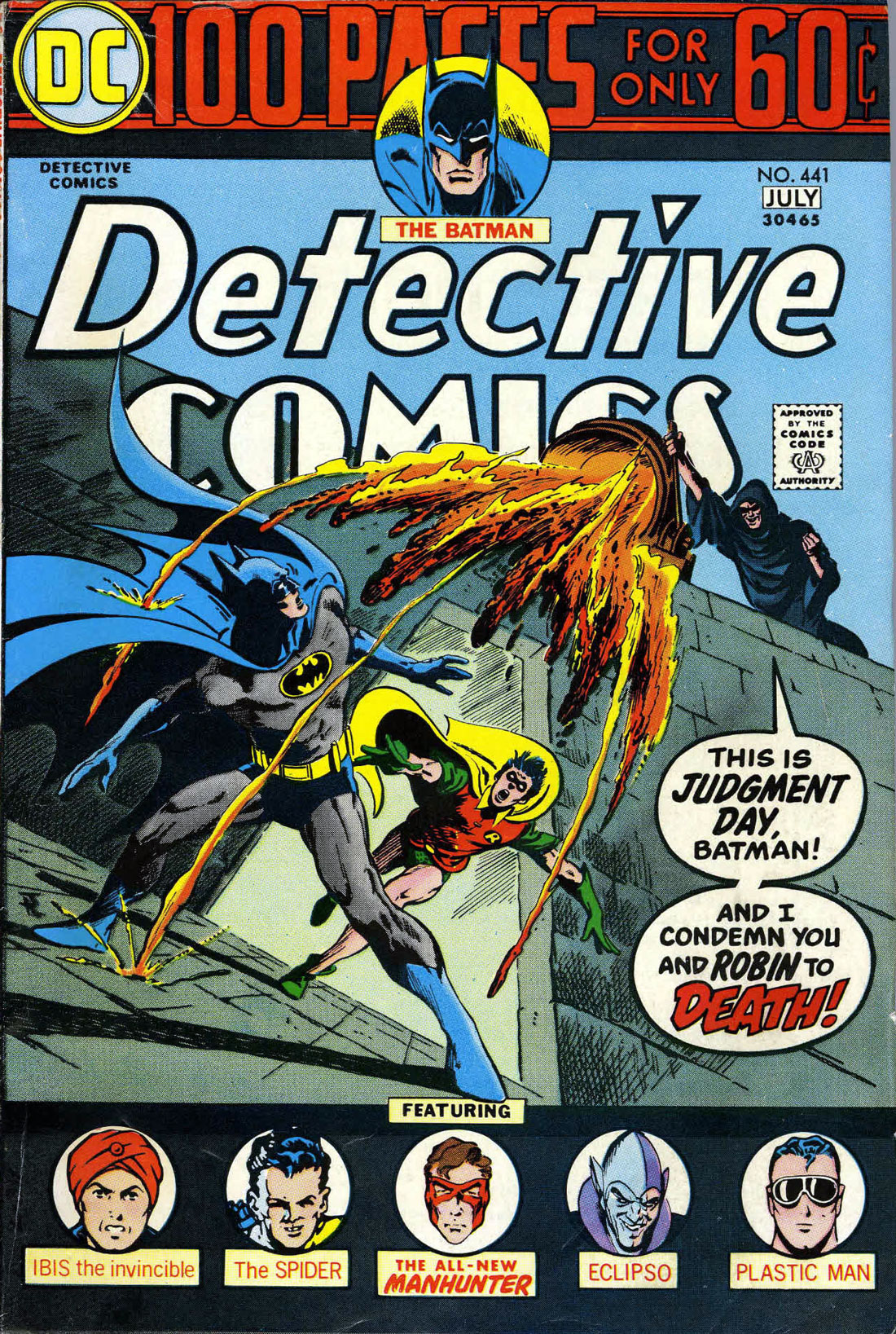


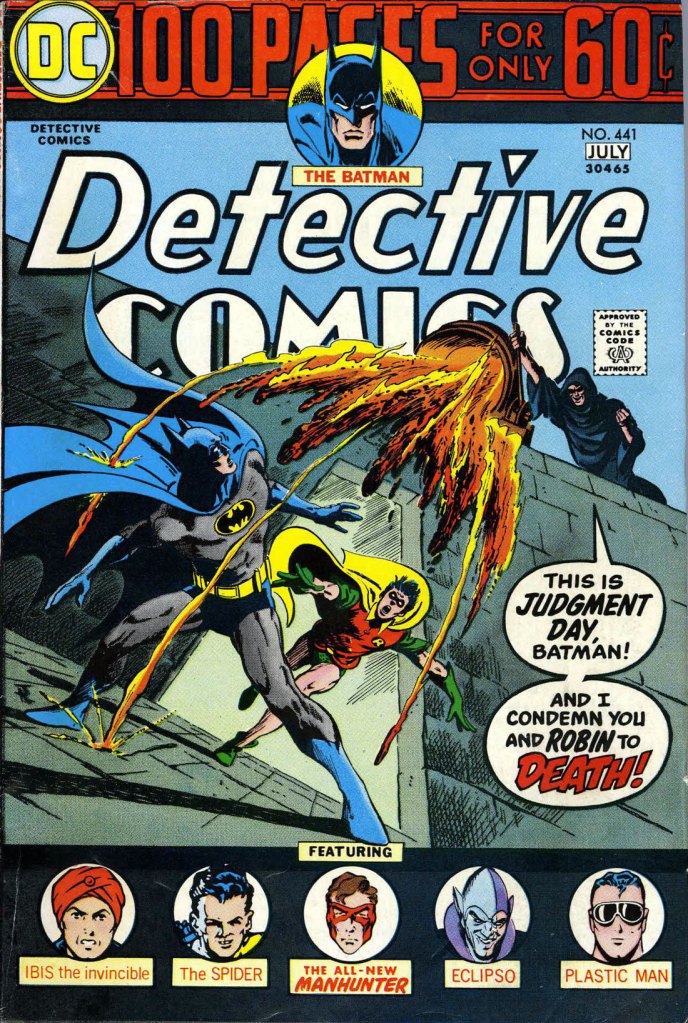
There would typically be some specific reason why I asked to borrow a particular comic book from my grade school friend Donald Sims. Usually, it was because I’d gotten interested in a specific character and was invested in learning more about them. So it was with this 100-Page issue of DETECTIVE COMICS, which I borrowed because at that moment I was fascinated by the history of Plastic Man. I likely had reread the COMIC BOOK BOOK which had a chapter dedicated to the ductile detective and I was keen to experience more. As it so happened, a golden age Plastic man story was reprinted in this issue–so there we went.
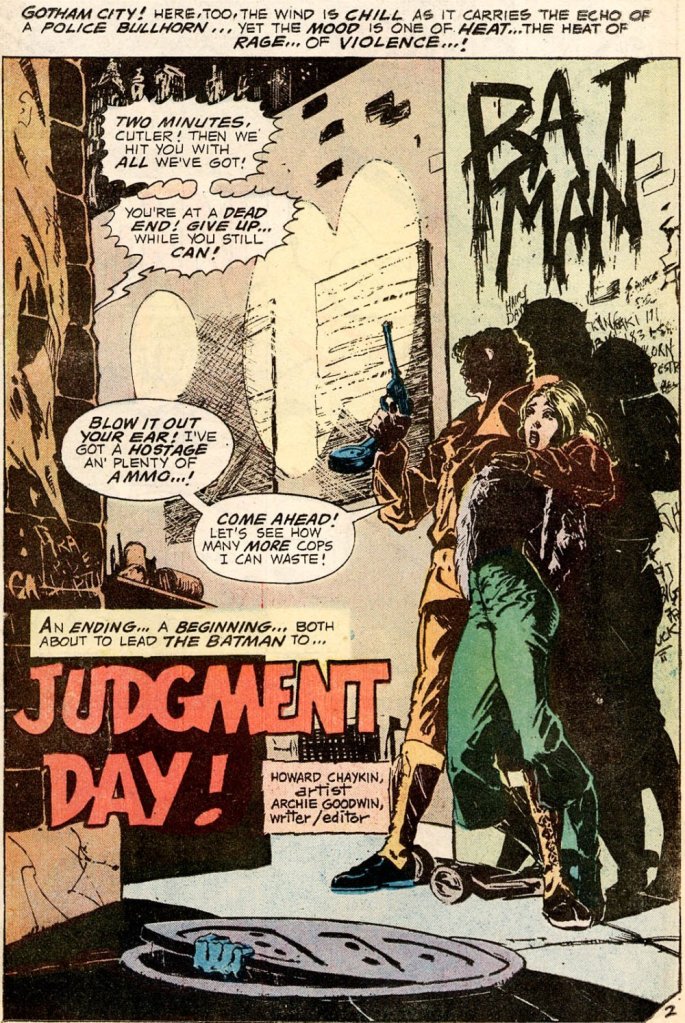
I didn’t appreciate this at the time, but this issue of DETECTIVE COMICS was one of a short run edited by the great Archie Goodwin, who also wrote both the Batman story and the Manhunter story in this issue. Archie made a concerted effort to elevate the material, in particular the lead Batman stories he was working on. His run was illustrated by a bevy of the best in the industry at that moment–in this case, a young Howard Chaykin. it wasn’t really to my tastes as a kid, in that Batman and Robin are the only fantastic elements in the story. But it looks and reads well in hindsight. It’s about a demented judge who attempts to put Batman on trial for his vigilante actions because his daughter had been blinded by a stray shot when the Masked Manhunter was taking down a killer.
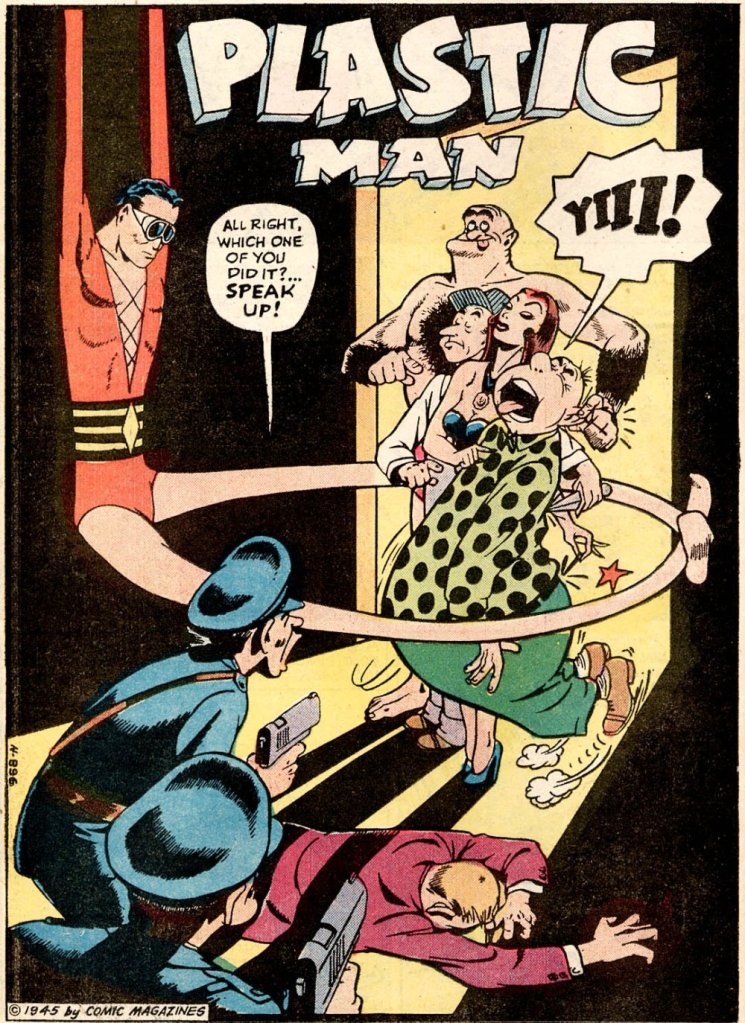
The next story was the one that i was the most interested in, a Plastic Man story from the midst of the Golden Age. While it was drawn by the character’s creator Jack Cole, this tale was apparently written by Joe Millard. Goodwin left the selection of the reprint material to Assistant Editor E. Nelson Bridwell, who had an encyclopedic knowledge not only of DC’s output but that of the various characters they’d acquired over the years, so there are stories from Quality Comics and Fawcett in this issue as well as DC. The story is about Plas and Woozy attempting to solve the murder of a gossip columnist who was revealing embarrassing secrets about a number of people, including Woozy.
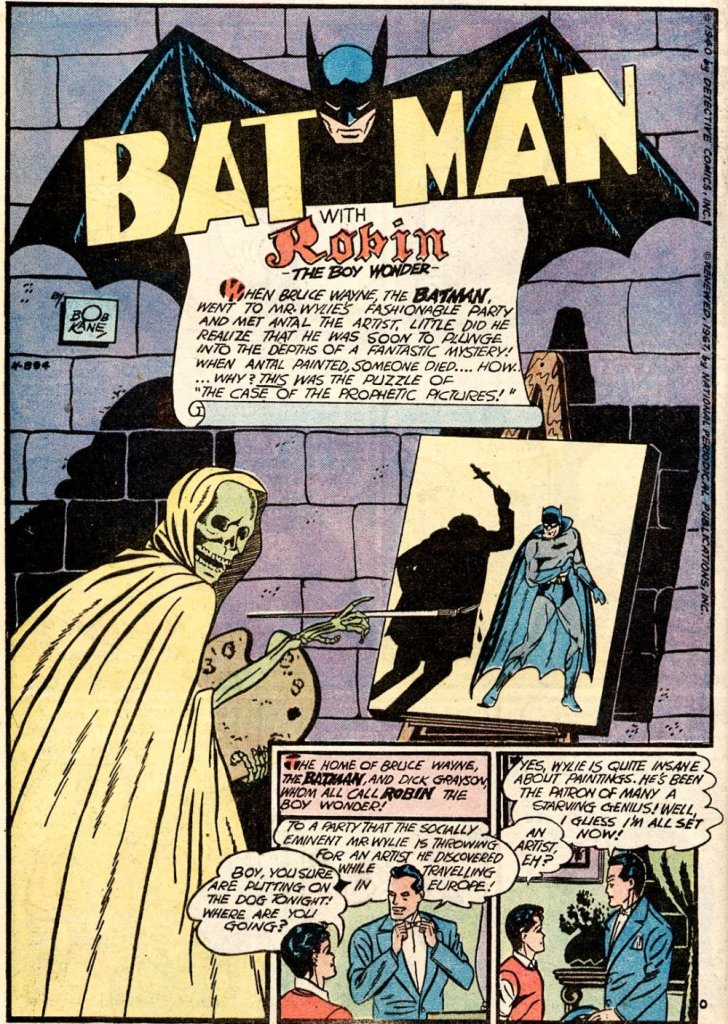
The first of the two reprinted Batman stories in this issue is a very early tale, written by Bill Finger and illustrated by Bob Kane and (likely mostly) Jerry Robinson. It concerns a killer who uses prophetic paintings to target his victims. But that’s not what makes is particularly interesting. What does is the fact that this random story spawned a sequel some seven years later–and Bridwell included that sequel story in this issue, too. On its own, this tale is a good representation of the era. it’s a bit too crowded with tiny panels containing tiny figures, often boxed in by big chunks of copy. But it’s also got that early Batman mysterioso quality, back before the character became a duly deputized operative of the law.
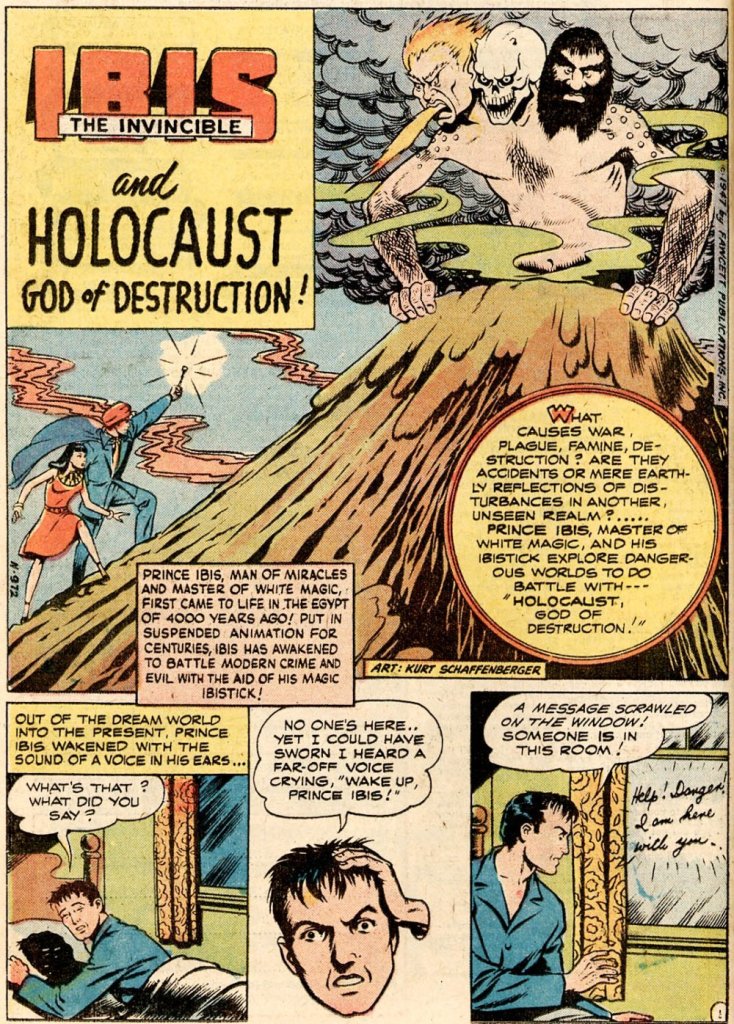
Next comes a short story featuring WHIZ COMICS perennial second banana Ibis the Invincible. It’s illustrated by Kurt Schaffenberger, who was still working for DC all these years later, and written by Bill Woolfolk. Here, Ibis is called upon by one of seven guardians who is keeping the God of Destruction, Holocaust, chained up so that he cannot ravage humanity. Ibis uses his all-powerful wand, the Ibistick, to vanquish Holocaust when the mad deity gets loose. Really, he never stood a chance. It’s also got an unassuming cameo by Freddy Freeman, secretly Captain Marvel Jr., which must have tickled Bridwell.
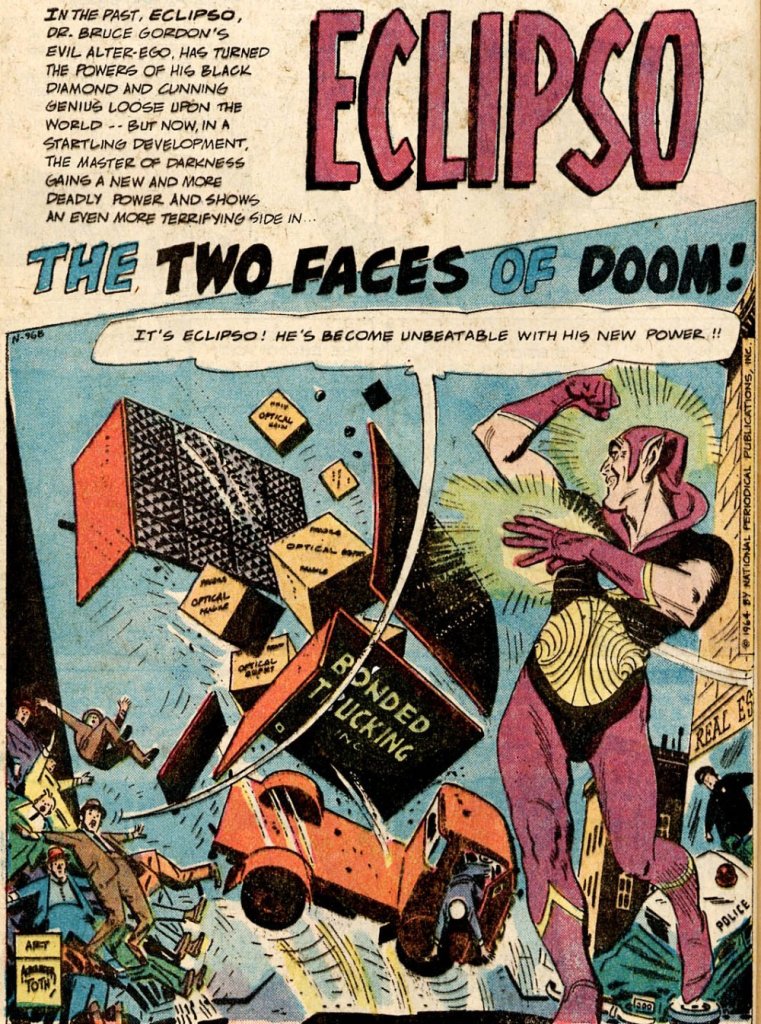
The next story up featured Eclipso, the character who was hero and villain in one man. This installment was one of a number illustrated by the great Alex Toth, and written by Bob Haney. In it, an attempt by Bruce Gordon to arrange it so that his intellect remains in control when he turns into Eclipso at first seems to bear fruit. But it turns out to be a trick by Eclipso so that he can gain new mind-over-matter powers triggered by sunlight, typically his weakness. It falls to Professor Bennet and his daughter Mona to put Eclipso back into his box. I had encountered Eclipso earlier as a villain in a Justice League story, but I’m not sure that I knew he had once been a headliner until I read this adventure. The Toth art was striking, but not really to my taste as a kid.
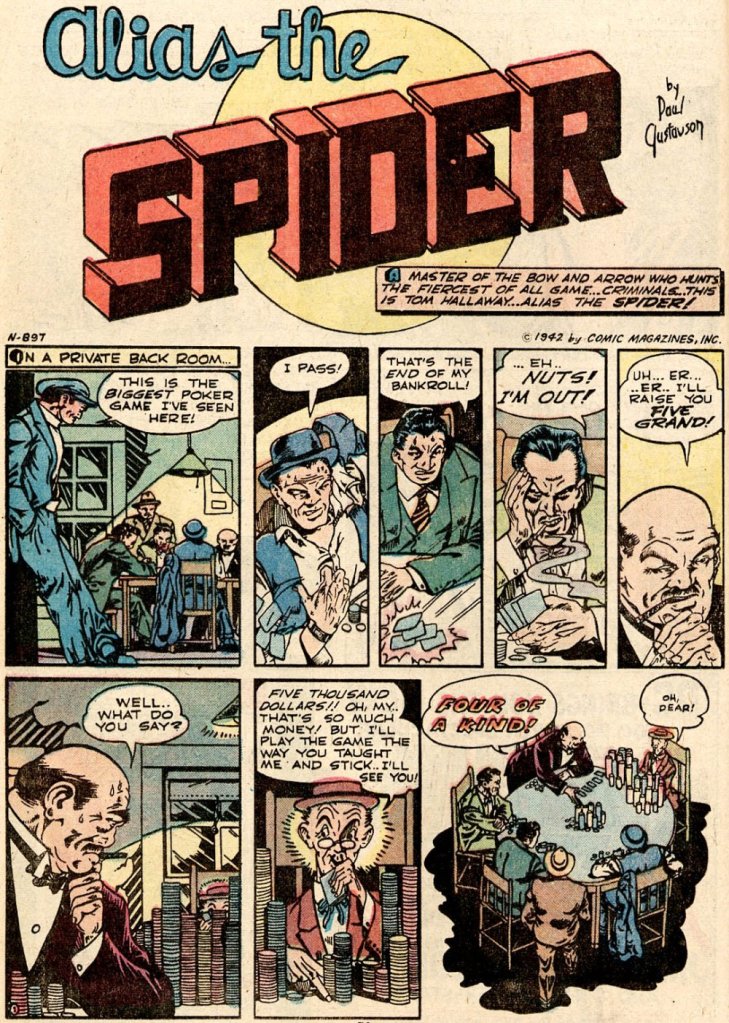
Next up came another Quality Comics story, Alias the Spider. The thing that I remember most about this character is the fact that, not knowing any better, many readers in the 1940s assumed that Alias was his real name–they thought he was called Al. Al Spider. But no, he’s another crime-fighting Robin Hood outlaw, a master of the bow and arrow. Paul Gustavson was responsible for this story, which was perfectly fine but unremarkable in any way. But it did feature the sort of clean, open artwork that Quality’s head “Busy” Arnold preferred.
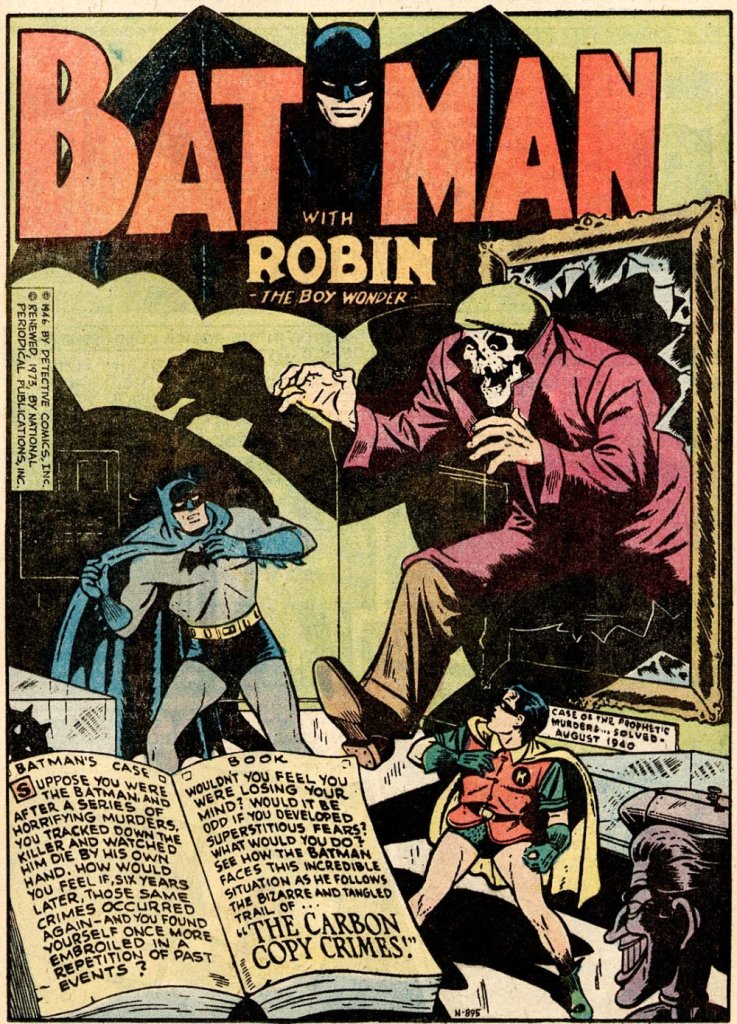
Next came “The Carbon Copy Crimes”, the Batman story that was a latter day sequel to the one reprinted earlier in this issue. It’s a rare use of continuity in those early years, and involves somebody recreating the Case of the Prophetic Murders, which Batman suggests is the first big case that he and Robin cracked. The story even re-creates an entire page from the original, with artist Jim Mooney channeling the earlier Bob Kane and Jerry Robinson. (Writer Bill Finger wrote this sequel too, of course.) The perpetrator is a psychologist who is attempting to prove that had Batman’s first big case not been a success, he wouldn’t have gone on to become a great crime-fighter. The Dynamic Duo thwarts him by removing their masks and claiming to not be the actual Batman and Robin at all, but rather Bruce Wayne and Dick Grayson standing in for them. In the end, the criminal psychologist meets the same gruesome fate as the original villain in the earlier story. I was pretty fascinated by the recursion in this tale, and would flip back and forth between the two stories to compare the repeated images.
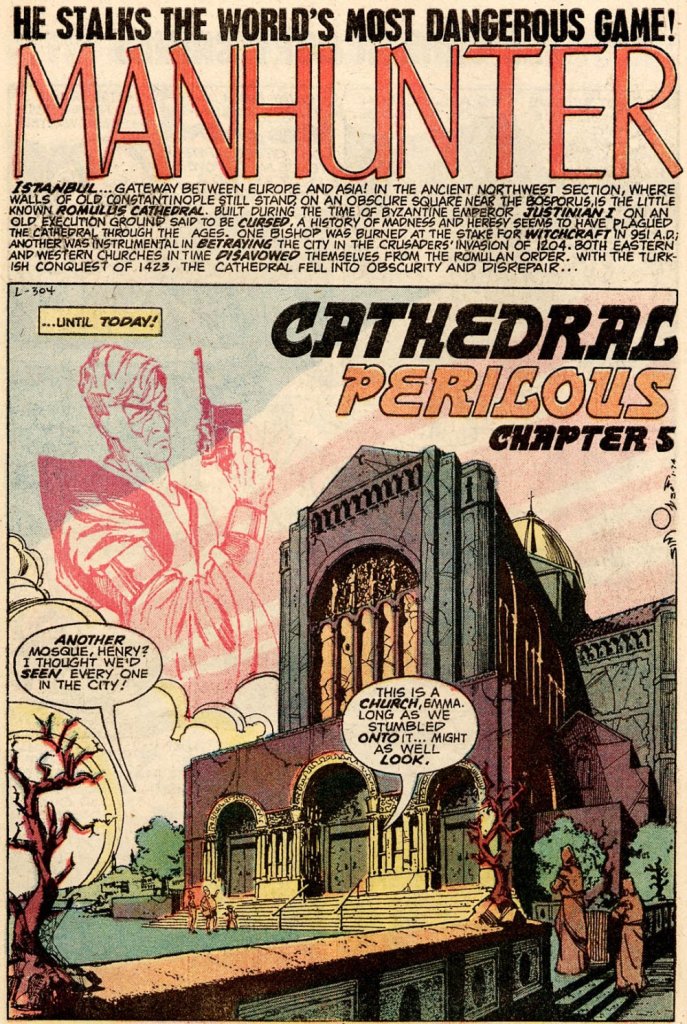
The final story in the issue is the best thing in the magazine, though it didn’t make a whole lot of impact on me as a kid. It was another chapter in Archie Goodwin and Walter Simonson’s revamp of Manhunter into a contemporary character, and it packed a ton of excitement and visual panache and character work into eight short pages. In that way, it reminds me today of one of the great Will Eisner Spirit stories that would often do the same thing. Simonson’s art, while early in his career, is crisp and design-oriented, and Goodwin is a master of plot and characterization. Both are able to accomplish more in these eight pages that others can do in a full issue. It’s a great capstone to a very fulfilling issue, a good example of what I loved so much about this 100-Page Super-Spectacular format. You got a lot of value for your money.


When it comes to the Manhunter, I’m a Golden Age [ Adventure Comics#73 ( April 1942 ) ] & Jack Kirby [ 1st Issue Special#5 ( August 1975 ) ] versions fan. When I saw the golden age DC Comics version in All-Star Squadron#31 ( March 1984 ) my mind went to Ghost Rider & Spider-Woman foe the Enforcer. I wished then that there could be a golden age Marvel Version ( I wanted to find a character in shadow hopefully in a Simon & Kirby story that could be revealed to be that character — as a hero ).
LikeLike
A good example of why those 100 pages were so great.
I wonder if people assumed the Spider was “Al Spider” because there’s no other reason for him to call himself the Spider.
Ibis didn’t interest me at all — too easy for him to win, even against a god — but I had no idea it was Schaffenberger.
LikeLike
That Eclipso splash sure shows how Toth’s art influenced Don Heck.
I was a Marvel kid but I loved the DC 100 pagers regardless of the featured star. I generally preferred them to the Giant-size marvels… which were 10 cents cheaper but 32 pages thinner. Of course none of the DC 100 Pagers as far as I know have any lead stories that are as great as GS Xmen #1 or GS Avengers #2.
LikeLike
I remember buying this off the rack and loving it. This was the only Alias the Spider story I ever got to read for decades. I found it really really strange but fun. I kinda of liked Manhunter, not knowing anything of the golden age one [or two if you count the Quality one that outlasted most heroes of that day], but wasn’t really into my heroes shooting people. The Vigilante always shot for the hand or objects to bring down the crooks. Got a little older and started accepting heroes shooting bad guys but to my mind, they were never SUPERHEROES, just vigilantes.
LikeLike
The only downside to the Manhunter series was how it ended.
LikeLike
Manhunter gets killed off in Detective#443 ( October-November 1974 ) and Nemesis in The Brave and the Bold#193 ( December 1982 ). Both fought an organization called The Council ( not to be confused with The Council that Supergirl fought in The Daring New Adventures of Supergirl Vol.2#3 ( January 1983 ) — noticed all three reading Who’s Who ).
LikeLike
It’s funny — you were interested in the reprints and didn’t appreciate the new stuff at first, and I was exactly the opposite. I liked the new stuff and resented the reprints, and now I look at them and think, “Wow, treasure!”
In the case of this particular Manhunter chapter, the Eisner flavor is deliberate — Archie and Walter have both talked about how this chapter, as they were plotting it, seemed flat, just a lot of action without much else. So, thinking of Eisner Spirit stories, they added in the tourist family, and that’s what elevated the story to a real charmer.
And they won a Shazam Award for it, for Best Short Story of the year.
LikeLiked by 1 person
I liked all of the 100-page Spectaculars, but DETECTIVE seemed to have especially good reprints. I wonder if Goodwin had more of a hand in the picks than usual, because the emphasis seemed to be on spotlighting interesting artists, whereas Bridwell tended to be story-oriented (grouping stories with a similar theme, for instance).
LikeLike
I loved Archie Goodwin’s run on Detective. If I remember correctly, he took some guff from readers back then for reverting Bruce Wayne to the “bored playboy” persona of the late 1930s, only for that portrayal to become the character’s default mode several years later. Manhunter also left a strong impression on me, as he was unlike any super-hero I had seen at that point. He arguably wasn’t even a super-hero at all, bearing a closer resemblance to pulp fiction and espionage characters. Simonson’s artwork – even at that early stage – stood apart from the crowd. The reprints in this particular issue were also strong.
LikeLike
I just reread the Manhunter Deluxe Edition and was pleasantly surprised by how well it holds up. Kind of a proto-Bourne Identity (but with super-heroes) that still feels modern (not something I can say about a lot of Bronze Age comics).
I’ve never seen that Eclipso story. I kinda hope it’s included in the upcoming DC Alex Toth Deluxe Edition collection.
LikeLike
100 pages? I could have never read a comic with so many pages…but it didn’t matter because I didn’t have .60 🙂
The Toth of course is a game changer but as a kid I hadn’t really dialed in who was doing what.
Like the ReMasterworks making a return, the Toth deserves collection.
LikeLike
ALIAS THE SPIDER ( Jess Nevin’s Encyclopedia of Golden Age Superheroes ): Tom Hallaway, a wealthy playboy, decides that there’s too much crime in the world and that he needs to do something about it. So he puts his skill at archery to good use, donning a cheery costume and nailing criminals as the Spider. He is helped by his valet and chauffeur Chuck. He is a killer vigilante. He has no superpowers but is very, very accurate with his arrows, has a “spider seal” that forces victims to drop their guns, uses various trick arrows, and the Black Widow, a fast car. He predates Green Arrow[ More Fun Comics#73( November 1941 ) ] by 1 year [ Crack Comics#1 ( May 1940 ) ].
LikeLike
I was curious about the “spider seal” so tried to look up Crack Comics and found [ https://archive.org/details/CrackComics009/mode/2up ] and discovered that the Black Widow is a cool futuristic looking car with 3 tires ( 2 in the front & 1 in the back ) that he was able to drive on the wall of a building to avoid hitting pedestrians, plus he and chuck did not sit in the car but lay down in a sniper position while the Spider drove ( Crack Comics#9 ). Later when I tried find it again [ more issues — https://archive.org/search?query=crack+comics ] found issue number and saw the Spider Seal in action ( He drove a normal car in that first issue ).
LikeLike
I really liked the Goodwin run on Detective Comics. I thought Manhunter was a particularly interesting concept. I did think Goodwin’s Batman stories tended to be atmospheric but (other than Englehart’s Night of the Stalker) not memorable.
I thought making Bruce Wayne more his original archetype was an odd move. Wouldn’t people who knew the Broome/Robbins Bruce Wayne think it odd that he had changed so much from the active citizen they had known? One thing that did not make sese in this episode was Robin’s presence. Was it an attempt to boost sales or had Chaykin wanted to use him?
Manhunter had started with two sticking introductory stories, then two origin issues and would soon drive into the conclusion. This story was filler to some degree. Goodwin and Simonson tried something (that did not quite work) but the effort was appreciated.
On the reprints, I wonder if they were as good as they were because Goodwin took less of an interest? Schwartz and Boltinoff had been the editors (or at least involved) when a lot of the reprints had been done as originals and what appeared in the books they edited probably reflected their tastes.
Chaykin was an interesting choice for a Batman story This was before The Scorpion and he was more known for Science Fantasy than pulp-noir.
Kurt Schaffenberger did nice work on the Ibis story but it is notable how much his art had developed by the time he started to work on The Marvel Family just a few years later (those stories were being reprinted in Shazam around the time this issue appeared.
Alex Toth’s Eclipsco story looks a bit different than a couple of Alex Toth Eclipsco stories reprinted in World’s Finest around the time this issue appeared.
Alias the Spider has since become an important character by retcon, a deeply post-modern thing.
LikeLike
If I remember correctly characters in-story did remark upon Bruce’s apparent change in personality. Commissioner Gordon, for one, outright stated that he didn’t like it very much.
LikeLike
I remember that panel.
However, as involved as previous stories had shown Bruce Wayne to be: heading an effort to save Gotham Village in the first “New Look” Batman story by John Broome; serving as a US Senator to finish out an assassinated Senator’s term in the Bob Haney/Neal Adams B&B that introduced Green Arrow’s new look; or the “Victims, Inc. Program”[“VIP,”] created by Frank Robbins) you would expect this to be a bigger deal.
Since Schwartz also used this. I was surprised Steve Englehart dis not use this more . . . .
LikeLike
The early 1970s were a good time to be a fan of DC Comics! The 52 and 100 page formats with lots of reprinted material from the golden age were a treat!
LikeLiked by 1 person
I wonder if dc had g gotten the fawcett and quality negatives..the reprints are very good
Get Outlook for Androidhttps://aka.ms/AAb9ysg
LikeLike