

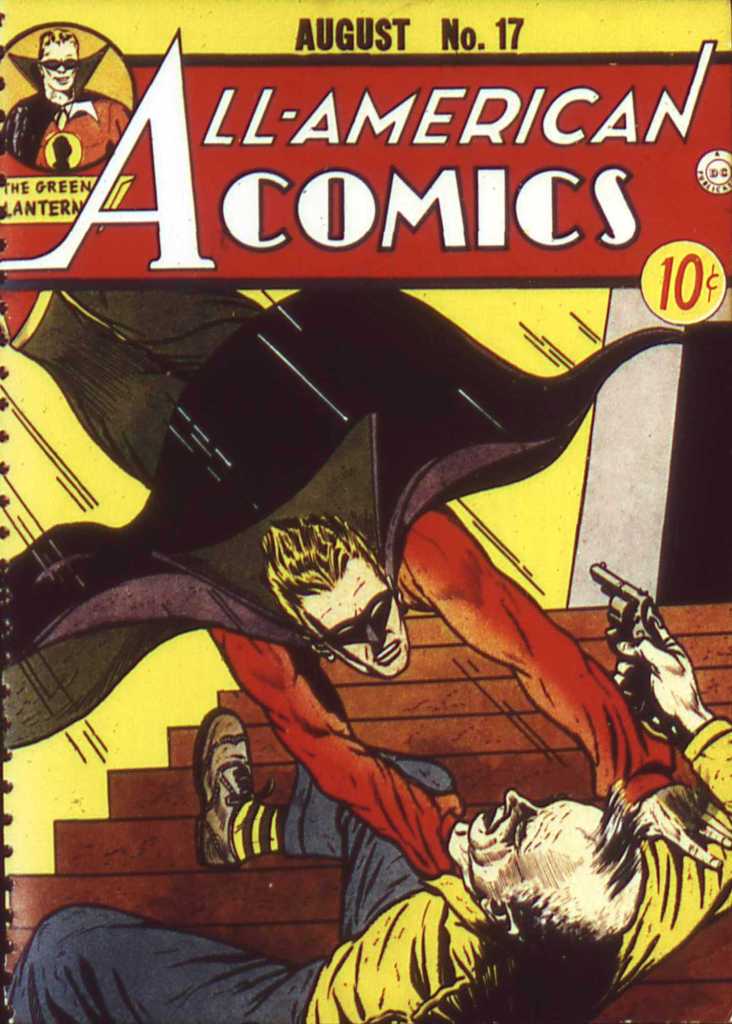
As comic books entered teh 1940s, it became apparent to publishers that the thing that was really driving sales to kids, at least right at that moment, was super heroes. Larger-than-life costumed do-gooders dressed in outlandish costumes. Superman had shown the way, and every pulp publisher with two nickels to rub together began following suit. In an attempt to buoy up the lagging fortunes of their ALL-AMERICAN COMICS, All-American’s editor Shelly Mayer agreed to buy a concept for a new hero pitched to him by artist Martin Nodell. It was a modern day updating of Aladdin’s Lamp (the hero was even momentarily going to have the civilian name of Alan Ladd until wiser heads prevailed) but rather than carrying an unwieldy lamp around with him everywhere, he’d lop off a piece and forge it into a ring, one whose incredible power needed to be renewed once every 24 hours through contact and communion with the lamp. This was the Green Lantern.
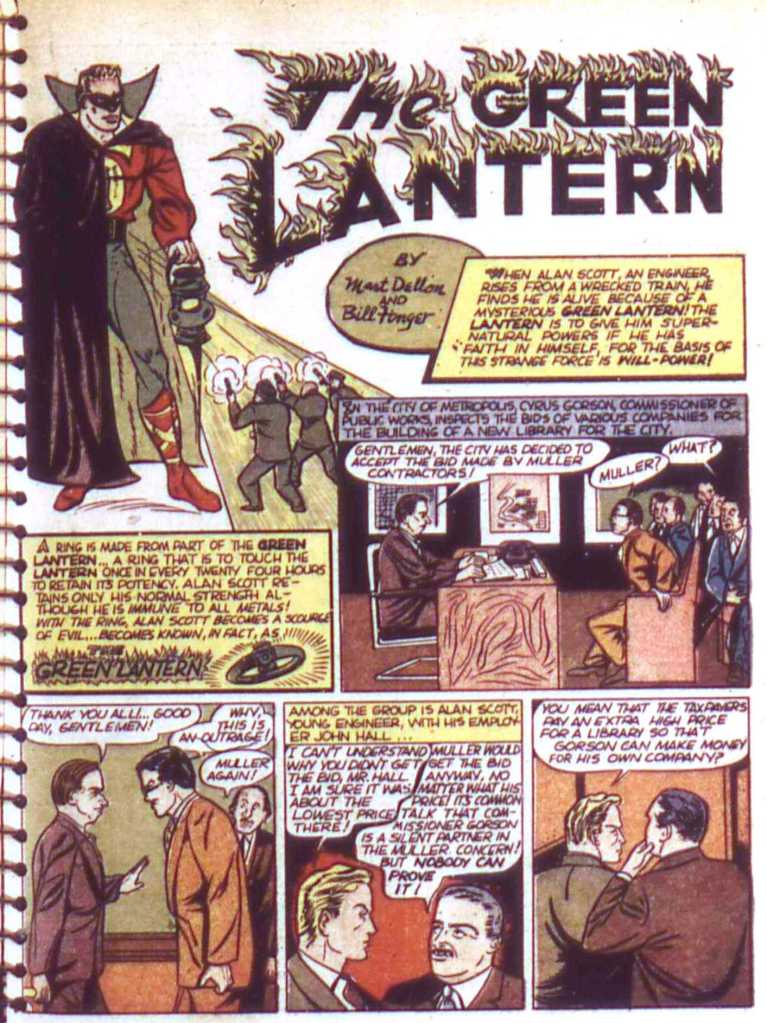
It has to be said that Green Lantern is a pretty stupid name for a super hero. We’re all used to it now after 80 years of use, but just think about it for a second. What image does it convey to you? Nodell said years later that he was inspired by a railway worker who waved a green lantern on the tracks when a dangerous situation had been resolved. But in 1940, the Green Hornet was extremely popular on the radio, and so Green Lantern carried the same cadence. As you can see above, in this second story, the Green Lantern operates out of Metropolis, which was only beginning to be associated with Superman. GL would relocate shortly, rather than risking the ire of the Man of Steel–though he’d settle in Gotham City, Batman seeming to be somebody he felt he could hold his own with.
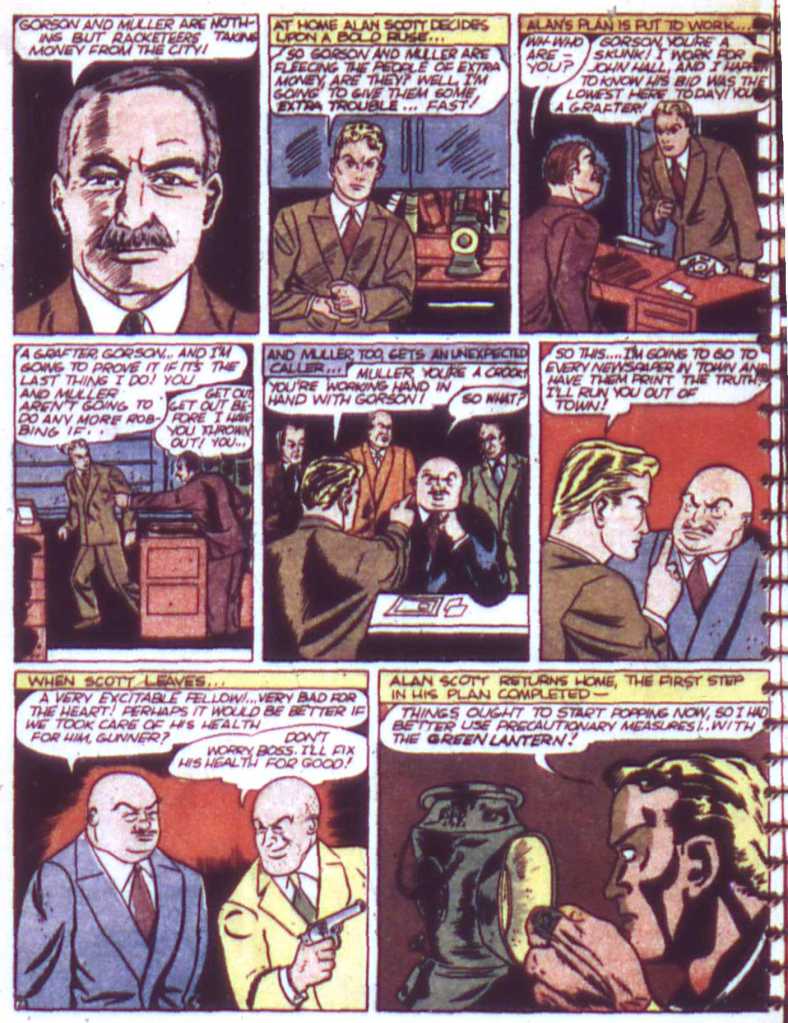
Like the initial story, this second one was illustrated by Mart Nodell and written by Bill Finger, one of the most important and undersung creators of teh era. Finger was responsible for much of what made Batman popular, and he innovated on a bunch of other characters who are still turning up today, Green Lantern being one of them.
Green Lantern’s oath, which would become a signature part of teh strip, hadn’t yet been invented. So here Alan Scott simply recharges his ring by making contact with the mystic lantern.
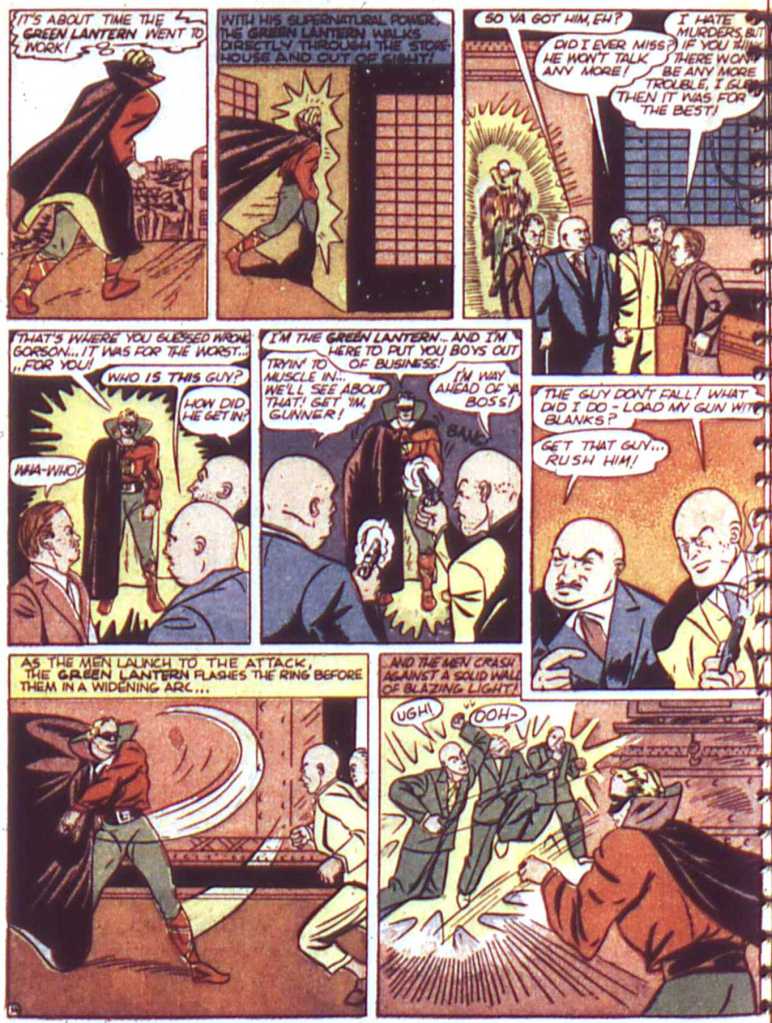
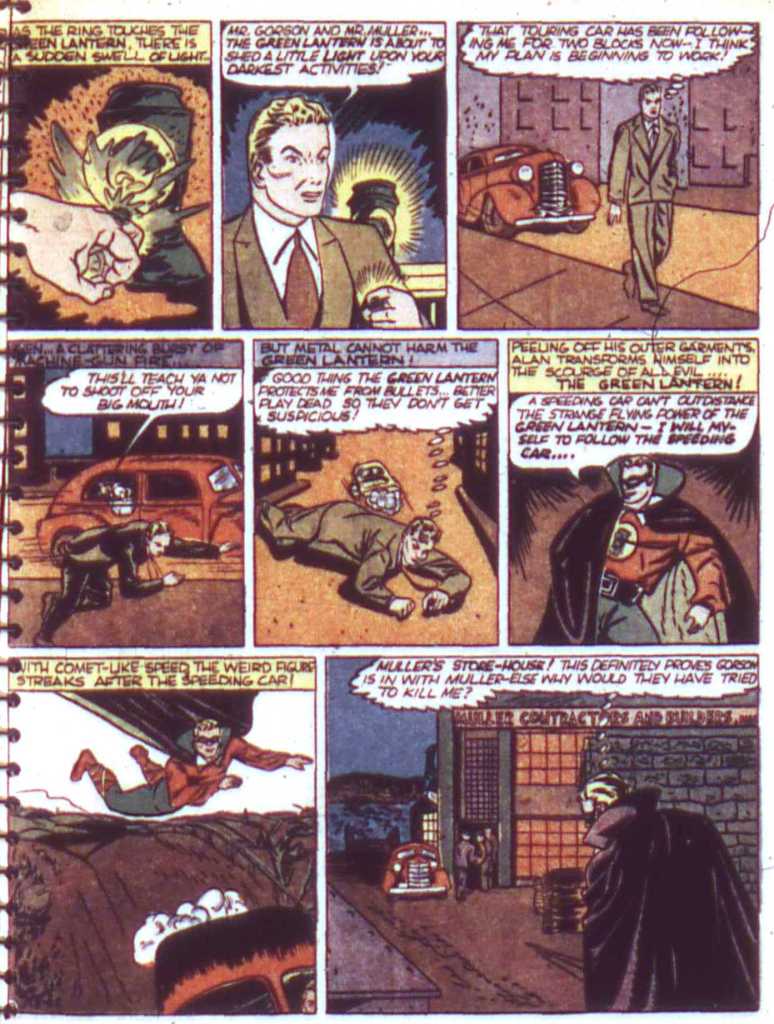
The manner in which the Power Ring was used and just what it could do was still being formulated in these early stories. It was very much a free-for-all, in which Green Lantern could accomplish pretty much anything that the story needed him to.
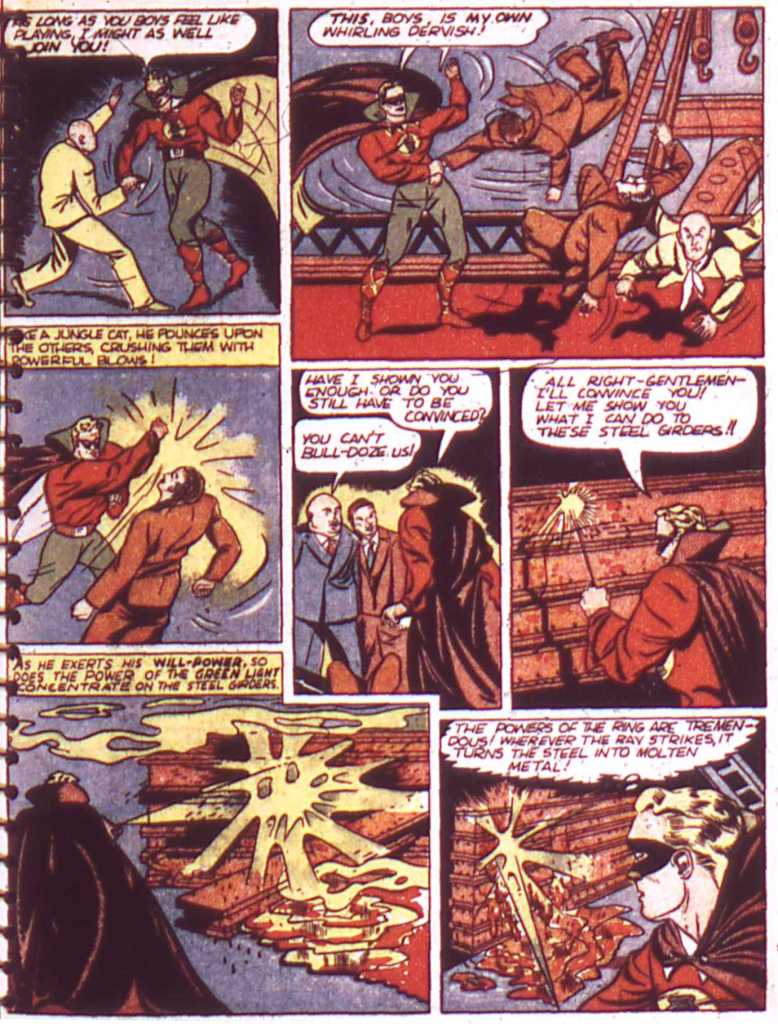
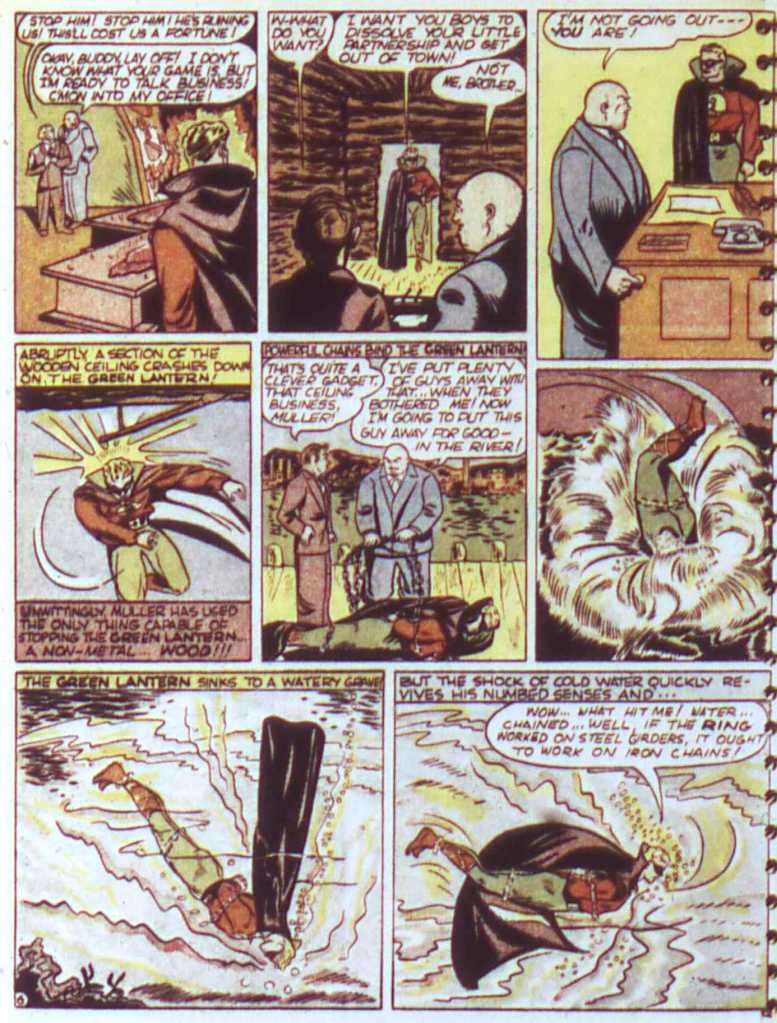
In the earliest stories, Green lantern wasn’t specifically vulnerable to wood, but rather to any non-metal. This swiftly became codified into a weakness against wood, though, after sequences like this one.
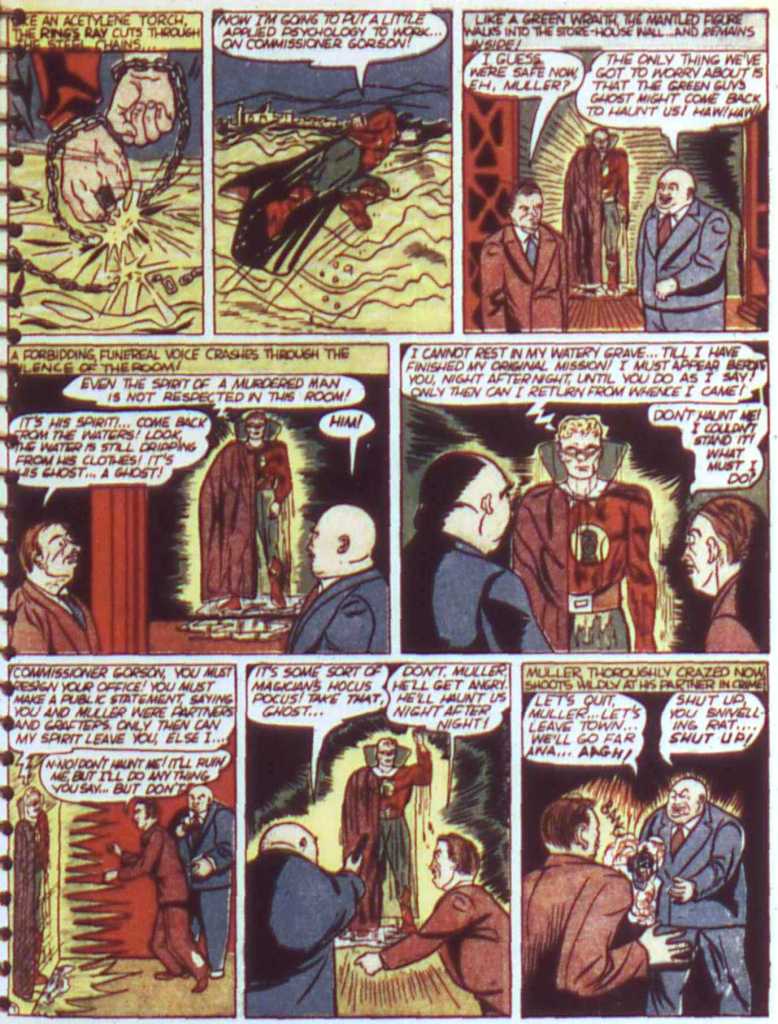
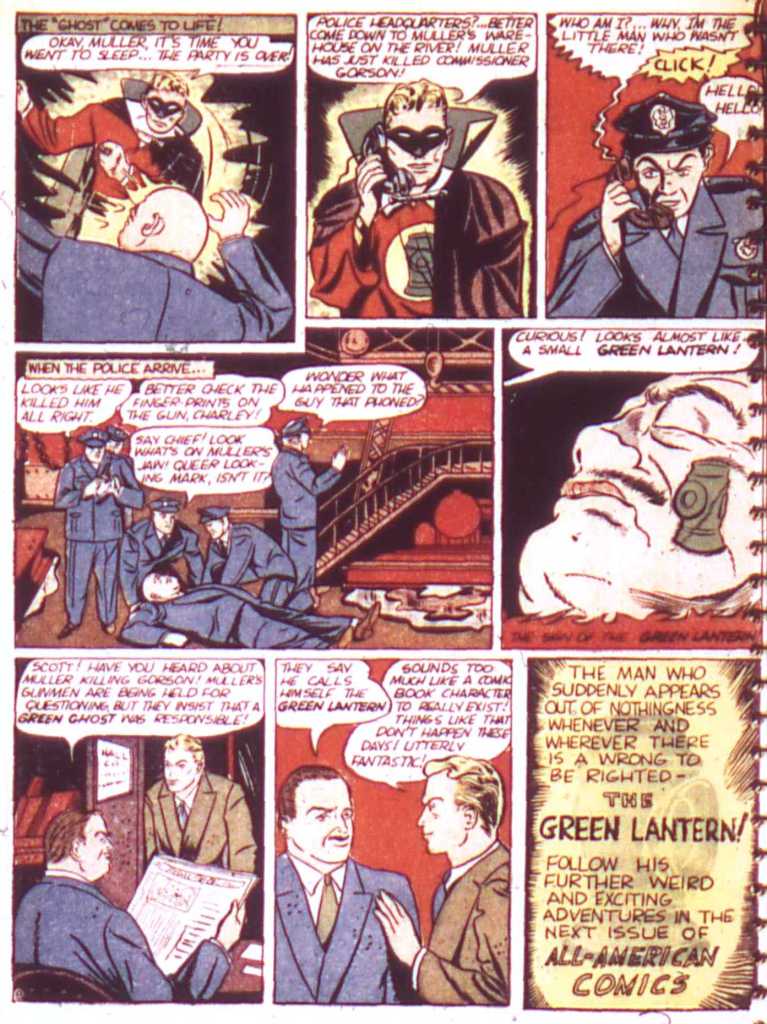
This bit where the impression from Green Lantern’s punch left the imprint of the lantern on the faces of his enemies was lifted straight from Lee Falk’s Phantom comic strip. And even this early on, it’s become a standard retort for a character to say something like, “Sounds too much like a comic book character to really exist!” as Alan Scott does in the final panel.
 The Tom Brevoort Experience
I always liked Finger’s work. Now that I’ve read so much reprinted Batman, my respect for him has increased. Plus his work on Superman, Green Lantern, etc.
LikeLiked by 2 people
Martin & Carrie Nodell once told me that Green Lantern’s name was always going to be Alan Scott, and they don’t know where the “Alan Ladd” myth came from, but it’s not true. I first ran across it in Jim Steranko’s History Of Comics, and have no idea what Jim’s source was. But it obviously wasn’t Martin Nodell.
LikeLiked by 2 people
In SECRET ORIGINS OF THE SUPER DC HEROES from 1976, Denny O’Neil quotes Sheldon Mayer as saying Bill Finger came up with the idea of GL’s secret identity being Alan Ladd, but that Mayer rejected it as “ridiculous.”
LikeLike
Finger was one of DC’s best writers of the Golden Age. By the Silver Age, I think DC’s editorial control (at least, among the editors Finger worked for) had kind of squelched Finger’s “voice” as the scripts got homogenized.
But those early Batman stories have a lot of mood and energy to the scripting. And here, he’s setting a very nice supernatural flavor that the series doesn’t really stick with, but it’s well done nonetheless less.
Nodell’s work is considerably weaker, those there’s a charm to it. Still that panel where a gigantic Alan Scott has fallen, stretching from one side of the street to another, as a tiny car hurries off is pretty perplexing.
LikeLiked by 2 people
“Nodell’s work is considerably weaker, those there’s a charm to it. Still that panel where a gigantic Alan Scott has fallen, stretching from one side of the street to another, as a tiny car hurries off is pretty perplexing.”
Yeah it’s clear he’s winging it. It’s not a convincingly drawn panel by any stretch but “guy falls off the sidewalk and car speeds away into the city” is easier said than drawn without any photo reference. The panel in the lower left corner on the same page is similarly off-kilter and looks spontaneously tossed off.
The crudeness, the forced perspective, and the off-kilter scale is big part of the naive charm to my eye. Those qualities and the consistent flatness of the panels create a spooky expressionistic vibe similar to what Bob Kane/Robinson and Carl Burgos could also deliver.
When I first encountered golden age comics in 74-75 I thought they were very odd, darker and more compelling than the new stuff DC was then publishing.
LikeLike
Green Lantern wasn’t the only golden age hero with a magic ring: Craig Carter [ Wham Comics#1 ( November 1940 ) ( Centaur ) – it could summon up Greek gods ( Zeus, Mercury, Pluto ), Norse god Thor and a Pegasus ], Diamond Jack [ Slam-Bang Comics#1 ( March 1940 ) ( Fawcett ) – using the black diamond ( once the eye of the evil god Khor ) he becomes physically strong and mentally beyond all ordinary mortals, allows him to create constructs from nothing ], Scarab ( Peter Ward ) [ Startling Comics#34 ( July 1945 ) ( Standard )– rubs scarab ring he becomes the Scarab, super-strong, invulnerable and capable of flight. He’s accompanied by the black cat ( reincarnation of Akh-Tu-Men ), who is unusually intelligent and defends Ward ] and Wonder Man ( Fred Carson ) [ Wonder Comics#1 ( May 1939 ) ( Fox ) –a yogi in Tibet gives him a magic ring that gives him super-strength, performing Hulk leaps and repelling bullets ].
LikeLike
Green Lantern’s first 2 stories are connected to his Alan Scott job and the 3rd [ All-American Comics#18 ( September 1940 ) ] to his All-Star Squadron future: 1940 World’s Fair and the Perisphere that would become the HQ of the All-Star Squadron[ introduced in All-Star Squadron#19 ( March 1983 ) and HQ in All-Star Squadron#21 ( May 1983 )].
LikeLike
ALADDIN ( trivia ): In the original story of Aladdin, there are TWO GENIES, the POWERFUL GENIE IN THE LAMP, and LESSER GENIE IN THE MAGIC RING lent by the sorcerer who double crossed him. And there is no limitation on how many wishes he can ask ( Reddit, aladdin.fandom.com and I have seen and read the original ).
LikeLike
Green Lantern striking a villain on jaw and leaving a “green lantern” emblem behind appears in All-American#98 ( June 1948 ) too ( comics.org ). I thought the golden age Hawkman villain The Ghost ( Gentleman Ghost ) was unique but golden age Green Lantern fought a similar looking foe in Professor Nobody [ All-American Comics#87 ( July 1947 ) “Professor Nobody!” ( comics.org — doesn’t look as cool as the Ghost/Gentleman Ghost because his clothes aren’t one colour and he isn’t wearing gloves ( going by the cover ) ).
LikeLike
The little voice in my head told me to look up Professor Nobody before I added him and I ignored it, cause I later found out the cover of All-American Comics#87 is misleading and no character in that Green Lantern story is invisible ( Misleading like the cover of All-American Comics#52 ( September 1943 ) GL foe The Silhouette who looks like he could be a living shadow ). Which sucked he looked like an interesting villain ( Plus his name reminded me of the 1960s Spider-Man cartoon invisible villain Dr. Nobody ( Dr. Noah Boddy –“Spider-Man Meets Dr. Noah Boddy” & “To Catch A Spider” ).
LikeLike
I met Mart Nodell at a comic con in Detroit back in the early 2,000s. He was at a table near Carmine Infintino (who I also met) drawing what amounted to doodles of his version of Green Lantern. His drawings then looked pretty much what they looked like in the early stories he drew. I remember a young kid walking by and after seeing his drawing he said “That’s not Green Lantern”. If only he knew.
LikeLike