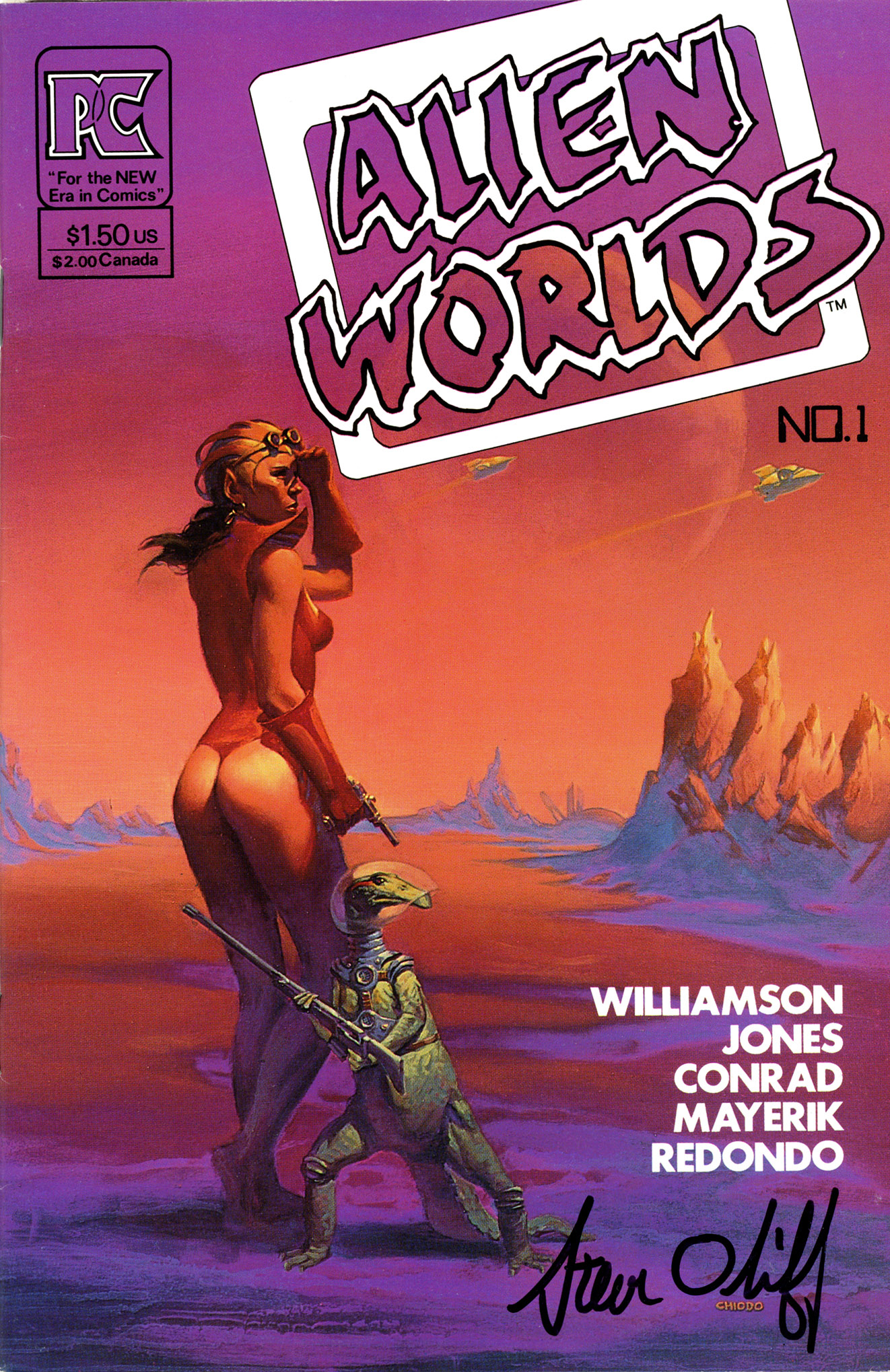


It was only shortly after Pacific Comics launched writer/editor Bruce Jones’ attempt to bring back the horror flavor of the classic EC Comics in the series TWISTED TALES that Jones’ other tribute to that well-remembered long-ago line saw the light of day: ALIEN WORLDS. If TWISTED TALES was attempting to be a contemporary modernization of TALES FROM THE CRYPT, then ALIEN WORLDS was Jones’ modern day answer to WEIRD SCIENCE. Like that earlier publication, ALIEN WORLDS was an anthology series with each issue featuring four stories written by Jones and illustrated by assorted practitioners in the field. The cover, by Joe Chiodo, gives more the impression of a SF/Fantasy book cover than an EC title, but I suspect that was deliberate. TWISTED TALES and ALIEN WORLDS were both bimonthly, so the idea was that they’d alternate releases with one another.
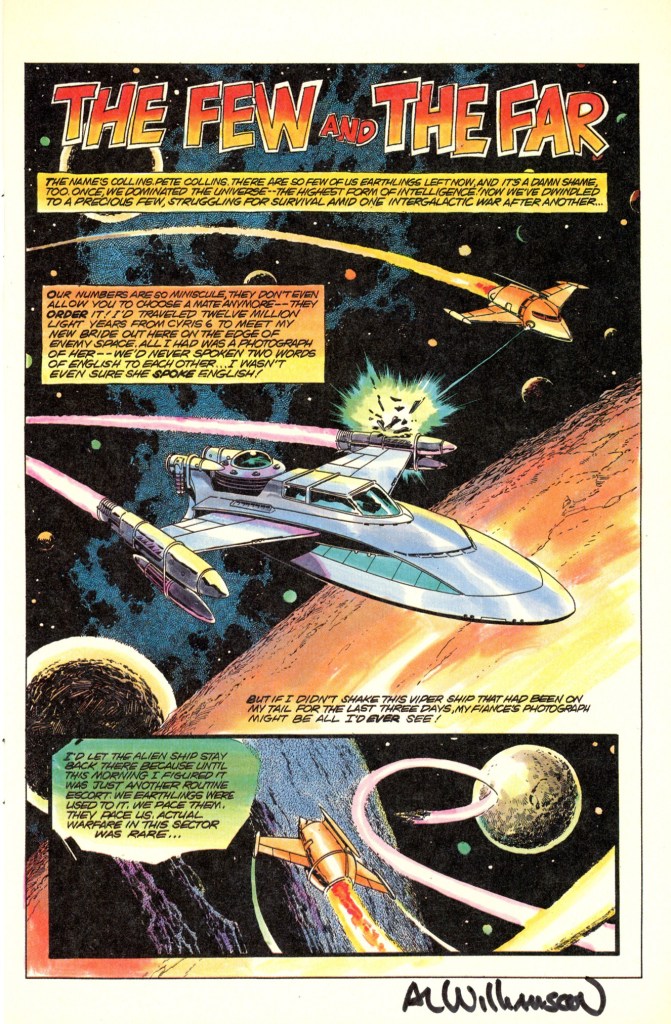
The opening tale in this issue was illustrated by the great Al Williamson, a creator who had worked for EC on its science fiction series back in the day. Al was one of the most respected figures in the industry and a gregarious friend to all. He was a fan of the classic work of Alex Raymond and Hal Foster, and brought the sensibilities of a vintage comic strip artist to a lot of his work. He was especially adept at crafting science fiction stories, so his appearance in the opening slot here is intended to send a message about the level ALIEN WORLDS is attempting to achieve. This opener is only six pages long, the shortest entry in this inaugural issue, but it did its job.
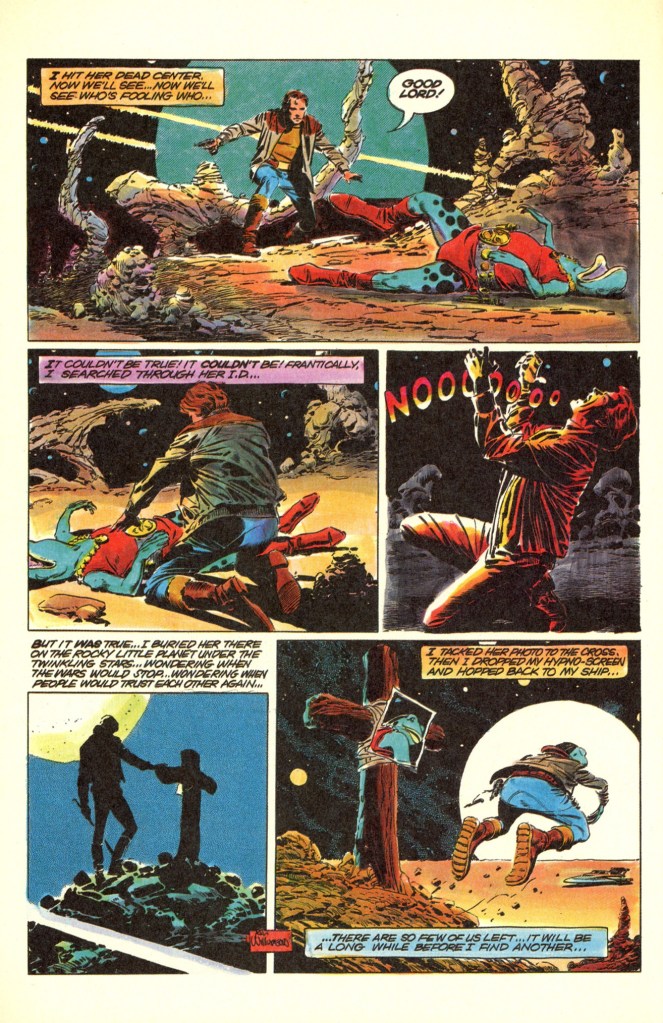
The story itself isn’t especially memorable. It feels like something that could easily have run in any of the Jim Warren magazines of the time. It’s about pilot Pete Collins, one of the few survivors of Earth left in the galaxy who is headed to a remote planet on the edge of enemy territory to meet the bride that he’d been assigned. But as he approaches the planet, he’s engaged by an enemy ship and both craft make planetfall. The pilot of the enemy vessel seems to be a beautiful woman, but Collins fears that she may be using a hypno-screen to conceal her true appearance. So he decides to wait her out, knowing that she won’t be able to keep up the hypno-screen illusion once she falls asleep. But the woman makes a run for his spaceship and Collins is forced to gun her down to prevent her from stealing it. It’s only then that he gets to see her true form–and he buries her before hopping back to his craft to head out on the hunt once again. Both he and the woman were actually evolved frogs. It’s a bit of a weird ending, but the whole thing kind of works.
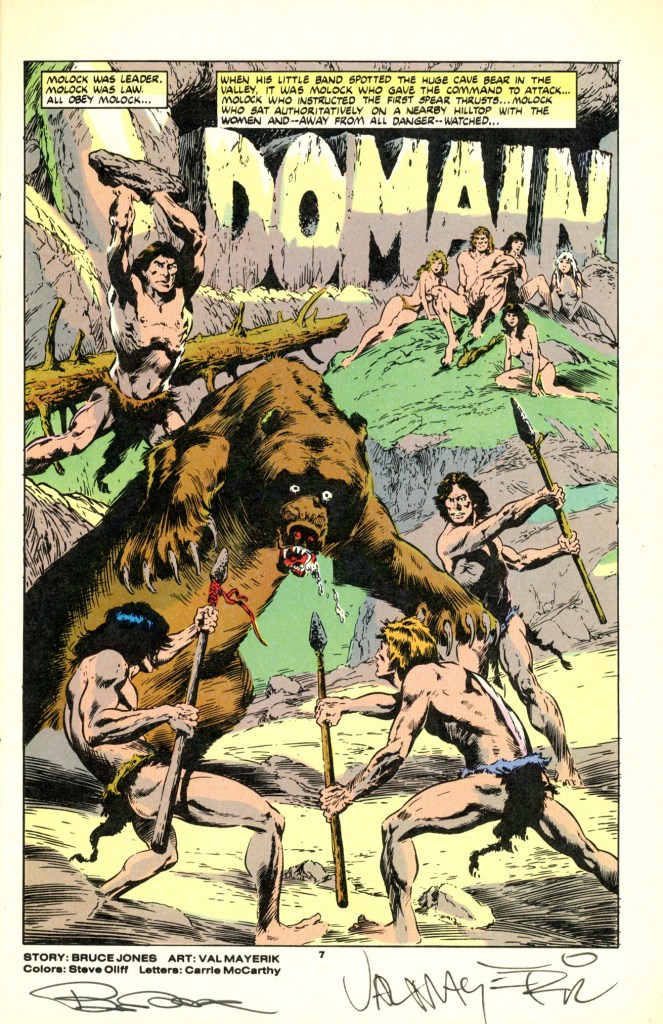
The second story was illustrated by Val Mayerik and has a nice Joe Kubert influence to it. It concerns a primitive tribe led by the narrator of the story, Molock. Molock relates becoming leader of the tribe, which has separated itself from the “Big Tribe” and set out on its own. All of his people know not to speak the forbidden words, lest they be struck down by him. We watch the tribe go about its daily business, with Molock as leader dallying with a number of the half-clad women despite them being the mates of others–as leader, this was his right. In the end, in the middle of the night, Molock follows a women to a half-destroyed spaceship where she’s attempting to contact Earth. This was just supposed to be a vacation, she radios, but Miller has gone crazy, smashed their equipment and has them all running around like savages. These are all, of course, forbidden words, and so Molock kills the woman and returns to the tribe as leader. It’s a nasty little piece, especially given the strong sexual undertones of it, but it does make an impact.
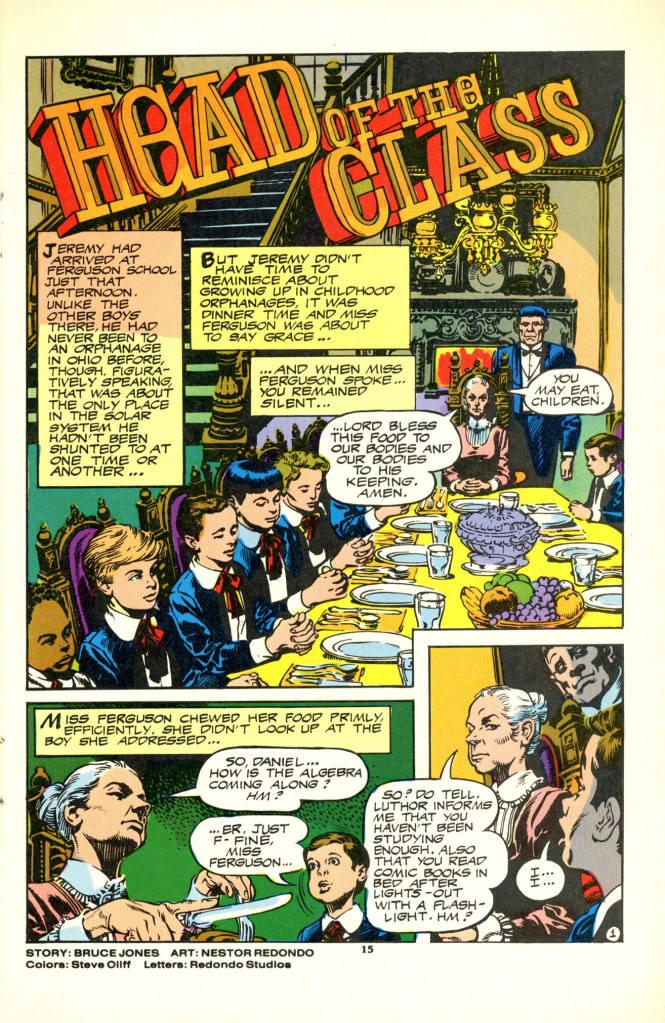
The third story was drawn by Nestor Redondo, one of the great Filipino artists who had become known on the American comic book scene after he started doing work for DC in the early 1970s. The story centers on an orphanage, the Ferguson School, lorded over by the strict Miss Ferguson. Miss Ferguson believes in corporal punishment, pulling off the children’s fingers and even entire limbs for various infractions of the rules. All of the kids and even Miss Ferguson, you see, are robots–all except the new arrival Jeremy, who is accidentally killed when his head is pulled off. With this, the robot kids have had enough, and they turn on Miss Ferguson and pull of her head, replacing it with one of their own, belonging to Ralph. But it makes no difference–Miss Ferguson is a new model, and her brain is situated in her chest cavity, so even with her head swapped, she’s still in control–and the unruly children are all up for disciplinary action. This one was a bit of a mess, with the shock value of seeing kids having their limbs pulled off attempting to disguise just how thin and poorly-thought-out the central premise really is. But the art is nice enough, with a bit of a woodcut flavor to it.
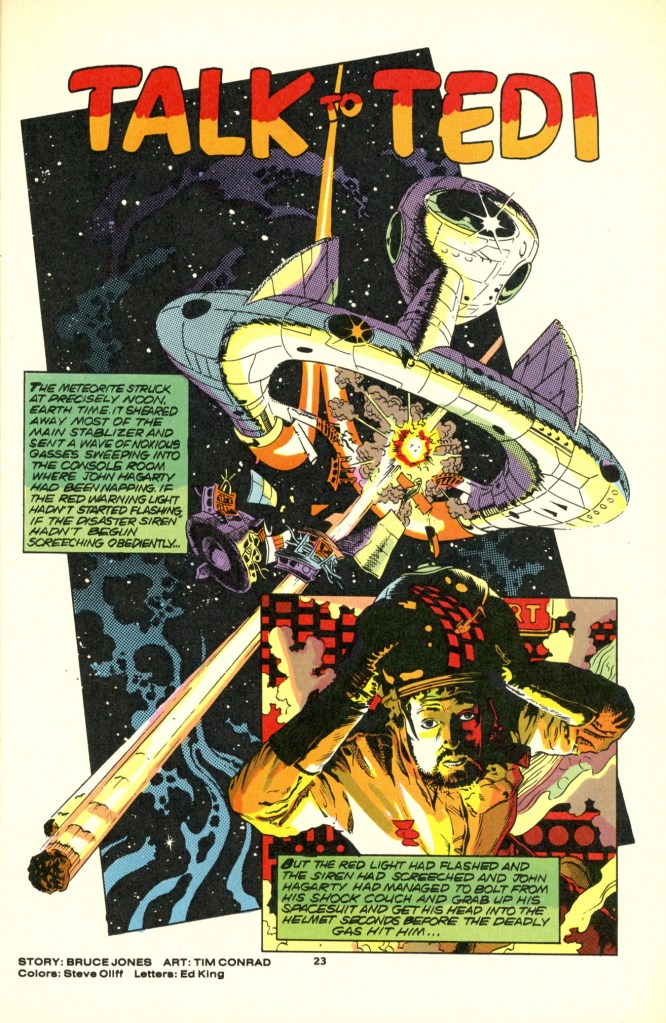
The final story is also the longest, and it’s illustrated by Tim Conrad, who does a wonderful job with it. This was the story that readers talked about after all was said and done, because it’s the one that had the most genuine heart to it. It’s about space worker John Hagarty, who is serving on a remote space station that gets damaged by a meteor strike. He crashes down on a remote planet, but he’s got enough gear with him to survive for a while. But rather than the books that he had packed to while away his off-hours in space, John finds that his son Bobby had replaced them in his pack with Traveling Tedi, a robotic teddy bear that follows voice commands. This is valuable, because John can’t step out of his ship into the hostile environment of the planet–but he can dispatch Tedi out through the airlock to bring him back nearby fruits to survive on.
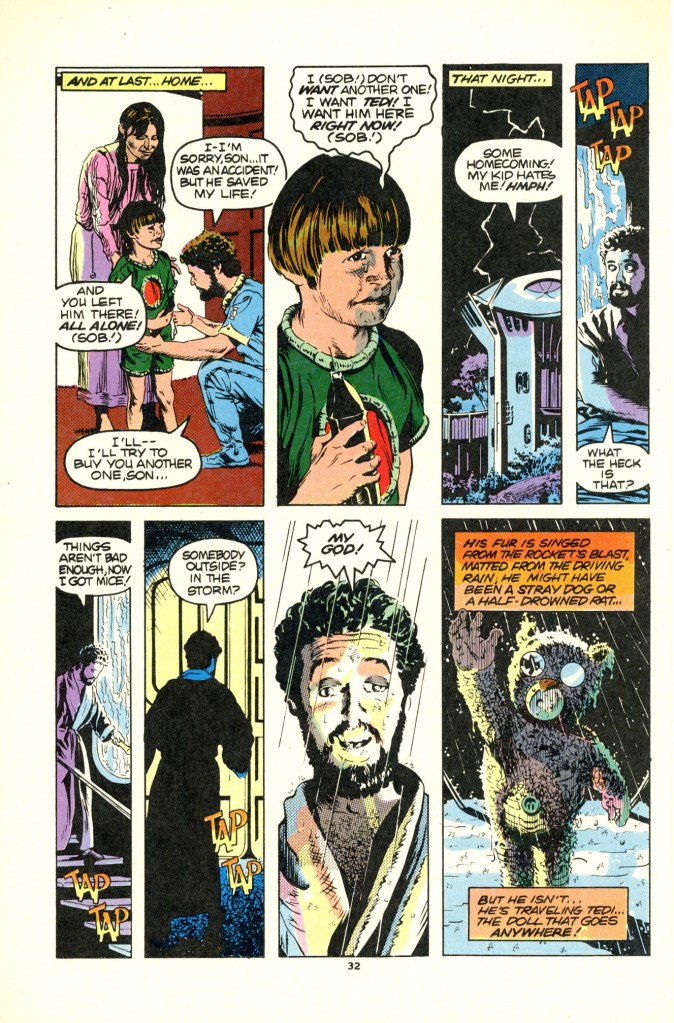
John is also able to use Tedi to being to make exterior repairs on his stricken ship, and to fight off predators with electric shocks. Unfortunately, Tedi is still in the ship’s rocket tubes when the engine is repaired and the ship takes off, blasting the figure out and incinerating it. But John is able to get off the planet and make his way back home to his family. He tries to procure a replacement Tedi for Bobby along the way, but nobody he encounters has ever heard of anything like that toy. When John makes it home, Bobby is inconsolable–but only for a time. Because there’s a faint knocking at the door, and when John goes to it, he finds the half-intact form of Traveling Tedi standing there, having made its way somehow back to them. It’s by far the most upbeat story in the issue, even if there’s still a bit of a hint of menace to Tedi by the end.


Gotta wonder if some of the stories in ALIEN WORDS and TWISTED TALES weren’t premises that had been pitched to Warren and rejected, over the years. I expect if I’d been writing for Warren (or for HOUSE OF MYSTERY or GRIMMS GHOST STORIES, whatever), I’d end up with a reject pile of stories I wanted to write, and then boos under my control would be a great place to use them.
Still, some of them might have been rejected because they just weren’t that good as story ideas. But so it goes.
This issue had terrific art throughout, so it definitely had that going for it.
LikeLiked by 1 person
Beautiful pages. Our pal, and master illustrator, Al Williamson. Just amazing imagery and storytelling. Did Steve Oliff color this, too? Thank you for including at least 2 pages of this story. More evidence (as if the strip itself wasn’t enough) that he was a great choice to draw “Star Wars”.
Val Mayerik’s style’s been tweaked over the years. I see some reference to Williamson in the page. Tom Yeates would’ve been my first guess if I’d just seem this on Google images and if the credits weren’t listed.
Nestor Rodondo did some gorgeous, lush work I’d see only randomly. This opening page seems potentially creepy…
Tim Conrad’s name sounds familiar. Maybe one of those top tier artists who worked more in other industries like movies than in comics. Definitely from that similar Alex Raymond (and Al Williamson “school”). With some precise, slick inks that remind me of later Michael Golden. But also John Bolton (another Foster/Raymond fan, likely?), and maybe Sandy Plunkett. I want to say I came across more of Tim Conrad’s work from Image, maybe late 1990’s or early 2000’s, but I could be mistaken.
LikeLike