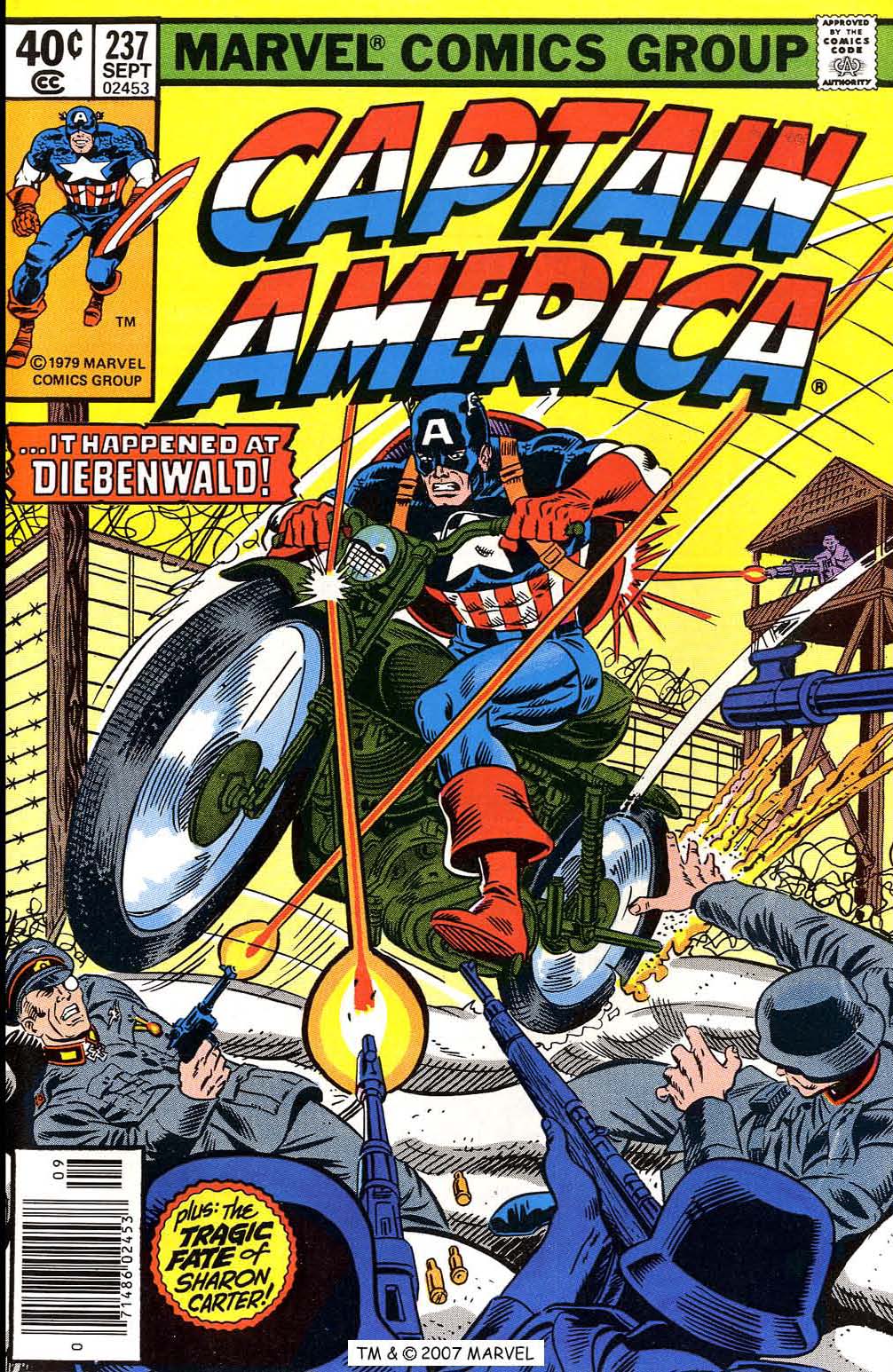


After a steady run, CAPTAIN AMERICA was about to enter the doldrums, a period of frequent fill-ins and creative instability. I obviously didn’t know any of that when I picked up this latest issue at the Stationery store, but I did find that I didn’t especially care for it. It was fine, but not a comic book that especially excited me or blew me away. What this issue is remembered best for is being the story that confirmed definitively that Cap’s longtime girlfriend Sharon Carter had actually been killed off in the previous adventure. Even at the time, this felt like a weird way to go about dispensing with a character of such importance, and so it was no real surprise when Sharon was resurrected 15 years later, given that the evidence of her death was an easily-doctored video tape.
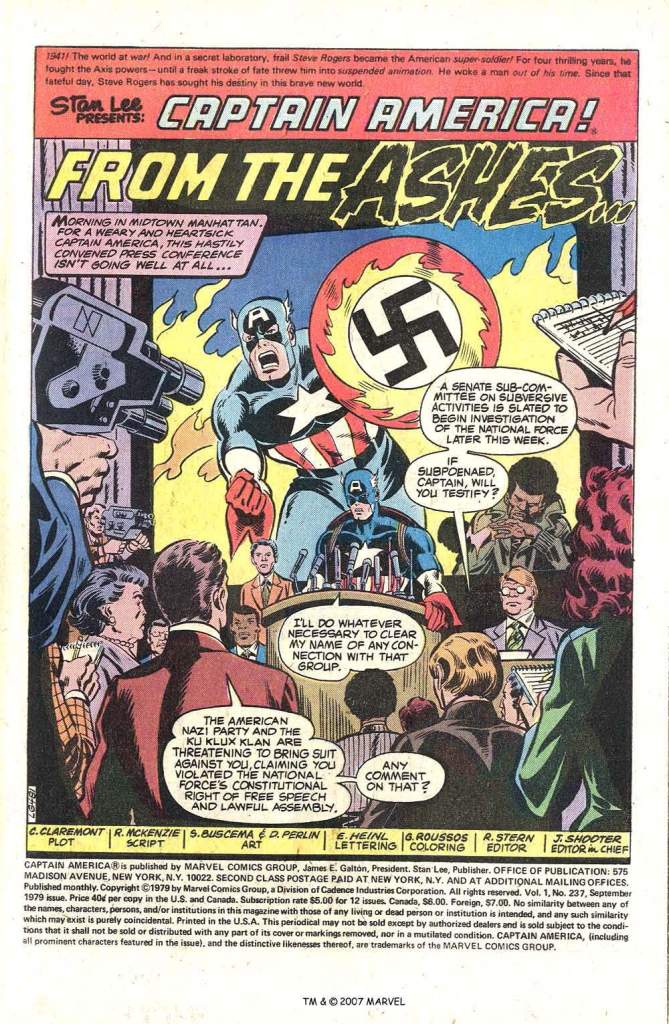
This was a transition issue, in which the storylines of the past few months were wrapped up and a new beginning was set up for Cap, or really for Steve Rogers, his alter ego. Nobody had really done a whole lot with Steve Rogers in all the time the book had run. His appearances would mostly be about marking time until a problem broke out that Captain America had to solve. But it never felt like he had an actual life in the manner of a Peter Parker. Efforts would be made to change that over the next year or two, and they’d work to a certain degree. This particular story was plotted by Chris Claremont, filling in for some reason, though the final dialogue and copy was provided by regular writer Roger McKenzie. I have to assume that McKenzie directed Chris in the specifics of the character set-up stuff, since Claremont wouldn’t have simply gone off and done all of that worldbuilding on his own.
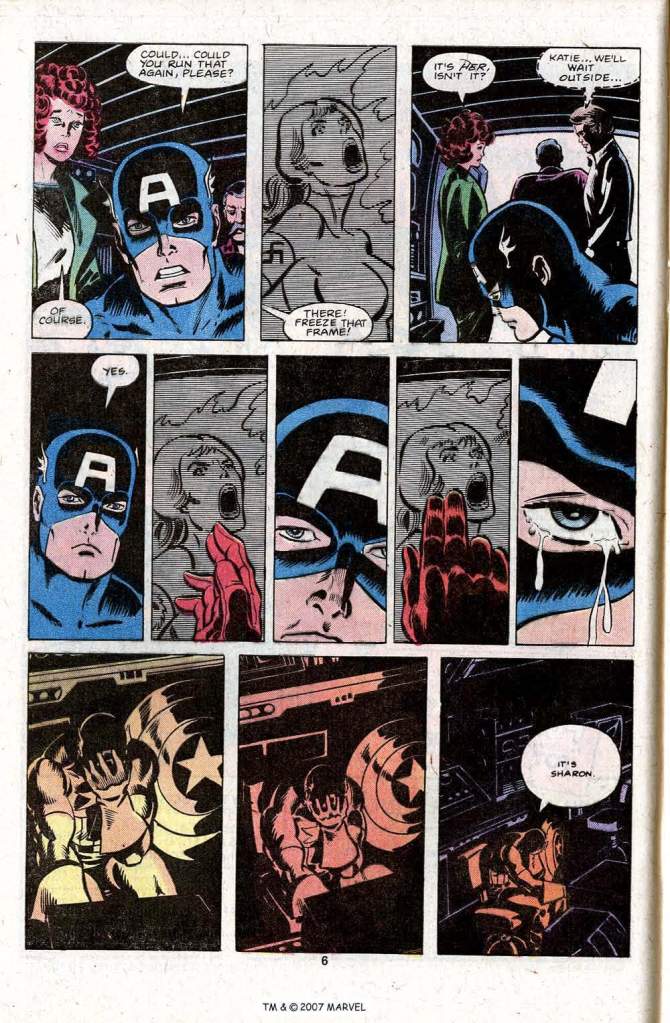
The story opens in the aftermath of last issue’s triumph over the Grand Director and his National Force. Cap gives a press conference in which he attempts to establish his innocence, claiming honestly that he was brainwashed into saying and doing all of the hateful things that he’d done the past few issues. Apparently, despite some skepticism among the crowd, everybody bought into this, as the matter never comes up again. While there, Cap is summoned by a CBS News reporter whose crew happened to have captured footage of Sharon Carter immolating herself under Doctor Faustus’ mental control. This serves as proof to Cap that his lady love is no longer among the living.
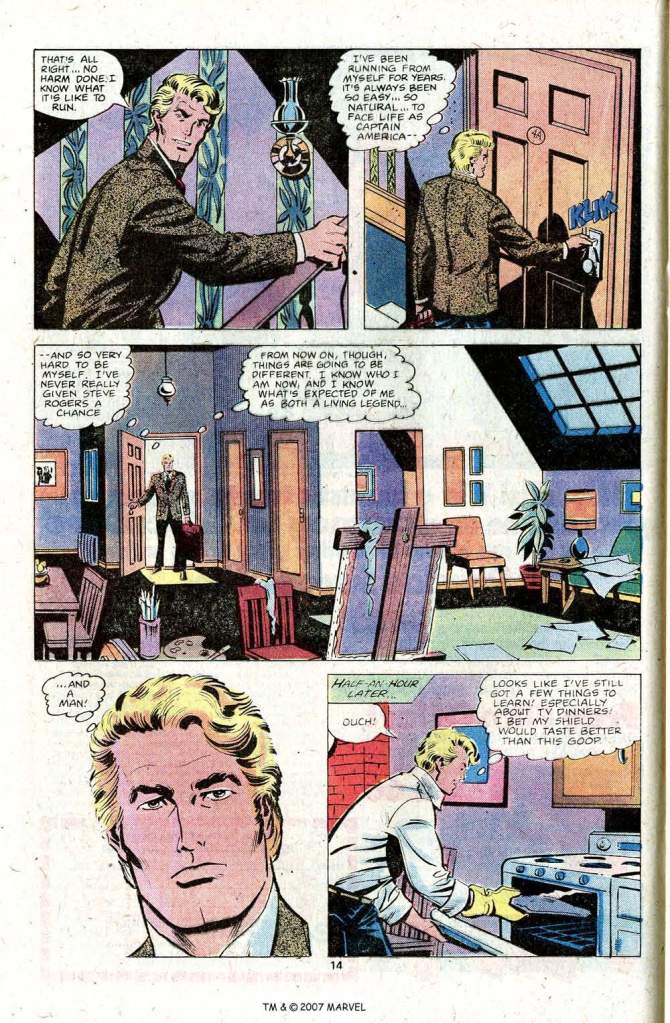
But Cap wasted little time (read: none) in mourning, and by the next page, it’s a week later and the Falcon discovers that Cap’s apartment is empty. Heading over to Avengers Mansion in the hopes of locating his erstwhile partner, he find Steve Rogers there, who tells him and the assembled Avengers that he’s moving to a new place in Brooklyn Heights. He’s also setting out on a new career for himself as a commercial illustrator. This was really the point where it was established that Cap had artistic aspirations in his youth, though I seem to recall that there was a one-off line buried in some earlier story that pointed in this direction. In any event, the idea here is to set up Steve Rogers in a new place with a new job and a new cast of supporting characters surrounding him.
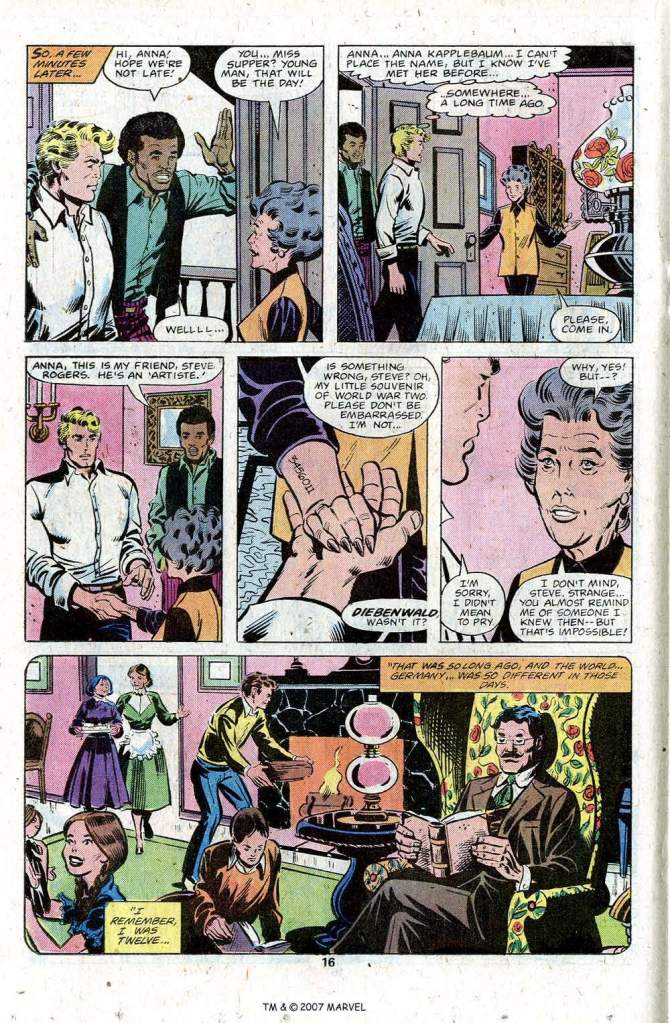
And so, the story wastes no time in introducing us to some of the new players in Cap’s life. Approaching his new place, Steve is almost bowled over by firefighter Mike Farrell who is on his way to an active blaze. Then, after making dinner, he runs into neighbor Josh Cooper, who has come to invite him to a dinner being hosted by their mutual neighbor Anna Kapplebaum. Anna is an old woman, but Steve has a vague sense of having met her someplace before. Upon meeting her, Steve notices that Anna carries a number tattooed on her arm, a remnant of the days she spent as a prisoner in the Diebenwald Concentration Camp during the war. As the two speak, we get an extended flashback to Anna’s memories of those dark days.
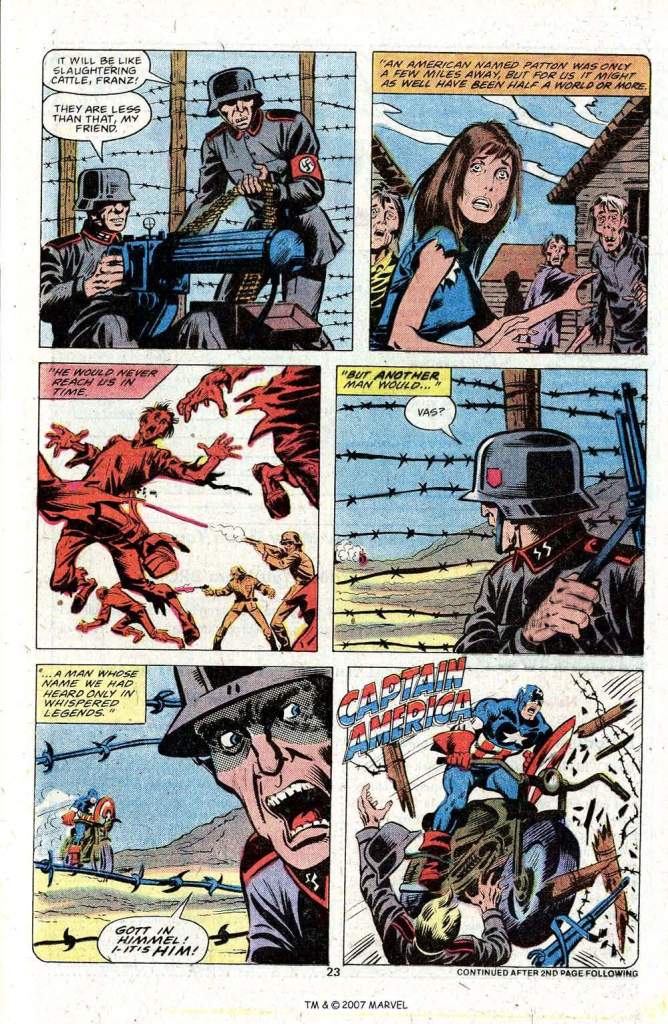
This of course leads to the moment late in the war when Captain America showed up to liberate the camp, just as the guards were readying to execute all of the remaining prisoners before taking off for safer ground, Patton’s army nearing the area. it’s pretty nasty stuff, though sanitized for a Comics Code-era comic. This next section unfortunately plays just a little bit too much like any number of Sgt. Fury stories of the period, where the American super hero takes out the bad guys without any apparent loss of life, and while an effort is made to showcase the horrifying reality of the Holocaust, this too is blunted in a frankly unsatisfying way. I suppose it had to be enough that such a serious subject was being tackled in a super hero comic aimed at a young audience, but it was still a far cry from being much more than naked propaganda.
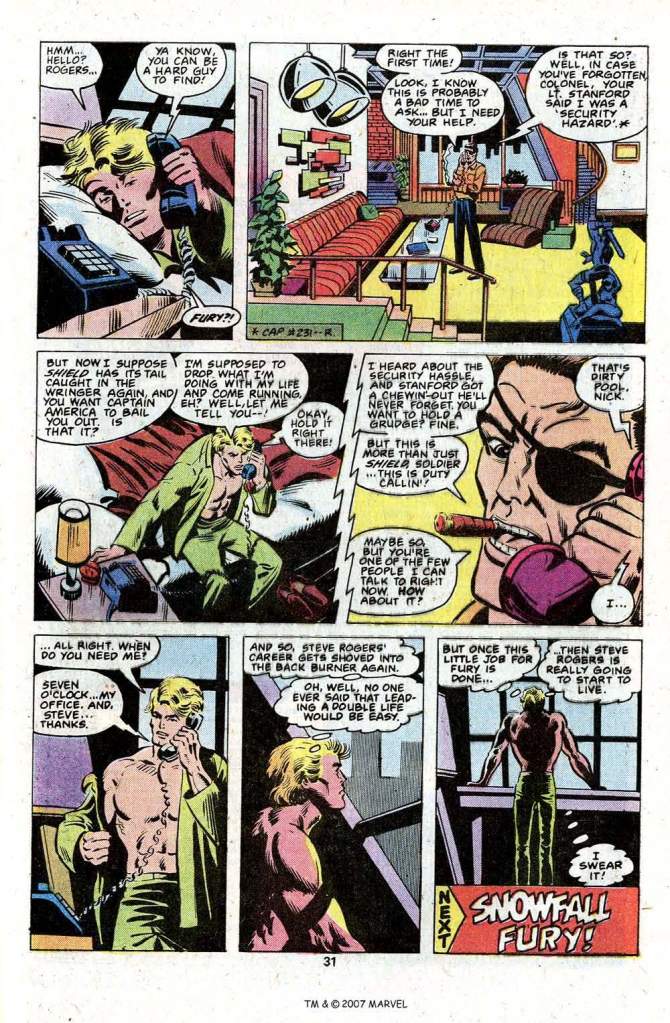
Anyway, the evening ends, and Steve retires, contemplating his career as Captain America which he was toying with giving up in the wake of Sharon’s death. But obviously, he isn’t going to do that. Then, in a last page which shows some evidence of other hands–I’d bet that Al Milgrom either penciled or inked it, or both–Cap gets a phone call from Nick Fury about an urgent matter. In recent issues, Cap had been on the outs with SHIELD, but the fill-in job that will occupy the next two issues is a mission that Cap goes on at SHIELD’s behest (possibly it was commissioned before the falling out between the two parties) and so a page was needed to set it up and make it make sense. This does mean that after an entire issue in which Steve overtly dedicates himself to having a regular life, he immediately puts all of that on the back burner to jet off as Captain America again. What’s more, it’ll be a while before the new set-up can really be used effectively, as assorted fill-ins and a lack of a stable creative team get in the way. Writer Roger McKenzie won’t be back in the driver’s seat until issue #243, six months later.


Does anyone know if Mike Farrell was an homage to Fireman Farrell from DC’s SHOWCASE 1?
LikeLike
Haven’t got a clue, but was Captain America as a NYPD officer in Captain America#139-159 a homage to Simon & Kirby’s Guardian being a police officer [ Star Spangled Comics#7 ( April 1942 ) ]?
LikeLiked by 1 person
and for a 2 pages in Cap 231
LikeLiked by 1 person
I just read the issue where Steve puts on the blue. It’s framed as returning to Cap’s early years — Steve as a cop instead of a GI, with an angry supervisor a la Sgt. Duffy who thinks the new kid is a schmuck.
LikeLiked by 1 person
If I remember right, Roger’s said so in the past…
LikeLike
[Stern, that is, not McKenzie.]
LikeLike
Thanks Kurt!
LikeLike
Here I thought being a NYPD officer was his first real job, but Google AI says the NYPD Commissioner recruited Steve to go undercover to solve a series of mysterious disappearance involving both police officers and local citizens [ Captain America#139-159 ( July 1971 – March 1973 ) ] making that as much as a cover as being in the U.S. Army during WW2. His SHIELD stories is like the MCU movies before Captain America: The Winter Soldier ended SHIELD. The SHIELD stories were just a then modern version of his Military WW2 stories ( The Super-Agent Timely Comics origin says he was suppose to be ). Steve Rogers the Artist/Commercial Illustrator is more like what his life might have been like if he wasn’t ever Captain America.
LikeLiked by 1 person
If I remember correctly, Chris didn’t plot this issue for Roger McKenzie to write. He plotted it because he was the new regular CAPTAIN AMERICA writer, so all the setup he was doing — taking Sharon off stage, introducing a whole new supporting cast — was setup for what he intended to do with the book; this is plotted as the first issue of a new run, not just development along the way of Roger’s run. And if you read it that way it makes perfect sense, except for that last page.
But before the issue got scripted, someone decided that Chris didn’t have time to write another monthly book, and it was given back to Roger to finish up.
Presumably, Sharon’s death and Cap’s reaction to it would have been given more focus in a Claremont script, which would have run to more introspection than a McKenzie script. And it would have been a factor in upcoming issues. Heck, Chris might have meant to bring her back in a few issues, for all we know.
I believe editor Roger Stern was responsible for Mike Farrell’s name, though, a nod to “Fireman Farrell” of SHOWCASE 1.
LikeLiked by 3 people
Chris Claremont writing Captain America. With nods to Tom’s subsequent review of “What If,” that is an alternate universe that does intrigue me. I could joke about Steve Rodgers suddenly discovering latent mutant powers or that the book would have around 1600 subplots. But in all fairness, I have to think that Claremont’s talents would brought some depth to Steve Rodgers – going beyond the “Sentinel of Liberty” aspect as well as truly engaging stories.
If nothing else, he and Wolverine could have had some fun interactions.
LikeLiked by 2 people
I can immediately think of only 3 issues of “Uncanny ❌🚹 X-Men” where I got to read Chris Claremont’s Cap. The Kulan Gath 2-parter, “An Undreamed Of” (appropriate Conan reference)” & “Raiders of the Lost Temple”, with art by JR,Jr. & Dan Green.
then a few years later, a WW2 flashback that opens with a full splash page of that iconic pose of Cap leaping towards the reader, by the somewhat still recently assigned ❌🚹 art team of Jim Lee & Scott Williams.
Chris “got” Cap’s character more than enough for the dialog to ring pretty true (like freedom itself from the Liberty Bell). Especially the Kulan Gath story. Brutal. Poor Spidey. But Cap was Cap, at his idealistic best, even if he looked a bit like Thundarr. His interaction with Ororo towards the end was one of my fave Cap interactions. I kind’a wish we’d gotten 12+ issues of Cap’s solo series by Claremont. Ah, well.
I’ve read worse (& better) comics than this Cap # 237. Not the best work by all involved, but there are some hall of fame caliber names in the credits
LikeLiked by 1 person
And I thought that the Cap in the Kulan Gath story looked like Zandor from the Herculoids – but yeah, Thundarr also works. I definitely liked Claremont’s characterization of him in all three of those stories.
LikeLiked by 1 person
Rick, now I’m replaying Cap’s dialog in that story in Zandor’s voice (Race Bannon’s, too, same voice actor). 🙂 It works.
LikeLiked by 1 person
Mike Road’s voice. 😉
LikeLiked by 1 person
Robert Ridgely (“Tarzan”, “Flash Gordon”, “Thundarr”) could’ve done a good Cap voice, too. Especially stories set back in his early years in WW2.
But zooming out for an Avengers team, Road’s voice had a slightly older feel to it. Appropriate for Cap. Ridgely’s had a bit more exuberance. I’d have him voice Thor, who doesn’t physically show his age as long as he eats those golden apples.
The necklace Cap wore in those Kulan Gath “X-Men” issues was bulky like Zandor’s . I think it was just the long blond hair that made me think if Thundarr.
LikeLiked by 1 person
The longer hair was definitely more reminiscent of Thundarr and may have been what JR JR was going for. But being a big-time Herculoids fan, that’s where my head went on those comics. And yeah, I could “hear” Mike Road’s voice. I also agree that Robert Ridgely booming voice would have fit better with Thor, but also worked on Cap.
LikeLiked by 1 person
I don’t think Tom’s wrong that the book would enter the doldrums for a bit, but I don’t think it lasted too long. The Adonis two-parter in 243-244 is at least weirdly interesting with funky art by Tom Sutton and RIch Buckler… and 245 and 246 are entertaining standalone issues before Stern and Byrne would knock it out of the park for the next 9 issues. So for 13 issues Captain America was decent to fantastic. Some very nice covers by Frank Miller and Perez along the way.
LikeLiked by 1 person
This issue stood out for me as the first time Cap was shown saving victims within a death camp or otherwise specifically dealing with some of the worst atrocities of the Nazis, albeit hardly in an all-too typical comicbooky manner. I have no idea if in the decades since this story was published if anyone has made an effort to do a timeline or otherwise make sense of the final weeks or months of Cap’s WWII exploits to detail the whats, whens and wheres of his activities up to the moment he and Bucky tried to stop that bomb heading towards England that “killed” Bucky and somehow resulted in Cap being frozen in ice for, well, however long current continuity requires! The Lee/Kirby set up in Avengers #4 implies that happened sometime before the surrender of the Nazis, and Cap is later shown fighting the Red Skull in a bunker, apparently during the Battle of Berlin (which the American forces did not take part in) and Lee later has Cap remembering fighting Warlord Fang during the non-existent “Battle of Hiroshima” which Cap should have no personal memory of as he should have been iced up at the time the atomic bomb was dropped on Hiroshima. Admittedly, it’s rather silly to dwell on such minutia as, after all, it’s all fantasy. Writers can concoct tales in which Cap does 1,000 entirely contradictory things but none of them are more true or false than another as they’re all entirely fiction. But a lot of us fans prefer some sort of sense within our fictive narratives so that they don’t appear too absurd.
On other matters, I did appreciate Claremont’s effort, followed up later Cap chroniclers, to build up a supporting cast for the mag that focused a bit more on Steve Rogers, to spruce him up more a character and make Cap himself seem more three-dimensional rather than just a guy in a patriotic costume who beats up bad guys.
LikeLiked by 2 people
It was established by writer Brian K. Vaughan in Captain America: Sentinel of Liberty #7, which came out in 1999, that Cap and Bucky’s final mission, the one with Zemo attempting to steal the drone plane, took place almost immediately after FDR’s death on April 12, 1945. I have no idea if anyone else has written anything else different from that in a subsequent story. As you say, there have been ton of Cap stories set during World War II, and quite a few of them contradict one another.
LikeLiked by 2 people
” I have no idea if in the decades since this story was published if anyone has made an effort to do a timeline or otherwise make sense of the final weeks or months of Cap’s WWII exploits”
It’s funny you should mention that. Years ago, I assembled what we knew about the final days of WW2 in the MU:
https://fiawol.org.uk/FanStuff/Blog/MU1945.htm
LikeLiked by 3 people
Whatever the flaws in this plot (Cap finding out that Sharon Carter has died via a video recording) I feel that Sal Buscema did an exemplary job with the storytelling on that page, making it a genuinely tragic, emotional scene.
LikeLiked by 1 person
I have been rewatching MST3K recently before their free website goes dark in September and by coincidence I watched “Space Mutiny” with Reb Brown of 70s Cap TV movie infamy yesterday after reading this post. So I rolled over to his Wikipedia page and those of the Cap movies. On the first movie page I discovered this passage about its influence on the comics, mentioning this issue specifically:
https://en.wikipedia.org/wiki/Captain_America_(1979_film)#Adaptation_of_elements_in_other_media
LikeLike
I didn’t read this, wouldn’t have wanted to read this as a kid. I’m older now, and even with the flaws there are strengths here.
It would have been interesting to see what Claremont would have done. Or maybe not.
But good or bad there was some effort to expand the CA/Steve Rogers experience and I would have been hopeful.
LikeLike