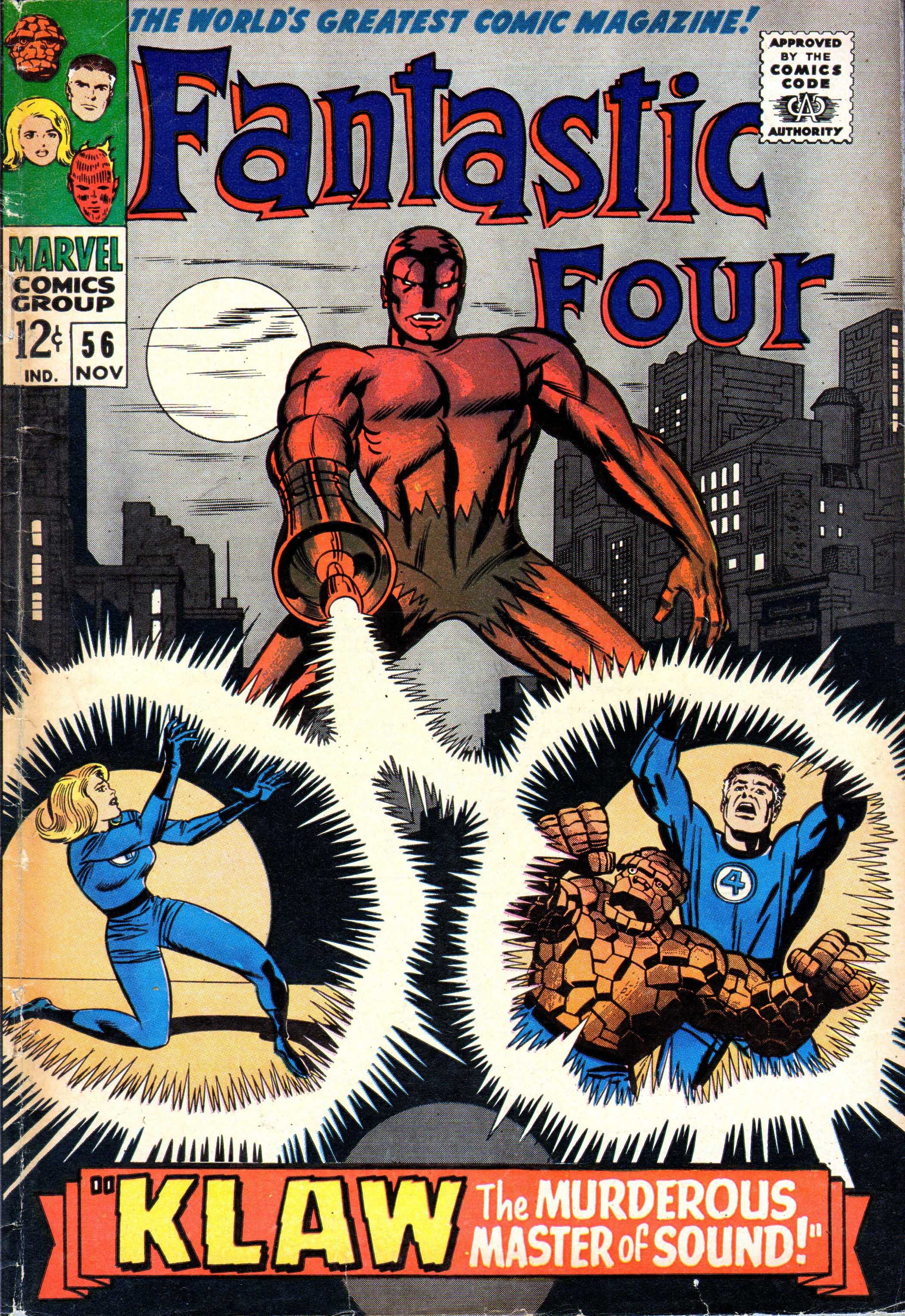


As I’ve mentioned before, I first really met my friend David Steckel when the both of us attended the once-a-week gifted student education program in our school district. It was designed to give the top students in the community more creative and hands-on learning opportunities, and was a terrific program that did a lot for me. But even before that, we’d had one earlier encounter a year before. My old fourth grade teacher Brian O’Leary knew that I was an avid comic book fan–I had done little to conceal that fact–so when David brought in a stack of FANTASTIC FOUR issues that he’d been given by a relative, Mr. O’Leary had me summoned to his classroom so that I could see them. Once we became friends a year later, I wound up reading and/or borrowing pretty much all of the issues that I saw that day. But this issue, Steckel’s oldest, wasn’t then among them–though he no doubt got it from the same source. Like myself, FANTASTIC FOUR was David’s favorite comic book, so that was something that we bonded over. He was a lot more outgoing and athletic than I was, which I think was good in terms of getting me more out into the world than I had been up to that point.
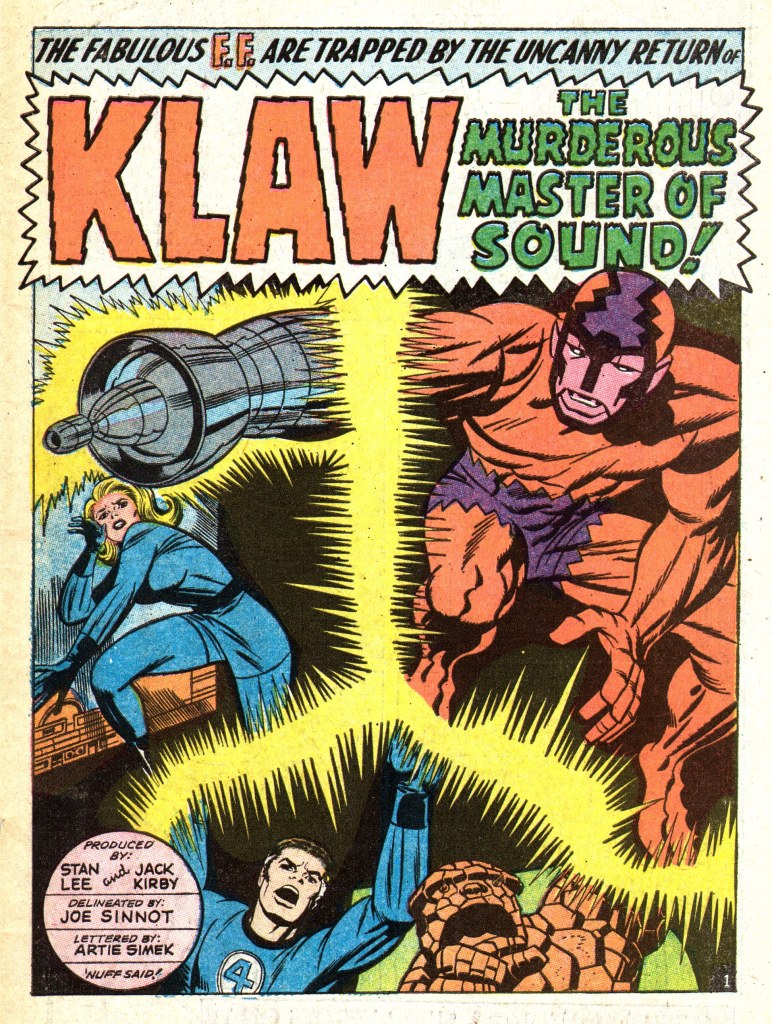
This particular issue of FANTASTIC FOUR is noteworthy to a chance made to the credits. Following the disastrous interview that had appeared in the New York Herald-Tribune (which we covered at the link below) which ascribed the full credit for the innovations of the Marvel line to writer/editor Stan Lee, and which had characterized Jack Kirby as being akin to the foreman in a girdle factory, in order to assuage Kirby’s anger, Lee agreed to thereafter list their credits as Produced by Stan Lee and Jack Kirby in reflection of the fact that Kirby was doing virtually all of the plotting on the series. This adjustment did little to arrest Kirby’s steadily-worsening animosity–especially given that it wasn’t employed consistently, and so there’d continue to be stories crediting Lee as the writer and Kirby merely as the artist.
Unfortunately, the name of FANTASTIC FOUR’s third creative contributor, polished inker Joe Sinnott, was misspelled on this page.
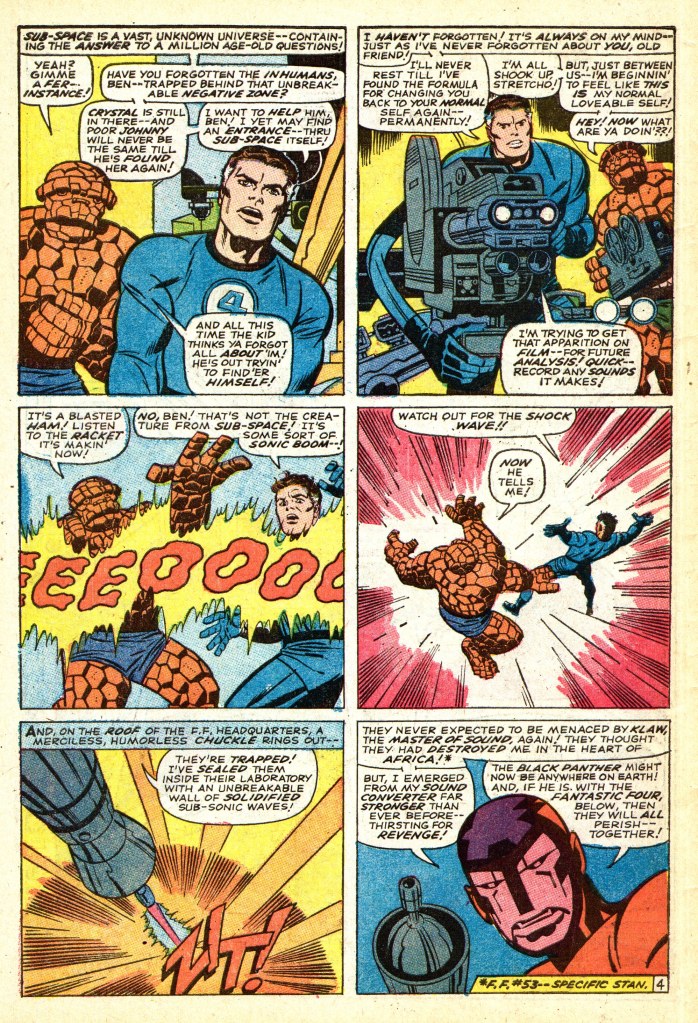
When I got to read this story, I recognized it almost immediately. the previous summer, Hanna Barbera had put their 1967 Fantastic Four cartoon series back into syndication as a part of an umbrella package called Hanna Barbera’s World of Super Adventure. The show grouped a number of the firm’s short-lived super hero shows, though only Fantastic Four was based on an outside source. The very first episode, “Klaws”, was a more-or-less straight up adaptation of this story, with the Black Panther eliminated and replaced by the Human Torch, who was going on vacation at the start of the story and who returned in time to deliver the vibranium units to Reed Richards that would allow the group to defeat Klaw. So I was familiar with the story in general, but the additional power of the Kirby and Sinnott artwork made it all feel a lot more dramatic, and much of Stan Lee’s crazy copy had to be excised from the animated incarnation as well. Here’s a quick look at the next episode trailer highlighting that episode:
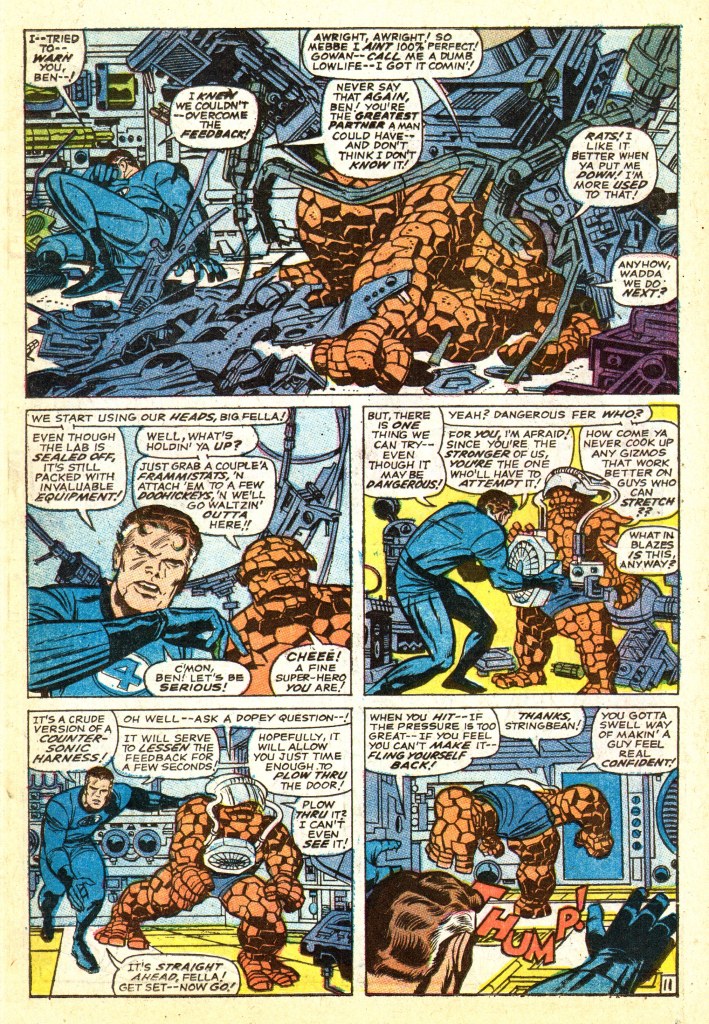
This issue came out at the height of the series’ most innovative period, a time where everything was firing on all cylinders and the book was rolling out new characters and concepts at an almost frightening pace. Klaw himself was the big new player in this story, even though he’d contended with the FF and the Black Panther a few issues earlier. at the close of that adventure, Ulysses Klaw entered his own sonic device, transforming himself into a create composed of pure solidified sound. As this issue opens, he attacks the Fantastic Four (or the three of them who are present–the Human Torch is still off with Wyatt Wingfoot and Lockjaw looking for a way to penetrate the great barrier that has sealed away the city of the Inhumans, including his beloved Crystal) within their Baxter Building headquarters. His first strike seals Reed and Ben inside the space-time lab behind a barrier of solidified sound, then he goes to take out Sue.
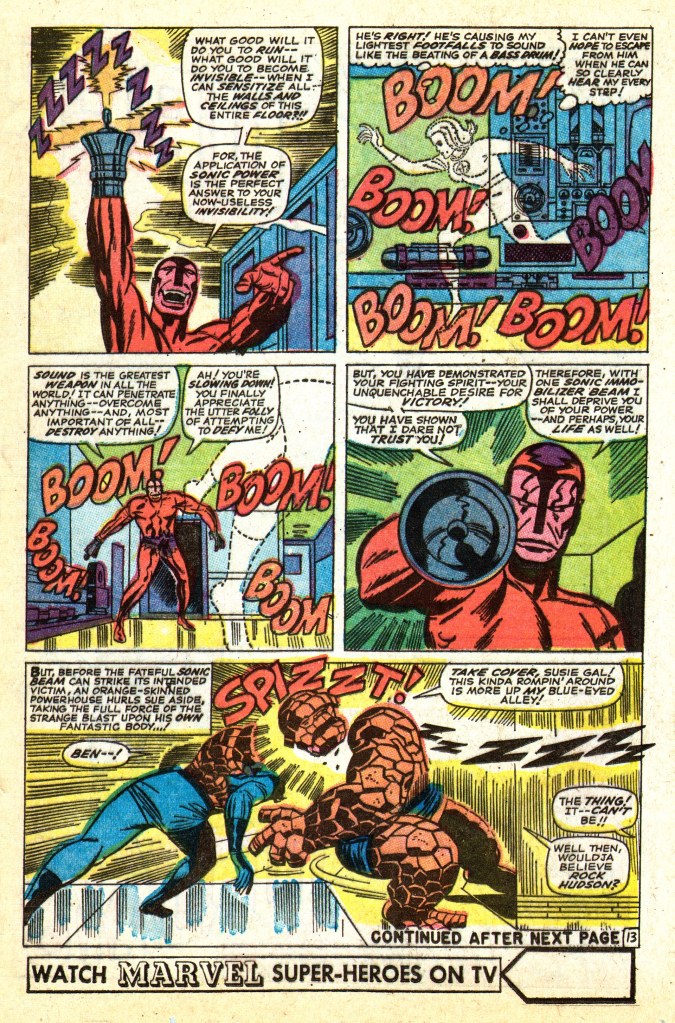
With the FF now on the ropes, Klaw is hoping to coerce Sue into contacting the Black Panther and drawing him away from Wakanda to come to the team’s aid–and directly into a trap. Sue’s able to hold her own, though, but of course, this being the 1960s, her force-field isn’t mighty enough of a weapon to stop Klaw’s relentless attacks. Fortunately, Reed is able to jury-rig a Counter Sonic Harness for Ben out of equipment within the lab they’re imprisoned in, and the mighty Thing is able to use it to break through the barrier containing them and take the fight directly to their attacker.
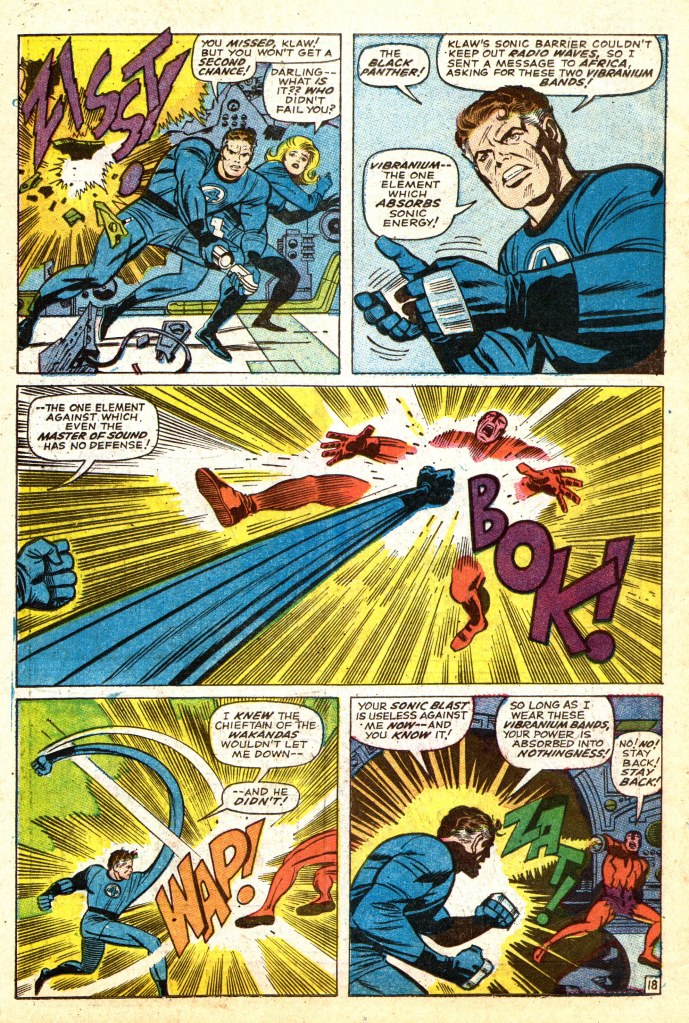
But even the Thing is overwhelmed by the onslaught of Klaw’s sonic force, enough raw power that it blows out the lightbulbs of every building in the vicinity of the FF’s headquarters. But as Klaw faces Reed Richards for the final showdown, there’s a sudden appearance at the window: a tiny rocket fired towards Manhattan from the African nation of Wakanda enters through the open window, delivering to Mr. Fantastic just the thing he needs to put an end to the danger: a pair of vibranium bands, made of the extraterrestrial material that absorbs all vibrations, including sound. While he wears the bands that the Black Panther has sent his way, Reed is impervious to Klaw’s sonic onslaught, and so he whales on the now-disarmed villain.
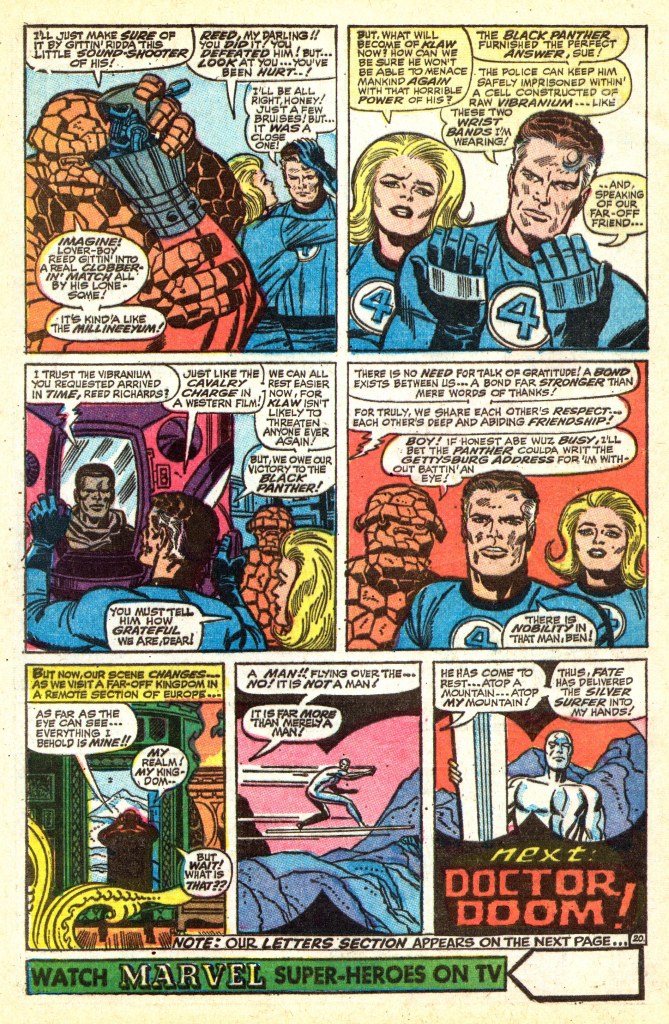
And that’s all she wrote for poor old Klaw, who in the end wasn’t quite as devastating a villain as he seemed to be for a couple early pages there. In the end, the FF radio the Black Panther, thanking their friend for his aid, and the issue prepares to wrap up. But before it does, events are transpiring in far-off Latveria that will soon portend trouble for the Fantastic four and the world. For the Silver Surfer, herald of Galactus who has been trapped upon our world, has come into the orbit of the team’s greatest foe, Doctor Doom! To Be continued! In all honesty, while it looked great and read well, this was a bit of a lesser effort than many of the issues that surrounded it, and I think that comes down to the fact that Klaw turned out to be a bit of a piker, for all that he’d return time and again across the Marvel line.
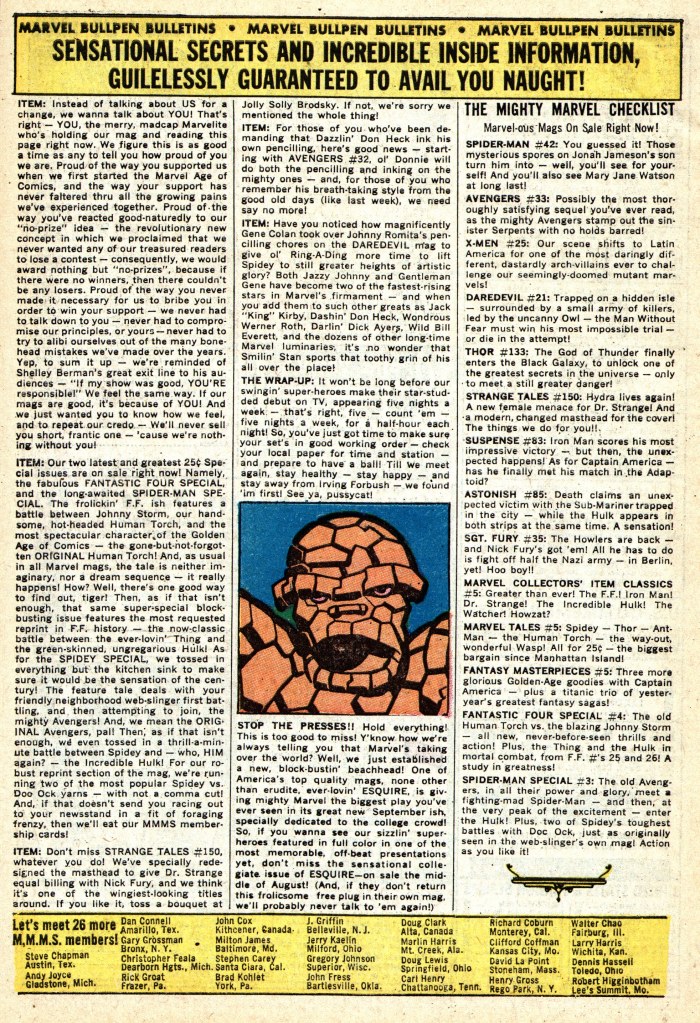
Almost as much as the stories, I loved reading the ancillary materials in these old books, and getting a bit of a peek at the other magazines that were on sale at the same time. The Bullpen Bulletins page hadn’t yet evolved to the point where it included Stan Lee’s Soapbox column every month, but it was chock-a-block full of interesting tidbits about what was going on throughout Marveldom at that time. Which in this instance included hype about the upcoming AMAZING SPIDER-MAN and FANTASTIC FORU Annuals, some love for Gene Colan’s work on DAREDEVIL, the announcement of a new logo for STRANGE TALES and an upcoming feature on marvel that would be running in the pages of Esquire magazine, a legitimate publication. Plus the intriguing Marvel Checklist and a listing of 26 more members of the merry Marvel Marching Society fan club.
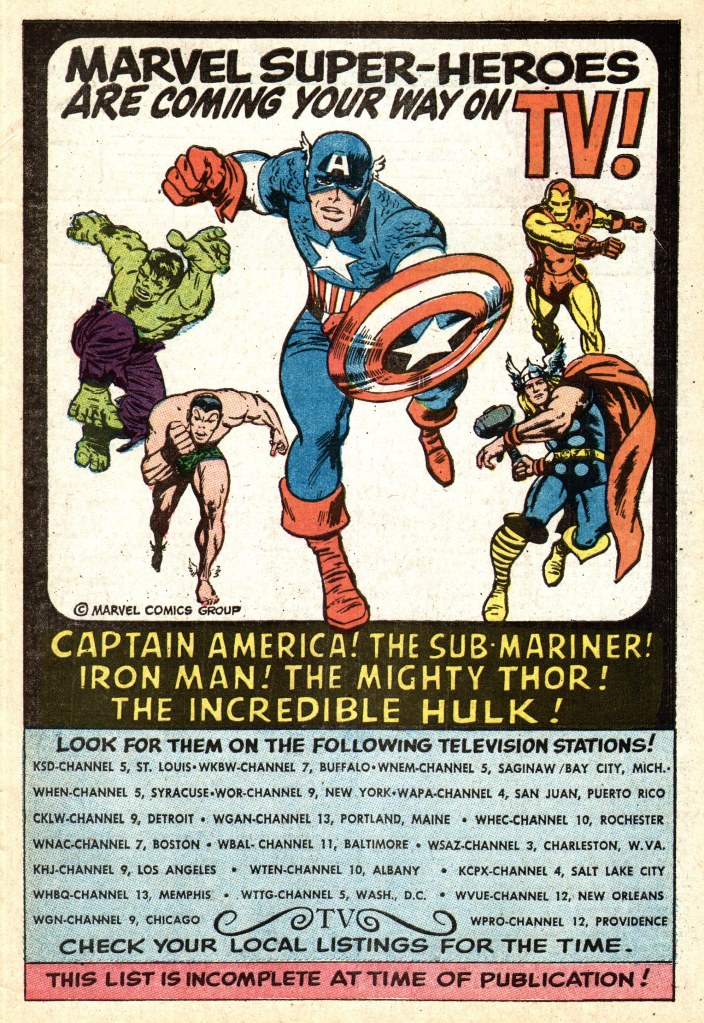
The big news at this moment was the impending arrival of the MARVEL SUPER HEROES cartoon in syndication all across the country. This was the first big media exposure that the Marvel characters ever received, and it helped to build awareness of the line among potential young readers. The animation on these old cartoons was primitive to say the least, but they drew directly from the Marvel stories and artwork (to the point where artists such as Jack Kirby felt understandably taken advantage of, as their drawings appeared on national television without them receiving any manner of recompense for that usage.) The show was blurbed across the bottom of several pages, but this issue went to print early enough that the arrows on each blurb, which later would contain the name of a particular TV station that was running the show, would here remain blank.
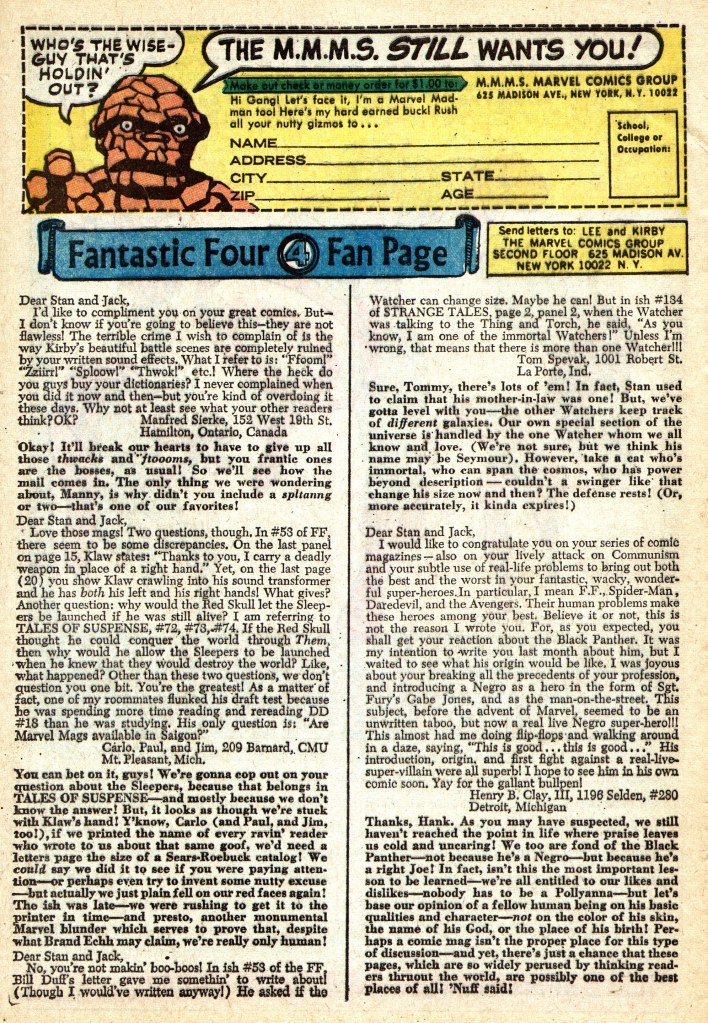
Lee’s letters pages during this era were perhaps some of his strongest writing and the place where his full personality would often shine through. They were just fun to read, and were simultaneously outrageously bombastic and completely self-effacing, a delicate balancing act that Lee pulled off better than just about anybody else in the field. These were simply fun to read, and made you feel like you were a part of some insider crowd in a very effective manner.
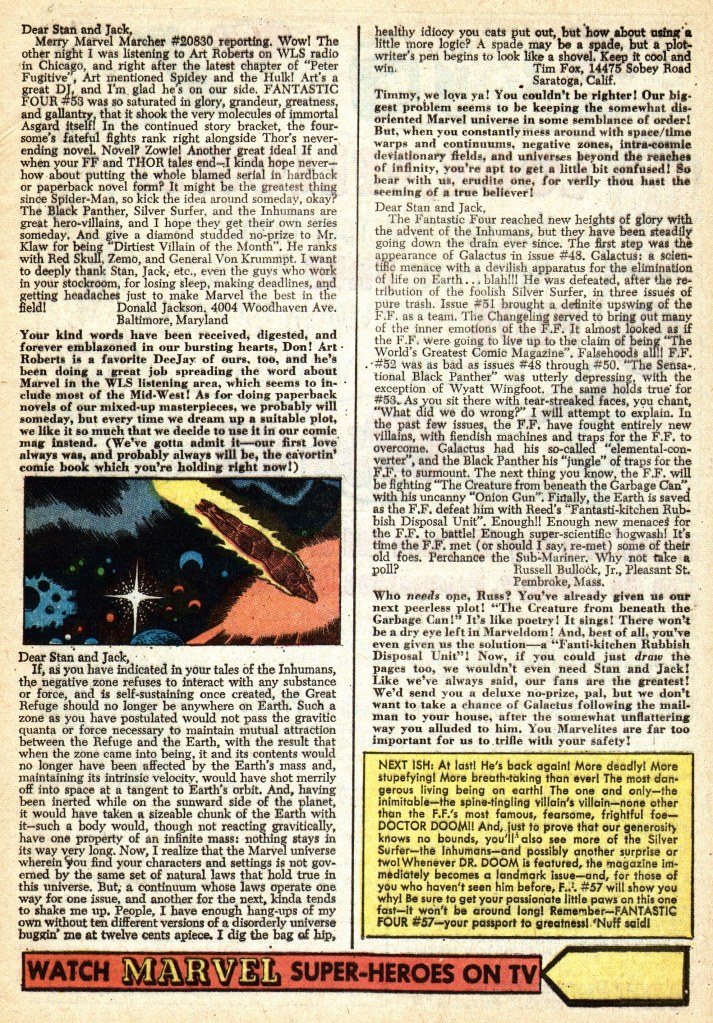


Thanks to the 1967 Hanna Barbera cartoon, this issue of the Fantastic Four stands out prominently to me – perhaps a bit more than it should as Tom indicated. But that also underscores the outstanding quality of this series at that time. I mean, you’ve got the Negative Zone, Black Panther, Vibranium, Klaw with that funky hand gadget, the Silver Surfer and Dr. Doom. I suppose it could be argued that how could Klaw compete against all of that.
And forgive me, but the cartoon nerd in me has to point out that the trailer Tom shared shows segments of that “Klaws” episode that didn’t air. As this was only a 7-minute episode – half the length of the others – I’ve always wondered if it wasn’t trimmed at some point. Ditto for Red Ghost episode that accompanied it that was a “blink and you’ll miss it” summation of FF #13. I don’t suppose I should hold my breath waiting for the “uncut” versions to ever appear. 😊
LikeLike
Notice how all the letters on the first of the two letter’s pages are from fans in the midwest: Michigan, Detroit, Mt. Pleasant, Ontario, Indiana… all around my home town in mid-Michigan. I suspect this is because Marvel Comics suddenly had better distribution around this time, and so were more prominent, thanks to Suits News Company doing twice weekly deliveries of new issues and magazines!
This turned out to be the second new issue I bought off the spinner racks, and the ads for Marvel Comics Superheroes on TV was not lost on me. I had no idea how to find which station was going to have them!
Finally, I wonder how the authorities (Army, Navy, AirForce) would have taken to a foreign power like Wikanda firing a missile at New York City? It makes one wonder how it slipped under their radar.
LikeLiked by 1 person
Dude it’s T’Challa. Of course he can bypass radar, probably with vibranium anti-radar baffles.
LikeLike
I like Klaw. In Avengers#55 ( August 1968 ) page 6 panel 5 the Crimson Cowl ( Ultron-5 ) threatens Klaw with his lethally-set Gas Gun, Klaw a man made of solid sound ( No lungs, bones, organs, etc. ). As for how dangerous Klaw can be, sounds above 150 dB have the potential of causing life-threatening issues. Sounds between 170-200 dB are so intense that they can cause lethal issues like pulmonary embolisms, pulmonary contusions, or even burst lungs. As for exploding heads, you can expect that from sounds above 240 dB ( Can Sound Waves Kill You — https://decibelpro.app/blog/can-sound-kill-you ) — Imagine if The Doctor ( Doctor Who ) dialed the sound on his sonic screwdriver. Plus there there are those Green Lantern like things Klaw can do with his power ( Create animals or objects ). As an energy being he can’t be killed and is immortal.
LikeLiked by 1 person
I agree, he can be a weighty threat. However, under Jim Shooter in Secret Wars, he was reduced to playing The Fool!
LikeLiked by 1 person
i think Lee and Kirby meant Klaw to be semi-invulnerable, but by the time of that Masters of Evil story, he has a contretemps with the Crimson Cowl (AKA You Know Who) and has to grovel for his life to avoid being shot by a gun– a gun which Klaw instantly knows can be fatal to him.
LikeLike
I dunno… I think Klaw is a pretty good villain by and large. I love that his name works both for and against him… like naming Captain Ahab “Leg”.
As noted above he’s a member of the new Masters of Evil in Avengers 54-55. A two parter that I think casts a long shadow on the Avengers and Marvel comics when it comes to raising the stakes in a team book. I first read it years after it was published and it’s still one of my favorite Avengers stories. A team consisting of Goliath, Wasp, Hawkeye, and spandex suit wearing Black Panther, and no ebony blade Black Knight was way out powered by a team of Melter, Klaw, Radioactive man, Whirlwind and pre-adamantium Ultron.
Like Sandman I think that wayward characterizations of Klaw can be chalked up to his powers making him not all there and/or not quite right. He is a way lesser villain compared to Dr. Doom… though Shooter portraying him as Toad to Doom’s Magneto never felt right.
I think I was introduced to the character in Avengers #126… which incidentally featured very nice art by Brown and Cockrum and was a swansong for the Black Panther as an Avenger for a long while. Klaw isn’t just a badguy in that story, he’s a virulent racist… or pretending to be a virulent racist from South Africa since he can’t shake hands.
LikeLiked by 1 person
I always felt Klaw (in human form) in FF #53, was patterned after Gregory Peck in the film Moby Dick. So your reference to Captain Ahab is especially on point!
LikeLike
Klaw would have been a more credible threat if he hadn’t just been Some Guy granted powers. He’s not a genius, didn’t invent the device that transformed him, and usually has been a super powered thug rather than a master villain.
LikeLike
To the Steve that Is Always Right, Ulysses Klaue ( Klaw ) was a physicist who was working in the field of applied sonics and designed a sound transducer which converts sound waves into physical mass ( He stole vibranium to power his device — wikipedia.org & the Official Handbooks ). If Klaw could isolate the frequencies he should be able to duplicate the abilities of sound producing characters ( Angar the Screamer ) and technologies ( mad bombs or sonic mind-warper ( Crossfire — MTIO#52 ). speaking of Angar the Screamer, I know his power works different than that sonic device Obadiah Stane used against the Ten Rings and Tony Stark but Angar power ( Hallucinations or immediate catatonic sleep ) would come in handy in bank and museum robberies ( He or with a crew could just walk in and steal things with no interference ).
LikeLike
I suspect that Lee was inspired by Einstein’s matter-energy equivalence, and simply substituted “sound” for “light” (so that Klaw is transformed into a being of pure sound). But his original power–to create glowy red simulations of jungle animals out of sound–seems more Green Lantern-esque.
LikeLike
I have never understood (other than the jungle theme) why Klaw created jungle animals to ravage Wakanda in #53… What was the intent? What was he trying to accomplish? It gained him nothing!
LikeLiked by 1 person
Isn’t that Klaw’s MO though? He might have been technically smart as John pointed out but he’s never used his powers smartly. He’s basically a thug made of sound waves. That’s what I read when he appeared after I started reading comics and I don’t think he’s shown any smarts for tactics or uses of his powers in anything I’ve read since.
LikeLike
Bei Dawei:
>> I suspect that Lee was inspired by Einstein’s matter-energy equivalence…>>
I’d bet Kirby, at that stage of FF plotting/collaboration.
LikeLike
Yeah, I think the jungle theme (Kirby just wanting to draw things with genre associations) was the only reason. One might think of Klaw as a scientist who had one intense insight into his specialty, and no interest in thinking outside that box, much less being a polymath like Reed, Tony and Henry.
LikeLike