

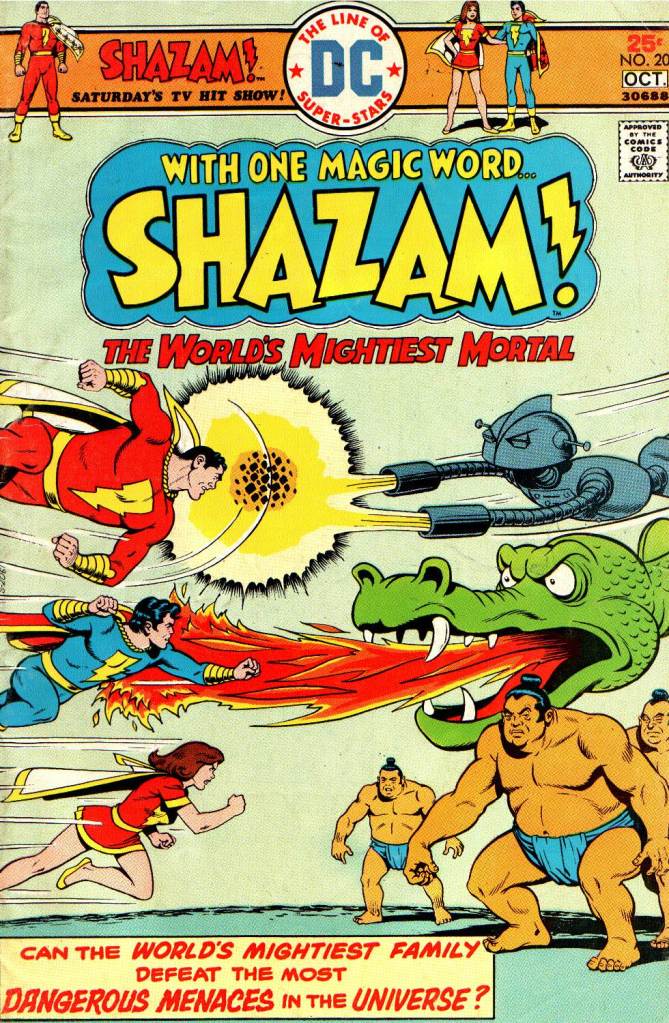
I was still making my way through the complete run of SHAZAM that had been lent to me by my grade school friend Donald Sims. I didn’t need to read issue #19, as I’d bought that one when it first came out–and went through it here:
So it was on to issue #20 for me. As you can see from the above, DC continued to be forbitten from using the name Captain Marvel anywhere on their covers (though they could still refer to the character by that name on the interiors of the book.). Consequently, the copy references the Marvel Family only as the World’s Mightiest Family. I can’t say that I really noticed this at the time, but it’s readily apparent to me now. Additionally, as with a lot of DC’s super hero covers during this period, the cover is a bit empty and lacking in impact. This wasn’t a great time for DC covers, and it would be a year or so before they really started to get better, the result of artist Nick Cardy having departed the company.
The bloom was definitely off the rose for SHAZAM by this point, and what had started off showing such promise (as unscrupulous dealers moved to corner the market on copies of SHAZAM #1 prior to its official release) had now been downgraded to bimonthly status, a sure sign that sales and interest were flagging. The only thing that was keeping Captain Marvel and the series going was the successful Saturday Morning live action SHAZAM series, which was touted prominently on the cover. But it didn’t seem as though there was much carry-over from readers who may have come to the book after seeing the show. The material being offered here was simply too different. That situation would be addressed as well in just a few more issues.
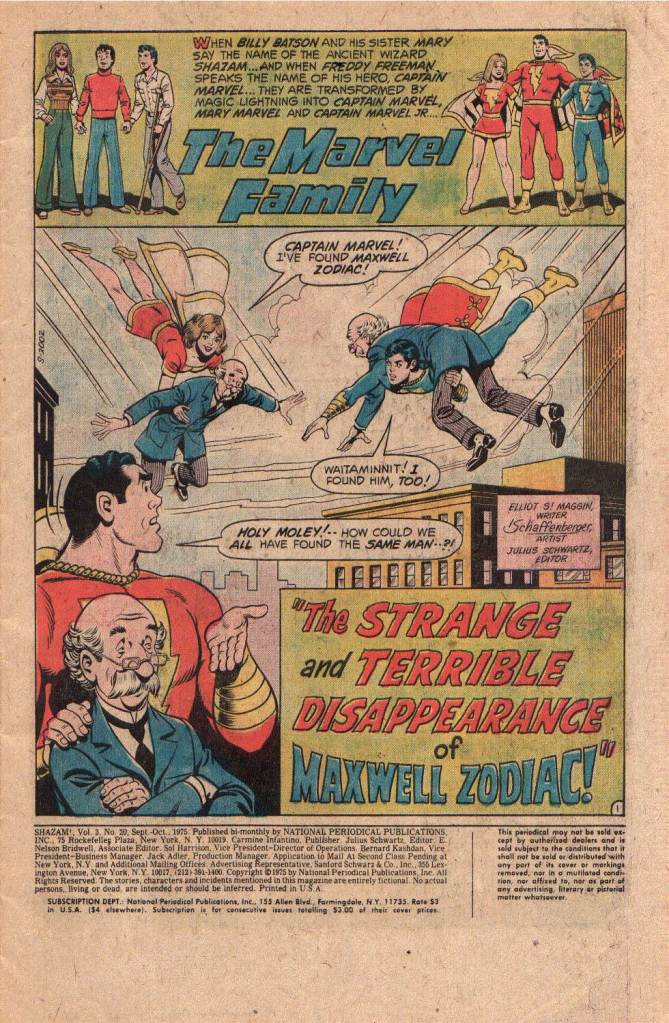
The story in this issue is a bit of an improvement over recent outings–it seems as though editor Julie Schwartz was finally getting his arms around what to do with the series in the aftermath of creator C.C. Beck’s departure. The issue featured one book-length tale, which had enough space for some decent character development and a variety of incident–it felt a lot more substantial than the short 7- and 8-page stories that had ben featured in the series for the most part. The artwork was handled by Kurt Schaffenberger, who had worked on the Marvel Family during their original Golden Age run and whose clean, open style was a perfect match for the strip’s feeling of whimsy and charm. Elliot S! Maggin wrote the story, and while he never seemed entirely comfortable with the Captain and his world, he had proven to be more adept at taking the assignment seriously than some of his contemporaries had.
The story opens on a bit of a mystery. A woman comes forward saying that she knows that Captain Marvel gets his powers from a bolt of lightning, and that she knows who he is. She recounts her tale to Billy Batson: she lived next door to an eccentric man named Maxwell Zodiac. One day, while spying on Zodiac as he flew a kite in a thunderstorm, she saw the man get struck by lightning and vanish. In her mind, Maxwell had become Captain Marvel, and this is why she never saw him again. She also came with a map scavenged from Maxwell’s apartment, with three locations marked off. Billy tells Mary and Freddy about the woman’s story, and while they know that Maxwell isn’t Captain Marvel, they are curious about what happened to him. So changing to their Marvel forms, they split up to check out the three marked locations, hoping to find a clue.
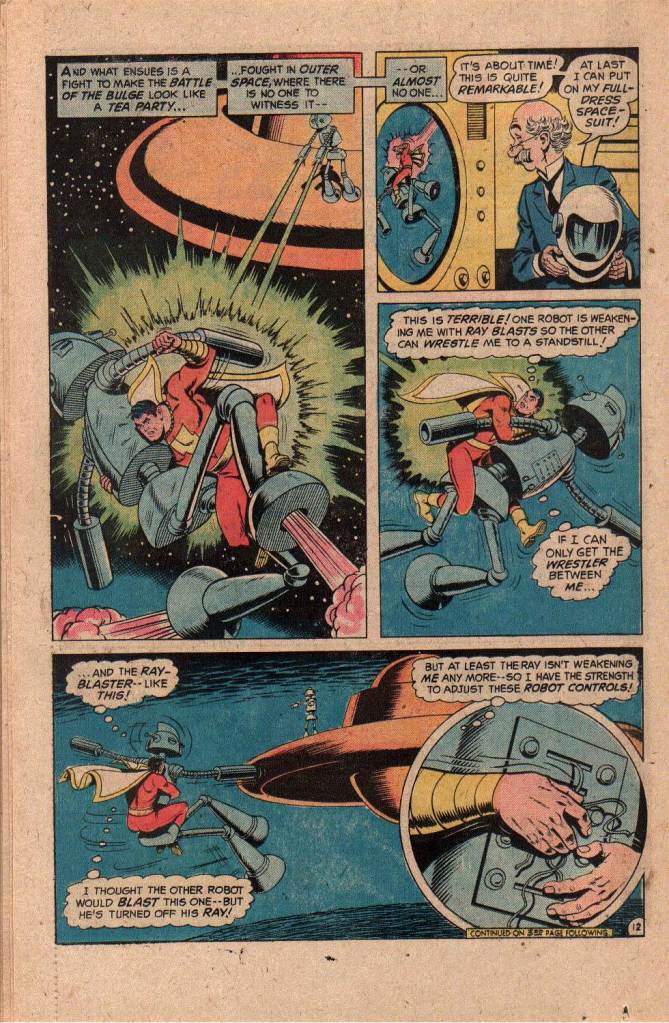
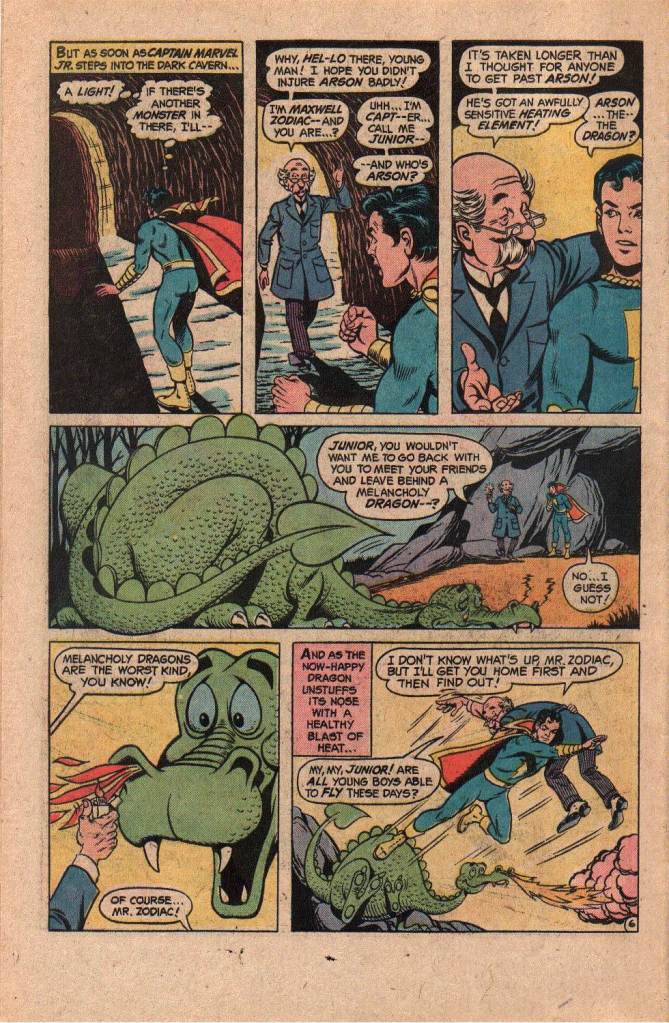
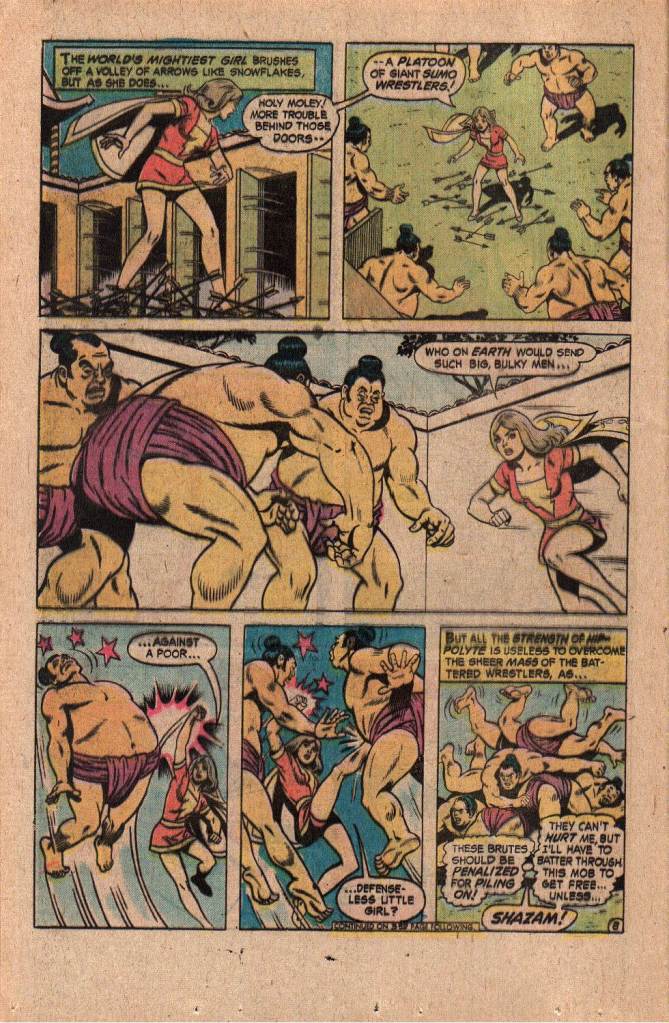
But in each of the three locations, the assorted Marvels all have similar experiences: they encounter danger, triumph over it, then find Maxwell Zodiac. In Junior’s case, he’s got to overcome a fearsome dragon who turns out to be pretty harmless. Mary ventures to Japan, where she contends with some sadly stereotypical sumo wrestlers (who are colored in an unfortunate orange shade). Captain Marvel heads up into the stratosphere to the location of a flying saucer (no idea how anybody would have marked that location on a map of Earth) where he battles a bunch of robots created by his usual foe Sivana. All three Marvels return with Maxwell Zodiac, and are astonished to find that there are now three of him.
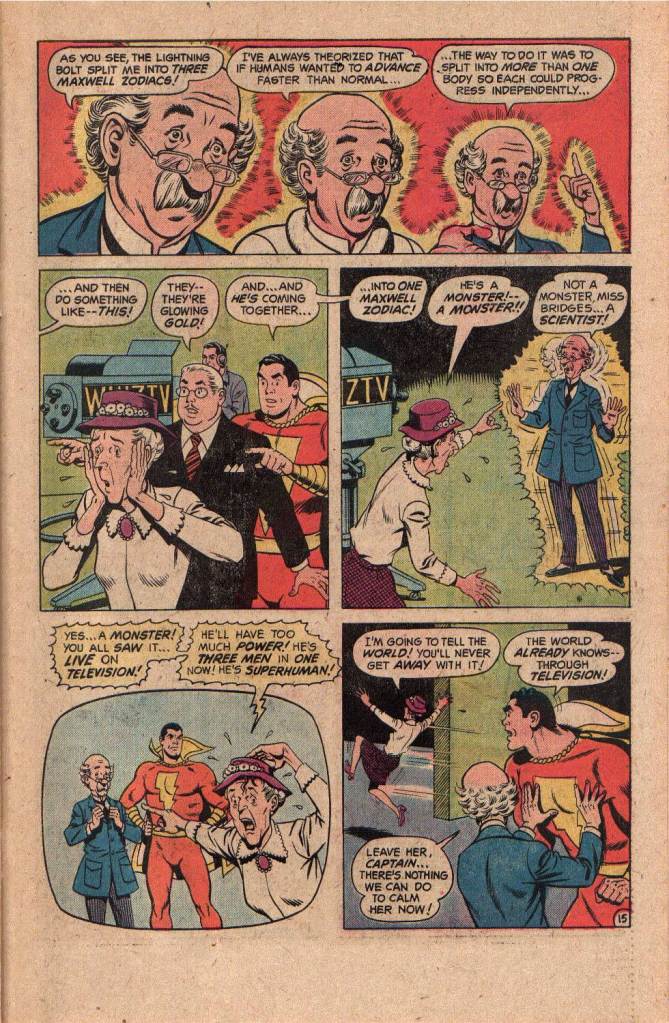
Returning to Television Station WHIZ, the Marvels broadcast their reunion of the disparate Mr. Zodiacs to the world. Zodiac tells them that he’d always theorized that if a person wanted to advance faster than normal, that the solution would be to split themselves into multiple bodies, then reform after each had had separate experiences, thus giving their combined form the benefit of all of that additional experience. And that’s what the three Zodiacs proceed to do, return to a single form. This, though, causes panic and terror among the viewership of Station WHIZ, and despite all that the Marvels can do to try to quell the panic, society as a whole is fearful that Maxwell Zodiac has now somehow acquired fearful powers which he might use to terrorize the city–despite all evidence to the contrary.
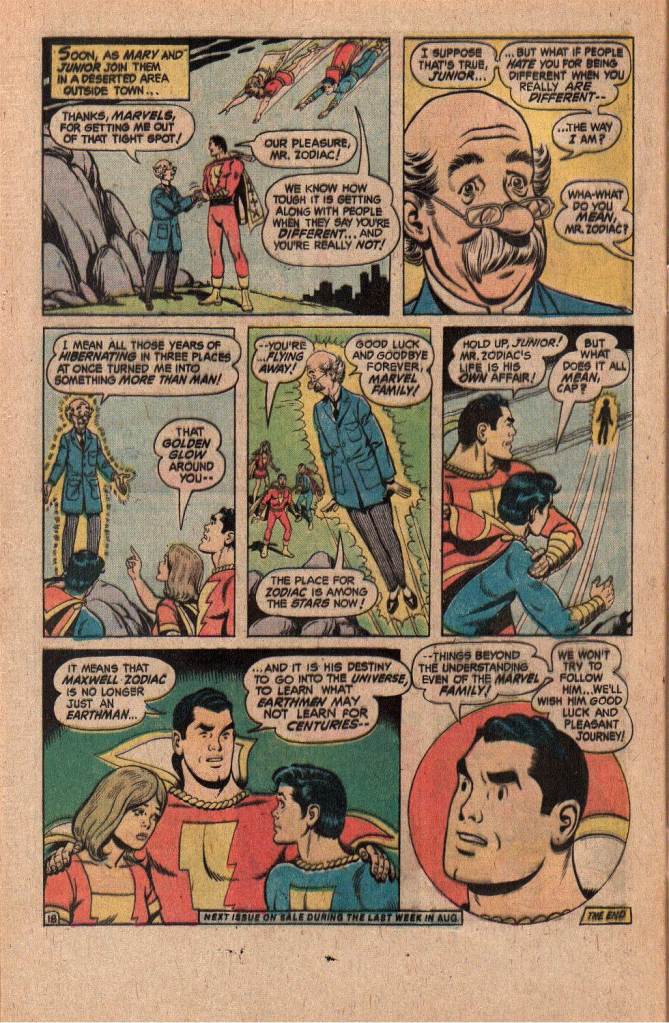
With little recourse, the three Marvels carry Mr. Zodiac away from the angry mob, eventually alighting with him some distance from the city. There they learn that at least a portion of the people’s concern was justified: Zodiac’s experiences have left him imbued with cosmic powers. Fortunately for all concerned, in his new state, Maxwell Zodiac doesn’t have any interest in the affairs of men, and so he heads off into the cosmos to seek his destiny–a pretty typical ending for stories involving human characters becoming semi-divine, of which there were quite a few in this period of comics. So the whole story was relatively basic but still charming in its presentation, and felt like a bit of a step forward. Unfortunately, this wasn’t to be the case, and beginning with the next issue, SHAZAM became entirely a reprint magazine.
 The Tom Brevoort Experience
Maxwell Zodiac splits into 3 identical bodies and over at Marvel Two-in-One#55 there is Nuklo who can do the same ( in Giant-Size Avengers#1 ( August 1974 ) ). I never knew that DC Comics had characters like Him( Adam Warlock ) [ Fantastic Four#67 ( October 1967 ) ], Alpha the Ultimate Mutant [ The Defenders#15-16 ( September-October 1974 ) ], the Lords of Light and Darkness ( Yama Dharma, Brahma, Shiva, Mara, Kali, Vishnu, Agni & Ratri ) [ Marvel Team-UpAnnual#1 ( 1976 ) ], Ethicals ( Kora, Akra & 3 others ) [ Machine Man#12 ( December 1979 ) ], the Futurist [ Fantastic Four#215-216 ( February-March 1980 ) ] and Red Guardian ( Dr. Tania Belinskya ) & the Presence [ The Incredible Hulk#259 ( May 1981 ) ] that abandoned Earth for the stars ( Temporarily the High Evolutionary ). The dragon looks Saturday morning cartoon or children’s book-like and the alien robots very primitive.
LikeLike
When I was a child i wish I had a buddy like Donald Simms! Very few of my friends read comics and those who did never let them out of their grasp
LikeLiked by 1 person
Not much of a story. Nice art.
In a lot of the Mary panels, though, it looks like her hair has been reworked, as if Schaffenberger drew the wrong hairstyle and someone else corrected it,
LikeLike
What is the term for the circular panel that we see in the last panel on the last page here with Captain Marvel? We don’t call it a looking-glass panel, do we? What’s the trade term?
LikeLike
“A woman comes forward saying that she knows that Captain Marvel gets his powers from a bolt of lightning”
We as readers know that the Marvel family got their powers from magic lightning, so we took it for granted that they had a lightning bolt as a chest emblem. But for the characters in-universe who didn’t know that the characters derived their powers from lightning, did they ever wonder why they all had lightning bolts on their chest? Especially since at the time (I think this has changed in the last 15 years or so) the characters had no electrical powers?
LikeLike
Well, The Flash has a lightning bolt as a chest emblem too, and often various lightning motifs in his costume (both Golden Age and later versions). Yet he doesn’t have electrical powers either.
I suppose in-universe people just think it’s branding. Or maybe some sort of simplified family crest.
LikeLike
. . . or denotes the speed and flying ability . . . .
LikeLike
I thought this was a major improvement (although it came too late).
It almost seems like Maggin was reading some of Binder’s older Marvel Family stuff that was being reprinted around that time. Maggin was a solid writer, although he only had about a year left on his first tenure at DC (he had a confrontation with Julius Schwartz, who finally let him come back in the early 1980s)
There was real potential in this. It is good that ENB kind of found a good track for these characters a bit more than a year later.
LikeLike
So according to comicbook.com DC has decided to call Billy Batson’s alter ego Captain Marvel [ Justice League Unlimited#18 ] again ( They ask, but how long do we think this will last? ). I don’t know why they changed it in the first place. Just because the character can’t have his name on the cover is no reason, Shazam! or The Power of Shazam! works for a series title because that is what he is powered by Plus he had the name first and it’s part of his history. It isn’t like Marvel & DC Comics don’t have other heroes with the same name: Guardian, Witchfire ( both red headed sorceresses — I wish DC’s had been the Canadian Beta/Gamma Flight member. Marvel’s went bad ), Quicksilver ( Quality’s Quicksilver got a name change – Max Mercury ), Hercules & ?
LikeLike
They changed it because DC can’t trademark “Captain Marvel”, as Marvel grabbed that trademark and will never let it go. The article’s not too bad on that.
https://comicbook.com/comics/feature/dcs-captain-marvel-officially-returns-15-years-later-but-for-how-long/
I wouldn’t expect the change to stay around at all. The trademark (meaning merchandising) problem is too much. Moreover, it’s not just “same name”, it’s the name of DC’s major rival company.
“Shazam” is not a good name for him, but it seems like he’s stuck with it.
Captain Thunder? Captain Lightning? Captain Whizbang?
LikeLike
I know about the trade mark issue. The character was called Captain Marvel in the 1974 Shazam! tv series( It had an 8-inch action figure under the Shazam name ). Just looked up what Mary Marvel’s new names was/is ( Lady Shazam ) & Captain Marvel, Jr. is just another version of Shazam ( Google A.I. Overview ) or Shazam, Jr.( People also ask ). Captain Marvel was originally named Captain Thunder in Flash Comics and Thrill Comics ( ashcan — https://www.cosmicteams.com/fawcett ) — Bill Parker wasn’t able to secure the rights to Captain Thunder, Flash Comics or Thrill Comics so Captain Thunder was renamed Captain Marvel.
LikeLike