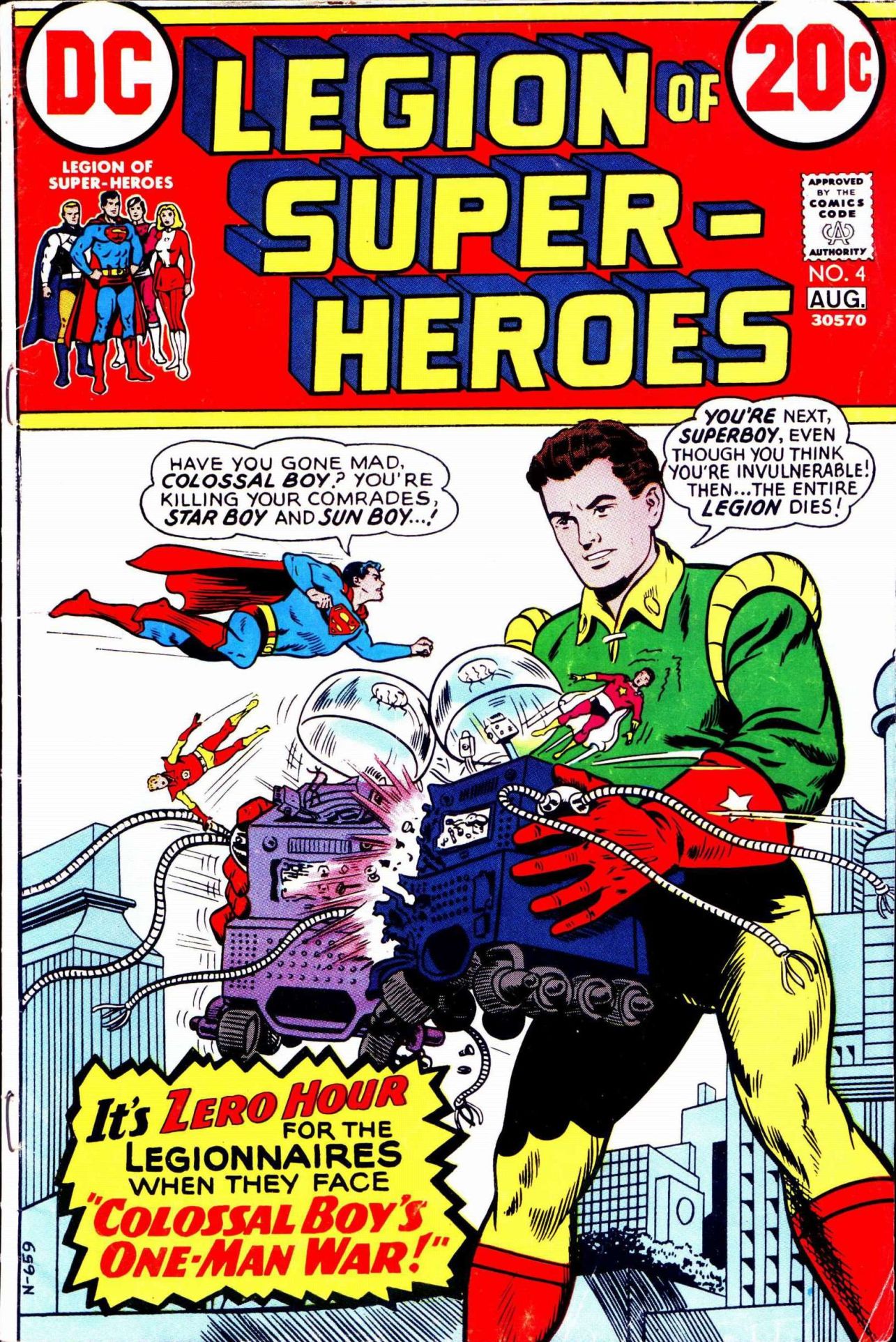


This is another comic book that I never quite borrowed. Rather, I saw it lying around over at the house of my neighbor Charles Grella at some point when I was there. I think the fact that it was such an odd thing was what made me remember it; at the time, the Legion of Super-Heroes didn’t have a series of their own and I had no inkling that they ever did. So it was a surprising thing to behold. It was actually a reprint title, one of several that DC head Carmine Infantino released in 1973 in an attempt to hold onto display space for the DC line in the wake of Marvel’s aggressive expansion. This must have been an easy and affordable book to produce, given that it reused the story and even the cover artwork from a 1966 issue of ADVENTURE COMICS. Still, that didn’t mean it was successful, and this fourth issue was the last one in the series.
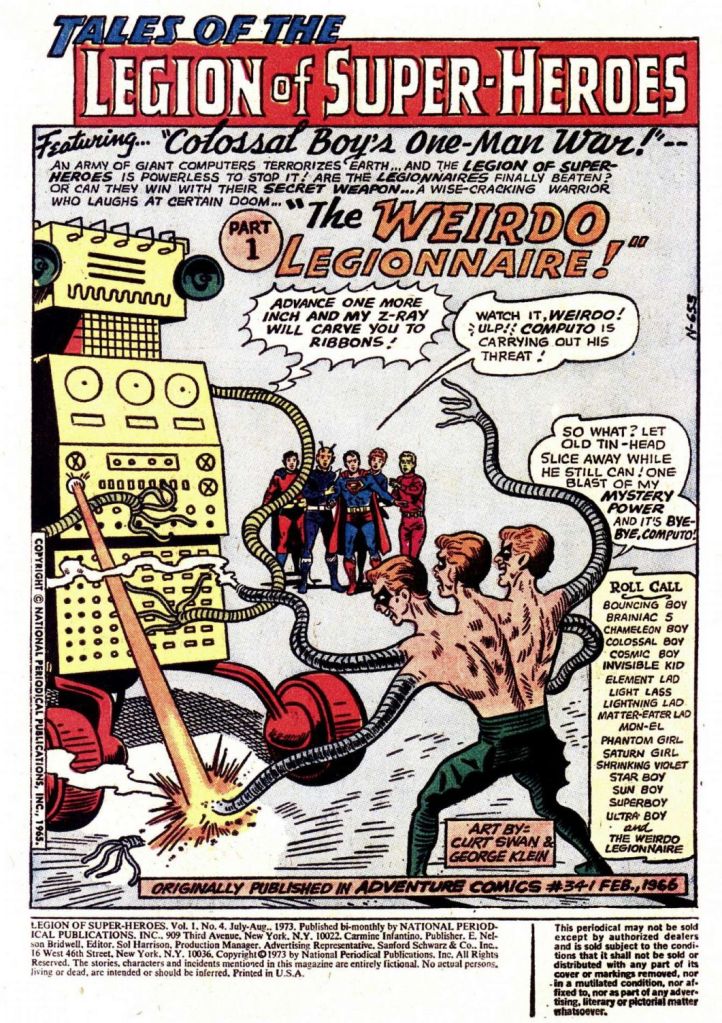
Charles Grella didn’t really have any interest in comic books, and looking at his exposure to this one, I can kind of see why. Even only a relatively short number of years from its original publication, the story feels immediately dated and quaint to even 1973 eyes. The bit threat of the story, Computo, feels almost comical in his throwback design. And the titular Weirdo Legionnaire is similarly an absurd creation. Add on top of that the antiquated names of several of the Legionnaires themselves (in particular the Lads and Lasses) and the entire package doesn’t feel like it’s designed to appeal to a kid in the 1970s at all. The artwork by Curt Swan and Sheldon Moldoff (not George Klein as the splash page mistakenly miscredits) feels like a throwback to the 1950s or even the 1940s in its depiction of the far future.
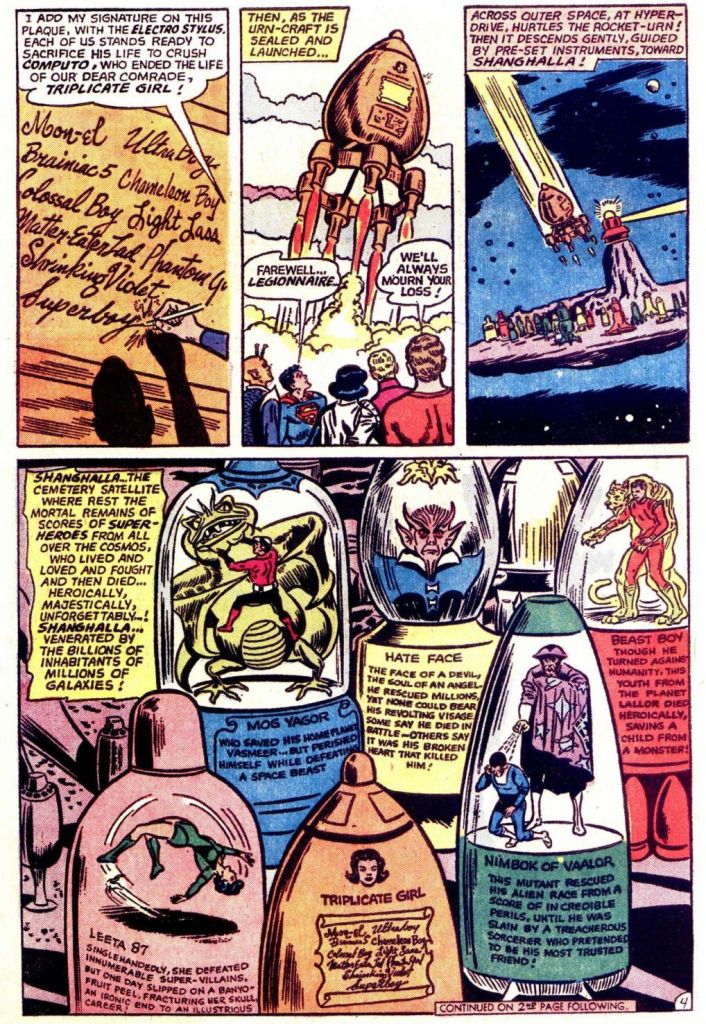
The story was written by Jerry Siegel, Superman’s creator, and its tone is all over the place. Siegel, it seems, isn’t quite certain how seriously he should be taking any of what he’s writing, so he bounces back and forth between attempting drama and then undercutting his own stakes with comedy. This can readily be seen in the opening sequence. This is the second part of a two-part adventure, and in the opening, Computo, a sinister automaton accidentally created by Legionnaire Brainiac 5, has killed Triplicate Girl. So this story opens with the Legionnaires having an impromptu funeral for her, gathering up the scattered particles of her remains and sending them by rocket to the hero’s graveyard on far-off Shanghalla, there to rest among the memorials to the greatest fallen heroes in the galaxy. This group includes poor old Leeta 87, whose memorial tells us that after triumph after triumph, she broke her own skull tripping on a space banana peel. It’s a memorable gag, but one that deflates the somberness of the occasion.
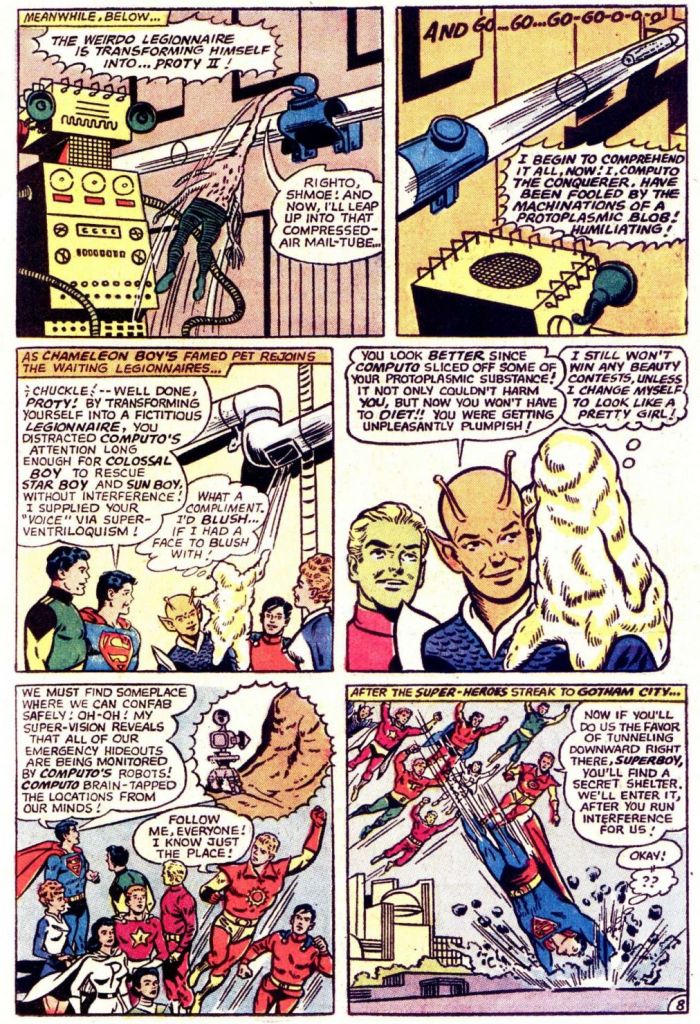
It’s okay, though, because it was only one of Triplicate Girl’s three bodies that Computo killed–the other two are just fine, And with a codename change to Duo Damsel, she’s ready to get back into the fight. This means first freeing the members of their team that have been captured by Computo, which requires the Legion to unleash their secret weapon, the Weirdo Legionnaire, on the angry AI. Weirdo is an absurd design, with three heads and strange tentacles for arms. He’s also a motormouth with a bad attitude and he distracts Computo for long enough for Colossal Boy to free Star Boy and Sun Boy from confinement, though Colossal Boy makes it look as though he’s killing his fellow Legion members to justify the cover illustration. Weirdo turns out to be Chameleon Boy’s pet Proty II, who can change form, in case you were wondering. He was an enormous bluff, in a story filled with nonsensical actions. With that taken care of, the Legion retreats, hiding out in the now-disused Batcave which is still there untouched in the future world of a thousand years from now.
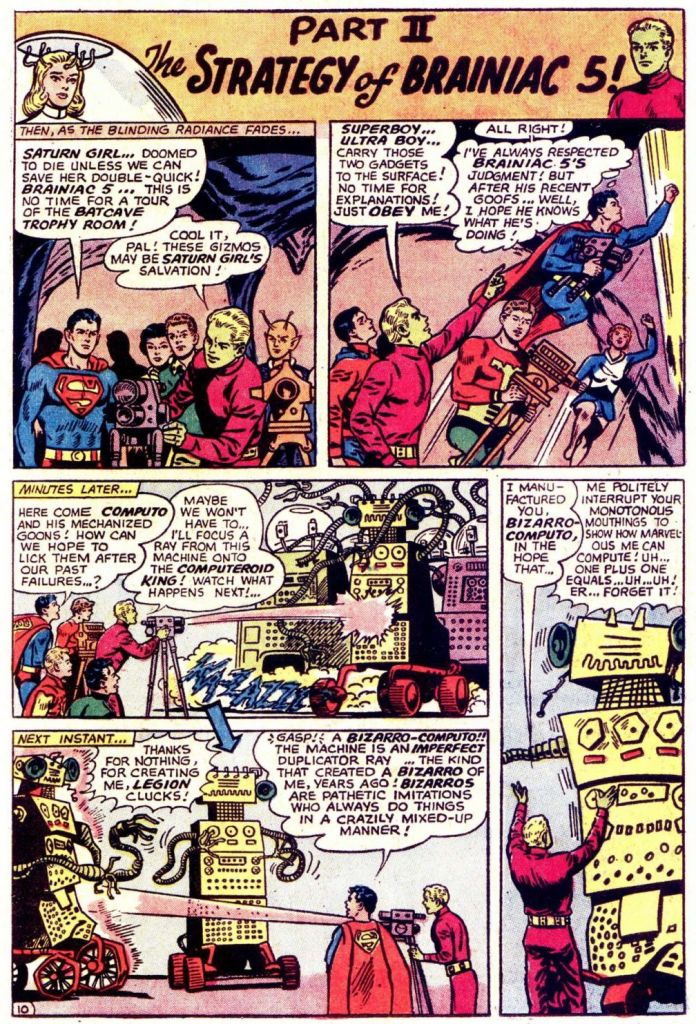
But Saturn Girl, Lightning Lad and Invisible Kid are still the captives of Computo, and so to rescue them, Brainiac 5 decides to employ the Imperfect Duplicator Ray that created Bizarro on Computo, creating a Bizarro Computo that he hopes will help battle their foe. But this whole stratagem is a bust, as Bizarro Computo acts just as goofily as you’d expect, trying for laughs but eliciting only groans with his ill-timed antics. Eventually, Computo himself has had enough and he casually destroys his Bizarro counterpart. Bouncing Boy, one of the more ridiculous Legionnaires, steps forward intent on rescuing Saturn Girl despite the fact that he’s lost his bouncing powers. The fair-minded Computo exposes Bouncing Boy to a gas that’ll restore his abilities for thirty minutes–pretty nice of the dude. But even given all of his old skill back, Bouncing Boy can’t lay a finger on either Computo or the captive Saturn Girl.
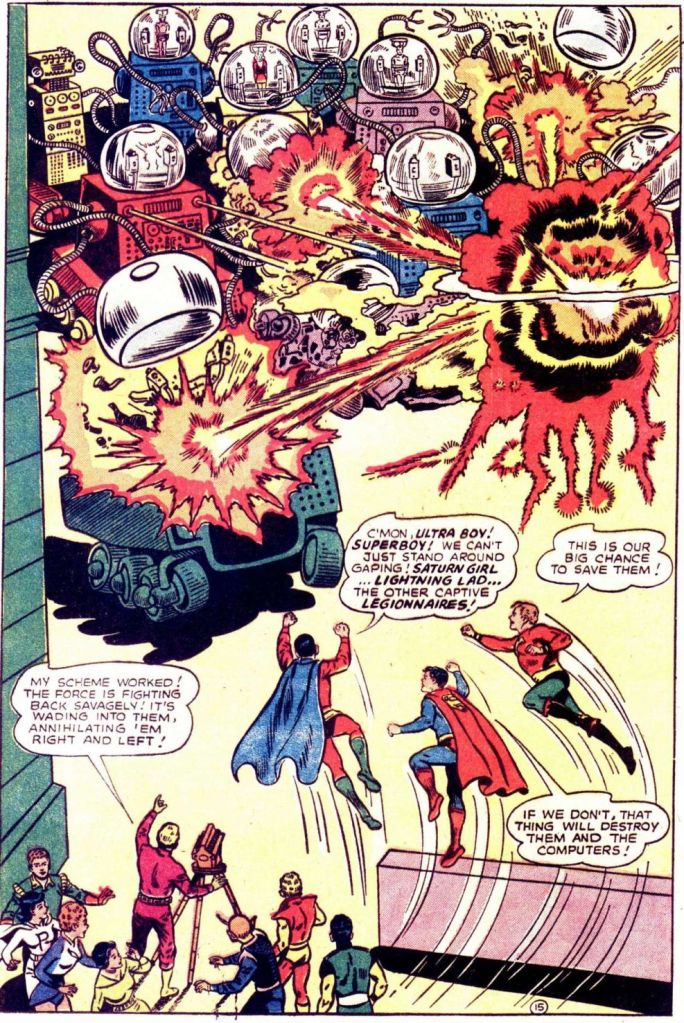
But Brainiac 5 still has one last card to play. Using equipment scavenged from the Batcave, he cobbles together a device that releases an Anti-Matter Force into their universe, hoping that it will be able to destroy Computo and his minions. And what do you know, it does! In the excitement, Superboy and his fellow are able to rescue Saturn Girl and the remaining captured Legionnaires before the robots holding them are vaporized. At that point, it’s a simple enough matter for Brainy to devise a way to knock the Anti-Matter Force back into its own universe. So the day is saved–but as Superboy returns to the present, the details of the adventure escape him, as he can’t retain his knowledge of the future. The whole story is a bit of a farce, with stakes that feel more comical than critical, and events that rely on silliness. The Legionnaires themselves don’t come across as particularly heroic or even competent. So there’s very little here to make a fan out of a new reader apart from the sheer number of costumed characters. The story was produced right at around the time the BATMAN live action series was first hitting the airwaves, and you can sense a similar strain of self-parody in this story.
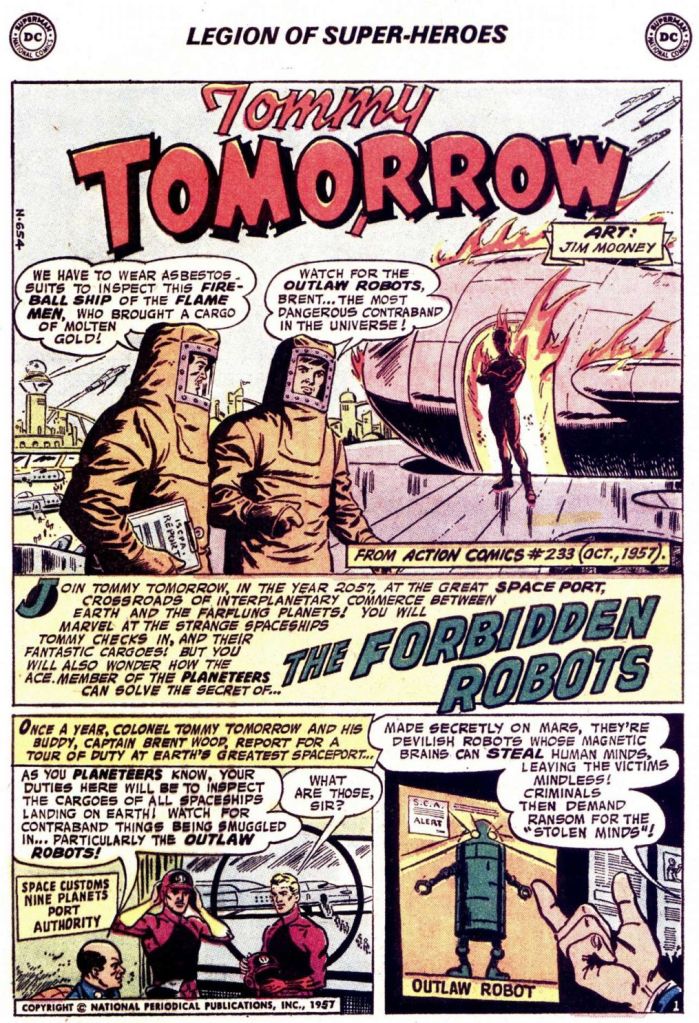
As the lead adventure ran a bit short, there’s a back-up as well, a Tommy Tomorrow story from 1957. I was never much of a fan of Tommy Tomorrow’s series. There was something at once both silly and dull about it. In this Otto Binder-written outing, with art supplied by Jim Mooney, Tommy and his buddy are posted to a spaceport where they’re on the lookout for contraband evil robots that can steal the minds of their victims. turns out that a space salesman by the name of Bart Bruce is the one smuggling them into port disguised as spaceships rather than smuggled aboard them. Tommy naturally figures out the deception when he spots that Bruce’s space odometer doesn’t indicate a trip to Saturn as he claimed, but rather one to Mars where the evil robots are being manufactured. It’s harmless but tepid, the kind of background strip that DC was rife with in the 1950s. It’s pretty easy to see why issues like this one wouldn’t have retained their power over children in the early 1970s.


I love how you would go over to your friends’ houses and just read comics.
LikeLiked by 1 person
“Bouncing Boy, one of the more ridiculous Legionnaires” – certainly uncool, but I will defend him. He’s bullet-resistant, knife-resistant, and packs a huge wallop coming at any opponent (without any risk of being hurt himself from impact). That immunity to impact-damage is underrated. He can slam into an opponent with a lot of speed, especially if he uses his flight-ring. And personally, he’s as brave and heroic as they come (“steps forward intent on rescuing Saturn Girl despite the fact that he’s lost his bouncing powers”).
Part of the appeal of the Legion at its best is clever but effective use of powers which aren’t the standard super-strength or energy-blast.
LikeLiked by 1 person
Agreed. In the early 1980s I was surprised at how engaging the storylines for LSH were, not at all the corny 1960s version I thought they were. And even the so-called Substitute Heroes (that Bouncing Boy came out of) were taken seriously by writers Paul Levitz and Keith Geffen. I often regretted that I came to the party rather late in reading lSH, since the Darkseid Saga was when I actually got onboard to consistently reading the title. By
LikeLike
All I can say is, as an actual 1970s kid, I found these Legion reprints absolutely fascinating. I loved the many members and learning all their powers and names and what planets they were from and so on. Sort of like kids today collecting Pokemon, I guess. And, clunky design aside, I thought they did a pretty good job making Computo feel like a serious threat. Brainy and Computo are sort of prototypes for Hank Pym and Ultron, now that I think about it…
LikeLiked by 2 people
I dug these issues too… hokey as they are. There’s definitely a contrast between DC and Marvel books during this time with how hard each would go when it came to super-heroic action. I think the Legion in the sixties is a pretty appealing book for younger readers not quite ready to read about knife fights or girlfriends getting tossed off bridges.
I’ve also pondered whether Computo was an inspiration for Ultron.
LikeLiked by 1 person
At the risk of sounding a bit harsh, it has to take some degree of skill to make a book about a team of teen superheroes a thousand years into the future look incredibly dated.
My introduction to the Legion came via a means similar to Tom’s. Only these were the issues blessed by Dave Cockrum’s stunning art and those eye-catching new costumes. That made stumbling across reprints like this so much more difficult to bear.
All that said, as a certified older guy, I do find a greater appreciation for these stories now.
LikeLiked by 1 person
It’s been quipped that it’s no wonder that DC artists back in the day struggled to convey the future since they could barely portray the present.
LikeLiked by 1 person
Ouch but yes.
LikeLike
Cockrum drew me into the Legion too and it survived years of bad art and boring stories but I don’t include Swan’s run which I’ve read in its entirety in reprints in either category. Yes, there was limited imagination about the future setting but the characters were delightful and odd and were stalwart heroes.
LikeLiked by 1 person
I would guess that these sold well enough that Carmine Infantino greenlighted making Superboy into Superboy and The Legion of Superheroes (you would guess in concert with the sales on the Superboy issues that featured The Legion).
The reprints on this were kind of random, the first was really weak the second was a time travel story with Kryptonian Colonists and early Atlanteans on a Mesozoic Earth by Edmond Hamilton (that was fondly remembered).
I have always wondered if the Metal Men reprint title sold fairly well, since they brought the book back about two years later in early 1976.
LikeLiked by 1 person
My introduction to Computo was in The Legion of Super-Heroes Annual#1 ( August 1982 ) wearing Danielle Foccart the younger sister of the new Invisible Kid ( Jacques Foccart — first appearance ). The primitive looking Computo that Tom shows here was seen not in flashback but as a holographic projection. TRIVIA: The X-Men fought a Computo created by Quasimodo [ X-Men#48 ( September 1968 ) & Cybertrons ( robots ) ]. What is funny is a 1966 artist created a primitive looking Computo and a 21st century Marvel artist created a Electro the Marvel of the Age ( see The Twelve ) that looks primitive next to the 1940’s Electro the Marvel of the Age ( The 1940’s Electro looks like a kissing cousin to the Titanium Man ).
LikeLiked by 2 people
Huh. I didn’t get into the Legion until the late 1990s, and that was via back issues and the hardcover Archive volumes. I have a fondness for the Silver Age stories. They’re sort of corny, yet at the same time I find a lot of them had some really cool pulp sci-fi elements to them, and the fact that (Superboy aside) the characters were basically B-list meant that the writers could do a limited amount of character development with them. So, yeah, Computo in his original boxy form here looks pretty hokey, and some of the shenanigans in this story are really goofy, but I still like this particular tale.
LikeLiked by 1 person
Part of the issue with this book was that the (pre-Jim Shooter) Mort Weisinger Legion feature was somewhat different in tone from not only what Marvel was doing but also what Julius Schwartz was doing in his books or what Kanigher was doing on his war comics (if not Wonder Woman) and what Boltinoff was doing on (say) Doom Patrol in 1966.
DC was (even in the 1970s) more of a set of editorial fiefdoms, with guys like Weisinger, Boltinoff, Schiff and Kashdan coming out of DC and Schwartz and Kanigher coming out of All=American that used the DC trade dress and had something of common ownershio.
LikeLiked by 1 person
My guess about the story’s tonal changes would be that Siegel knew he was going to end the story with B5 unleashing a possible “doomsday weapon” on Computo, but he had to build up slowly to generate suspense. Unfortunately, as Tom says, goofy stratagems like the Weirdo Legionnaire and Bizarro-Computer made the whole Legion look pathetic. I suspect Siegel didn’t give the matter much thought because he liked injecting zany stuff into serious stories. And yet he was at his best when he did keep the serious stuff serious, like 1963’s “Stolen Super Powers,” and he confined the crazy stuff to Bizarro World.
LikeLike
Siegel, as d9 says, loved zany stuff and shtick. This must have been up his ally.
As an LSH fan starting a decade earlier, I was delighted to get four reprints of stories I hadn’t read. And I’m old enough their future still appeals to me more than, say, Grant Morrison’s 1 million setting (which I enjoyed, to be clear). It’s what we all knew the future would be like some day.
LikeLiked by 1 person
Tom, you may find my December, 2025 post about the original publication of this story to be of some interest (if for no other reason than that your current post allowed me to add an addendum re: the writing credit): https://drcwrites.com/2025/12/28/on-sale-in-december-1965-3/
LikeLiked by 1 person