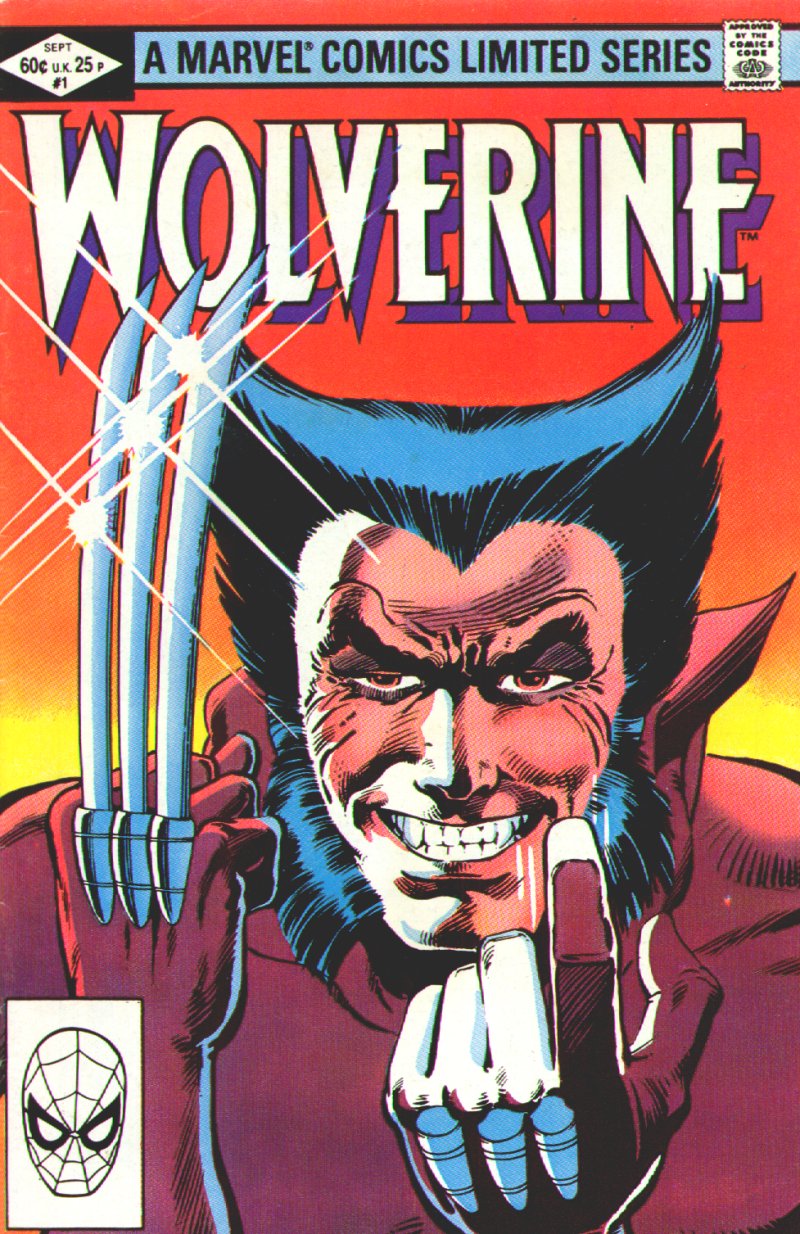


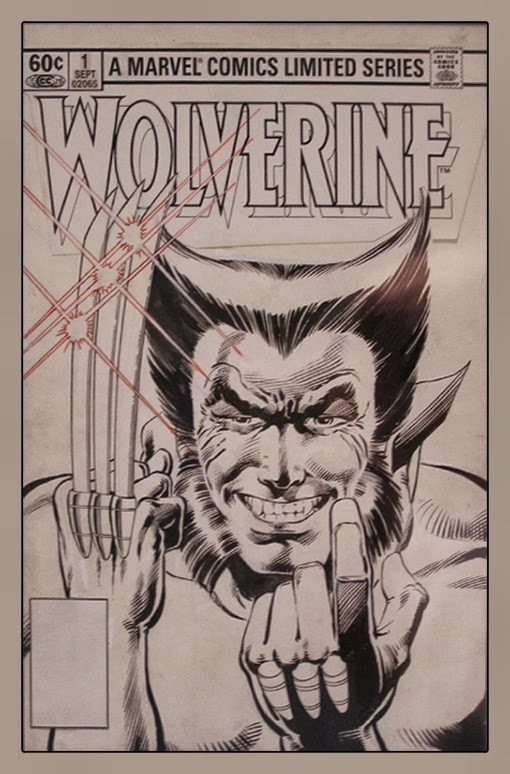
At the very end of the 1970s, comic books began to take a cue from network television. There, the concept of a limited series of broadcasts had become popular as important destination viewing, garnering ratings that proved such programming to be attractive to potential viewers. Accordingly, first DC and them Marvel began to experiment with the idea of producing limited series built around particular properties and characters. In 1982, few enough of these had so far been done that they did legitimately seem like important releases. And in particular, this WOLVERINE limited series was the singular publication that exploded the character’s popularity into the stratosphere. Prior to this, Wolverine’s fan base had been growing steadily since the Chris Claremont/John Byrne issues of X-MEN a few years before. But this was the story that crystalized all of the elements of the character that would prove to be exceedingly popular all the way to the present day. It’s a great piece of work, and the example that I point to for editors and creators alike in terms of crafting a single meaningful adventure for a given character that tells the reader everything that they need to know about them.
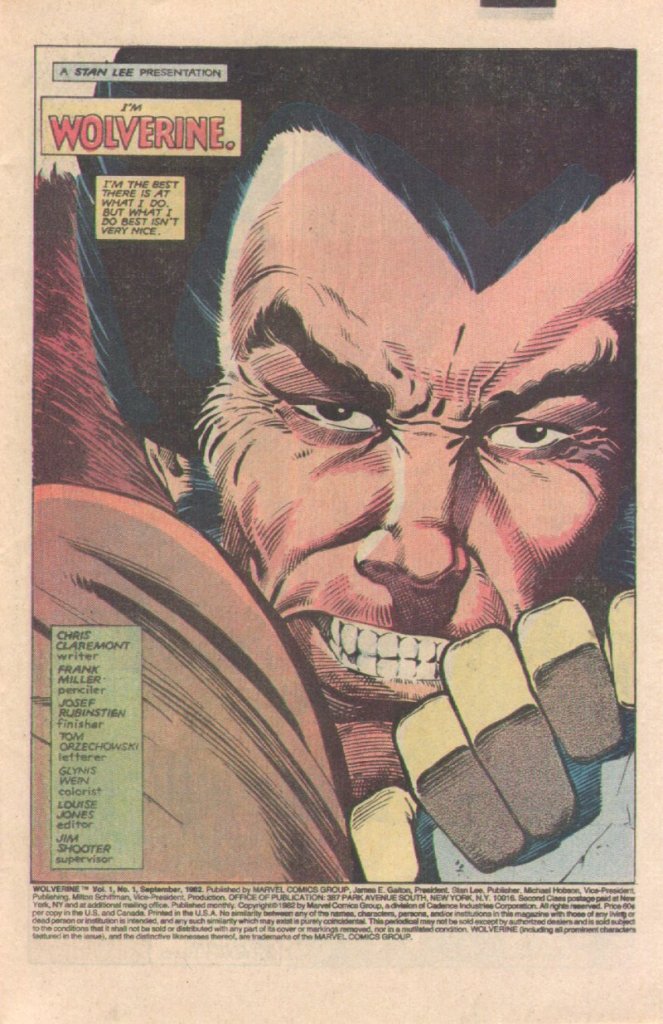
The project was also the fusion of a number of top talents, all of whom were in their prime at this particular moment. X-MEN writer Chris Claremont had already evidenced a process that he’d use successfully all throughout his tenure on the series: whenever something popped in either popular culture or in the world of Marvel, Chris moved immediately to bring those elements into his X-MEN work. In cases such as Ann Nocenti and Arthur Adams’ LONGSHOT limited series, Chris swallowed that material whole and made it an important part of the X-MEN lexicon. In this case, however, he was only able to draft off of Frank Miller’s popularizing of ninjas in the form of the Hand in his DAREDEVIL work. But it was enough, and the characters became as much associated with Wolverine hereafter as they were with Daredevil. No doubt this had a lot to do with the fact that Frank co-plotted and illustrated this series.
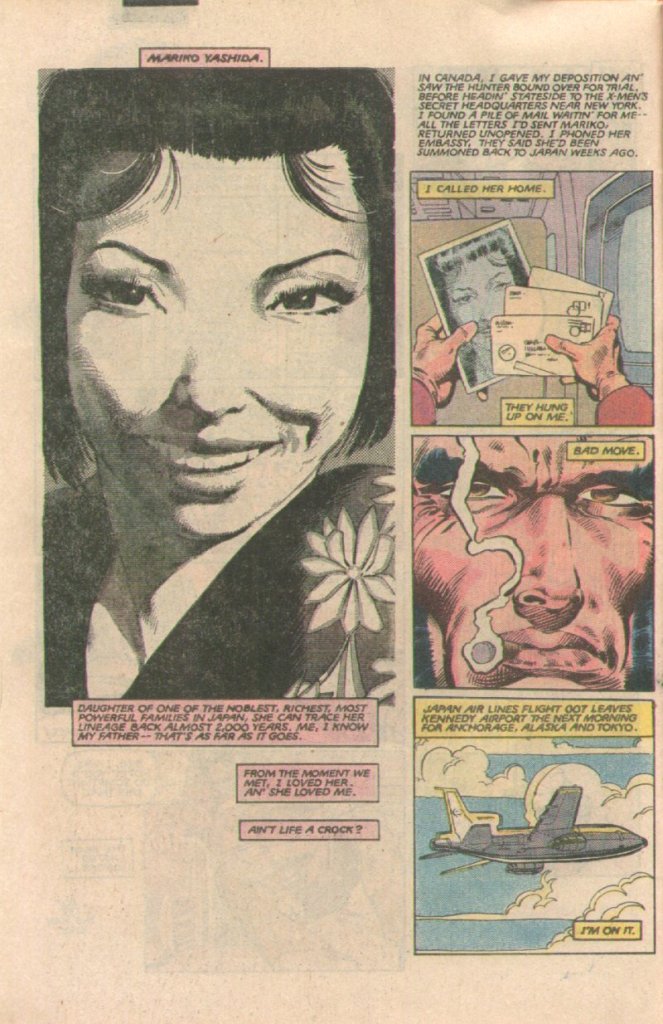
According to legend, Chris and Frank plotted out the events of this limited series on a car ride from the San Diego Comic Con that year back to Los Angeles where they had meetings. And it’s clear that a lot of the storytelling in particular derives from Miller’s influence. His pages are staccato and open, with a clear visual rhythm to them. He leaves Chris plenty of room to add text, the sort of “frosting” that Claremont would typically provide over the work of collaborators such as Cockrum and Byrne to bring the characters’ inner lives to light. In this instance, Chris takes a cue from what Miller had been doing on occasion in DAREDEVIL and has Wolverine provide first person narration all throughout the four issues. It’s an inspired choice, giving Claremont the space to develop the different colors of the character’s personality while allowing the artwork to carry the main plot narrative forward.
Ever since having read James Clavell’s novel SHOGUN, Chris and his collaborators had been introducing elements of Japanese culture into Wolverine’s world. But this is the story that overtly cast him in the role of a ronin, a masterless samurai guided by his own personal sense of honor. it marked the transition of the character from being merely a violent little spark plug into something more noble and nuanced. The issue opens with a prologue adventure in which Wolverine hunts down a maddened bear that had killed a number of campers, then also seeks out the careless hunter whose poisoned barb had inflamed the bear to its homicidal actions. This brief introduction showcases all of Wolverine’s powers as well as his demeanor and outlook: he’s a hard, rough man, but one that’s guided by an almost elemental vision of right and wrong. And most crucially in this era, he’s established as a super hero who won’t hesitate to kill should the situation call for it. This was an aspect of the character that EIC Jim Shooter had been pushing back against, and it’s likely his influence that explains why the sequence ends with Wolverine explicitly allowing the hunter to live rather than taking his life. Shooter didn’t think that Marvel heroes should go around killing people, even bad people, without there being consequences.
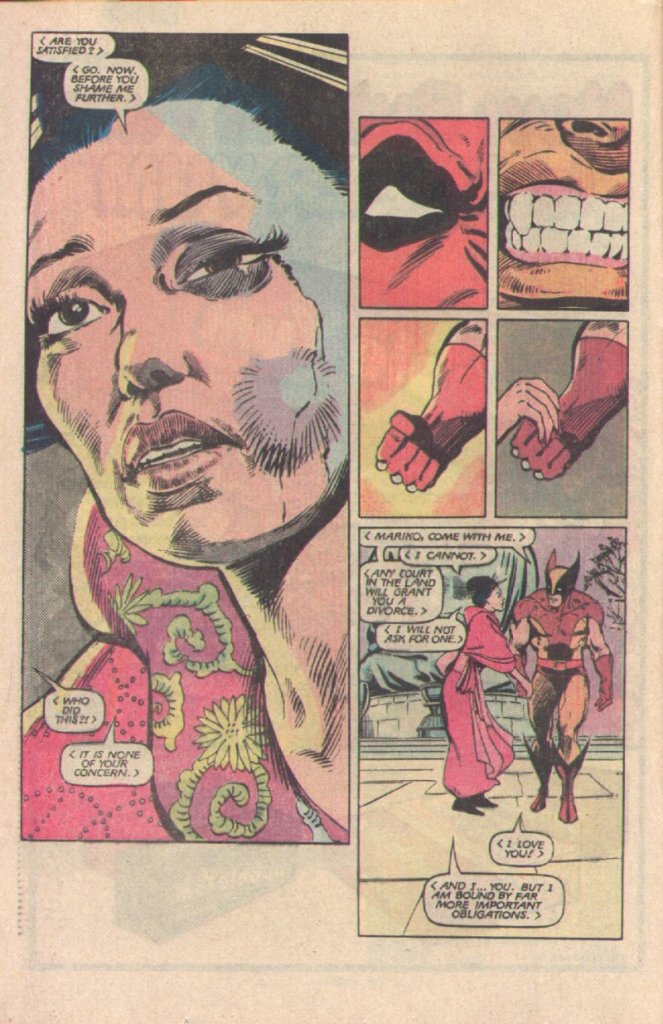
From there, the story moves to Japan. For some time, Wolverine had been building a relationship with Mariko Yashida, the young cousin of sometimes-X-Man Sunfire. But of course, this being a Chris Claremont story, Mariko couldn’t turn out to be anything so simple as a regular person. We learn that she’s the daughter of Lord Shingen, one of the most powerful underworld figures in the country. When she suddenly cuts off all contact with Logan, he follows her to Japan, but he’s unable to gain an audience with her through any official channels. Consequently, Wolverine suits up and sneaks into the compound of Clan Yashida. There he learns that Mariko has been promised as a wife to another criminal figure in order to pay off a debt, and that this man has been beating her. Logan wants to take her away from this life, but she feels bound by obligations of honor to remain–she will not disgrace her family by leaving.
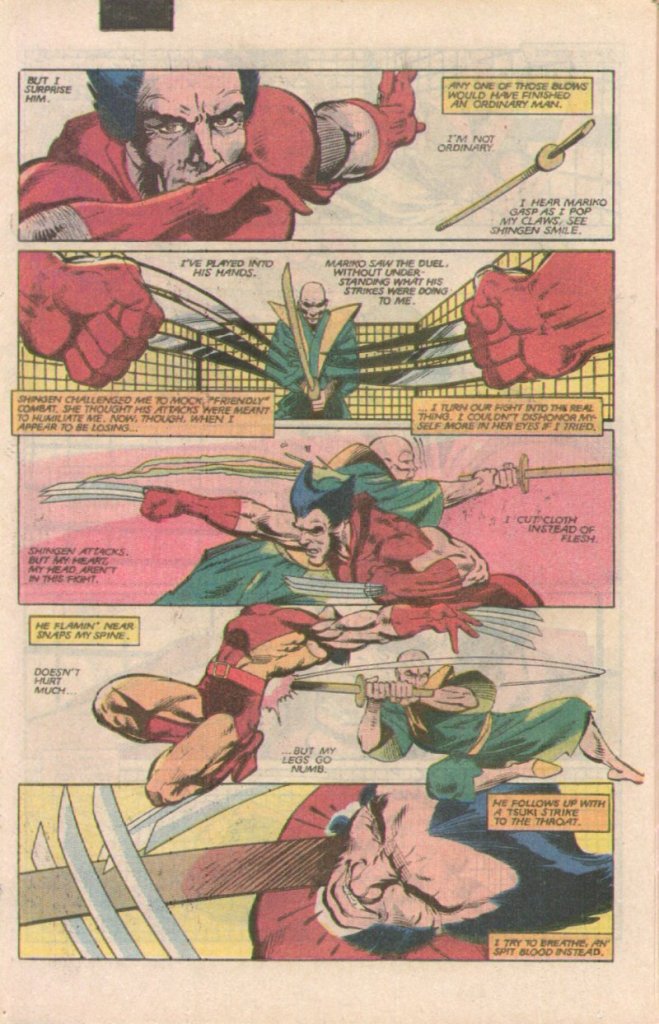
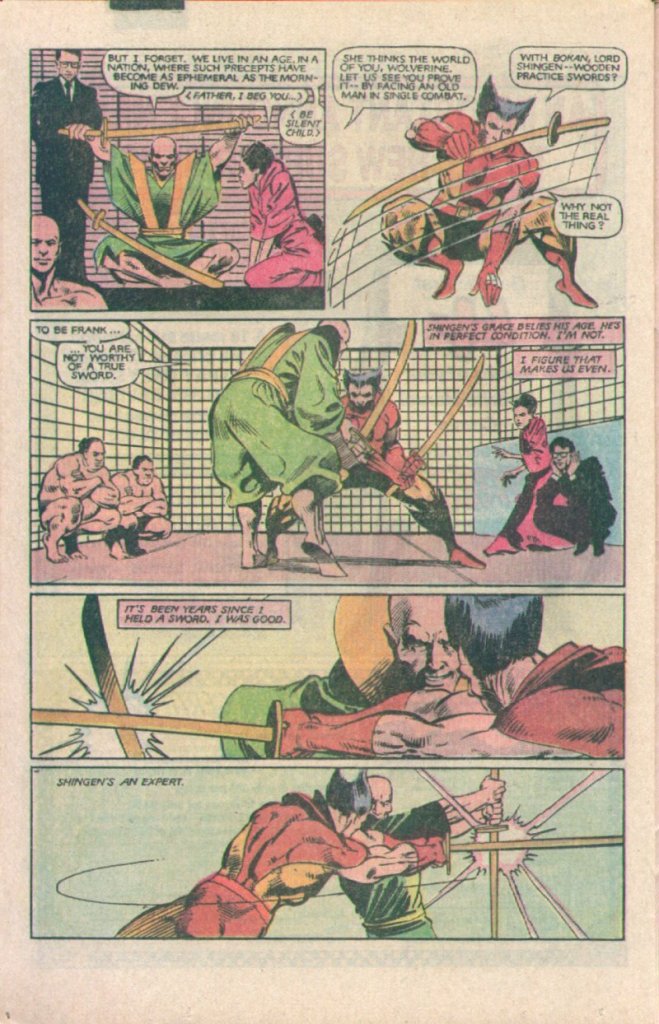
Wolverine lingers too long, and he’s suddenly overwhelmed by drugged shuriken that drive him unconscious–his fabled healing factor wasn’t so all-powerful in these days. When he wakes, he’s confronted by Lord Shingen himself, who challenges him to a duel to prove his worthiness. The old man throws Wolverine a wooden practice sword, telling him that he isn’t worth a true blade. Shingen himself is an expert swordsman–and this is still the days before Wolverine would effortlessly slash his way through armies of such foes. Instead, despite his skill, Shingen kicks the crap out of him. And when Logan is wounded and resorts to popping his claws, true lethal weapons, he dishonors himself before the assembled retinue. Not that it matters, he can’t even tag his opponent once. The battle is a rout, and before he fades into unconsciousness, Logan hears Shingen tell Mariko that her professed lover is no more than an animal in human form and unworthy of her hand.
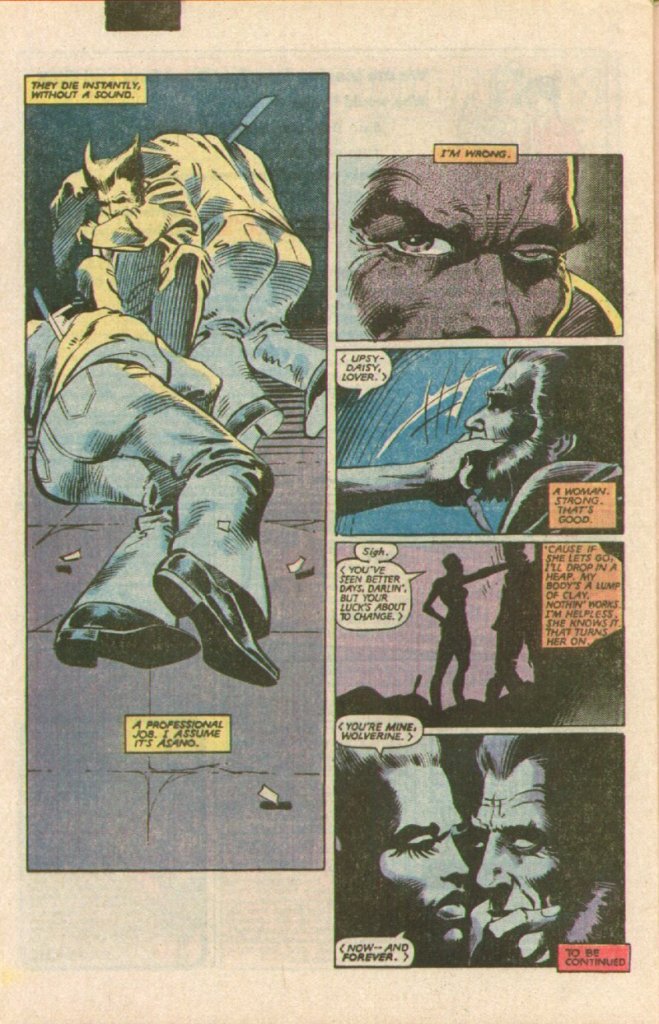
As the issue reaches its conclusion, Wolverine awakens in an alleyway, still injured and unable to move. But he’s rescued from a trio of would-be muggers by a mysterious beauty. This will turn out to be Yukio, a key character in the story as it moves ahead. But after an opening that illustrated Wolverine’s true prowess and grit, we’ve now seen him fall to his lowest point. The next three issues will be about him climbing back out again and restoring his lost honor. Miller in particular channels his obvious love of samurai cinema and manga throughout this series, and his work is embellished well by Joe Rubinstein, a more mainstream-friendly inker than Miller would typically with with. It’s a good combination, maintaining Frank’s sharp storytelling while making it all feel like an extended part of the X-Men’s world. Similarly, the synthesis between Miller’s approach and Claremont’s is also virtually seamless. This is a story that knows exactly what it’s trying to be and hits the bullseye spot-on. There’s a reason why it’s still so highly regarded even after forty-plus years.


The dichotomy of how good this series was and the awfulness of the start of his regular series is something that needs to be studied to prevent it from ever happening again.
LikeLiked by 1 person
I’m pretty sure there was some interview or panel in which Miller said he used big panels to give CC lots of space for copy, while CC said, having seen the Miller work on DD, chose to “write terse.”
LikeLiked by 2 people
Miller made a number of significant visual changes… the shape of Wolverine’s claws and that he spends a fair amount of time unmasked and/or in street clothes. Before this… the claws conformed to the shape of the glove ports. They slashed but they were more like rapiers. Frank turned them into katanas… which somehow wider at the tip than the holes they sprang from.
Rubinstein brings a lot to the table here…. he was everywhere in those days.
LikeLiked by 2 people
The first inker I learned to recognize.
LikeLike
To be honest, this initial issue of the miniseries left me underwhelmed. But, to the credit of the creators involved, by the fourth issue, I savored every panel, realizing this was an outstanding comic book series. Bear in mind that I had not read Miller’s Daredevil – as I was easing back into comic books at that time.
I also found it intriguing that while an aged Japanese warlord was essentially beating up on Wolverine in this book, that our hero was essentially taking on an entire planet of the Brood over in the X-Men at that same time.
Apples and oranges and all wonderful reading!
LikeLiked by 1 person
Adventure comics didn’t come much better than this series.
LikeLiked by 1 person
Claremont’s interest in Japanese culture/tropes wore out its welcome with me relatively quickly. I remember a story where Juggernaut implausibly starts tossing out Japanese concepts of honor, which didn’t work at all.
LikeLike
Betsy Braddock getting an Asian skin suit was bizarre too. A wee bit offensive too when a later writer used the rich white woman who had a body swap as evidence of racial diversity on the team.
LikeLiked by 1 person
I wonder why that wasn’t stopped, cause I thought that was the reason Doctor Droom [ Amazing Adventures#1-4 ( June-September 1961 ), #6 ( November 1961 ) ] was remade as Doctor Druid, minus a Caucasian man getting changed into an Asian man ( That whole only a Caucasian can play an Asian man thing — Mr. Moto ( Peter Lorre, Henry Silva ), Charlie Chan ( Warner Oland ), Chun ( Joel Grey — Remo Williams: The Adventure Begins ).
LikeLike
Betsy was hotter and more popular as Asian with lots of skin. They should have swapped minds back and not killed the real Psylocke much, much sooner.
LikeLike
My thoughts Steve was if Chris Claremont wanted an Asian member [ The Uncanny X-Men#256 ( Late December 1989 ) Psylocke ( Kwannon – dream ) & Lady Mandarin ( Betsy Braddock — first appearance ) ] he should have booted Betsy over to Excalibur[ they clearly were a team then — Excalibur#1 ( October 1988 ) ] and used Kwannon in the X-Men. Not like there weren’t siblings in Marvel hero teams ( Quicksilver-Scarlet Witch, Northstar -Aurora, Human Torch-Invisible Woman, Cyclops-Havok ).
LikeLiked by 1 person
“Mariko” was also the love interest in “Shogun.” “Logan” seems to come from “Logan’s Run.” And of course there’s a fair amount of Clint Eastwood / Charles Bronson in his character.
LikeLiked by 1 person
In this issue was an ad for Darkseid-Dark Phoenix ( a.k.a. Marvel and DC Presents Featuring the Uncanny X-Men and the New Teen Titans#1 ). I remember this issue but not my thoughts at the time for it or the rest of the mini-series. I’m sure my thoughts when I saw an ad for it was, “They are giving Wolverine a limited series, I’m getting that”.
LikeLike
I confess that I wasn’t going to buy the Wolverine mini series when it came out. It wasn’t until the fourth issue concluded with the great wedding invitation that I realized I had missed something great. So I bought that fourth issue.
While unemployed, and looking for another job, I visited my folks and my dad took me to an autoparts store to buy a new muffler for my car. We went next door to a Walgreens and there were a bunch of bagged comics hanging on a pegboard hanger. Most of them were fronted by either the Care Bears, or Archie, or something similarly aimed at young kids, but a 3 for $1.25 or so, it was a good enough value to flip through.
Hanging two bags in, was a Wolverine #1 facing me. I couldn’t believe my luck. I pulled it off the peg and flipped it over, discovering it had #3 on the backside. I strained and pulled at the bag until I got a glimpse of the spine of the third issue that was in the middle. I could recognize the Marvel trade dress at the top, and the dark coloring of the cover, but didn’t know what it was.
I BEGGED my father to loan me $2 for a purchase, as I didn’t carry any change at the time, and I had just put the muffler on my credit card. There was no ATM for my bank in that small town. After a little deliberation, he handed me the $2 and I bought the bagged comics, figuring my luck would only hold for the two issues I could see.
To my great pleasure, when I slit the bag open at home, I found I had mint copies of Wolverine mini series #1-2-3 in my hands. Together with my fourth issue back in my apartment, I had the complete set. I was thrilled!
I have never forgotten that day, and my Father’s dubious look when I asked him for two dollars while I was unemployed for a pack of comic books. He never understood, even when I told him how important and how rare these books were. He just never understood.
I have never forgotten that day.
LikeLiked by 1 person