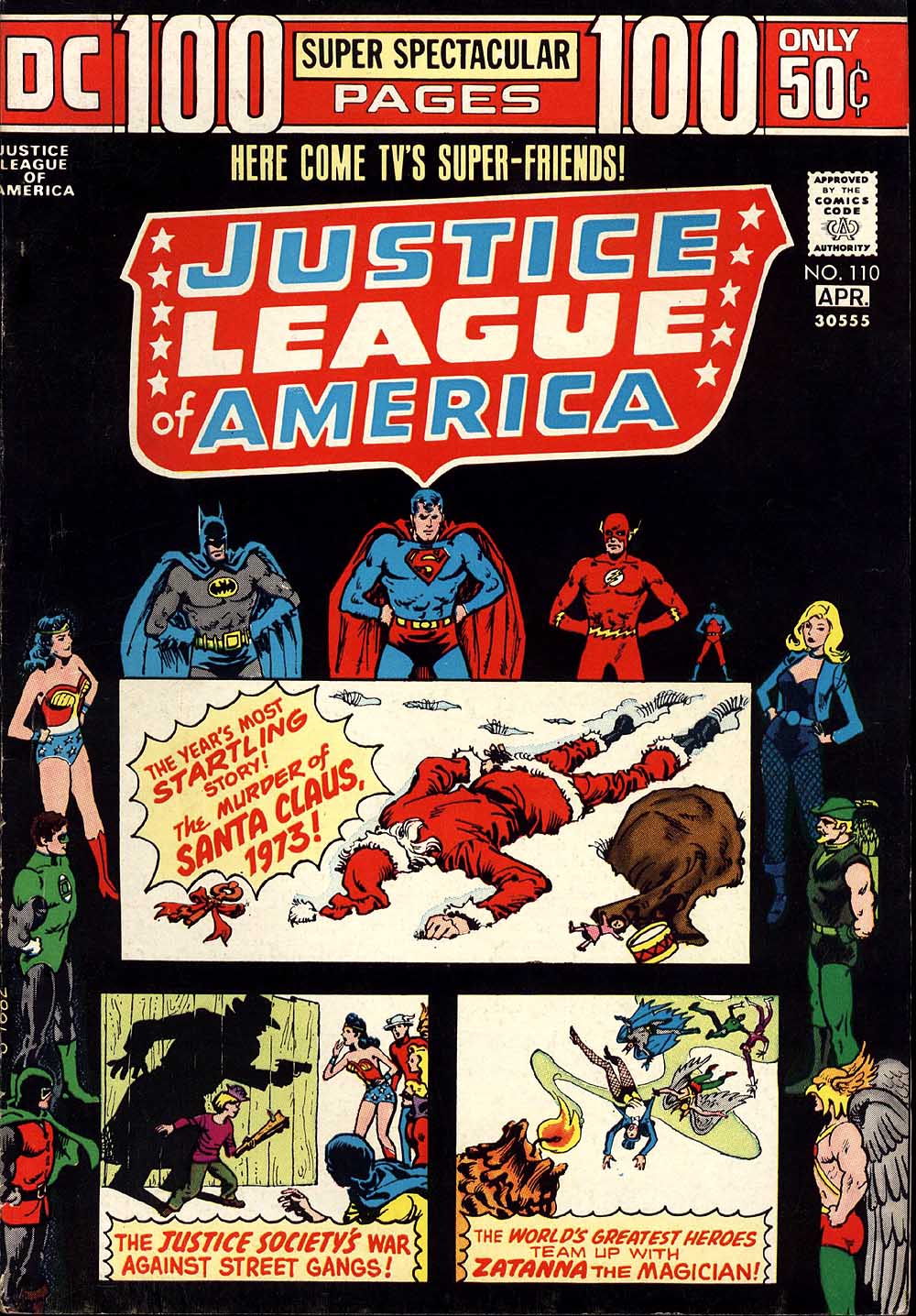


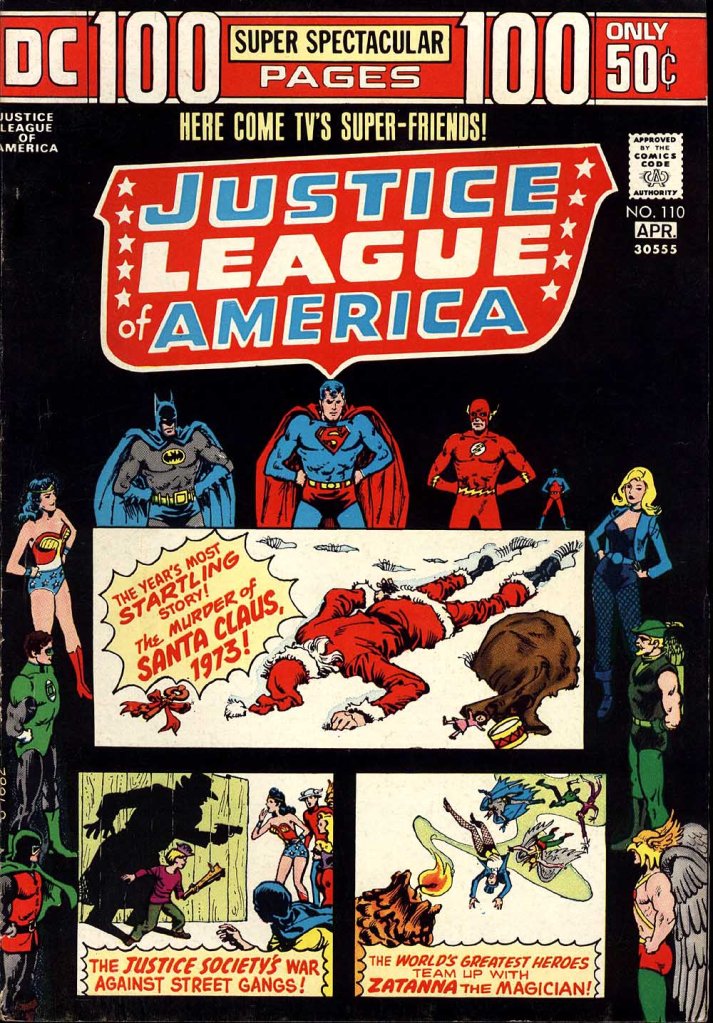
This next book isn’t one that I ever actually borrowed from my next-door-neighbor Johnny Rantinella. But it was one that I saw over at his house and flipped through extensively–enough so that I can clearly recall several details about it. I had only begun reading JUSTICE LEAGUE OF AMERICA with the preceding issue, and would only have been six years old in the first place. All of which is to explain that, not having fully absorbed the story in this issue, I thought it was about the Justice League solving the murder of the genuine Santa Claus, rather than a charity worker in Santa’s garb. In 1973, I was still harboring the illusion that Santa Claus was a genuine entity.
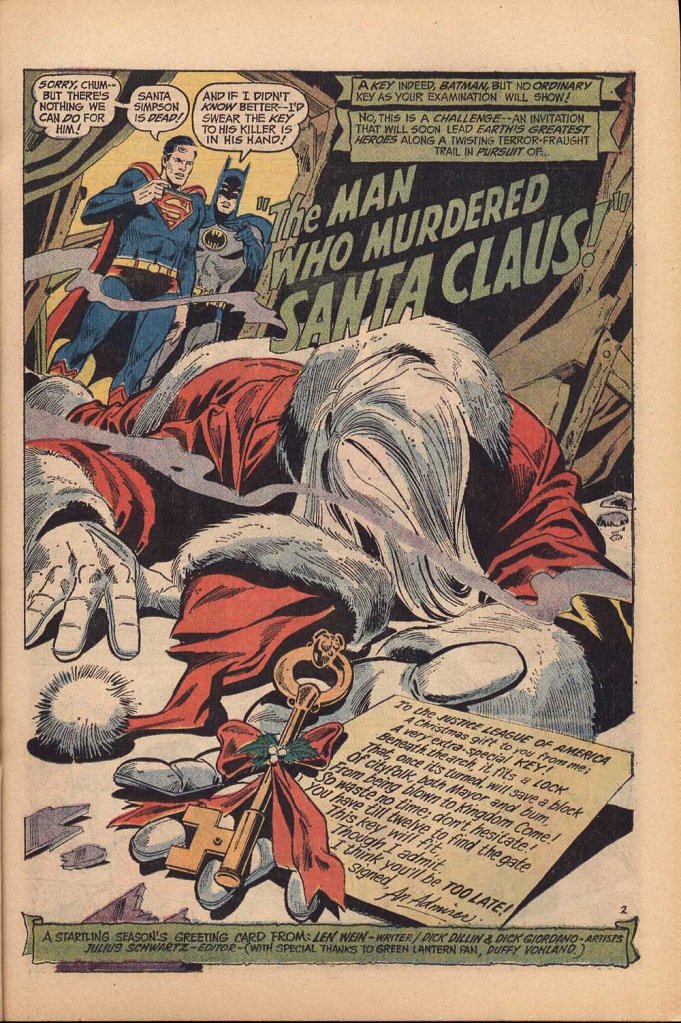
This period during which writer Len Wein was helming JUSTICE LEAGUE OF AMERICA is one of my favorite in the title’s history, and not just for nostalgic reasons. After a long stretch of time in which the series had grappled with attempting to be relevant in the wake of the popular success of the GREEN LANTERN/GREEN ARROW series, Len was the first to steer the book back towards its roots as a super hero action-adventure series. He also made good use of the extended nascent DC Universe of characters, adding new members to the team such as the Phantom Stranger, who turns up in this issue as a Deus-Ex-Machina to pull the rest of the group out of trouble. It was very much the classic Gardner Fox/Mike Sekowsky approach but modernized and made a bit more contemporary, and I found it incredibly appealing.
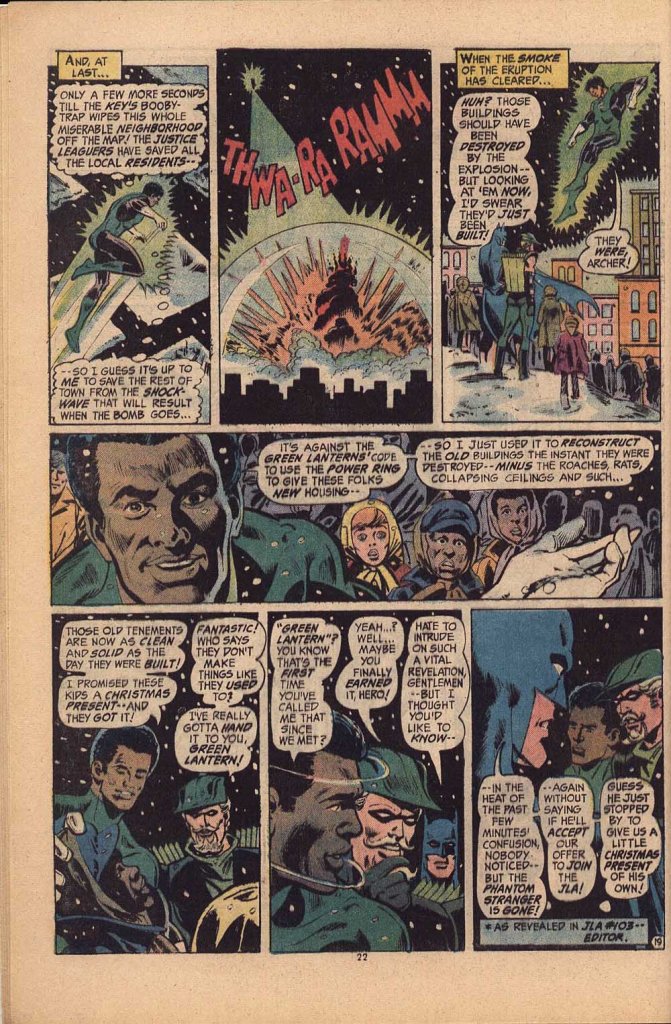
The story concerned the League’s old enemy the Key killing prominent charity Santa Claus in order to lure the team into a series of death traps–the Key himself is dying, and he intends to finish off his foes before he meets his maker. This is also the classic story in which clumsy Hal Jordan slips in the shower and knocks himself unconscious, causing his power ring to seek out the recently-introduced John Stewart to take his place when the JLA alert comes in. (Stewart was referred to in this story as “Black Lantern” for a bit of it, an appellation that thankfully didn’t stick.) Otherwise, it’s an exciting holiday adventure with some good feelings as well as jeopardy and excitement. At the end of it, the Red Tornado gets a new costume, one designed by Wein himself that the character will wear for the foreseeable future. Not everybody liked this look, but as a kid it worked for me, even if it was a bit overdone.
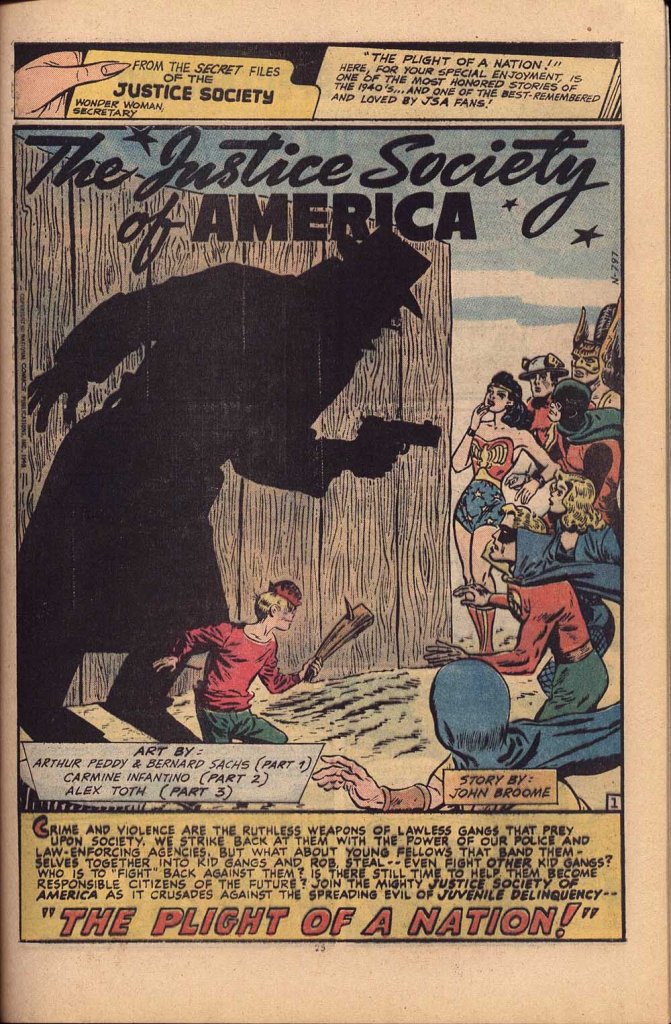
The next story in this classic issue–I loved these 100-Page Super-Spectaculars for their thickness and for the classic tales that they reprinted–was a full-length adventure of the JLA’s predecessors, the Justice Society of America. Or, as I pronounced it as a six-year-old, the “Justice Sotery”, not being familiar yet with the word Society. This was a well-remembered story in which the JSA took on not a mad scientist or criminal mastermind but rather the broad ills that were turning the kids of the day into juvenile delinquents. It was written by future Flash scribe John Broome and illustrated by the trio of Arthur Peddy, Carmine Infantino and Alex Toth, each one taking a chapter, each one a lot younger in their careers. This would have been my first encounter with the Justice Society and I didn’t entirely know what to make of them yet.
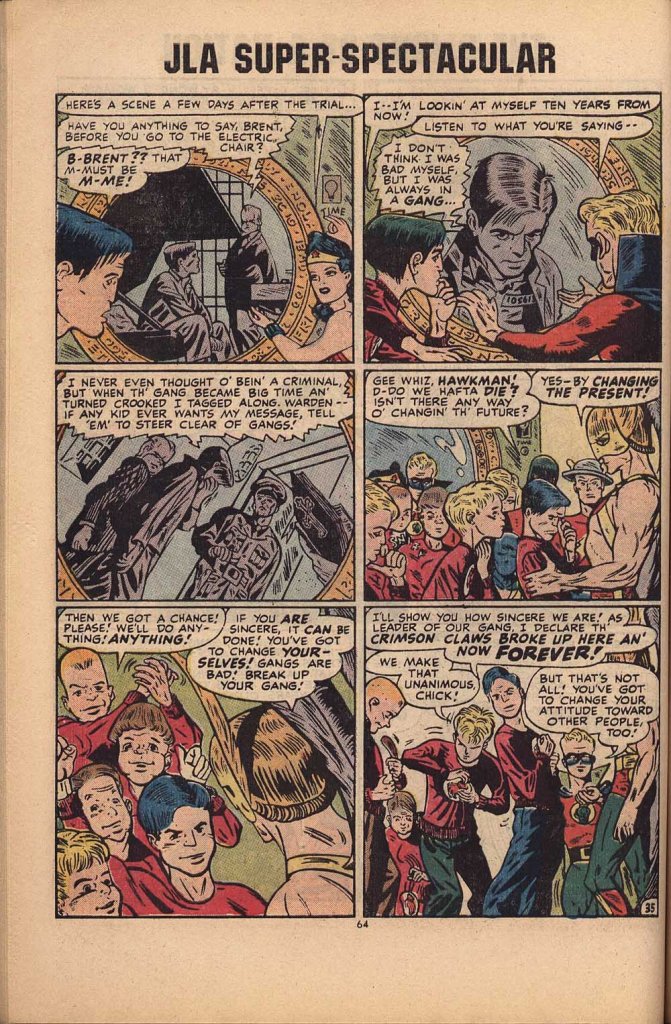
The story involves the Justice Society moving against the criminal Crimson Claws gang and getting involved in the lives of some kids who have formed a junior Crimson Claws organization in emulation of the gangsters they hold as heroes. It’s pure B-movie schmaltz, with the Junior Justice Society fan club also playing a role. In the end, Wonder Woman shows the boys what will happen to them if they don’t change their ways with her Magic Sphere, and the kids promise to walk the straight and narrow from then on. This was all definitely a reaction t the increasing popularity of crime comic books in the marketplace at the time this story was first printed, a way for ALL-STAR COMICS to ride that bandwagon a little bit, while simultaneously delivering the sort of pro-social message that had become one of its hallmarks.
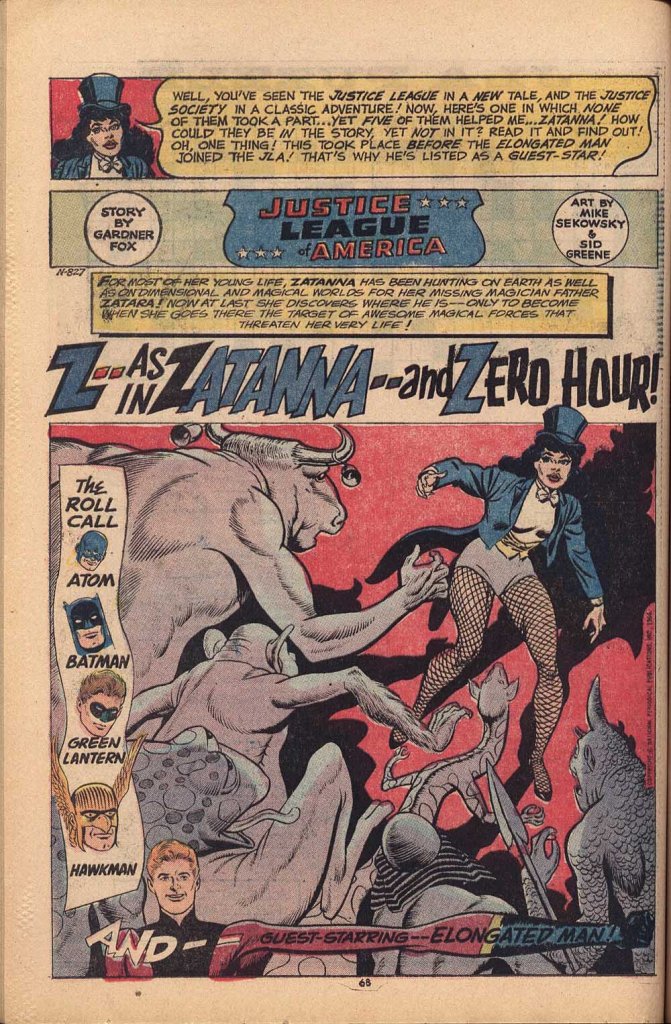
The final reprinted story in this oversized issue was the wrap-up to a long serial that had bounced around through the pages of editor Schwartz’s titles back in the 1960s–and which he had been reprinting chapter-by-chapter across the pages of several modern 100-Page Super-Spectaculars. This was “Zatanna’s Quest”, in which the newly-introduced lady sorceress was on a search for her missing father Zatara, who himself had been a featured DC hero dating back to the pages of ACTION COMICS #1. This JLA story brought together all of the heroes who had aided Zatanna in her journey up to this point, including the Elongated Man who wasn’t yet a JLA member, and Batman, who insisted that he’d never met Zatanna but who was so popular thanks to his television series when this story was produced that he had to be included. A previous Batman adventure was amended to indicate that Zatanna had secretly been the criminal witch that the Caped Crusader had encountered in that earlier tale, thus justifying his inclusion.
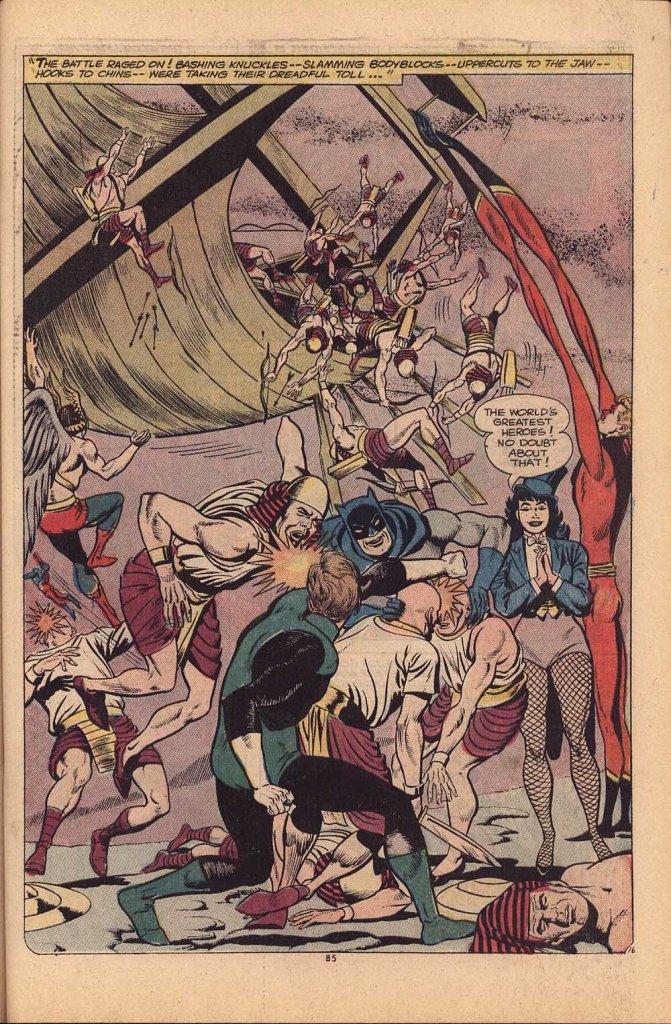
And in fact, the actual Justice League members aren’t involved in the actual action at all. The story opens with Zatanna appearing before the assembled group in their secret sanctuary to thank them for their assistance, then revealing how she was able to locate and liberate her dad thanks to the assistance of magically-conjured duplicates of the various heroes, the creation of which was only possible due to her earlier encounters with them. It was a long way to go–probably easier and more satisfying all around to have simply had Zatanna request the League’s aid for the final leg of her journey. But, hey, I’m no Gardner Fox, who wrote this story. The art was by the quirky Mike Sekowsky, who was clearly having to adjust his approach for the smaller original art paper that was beginning to be used at around this time. Consequently, his pages in this story are more chaotic and cluttered than usual, as he was still getting used to the available space having drawn so much larger for so long.


Yeah, I had this one too and it made quite an impression, particularly the “scared straight” segment of the JSA story. I also vaguely remember wondering why John Stewart couldn’t be Green Lantern all the time after reading the JLA story, though I’d forgotten the part about how the Green Lantern code forbids using their rings to build homes for the unhoused.
I believe that this was one of the few 100-Page Specials I got for 50 cents that had a mixture of old and new material before the price went up to 60 cents. I seem to recall that some of the earlier 50-centers were all reprints, but made up for it by having no ads, which was something I always liked.
LikeLiked by 1 person
I really enjoyed that Justice Society story; it was refreshing to see them dealing with more down-to-earth concerns (although it’s a stretch to believe that a gang of ordinary crooks could give them so much trouble). Wonder Woman pulling the “scared straight” routine with her Magic Sphere was a clever use of her established lore. The sequence where they talk about the causes of juvenile delinquency — poverty, hunger, absent parents, etc. — almost seems like a direct response to those who claimed comic books were to blame. Dr. Wertham and his crusade were still a few years into the future, but perhaps there were other people saying similar things even back then?
LikeLike
This was a recurring problem with the JSA. One advantage of the Seven Soldiers was that they didn’t have heavy hitters like Green Lantern or (in other adventures) Spectre.
LikeLike
IIRC Mike Friedrich retelling the JLA origin in 97 got me reading comics again after a long separation. Len Wein had a much better sense of how to make the stories sing. I was bummed when for some reason I didn’t pick this one up but I found a used copy a couple of months later. PHew!
LikeLiked by 1 person
Aw man, does this one bring back memories! Myself with two other buddies in middle school reading the latest collection of Marvels with the occasional DC thrown in for good measure. JLA often made the cut because we all knew Len Wein’s name from his Marvel work – giving the “direct competition” the authenticity to plunk down our hard-earned lawn mowing earnings. That and this was at least how we wished stories like these were what we’d see on that first season of The Superfriends. And oh my, the fun arguments we’ve have with Marvel vs. DC characters. Then we’d all admit that we preferred what we thought was Marvel’s action to all that “brain-power” at DC. The reprints didn’t grab us quite as much at the time. That said, we never, ever, objected to Zatanna appearing in any series.
LikeLike
I’m middle of the road about Wein’s writing but he was responsible for the second worst costume in JLA V1’s history? Not the way to get me to like his work more in retrospect…
LikeLike
This run wasn’t just marked by Len’s fun stories that gave the Leaguers a lot more personality that previous, but also the inks of Dick Giordano, who made Dillin’s superhero art look better than I think it ever did elsewhere.
A very nice run that could use an oversized HC collecting the whole thing.
LikeLiked by 2 people
No disagreement on the Dillin-Giordano art. It was different than what we saw from Marvel at that time, but the more angular look certainly worked for us. I’ll also second that DC publish a collection of this run.
LikeLike
A Wein/Dillin hardcover.
An Englehart/Dillin hardcover.
And I’d like a set of collections of the Wein editorial run, but I think that’d be more likely in the DC Finest line than as a deluxe hardcover. I mean, I’d like a deluxe hardcover of the Conway/Heck run, but I’m pretty well aware it wouldn’t sell well.
A Conway/Pérez hardcover would probably do okay, though.
LikeLiked by 1 person
I loved the way John Stewart bent the rules at the end of this story, in using the power ring to reconstruct all the houses. It’s pushing against the genre conventions, but it worked here for me. I wish this had been used more as a social-activist character aspect of his. Green Arrow’s a loudmouth about activism. A good contrast would be someone looking out for ways to work “within the system”, but rules-lawyering it all as much as he could. That keeps it from getting out of hand, but still allows him to have a very distinct personality in terms of being a Green Lantern.
LikeLike
Yep, a great issue, overall, which I fondly remember buying fresh off the stands. The Wein-Dillin-Giordano era was one of the JLA’s best, to my mind, and the lead story is but one of the reasons why (even if I disagree with your positive assessment of the RT costume change). The JSA story was, if I recall correctly, only the second to have been reprinted by DC by that time and it was a nice treat, especially for those of us who’d been along for the JSA-revival ride from (or, in my case, very near) its early ’60s start. Rounding things out, I’d missed the conclusion to the series-spanning Zatanna arc when it was originally published, so it, too, was a treat, even if I was never especially fond of Greene’s heavy inks over Sekowsky’s pencils.
LikeLiked by 1 person
Sid Greene: my second least-favorite inker (after Vince Colletta) of all time. His inks are like fingernails on a chalkboard for me.
LikeLike
Well at least I’m not the only one who didn’t know how to pronounce the word society. When I first read a JLA/JSA adventure I thought it was pronounced Socketty.
LikeLike
I was able to handle “society”, but got caught on Ralph Dibny’s alter-ego, pronouncing it as “Elonjated Man”.
LikeLike
At least you were phonetically correct.
LikeLike
Yeah – had the same problem with the word “society”. I pronounced it “sosh – ity”
LikeLike
This book’s on sale date was two days after my 13th birthday and I can remember the excitement I had buying it from my local drug store (a local comic shop was still 3+ years away). Truly was the pinnacle of the League until Englehart came along.
LikeLike
Definitely one of my more fondly remembered issues! I recall being simultaneously excited (because he was my favorite member of the JSA) and troubled (because he was the only member of the JSA standing on the periphery with the JLA) by Doctor Mid-Nite’s appearance on the cover. Oh, to be 9 years old again!
LikeLike
DC decided that they didn’t have to just print once and let it be done. JLA bronze vol 1 is being reprinted. Collects 77-113. As there are additional volumes that have already been printed in the past and sold out, it’s safe to say that DC will do it to us at least one more time. Which is the way it ought to be.
Marvel could take a hint with the ReMasterworks… 🙂
LikeLike
Tom could be right that Fox went back and changed the intended meaning of the witch-story in BATMAN, but since no one ever gave Gardner Fox a super-detailed interview, we are fated never to know. But since I like playing devil’s advocate–
So we know that from Julie Schwartz’s bio that the Outsider started out as an all-purpose master villain who didn’t originally have a designated origin, and that, when William Dozier wanted Alfred back in the comics for whatever benefit he perceived the butler brought to the party, Schwartz and Fox whipped together an Outsider-origin involving Alfred, which allowed the butler to continue his butling career once more.
The “scarecrow” (small S) story I don’t have in front of me but I reread it some months back. The cover-gimmick has the witch antagonist, belatedly revealed to be a pawn of the Outsider, turning Batman into a scarecrow. Since this event only occupies a couple of pages, I theorize that it was one of the incidents where the editor dictated what the cover would be and told Fox to work that scenario into his story.
Thing is, the story, even for one of the Outsider-tales, is really weak. It might be weak because it was just another DC “phony Gothic,” where some character pretends to demonstrate magic powers but is really reliant on trickery, super-science, or both. At story’s end, the unnamed witch’s tricks are revealed by the Outsider to be the result of her psychic abilities
Okay– I admit that Fox and a lot of other comics writers would toss out absurd ideas with ridiculous explanations over and over again, because it was comic books. Yet something about Fox using a relatively mundane explanation like “psychic powers” to explain an entity changing a human being into a scarecrow seems unusually dumb,
So it’s my theory that, since Fox was the only guy setting up the Zatanna quest, he might have planned to wrap up the Zatanna plotline in JLA once it got going, and that he might have always planned to reveal that the unnamed witch was Zatanna. This for me would explain the hurried, almost farcical resolution to the “scarecrow story,” in which the criminal witch doesn’t even have a given name, after the revelation that she’s supposedly just a human being with psychic powers. It’s so underdeveloped, I favor the idea that Fox always meant the witch to be Zatanna, being used as a catspaw against Batman the same way the Outsider used both the Batmobile and the Blockbuster. To me it makes sense that Fox would dovetail the two continuing plotlines he had going at the time, just for the fun of it– even though, as I said, he wasn’t able to control the resolution of the Outsider plot.
As for the bit in “Zero Hour” about Zatanna conjuring up duplicates of the heroes she’d met instead of the real ones, IMO that was also a DC standard for the time: put the heroes in some puzzling situation and then see how the writer contrives a way out.
.
LikeLike