

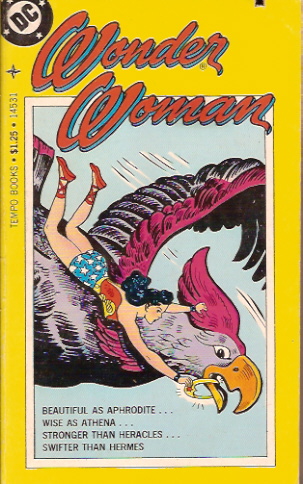
All in all, I wound up buying four of the six paperback editions that Tempo Books put out featuring the DC super heroes–though I didn’t purchase them all at once. Rather, I wound up picking them up at odd times and in odd places. Because they were paperbacks, they wound up being available in a lot of stories that didn’t otherwise carry comic books, and so on a couple of different occasions I prevailed upon my parents to get one or another for me. I passed on the JUSTICE LEAGUE OF AMERICA volume because I’d already read all of the stories that it contained, and for some reason the SUPERMAN volume never made its way into my hands. But I did get the other four, including this WONDER WOMAN volume.
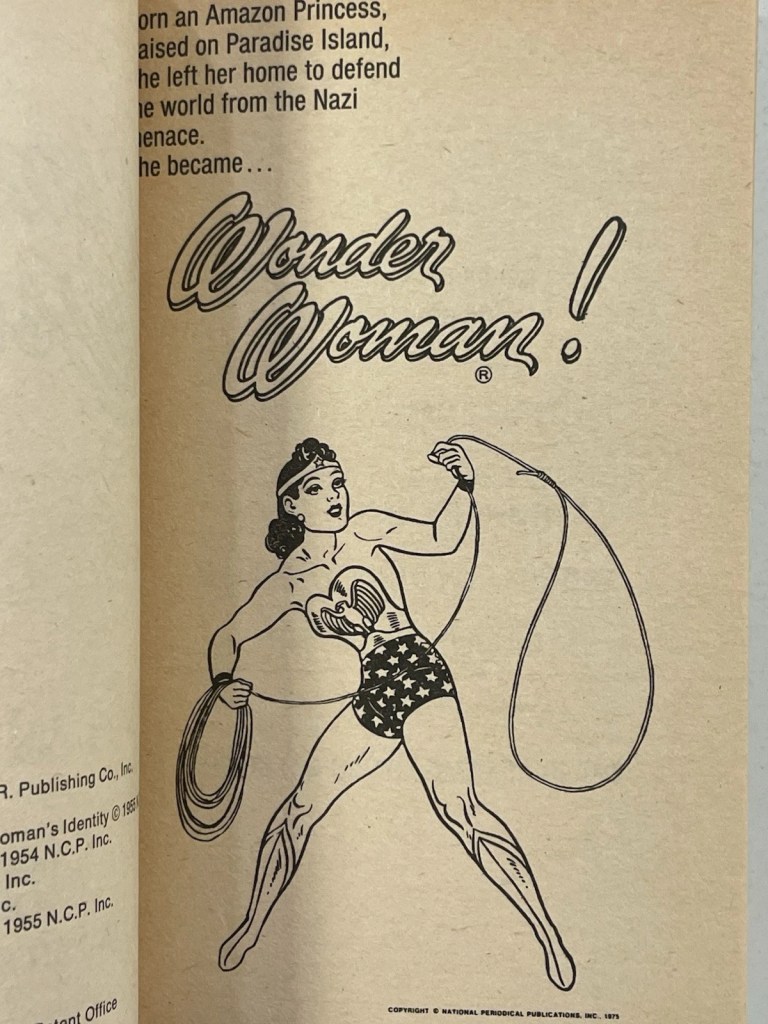
At the time, Wonder Woman was undergoing a bit of a resurgence if not a renaissance. She was featured weekly on television in a live action series starring Lynda Carter in the lead role, and that meant that she was forward in the popular culture in a manner that she hadn’t been for a long while. That said, her monthly comic book continued to feel a bit like an afterthought, with a series of creators telling perfectly competent but not especially thrilling stories with the character. In a lot of ways, Wonder Woman had the longest stretches of any popular character where a lot of the material that was being featured in her series wasn’t especially good. That in part may explain the selections made for what to reprint in this volume. As opposed to the others in the line, that primarily pulled from the 1960s and 1970s in order to fill their pages, this volume takes stories from the 1950s with just a little bit of the 1940s thrown in. I’m sure that this is because these were the stories that might best reflect what a prospective buyer was seeing on TV, but it made this a somewhat odd collection, even among other odd collections.
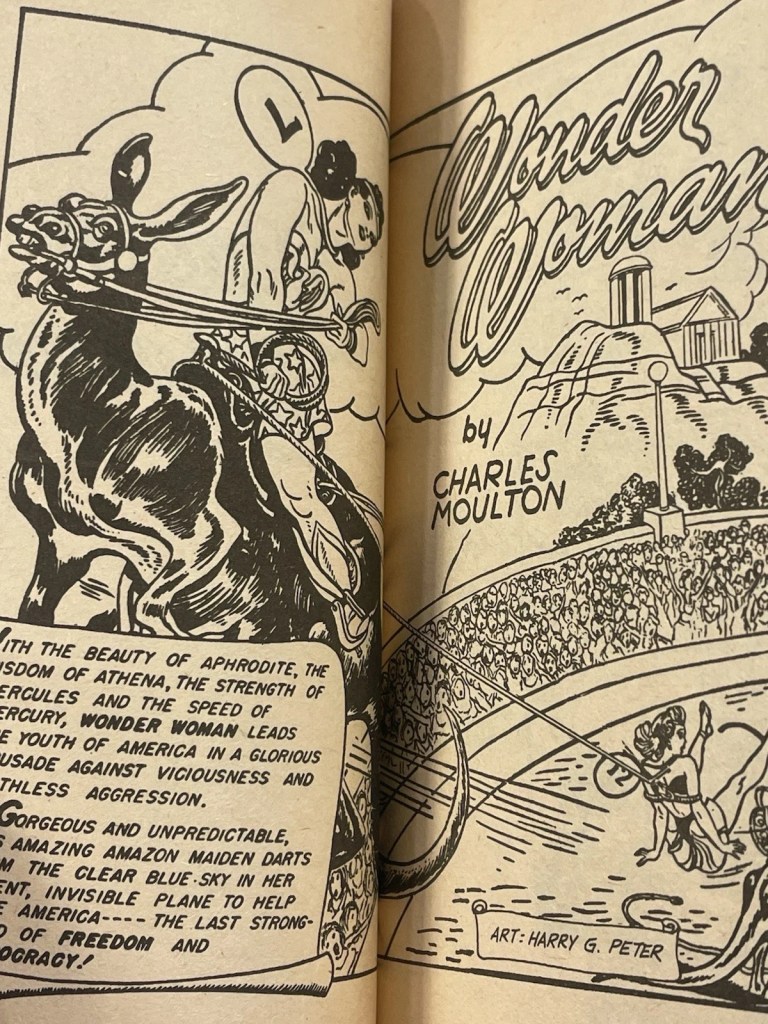
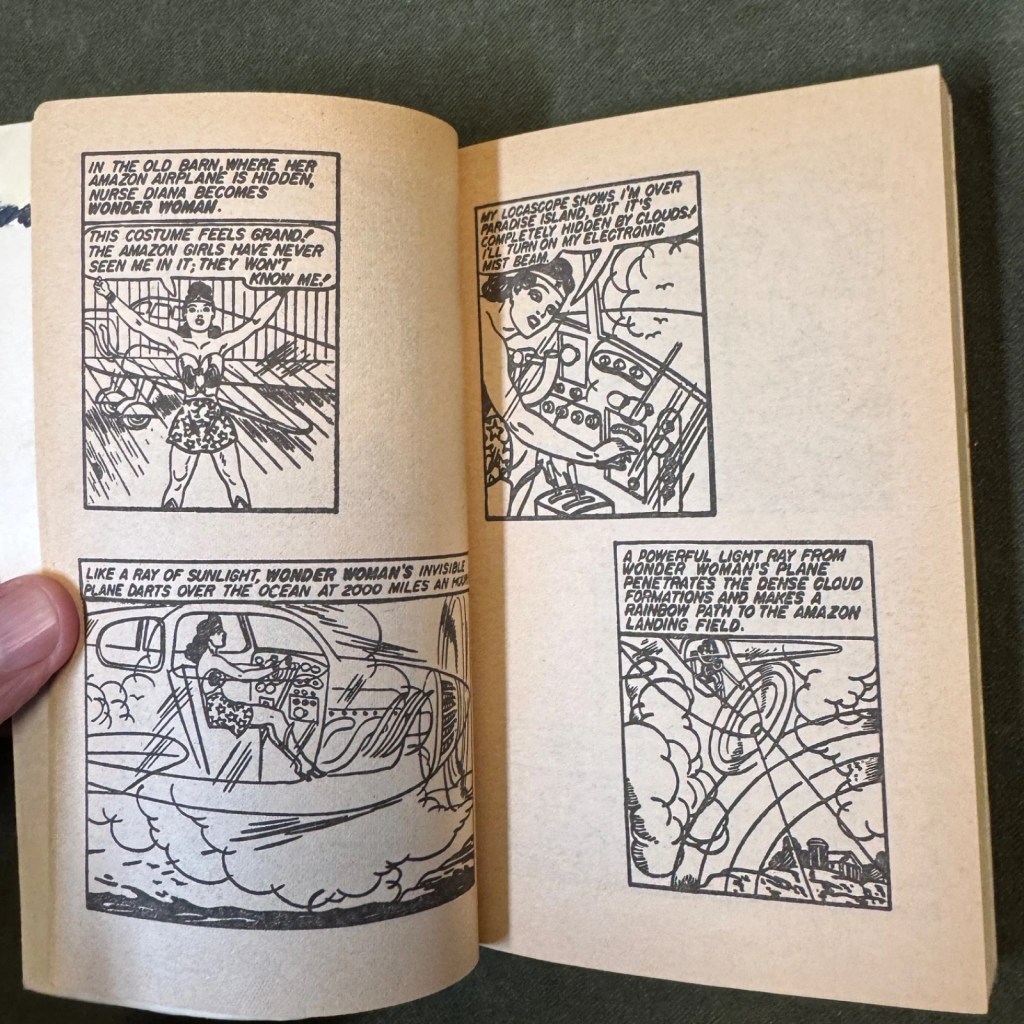
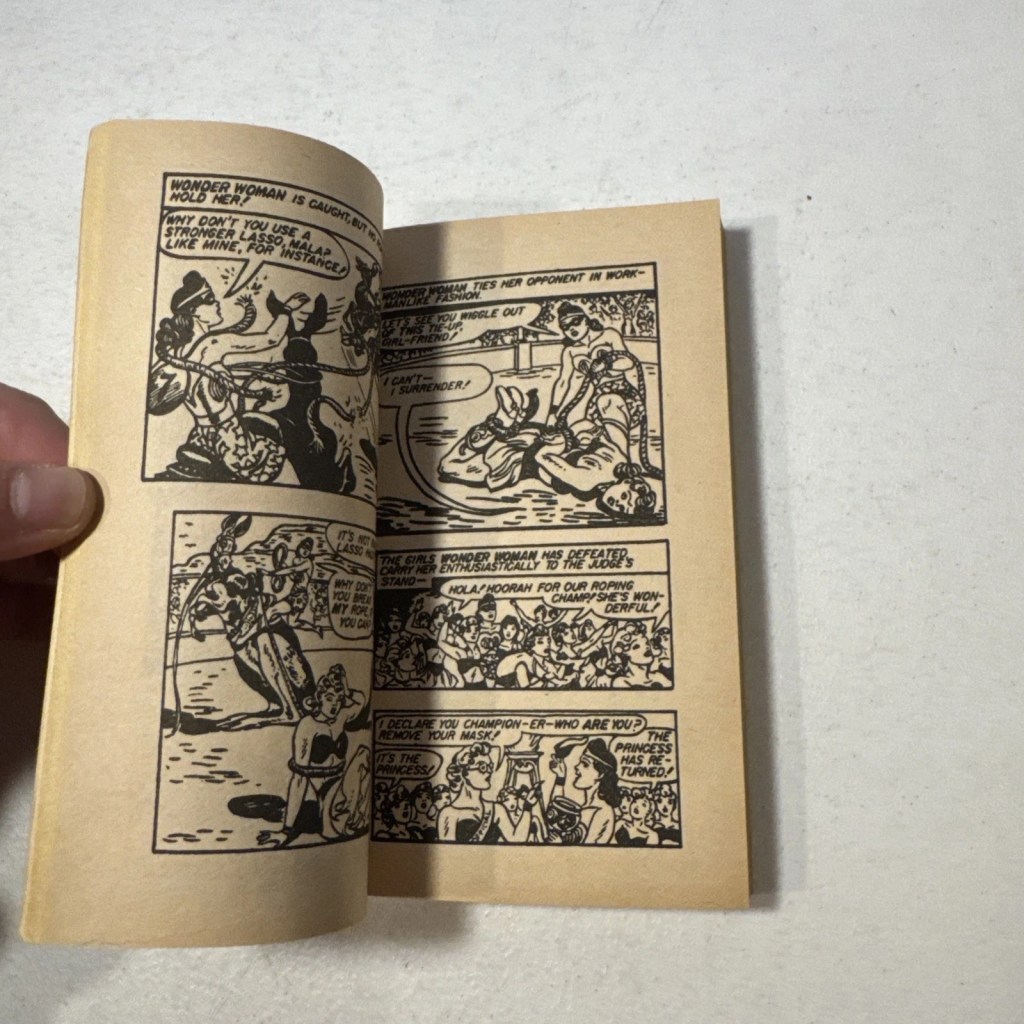
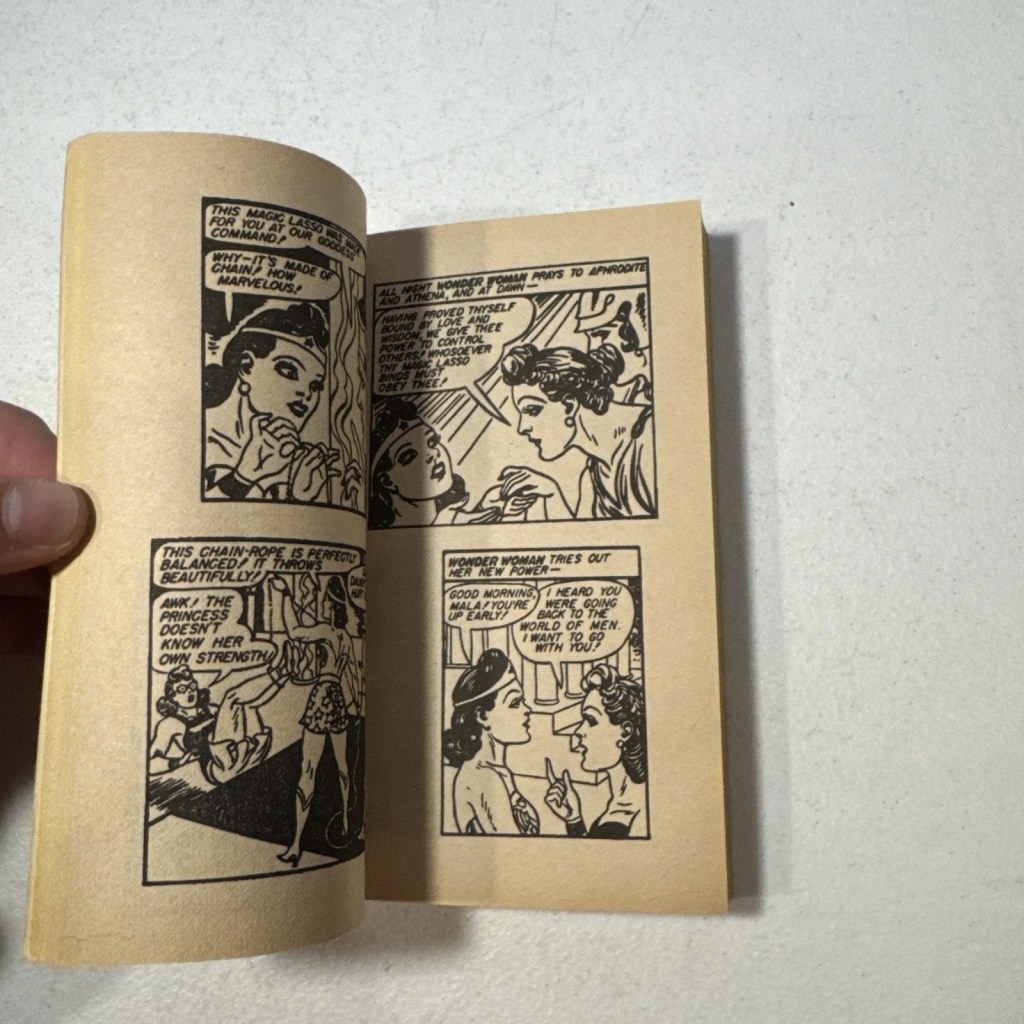
The book opens with not a 1950s story but rather one from the 1940s, from SENSATION COMICS #6. it was put together by the character’s originators, William Moulton Marston and H.G. Peter (operating under the pseudonym Charles Moulton), and it represented the first time Wonder Woman was given her ubiquitous Lasso of Truth to help her in her adventures out on “Man’s world”. For all that this material was rife with fetishism (as Marston conceived the series as a way of popularizing his belief that society would be better off if women were placed in a position of “loving dominance” over men) these stories had an undeniable snap to them. Even at the time, Peters’ art style was a bit antiquated–it captured a lot of the feeling of woodcut art, and could be stiff and awkward in a charming fashion. The character has a bit more going for her than simply being a distaff Superman.
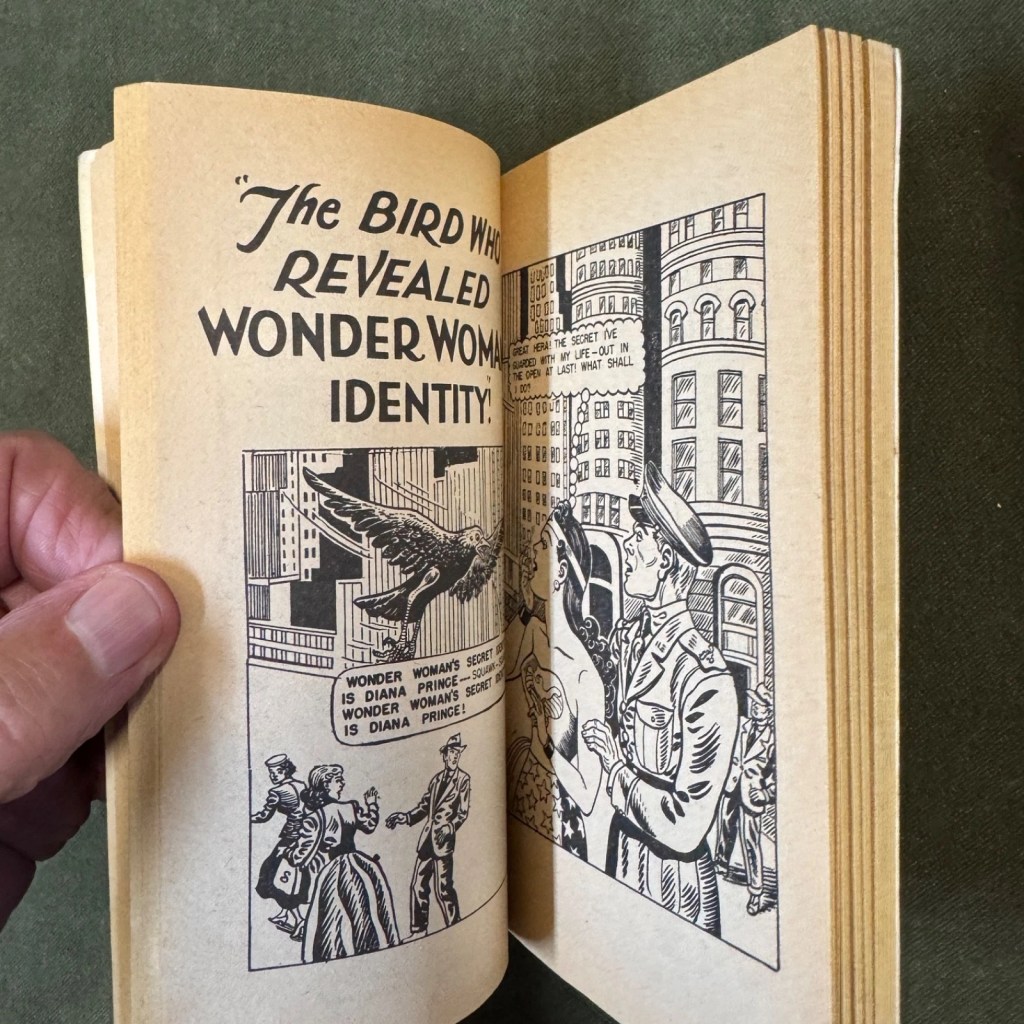
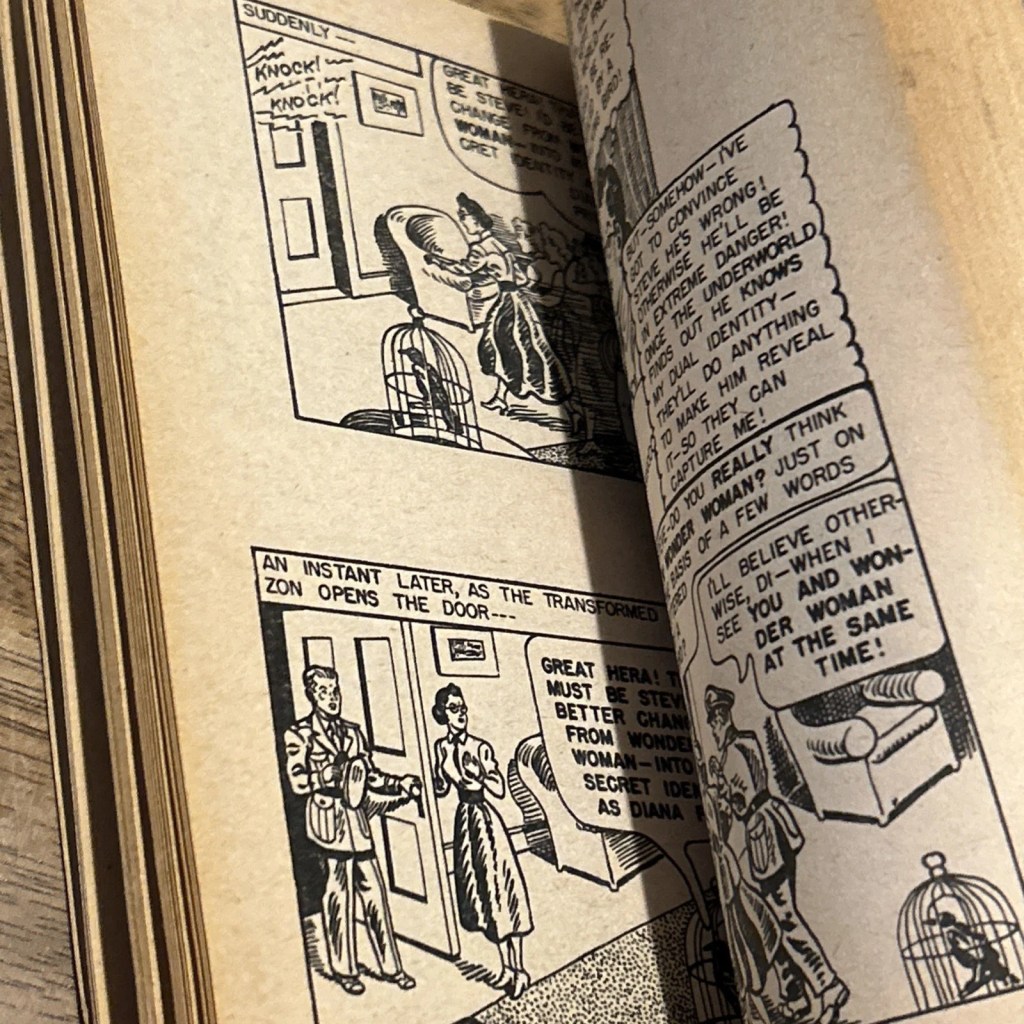
Still, the very things that gave the strip its frission were the selfsame elements that made people uncomfortable with it, especially during the time of the Senate hearings on the connection between comic book reading and juvenile delinquency. So as the 1940s passed into the 1950s, DC eradicated those influences from the series. Writer/editor Robert Kanigher took over the title following Marston’s untimely death, and he shepherded the property for more than two decades. Kanigher could be a very good writer when he wanted to, but there’s a sense that comes through his Wonder Woman stories that he has disdain for the material and for the audience who followed it, and so he didn’t do his best work here most of the time. H.G.Peter carried on as the artist, but as he got older, his style became even stiffer and more abstracted, more like a woodcut. The stories felt old even at the time they were first being published, and in the 1970s when this paperback came out, they seemed utterly alien.
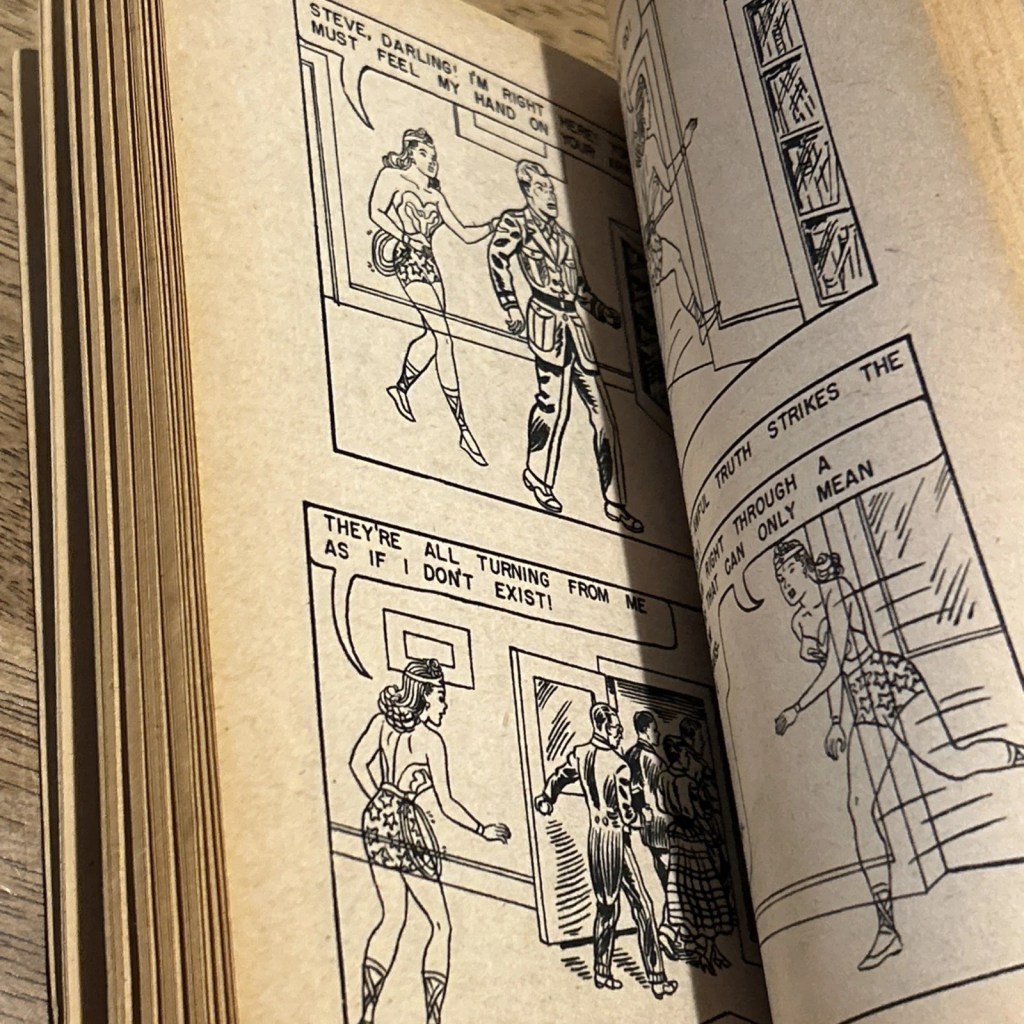
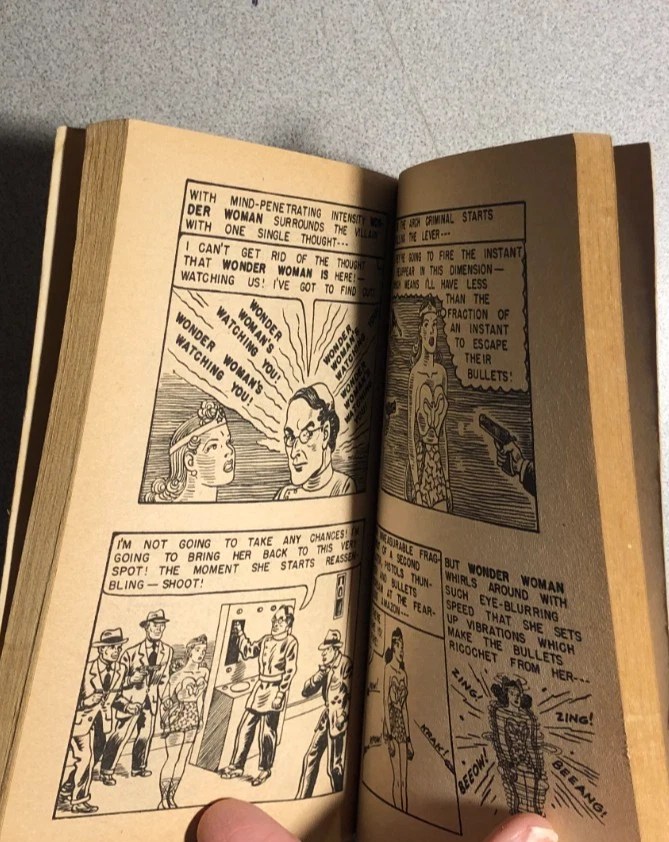
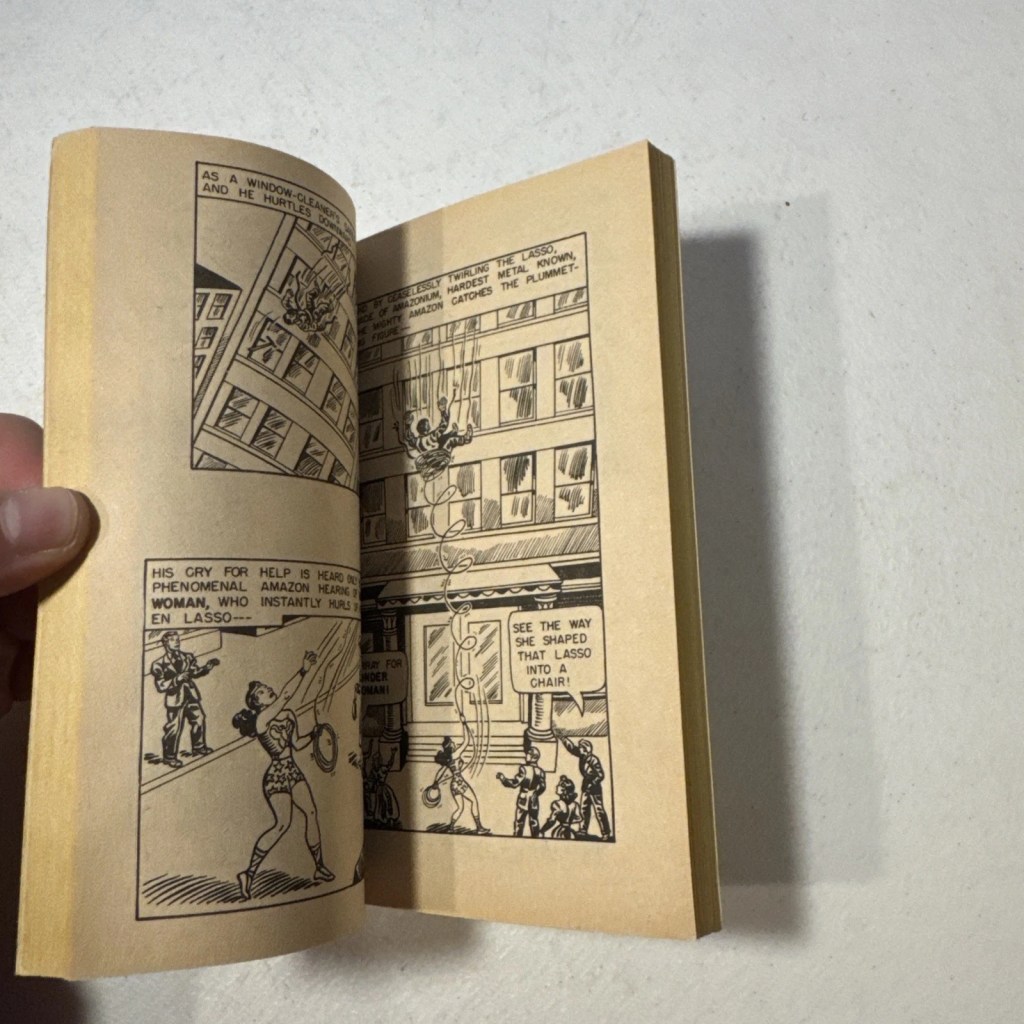
All of these issues were accentuated by the format of these paperbacks, which sliced up the original pages so as to run only a panel or two on each page. This often meant the artwork was fit together awkwardly, with plenty of unnecessary dead space and a haphazard flow from panel to panel.
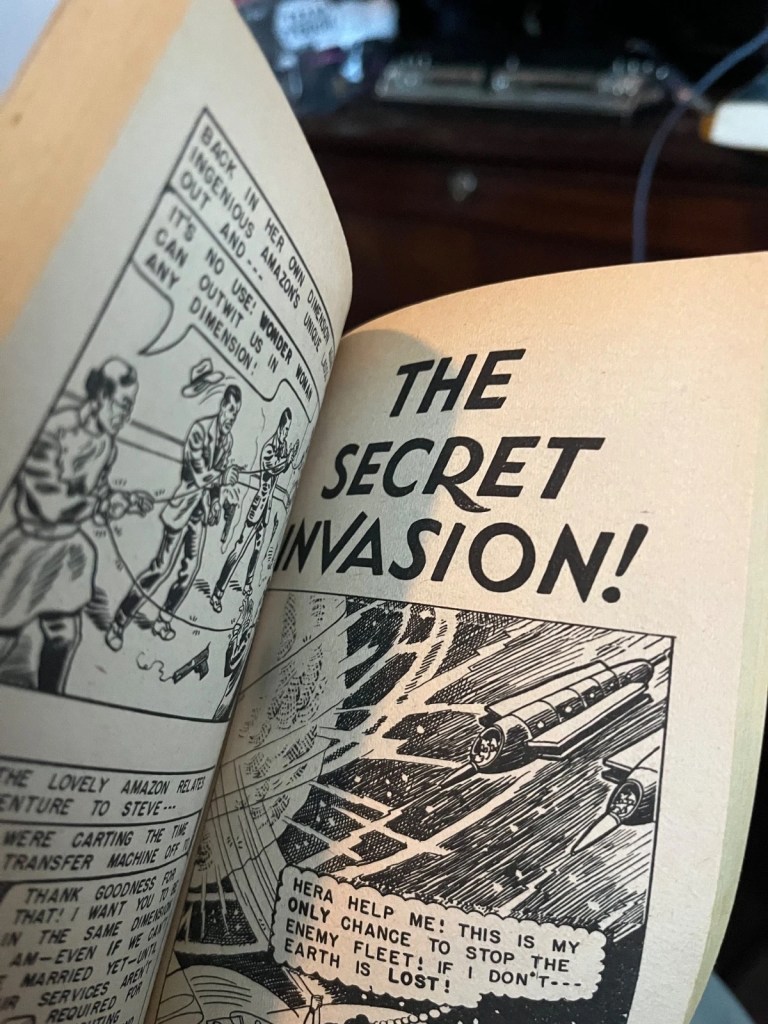
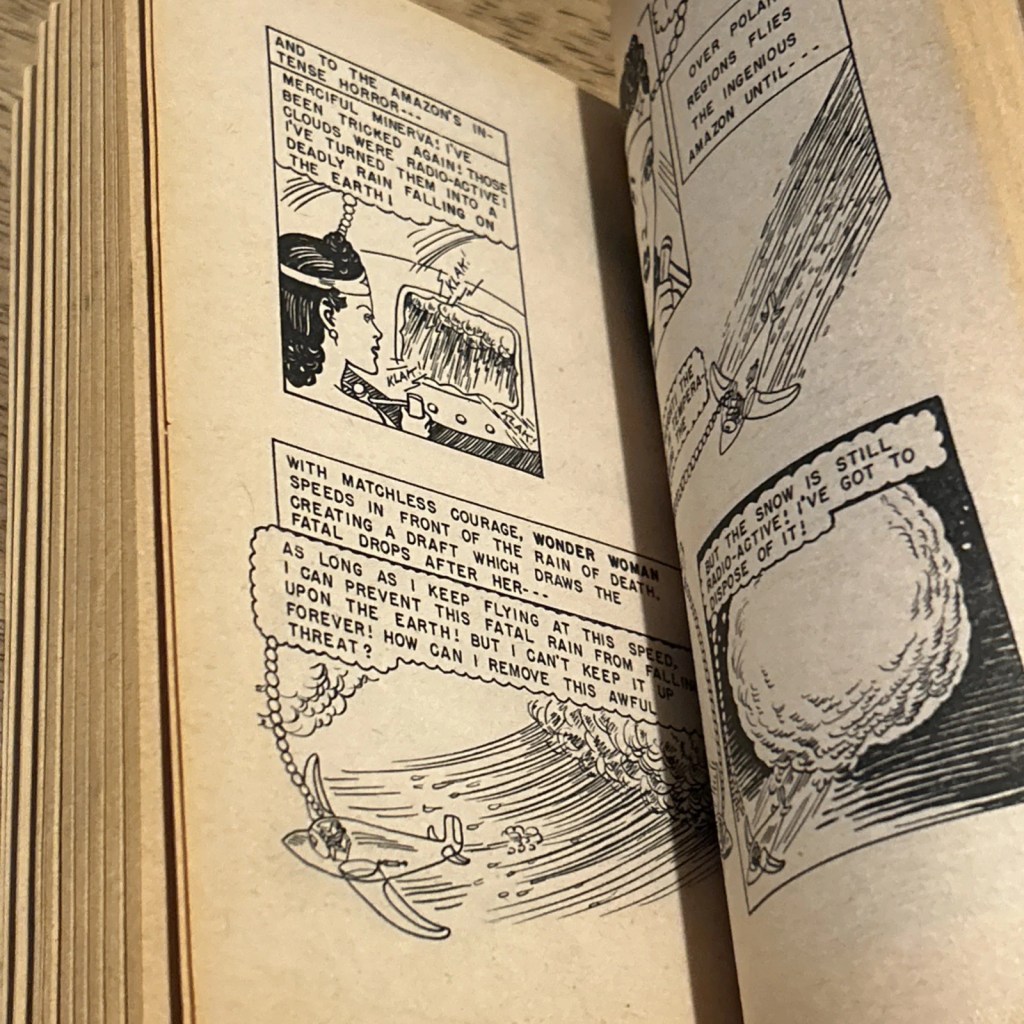
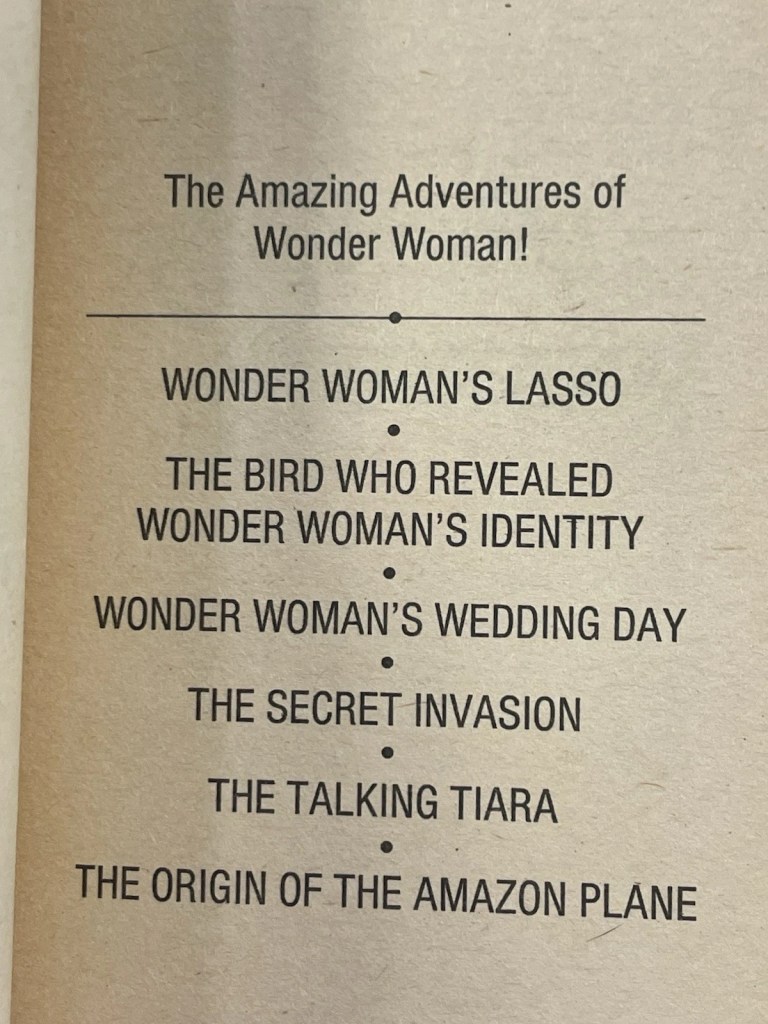
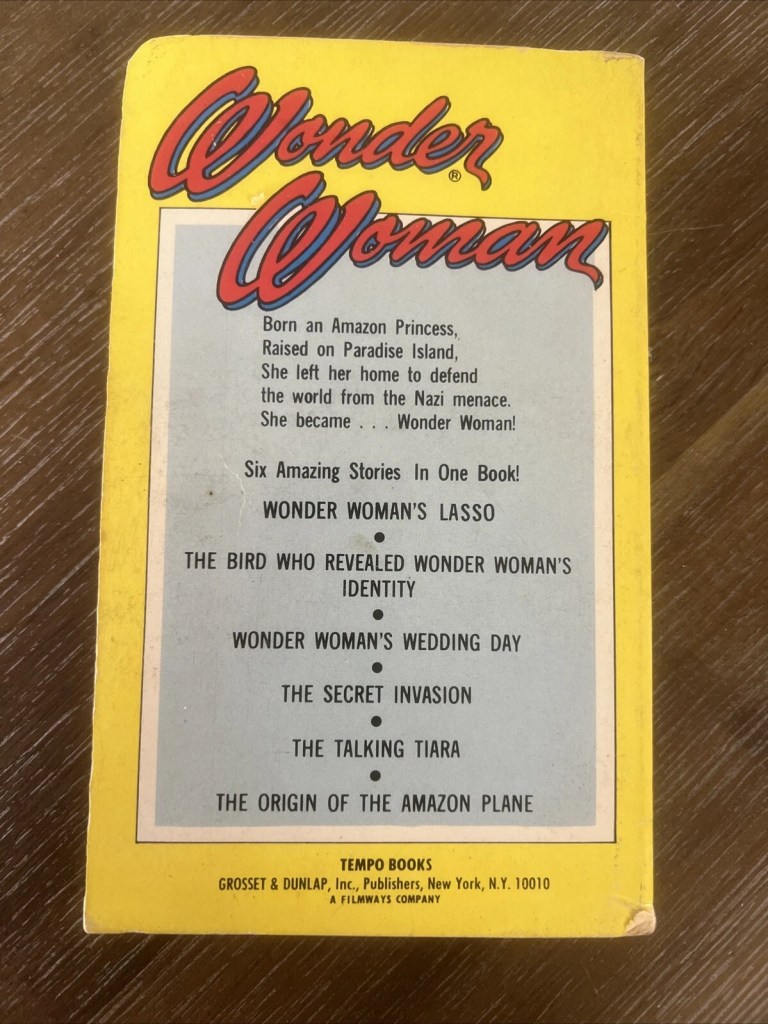
Because these individual stories were so short–you’d get three or even four of them in an issue of WONDER WOMAN when they were first published–this volume contained six tales in total. After the opening adventure in which the just-starting-out Wonder Woman gained her magic lasso came a later story in which a talking mynah bird threatens to expose Wonder Woman’s secret identity. That one is followed by a story in which Wonder Woman agrees to marry Steve Trevor because all crime has suddenly ceased, but before she can do so, she is projected into another dimension, which makes her an ephemeral phantom walking around the city. As you can probably immediately tell, these both feel a lot more like the Superman stories of the period, and that’s very much what Kanigher appears to have been going for. Any sense of female empowerment has been severely blunted–nobody is trying to make waves here.
This is followed up by three further innocuous stories. In the first, the Duke of Deception (called Duke Deception here) plays a series of tricks on Wonder Woman to get her to weaken her defenses in advance of a coming alien invasion. This is followed by the tale of how a young Wonder Woman went through trials to earn her tiara, which allows her to understand all languages. And finally, the last story in the volume concerns Wonder Woman needing to complete three trials in order to acquire the components necessary to construct her invisible robot plane–one of the guiding concepts behind this collection appears to have been the origins of Wonder Woman’s unique gear. Which is fortunate, because Kanigher produced a lot of those stories over the years, some of which were in active conflict with one another. But he didn’t think any of his young readers would notice or care so long as he gave them an exciting adventure.
So this was a bit of a strange package to be released in the late 1970s. It’s definitely steering more into nostalgia than any earnest attempt to capture a potential readership of the day who might be drawn into reading the character regularly. Even with her strong presence on television, it seems like there was some institutional resistance to the idea of putting a full-on effort behind Wonder Woman with an A-list creative team. That wouldn’t happen until the aftermath of 1985’s CRISIS ON INFINITE EARTHS when George Perez and company reinvented the character and restored a bit of luster to her after literal decades of inconsistent and underwhelming adventures.
 The Tom Brevoort Experience
Wonder Woman is one of my favorite characters, but I have to agree with Tom, there were a lot of stretches over the decades when her series really wasn’t all that good. I especially find some of the stories written by Robert Kanigher to be unreadable. Wonder Woman, in my opinion, did not truly become a genuine A-list character until George Perez’s epic post-Crisis run that commenced in 1987.
LikeLike
I didn’t like Perez’s Wonder Woman much more than those drawn by Jose Delbo TBH. Stripping away Paradise Island’s super science still bothers me and Amazons are portrayed mostly as generic female barbarians by most writers.
LikeLike
I’m very much a Wonder Woman fan and would love the opportunity to do an extended run someday. And there are periods of the series that I like a lot, but I generally think they have some flaw or other that often amounts to “Well, that’s not what I’d do,” which isn’t really a fair critical approach, but I’m stuck with it in this case.
But there’s stuff in virtually every era of WW I’d want to pick up and modernize, from forgotten Marston/Hummell/Peter villains to Kanigher weirdos to aspects of George’s and Gail’s and Greg Rucka’s runs.
My sweet spot on WONDER WOMAN is really the stretch of the Conway/Delbo run once Len Wein becomes editor and it becomes a bit more solidly “Marvelized” through the Thomas/Colan era and into the Mishkin/Heck era at least partway. I wouldn’t argue that this is the best of WONDER WOMAN history; it’s just the stretch that resonates with me, and that I kind of think of as “proper” Wonder Woman, with everything else a variant.
If only Minister Blizzard had shown up in that era…!
LikeLiked by 3 people
I enjoyed the Legend of Wonder Woman miniseries you did with Trina Robbins. I felt it was a nice tribute to the original Golden Age stories without being a slavish imitation.
LikeLiked by 2 people
That was enormous fun to do, but I was very much trying to do, as you say, a modernized tribute to the WW of Trina’s youth. We’d thought at the time it was Marston/Peter, but it turns out the stories she liked most were largely Hummell/Peter.
If I got to do WW on my own hook, without the guidelines we had back then (which includes “We don’t want it to sell well, because we don’t want to steal any thunder from the Pérez launch”), it’d be very different. A lot more world mythology, a mixture of influences alongside WW’s past creators, including Claremont’s X-Men and Kirby’s Thor and Agent of SHIELD, a lot more for Diana Prince to do, plus plenty of old GA and SA villains buffed up for a new era, and Holliday College as both a current presence and an important part of WW history.
Plus: the return of Mark Merlin! The 20th century descendant of DC’s Nighthawk! Baba Yaga! Characters from Shakespeare!
And lots, lots of (hopefully) interesting women characters with interesting stuff to do.
LikeLiked by 2 people
“Your ideas are intriguing to me and I wish to subscribe to your newsletter.” 🙂
My “ideal” Wonder Woman was a little earlier — the “Twelve Labors” storyline and it’s immediate aftermath, mostly written by Marty Pasko. I thought he had a really fresh & modern take on the character, while still respecting her history. And it was a crying shame that his run got cut short in order to shift the series to World War II mode in order to emulate the TV show.
LikeLike
That’s the era I love too but Delbo was the only creator I could recall without Googling. I’d also love to see the conclusion to the cliffhanger in the issue before Diana got her costume and powers back.
LikeLike
I really like 1940’s Wonder Woman… the weird fetish stuff went over my head as a kid, but the “man’s world” stuff with the bondage and gender rules makes those stories feel so mythic and strange. I can understand why DC would want to alter her so she was just another one of their “polite and square citizen heroes” but the 40’s version feels like the authentic version to me.
I didn’t pick up much “modern” Wonder Woman though I thought Don Heck did solid art during his run. He was a good fit for the material.
LikeLiked by 1 person
A note on “first time Wonder Woman was given her ubiquitous Lasso of Truth” – it wasn’t the Lasso of Truth then, it was more like the lasso of compelling obedience (which could of course compel people to tell the truth as a minor application of the broad power). Much more disturbing in implication. https://www.cbr.com/comic-book-legends-revealed-376/
One of the more interesting aspects in the 1940’s stories that’s been lost, and I don’t think ever been updated well, is a sense of the Amazon society as a strong but distinctly alien culture. They were originally basically one of those secret but advanced civilizations of pulp adventures. But their portrayal seem to have degenerated, maybe in parallel with the cliches about “warriors” (perhaps from violence replacing the fetish element?).
LikeLike
George Perez took the Amazons back to their mythological roots ( Naming the island after the Amazon capital Themiscyra. Minus the Amazons being descendants of Ares and the nymph Harmonia — parents of the first Amazon Queen Otrera, a demigoddess – wikipedia. George had the Greek Goddesses take the souls of women murdered by men and created the Amazons – WW#1 ( Feb. 1987 ) ) and not their DC Comics roots. I did love the authentic looking ancient Greek outfits and hair styles( His Greek Gods looked futuristic in their ancient looks ). I loved everything George Perez did except robbing Wonder Woman of her place as a founding member of the Justice League of America.
LikeLike
Much of that was initial writer Greg Potter.
LikeLiked by 1 person
Kurt, thanks for the correction. In my mind I just remembered George writing Wonder Woman and didn’t check to see when he started. So I have Greg Potter to thank for those changes to Wonder Woman.
LikeLiked by 1 person
If it were me I wouldn’t go with Nazis or with the Conan approach.
It would be fun to take her back to the 70s and retread some of O’Neils over the top hysteria (thinking Justice League here as well).
I could see Superman on the cover lifting a building and telling Wonder Woman that it’s ok, he’s got it. Or another cover with a distressed Diana Prince watching women chanting “Burn your Bra!”..
I really liked Godot and Pine in the movies and it’s a shame they didn’t get to continue. Going through the eras was a winner but it didn’t get too far.
LikeLike