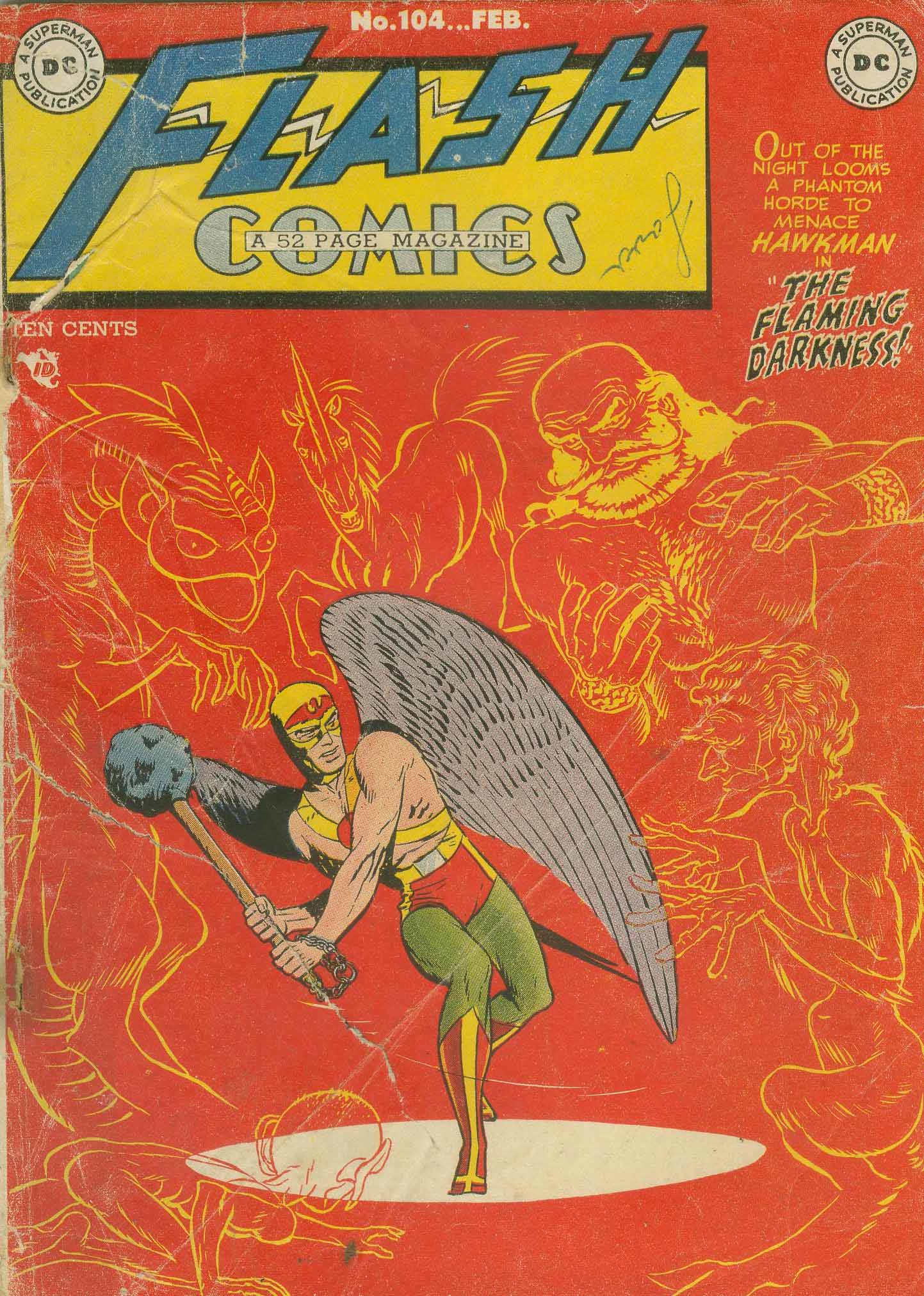


As with Hawkman, the Flash’s final golden age appearance was in ALL-STAR COMICS #57 in 1950 as part of the Justice Society of America. But we’re talking about the Scarlet Speedster’s solo exploits here. And by that metric, Jay Garrick’s final run in his winged helmet took place in the final issue of FLASH COMICS, #104, at the tail end of 1948.

There are a couple of things that are noteworthy about this last Flash story. The first is that, for the first time possibly since 1941, Jay Garrick’s origin is recounted in detail. So his first story and his final story both revolved around the character’s beginnings. (The same thing is true of the Human Torch, whose exploits coincidentally began and ended almost simultaneously with the Flash’s.)

The second is that this final story was written by John Broome and drawn by Carmine Infantino, while being edited by Julie Schwartz. This was the same creative and editorial team that would revive the character in a new form half a decade later and carry him into being the first real success of what has become known as the Silver Age of Comics.

DC has reprinted this final Flash story a couple of times over the years, firstly in FLASH #211 in 1971. Consequently, Geoff Johns later brought The Rival back as a villain to oppose Jay in some issues of JSA in the early 2000s.

This wasn’t intended to be the final solo Flash adventure. Editor Julie Schwartz was working well ahead, and had material on all of his series in production up through at least FLASH COMICS #112. In fact, a notation on the splash page of this story reveals that it had been commissioned to run in FLASH COMICS #110, an issue that would never come. Years later, some of those unpublished Flash stories (as well as an Atom story or two) would be printed in assorted DC books once the character had been revived. But the point is that the decision to terminate FLASH COMICS must have come quickly and relatively unexpectedly.
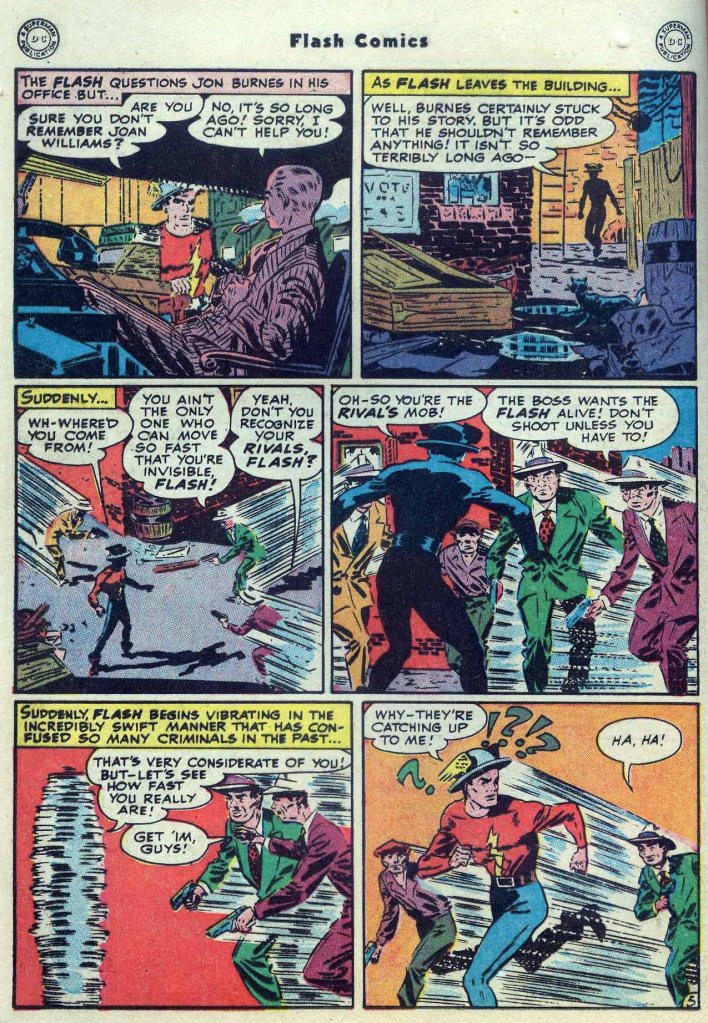

Looks like some lettering was taken out of the first balloon in Panel 5 and the remainder reflowed to fill the space. Wonder what it originally said.


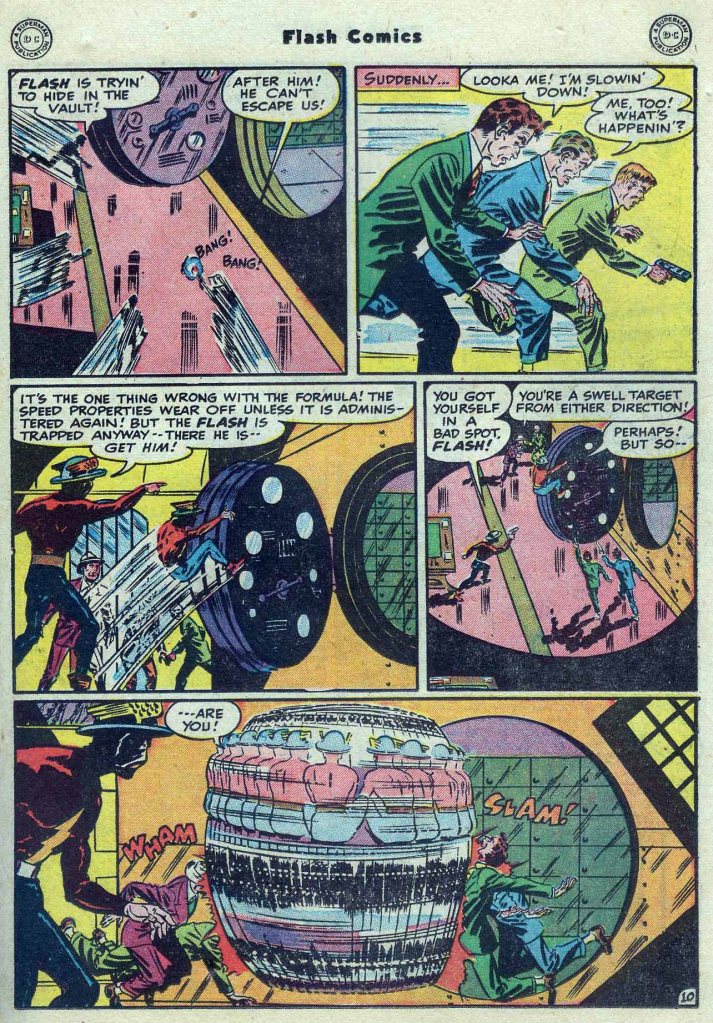

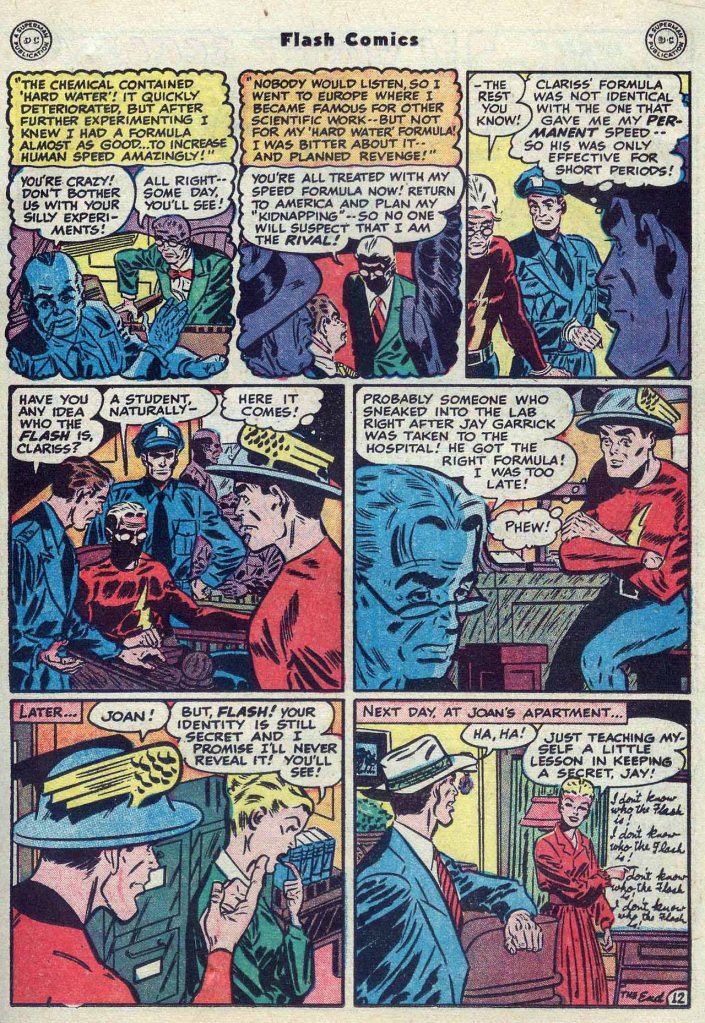
Doctor Clariss must be one of the dimmest men alive to not have connected the Flash to Jay Garrick. But it was a necessity in order to preserve the Flash’s secret identity and his status quo.


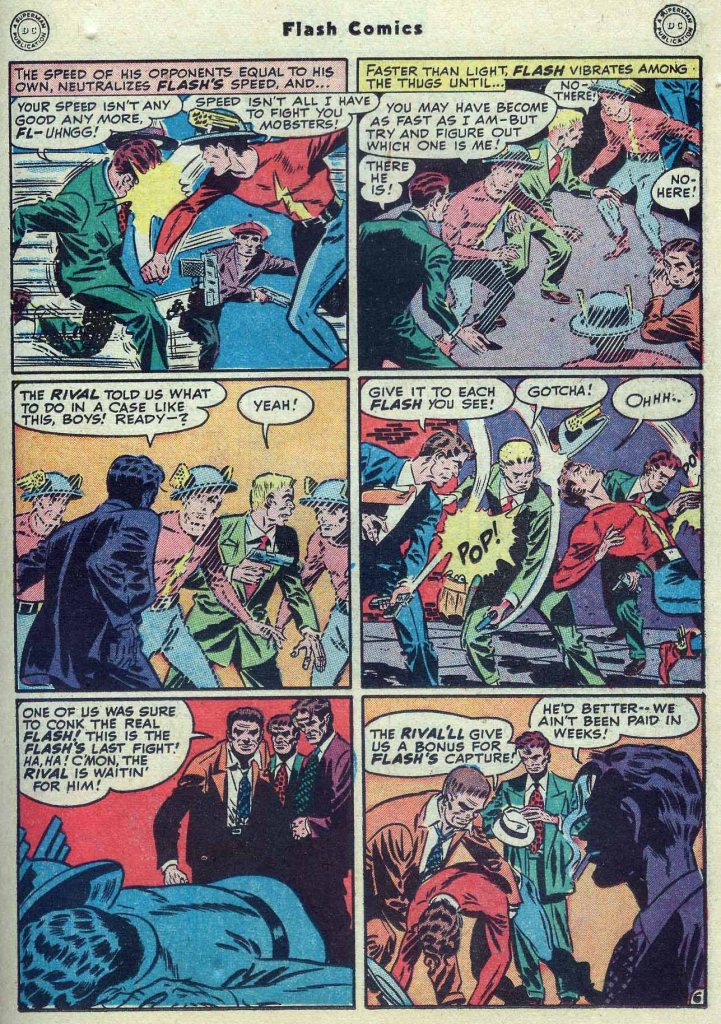
That’s easily the best art I’ve seen on a Golden Age Flash story.
LikeLiked by 3 people
I agree! It doesn’t match his later style for oomph but it’s up there with Kubert for being heads and shoulders above the usual Golden Age standards.
LikeLiked by 1 person
First time I saw this story I was shocked to see that The Rival was much older than the Flash. But at least he had powers unlike the False Flash [ All-Flash Quarterly#3 ( Winter 1941 ) Chapter IV: The Flash vs. the Flash! — henchman of Adam Adams ( who was after the Hard Water Formula from Dr. Manning ) ]. And yeah the art is good in this story.
LikeLiked by 1 person
A formula that makes anyone as fast as the Flash for a short period with no apparent side effects is kind of a big thing to have hanging out there.
LikeLike
You would think that either the U.S. government or foreign government ( friendly or not friendly ) would be getting him out of prison so he could give them an army of super-speedsters.
LikeLike
It also looks like Jay Garrick is almost drawn as a caricature of Tyrone Power . . . .
LikeLike
If you look at various Golden Age comics, you can see gradual changes and improvements in the art and stories, especially with Green Lantern and Flash. I was impressed by how easy it was to really enjoy The Rival Flash!
LikeLike