

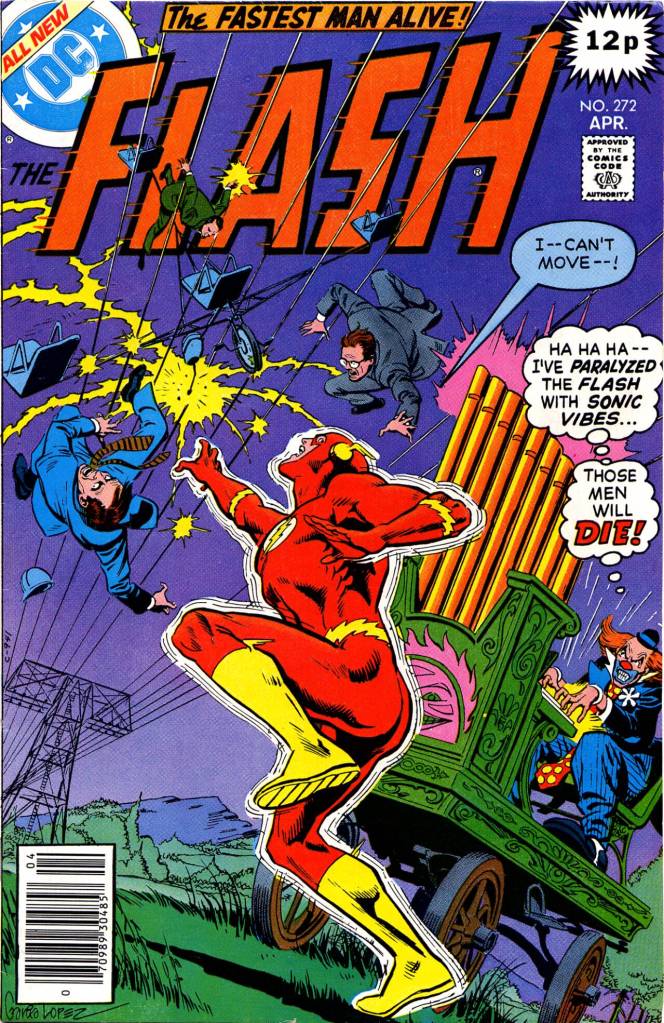
It had happened again. I had missed another issue of THE FLASH. Having never seen nor bought #269, now #271 proved elusive to me. And honestly, ever since my subscription had lapsed with issue #261, I was having the devil’s own time following the book regularly. You might think this would have prompted me to renew that subscription, but it didn’t. I still liked the Flash, but the series was turning in a direction that I didn’t quite care for as much, and I was a lot more interested at the time in the new Marvel books I was beginning to follow. So it bugged me when I missed an issue like this (especially since the cover to #271 had been spotlighted in house ads) but not to the degree that it once would have.
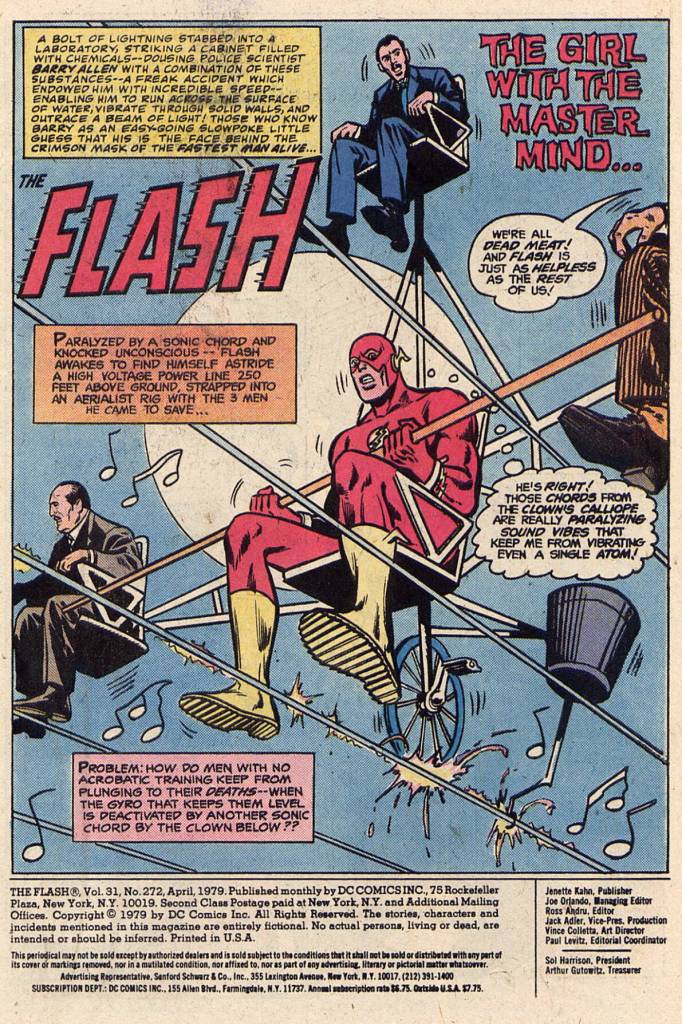
It wasn’t all that difficult to catch up, though, since the Scarlet Speedster was still fighting the same menace in this issue that he had been in #270, the silent Clown. But something immediately felt different about what was going on. It wasn’t just that the ever-reliable Irv Novick was gone, replaced in this issue by the two-fer pairing of John Calnan and Rich Buckler (inked by Vince Colletta into a consistent mush.) But something about the ethos of the series was different. It wasn’t Cary Bates, who was writing as usual. I couldn’t put my finger on it as a kid. But the truth is that longtime FLASH editor Julie Schwartz had handed the title over to Ross Andru, who had a very different take on the material and what needed to be done to make it a competitive series in 1979. I don’t know that Ross’s instincts were especially on point here, but given the title’s diminishing sales, I can see why such a move might have been made.
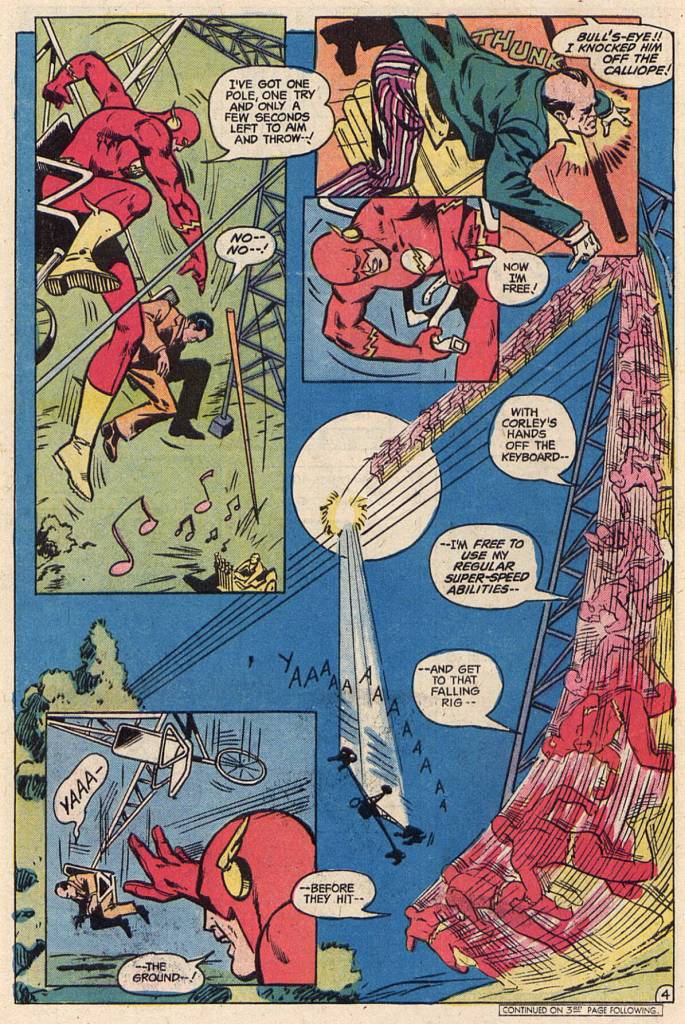
The direction that Ross and I would imagine Cary Bates wanted to move in was to instill more realism into the series. This meant subplots involving crooked Central City cops and stolen drugs and marital strife between Barry Allen and his spouse Iris. At the same time, though, they couldn’t refrain from having the Flash perform the usual repertoire of logic-defying super-speed tricks. So the tonal mismatch was a bit dissonant, especially in these first few issues. This one opens with the Flash and five other men in a too-elaborate deathtrap, wherein they are strapped to a high-wire unicycle perched upon high-voltage wires, and the gyroscope that automatically keeps them balanced has been turned off. Flash is still swift enough to save the five fallen men once he’s able to liberate himself. But this is squarely BATMAN television show stuff.
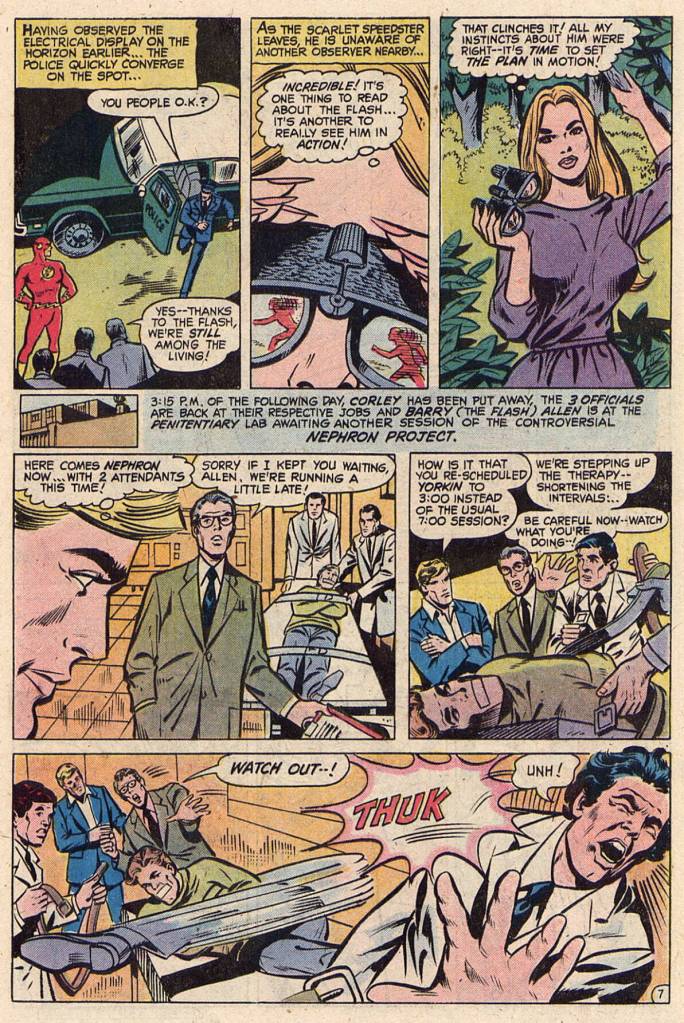
So the conflict with the homicidal Clown is wrapped up in the first part of the issue. But the mysterious red-headed woman from two issues back continues to follow and stalk the Flash, and she was there to witness this big win. It’s enough to convince her that the Flash is the man she’s been looking for. Later, picking up on a subplot established earlier, Barry Allen resumes his post as an observer to the Nephron Project, a psychiatrist’s Clockwork Orange-style method of reforming hardened criminals through shock therapy and associated processes. The subject of this conditioning, Clive Yorkin, attempts to break away before the latest treatment can be administered, and Barry is vocally against continuing. But after Allen departs, Dr. Nephron goes right on ahead with what he was doing. This will have consequences further on down the line.
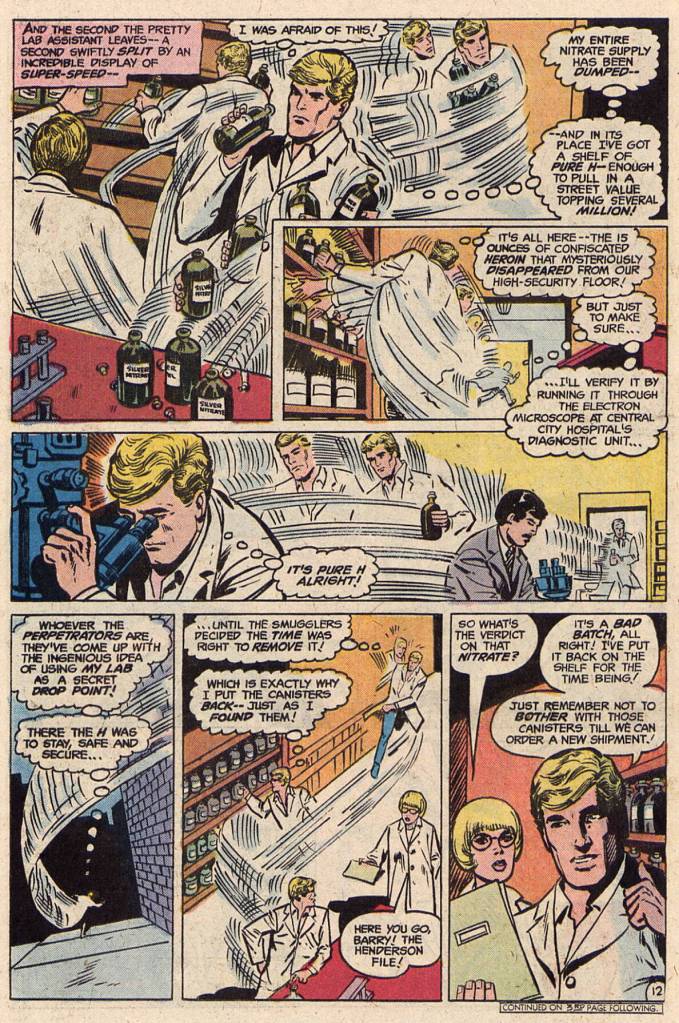
Back at his police lab, Barry is stunned to accidentally discover that all of the bottles of Nitrate have been filled instead with pure Heroin, worth half a million dollars on the street. Figuring that somebody must be smuggling the heroin through the police station, Barry replaces it on the shelves but sets up an alarm to alert him should anybody enter the lab when he is away. He then heads home to a forgotten romantic dinner with his wife Iris, with whom he’s been fighting the past couple of issues. But wouldn’t you know it, the alarm goes off just as Barry and Iris are about to have dinner, and he suits up as the Flash to run down the drug smugglers, leaving the abandoned Iris to stew over how unimportant she’s become in her husband’s life.

By the time the Flash can reach Barry Allen’s laboratory, he discovers that the Nitrate is back where it’s supposed to be, meaning that the smugglers have swapped out their stolen heroin and departed. An extremely quick job that, if Barry only just got an alert of activity within his lab a few seconds ago. Flash is able to locate the car of the perpetrator, but he wants to bring down the entire ring, and so he decides to let it lead him to the man’s confederates. But suddenly, he finds himself making a hard right turn and inexplicable racing off in a different direction. Some compulsion is drawing him elsewhere across town, and try as he might, he can’t seem to prevent himself from going.
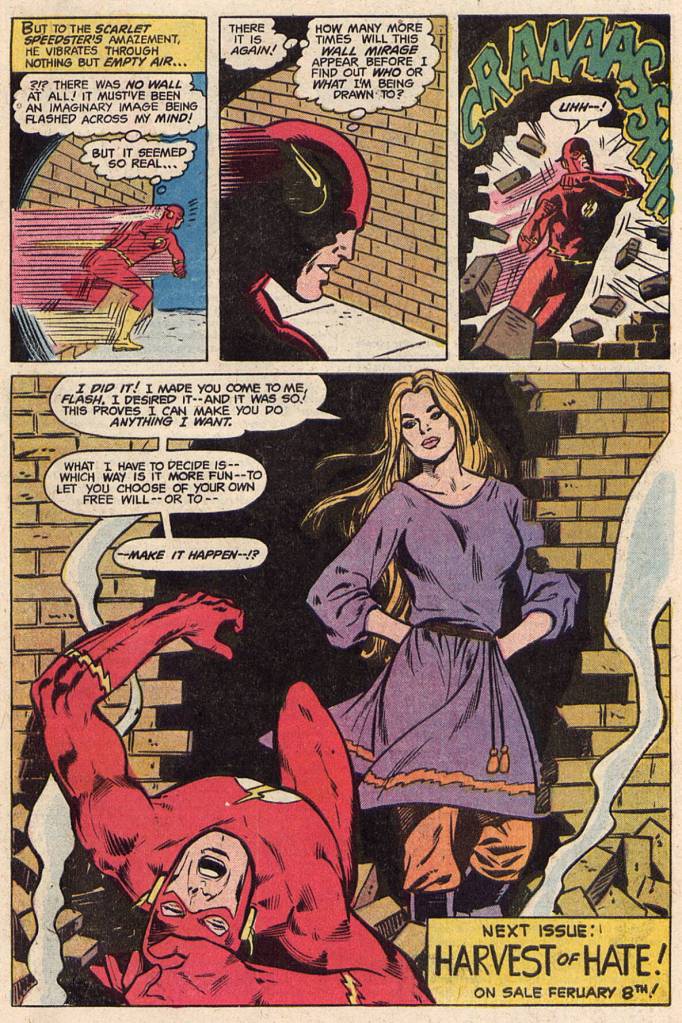
Suddenly, Flash finds himself racing directly towards a brick wall. Before he can vibrate his body into intangibility and race through it, he hits it–and it proves to be just an illusion. Seconds later, he approaches a second wall, and assuming that it’s a vision as well, he does nothing–and goes ramming right into it, the dumb sucker. He’s down and unconscious and hurt, and standing over him is his red-headed stalker from earlier. She somehow caused him to come here, and now she’s weighing whether in order to get what she wants from the Scarlet Speedster it would be better for him to accede to her wishes voluntarily or if it would be better to dominate his will again. And that’s the strange point at which this story is To Be Continued.
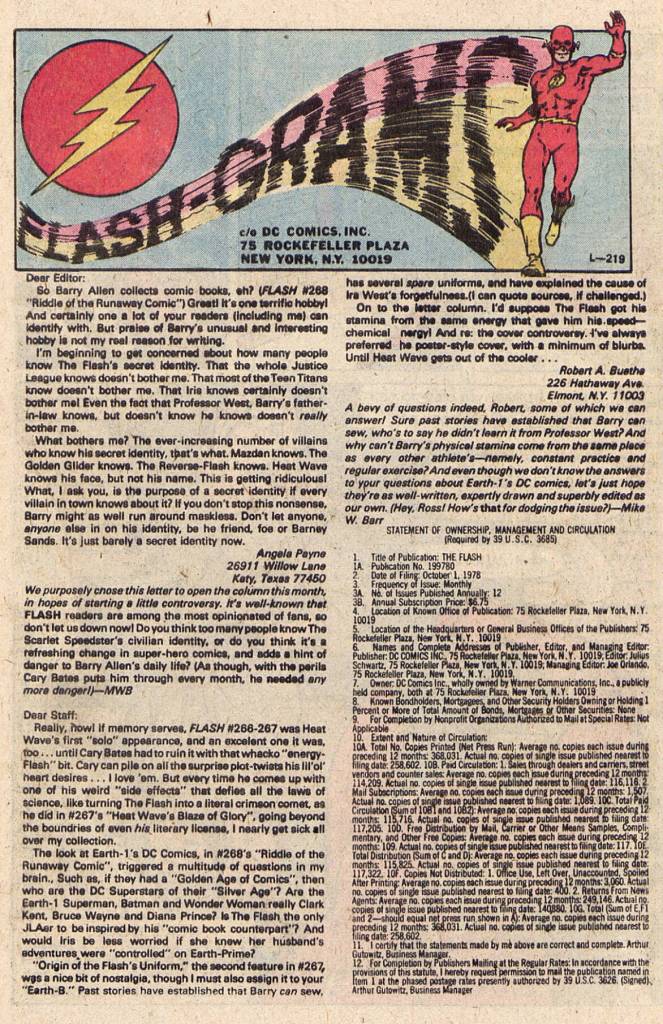
The Flash-Grams letters page for this issue also includes the yearly Statement of Ownership, which gives us a rough estimation as to how well the title had been selling during the previous year. It indicates that the book was selling 117,205 copies on a print run of 258,602 giving the book an efficiency of 45%, which really isn’t all that bad for the period.

This issue also includes another edition of the weekly DAILY PLANET promotions page, which included another of fan cartoonist Fred Hembeck’s silly gag strips. I can remember getting a chuckle out of this one. At a time when news of what would be appearing in upcoming comic book issues was difficult to come by, a new DAILY PLANET was quite welcome by me, as I was hungry for any such news.
 The Tom Brevoort Experience
Today’s column reminds me why I quit buying most of DC and Marvel in the ’70s. Unappealing art. Colletta inks were difficult to stomach over Kirby … but over anyone else? The comic immediately went back on the rack.
LikeLike
I couldn’t turn away from my favorite superhero but I hated this period. The art and the heavy handed oooh, the shit’s getting real!!! tone made it a slog to sit through any issue and the Clown was a fifth-rate foe at best.
LikeLike
it’s super super niche but I’d love a collection of those Daily Planet pages. Just like I used to suggest to TPTB there should be a Flash Facts collection.
LikeLiked by 3 people
A Fred Hembeck collection, too.
LikeLiked by 2 people
I’ll put it on the imaginary shelf, right next to my CAP’S HOBBY HINTS Omnibus!
LikeLike
I’d love to see a group of fans create a wiki-like site where they scan and collect the ancillary material from the comics — Daily Planets, Direct Currents pages, Marvel Bullpen Bulletins, house ads and lettercols — all organized and searchable.
I doubt the publishers would want to stop them, since it’d be useful. But like you say, it’s niche enough that I doubt they’d ever collect this stuff themselves.
But as long as we’re talking niche stuff, I’d love to see DC collect all those Henry Boltinoff filler strips, half-pages and single-page gags over the decades.
LikeLiked by 1 person
Sadly, this is more a copyright law problem than anything else. There’s enough scanned issues and indexing information out there nowadays, that this is basically extracting a list of “Page X from issue Y of title Z”. But the publishers would go after anyone who had all those scanned issues and came to their notice. Even the extracts would make the site a target. Just one copyright “take-down” letter from a lawyer looking to justify their existence, and such a site would likely be gone. Or at least, I wouldn’t want to be the person running that site in those circumstances.
Note, I’d buy a “Cap’s Hobby Hints” collection for entirely practical reasons. There was good, useful stuff in those strips. It’s where I first saw the trick of using a comb to hold a nail for hammering, and that alone was worth the price of the comic.
LikeLiked by 1 person
I honestly don’t think the publishers would go after an online site that put up text pages or even house ads from the comics. They’d recognize it as a fannish activity that serves to promote their books, and would be useful to them at times as well. So they’d quietly ignore it.
After all, as Dave-El pointed out, Mike’s Amazing World has all the Daily Planets up, and DC didn’t go after them. There’s also a site with all the Hostess ads up, and publishers aren’t going “Oh, no you can’t! We own Wonder Woman, so showing her baked-goods battle with the gigantic Cookie La Moo infringes on our copyright!”
I mean, if you asked them if it was okay, they’d need to say no, for legal reasons. But as long as they don’t have to take official notice of it, they won’t.
Now, I would have assumed that they’d make a complaint over an online Henry Boltinoff compilation — but Mike’s has one of those, too. No objection.
What I want to see is is a site with even more, plus have it be indexed and searchable.
LikeLiked by 2 people
There is a fantastic comic book resource website called Mike’s Amazing World of Comics (sadly, Mike is no longer with us) that contains in one handy dandy location the DC Daily Planet pages. http://www.mikesamazingworld.com/main/features/gallery.php?page=planet
LikeLiked by 3 people
Bravo! Thanks, Dave-El. 😉
LikeLike
Ross Andru’s FLASH was grim-and-gritty before it really became a thing, I guess the result of his trying to transplant some of the harsher SPIDER-MAN tropes he’d worked on with Conway
LikeLiked by 2 people
When Ross Andru went over to DC they interviewed him for the Daily Planet feature. Andru said, he wanted to make more humorous comics acceptable again.
Well, not quite in practice, per The Flash.
Andru was a gifted artist, but I imagine the powers that be at DC never seemed comfortable with Andru’s editing.
LikeLike