

Over the course of comic book history, the fortunes of super heroes as a genre waxed and waned as tastes changed and the marketplace shifted. This led to moments where a series that was once popular had fallen upon hard times or was seen as being out of step with the era, and needed to be retooled to maintain commerciality. Often, this simply meant that the title in question was discontinued, ending its run at least for the time being. But in a few rare instances, an attempt was made to salvage a given title by either combining it with another failing series or else simply adding a regular co-star in an attempt to broaden its appeal. Here then are Five Times Two Heroes Were Better Than One.
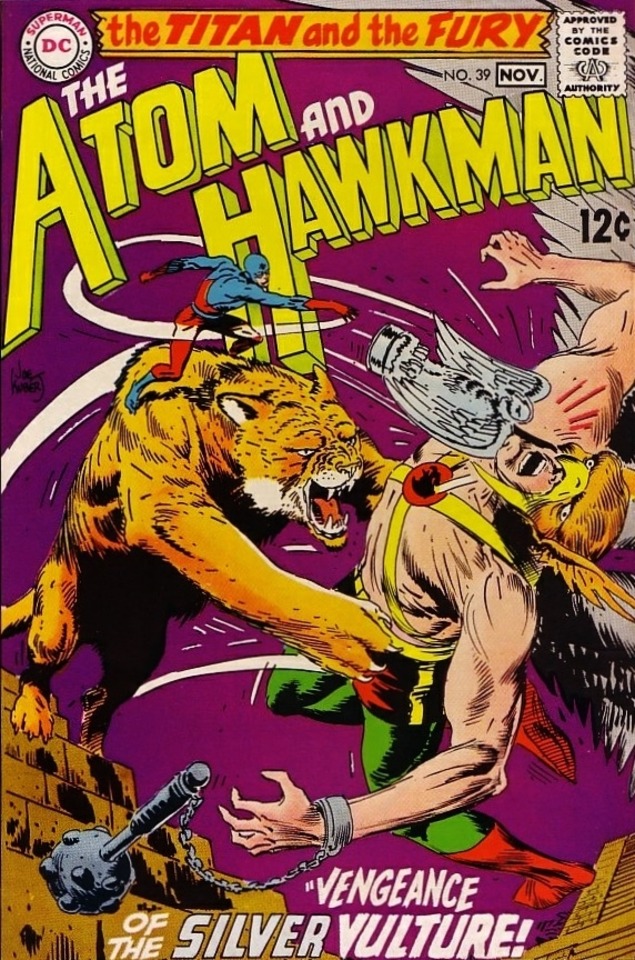
THE ATOM AND HAWKMAN: Two of the solid second stringer DC heroes found their titles combined into one in 1968 as the Super Hero fad of the 1960s began to lose steam. The two heroes had previously had a few team-up adventures in their own titles, an attempt by editor Julie Schwartz to create another recurring pairing similar to the Flash and Green Lantern. The thing is, the Atom and Hawkman didn’t really have much of anything in common. Their combined series was short-lived, running only through #46 a few months later, and from there on in, the characters would show up primarily in JUSTICE LEAGUE OF AMERICA and the occasional back-up story. During the run, the title alternated between featuring team-ups between the two heroes (three if you count the uncredited Hawkgirl in the mix) and separate solo adventure of half-length each. But it wasn’t enough to keep the Tiny Titan and the Winged Wonder from heading into comic book limbo for awhile, at least as headliners.

GREEN LANTERN CO-STARRING GREEN ARROW: This next pairing was a bit more successful and had legs that saw the two characters remain paired up for most of the rest of the 1970s. By the late 1960s, GREEN LANTERN was in sorry shape, a title that was drifting, with alternating creative teams taking their shots at the Emerald Crusader without much success. As a last-ditch attempt to save teh series, editor Julie Schwartz convinced hot young writer Denny O’Neil to give the book a go, with the proviso that he could do pretty much anything that he wanted to. Denny was interested in the issues of the day, and so he brought in Oliver Queen, a character whose design had recently been modernized to great effect by the artist who would be his collaborator on teh series, Neal Adams. Together, O’Neil and Adams sent Green Lantern and Green Arrow off on an Easy Rider-inspired trek to find the real America, with the Lantern played as the staunch conservative and the Arrow the bleeding heart liberal. So much attention did the series generate that for a year or two, “relevancy” became the newest sales buzz word in comics, and almost every title attempted to emulate what GL/GA was doing, to limited success. Eventually, though, the novelty wore off, and the book was ended with #89. But only a few years later, under new DC publisher Jenette Kahn, it was revived and continued into the next decade (though it lost Green Arrow as a co-star around 1980 or so.)

CAPTAIN AMERICA AND THE FALCON: One of the titles that was influenced by the success of GL/GA was CAPTAIN AMERICA, a series that was beginning to fall on hard times as the tenor of the country changed and a general distrust of the government and opposition to the Vietnam war made anything patriotic seem out of step. Editor and scripter Stan Lee decided to combat this problem by pairing the Star-Spangled Avenger up with a hero who had been introduced in the books pages a year or so before: Sam Wilson, the Falcon. Together, Cap and Falc emulated the conflict between GL and GA in their own way–mainly coming down to sharing adventures within the Falcon’s main stomping grounds of Harlem, where Cap soon picked up a new second career as a rookie police officer. But Steve and Sam were never as contentious as Hal and Ollie, so their partnership seemed a bit more friendly–even if the Falcon routinely felt like he was living within Cap’s shadow, as indeed he was a lot of the time. This pairing lasted for all of the 1970s, only falling away as 1980 loomed in the distance. By that point, Captain America was a bit more welcomed in the zeitgeist of the period, and the falcon often seemed like a bit of an afterthought.
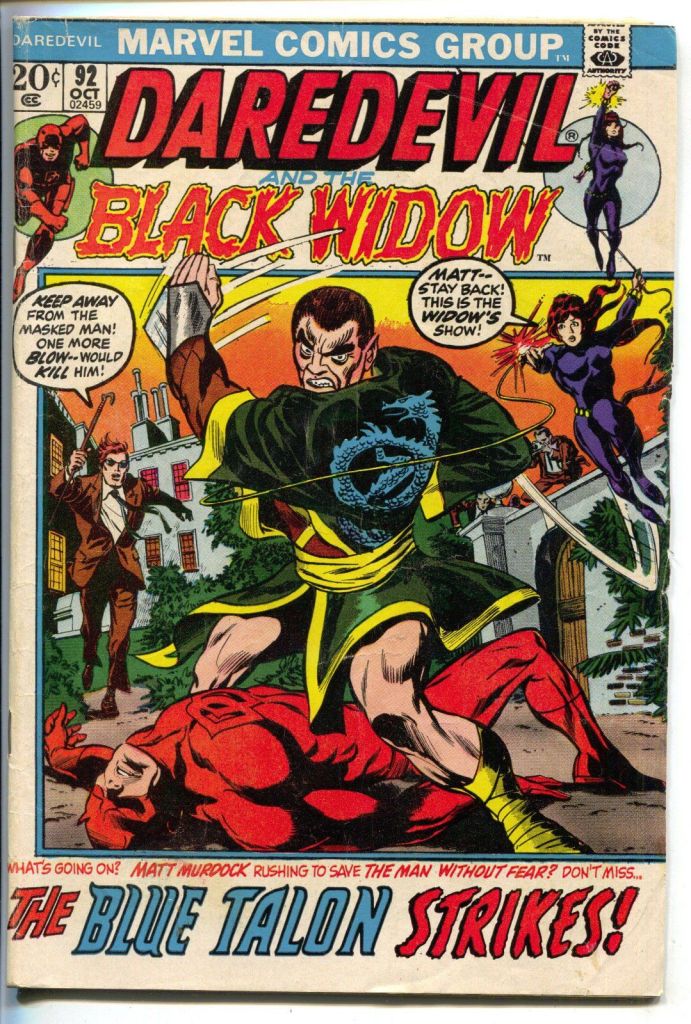
DAREDEVIL AND THE BLACK WIDOW: One of the other Marvel books that was beginning to struggle at the end of the 1960s was DAREDEVIL–sop much so that there were plans to combine the series with that of Iron Man which were announced in a Bullpen Bulletins page but never followed through upon. Looking for a way to differentiate the character from Spider-Man, writer Gerry Conway began guest-starring the Black Widow, whose adventures he had previously chronicled in a short-lived run in AMAZING ADVENTURES. Not only did Gerry formalize their professional and personal relationship, but he also moved the duo out of New York, relocating them to far-off San Francisco. Unfortunately, despite all of the good intentions of everybody involved, the stories in DAREDEVIL AND THE BLACK WIDOW were still pretty weak, and the combination didn’t do much to attract new readers. Within a relatively short time, DAREDEVIL was once again a solo series beginning with #108, and the sightless crusader both ended his romance with the Widow and returned to his native New York stomping grounds.

POWER MAN AND IRON FIST: Undoubtedly the most successful combined series and the one that is most fondly remembered. Chris Claremont and John Byrne had started a successful and popular partnership as they worked together on IRON FIST, a series that was created to tap into the then-waning interest in kung fu martial arts films. And so, the K’un Lun Kid’s title was going to be wrapping up, something that Claremont and Byrne weren’t keen on, as they still had plenty of stories to tell. The solution was for them to momentarily take over the reins of the ailing LUKE CAGE, POWER MAN series, a book that had similarly been created to take advantage of the Blaxploitation film marketplace and then bring their two heroes together into an unlikely partnership. So it was that issue #50 of Cage’s series became POWER MAN AND IRON FIST. Byrne didn’t stick around much past this inaugural issue, and Claremont departed shortly after, but the combination was appealing and the series lasted well into the 1980s, where it finally breathed its last with #125–a run that neither IRON FIST nor POWER MAN could have managed on their own.
 The Tom Brevoort Experience
Why was Falcon’s original costume green colored? What made “falcon” seem green to Marvel?
LikeLike
Probably just trying to come up with something that would contrast with Cap’s red, white, and blue. Not a lot of different colors to work with back then.
LikeLike
A subtle detail in the Spider-Girl series was that the black twin heroes the Ladyhawks were wearing a modified version of Falcon’s costume. I didn’t pick up on that until the series revealed they were the daughter’s of his mob-boss antagonist Morgan (so obviously a big FU to dad).
LikeLiked by 1 person
Funny that Morgan was a supporting character in another of Tom’s posts yesterday, a 1979 issue of Cap (but w/o the Falcon).
LikeLike
Never mind the colour of his costume, Falcon couldn’t even fly for the first 4 years of his existence! He used to swing around on a cable, like Daredevil.
LikeLiked by 1 person
Merging a struggling title with a more successful one may have been rare in the US, but it was very much standard practice in the UK. The fall of the axe was invariably heralded by the appearance of the dreaded “Great news for all our readers inside” banner on the front cover of the merged title’s final issue.
The practice produced some real eyesores when it came to mastheads, “Mighty World of Marvel featuring the Incredible Hulk and the Planet of the Apes” probably being the nadir.
LikeLiked by 2 people
Beano-style comics mergers sometimes merged the strips inside too when one was a copy of the other. The greatest extreme of that has to be “Ivor Lott and Tony Broke with Millie O’Naire and Penny Less” 😀
LikeLiked by 1 person
But those were 2 separate stories within the same issue, rather than the characters interacting? But man, I’d wanna read the Hulk on the Planet of the Apes. Maybe when he was reality jumping after Hulk # 300, exiled by Dr. Strange when the savage mindset took over completely.
I mean, imagine inserting Banner into the cornfield sequence in PotA, when mysterious oppressors were violently chasing and herding primitive humans. Maybe he gets knocked out before he transforms. Then wakes up in a cage in Zira & Cornelius & lab? “Don’t make me ANGRY, Dr. Zaius. You wouldn’t LIKE me when I’m ANGRY. Now get your stinking paws OFF me, you damn, dirty APES!” Come ON, Tom, please make it so! 😉
LikeLike
Yes, they were two separate stories, but your pitch for a crossover sounds good to me 😉
If I remember rightly, the Mighty World of Marvel title around this time also featured Daredevil, Captain Marvel and Sgt Fury and his Howling Commandos! Something for everyone there, unless you’re a diehard Millie the Model fan of course…
LikeLiked by 1 person
it doesn’t exactly fit the topic 100% but honorable mention to Quantum and Woody, oneof my favorite 1990s comics.
LikeLiked by 1 person
They were trying to differentiate Daredevil from Spider-Man by…having him team up with a spider-themed hero?
LikeLiked by 1 person
This is a fun dissection. Thanks!
Maybe it’s my Marvel bias showing but I think the pairings of Cap/Falcon, DD/Black Widow, and Powerman and Ironfist seem a lot less forced than GL/GA and Atom/Hawkman. I’ve tried to like those GL/GA issues and despite the beautiful Adams art… GL portrayed as perpetually ham-fisted compared to GA gets old fast.
Even though Cap , DD , and to a lesser extent Powerman are still the stars of their book, its an interesting shift in the genre for super heroes to move from Hero/sidekick to more or less equal partners. Generally speaking… I think Falcon, Black Widow and Ironfist added value to the headliners.
Its not the first time that I’ve read that Ironman was going to share a title with Daredevil. I can’t say I see how that pairing would have worked out or who could have been paired successfully with IM. Considering both books faced cancellation its strange they decided to shake up Daredevil with Black Widow and let Ironman’s title more or less unchanged.
LikeLike
Power Man And Iron Fist ( a guy with steel hard skin and a guy with a fist like iron — some how that just seems like a team-up that would work ), I know I enjoyed the issues I got ( especially the Kerry Gammill drawn issues ). Captain America And The Falcon: The Falcon feeling like he was in Cap’s shadow got amplified during the time Cap got super-strength.
LikeLiked by 1 person
I just discovered that T’Challa ( Black Panther ) was the one impersonating Daredevil in that issue. I know the Prowler ( Hobie Brown ) impersonated Spider-Man [ The Amazing Spider-Man#87 ( August 1970 ) “Unmasked at Last! — don’t know how he pulled off the wallcrawling ] which I only remembered today after learning that T’Challa impersonated Daredevil in the issue mentioned here, cause all this time I thought that was a DC Comics thing.
LikeLike
They took the Black Widow out of the DAREDEVIL logo with 108, but she stayed part of the book (and had had her “corner box” type figure in the trade dress for all but, I think two issues) through 124. She still felt very much like an ongoing series co-star when I started reading the book with 120.
It may not have solved all the series’ problems, but it did something to juice the book up or at least stabilize it for the next couple of years, since it didn’t drop to bi-monthly and didn’t get combined with another book. Two years later, it missed a month (right when they took her out of the logo), but stayed monthly for years, dropping to bi-monthly around 150, and not pulling out of it until Frank Miller was writing and drawing the series.
I thought they made a good team, but that may have been because that’s the way I “met” them. Still, both acrobatic, monochrome costumes and a lively interaction (plus the underrated Ivan) made for a fun book.
I like the idea of teaming the Atom and the Hawks, but — possibly because the short-lived combo series had a jumble of writers (three in seven issues) and only three team-up issues — it felt like no one bothered to give them a buddy dynamic, like all the other examples.
My favorite of the five was Power Man & Iron Fist, but I think that was due to Jo and Kerry. I think they could have done any of these five combos and it’d have been my favorite.
LikeLiked by 1 person
The Tiny Titan (was “Mighty Mite” used for the Golden Age Atom?) and the Winged Wonder. And then “the K’un Lun Kid”. 😉
I’d think the sci-fi aspects could’ve helped find common ground & shared purpose for the Atom & Hawkman. And unlike partnering w/Adam Strange, the Atom would also keep the Hawks more relevant to Earth-bound adventures. One of the few things I did like about the somewhat recent Vitti & Hitch “Hawkman” series was their bringing in Ray Palmer for a nostalgic visit.
And hey, that Joe Kubert cover is fantastic. Dang.
LikeLike
I would guess there is an interesting story about Atom-Hawkman, but anyone who would know first hand is probably dead.
The first issue was by Bob Kanigher (probably to give him some work, since Infantino had fired him as an editor and replaced him (with Kubert and Sekowsky). The Atom and Hawkman stories in issues 40 and 41 were probably Gardner Fox inventory stories since Fox had been fired by DC by this time. The fact that Anderson had been inked on the first issue by Giella indicated that Schwartz had been told about the new book with little notice or that Carmine did not have that much faith in the concept and told Schwartz to keep the budget low.
Denny O’Neil did two Atom/Hawkman Teamps and two Atom solo stories. It was not bad work (especially issue 45) but did not seem to go anywhere. Kanigher and Anderson revived Kanigher’s great Golden Age bad guy, The Ghost, as the “Gentleman Ghost” and those are probably the best two stories.
Schwartz and Fox did not usually launch any of their new books (JLA, Atom, Hawkman or The Specter) with such a miniseries (as he generally did with Broome Grodd in The Flash and Qward in GL) so there was nothing like that, which would have given the book an initial focus. (Perhaps he only later realized that O’Neil was capable of that kind of thing, as with GL/GA and Superman and the “Kryptonite No More” storyline).
Fox and Schwartz had done something similar with Batman and Zatanna in the Outsider stories, but that seemed to be a later “fix-up.”
Back in 1968 (and until 1970) Broome was still being published by DC, but he had not written the Atom and Hawkman in the Silver Age (as opposed to the Golden Age) and was just before leaving, not only DC, but the writing profession, in order to become an ESL Teacher in Japan.
The only people who are still around who might have some background would be Mike Friedrich or Marv Wolfman or possibly Gerry Conway.
LikeLike