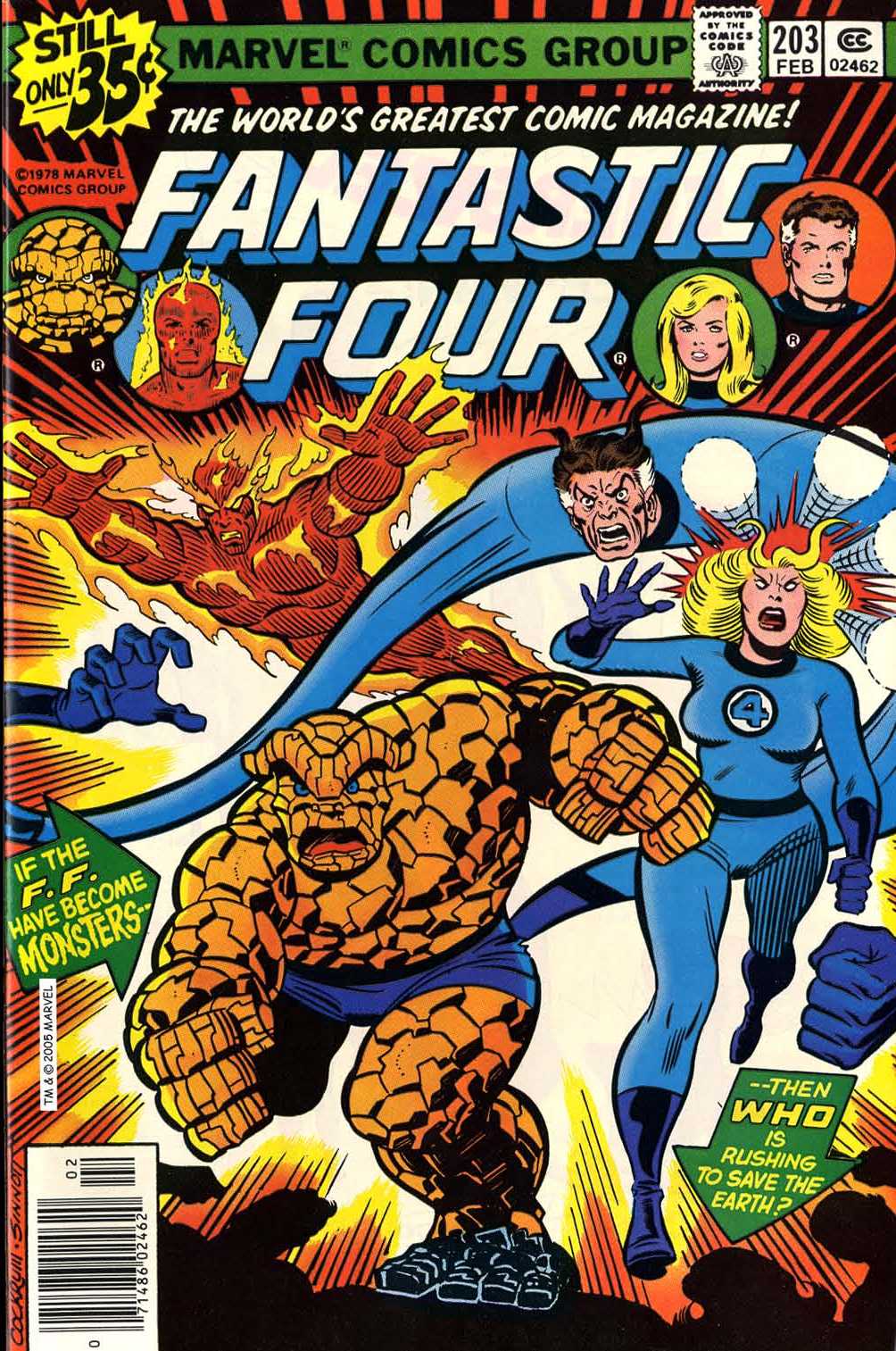


This issue of FANTASTIC FOUR doesn’t at first glance appear to be anything special, just another one-off story in this run. But it has an interesting story behind it. You see, writer/editor Marv Wolfman had been friends with FANTASTIC FOUR co-creator Jack Kirby since Marv was a child. He knew about Kirby’s reluctance to draw the scripts of others, feeling (rightly) that his own plotting contributions would inevitably be credited to the writer. Still, Marv made Jack this offer: he would write an issue full script for Jack to just draw, and as the editor, he’d make sure that nobody messed with Kirby’s work. Jack tentatively agreed, most likely wanting to be accommodating, but when the moment came, he begged off of the assignment. In the end, regular series penciler Keith Pollard wound up drawing this story. I don’t know whether the story was still done from a full script, but I’d imagine so.

It’s a perfectly fine issue that has the feel of a fill-in, being a clean done-in-one adventure. But I didn’t think twice about it when I bought it off the spinner rack at my regular 7-11. It opens on a classic FF-style splash page where the Thing is ready to go bowling with his best friend Reed, but the scientist has discovered a radiation pocket in a ventilator shaft that he needs to dissipate immediately. Which is pretty funny when you get down to it. Especially at the end of his run, Kirby delighted in opening his FANTASTIC FOUR stories with the characters doing something unusual (and often with Ben in regular clothes, which always brought a comedic element.)

After that initial interlude, Reed and Sue are summoned to the bedside of Willie Evans Jr., who is suffering from a strange malady. His father, Willie Sr., had been in the military in 1968 and was one of the subjects of an experiment to see what would happen to soldiers exposed to cosmic rays. Willie came through the experience fine, but he clearly passed that energy down to his son, who is now stricken. Willie’s doctor is an old mentor of Reed’s, though, and he calls in the leader of the Fantastic Four as the world’s foremost expert on cosmic ray exposure. Reed agrees to try to treat the younger Willie, of course, installing the kid in a “comatron” that will monitor his assorted vital functions. But after everybody leaves the room, young Willie, having heard talk about the Fantastic Four, in his delirium manifests monstrous versions of the quartet.
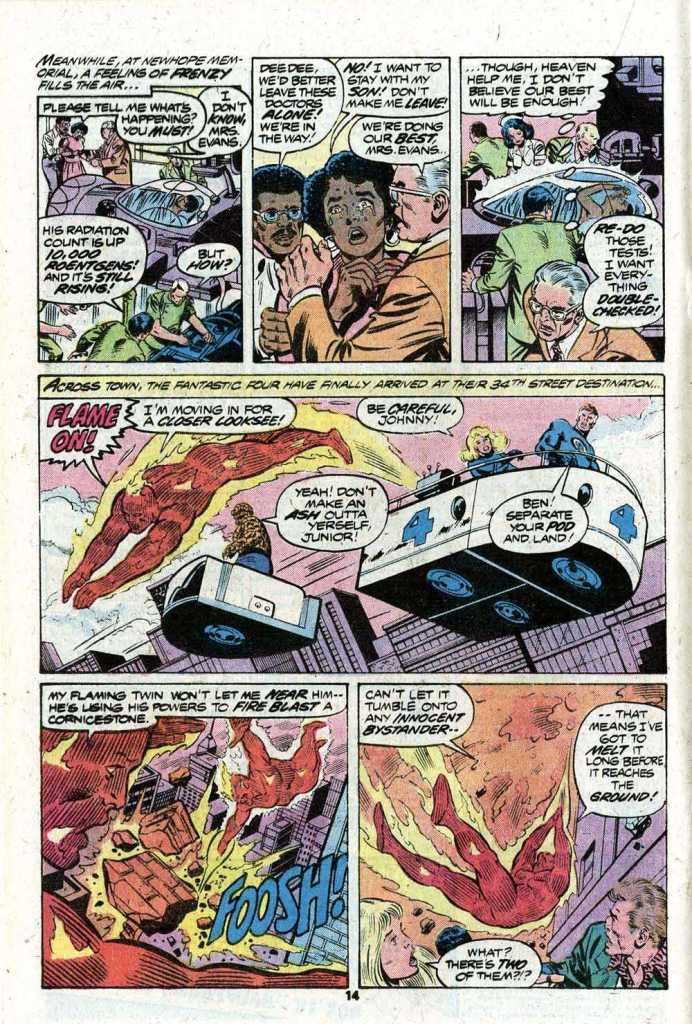
Willie’s monstrous creations head out into the city, causing destruction and panic. Of course, people assume that this is the genuine Fantastic Four who have gone on a rampage. Back at the Baxter Building, Reed picks up a news broadcast about the chaos and the team heads out in their classic “bathtub” Fantasti-Car to confront their impostors. As they do so, back at the hospital, Willie Evans’ radiation count is spiking. He’s putting out more and more power in response to the needs of his accidental creations. They’re a manifestation of his condition, and the more energy they use up, the weaker Willie gets.
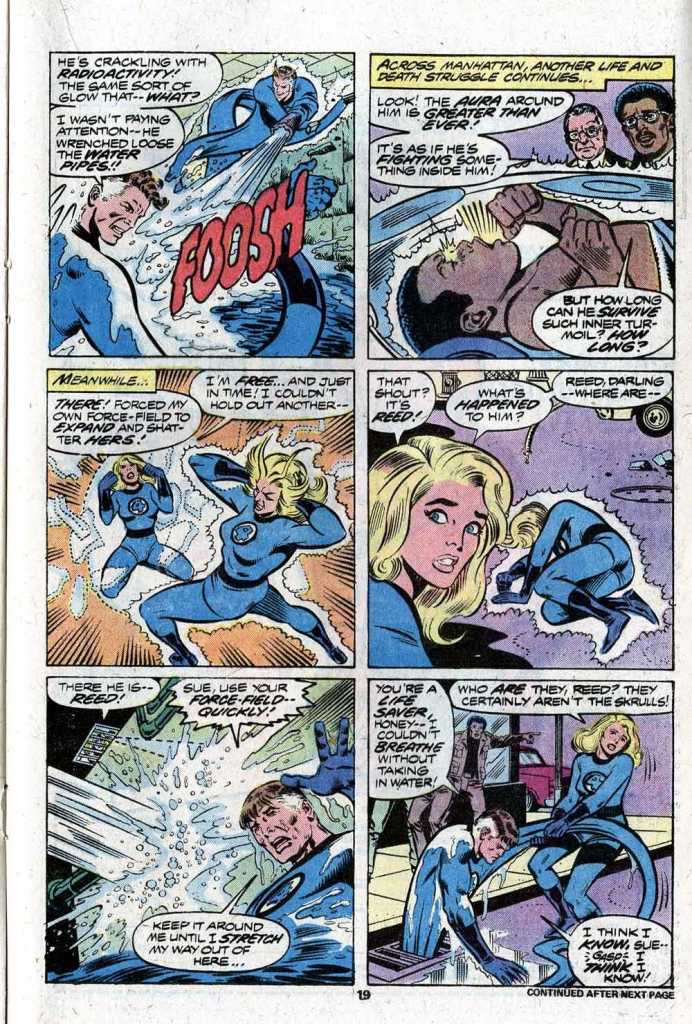
We’re treated over the next bunch of pages to a running battle between the actual Fantastic Four and their even more powerful duplicates. The actions of the ersatz FF are random–they don’t have much to say, and they’re simply acting out. And back at the hospital, Willie gets more and more agitated and his radiation output increases as the battle continues on. Eventually, though, Reed notices the similarity between the glow surrounding his counterpart and the readings that he took off of Willie earlier in the issue. He’s got a theory, but to test it, he’s going to need to hustle back to the Baxter Building while the rest of the team continues to hold off the monsters.

Reed’s instructions to the team are to counter the creatures and save lives and avert damage, but to try not to fight them directly. He’s realized that they’re a manifestation of Willie’s condition and drawing their life-energy from the boy. This means the FF are fighting with one hand behind their backs, and outnumbered as well. They follow their duplicates to the Statue of Liberty, where they have a showdown. Their enemies are behaving more violently, more lethally, and in the end, the real FF is caught on the back foot and about to be incinerated by the evil Human Torch’s flame. But then, suddenly, the distorted duplicates all melt away into nothingness.
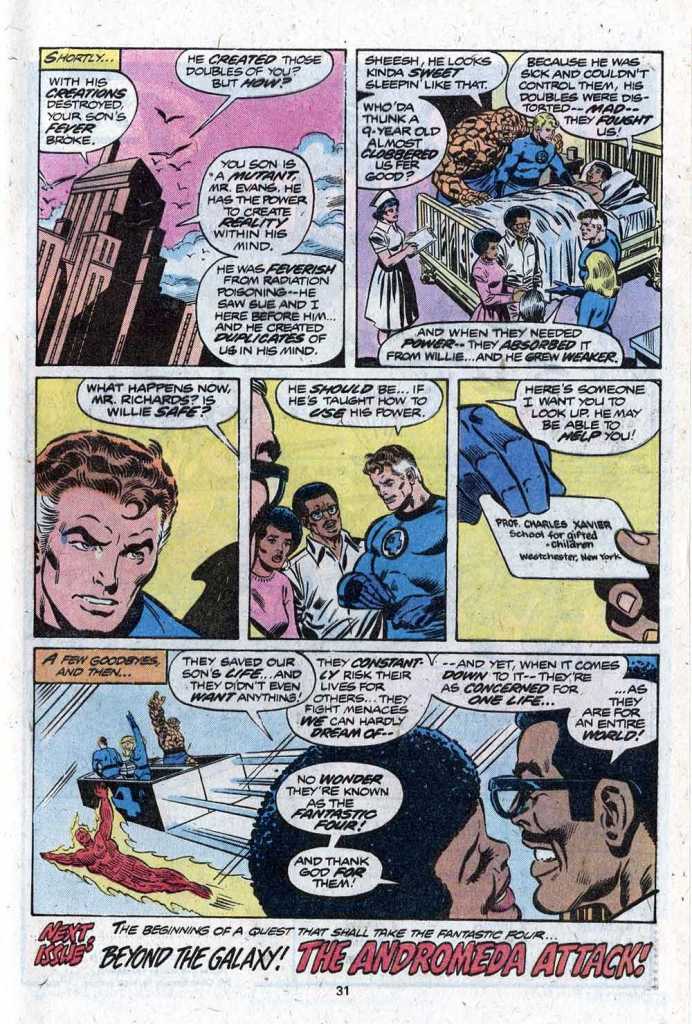
And Reed appears, hauling the Radiabsorber that he used to dissipate the creatures–the same device he was tinkering with on the splash page, just to bring the whole story full circle. In destroying them, Willie’s fever has broken as well, and he’s on the road to recovery. On the final page, Reed gives Willie Sr. the card of Professor Charles Xavier, explaining that his son is a mutant and that the Professor can help train him to control his abilities. For years afterwards, I waited for Willie to show up in X-MEN as a member of the New Mutants or something. But it never happened. He did reappear in an IRON MAN ANNUAL that guest-starred X-Factor, though, in which he was unceremoniously killed off after once again becoming a menace. And that kind of makes sense, a character with reality-warping powers like Willie’s would make other teammates pretty much extraneous in most situations. I don’t know how this issue might have played out if Kirby had drawn it, but Keith Pollard backed up by FF stalwart Joe Sinnott did a credible job throughout.


I had no idea about Wolfman and Kirby.
The kid sounds like a dry run for Proteus (or did Proteus come first?)
LikeLiked by 1 person
I first read this issue as a reprint in The Fantastic Four: The Secret Story of Marvel’s Cosmic Quartet. In hindsight, it struck me as a less-than-great choice for inclusion. It does have the one-and-done quality to it and was moderately current at the time, compared to the other two stories by Lee/Kirby, but it did a less than ideal job in showing off the characters, and ends with name-dropping other new characters otherwise unrelated to this story and/or any of the other books from Ideals in that same line. #201, #202, or maybe Annual #13 strike me as better choices; I’ve long wondered why none of those were chosen instead.
The inclusion of FF #83 in that collection also seemed odd. I mean, it was classic Lee/Kirby but it’s the end of a months-long saga, and barely has Sue in it at all. #51 is, by now, reprinted so often as to be an almost cliche go-to, but it wasn’t back in 1981 — why wasn’t that used? Granted, Johnny’s appearance in the issue is barely a cameo, but so is Sue’s in #83.
It’s been decades now, and my mind always goes to wondering about the decisioning that went into making that book every time I see reference to FF #203. I probably should have made a greater effort to reach out to David Anthony Kraft before he passed.
LikeLike
During some of this time, it was Marvel’s policy to only reprint a given story once, so as to not take advantage of readers who’d already bought it. That meant that a lot of stories would have been considered out of bounds when that book was being assembled. Exceptions were sometimes made for projects such as that, but this is why, for example, the stories reprinted in ORIGINS OF MARVEL COMICS were skipped over when their time came up in MARVEL TALES and like reprint series. I’d guess that this perhaps had something to do with the selections.
LikeLiked by 1 person
And as far as the inclusion of this issue is concerned: in 1981, I wonder if that final-page inclusion of the words “mutant” and “Charles Xavier” were all it took to make that instantly appealing to the marketing powers-powers-that-were.
LikeLiked by 1 person
John Byrne made an interesting observation about a monster version of The Thing not making a lot of sense as The Thing is already a monster. Or at least he was supposed to be, but at the time of this issue he’d been more like a cute teddy bear-type Thing for a number of years. That’s why Byrne ‘restored’ him to a craggier version when he took over the title as regular writer and artist.
LikeLiked by 1 person
When this issue came out I never saw Willie Evans, Jr.’s powers as reality-warping but similar to the later Hellion member Tarot or a much more powerful version of Danielle Moonstar ( Mirage ) but instead of illusions creating energy duplicates of Heroes or even Villains. In my mind back before his Iran Man Annual return I saw him manifesting whatever hero or villain he need to defeat the bad guy he and his teammates were battling. Question, is what he did in this issue really reality-warping? Cause what Franklin Richards does is ( same with Skip Collins in FF#234 (September 1981 ) ).
LikeLike