


By 1966, there was a divide forming between the entertainment preferred by older generations of Americans and what interested the young people of the time. This was when the term “generation gap” was first coined, and it represents the state of affairs perfectly. Creators in all media sought some way of reaching a more youthful demographic without giving up the bedrock values that they believed in. Accordingly, there’s an awful lot of material from this time that’s either dismissive of youth culture or which, more benignly, over-estimates their interest in the culture of their parents. All of which is to that that if editor Mort Weisinger thought that he’d scored a coup by arranging to feature Allen Funt and his CBS television series Candid Camera in this latest issue of ACTION COMICS, he may have mis-evaluated the interest of his youthful audience.
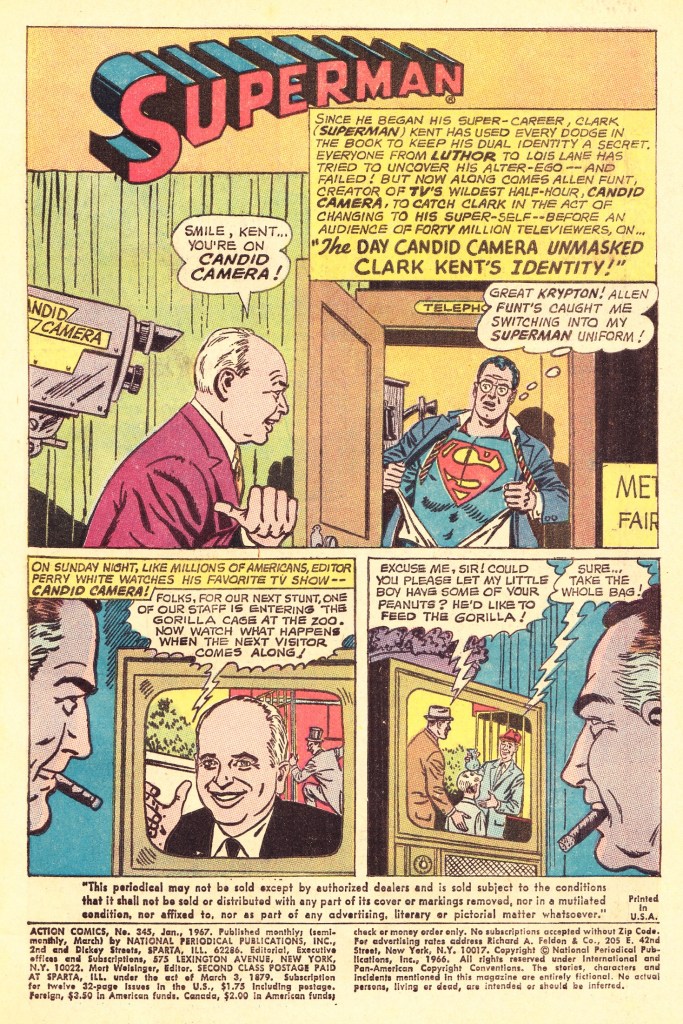
For those who’ve never experienced it, Candid Camera was a program that focused on “embarrassment entertainment”. The producers would set up some ridiculous situation, have some unsuspecting ordinary person walk into it, and film the results with a hidden camera. The victim being confused and reacting with shock or horror or looking foolish was the desired result. It was a popular series and it ran for many years, well into the 1970s. And Mort, I suppose, figured that it might be just the thing to give Superman and ACTION COMICS a boost.
As a bit of a relevant example, here’s a 1964 bit where Candid Camera has Superman interrupting people situated inside a gimmicked phone booth, and then lifting the booth with them inside it into the air. It’s entirely possible that this use of Superman opened up a dialogue between the producers and National Periodical Publications that led to Funt and the show’s appearance in this issue. It’s a pretty fun bit.
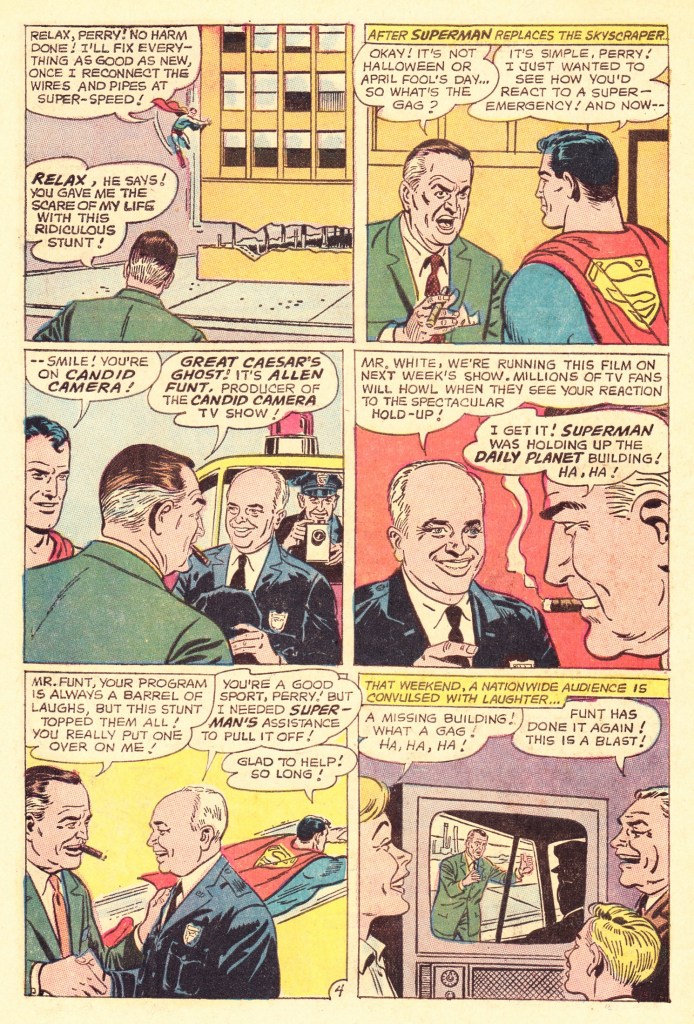
The story opens with Daily Planet editor Perry White watching his favorite program, candid Camera, when he gets a phone call indicating that the Planet offices are being held up. Racing to the offices, Perry is dumbfounded to find only an empty lot–Superman is flying in the sky, having pulled the entire structure off its foundation and flown it aloft. But this is all a Candid Camera gag on Perry, and Allen Funt appears to let him in on the joke. Apparently, this winds up being one of the most successful bits Funt has ever put on the show, and so he and his staff decide to play a few more pranks on the Planet staff. Specifically, he’s going to pull a prank on Clark Kent, and because the story requires it, while the candid Camera bits are typically filmed beforehand, this one he’s going to broadcast live.

We get this ad for captain Action at around this point, Ideal’s answer to Hasbro’s wildly popular G.I.Joe line of action figures. The gimmick of Captain Action was that he could adopt the persona of a dozen other established characters, including Superman. It was a bit of a trip for fans of the time to see Marvel’s Captain America and Sgt. Fury sharing an image with Superman, Batman and Aquaman from DC. A story involving the heroes of both rival companies must have seemed like a pipe dream.

There’s also this house ad for the latest 80 Page Giant, this one spotlighting stories whose descriptions spell out the word SUPER. It’s a bit of a flimsy premise, but the reprinted tales are pretty great, so this wound up being a good package.

Back at the story, after a few more random Funt gags, Clark Kent is lured into what is meant to be a phonebooth with a dead phone. But when Funt opens the doors, he himself is shocked to see Clark changing into Superman. Uh-oh! But as Clark continues his striptease, it turns out that the bottom half of his costume is that of Batman, and he convinces Funt that this was some turnabout on his part, as he’d figured out what was going on earlier and armed himself with costume pieces purchased at a nearby costume store. In reality, Superman’s super-hearing overheard Funt about to lower the boom on him. But rather than doing the sane thing and resuming his Clark Kent guise, Superman instead burrows out of the bottom of the booth, races over to Jimmy Olsen’s apartment where he borrows the necessary items for his ruse, then races back, repairs the damage to the floor and carries out his reversal on Funt. Seems like a lot of work for very little return, but one has to expect that the Superman of the Silver Age is really bored much of the time, so situations such as this one are intoxicating to him. The story was written by Leo Dorfman and drawn by Al Plastino.

DC was continuing to run its knock-off of the Mighty Marvel Checklist every month, so here’s the Direct Currents listing for this issue. It’s a good snapshot of the sort of stories the outfit was then putting forward, and a hint perhaps as to why they were losing ground.
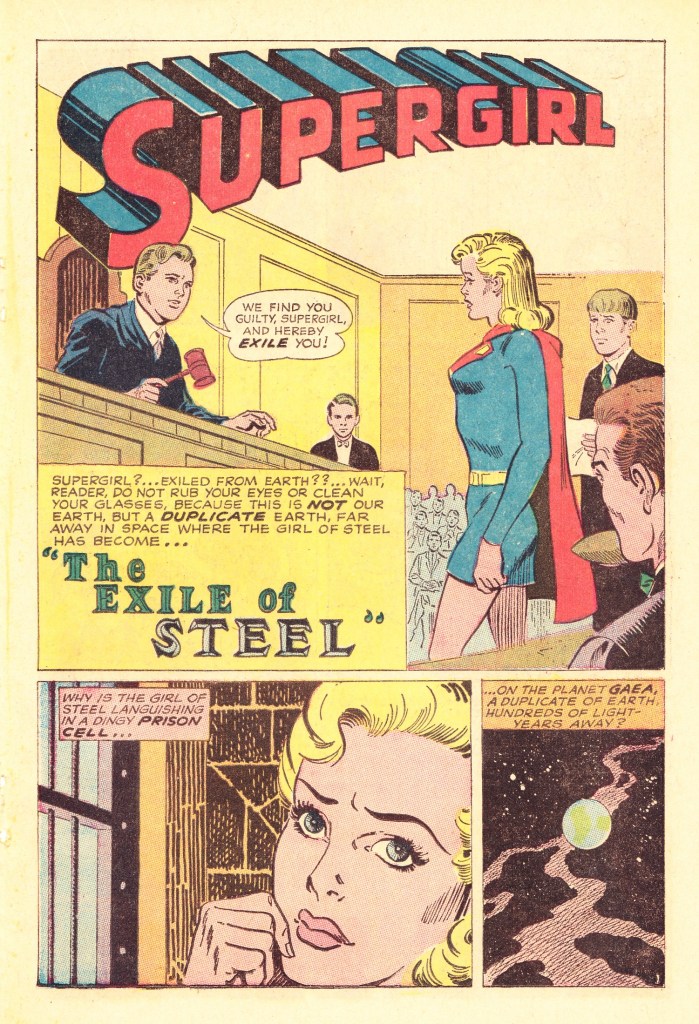
The Supergirl back-up story was written by Jim Shooter and illustrated by Jim Mooney and was the second half of their absolutely bat$#!@ crazy two-parter where Supergirl visited the far distant planet of Gaea, which was a near-duplicate of Earth except that everything was run by teenagers. Through a sequence of absurd events, Supergirl is considered public enemy number one, while her alter ego Linda Danvers is elected President. This is all a plan on the part of the Adult Revolt Movement to take power on Gaea. As the last chapter ended, Linda’s true identity as Supergirl was revealed to the world, and she was arrested to be put on trial. Her Vice President, Dick Malvin, an A.R.M. operative, became President following her impeachment. And so this episode opens with Supergirl locked away in prison awaiting trial.
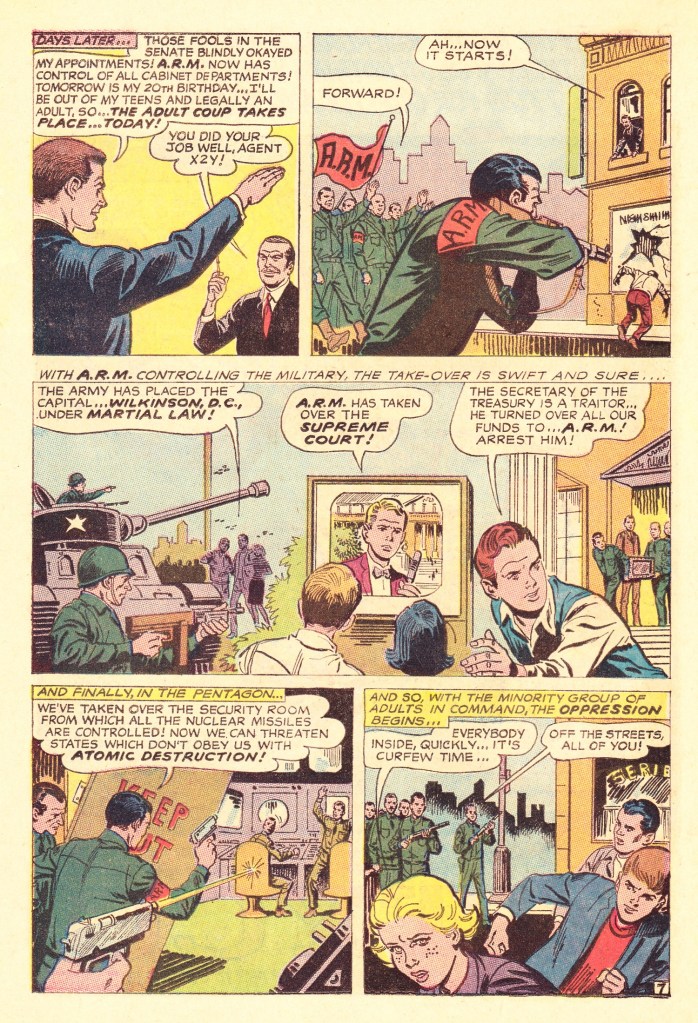
After a lengthy recap of the earlier events, Supergirl’s trial begins, and it’s a bit of a farce. Despite the best efforts of her lawyer Lucas Nevins, she is found guilty on all charges and exiled from Gaea. How anybody is going to enforce her sentence is something that’s never brought up, but an angry Supergirl cooperates and soars away from Gaea seemingly forever. In her absence, president Malvin packs the cabinet with A.R.M. collaborators and then stages a coup, turning the nation into a hostile police state based not on any rule of law, but operating at the vengeful whims of A.R.M. and its leadership. I’m sure that this seemed pretty far-fetched when this story was first published.

It’s a pretty harrowing place, given that this is a Weisinger comic book, one replete with public hangings and firing squads. But before anybody is killed on camera, Supergirl returns and routs out A.R.M. in something like three panels. Her departure was a ruse, and she only let them get so far because she was distracted by an emergency in a nearby star system. But teenage democracy is restored, so all is forgiven. The teens want Supergirl to stay on as acting President until they can have new elections, but she tells them that her college break back home is almost over and she’ll need to be returning. The appreciative teens throw her a ticker-tape parade before she goes, and this bananas two-parter wraps up. The final page gives us a glimpse of the debut of the all-new Batgirl in DETECTIVE COMICS, then on sale.
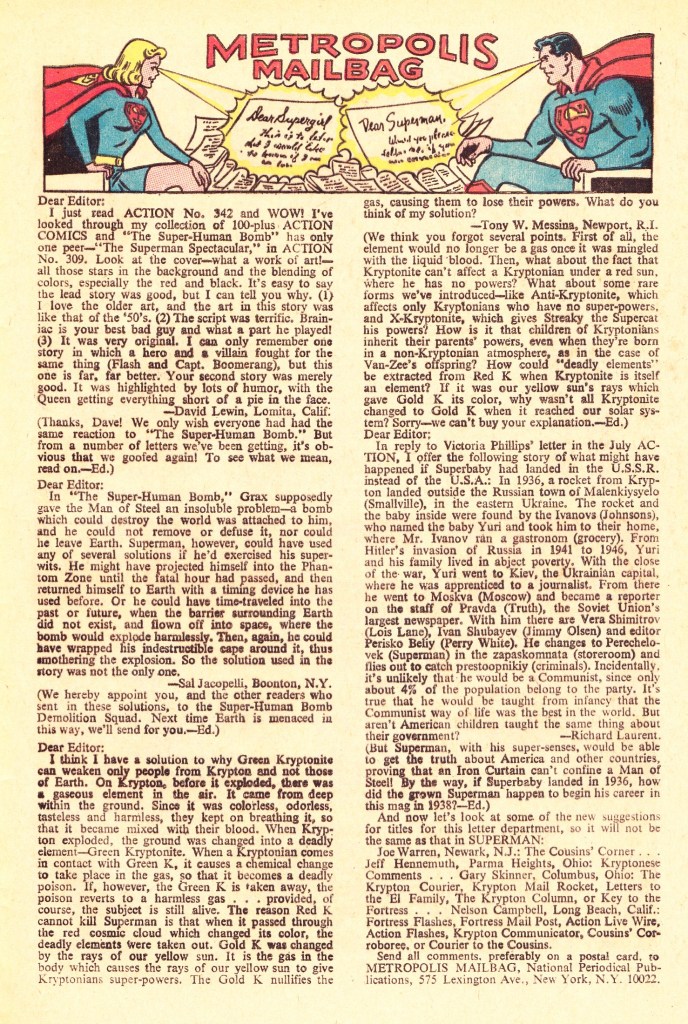
And the issue wraps up with the dependable Metropolis Mailbag letters page.


While there were lots of brutal dictators doing brutal dictatorial things in the Silver Age, this was easily the most effective, grimmest example.
I was a kid in this era but I thought Candid Camera was hilarious. By “kids” did you mean teenagers? — that I can believe.
LikeLiked by 1 person
I nominate Clark’s balloon as the single most unnecessary bit of cover copy in all of comics history.
LikeLiked by 2 people
I think Candid Camera’s “embarrassment” media niche got taken later by so-called “reality TV”, and then further by social media. Still, the general concept survives even today on YouTube in “prank videos”. At its best, it did some interesting illustrations of psychology. At its worst, it was pandering to some bad impulses. But given how popular it was in its heyday, it made perfect sense as part of a story. This fits right in with standard DC plots – Silver Age Superman was always pranking his friends, so why not give a famous TV show host a taste of his own medicine? The execution isn’t especially memorable, but I don’t see this as much of a “generation gap” topic. In contrast, the planet ruled by dictatorial teenagers is a screaming example.
LikeLiked by 1 person
That was certainly a recurring motif on the covers of the Superman titles in the Silver Age, with Superman’s secret identity of Clark Kent being revealed to the world, enticing readers to pick up those issues to find out how he was going to get out of the fix this time around. Inevitably some contrived fake-out was involved every single time. I wonder if anyone ever kept count of how often Weisinger used the gimmick.
LikeLike
Oddly enough, the CBS Candid Camera was in its last full season. It aired on Sunday nights with What’s My Line until August of 1967. What’s my line’s Producers might have reached out to DC. Since this comic came out in November of 1966, it might already have been too late.
LikeLike